B2B Lead Generation Trends 2026: What Actually Works Now
The 2026 playbook for B2B lead generation: intent data, signal-based outbound, AI scoring, and the channels driving real pipeline this year.
The way B2B teams fill pipeline changed more between 2024 and 2026 than in the decade before it. Buyers research in private, gatekeep their inboxes, and ignore anything that smells like a blast. If your playbook still assumes a bought list plus a four-email sequence equals pipeline, you are funding your competitors' growth.
This guide breaks down the b2b lead generation trends that actually move revenue in 2026 — what is rising, what is dying, and where to put your next dollar.
TL;DR#
- Intent and signal-based outbound beat volume. Reaching out when a buyer shows behavior converts several times better than cold spraying a static list.
- AI is now table stakes for scoring and personalization — but it amplifies bad data, so accuracy at the contact layer matters more than ever.
- Dark social and self-serve research mean most of the buying journey happens before a rep is involved; your job is to be findable and credible.
- Email deliverability got harder after Google and Yahoo tightened sender rules — clean lists and verified contacts are non-negotiable.
- Consolidation is real: teams are trading 8-tool stacks for 2-3 platforms that do finding, verification, and enrichment in one place.
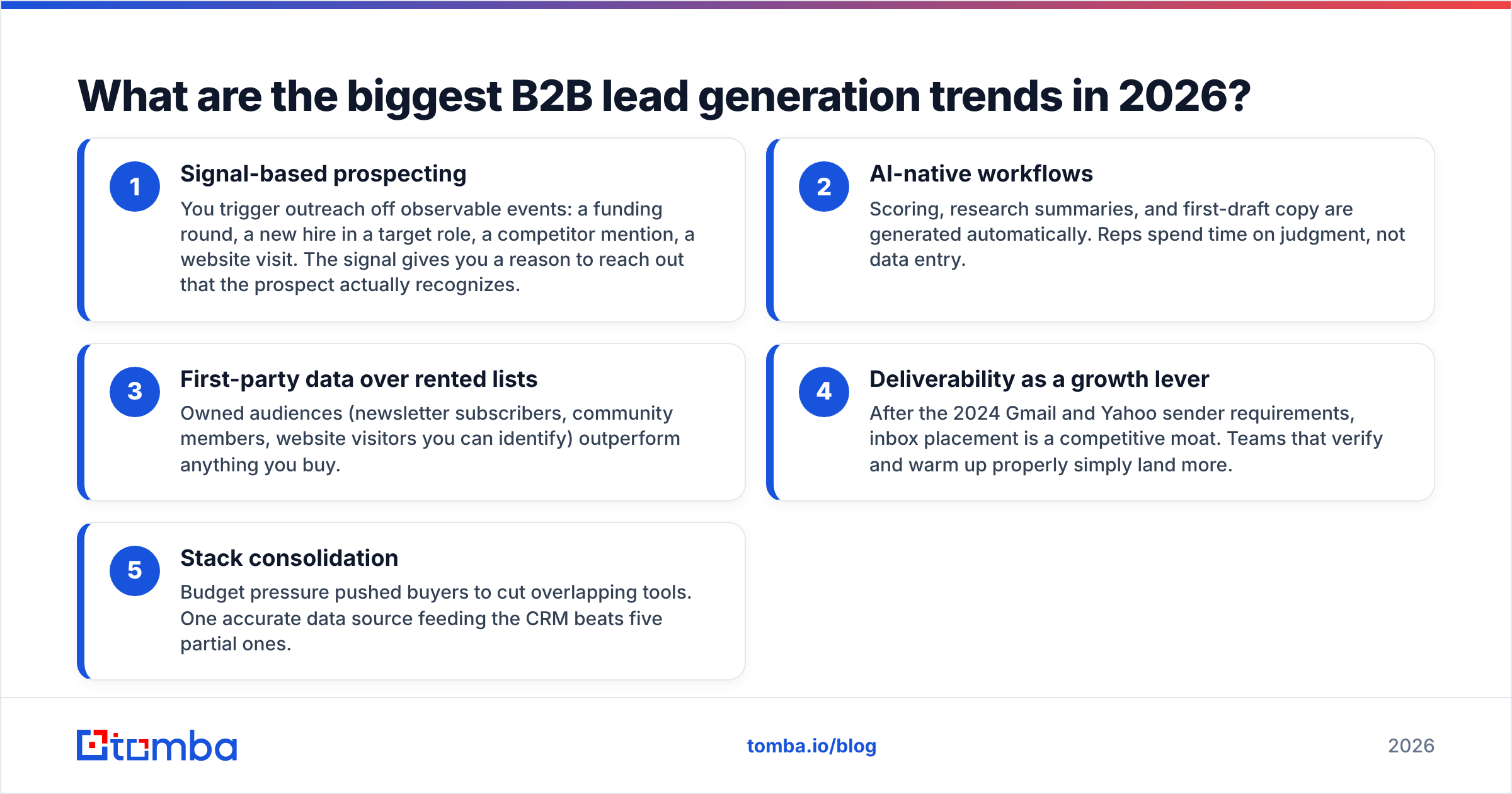
What are the biggest B2B lead generation trends in 2026?#
The headline shift is from interruption to relevance. Buyers gave up on tolerating irrelevant outreach, and the platforms they use (LinkedIn, Gmail, spam filters) now actively punish senders who ignore that. Five forces define the year:
- Signal-based prospecting — You trigger outreach off observable events: a funding round, a new hire in a target role, a competitor mention, a website visit. The signal gives you a reason to reach out that the prospect actually recognizes.
- AI-native workflows — Scoring, research summaries, and first-draft copy are generated automatically. Reps spend time on judgment, not data entry.
- First-party data over rented lists — Owned audiences (newsletter subscribers, community members, website visitors you can identify) outperform anything you buy.
- Deliverability as a growth lever — After the 2024 Gmail and Yahoo sender requirements, inbox placement is a competitive moat. Teams that verify and warm up properly simply land more.
- Stack consolidation — Budget pressure pushed buyers to cut overlapping tools. One accurate data source feeding the CRM beats five partial ones.
)
These are not independent fads. They reinforce each other: better signals make AI scoring meaningful, cleaner data makes deliverability achievable, and consolidation makes the whole loop affordable.
Why is intent and signal-based outbound replacing list buying?#
Because the math flipped. A purchased list of 10,000 contacts now yields fewer meetings than 500 contacts reached at the right moment, and it can torch your domain reputation in the process.
Intent data — the digital breadcrumbs a buyer leaves while researching — lets you prioritize accounts that are actually in-market. According to industry research aggregated on G2, intent-driven campaigns consistently report higher reply and conversion rates than untargeted outbound. The reason is simple: you are joining a conversation the buyer already started.
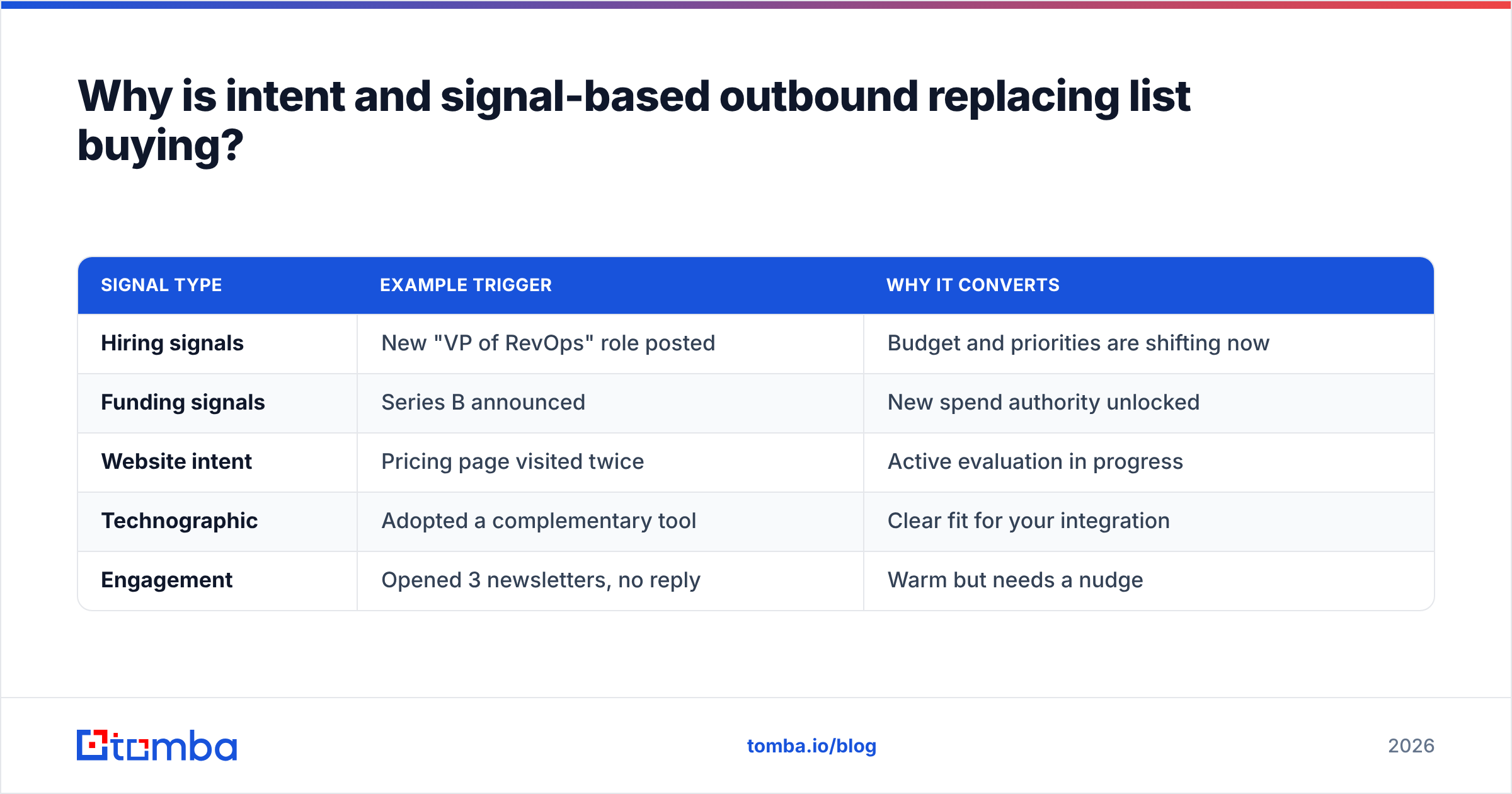
A practical 2026 signal stack looks like this:
| Signal type | Example trigger | Why it converts |
|---|---|---|
| Hiring signals | New "VP of RevOps" role posted | Budget and priorities are shifting now |
| Funding signals | Series B announced | New spend authority unlocked |
| Website intent | Pricing page visited twice | Active evaluation in progress |
| Technographic | Adopted a complementary tool | Clear fit for your integration |
| Engagement | Opened 3 newsletters, no reply | Warm but needs a nudge |
The hard part is turning a company-level signal into a person you can actually email. That is where contact data quality decides whether the trend works for you. A signal is worthless if you can only reach a info@ address. Pairing intent with a reliable email finder is what makes signal-based outbound operational rather than theoretical. You can also identify anonymous demand with website visitor reveal and route those accounts straight into sequences.
How is AI changing lead generation in 2026?#
AI moved from novelty to infrastructure. The teams winning with it are not the ones generating the most content — they are the ones using it to compress research and improve targeting.
Three use cases dominate:
- Lead scoring and prioritization — Models weigh dozens of attributes and behaviors to rank who to contact first. This replaces gut-feel and crude "fit" rules.
- Research synthesis — Instead of a rep spending 15 minutes reading a prospect's site and LinkedIn, an AI summary delivers the relevant hooks in seconds.
- Personalization at scale — First-draft openers reference real, specific details. Reps edit rather than write from scratch.
But there is a catch the hype skips: AI amplifies whatever data you feed it. Generate a thousand "personalized" emails on top of stale or unverified contacts, and you have just automated bounce rates and spam complaints. This is why data enrichment and verification sit upstream of every serious AI workflow in 2026. Garbage in, confidently-worded garbage out.
)
The vendors leaning hardest into AI-native prospecting — HubSpot on the marketing side, Apollo and Clay on the outbound side — all share one assumption: the underlying contact and company records are correct. That assumption is yours to earn.
Is email still the best B2B lead generation channel?#
Yes — but only if it lands. Email remains the highest-ROI outbound channel for B2B, and that has not changed in 2026. What changed is the cost of doing it badly.
The 2024 sender requirements from Google and Yahoo (SPF, DKIM, DMARC, and a hard spam-complaint ceiling) turned sloppy sending into an existential risk. One bad campaign can drop your inbox placement for months. The result: deliverability is now a board-level lead-gen metric, not an ops afterthought.
What the best teams do differently in 2026:
- Verify before every send. Run lists through an email verifier to strip invalid and risky addresses. Bounce rate above 2-3% is a reputation killer.
- Authenticate fully. SPF, DKIM, and DMARC are mandatory, not optional. Use an SPF checker to confirm your records before scaling volume.
- Warm up new domains. Ramp sending gradually; never blast from a cold domain.
- Segment ruthlessly. Smaller, more relevant sends protect sender reputation and lift reply rates.
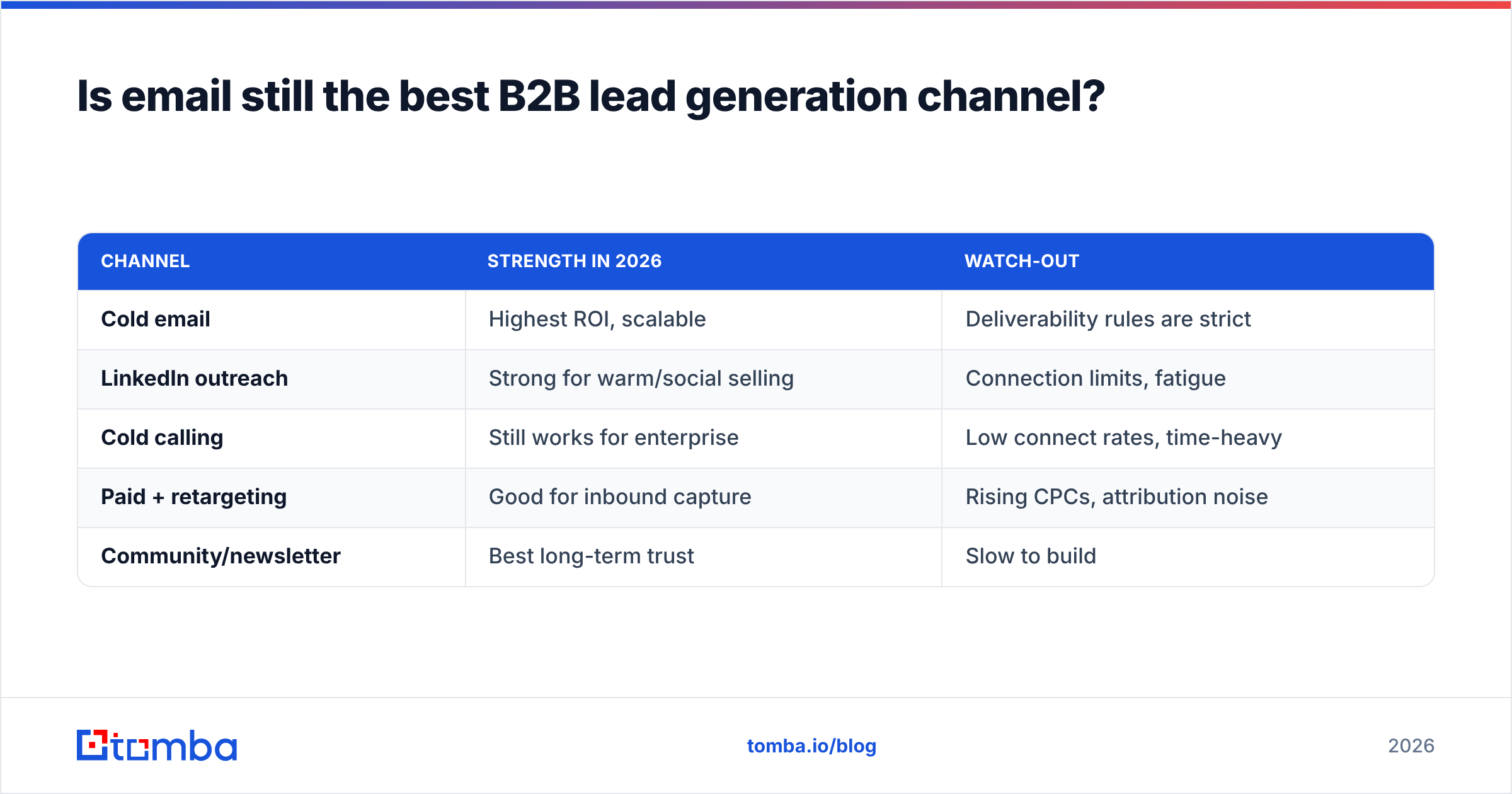
Here is how the channels stack up for B2B pipeline this year:
| Channel | Strength in 2026 | Watch-out |
|---|---|---|
| Cold email | Highest ROI, scalable | Deliverability rules are strict |
| LinkedIn outreach | Strong for warm/social selling | Connection limits, fatigue |
| Cold calling | Still works for enterprise | Low connect rates, time-heavy |
| Paid + retargeting | Good for inbound capture | Rising CPCs, attribution noise |
| Community/newsletter | Best long-term trust | Slow to build |
Email is not dead. Lazy email is dead. The teams treating email deliverability as a discipline are the ones still getting replies.
What role does dark social and self-serve research play?#
A huge one — and it is the trend most teams still under-measure. Buyers now complete the majority of their research before ever filling out a form or talking to sales. They lurk in Slack communities, LinkedIn comment threads, podcasts, and peer DMs. None of it shows up cleanly in your attribution dashboard. That is "dark social."
The implication for lead generation is uncomfortable but clarifying: you cannot capture demand you failed to create. If your brand is not present and credible in the places buyers actually research, no amount of outbound rescues you. The practical responses in 2026:
- Invest in distribution, not just content. A great post nobody sees creates zero pipeline.
- Identify the demand you do create. When dark-social research drives someone to your site, tools that reveal company-level visits let you act on otherwise invisible intent.
- Make self-serve easy. Clear pricing, comparison pages, and documentation help buyers qualify themselves in.
This is why social selling shifted from a buzzword to a core motion. Reps who build a real presence get inbound replies that cold senders never will.
How are lead gen tech stacks consolidating?#
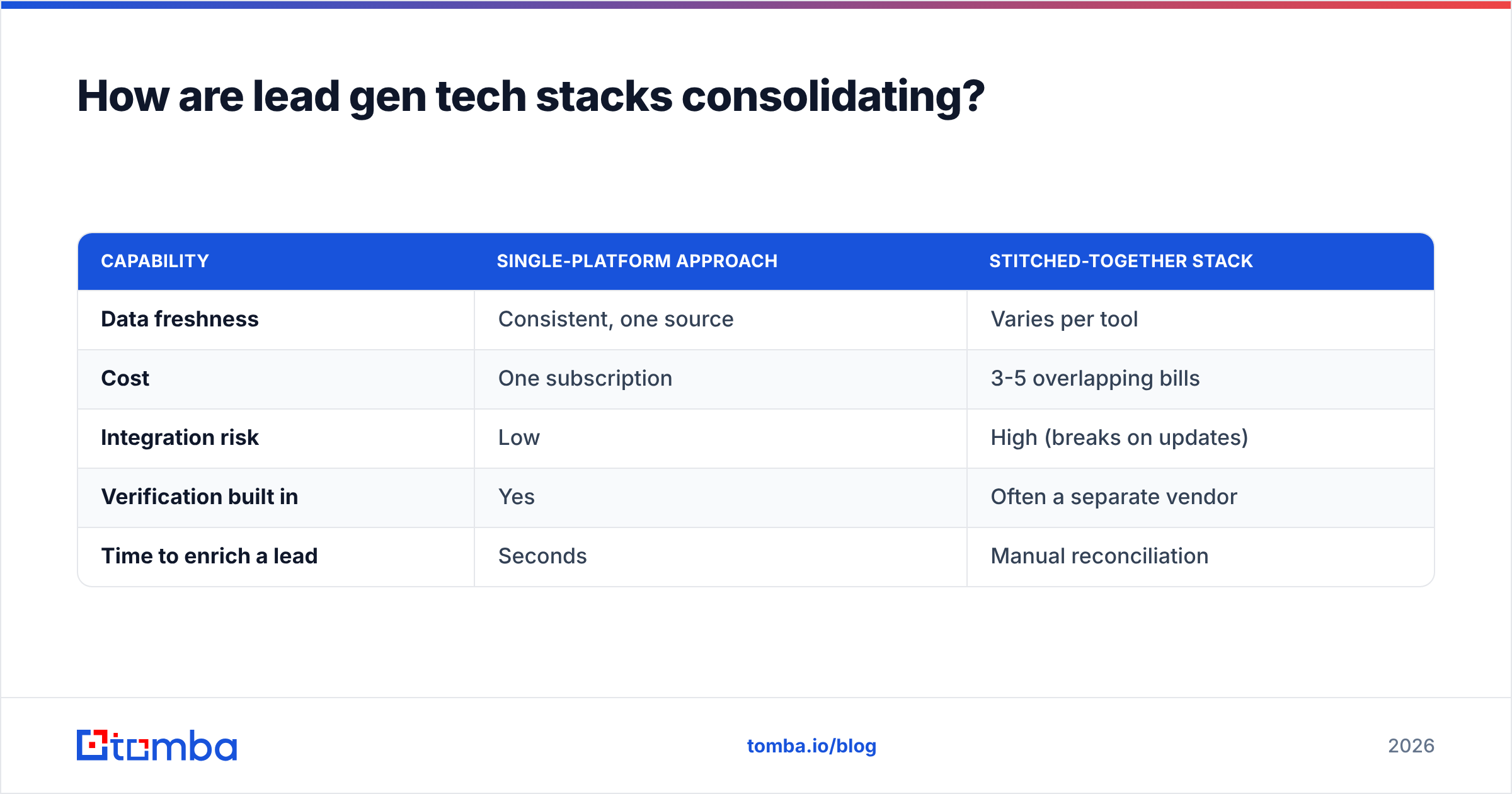
Toward fewer, deeper tools. The 2021-2023 era of stacking a dozen point solutions ended when budgets tightened and integrations broke. In 2026, the dominant pattern is a lean core: a CRM, an outreach platform, and one trusted data layer that handles finding, verifying, and enriching contacts.
Consolidation matters for lead gen specifically because every handoff between tools is a place where data decays. A contact found in one tool, verified in another, and enriched in a third often arrives in the CRM with conflicting fields. A single source reduces that entropy.
When teams evaluate the data layer, the comparison usually comes down to accuracy, coverage, and price:
| Capability | Single-platform approach | Stitched-together stack |
|---|---|---|
| Data freshness | Consistent, one source | Varies per tool |
| Cost | One subscription | 3-5 overlapping bills |
| Integration risk | Low | High (breaks on updates) |
| Verification built in | Yes | Often a separate vendor |
| Time to enrich a lead | Seconds | Manual reconciliation |
For most mid-market teams, the consolidation winner is whichever platform combines an accurate finder, a verifier, and enrichment without nickel-and-diming each function. Tomba sits in that category, and its transparent pricing — a free tier with 25 searches, Starter at $49/mo, Growth at $99/mo, and Pro at $249/mo — reflects the consolidation trend rather than fighting it. You can also push everything into your CRM directly via the HubSpot integration or Salesforce integration.
What should you stop doing in 2026?#
Trends are as much about subtraction as addition. Cut these now:
- Buying static lists. They decay ~30% per year and wreck deliverability.
- Spraying generic sequences. Filters and buyers both ignore them.
- Skipping verification. A 5% bounce rate quietly destroys your domain.
- Measuring activity over outcomes. "Emails sent" is vanity; meetings booked is pipeline.
- Treating data as one-and-done. Records rot; enrichment is continuous.
How do you build a 2026-ready lead gen motion?#
Put the trends together into one loop:
- Define your ICP and trigger signals — know who and when.
- Source contacts from a verified, accurate data layer — not a bought list.
- Enrich and score with AI — prioritize who to reach first.
- Personalize off real signals — reference the trigger, not a template variable.
- Protect deliverability — verify, authenticate, warm up.
- Measure pipeline, not activity — and feed learnings back into scoring.
Each step depends on the one before it, and every step breaks if the contact data underneath is wrong. That is the through-line of every trend on this list: accuracy compounds, and so do errors.
Where Tomba fits#
If 2026 has one lesson for lead generation, it is that clean, verified, well-sourced contact data is the foundation every other trend stands on. Intent means nothing if you can't reach the person. AI personalization fails on stale records. Deliverability collapses on unverified lists.
Tomba's Email Finder gives you accurate professional emails by name, domain, or company — with verification and enrichment built into the same platform, so your signal-based, AI-assisted, deliverability-conscious motion runs on data you can trust. Start free with 25 searches and scale into the plans as your pipeline grows. Build your 2026 motion on a foundation that won't bounce.
// get started
Find, verify and enrich your first contacts today
Start on the free plan with 25 searches a month, then scale when your team is ready.
Free plan · No credit card required · GDPR & CCPA
// about the author