B2B Lead Generation Websites: Top 12 Picks for 2026
Not all B2B lead generation websites pull their weight. Here's how the top 12 platforms compare on data accuracy, pricing, and pipeline fit in 2026.
TL;DR
- "B2B lead generation websites" covers four different jobs: finding contact data, capturing inbound demand, sourcing intent signals, and running outbound at scale. Buying the wrong category is the most common mistake.
- For accurate, verified B2B emails and direct dials, data platforms like Tomba, Apollo, and ZoomInfo lead — but they differ wildly on price and free tiers.
- For inbound capture, tools like HubSpot and Leadfeeder do a job no contact database can replace.
- The cheapest path for a small team is usually a precise email finder plus a verifier, not a $15k/year all-in-one suite.
- Match the website to the stage of your funnel you're actually starving — don't pay for seats you won't use.
What counts as a B2B lead generation website?#
A B2B lead generation website is any platform that helps you identify, attract, or contact potential business buyers. The term gets used loosely, which is exactly why teams overspend. A tool that captures form fills on your site is solving a completely different problem than a tool that hands you 10,000 verified CFO emails.
Think of it like a kitchen. A contact database is your pantry — raw ingredients (names, emails, phone numbers) you pull on demand. An inbound capture tool is the front-of-house host, noticing who walked in and writing down their table. An intent platform is the weather report telling you who's hungry this week. You need different appliances for different meals, and almost nobody needs all of them at once.
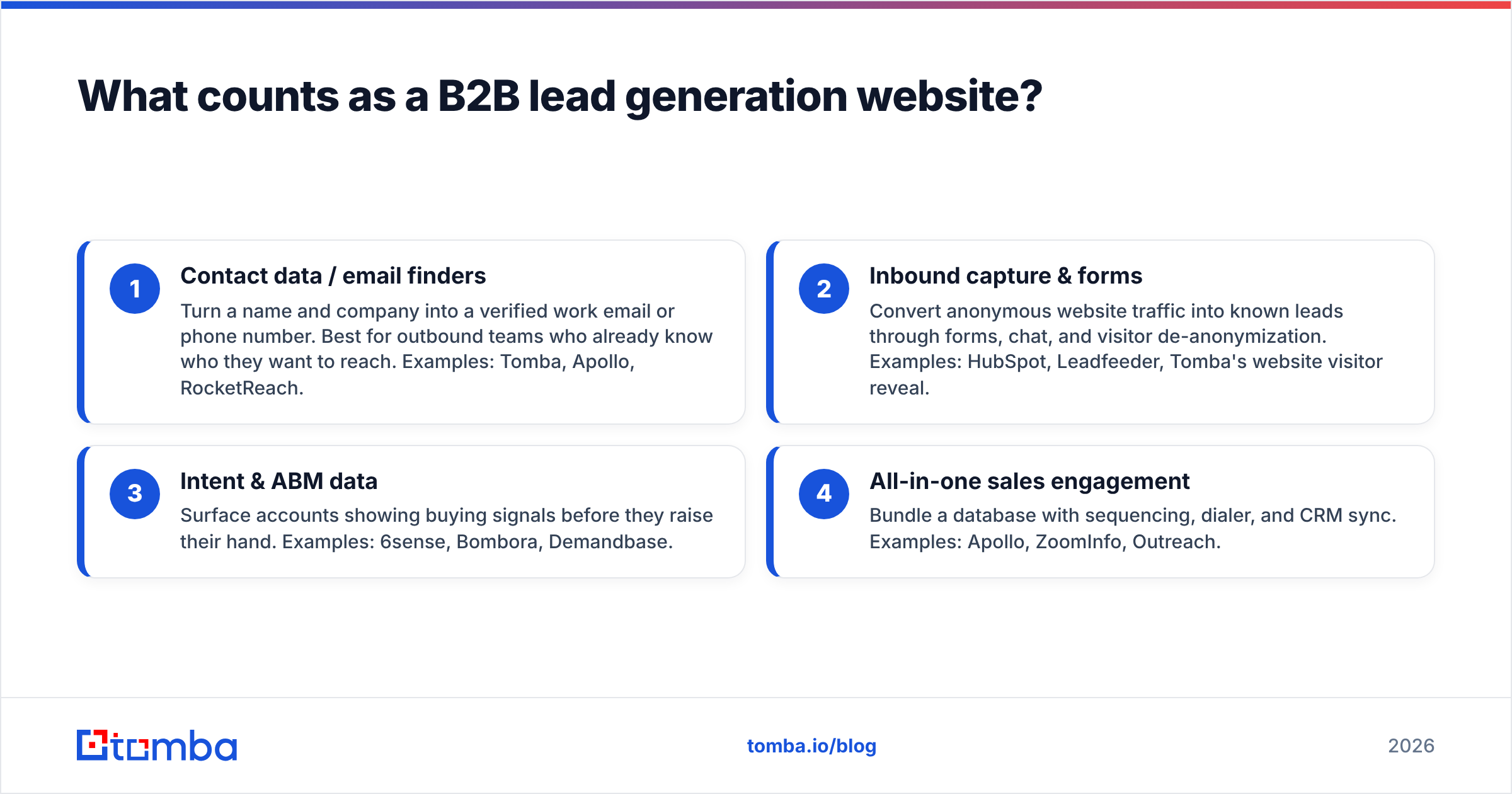
Here are the four jobs these websites actually do:
- Contact data / email finders — Turn a name and company into a verified work email or phone number. Best for outbound teams who already know who they want to reach. Examples: Tomba, Apollo, RocketReach.
- Inbound capture & forms — Convert anonymous website traffic into known leads through forms, chat, and visitor de-anonymization. Examples: HubSpot, Leadfeeder, Tomba's website visitor reveal.
- Intent & ABM data — Surface accounts showing buying signals before they raise their hand. Examples: 6sense, Bombora, Demandbase.
- All-in-one sales engagement — Bundle a database with sequencing, dialer, and CRM sync. Examples: Apollo, ZoomInfo, Outreach.

Which B2B lead generation websites are best in 2026?#
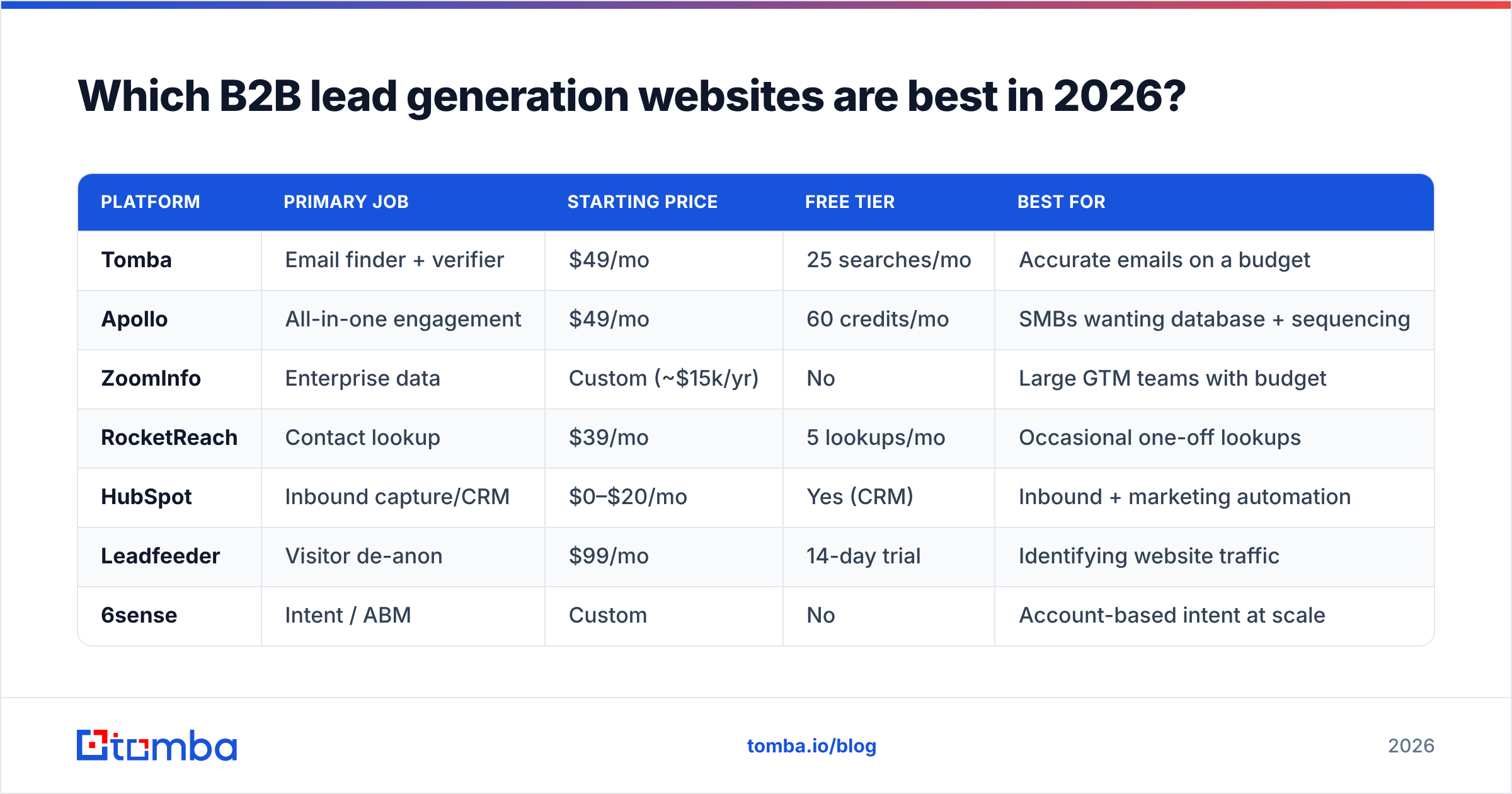
Best answer: it depends on the job you're hiring it for — but if you need accurate contact data on a real budget, a focused data platform beats a bloated suite. Below is a side-by-side of the platforms most B2B teams shortlist, grouped by what they're genuinely good at.
| Platform | Primary job | Starting price | Free tier | Best for |
|---|---|---|---|---|
| Tomba | Email finder + verifier | $49/mo | 25 searches/mo | Accurate emails on a budget |
| Apollo | All-in-one engagement | $49/mo | 60 credits/mo | SMBs wanting database + sequencing |
| ZoomInfo | Enterprise data | Custom (~$15k/yr) | No | Large GTM teams with budget |
| RocketReach | Contact lookup | $39/mo | 5 lookups/mo | Occasional one-off lookups |
| HubSpot | Inbound capture/CRM | $0–$20/mo | Yes (CRM) | Inbound + marketing automation |
| Leadfeeder | Visitor de-anon | $99/mo | 14-day trial | Identifying website traffic |
| 6sense | Intent / ABM | Custom | No | Account-based intent at scale |
| Clearbit | Enrichment | Custom | Limited | Real-time form enrichment |
A few honest notes on this table. ZoomInfo and 6sense are excellent but priced for teams with five-figure annual budgets and a procurement process. Apollo is the popular middle ground, though its data accuracy on direct dials is inconsistent. Tomba wins on cost-per-verified-email and a usable free tier, which is why it shows up on so many Apollo alternative shortlists. None of these are "wrong" — they're just built for different funnels.
How do you pick the right lead generation website?#
Start from the gap in your funnel, not the feature list. Run through this in order:
- You have target accounts but no contact info → you need an email finder and verifier. This is the most common starting point and the cheapest to solve. A domain search that returns every email pattern at a company plus a verifier to scrub bounces is usually enough.
- You get traffic but don't know who's visiting → you need inbound capture or visitor reveal, not a database. Adding more cold contacts won't help a leaky site.
- You don't know which accounts are in-market → you need intent data. This is a luxury, not a starting point; skip it until your outbound motion is already working.
- You're scaling a proven outbound motion → now an all-in-one or a database + sequencer combo earns its price.
The mistake I see most: a three-person team buys a $1,200/month all-in-one suite to "do lead gen," uses 8% of it, and churns in four months. Buy the narrow tool that fixes your actual bottleneck, then expand.
Why does data accuracy matter more than database size?#
Because a big database full of dead emails costs you more than a small one. Every bounced email chips away at your sender reputation, and once your domain is flagged, even your good emails land in spam. Vendors love to advertise "275 million contacts," but raw count tells you nothing about how many of those emails still resolve.
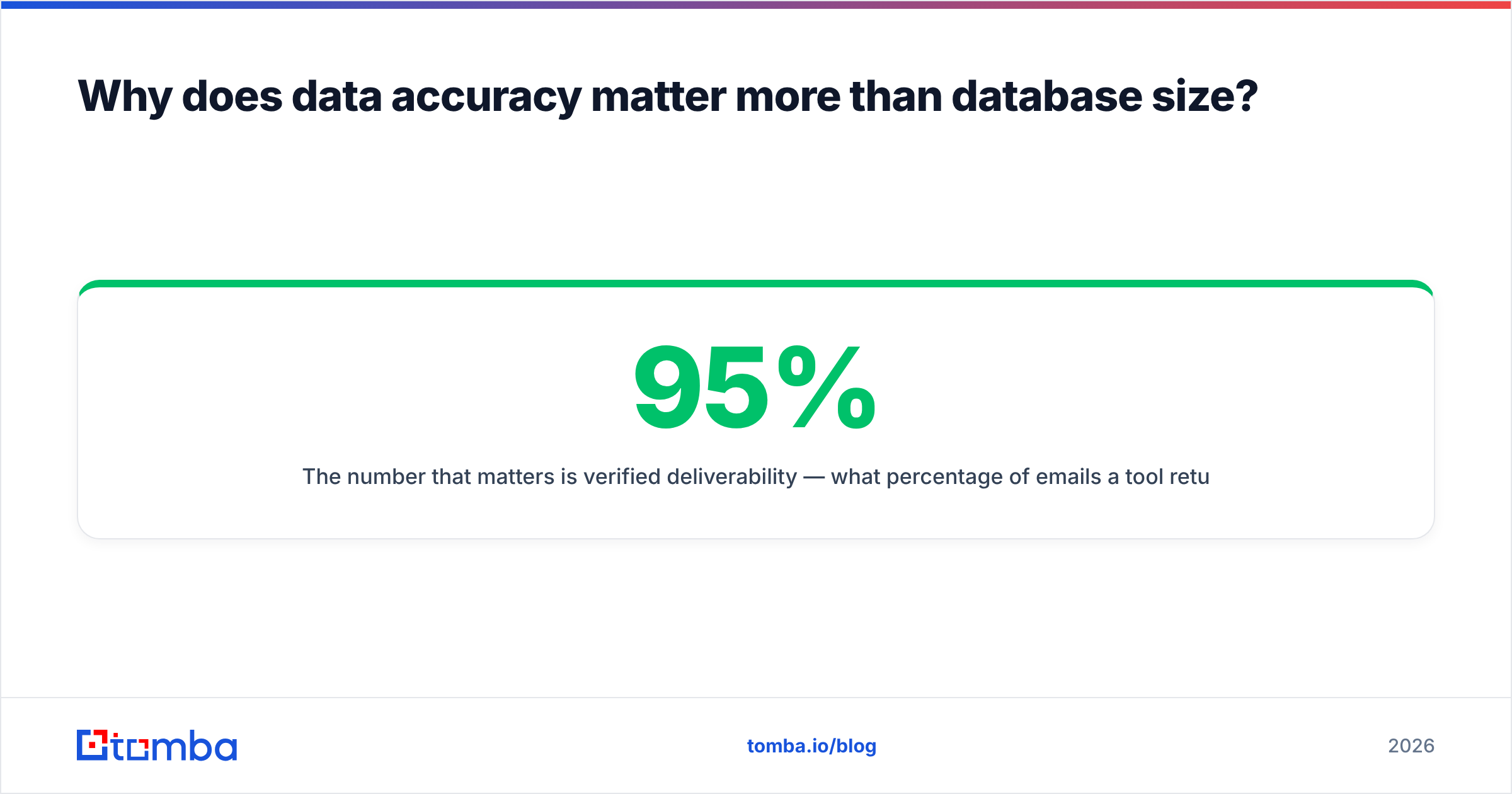
The number that matters is verified deliverability — what percentage of emails a tool returns actually reach a real inbox. Independent reviews on G2 consistently show a wide spread here, and the gap is where your money leaks. A tool with a 95% valid rate at $49/month beats a tool with a 70% valid rate at $99/month, even before you count the deliverability damage from the extra bounces.
This is why pairing a finder with an email verifier is non-negotiable in 2026. Catch-all domains, role addresses (info@, sales@), and stale records all need to be filtered before you send. If your provider doesn't verify in-line, you're outsourcing your sender reputation to luck. For teams enriching large lists, running everything through data enrichment and dedup before import saves both credits and your domain health.
What does a B2B lead generation website actually cost?#
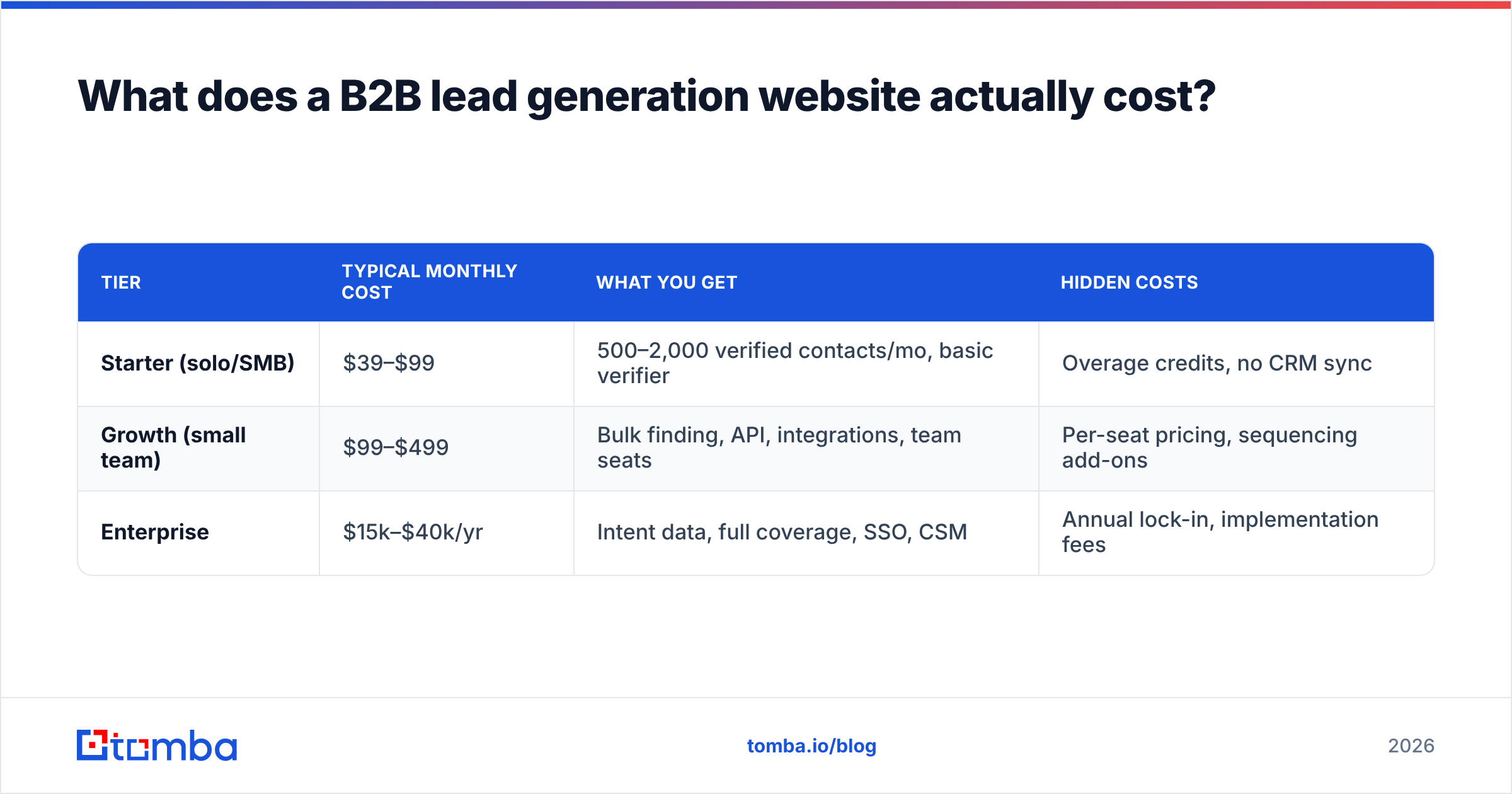
More than the sticker price, and less than the enterprise quote. Here's how the real total cost breaks down across the three tiers most teams land in:
| Tier | Typical monthly cost | What you get | Hidden costs |
|---|---|---|---|
| Starter (solo/SMB) | $39–$99 | 500–2,000 verified contacts/mo, basic verifier | Overage credits, no CRM sync |
| Growth (small team) | $99–$499 | Bulk finding, API, integrations, team seats | Per-seat pricing, sequencing add-ons |
| Enterprise | $15k–$40k/yr | Intent data, full coverage, SSO, CSM | Annual lock-in, implementation fees |
Two things blow up budgets. First, per-seat pricing on suites — what looks like $99/month becomes $99 × 6 reps. Second, credit overages, where the advertised plan covers far fewer real searches than you'll burn in a normal month. Read the credit math before you sign. Tomba's pricing keeps this simple: Free (25 searches/mo), Starter $49/mo, Growth $99/mo, Pro $249/mo, and custom Enterprise — with verification bundled rather than sold as an upsell.
For a quick sanity check on any vendor, divide the monthly price by the number of verified contacts you realistically expect, not the credit cap. That cost-per-good-lead is the only apples-to-apples number across these websites.
How do data platforms compare to inbound-only tools?#
They're complementary, not competitive — and treating them as interchangeable is how teams end up with a half-working funnel. A contact database is an outbound engine: you decide who to reach and go get them. An inbound tool like HubSpot or Leadfeeder is a demand-capture engine: it works the traffic you already earned.
The strongest GTM motions run both. You capture inbound intent with forms and visitor reveal, then use a data platform to enrich those anonymous or partial leads into full, contactable records. Someone fills out a form with just a work email? Enrich it into a name, title, company size, and direct dial. Someone's company visits your pricing page anonymously? Reveal the company, then find the right buyer's email.
This is also where research-heavy teams lean on niche finders — a LinkedIn finder to convert profiles into emails, or a phone finder when email-only outreach stalls. The point isn't to own every tool; it's to make sure the outbound database and the inbound capture layer actually hand off to each other instead of living in separate spreadsheets.
What are the most common lead generation website mistakes?#
The expensive ones are predictable. Avoid these and you'll outperform teams spending three times as much:
- Buying database size over accuracy. A 200M-contact directory with stale data is a liability. Verify before you send, every time.
- Paying for an all-in-one you'll barely use. Suites bundle features to justify the price. If you only need finding and verifying, buy finding and verifying.
- Skipping verification. Bounces above 3–5% put you in spam territory. Read up on email deliverability before you scale sends.
- Ignoring the API. Manual lookups don't scale. A clean email finder API lets you enrich inside your CRM or product automatically.
- No dedup discipline. Importing overlapping lists wastes credits and annoys prospects with duplicate touches.
- Confusing intent data for product-market fit. Intent tools amplify a working motion; they don't create one. Earn the basics first.
Vendor-neutral resources like HubSpot's lead generation guide and analyst coverage from Gartner are worth reading before any purchase — they'll keep a slick sales demo from talking you into a tier you don't need.
How should a small team get started?#
Cheapest viable stack first, then expand. For a team under ten people, here's a path that works without a procurement cycle:
- Step 1: Start with a free tier to test data quality on your target accounts, not the vendor's demo accounts. Tomba's 25 free searches/month exist for exactly this.
- Step 2: Add a verifier and run every list through it before sending. Keep bounces under 3%.
- Step 3: Connect the finder to your CRM via API or a native integration so enrichment happens automatically.
- Step 4: Only add inbound capture or intent data once your outbound motion books meetings reliably.
This sequencing keeps your spend tied to results. You're never paying for capability you haven't earned the right to use yet.
The bottom line#
There's no single best B2B lead generation website — there's the right one for the gap in your funnel. If that gap is contact data, accuracy and cost-per-verified-lead matter far more than database size or feature count. If it's inbound, no database will fix a leaky site. Map your funnel, buy the narrow tool that fixes the real bottleneck, and expand only when the numbers justify it.
If your bottleneck is finding accurate, verified emails without an enterprise contract, start free with the Tomba Email Finder. You get 25 searches a month at no cost, built-in verification so your sender reputation stays clean, and an API that drops straight into your CRM when you're ready to scale. Test it on your own target accounts, compare the verified-deliverability rate against whatever you're using now, and let the bounce rate decide.
// get started
Find, verify and enrich your first contacts today
Start on the free plan with 25 searches a month, then scale when your team is ready.
Free plan · No credit card required · GDPR & CCPA
// about the author