B2B Lists vs Apollo.io: Which Wins for Pipeline in 2026?
Static B2B lists or a live platform like Apollo.io? Here's an honest, data-decay-aware breakdown of cost, accuracy, and which one actually fills your pipeline in 2026.
You have a number to hit and two ways to get the contacts: buy a B2B list, or subscribe to a platform like Apollo.io and pull your own. Both promise thousands of leads. Only one of them is right for your specific motion — and the wrong choice quietly burns your domain reputation and your budget for months.
This is a neutral breakdown of b2b lists vs apolloio: what each actually delivers, where the data comes from, what it costs once you account for waste, and how to combine them without nuking your deliverability.
TL;DR#
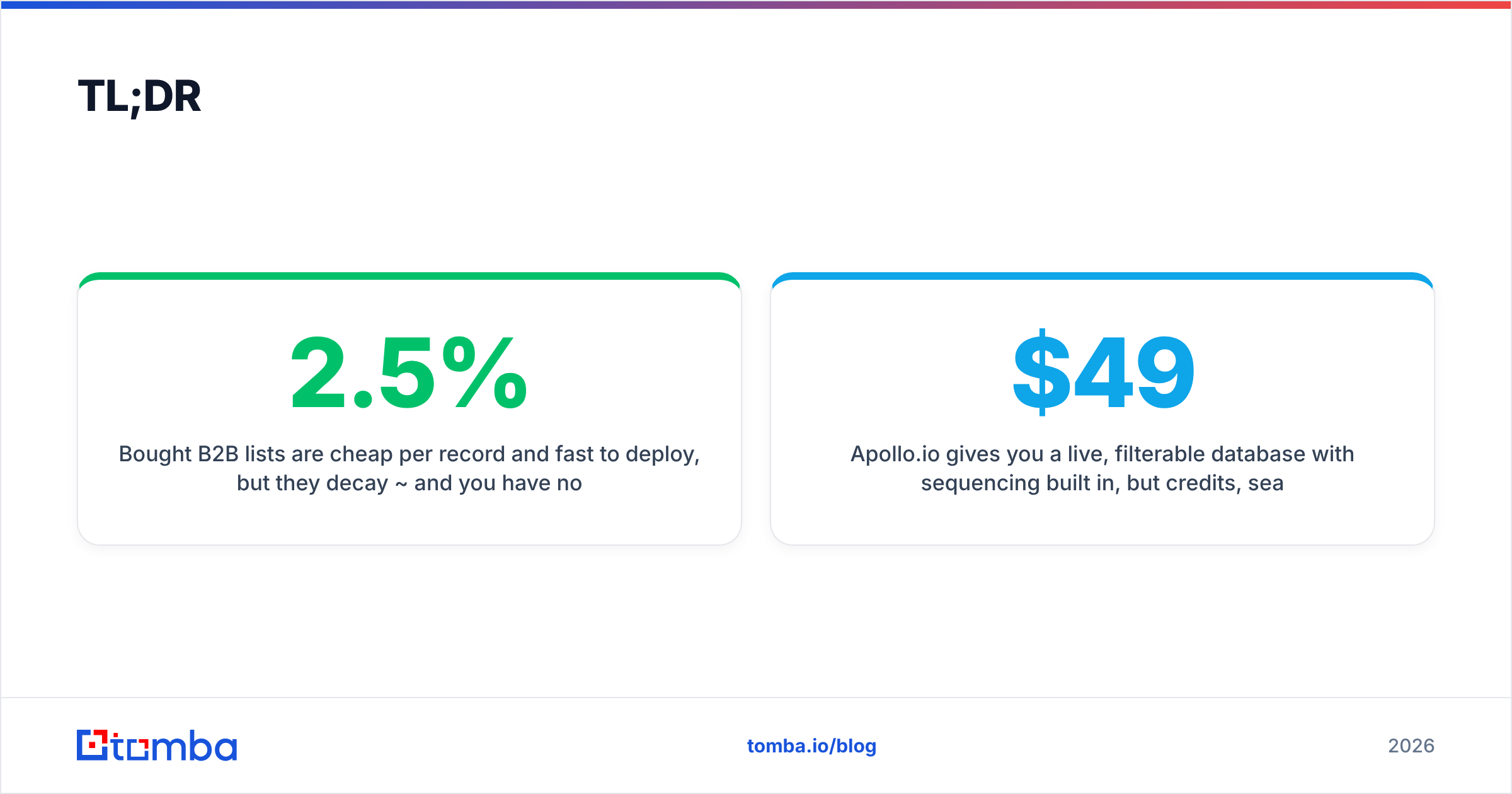
- Bought B2B lists are cheap per record and fast to deploy, but they decay ~2.5% per month and you have no control over freshness or consent — expect 20-40% bounce on untouched lists.
- Apollo.io gives you a live, filterable database with sequencing built in, but credits, seat costs, and aggressive enrichment limits mean the "$49 plan" rarely covers a real team.
- The accuracy gap is the whole game: a static CSV is a snapshot; a platform is a feed. Neither is verified at the moment you send.
- The pragmatic 2026 setup is a platform or list for discovery + a dedicated verifier/finder for the send-time check — this is where a tool like Tomba slots in.
- Skip to the comparison table if you just want the decision matrix.
What is the real difference between a B2B list and Apollo.io?#
A bought B2B list is a file. Someone ran a query against their database, exported the rows, and sold you a frozen copy. The moment it lands in your inbox it stops updating. Job changes, company moves, and email format changes keep happening in the real world — your file does not.
Apollo.io is a subscription to a living database plus a workflow layer. You filter contacts yourself, reveal emails and phones using credits, push them into sequences, and (in theory) pull a fresher record next quarter. You're renting access, not buying rows.
Think of it like the difference between a printed phone book and a maps app. The phone book was accurate the day it was printed; the maps app re-checks the route while you drive. Both can get you there — but only one notices the road closed yesterday.
That single distinction — snapshot versus feed — drives every other tradeoff below.
)
Where does the data actually come from?#
This is the question most "best leads" pitches dodge. Provenance determines both accuracy and legal risk.
- Brokered B2B lists are usually aggregated from web scraping, recycled marketing databases, trade-show exports, and other lists. You rarely get a clear chain of consent, which matters under GDPR and CAN-SPAM.
- Apollo.io builds its database from a mix of public web data, user-contributed contacts (its community data model), and third-party licensing. Coverage is broad, especially for US tech, but contributed data ages the same way any crowdsourced set does.
- Verification-first tools like Tomba lean on pattern detection plus live SMTP and catch-all checks at lookup time, and they publish their data sources so you can audit how a record was found.
The lesson: a big number on a pricing page tells you about coverage, not correctness. A 275M-contact database with no send-time check still hands you the same dead address a 10M one would — it just hands you more of them.
How accurate is each, really?#
Accuracy decays. That's the part vendors don't print in bold. B2B contact data degrades roughly 2-2.5% every month as people switch jobs — call it 25-30% a year. A list you bought in January is meaningfully worse by summer, and you paid for the whole thing up front.
Apollo's live model handles decay better than a static file because records can refresh, but you still hit two issues: contributed emails that were never validated, and a large share of catch-all domains where the server accepts everything and tells you nothing. A platform's "verified" badge often just means "syntax is valid and the domain has MX records," not "this inbox exists."
That's why the send-time check is non-negotiable regardless of source. Running any list — bought or Apollo-exported — through an email verifier before the first send is the single highest-ROI step in the whole process. For the murky middle, a dedicated catch-all verifier resolves addresses that generic platforms flag "unknown" and skip.
If you blast an unverified list, you don't just waste sends — you train inbox providers to distrust your domain, and that damage outlives the campaign. (See Tomba's primer on email deliverability for how bounces feed sender reputation.)
How do B2B lists and Apollo.io compare head-to-head?#
Here's the side-by-side on the attributes that actually change your results.
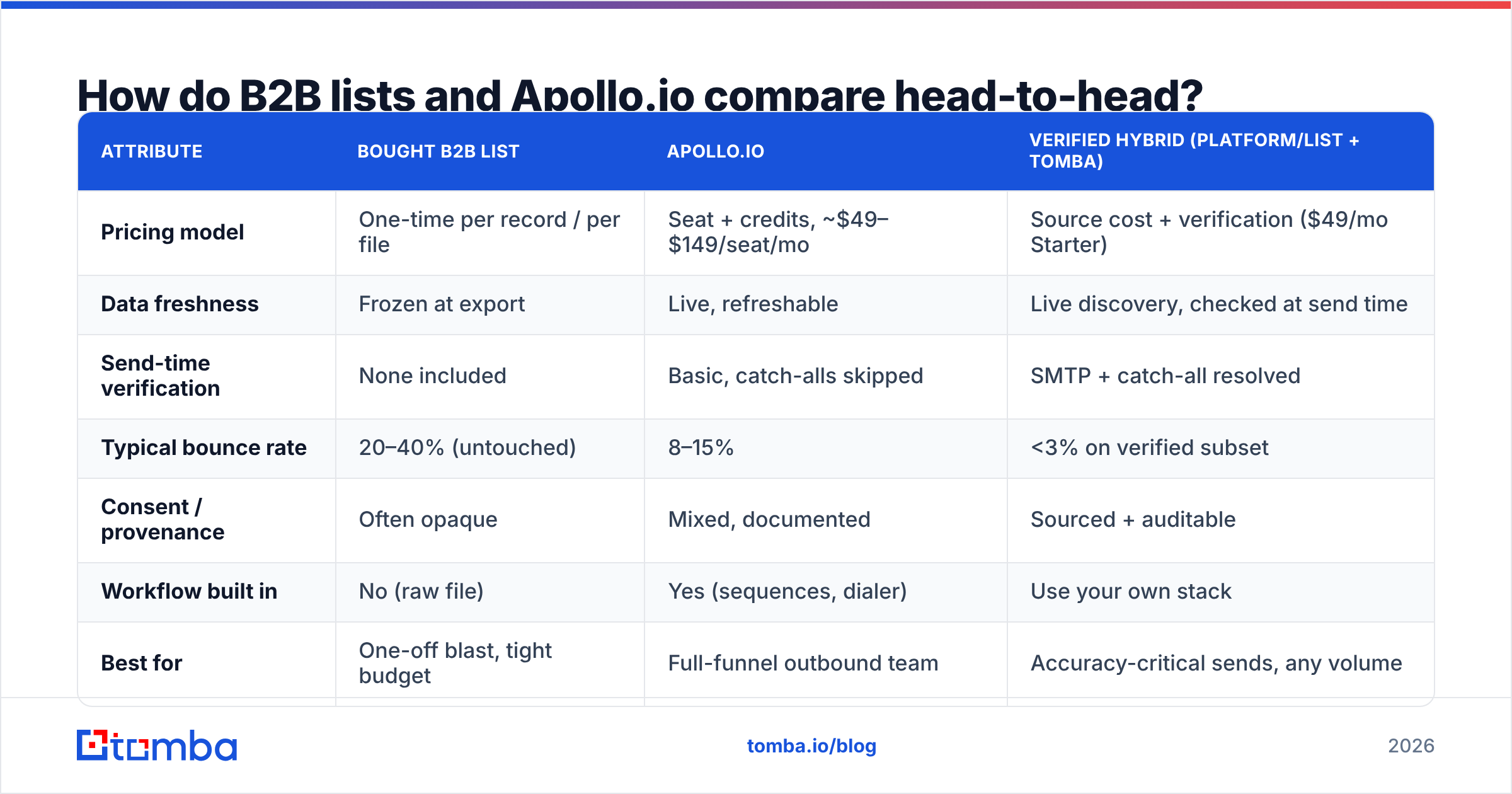
| Attribute | Bought B2B List | Apollo.io | Verified hybrid (platform/list + Tomba) |
|---|---|---|---|
| Pricing model | One-time per record / per file | Seat + credits, ~$49–$149/seat/mo | Source cost + verification ($49/mo Starter) |
| Data freshness | Frozen at export | Live, refreshable | Live discovery, checked at send time |
| Send-time verification | None included | Basic, catch-alls skipped | SMTP + catch-all resolved |
| Typical bounce rate | 20–40% (untouched) | 8–15% | <3% on verified subset |
| Consent / provenance | Often opaque | Mixed, documented | Sourced + auditable |
| Workflow built in | No (raw file) | Yes (sequences, dialer) | Use your own stack |
| Best for | One-off blast, tight budget | Full-funnel outbound team | Accuracy-critical sends, any volume |
A few honest notes on this table. Apollo's bounce range assumes you use its native "verified" filter; turn that off and it climbs. The hybrid column's sub-3% number only holds for the records that pass verification — verification's job is to shrink your list to the addresses worth sending to, not to magically fix dead ones.
What does each option actually cost?#
Per-record price is a trap. The number that matters is cost per delivered, accurate contact.
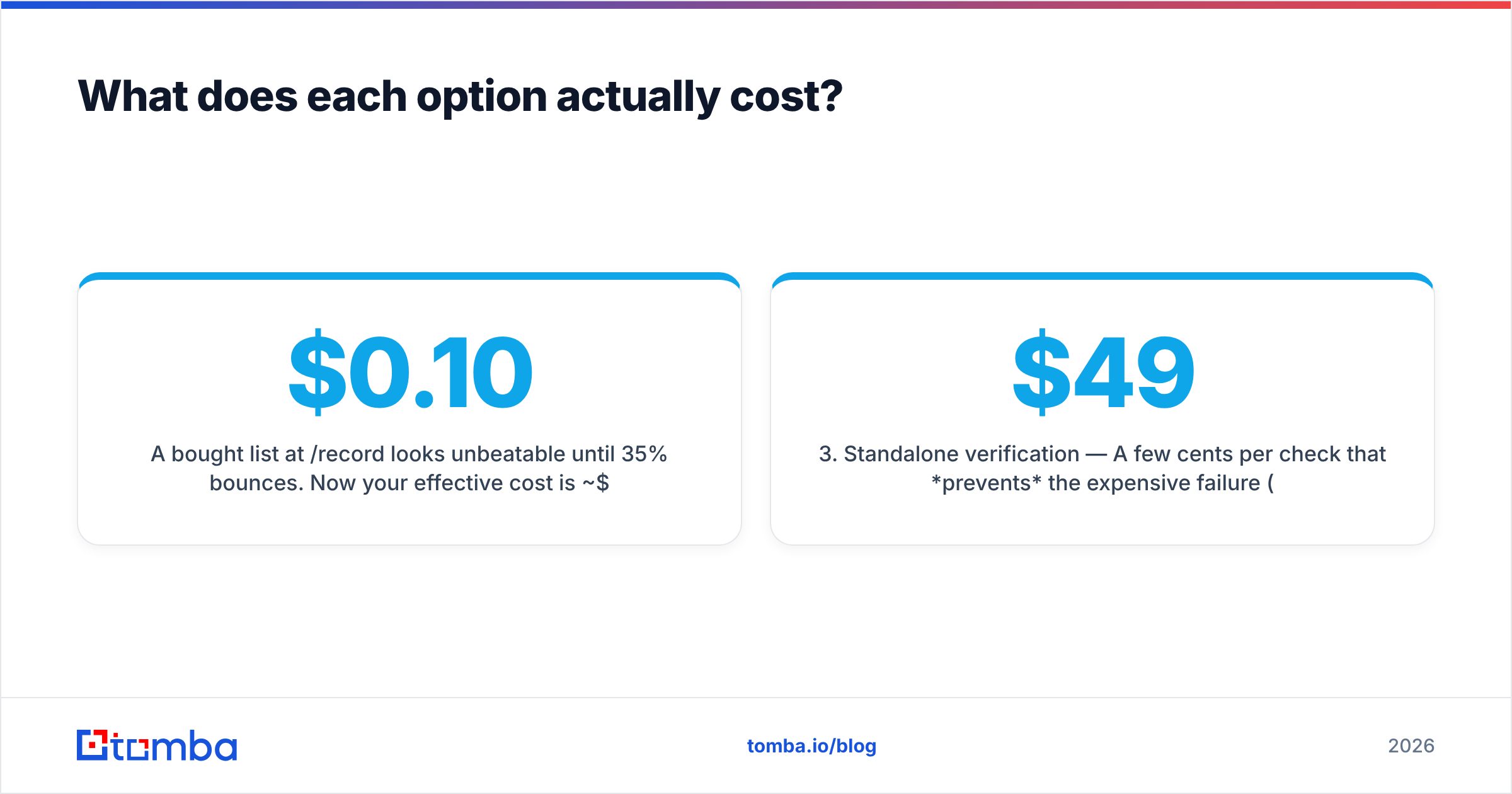
A bought list at $0.10/record looks unbeatable until 35% bounces. Now your effective cost is ~$0.15 per usable address — before counting the reputation hit from the bounces themselves, which has no clean dollar figure but absolutely has a cost.
Apollo bundles discovery, enrichment, and sequencing, so the headline seat price hides credit math. Heavy enrichment users routinely blow through monthly credit caps and either upgrade tiers or stall mid-month. Budget for the tier above the one the calculator suggests.
Here's the cost logic laid out:
- List broker — Lowest sticker price, highest waste. You pay once and inherit all the decay. Good only when volume matters more than precision.
- Apollo.io — Mid-range, predictable monthly spend, but credits and seats compound as the team grows. You're paying for the workflow as much as the data.
- Standalone verification — A few cents per check that prevents the expensive failure (bounces, blacklisting). The cheapest insurance in the stack. Compare Tomba pricing: Free covers 25 searches/mo, Starter is $49/mo, Growth $99/mo.
- Hybrid — Source broadly, then verify ruthlessly. You spend slightly more per record and far less per meeting booked, which is the only metric your CRO cares about.
)
Is Apollo.io better than buying a list?#
For most teams running ongoing outbound, yes — but not for the reason the pricing page implies. Apollo wins on workflow and recency, not on raw data quality. The sequencing, the Chrome extension, the dialer, and the live refresh are worth real money if you're sending every week.
Buying a list still beats Apollo in three narrow cases:
- One-time campaigns where a subscription makes no sense (an event invite, a single regional push).
- Hyper-niche segments Apollo covers poorly — local trades, specific public-sector roles, non-US markets where contributed data is thin.
- Bulk top-of-funnel where you'll verify aggressively anyway and just need raw volume cheaply, ideally fed through a bulk email finder to fill gaps.
If your objection to Apollo is price or lock-in rather than the concept, the more useful move is to look at a focused Apollo alternative that unbundles data from the workflow, so you're not paying for a dialer you don't use.
How do you turn either source into a clean, sendable list?#
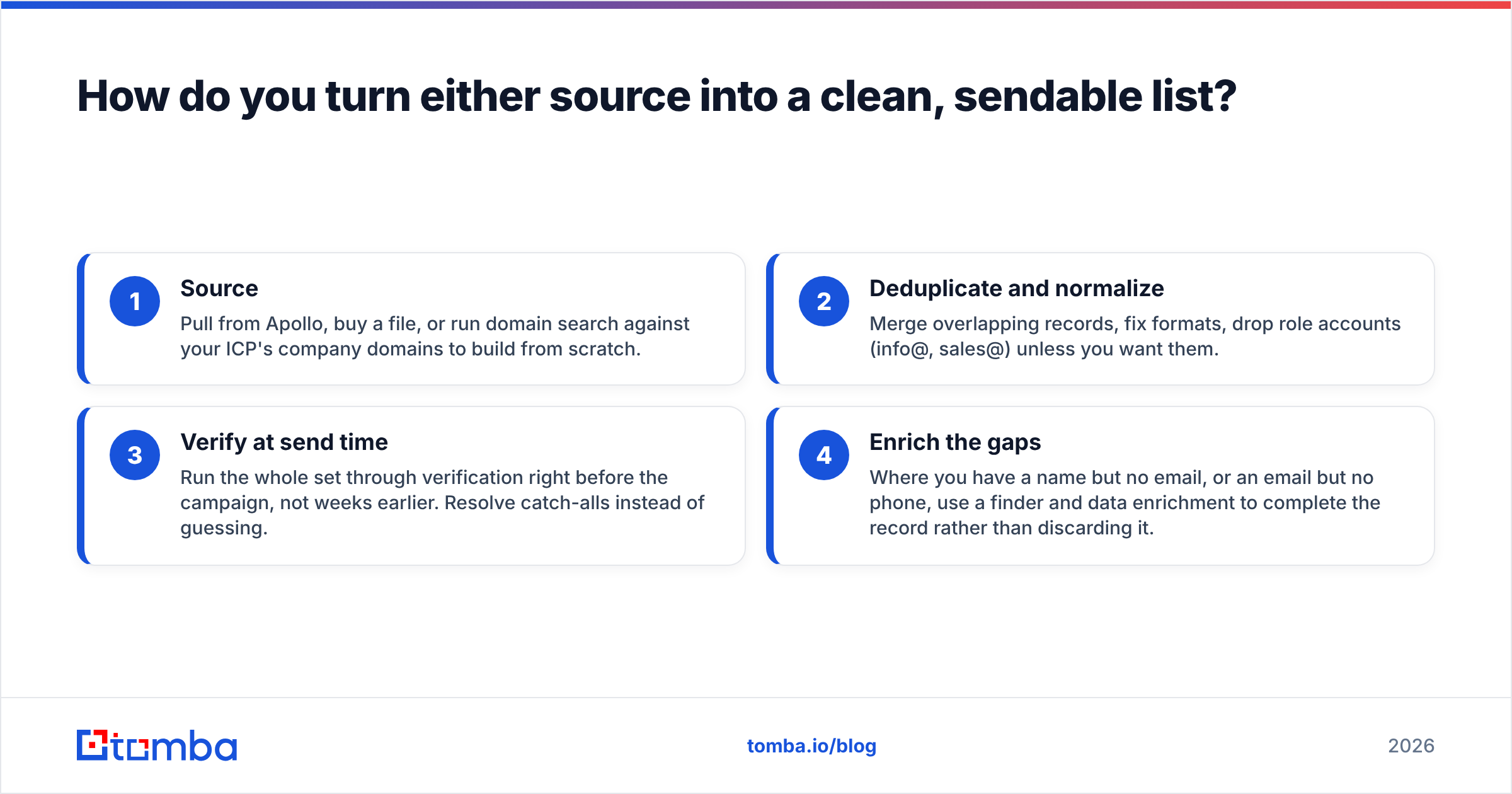
The workflow is the same no matter which side of the b2b lists vs apolloio debate you land on. Source is step one of four, not the finish line.
- Source — Pull from Apollo, buy a file, or run domain search against your ICP's company domains to build from scratch.
- Deduplicate and normalize — Merge overlapping records, fix formats, drop role accounts (info@, sales@) unless you want them.
- Verify at send time — Run the whole set through verification right before the campaign, not weeks earlier. Resolve catch-alls instead of guessing.
- Enrich the gaps — Where you have a name but no email, or an email but no phone, use a finder and data enrichment to complete the record rather than discarding it.
Skipping step three is the mistake that quietly ends most cold campaigns. A 30-day-old "verified" status is not verified — it's a memory.
Which should you choose for 2026?#
Match the tool to the motion, not the hype:
- Lean startup, occasional sends, tight budget → Buy a targeted list, then verify every address before touching it. Don't pay for a platform you'll log into twice a month.
- Dedicated SDR team, weekly sequences, US-heavy ICP → Apollo.io earns its seat cost through workflow and refresh. Still verify exports before the first touch.
- Accuracy-critical or deliverability-sensitive sending (regulated industries, executive outreach, low-volume high-value) → Source however you like, but make a verification-first tool the gatekeeper. This is the lane where a precise email finder plus verification beats raw volume every time.
- International or niche segments → Don't trust any single source. Cross-check with domain search and live SMTP verification, since contributed databases skew toward US tech.
The market data backs the "verify regardless" stance: review sites like G2 consistently surface deliverability and data accuracy as the top complaint across every lead platform, Apollo included. The differentiator in 2026 isn't who has the biggest database — it's who hands you addresses that still land.
The honest verdict#
There's no universal winner, and anyone who tells you otherwise is selling one. Bought lists win on speed and one-off cost. Apollo.io wins on workflow and freshness. Neither verifies at the moment you hit send — which is exactly when verification matters.
So treat the source as a commodity and the verification as the moat. Buy the list or rent the platform based on your motion, then make a dedicated finder-and-verifier the non-negotiable last step. That's how you stop paying for bounces and start paying for booked meetings.
If accuracy at send time is your bottleneck, start with the Tomba Email Finder. Find professional emails by domain, name, or company, verify them with live SMTP and catch-all checks, and export a list that actually lands — on a Free tier of 25 searches/mo, scaling to $49/mo when you're ready. Pair it with whatever discovery source you prefer, and let the verification do the heavy lifting your pipeline depends on.
// get started
Find, verify and enrich your first contacts today
Start on the free plan with 25 searches a month, then scale when your team is ready.
Free plan · No credit card required · GDPR & CCPA
// about the author