The B2B Marketing Email Playbook for 2026 (Strategy + Templates)
A no-fluff 2026 guide to B2B marketing email: list quality, segmentation, deliverability, copy frameworks, and the metrics that actually predict pipeline.
TL;DR
- A B2B marketing email is a one-to-many message sent to a segmented list of business contacts to nurture, educate, or convert them — different from cold outreach and different from transactional mail.
- The program lives or dies on list quality. Clean, verified data beats clever copy every time; a 30% bounce rate sinks your sender reputation before anyone reads the subject line.
- Segmentation, plain-text-feeling design, and one clear call to action drive more replies than polished templates blasted to everyone.
- Track reply rate, click-to-open, and pipeline influenced — not just opens, which Apple Mail Privacy Protection has made nearly useless since 2021.
- Tools matter in this order: accurate contact data first, deliverability hygiene second, automation last.
What is a B2B marketing email?#
A B2B marketing email is a message you send to a list of business contacts to move them toward a buying decision — a newsletter, a product announcement, a webinar invite, a case-study drip, or a re-engagement campaign. The audience is a buying committee, not a single consumer, and the sales cycle is measured in weeks or quarters, not minutes.
Think of it like a slow dinner party instead of a flash sale. You are not trying to close in one message; you are trying to stay welcome at the table long enough for the prospect to decide they trust you. That changes everything about how you write, how often you send, and what you measure.
Three categories get confused constantly, so let's separate them clearly:
- Marketing email — One-to-many, sent to opted-in or legitimately-interested business contacts. Newsletters, nurture sequences, event invites. Governed by CAN-SPAM and GDPR.
- Cold email — One-to-one (or small batch) outreach to people who have not opted in, usually from a sales rep. Higher legal sensitivity, lower volume, hyper-personalized. See our take on the difference in the cold email templates library.
- Transactional email — Triggered by an action (password reset, receipt, shipping notice). Not marketing, and you should never bolt promotions onto it.
If you remember one thing: the channel only works when the right message reaches a real inbox owned by a real person who might actually buy. Two of those three depend on your data, not your copy.

Why do most B2B marketing email programs underperform?#
Most programs underperform for one boring reason: dirty lists. Marketers obsess over subject lines and design systems while quietly emailing a database where one in four addresses is dead, role-based, or a catch-all that silently swallows mail.
Here is the chain reaction. You import a purchased or scraped list. A chunk of it bounces. Mailbox providers like Google and Microsoft read those bounces and spam-folder placements as signals that you are a careless sender. Your sender reputation drops. Now even your good contacts stop seeing you in the primary inbox. You blame the copy and rewrite the subject line — but the copy was never the problem.
The second-most-common failure is treating the whole list as one audience. A CFO at a 2,000-person enterprise and a founder at a 5-person startup do not share a problem, a budget, or a vocabulary. Sending them the same email guarantees both feel it was written for nobody.
The third is volume without consent. Buying a list and blasting it is not a marketing program; it is a deliverability liability. According to HubSpot's research on email marketing, segmented and targeted campaigns consistently outperform batch-and-blast on every revenue metric that matters.
What does a high-performing B2B email program look like?#
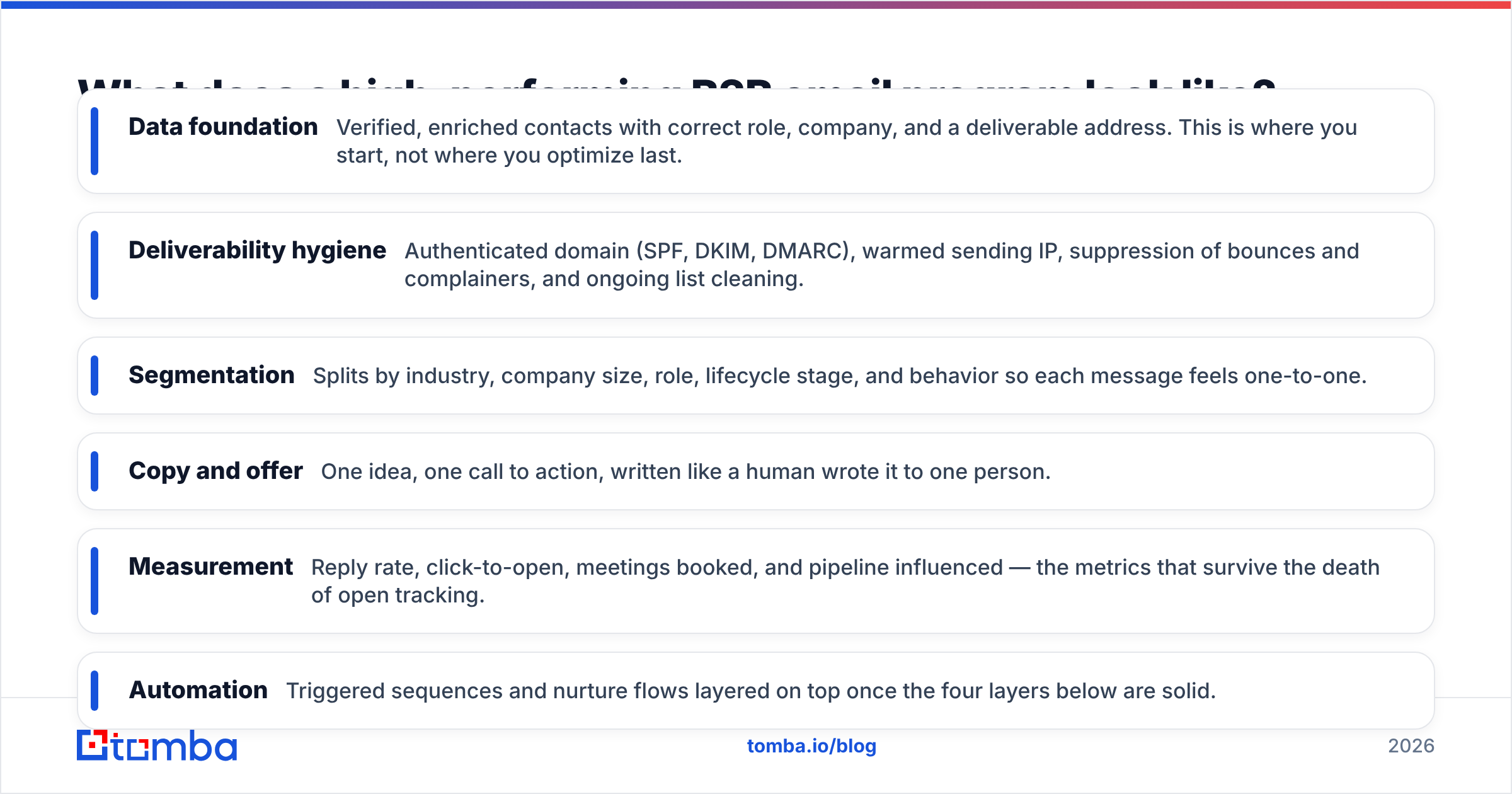
A high-performing program is built in layers, bottom-up. Get the foundation wrong and nothing above it holds.
- Data foundation — Verified, enriched contacts with correct role, company, and a deliverable address. This is where you start, not where you optimize last.
- Deliverability hygiene — Authenticated domain (SPF, DKIM, DMARC), warmed sending IP, suppression of bounces and complainers, and ongoing list cleaning.
- Segmentation — Splits by industry, company size, role, lifecycle stage, and behavior so each message feels one-to-one.
- Copy and offer — One idea, one call to action, written like a human wrote it to one person.
- Measurement — Reply rate, click-to-open, meetings booked, and pipeline influenced — the metrics that survive the death of open tracking.
- Automation — Triggered sequences and nurture flows layered on top once the four layers below are solid.
Notice the order. Automation is last on purpose. Automating a broken funnel just lets you fail faster and at greater scale.
How do you build a clean B2B email list?#
You build it by verifying every address before it enters your sending platform, and by enriching contacts so segmentation is even possible. There are three legitimate sources, in rough order of quality:
First-party (best). People who filled out a form, downloaded a resource, or attended your event. Highest intent, lowest legal risk, best engagement. Slow to grow but worth it.
Enriched and discovered (scalable). You know a target account and need the right person's email. An email finder takes a name and company domain and returns the verified professional address, while data enrichment fills in role, seniority, and company attributes so you can segment. Run a domain search when you want every relevant contact at a target company.
Purchased (avoid). Static, stale, shared across thousands of senders, and frequently a CAN-SPAM and GDPR minefield. The bounce rate alone will torch your reputation.
Whatever the source, the non-negotiable final step is verification. Run every address through an email verifier to strip out invalids, role accounts, and risky catch-alls before your first send. Aim to keep your hard-bounce rate under 2% — most mailbox providers start throttling well before that.
What metrics actually matter in 2026?#
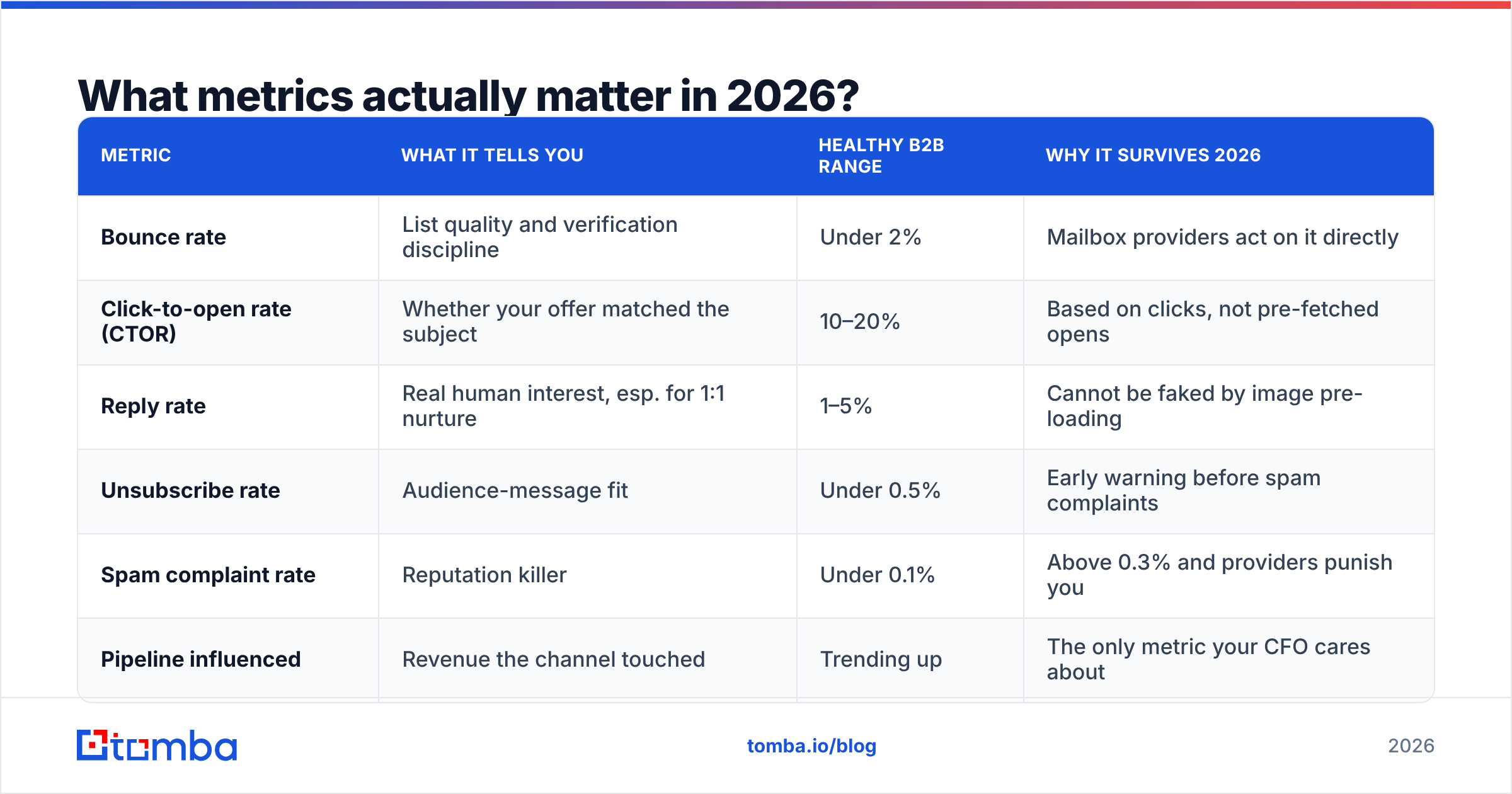
Reply rate, click-to-open rate, and pipeline influenced matter; raw open rate no longer does. Apple's Mail Privacy Protection pre-loads images for a large share of recipients, which inflates opens and makes "open rate" a vanity number you cannot trust for decisions.
Here is how to read the numbers that still mean something:
| Metric | What it tells you | Healthy B2B range | Why it survives 2026 |
|---|---|---|---|
| Bounce rate | List quality and verification discipline | Under 2% | Mailbox providers act on it directly |
| Click-to-open rate (CTOR) | Whether your offer matched the subject | 10–20% | Based on clicks, not pre-fetched opens |
| Reply rate | Real human interest, esp. for 1:1 nurture | 1–5% | Cannot be faked by image pre-loading |
| Unsubscribe rate | Audience-message fit | Under 0.5% | Early warning before spam complaints |
| Spam complaint rate | Reputation killer | Under 0.1% | Above 0.3% and providers punish you |
| Pipeline influenced | Revenue the channel touched | Trending up | The only metric your CFO cares about |
Build your dashboard around the bottom row. Opens are a diagnostic at best; pipeline influenced is the scoreboard.
How should you write a B2B marketing email that converts?#
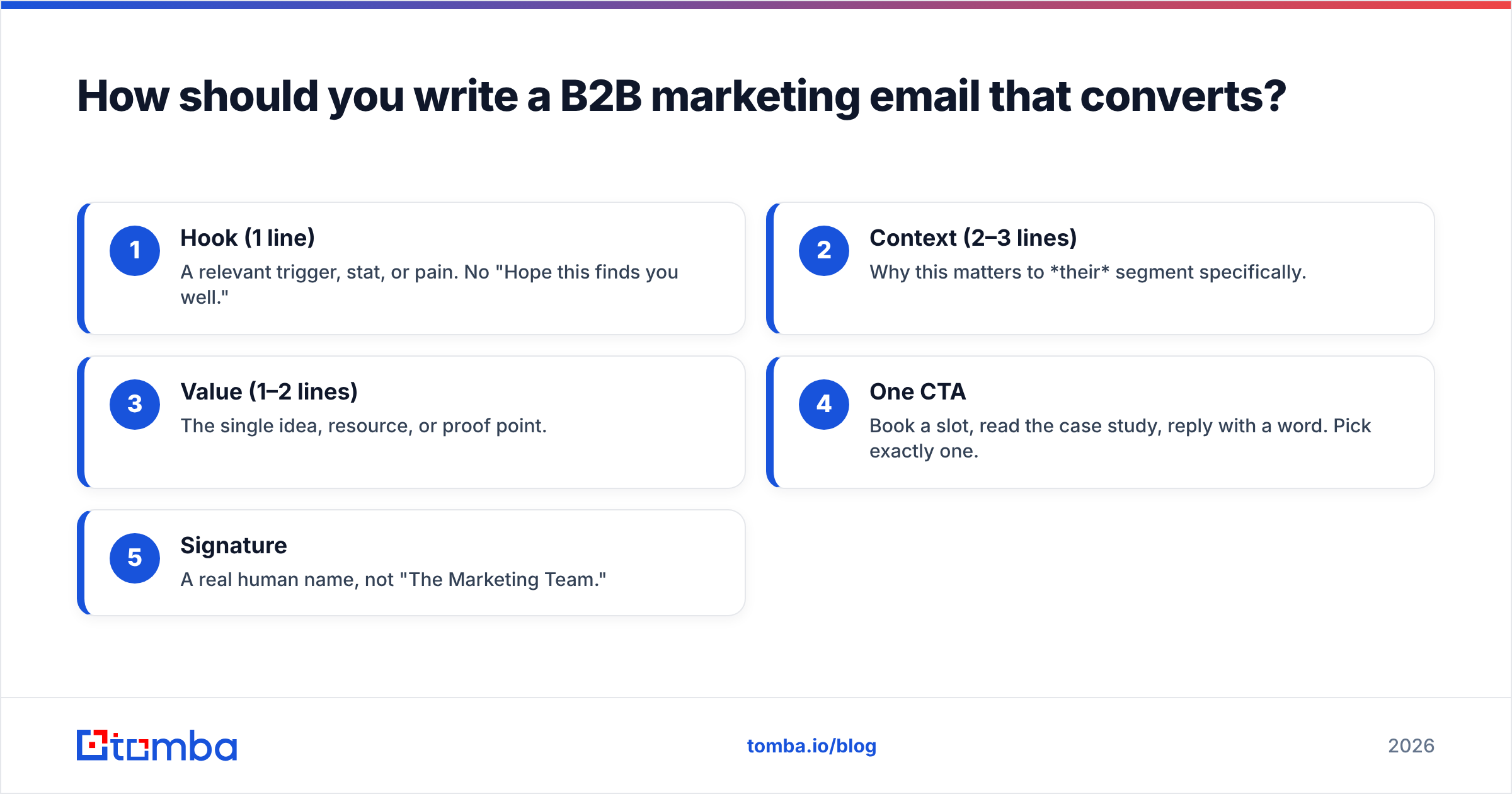
Write it like a message to one specific person, with one specific next step. The frameworks below are scaffolding, not scripts — fill them with a real insight and they work; fill them with filler and no template will save you.
A reliable structure for a nurture or announcement email:
- Hook (1 line) — A relevant trigger, stat, or pain. No "Hope this finds you well."
- Context (2–3 lines) — Why this matters to their segment specifically.
- Value (1–2 lines) — The single idea, resource, or proof point.
- One CTA — Book a slot, read the case study, reply with a word. Pick exactly one.
- Signature — A real human name, not "The Marketing Team."
Keep it under 150 words. Keep the design close to plain text — heavy HTML templates with three columns and a hero banner scream "bulk mail" to both filters and humans. If you need help generating angles fast, the subject line generator is a decent starting point for A/B variants, but always rewrite the winner in your own voice.
One more rule: segment before you write. A message to startup founders should not contain the word "stakeholder alignment," and a message to enterprise procurement should not open with a meme. Match the vocabulary to the audience or the copy quality is irrelevant.

Which tools do you actually need?#
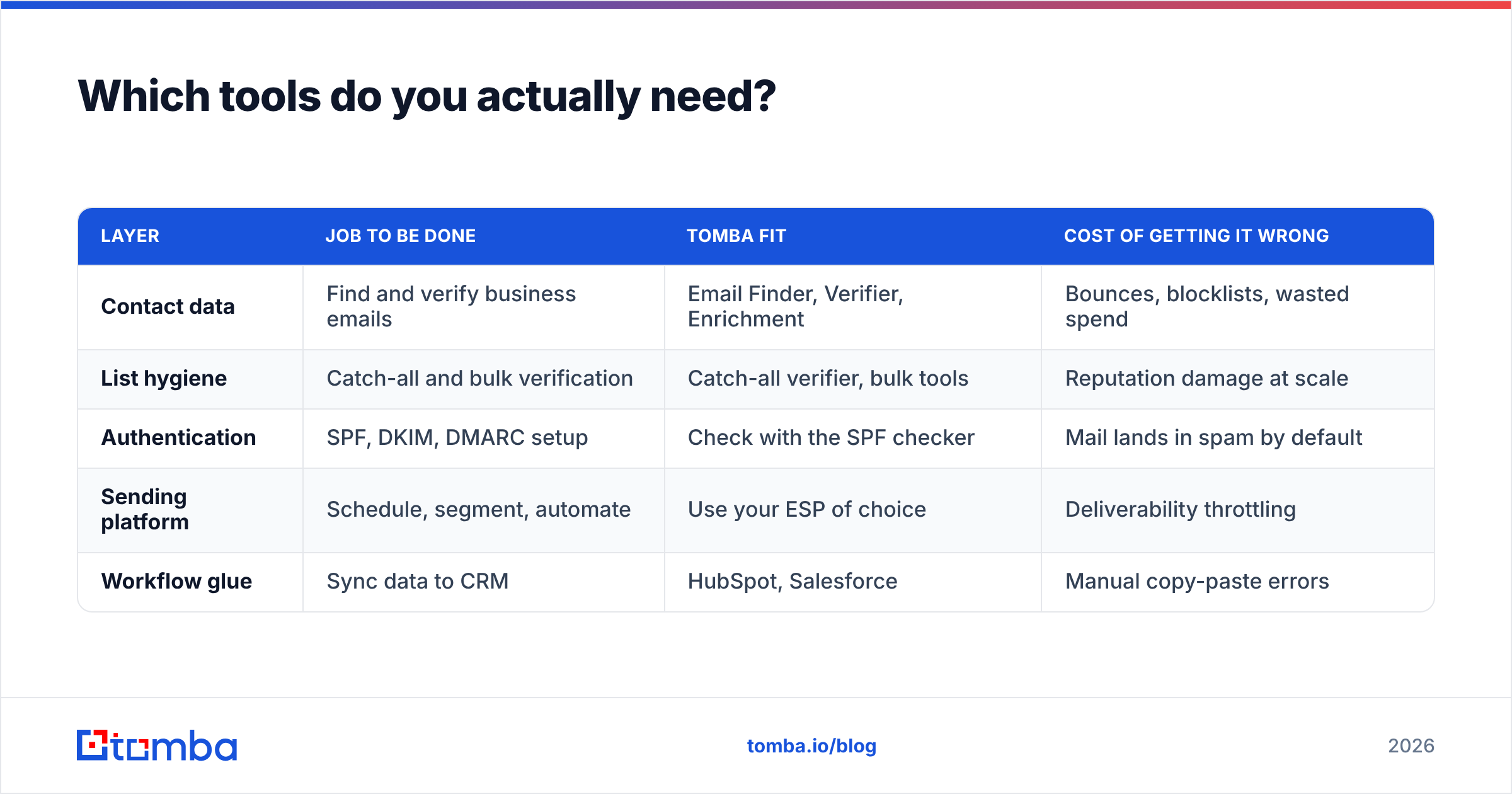
You need three things, and you need them in this order: accurate contact data, deliverability tooling, and a sending platform. Everything else is optional polish. Here is how the layers compare on what they do and what they cost to get wrong.
| Layer | Job to be done | Tomba fit | Cost of getting it wrong |
|---|---|---|---|
| Contact data | Find and verify business emails | Email Finder, Verifier, Enrichment | Bounces, blocklists, wasted spend |
| List hygiene | Catch-all and bulk verification | Catch-all verifier, bulk tools | Reputation damage at scale |
| Authentication | SPF, DKIM, DMARC setup | Check with the SPF checker | Mail lands in spam by default |
| Sending platform | Schedule, segment, automate | Use your ESP of choice | Deliverability throttling |
| Workflow glue | Sync data to CRM | HubSpot, Salesforce | Manual copy-paste errors |
Notice what is not on the critical path: a fancier email builder. Buyers in 2026 are saturated with polished campaigns; what cuts through is a relevant message to the right person from a sender they trust. That trust is a data-and-deliverability problem first.
For teams pricing this out, Tomba's pricing starts with a free tier of 25 searches per month, then Starter at $49/mo, Growth at $99/mo, and Pro at $249/mo — so you can verify and enrich before committing budget. Compare that against the all-in-one suites on a directory like G2 and you will usually find that buying data and sending separately gives you both better accuracy and lower total cost.
How do you keep a B2B email program healthy over time?#
You keep it healthy with routine maintenance, the way you would service a car instead of waiting for it to break down on the highway. Three habits separate programs that compound from programs that decay:
Re-verify quarterly. B2B contacts churn fast — people change jobs, companies fold, domains move. A list that was clean in January is 10–20% stale by Q2. Run it back through verification on a schedule, not just at import.
Watch the reputation signals. Monitor your domain against blocklists and keep complaint rates under control. A sudden dip in click-to-open across all segments usually means a deliverability problem, not a copy problem — check placement before you rewrite anything.
Suppress aggressively. Hard bounces, repeat non-openers, and anyone who complained should be removed, not re-tried. Sending to dead weight to "boost volume" is the fastest way to lose the inbox for everyone else on the list.
The teams that win at B2B marketing email are not the ones with the cleverest copywriters. They are the ones who treat their list as the asset it is — verified, segmented, and maintained — and then write honestly to it.
Start with the data layer#
If you take one action after reading this, fix your data foundation before your next send. Pull your list, run it through verification, enrich the gaps so you can segment, and suppress anything that bounces. Clean data is the single highest-leverage change available to most B2B email programs, and it is the one most teams skip.
The fastest way to get there is the Tomba Email Finder — find verified professional emails by name, company, or domain, enrich them with role and company data, and export a list your ESP will actually deliver. Start on the free tier, verify your current database, and watch your bounce rate — and your sender reputation — recover. Good copy is worth writing. It is only worth writing to inboxes that exist.
// get started
Find, verify and enrich your first contacts today
Start on the free plan with 25 searches a month, then scale when your team is ready.
Free plan · No credit card required · GDPR & CCPA
// about the author