B2B Rocket vs Ditlead 2026: AI Sales Outreach Compared
B2B Rocket runs autonomous AI agents; Ditlead runs multichannel sequences with inbox rotation. Here's which one fits your outbound motion in 2026 — and the data layer both depend on.
Choosing between B2B Rocket and Ditlead comes down to one question: do you want software that runs your outbound for you, or software that gives you tight control over every channel and message? Both promise more booked meetings, but they get there in fundamentally different ways — and the wrong pick can quietly waste a quarter of pipeline.
TL;DR — B2B Rocket vs Ditlead at a glance#
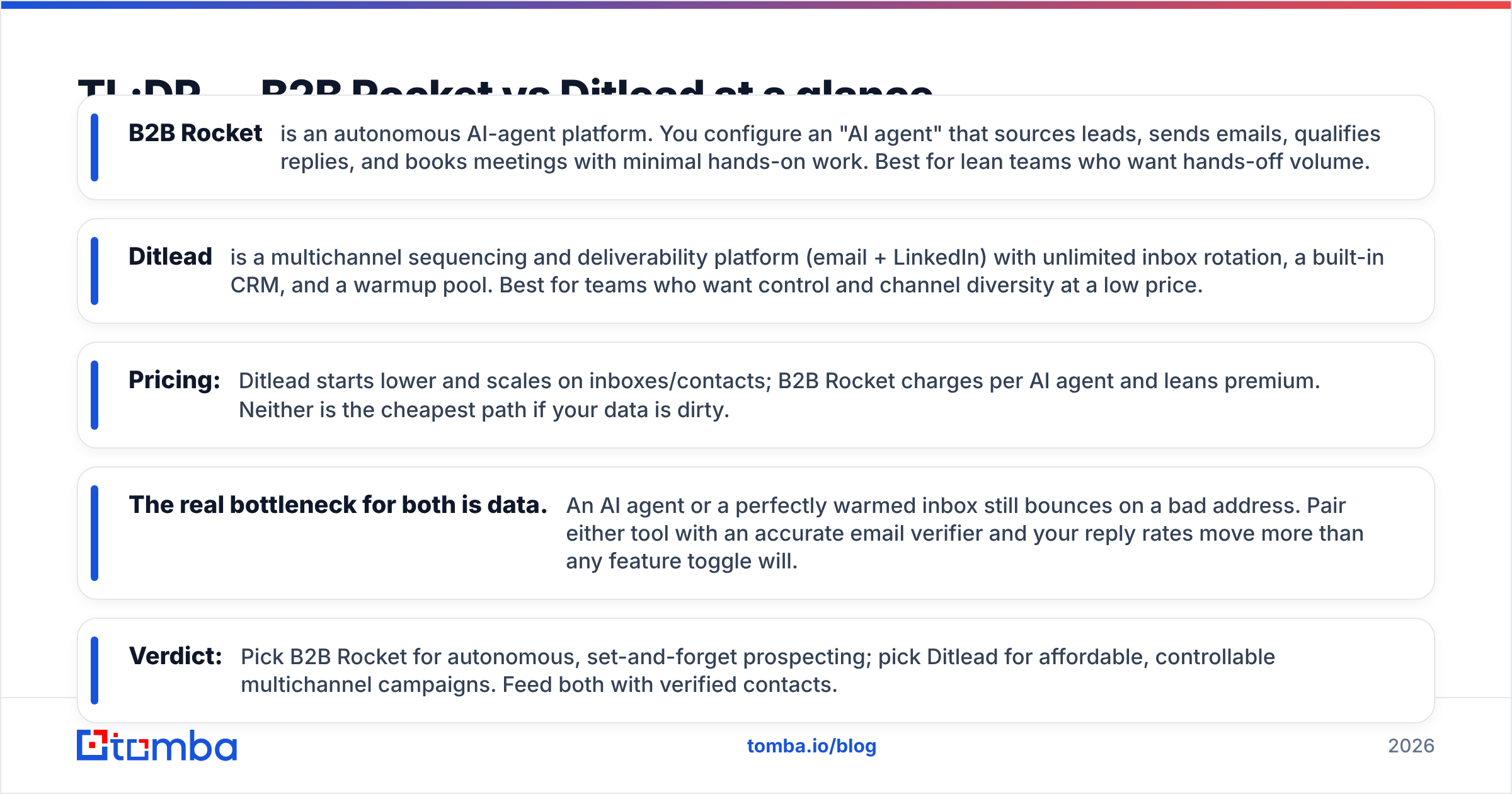
- B2B Rocket is an autonomous AI-agent platform. You configure an "AI agent" that sources leads, sends emails, qualifies replies, and books meetings with minimal hands-on work. Best for lean teams who want hands-off volume.
- Ditlead is a multichannel sequencing and deliverability platform (email + LinkedIn) with unlimited inbox rotation, a built-in CRM, and a warmup pool. Best for teams who want control and channel diversity at a low price.
- Pricing: Ditlead starts lower and scales on inboxes/contacts; B2B Rocket charges per AI agent and leans premium. Neither is the cheapest path if your data is dirty.
- The real bottleneck for both is data. An AI agent or a perfectly warmed inbox still bounces on a bad address. Pair either tool with an accurate email verifier and your reply rates move more than any feature toggle will.
- Verdict: Pick B2B Rocket for autonomous, set-and-forget prospecting; pick Ditlead for affordable, controllable multichannel campaigns. Feed both with verified contacts.
What is B2B Rocket?#
B2B Rocket is an AI sales automation platform built around the idea of an autonomous agent. Instead of you building a sequence step by step, you define an ideal customer profile, a value proposition, and a goal — then the agent identifies prospects, personalizes outreach, sends follow-ups, handles basic objections in the reply thread, and routes interested leads to a calendar.
Think of it like hiring an SDR who never sleeps and never asks for a raise. You give them a target account list and a pitch; they do the grunt work of sending and chasing. The trade-off is the same as with any junior rep: the output is only as good as the brief and the contact data you hand them.
B2B Rocket's pitch lands hardest with founders and small teams who don't have headcount to run a full outbound desk. The autonomy is the product. You're paying to not be in the weeds of campaign management.
What is Ditlead?#
Ditlead is a cold outreach and sales engagement platform that emphasizes deliverability and multichannel reach. Its core building blocks are sequences (email and LinkedIn touches mixed into one cadence), unlimited inbox rotation so volume spreads across many sending accounts, a warmup network to build sender reputation, and a lightweight CRM to track conversations.
Where B2B Rocket abstracts the work away, Ditlead hands you the controls. You decide the steps, the timing, the channel mix, and which inboxes rotate. That appeals to operators who've been burned by black-box automation and want to see exactly what's being sent and from where.
Ditlead competes in the same arena as Instantly, Smartlead, and Saleshandy. If you're evaluating that whole category, our roundup of an Instantly alternative and a Saleshandy alternative covers the adjacent tools you'll likely shortlist too.
B2B Rocket vs Ditlead: how do they compare?#
Here's the side-by-side on the attributes that actually change your results. Treat exact prices as directional — both vendors revise tiers — and confirm on their own pages before you buy.
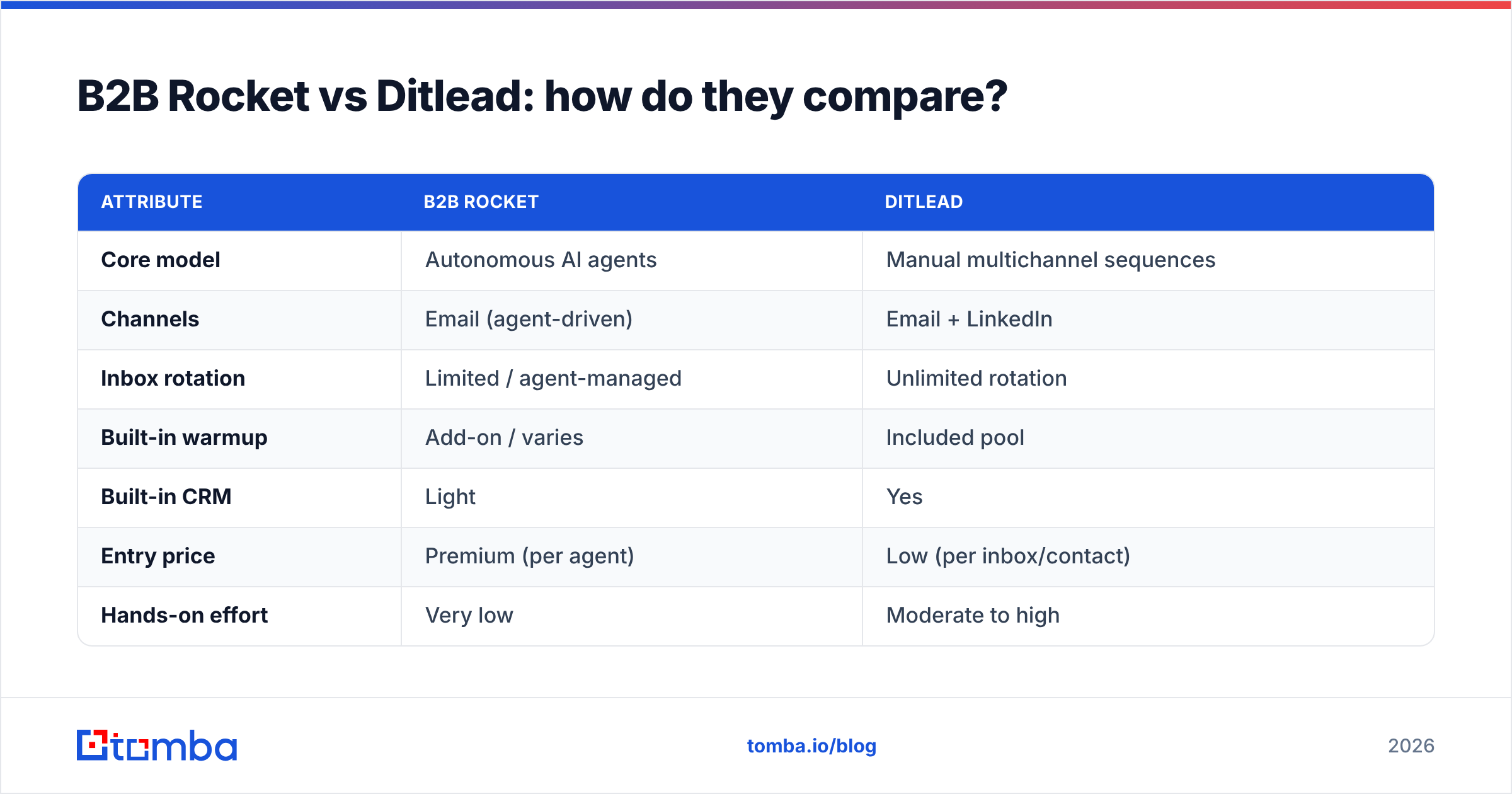
| Attribute | B2B Rocket | Ditlead |
|---|---|---|
| Core model | Autonomous AI agents | Manual multichannel sequences |
| Channels | Email (agent-driven) | Email + LinkedIn |
| Inbox rotation | Limited / agent-managed | Unlimited rotation |
| Built-in warmup | Add-on / varies | Included pool |
| Built-in CRM | Light | Yes |
| Entry price | Premium (per agent) | Low (per inbox/contact) |
| Hands-on effort | Very low | Moderate to high |
| Best for | Lean teams wanting volume | Teams wanting control |
| Learning curve | Low | Medium |
The pattern is clear: B2B Rocket sells convenience, Ditlead sells control and channel breadth at a lower entry cost. Neither is "better" in the abstract — they're optimized for different operators.
A few practical notes:
- Autonomy cuts both ways. B2B Rocket's agent will keep sending whether your list is clean or not. That's efficient when data is good and expensive when it isn't.
- Multichannel matters more than it used to. Inbox saturation means email-only motions underperform. Ditlead's LinkedIn steps give you a second touchpoint without bolting on another tool.
- Inbox rotation is a deliverability lever, not a magic trick. Spreading 1,000 sends across 20 inboxes protects reputation only if every address on your list is real.
- CRM depth is shallow on both. If you live in HubSpot or Salesforce, plan to sync — see Tomba's HubSpot integration and Salesforce integration for how contact data flows in.
Which one has better pricing?#
Ditlead wins on entry price; B2B Rocket wins on time saved — if you value that time correctly.
Ditlead's model scales with inboxes and contacts, so a solo founder or a three-person team can start cheaply and add sending capacity incrementally. B2B Rocket prices around the AI agent, which positions it as a premium, outcome-oriented spend: you're buying a replacement for SDR labor, not a cheaper sequencer.
The honest framing: compare each tool's monthly cost against the alternative it's replacing. If B2B Rocket genuinely removes 15 hours a week of manual prospecting, its premium can pencil out. If you'd run those campaigns yourself anyway, Ditlead's lower floor is the rational choice. Either way, budget separately for data — covered next — because neither price includes a guarantee that the emails you send actually exist.

What both tools get wrong about data#
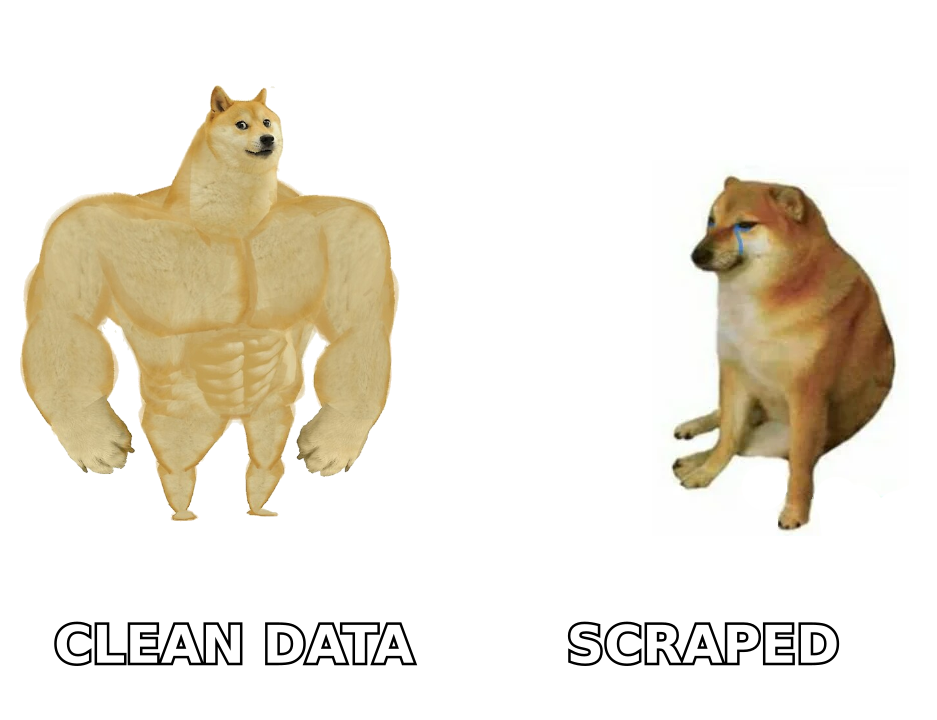
Here's the part the feature comparisons skip: the platform is not your bottleneck — your contact data is. An autonomous agent that emails 2,000 prospects and a hand-built sequence rotating across 30 inboxes both fail the same way when 20% of the addresses bounce. High bounce rates wreck email deliverability, drag down sender reputation across every inbox you own, and land your good messages in spam.
This is where the autonomy of B2B Rocket becomes a liability and the rotation of Ditlead becomes a false sense of safety. Volume amplifies whatever quality your list already has. Garbage in, garbage at scale.
The fix is unglamorous and effective: build and clean your list before a single message goes out.
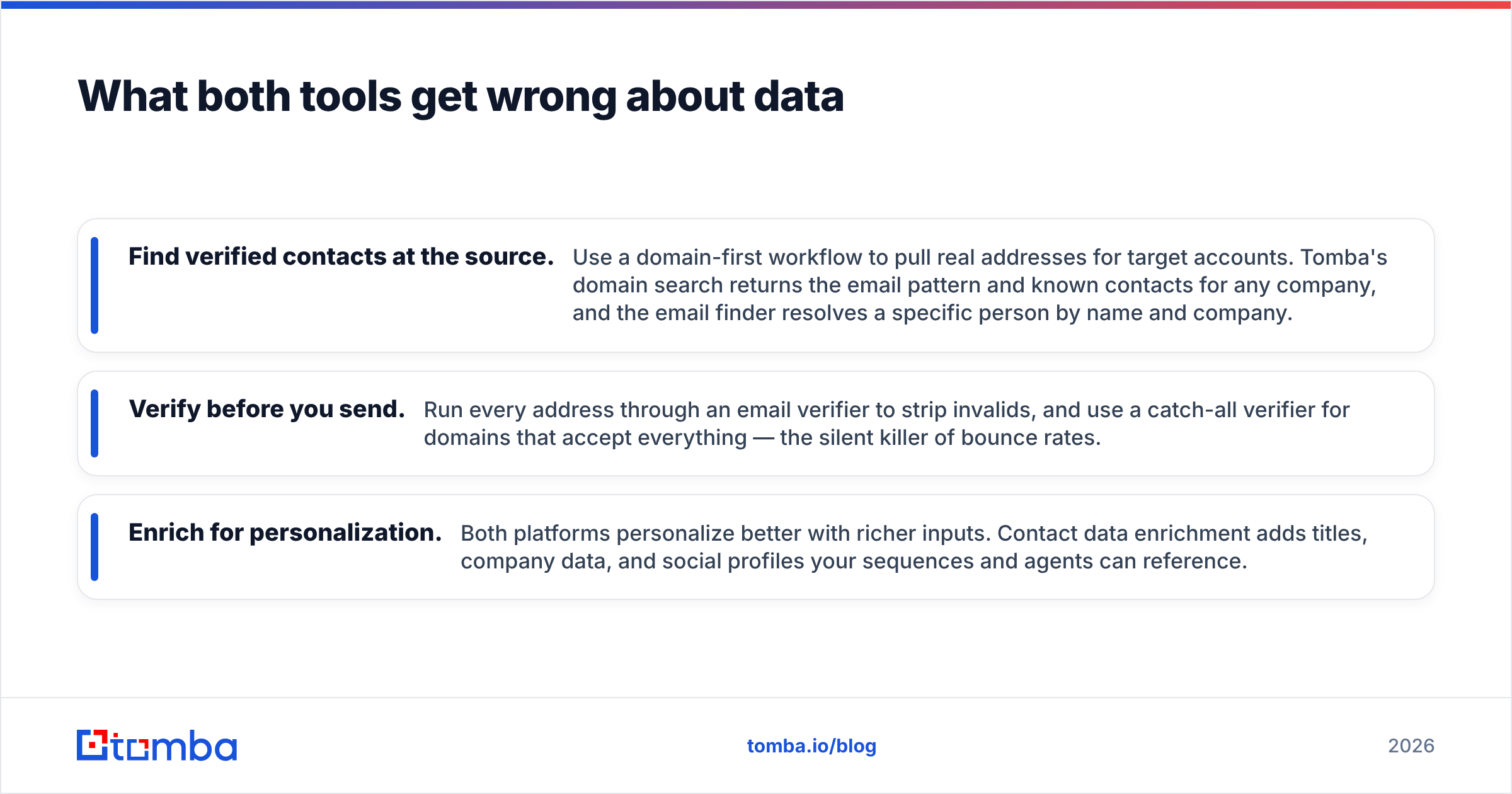
- Find verified contacts at the source. Use a domain-first workflow to pull real addresses for target accounts. Tomba's domain search returns the email pattern and known contacts for any company, and the email finder resolves a specific person by name and company.
- Verify before you send. Run every address through an email verifier to strip invalids, and use a catch-all verifier for domains that accept everything — the silent killer of bounce rates.
- Enrich for personalization. Both platforms personalize better with richer inputs. Contact data enrichment adds titles, company data, and social profiles your sequences and agents can reference.
Independent reviews on G2 consistently tie outbound success to list hygiene over tooling choice. The platform decision matters; the data decision matters more.
Is B2B Rocket better than Ditlead for cold email?#
For pure cold email at volume with minimal oversight, B2B Rocket's agent model is the more hands-off option — but Ditlead is the safer choice for deliverability-sensitive sending.
Cold email in 2026 is governed by sender reputation, and Google and Microsoft enforce bulk-sender requirements aggressively. Ditlead's unlimited inbox rotation plus included warmup is purpose-built for that reality: spread volume, protect each domain, monitor reputation. B2B Rocket can send cold email well, but you have less granular control over how sending is distributed, which matters when you're scaling past a few hundred sends a day.
If cold email is your primary channel, also handle the fundamentals the tool won't do for you:
- Authenticate every sending domain. Validate your records with an SPF checker and confirm alignment before launching.
- Warm new inboxes for at least two to three weeks. Tomba's warmup calculator estimates ramp time by daily volume.
- Pre-screen your copy. A spam checker catches trigger phrases before they cost you the inbox.
For deeper deliverability guidance, both vendors' docs and resources like HubSpot's email marketing benchmarks are worth reading alongside your tool's onboarding.
Is Ditlead better than B2B Rocket for multichannel outreach?#
Yes — multichannel is Ditlead's clearest structural advantage. Native LinkedIn steps inside the same cadence as email mean a prospect who ignores your first email gets a connection request or a profile view a few days later, all orchestrated in one sequence. B2B Rocket's agent is email-centric, so a true email-plus-LinkedIn motion typically means adding a separate LinkedIn tool.
If LinkedIn is core to your motion, weigh Ditlead against dedicated social-selling platforms too. Our Waalaxy alternative and Dripify alternative comparisons map that landscape, and the fundamentals of LinkedIn outreach explain why blended cadences outperform single-channel blasts.
Who should choose which?#
Choose B2B Rocket if you:
- Run a lean team with no dedicated SDR and want outbound to run itself.
- Value time saved over per-message control.
- Have a clean, verified list ready so the agent's volume works for you, not against you.
- Are comfortable with a premium, outcome-priced spend.
Choose Ditlead if you:
- Want low entry cost and the ability to scale inboxes incrementally.
- Need real multichannel (email + LinkedIn) in one cadence.
- Care about granular deliverability control and unlimited rotation.
- Don't mind a moderate learning curve and some hands-on campaign management.
Choose neither — yet — if your contact data hasn't been verified. Fix that first. The best automation platform in the world can't outrun a 25% bounce rate, and you'll blame the tool when the real problem was the list.
The bottom line#
B2B Rocket and Ditlead solve different problems. B2B Rocket automates the work of outbound with autonomous AI agents and asks you to trust the system. Ditlead automates the infrastructure — sequencing, rotation, warmup, multichannel — and keeps you in the driver's seat at a lower price. Match the tool to how hands-on you want to be and how much channel diversity you need.
But before you commit to either, win the battle that decides both: data quality. Start free with the Tomba Email Finder to source verified, accurate professional emails for your target accounts, then run them through Tomba's verifier so every send lands on a real person. Tomba's free tier covers 25 searches a month, and paid Tomba pricing starts at $49/mo when you're ready to scale. Pick your platform, feed it clean data, and let B2B Rocket or Ditlead do what it does best.
Ready to find emails that actually work?
Join 150,000+ professionals who stopped guessing and started sending. Free credits on signup — no credit card required.
Get the Tomba newsletter
Practical outbound tactics and product updates — once every two weeks.
About the author