B2B Sales Explained: A Complete 2026 Guide for Teams
B2B sales explained in plain terms: the stages, roles, metrics, and the modern data stack that turns cold lists into closed-won revenue in 2026.
TL;DR
- B2B sales is the process of selling products or services from one business to another, defined by multiple decision-makers, longer cycles, and higher contract values than B2C.
- A repeatable B2B sales process has seven stages: prospecting, qualifying, connecting, presenting, handling objections, closing, and expanding.
- Win rates live and die on data quality. Accurate contact data feeds every stage downstream, so it is the cheapest place to fix a broken pipeline.
- The modern B2B stack splits into four jobs: find contacts, verify them, engage them, and measure the result.
- You do not need a 12-tool stack to start. You need clean data, a clear ICP, and a process your reps actually follow.
What is B2B sales?#
B2B sales is the practice of selling to organizations instead of individuals. Think of it like supplying a restaurant kitchen rather than serving a single diner: you are not convincing one hungry person, you are convincing a chef, a purchasing manager, and an owner who all have to agree before a single order ships.
That multi-person dynamic is the whole story. In B2C, one person sees a product and buys it. In B2B, an average purchase involves 6 to 10 stakeholders, each with their own priorities, budgets, and reasons to say no. The deal is bigger, the cycle is longer, and the cost of a wrong contact is multiplied across every person in the buying committee.
Three traits separate B2B from everything else:
- Multiple decision-makers — a champion advocates internally, an economic buyer controls budget, and technical or legal gatekeepers can block at any point.
- Longer sales cycles — weeks to quarters, sometimes a year for enterprise. Momentum matters as much as the pitch.
- Higher contract values and retention focus — a B2B customer who renews for five years is worth far more than the first invoice, so expansion is part of the sale, not an afterthought.
How does the B2B sales process work, stage by stage?#
The B2B sales process is a repeatable path from "never heard of you" to "signed and expanding." Skipping a stage does not speed things up; it just moves the bottleneck downstream. Here is the seven-stage version most modern teams run:
- Prospecting — Build a list of accounts and contacts that match your ideal customer profile (ICP). This is where data accuracy pays off or punishes you. A list full of bounced emails poisons everything after it.
- Qualifying — Score whether a prospect has the budget, authority, need, and timeline to buy. Frameworks like BANT or MEDDIC live here.
- Connecting — Make first contact via email, phone, or social. Personalization and timing decide whether you get a reply or the spam folder.
- Presenting — Run the demo or discovery call. Tie features to the prospect's specific pain, not a generic feature dump.
- Handling objections — Price, timing, competitors, internal politics. Every objection is information about what the buyer actually needs to hear.
- Closing — Negotiate terms, send the contract, get the signature. Clean close steps prevent deals from stalling at the finish line.
- Expanding — Onboard, deliver value, then upsell and renew. In B2B, the second sale is cheaper than the first.
If you want the deeper mechanics of moving deals across these phases, the sales process and pipeline discipline is where stage definitions and exit criteria get formalized into a CRM.
What roles make up a B2B sales team?#
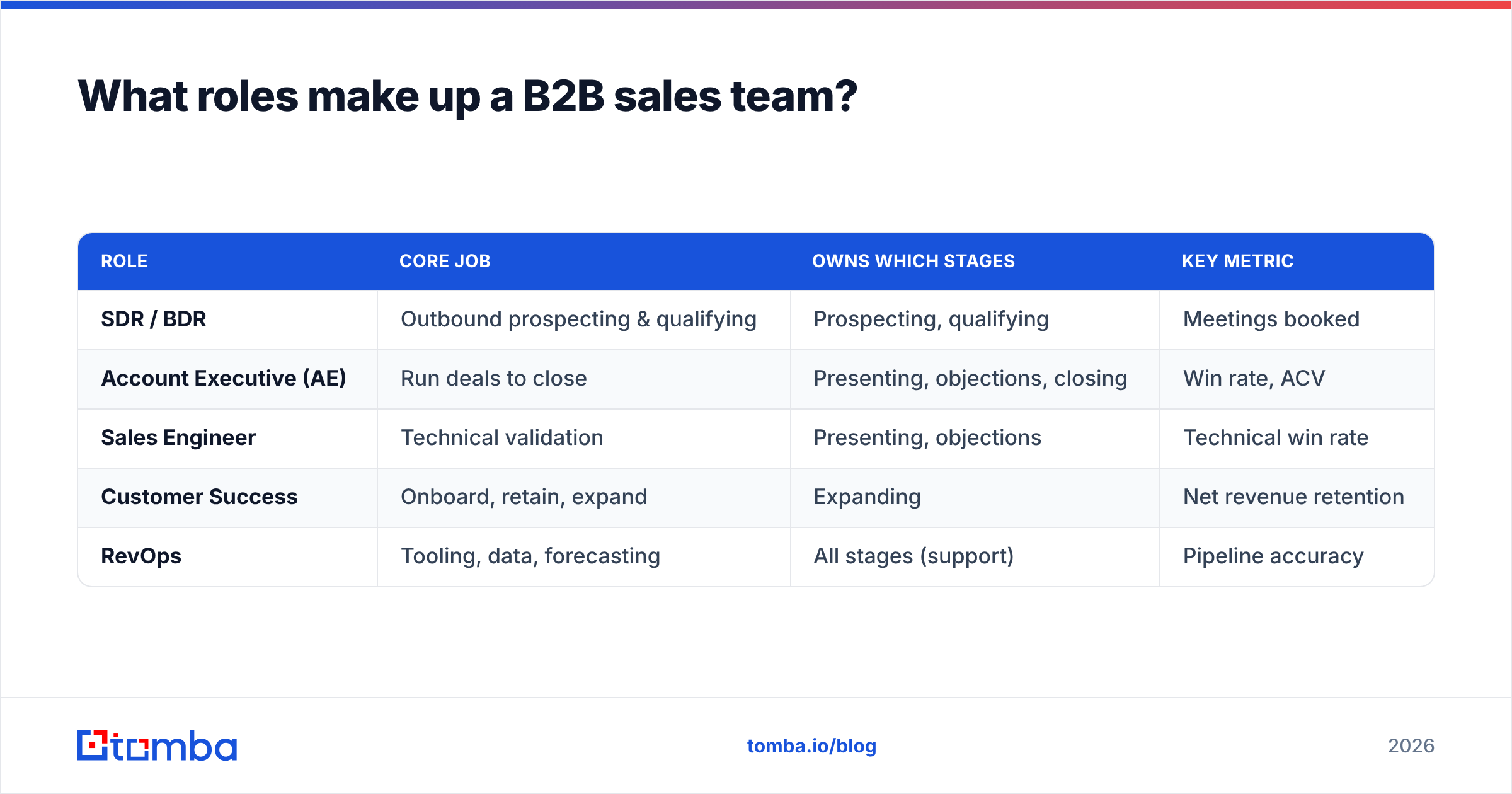
A modern B2B sales org divides labor so no single rep has to do everything badly. The split usually looks like this:
| Role | Core job | Owns which stages | Key metric |
|---|---|---|---|
| SDR / BDR | Outbound prospecting & qualifying | Prospecting, qualifying | Meetings booked |
| Account Executive (AE) | Run deals to close | Presenting, objections, closing | Win rate, ACV |
| Sales Engineer | Technical validation | Presenting, objections | Technical win rate |
| Customer Success | Onboard, retain, expand | Expanding | Net revenue retention |
| RevOps | Tooling, data, forecasting | All stages (support) | Pipeline accuracy |
The handoff between SDR and AE is the most fragile point in this chain. When an SDR books a meeting on bad contact data, the AE inherits a no-show. That is why data quality is a team-wide concern, not just a marketing problem.
Why is data quality the foundation of B2B sales?#
Bad data is the single most expensive silent failure in B2B sales. Here is the conclusion first: if your contact data is 70% accurate, you are wasting roughly a third of every reps' effort before they say a word.
The math compounds. Suppose your team sends 1,000 cold emails. At a 30% bounce rate from stale data, 300 never arrive. Worse, high bounce rates damage your sender reputation, which quietly pushes even your valid emails into spam folders. So bad data does not just waste the bounced 300 — it degrades deliverability for the other 700 too.
This is why the find-and-verify step deserves a real tool, not a guessing spreadsheet. An email verifier checks whether an address is deliverable before you ever hit send, and an email finder builds the list from a name and domain instead of from a permutation guess. Clean inputs are the cheapest performance gain in the entire funnel.
According to HubSpot's research on sales benchmarks, data decay and disconnected tooling remain top reasons reps miss quota — the problem is rarely the pitch, it is the list.
What metrics matter most in B2B sales?#
You manage what you measure, so pick metrics that map to stages you can actually influence. Vanity numbers like "total emails sent" feel busy but tell you nothing. These do:
- Pipeline coverage — Open pipeline divided by quota. Below 3x and you are likely to miss.
- Win rate — Closed-won divided by total qualified opportunities. Tracks deal quality and rep skill.
- Sales cycle length — Average days from first touch to close. Shrinking it multiplies capacity.
- Average contract value (ACV) — Revenue per deal. Drives whether your motion should be self-serve or high-touch.
- Reply and meeting rates — Early signals of message and data quality at the top of funnel.
- Net revenue retention — Expansion minus churn. The clearest measure of long-term B2B health.
A practical rule: if a metric does not change what a rep does tomorrow morning, stop reporting it on the dashboard.
What does a modern B2B sales tech stack look like?#
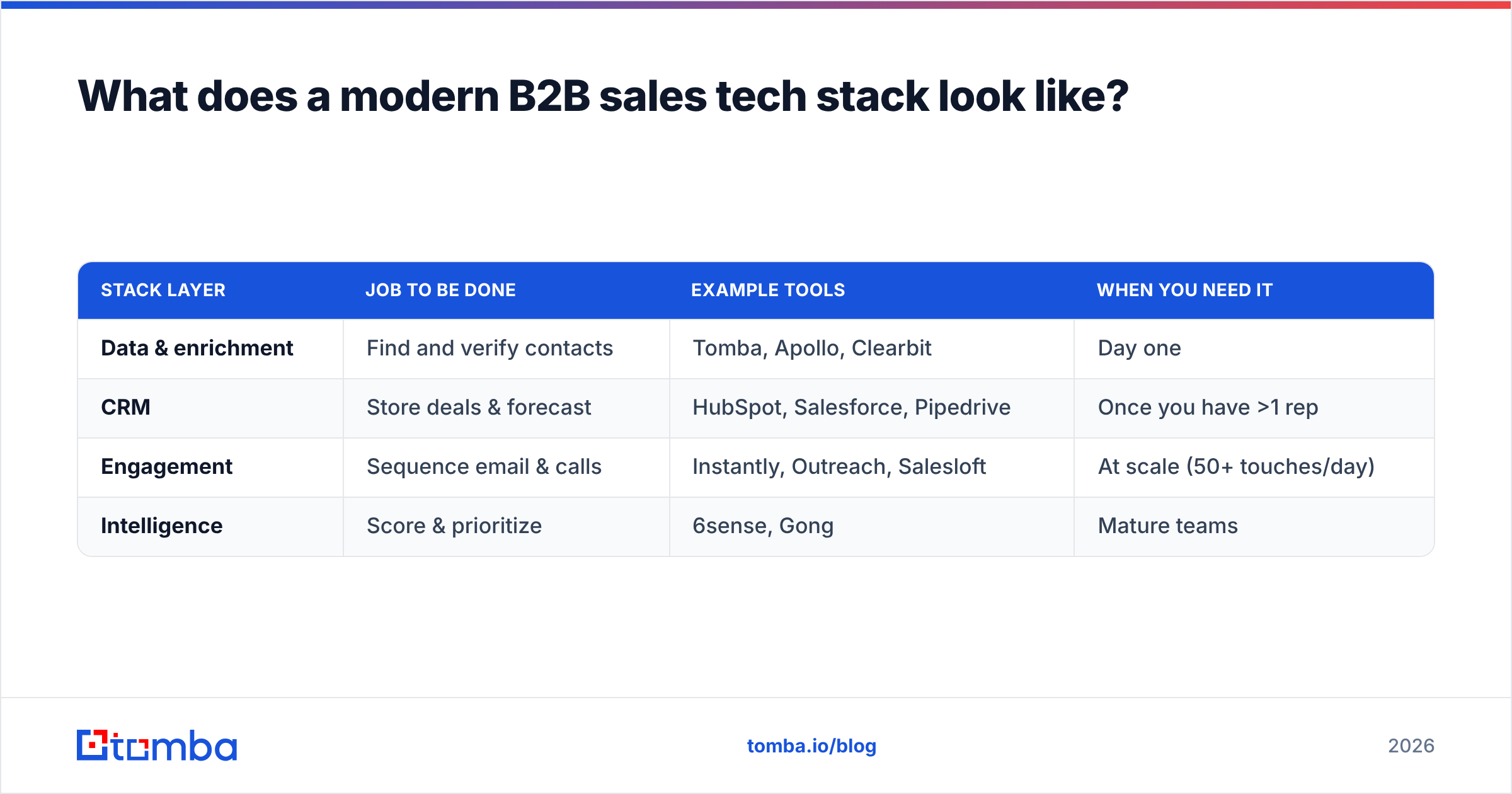
The modern stack splits into four jobs, and most teams over-buy on engagement while under-investing in data. Map your tools to the job, not the brand hype:
| Stack layer | Job to be done | Example tools | When you need it |
|---|---|---|---|
| Data & enrichment | Find and verify contacts | Tomba, Apollo, Clearbit | Day one |
| CRM | Store deals & forecast | HubSpot, Salesforce, Pipedrive | Once you have >1 rep |
| Engagement | Sequence email & calls | Instantly, Outreach, Salesloft | At scale (50+ touches/day) |
| Intelligence | Score & prioritize | 6sense, Gong | Mature teams |
Notice the order. Engagement tools amplify whatever data you feed them — including the garbage. That is why teams that start with the data enrichment layer see better returns from every downstream tool. If you are choosing your first stack, compare Tomba pricing against bundled platforms; an unbundled, accurate data source is often cheaper and cleaner than a do-everything suite you only half-use.
For teams replacing a bloated all-in-one, an Apollo alternative that focuses purely on accurate email and phone data can cut both cost and noise. The lesson from G2's category data is consistent: buyers consistently rate data accuracy above feature count when they review sales-intelligence tools.
How is AI changing B2B sales in 2026?#
AI has moved from novelty to plumbing. The conclusion: AI now handles the repetitive top-of-funnel and admin work, freeing reps for the human parts of B2B that still close deals — trust, negotiation, and reading a room.
Where AI genuinely helps in 2026:
- List building and enrichment — AI matches firmographic signals to your ICP and fills gaps in contact records automatically.
- Personalization at scale — Draft first-pass outreach that references a prospect's actual role and company, then let a human edit.
- Lead scoring — Rank inbound and outbound prospects by likelihood to convert so reps work the best accounts first.
- Forecasting — Pattern-match historical deals to flag which open opportunities are likely to slip.
Where it still fails: AI cannot build a real relationship, navigate internal politics, or be trusted to send unsupervised emails to your top accounts. Treat it as a force multiplier on a clean process, not a replacement for one. The teams winning with AI are the ones who fed it accurate data first — the Salesforce State of Sales findings repeatedly show that data trust is the gating factor for AI adoption in revenue teams.
B2B vs B2C sales: what actually differs?#
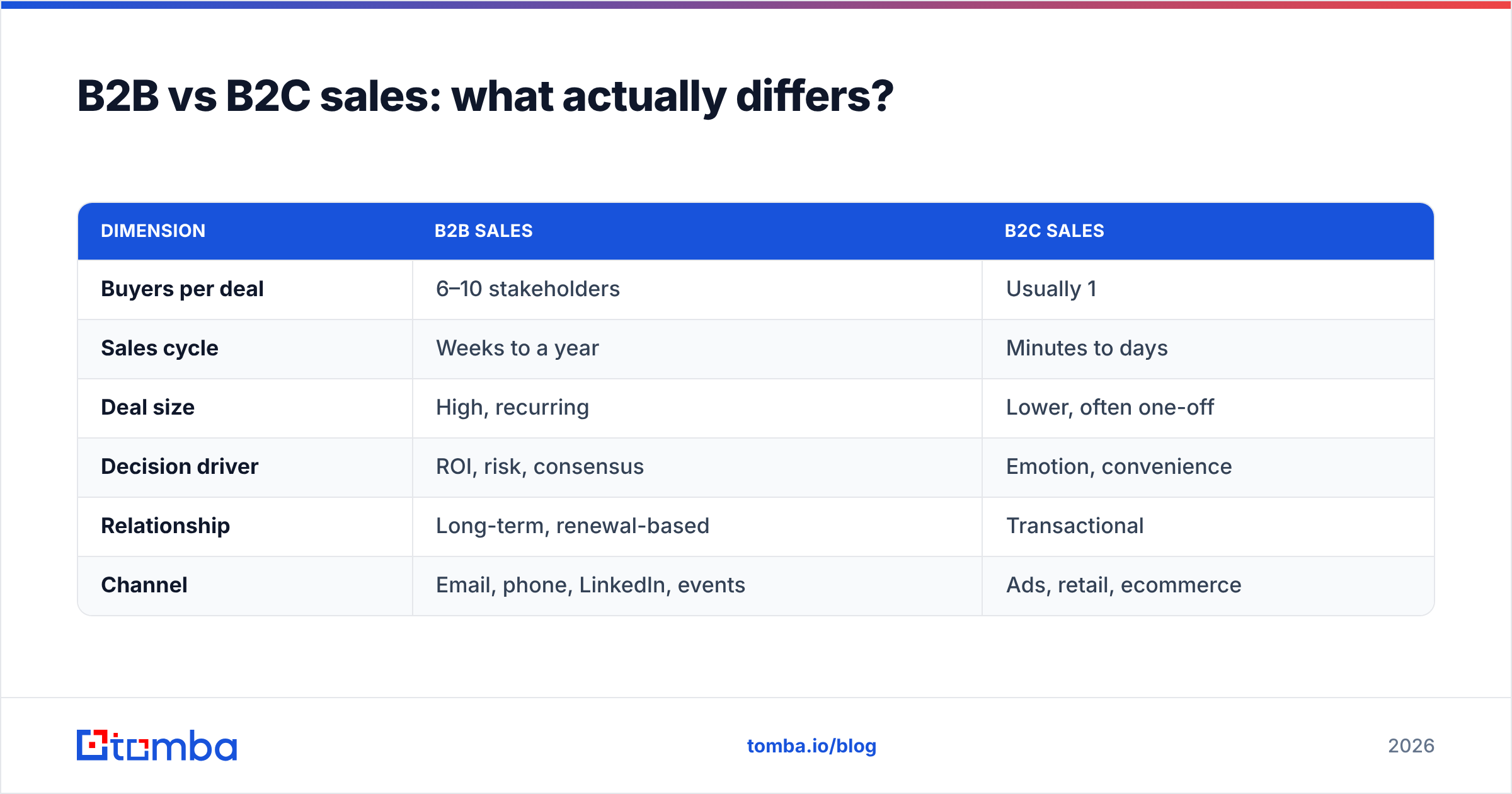
The differences are structural, not cosmetic. Understanding them stops you from copying B2C tactics that quietly fail in B2B.
| Dimension | B2B sales | B2C sales |
|---|---|---|
| Buyers per deal | 6–10 stakeholders | Usually 1 |
| Sales cycle | Weeks to a year | Minutes to days |
| Deal size | High, recurring | Lower, often one-off |
| Decision driver | ROI, risk, consensus | Emotion, convenience |
| Relationship | Long-term, renewal-based | Transactional |
| Channel | Email, phone, LinkedIn, events | Ads, retail, ecommerce |
The takeaway: B2B rewards patience, multi-threading across a buying committee, and disciplined data hygiene. A flashy one-time campaign that works in B2C will stall the moment it hits a procurement gatekeeper.
How do you start building a B2B sales motion?#
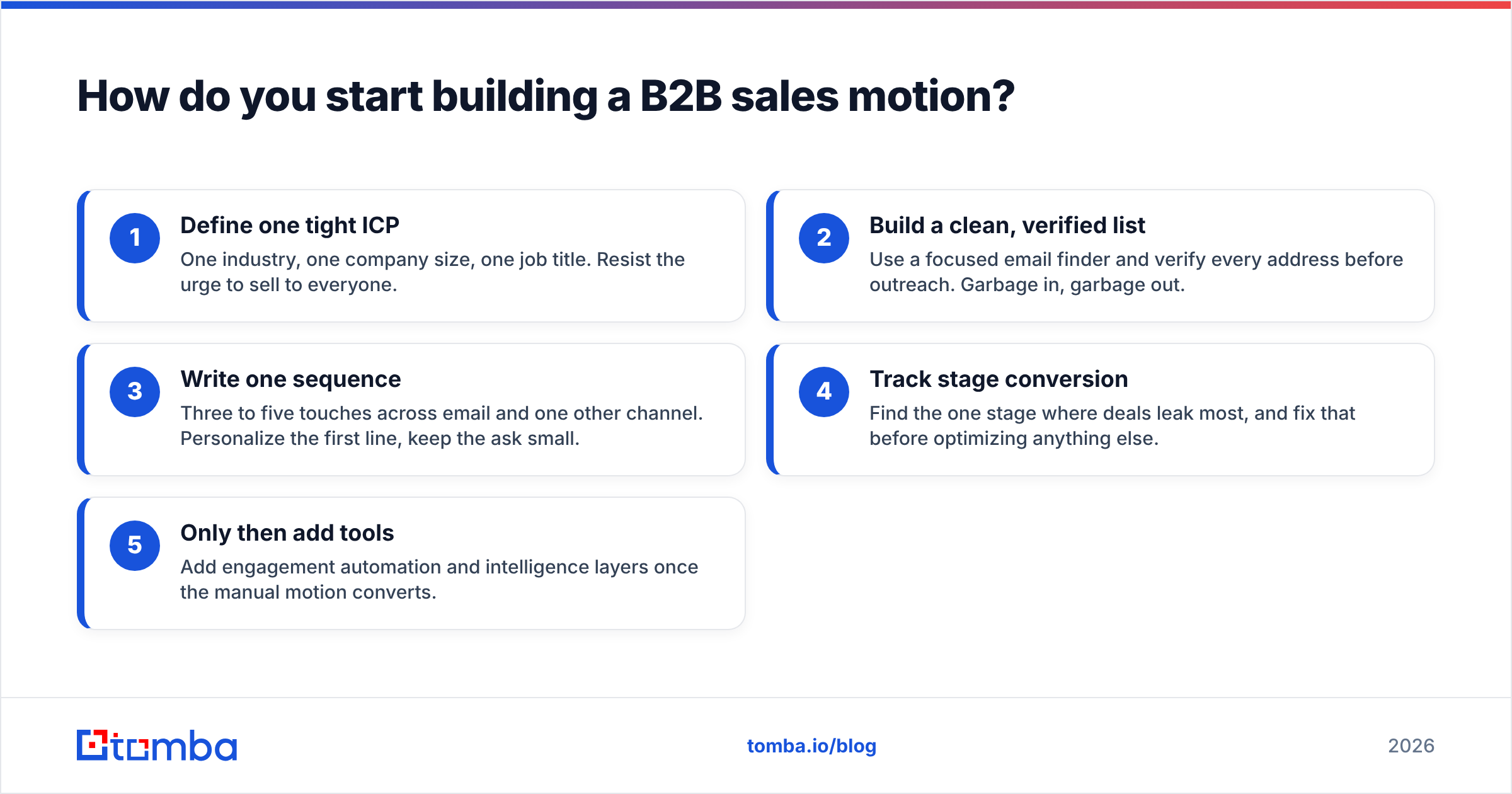
Start narrow, then widen. The most common mistake is building a 12-tool stack before you have proven a single repeatable deal. Do this instead:
- Define one tight ICP — One industry, one company size, one job title. Resist the urge to sell to everyone.
- Build a clean, verified list — Use a focused email finder and verify every address before outreach. Garbage in, garbage out.
- Write one sequence — Three to five touches across email and one other channel. Personalize the first line, keep the ask small.
- Track stage conversion — Find the one stage where deals leak most, and fix that before optimizing anything else.
- Only then add tools — Add engagement automation and intelligence layers once the manual motion converts.
A team that nails these five steps with clean data will outperform a team with twice the tooling and half the data quality. The unglamorous work — accurate contacts, a defined ICP, a followed process — is where B2B revenue actually comes from.
Final takeaway and next step#
B2B sales explained in one sentence: it is the disciplined, multi-stakeholder, data-driven process of turning the right accounts into long-term revenue. Every stage depends on the one before it, and every stage depends on accurate contact data underneath it.
If you want to fix the cheapest, highest-leverage part of your funnel first, start at the source. Tomba's Email Finder builds verified, accurate B2B contact lists from a name and domain, so your reps spend their hours selling instead of chasing bounced emails. The free tier gives you 25 searches a month to test the data quality yourself — start there, prove the accuracy, then scale the motion around it.
// get started
Find, verify and enrich your first contacts today
Start on the free plan with 25 searches a month, then scale when your team is ready.
Free plan · No credit card required · GDPR & CCPA
// about the author