B2B Sales Intelligence Tools in 2026: Top Picks Compared
A neutral 2026 breakdown of the best B2B sales intelligence tools — what they do, how they price, and how to pick the right stack for your team without overpaying.
B2B sales intelligence tools turn scattered firmographic, contact, and intent data into a single source of truth your reps can actually act on. The problem in 2026 is not finding a tool — it is choosing one without overpaying for data you will never use. This guide breaks down what these platforms do, how they differ, and how to assemble a stack that fits your motion.
TL;DR#
- Sales intelligence tools aggregate contact data, company firmographics, and buying signals so reps prospect with context instead of guesswork.
- The market splits into three tiers: all-in-one suites (ZoomInfo, Apollo), intent/ABM platforms (6sense, Demandbase), and focused data providers (Tomba, Cognism, Lusha).
- Accuracy and price-per-verified-contact matter more than raw database size — a 200M-record database is useless if half the emails bounce.
- A lean 2026 stack often pairs one data/email source with one engagement tool, not a single $40K suite.
- Start with a free tier, measure bounce and connect rates on real campaigns, then scale the tool that earns its keep.
What are B2B sales intelligence tools?#
Think of a sales intelligence platform like the dashboard of a car. The engine — your reps and product — does the work, but the dashboard tells you how fast you are going, how much fuel is left, and whether something is about to break. Without it, you are driving blind.
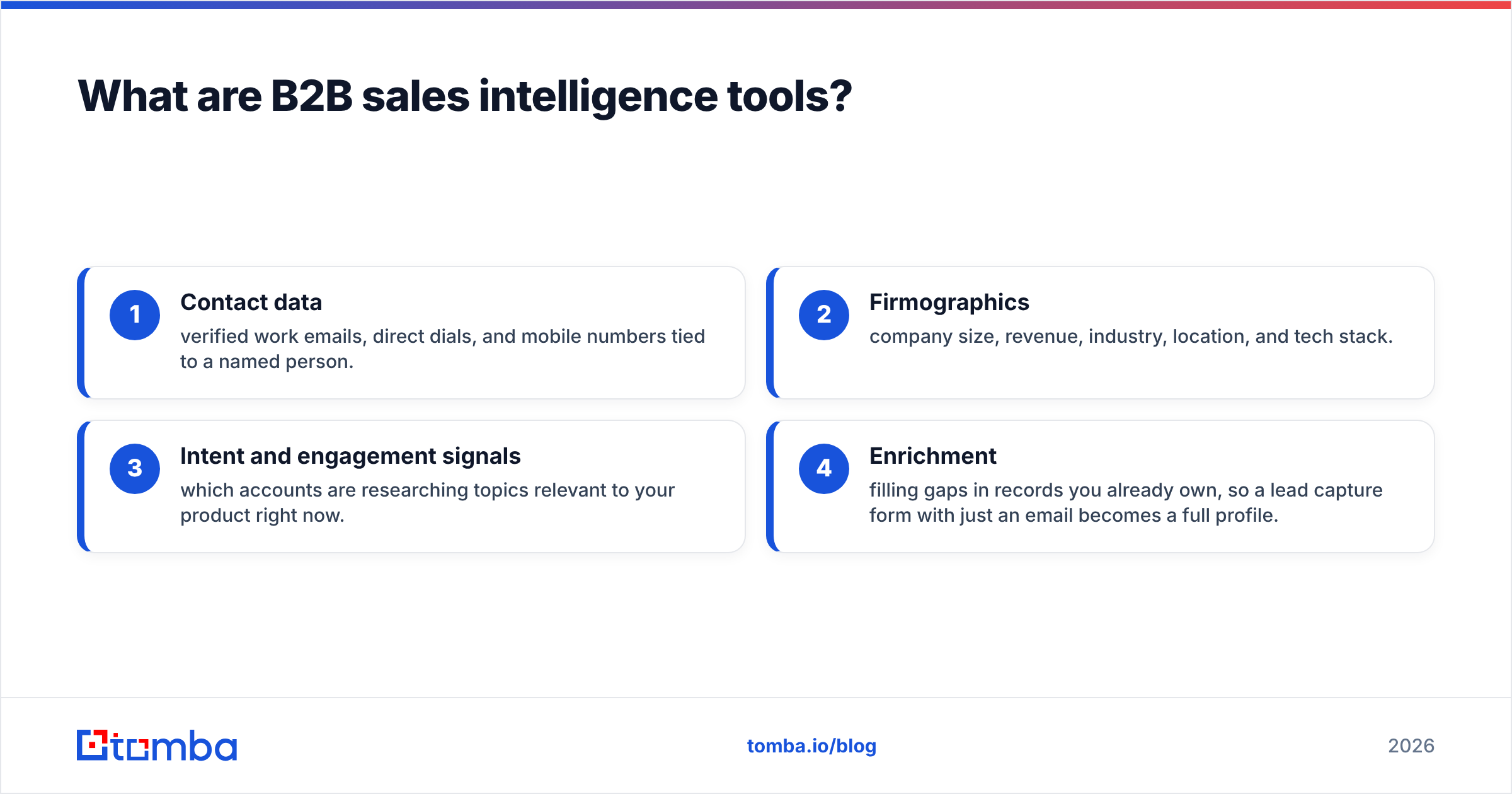
Technically, a B2B sales intelligence tool collects, verifies, and enriches data about companies and the people inside them, then exposes it through search, a Chrome extension, a CRM sync, or an API. The four data layers most platforms cover are:
- Contact data — verified work emails, direct dials, and mobile numbers tied to a named person.
- Firmographics — company size, revenue, industry, location, and tech stack.
- Intent and engagement signals — which accounts are researching topics relevant to your product right now.
- Enrichment — filling gaps in records you already own, so a lead capture form with just an email becomes a full profile.
The best tools do not just hand you a list. They tell you who to contact, why now, and how to reach them — and they keep that data fresh as people change jobs. If you want the textbook definition, the revenue operations and B2B database glossary entries are a good primer.
)
Why does data accuracy beat database size?#
Vendors love to advertise "275 million contacts." That number is a vanity metric. What actually moves pipeline is the percentage of those records that are correct today.
Here is the math that bites teams: if you send 1,000 cold emails and 18% of the addresses are dead, you have not just wasted 180 sends — you have signaled to mailbox providers that you are a spammer. High bounce rates wreck your sender reputation, which then suppresses the deliverability of your good emails too. One bad list poisons the whole domain.
That is why verification is the single most important feature in this category. A tool that returns fewer contacts but verifies each one against the live mail server (catch-all detection, SMTP checks, role-account flagging) will out-convert a bigger, dirtier database every time. Before you commit, run a sample list through a standalone email verifier and measure the real bounce rate — not the accuracy number on the pricing page.
What are the best B2B sales intelligence tools in 2026?#
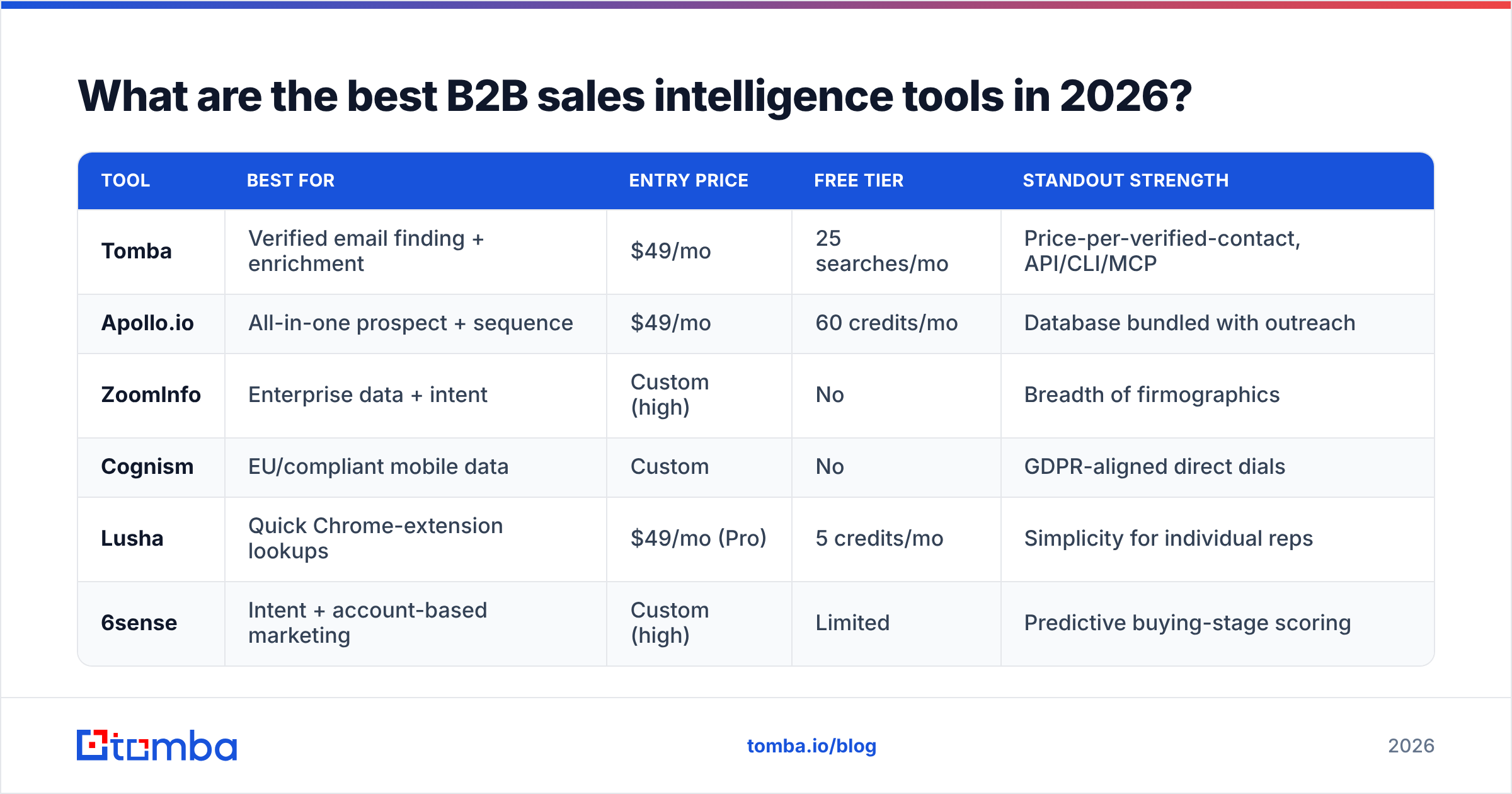
There is no single winner, because the tools optimize for different jobs. Below is a neutral comparison of the categories most teams evaluate. Pricing reflects publicly listed entry plans as of 2026 and shifts often — treat it as directional.
| Tool | Best for | Entry price | Free tier | Standout strength |
|---|---|---|---|---|
| Tomba | Verified email finding + enrichment | $49/mo | 25 searches/mo | Price-per-verified-contact, API/CLI/MCP |
| Apollo.io | All-in-one prospect + sequence | $49/mo | 60 credits/mo | Database bundled with outreach |
| ZoomInfo | Enterprise data + intent | Custom (high) | No | Breadth of firmographics |
| Cognism | EU/compliant mobile data | Custom | No | GDPR-aligned direct dials |
| Lusha | Quick Chrome-extension lookups | $49/mo (Pro) | 5 credits/mo | Simplicity for individual reps |
| 6sense | Intent + account-based marketing | Custom (high) | Limited | Predictive buying-stage scoring |
A few honest takeaways from the table:
- Enterprise suites (ZoomInfo, 6sense) are powerful but gate everything behind annual contracts that routinely land in the five-figure range. They make sense when you have an ops team to operationalize intent data.
- All-in-one engagement tools (Apollo) bundle data and sequencing, which is convenient but means you are renting the database and the email sender from the same vendor — a single point of failure for deliverability.
- Focused data providers (Tomba, Cognism, Lusha) do one layer extremely well and plug into your existing CRM and sequencer. This is the modular approach, and it is usually cheaper per verified contact.
If you are specifically replacing a tool, Tomba publishes side-by-side breakdowns like the Apollo alternative and ZoomInfo-class data sources pages that go deeper than this overview.
How do I choose the right tool for my team?#
Match the tool to your motion, not to the longest feature list. Use these five questions as a filter:
- What is your primary channel? Email-led outbound needs a verified email finder and clean domain search. Phone-led teams need a phone finder with mobile coverage in your regions.
- What is your geography? US-heavy data is abundant; EU mobile data with compliance documentation is scarcer and is where Cognism and similar specialists earn their premium.
- Do you need intent data? If your sales cycle is long and account-based, predictive intent (6sense, Demandbase) shortens prospecting. If you run high-volume SMB outbound, intent is overkill.
- How will it reach your reps? A Chrome extension fits individual SDRs; a bulk email finder and API fit ops teams enriching lists at scale.
- What is your real cost per booked meeting? Divide total tool spend by meetings sourced. A "cheap" tool with a 30% bounce rate is expensive once you price in the deliverability damage.
)
Should you buy an all-in-one suite or build a modular stack?#
For most teams under 50 reps, a modular stack wins on both cost and resilience. The all-in-one pitch is seductive — one login, one invoice — but it couples your data quality to your sending infrastructure, and it locks you into one vendor's refresh cycle.
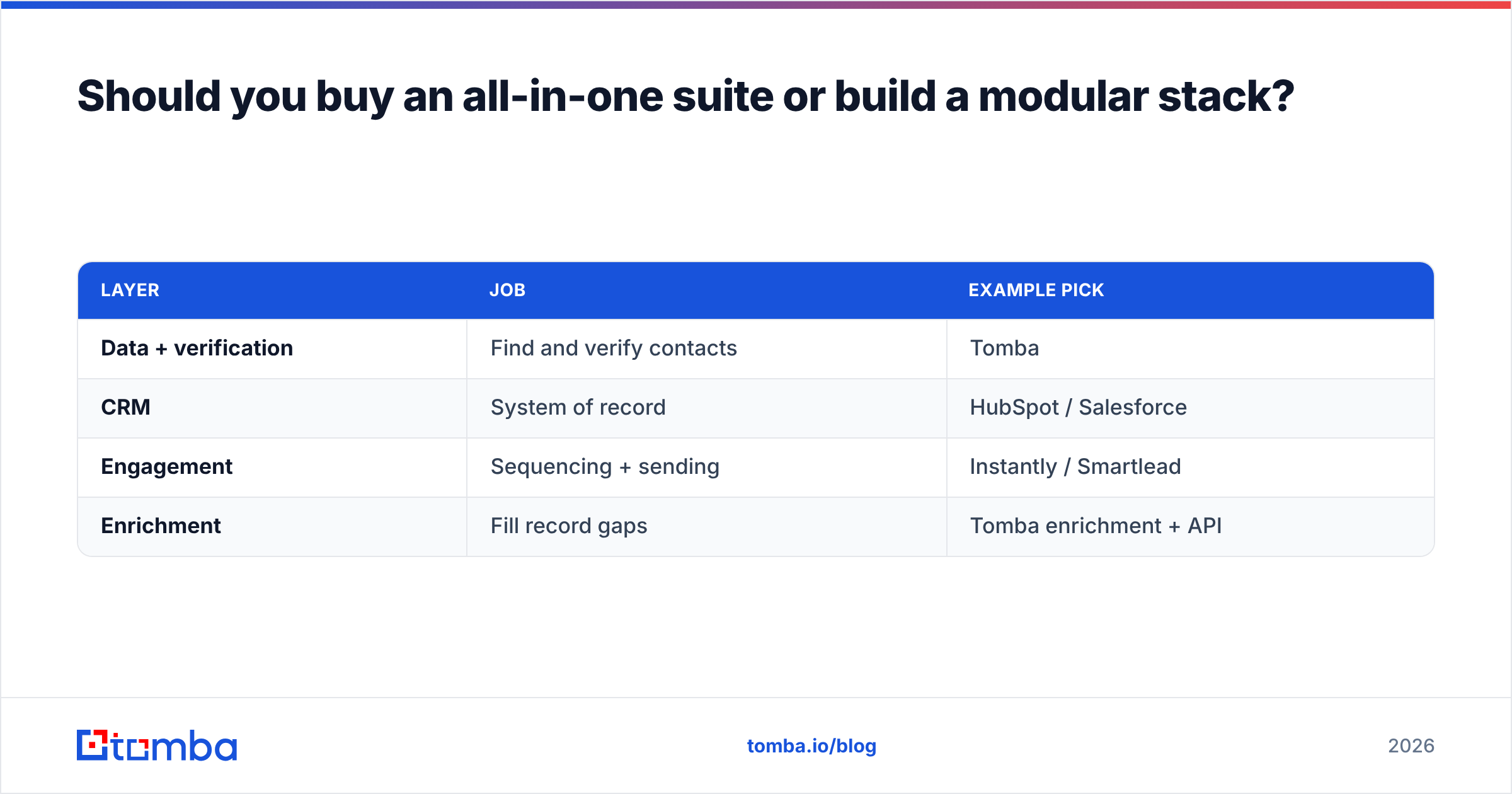
A modular 2026 stack typically looks like this:
| Layer | Job | Example pick |
|---|---|---|
| Data + verification | Find and verify contacts | Tomba |
| CRM | System of record | HubSpot / Salesforce |
| Engagement | Sequencing + sending | Instantly / Smartlead |
| Enrichment | Fill record gaps | Tomba enrichment + API |
The advantage is leverage. If your sequencer raises prices or your data vendor's quality slips, you swap one layer without ripping out the whole stack. Connecting them is rarely hard — most providers ship native integrations for HubSpot, Salesforce, and Pipedrive, plus Zapier and Make for the long tail.
Independent review sites are useful for sanity-checking vendor claims here. Cross-reference verified-buyer ratings on G2 and analyst coverage from Gartner before you sign anything — pay attention to the data-accuracy and support sub-scores, not the overall star average.
What does sales intelligence pricing actually look like?#
Pricing in this category is deliberately opaque, especially at the enterprise end. Three models dominate:
- Credit-based — you pay per contact revealed (Lusha, parts of Apollo). Predictable for low volume, punishing at scale.
- Seat + credit hybrid — a per-user fee plus a credit pool (most mid-market tools). Watch the overage rates.
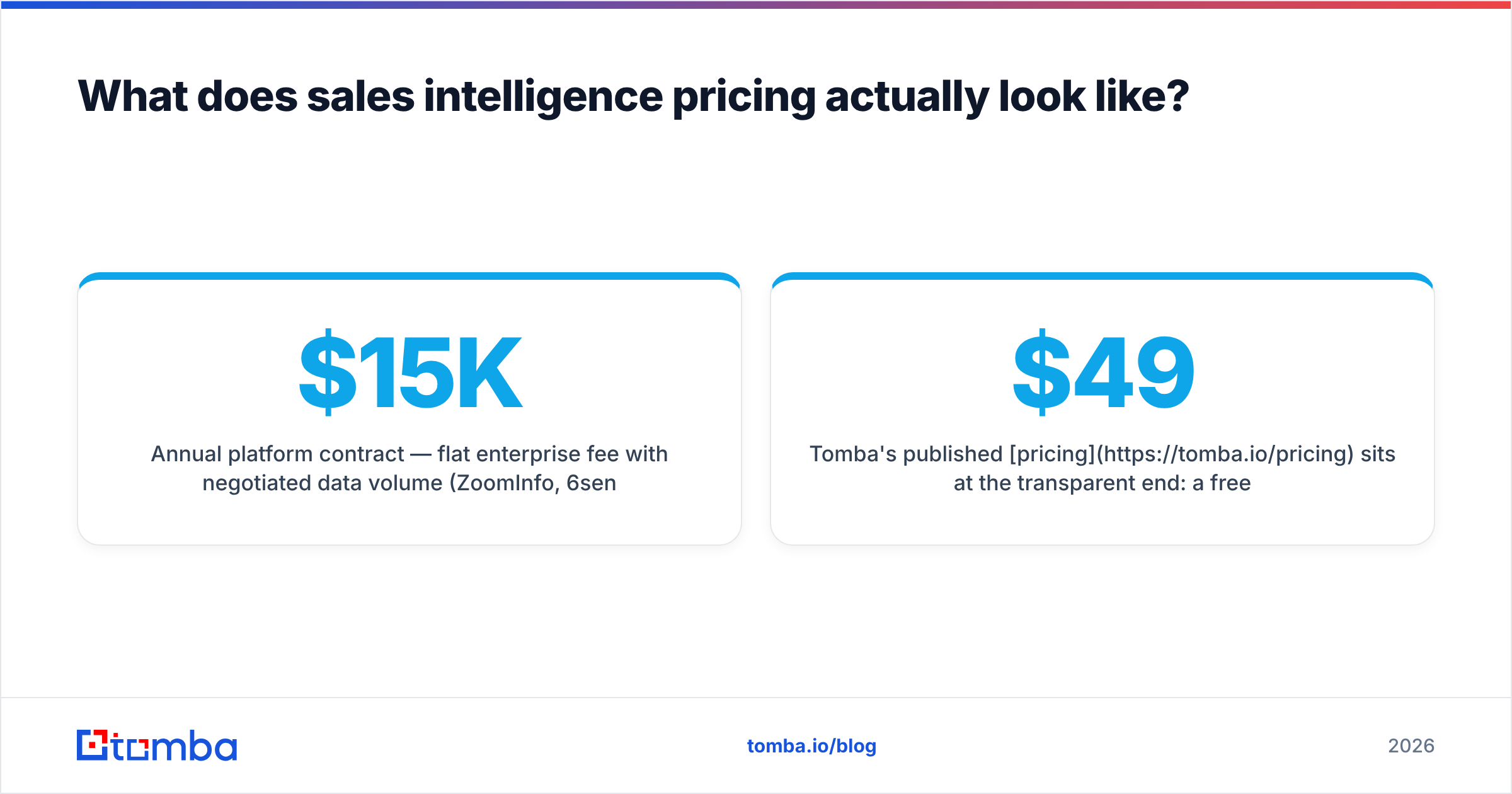
- Annual platform contract — flat enterprise fee with negotiated data volume (ZoomInfo, 6sense). Often $15K–$40K+ per year with multi-year pressure.
Tomba's published pricing sits at the transparent end: a free tier with 25 searches a month, Starter at $49/mo, Growth at $99/mo, and Pro at $249/mo, with credits covering both finding and verification. The point is not that one model is universally right — it is that you should normalize every quote to cost per verified, deliverable contact before comparing. A $99/mo plan that returns clean data can beat a $2,000/mo contract that returns catch-alls.
One more honest caveat: enterprise suites bundle compliance tooling, dedicated support, and CRM-grade SLAs that solo-tool buyers do not get. If you are at that scale, the premium can be justified — just make the vendor prove the accuracy number on your target accounts during the trial, not on a curated demo list.
How do you test a tool before committing?#
Never buy on the demo. Run a structured 14-day bake-off:
- Pull a real ICP sample of 200–500 accounts you actually want to close, not generic names.
- Run the same list through each tool and record match rate, verified-email rate, and direct-dial coverage.
- Send a controlled campaign and measure live bounce rate and reply rate — the only metrics that correlate with revenue.
- Stress the support and the API. Documentation gaps and slow enrichment surface fast under real volume.
- Check the catch-all handling. A good catch-all verifier distinguishes risky domains from safe ones instead of blindly marking everything "valid."
Teams that run this test almost always end up spending less, because the bake-off exposes the gap between marketed accuracy and delivered accuracy.
The bottom line#
The best B2B sales intelligence tools in 2026 are the ones that deliver verified, deliverable contacts at a defensible cost per meeting — not the ones with the biggest database or the loudest intent dashboard. Define your motion, run a real bake-off, normalize pricing to cost-per-verified-contact, and prefer a modular stack you can swap a layer at a time.
If your motion is email-led outbound and you want clean data without an enterprise contract, start with the Tomba Email Finder. The free tier gives you 25 searches a month to test match and bounce rates on your own ICP, and you can scale into the $49/mo Starter plan — with the same verification, API, and CRM integrations — only once the data has earned it. Build the stack the numbers justify, not the one the sales rep oversold.
// get started
Find, verify and enrich your first contacts today
Start on the free plan with 25 searches a month, then scale when your team is ready.
Free plan · No credit card required · GDPR & CCPA
// about the author