B2B Sales Performance: Metrics, KPIs & How to Win in 2026
A practical 2026 playbook for B2B sales performance: the metrics that matter, the leaks that kill quota, and the data and process fixes that actually move the number.
TL;DR
- B2B sales performance is not one number — it's the product of pipeline coverage, conversion rate, deal size, and sales cycle. Fix the weakest link, not the loudest one.
- Most teams miss quota because of leaky early-funnel data, not weak closers. Bad contact data inflates activity metrics while killing conversion.
- Track a tight set of leading and lagging indicators. Vanity metrics (emails sent, dials made) feel productive but predict nothing on their own.
- Coaching to the pipeline math beats coaching to anecdotes. Know your win rate, average deal size, and cycle length cold.
- Clean, verified contact data is the cheapest performance lever you have — it raises connect rates, deliverability, and rep trust in the CRM at once.
What is B2B sales performance, really?#
B2B sales performance is how efficiently your team turns pipeline into closed revenue — measured, not felt. The shorthand most managers use is "are we hitting quota?" but that lagging number hides everything you can actually control.
Think of it like a car's fuel economy. You don't improve miles-per-gallon by pressing the gas harder. You improve it by fixing the things upstream: tire pressure, engine tuning, how you drive. Sales performance works the same way. The closed-won number is the MPG readout. The levers are coverage, conversion, deal size, and cycle time — and the fuel is your data.
Here's the core equation every B2B sales leader should have memorized:
Revenue = Number of Opportunities × Win Rate × Average Deal Size
And velocity — how fast that revenue arrives — adds a fourth term:
Sales Velocity = (Opportunities × Win Rate × Deal Size) ÷ Sales Cycle Length
If you want more revenue, you change one of four inputs. That's it. Everything else is tactics in service of those four numbers.
Which B2B sales performance metrics actually matter?#
There are roughly 200 sales metrics you could track. You should report on maybe a dozen. The trap is confusing activity metrics (inputs you can fake) with outcome metrics (results that compound).
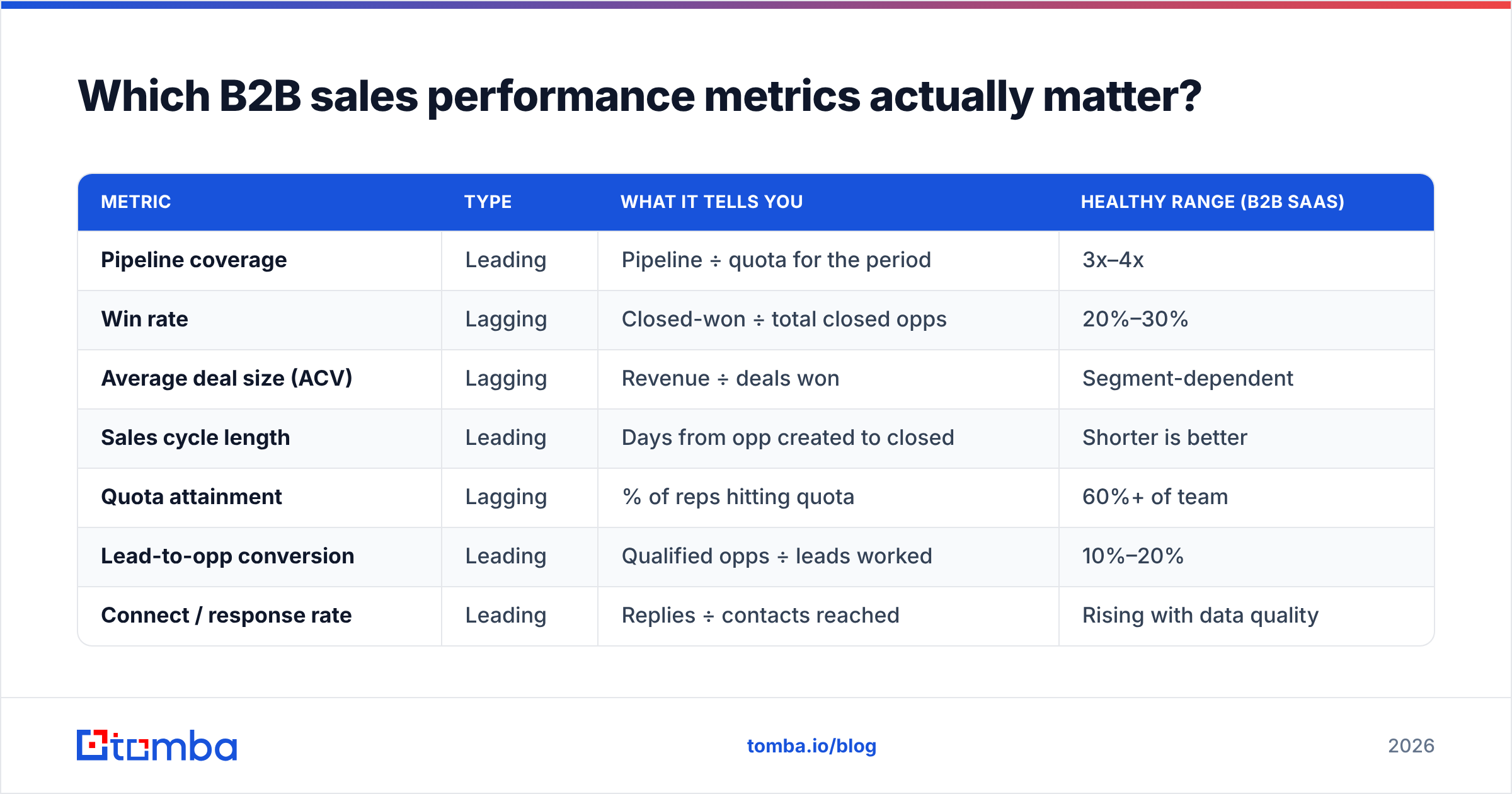
Below is the working set most high-performing B2B teams center their reviews around.
| Metric | Type | What it tells you | Healthy range (B2B SaaS) |
|---|---|---|---|
| Pipeline coverage | Leading | Pipeline ÷ quota for the period | 3x–4x |
| Win rate | Lagging | Closed-won ÷ total closed opps | 20%–30% |
| Average deal size (ACV) | Lagging | Revenue ÷ deals won | Segment-dependent |
| Sales cycle length | Leading | Days from opp created to closed | Shorter is better |
| Quota attainment | Lagging | % of reps hitting quota | 60%+ of team |
| Lead-to-opp conversion | Leading | Qualified opps ÷ leads worked | 10%–20% |
| Connect / response rate | Leading | Replies ÷ contacts reached | Rising with data quality |
Notice the balance: leading indicators (coverage, cycle, conversion, connect rate) let you intervene this quarter. Lagging indicators (win rate, attainment, ACV) tell you whether last quarter's interventions worked. A dashboard that only shows lagging metrics is a rear-view mirror — useful for confirming you crashed, useless for avoiding the wall.
For a deeper definition of the most-misused outcome metric, see Tomba's glossary entry on win rate and the related breakdown of response rate.

Why do most B2B teams underperform quota?#
Most teams blame the wrong stage. When the number misses, the instinct is to push reps to make more calls and send more emails — to attack the activity metric. But the leak is almost always earlier and quieter.
Industry research has consistently put the share of reps missing quota uncomfortably high. Salesforce's State of Sales reporting has repeatedly found that well under half of sellers feel confident hitting target, and analyst firms like Gartner tie much of that gap to data and process friction rather than effort.
Three failure modes dominate B2B sales performance:
- Bad data at the top of funnel. If 25% of your contact list is wrong — stale titles, bounced emails, people who left the company — then a quarter of your reps' effort produces nothing measurable. Activity looks fine; conversion quietly tanks.
- No qualification discipline. Reps chase deals that were never going to close because nobody enforces an exit criterion at each stage. Pipeline coverage looks healthy at 4x, but half of it is fiction.
- Coaching to anecdotes, not math. Managers debrief the one deal everyone remembers instead of the pattern across 50 deals. You can't improve a win rate you've never actually calculated by segment.
The first one is the cheapest to fix and the most overlooked. You can buy better closers slowly and at great expense. You can clean your data this week.
How does data quality drive B2B sales performance?#
Data quality is the highest-leverage, lowest-cost input to sales performance — because it multiplies through every downstream metric at once.
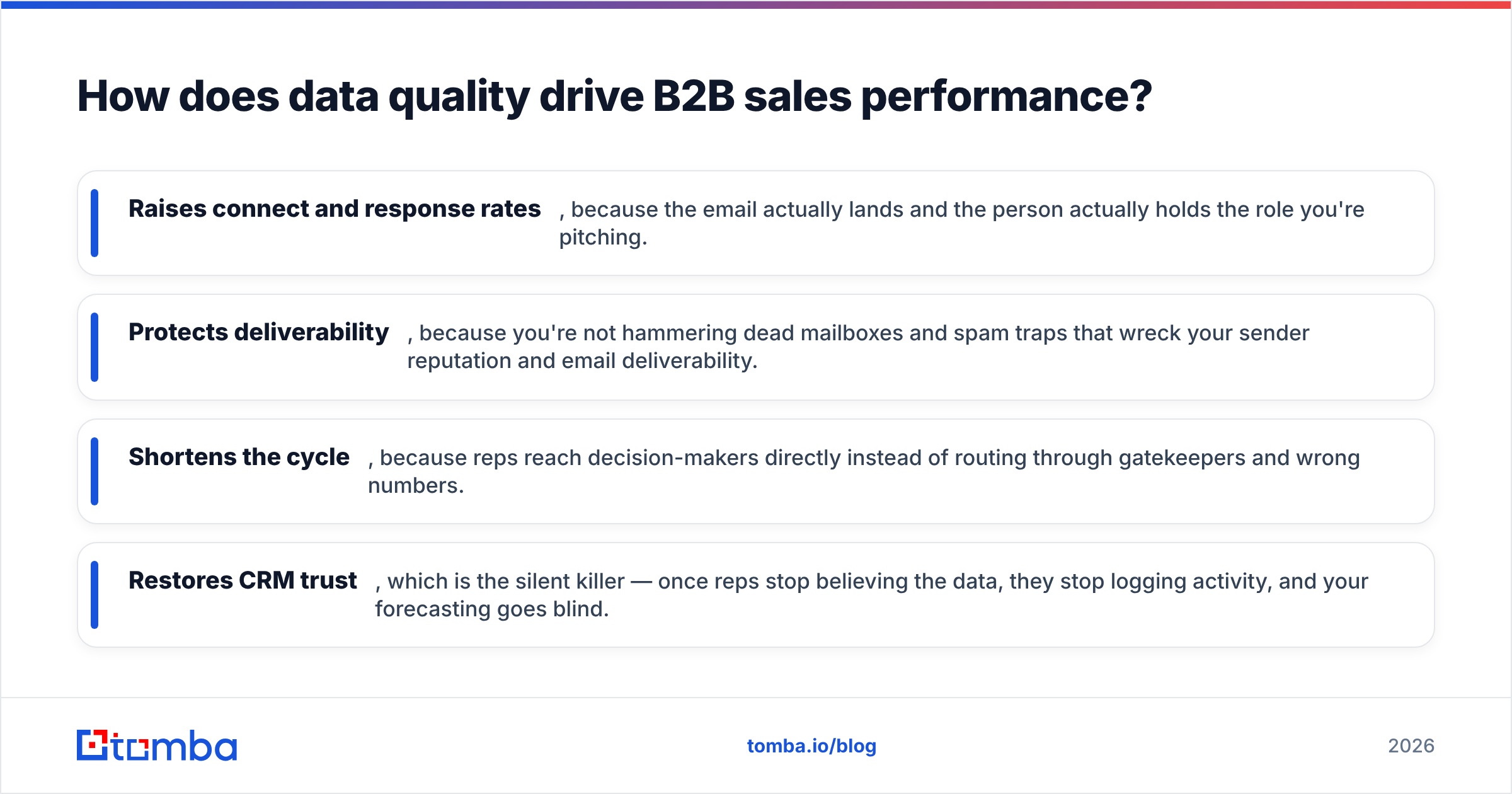
Walk the chain. A verified, accurate contact:
- Raises connect and response rates, because the email actually lands and the person actually holds the role you're pitching.
- Protects deliverability, because you're not hammering dead mailboxes and spam traps that wreck your sender reputation and email deliverability.
- Shortens the cycle, because reps reach decision-makers directly instead of routing through gatekeepers and wrong numbers.
- Restores CRM trust, which is the silent killer — once reps stop believing the data, they stop logging activity, and your forecasting goes blind.
Here's the math that makes managers move. Say a rep sends 1,000 outreach emails a month against a list that's 80% accurate. Two hundred of those are wasted before anyone reads a word. If a verified list pushes accuracy to 96%, you've recovered 160 real conversations a month per rep — without adding a single hour of work. That's pure performance gain from hygiene alone.
This is where a bulk email finder and an email verifier earn their keep. They sit before the sequence, not inside it, scrubbing the list so every downstream metric starts from a clean base. Pair that with data enrichment to fill in titles, company size, and direct-dial context, and reps spend their time selling instead of researching.

What does a B2B sales performance playbook look like in 2026?#
A playbook is just the four-lever equation turned into weekly habits. Here's a concrete operating rhythm you can adopt without a six-month transformation project.
Weekly (the rep + manager loop):
- Pipeline review against coverage math. Is each rep at 3x+ for the period? If not, the fix is sourcing, not closing.
- Stage-exit hygiene. Every opp must meet a written criterion to advance. Deals that can't are demoted, not parked.
- Data refresh on active accounts. Re-verify contacts before a major push so dead addresses don't pollute connect-rate reporting.
Monthly (the manager + ops loop):
- Win rate by segment. Calculate it by industry, deal size, and source. Kill or de-prioritize the segments that lose.
- Cycle-length audit. Find the stage where deals stall and attack that one stage.
- Conversion funnel review. Lead → opp → won, with the leak quantified at each step.
Quarterly (the leadership loop):
- Quota attainment distribution. If only your top two reps hit target, you have a system problem, not a talent problem.
- Tooling and data-source review. Audit where your contact data comes from and how fresh it is — see where Tomba gets data as a model for the questions to ask any vendor.
The discipline that separates high performers isn't exotic. It's the refusal to treat busy as productive. Tools like HubSpot for CRM and pipeline reporting, paired with clean inputs, give you the visibility — but only if the data feeding them is trustworthy.
How do you choose tools that improve sales performance?#
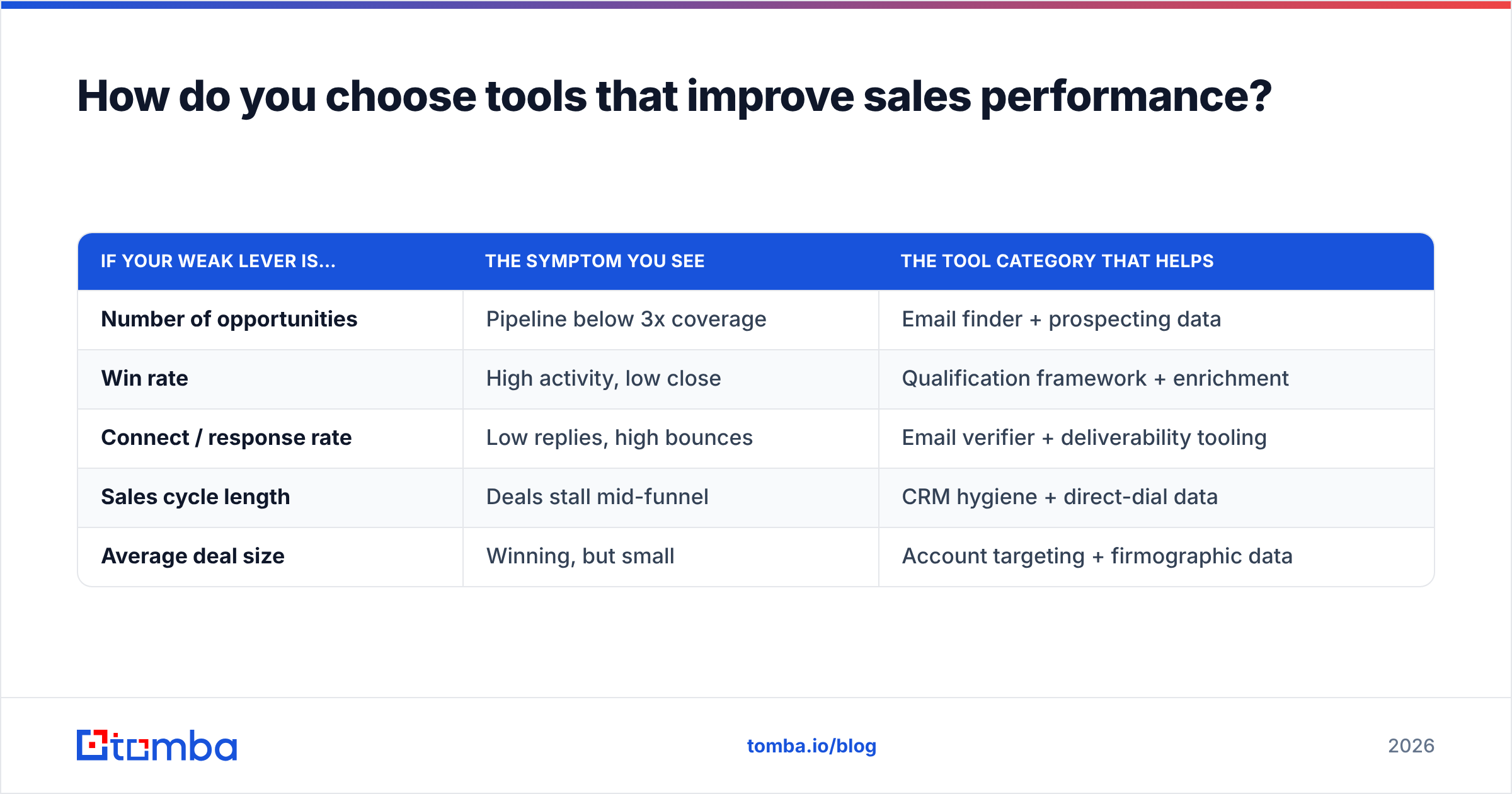
Match the tool to the lever you're trying to move. Buying an AI dialer to fix a data problem is like buying racing tires for a car with an empty tank.
| If your weak lever is… | The symptom you see | The tool category that helps |
|---|---|---|
| Number of opportunities | Pipeline below 3x coverage | Email finder + prospecting data |
| Win rate | High activity, low close | Qualification framework + enrichment |
| Connect / response rate | Low replies, high bounces | Email verifier + deliverability tooling |
| Sales cycle length | Deals stall mid-funnel | CRM hygiene + direct-dial data |
| Average deal size | Winning, but small | Account targeting + firmographic data |
The pattern across the top of that table is the same: most performance problems trace back to who you're reaching and whether the contact data is correct. That's the unglamorous foundation. You can layer AI sequencing, intent signals, and call coaching on top — but if the underlying contacts are wrong, you're optimizing a leaky bucket.
A quick gut-check before adding any tool: which of the four levers does this move, and how will I measure the change in 30 days? If you can't answer both, you're buying a dashboard, not performance.
For teams comparing platforms, G2 and Capterra are useful for filtering by verified-review use case rather than marketing claims — read the reviews from companies your size, not the headline score.
Common B2B sales performance mistakes to avoid#
- Rewarding activity over outcomes. If your leaderboard ranks dials and emails, you'll get dials and emails — not revenue. Rank on pipeline created and conversion.
- Ignoring data decay. B2B contact data degrades roughly 25%–30% a year as people change jobs. A list you bought in January is materially worse by Q3. Re-verification is maintenance, not a one-time event.
- Forecasting on feelings. "I'm confident in this one" is not a stage. Tie forecast categories to objective stage-exit criteria.
- One pipeline review cadence for everyone. A 14-day SMB cycle and a 9-month enterprise cycle need different review rhythms. Don't force them into the same weekly grind.
- Treating deliverability as marketing's problem. If your outbound domain gets flagged, every rep's email lands in spam. Sender reputation is a sales-performance issue now.
How do you measure whether it's working?#
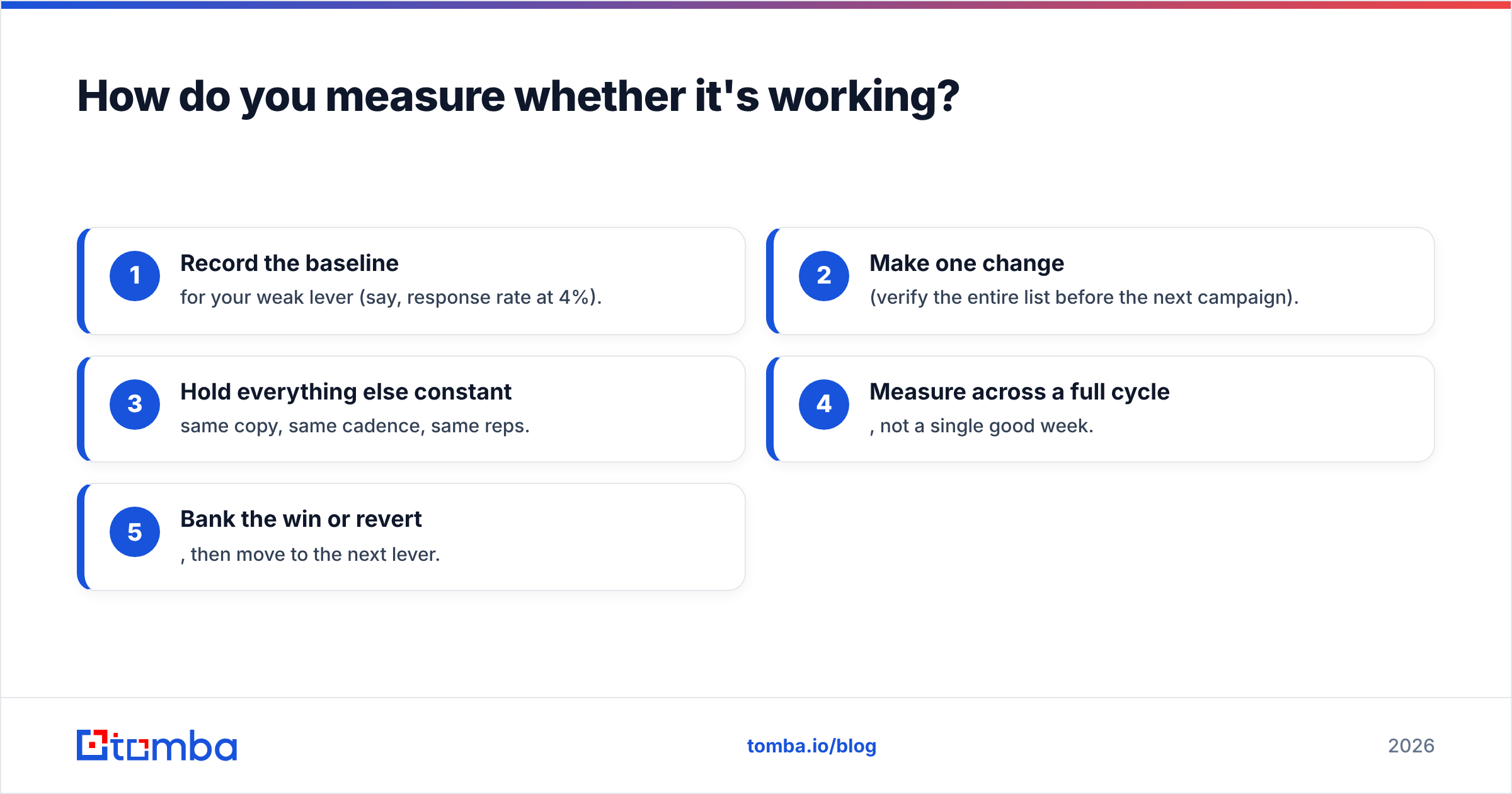
Pick a baseline, change one lever, measure for one full sales cycle, then decide. The most common analytical error is changing three things at once and never knowing which one worked.
A simple before/after frame:
- Record the baseline for your weak lever (say, response rate at 4%).
- Make one change (verify the entire list before the next campaign).
- Hold everything else constant — same copy, same cadence, same reps.
- Measure across a full cycle, not a single good week.
- Bank the win or revert, then move to the next lever.
This is slower than the "throw everything at the wall" approach, but it's the only way to build a repeatable performance engine instead of a lucky quarter. Over a year, four clean experiments compound into a system you actually understand.
The bottom line#
B2B sales performance is engineering, not motivation. You have four levers — opportunities, win rate, deal size, and cycle length — and one foundation underneath all of them: the quality of your contact data. Fix the data first, because it's the cheapest lever and it multiplies through every metric you report on. Then coach to the pipeline math, run disciplined weekly reviews, and change one variable at a time so you actually learn what works.
If your performance gap traces back to who your reps are reaching — wrong emails, stale titles, low connect rates — start at the source. The Tomba Email Finder finds and verifies professional email addresses by name, company, or domain, so your sequences start from accurate, deliverable contacts instead of guesswork. Run your list through it, check the lift in response and connect rates over one cycle, and let the numbers make the case. You can start free with 25 searches a month and scale up through Tomba's plans as the pipeline grows.
Performance follows data quality. Get that right, and the quota math finally works in your favor.
// get started
Find, verify and enrich your first contacts today
Start on the free plan with 25 searches a month, then scale when your team is ready.
Free plan · No credit card required · GDPR & CCPA
// about the author