B2B Sales Process Steps: The 7-Stage Framework for 2026
A repeatable B2B sales process turns guesswork into forecastable revenue. Here are the 7 steps, the metrics that matter, and the tools that move deals faster in 2026.
A B2B sales process is the difference between reps who hit quota on purpose and reps who hit it by accident. When every deal moves through the same defined stages, you can forecast revenue, coach weak spots, and fix leaks instead of guessing why last quarter slipped. This guide breaks down the seven b2b sales process steps, the exit criteria for each stage, the KPIs that tell you it's working, and where automation actually earns its keep.
TL;DR#
- A b2b sales process is a repeatable set of stages every deal moves through — typically seven, from prospecting to renewal.
- Each stage needs clear exit criteria so a deal only advances when something real happens, not when a rep feels optimistic.
- Qualification (using a framework like MEDDIC or BANT) is where most pipelines leak — fix it first.
- Accurate contact data at the top of the funnel compounds: bad emails poison every downstream metric.
- Track conversion rate by stage, sales cycle length, and win rate to know which step to fix next.
What is a B2B sales process?#
A b2b sales process is a documented, repeatable sequence of stages that turns a stranger into a paying customer and then a renewing one. Think of it like a commercial kitchen line: the same ingredients hit the same stations in the same order every time, so the result is consistent whether your best chef is on shift or not. Technically, it's a stage-gated workflow where each gate has entry and exit criteria, owned activities, and a measurable conversion rate.
The distinction that trips teams up: a sales process is not the same as a sales methodology. The process is the stages (what happens and when). The methodology — MEDDIC, SPIN, Challenger, Sandler — is the philosophy you apply inside those stages. You need both, but the process is the skeleton.
Why bother formalizing it? Because an undocumented process is just tribal knowledge that walks out the door when your top rep quits. According to HubSpot's sales research, teams with a clearly defined process consistently outperform those running on instinct. A defined pipeline also makes your sales process and pipeline forecastable, which is the only thing your CFO actually cares about.
)
What are the 7 B2B sales process steps?#
Here is the core framework. Most B2B teams land on some version of these seven stages, even if they rename them.
- Prospecting — Build a list of accounts and contacts that match your ideal customer profile (ICP). This is a data problem before it's a selling problem: you need the right companies, the right decision-makers, and a reliable way to reach them.
- Research & qualification — Score each lead against your ICP and a qualification framework. Disqualify fast. The goal is to spend selling time only on deals that can actually close.
- Outreach & connect — Make first contact through email, phone, LinkedIn, or a coordinated sequence. The aim is a booked meeting, not a pitch.
- Discovery & needs analysis — Diagnose the prospect's pain, priorities, decision process, and budget. This is where MEDDIC and SPIN earn their reputation.
- Proposal & presentation — Map your solution to the pain you uncovered, with pricing and ROI tied to their numbers, not your feature list.
- Negotiation & closing — Handle objections, align stakeholders, finalize terms, and get the signature.
- Onboarding, retention & expansion — The deal isn't done at signature in B2B. Handoff, value delivery, renewal, and upsell are where the lifetime value actually accrues.
Notice the shape: the first three steps are about volume and accuracy, the middle three are about diagnosis and fit, and the last is about compounding revenue. Weakness at the top silently caps everything below it.
How does each stage actually work?#
Stage 1 — Prospecting#
Prospecting fails when reps spray a list they didn't validate. Start from a written ICP (industry, headcount, tech stack, trigger events), build the account list, then find the humans. This is where a domain search earns its place: feed it a company domain and get back the verified email patterns and named contacts in seconds, instead of hand-guessing first.last@.
Exit criteria: a contactable, ICP-matched record with a verified email or phone number.
Stage 2 — Research & qualification#
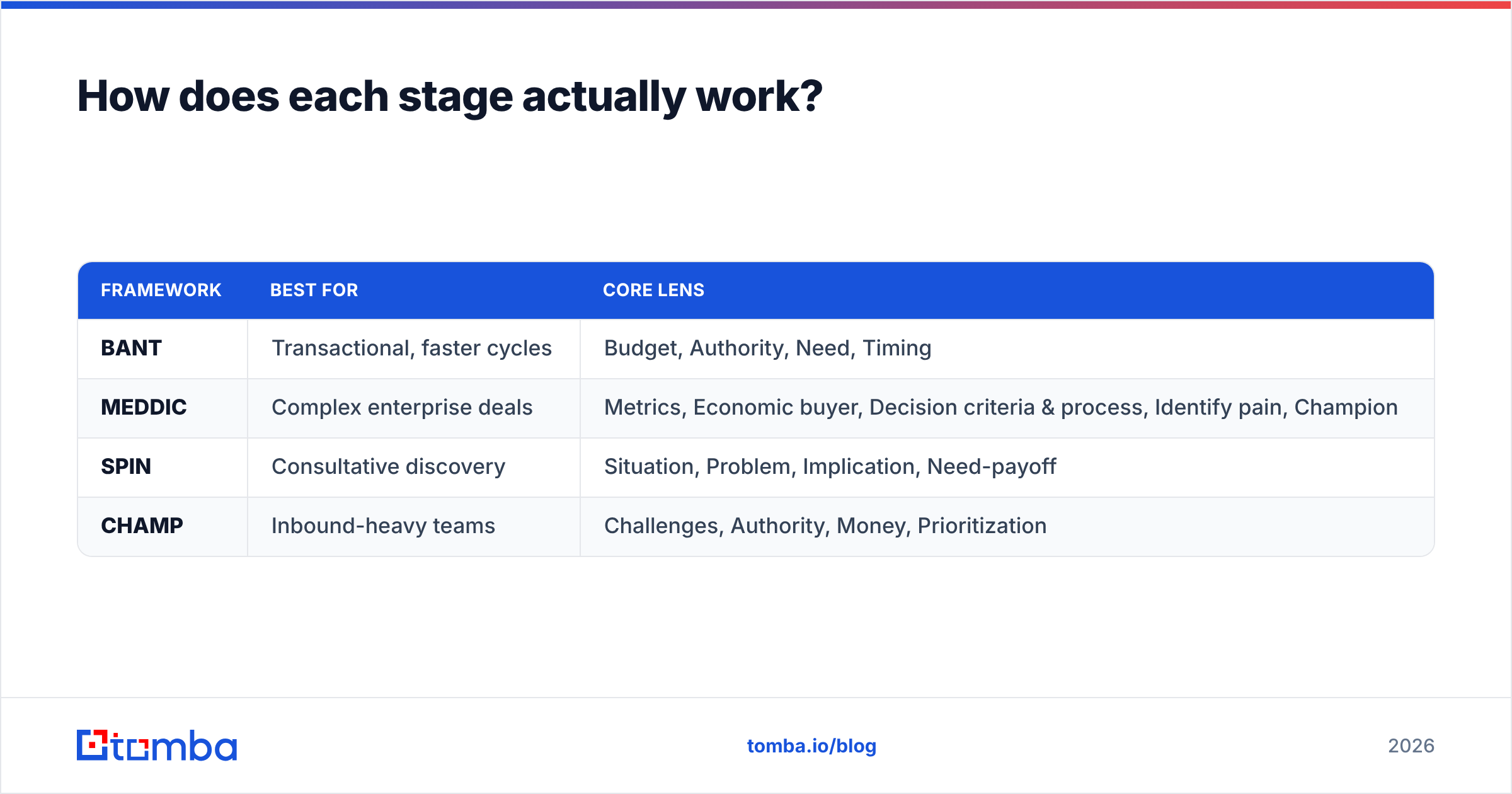
Now you decide who's worth your time. Run each lead through a framework:
| Framework | Best for | Core lens |
|---|---|---|
| BANT | Transactional, faster cycles | Budget, Authority, Need, Timing |
| MEDDIC | Complex enterprise deals | Metrics, Economic buyer, Decision criteria & process, Identify pain, Champion |
| SPIN | Consultative discovery | Situation, Problem, Implication, Need-payoff |
| CHAMP | Inbound-heavy teams | Challenges, Authority, Money, Prioritization |
The point of qualification is permission to disqualify. A smaller pipeline of real deals forecasts better than a bloated one full of tire-kickers.
Exit criteria: the lead meets your scoring threshold and a clear next step is booked.
Stage 3 — Outreach & connect#
Multichannel beats single-channel, but only if the data underneath is clean. A bounced cold email doesn't just fail — it damages your sender reputation and drags down deliverability for every other prospect on that domain. Verify before you send. Run your list through an email verifier so bounces stay under 2%.
Exit criteria: a positive reply or a booked discovery call.
)
Stage 4 — Discovery & needs analysis#
Talk less, diagnose more. The best discovery calls are 70% prospect, 30% rep. Uncover the metric they're measured on, who signs, what happens if they do nothing, and what their decision process actually looks like. Skipping discovery is why so many proposals get ghosted — you pitched a solution to a problem they never confirmed.
Exit criteria: documented pain, confirmed economic buyer, and agreed decision criteria.
Stage 5 — Proposal & presentation#
Your proposal should read like a mirror of their discovery call. Tie every line to a number they gave you. Present the ROI before the price, and bring a multi-threaded audience — single-threaded deals die when your one contact changes jobs.
Exit criteria: stakeholders have seen the proposal and given verbal interest.
Stage 6 — Negotiation & closing#
Objections this late are usually about risk, not price. Have your concession ladder planned in advance, keep procurement and legal moving in parallel, and never trade a discount without getting something back (term length, case study, faster signature).
Exit criteria: signed contract and a closed-won record in the CRM.
Stage 7 — Onboarding, retention & expansion#
In B2B, the renewal is the second sale and the cheapest revenue you'll ever book. A clean handoff to customer success, a measurable first-value milestone, and a documented expansion path turn one logo into a multi-year account. Feed account changes back into your data enrichment so you spot new buying committees and champion job-changes before the competition does.
Exit criteria: renewed or expanded account, plus a referenceable customer.
How do you measure if the process is working?#
You can't fix a stage you don't measure. Track these per stage, not just at the top line:
- Stage conversion rate — what % of deals move from each stage to the next. The lowest number is your bottleneck.
- Sales cycle length — average days from first touch to closed-won. Lengthening cycles signal qualification or discovery problems.
- Win rate — closed-won ÷ total qualified. See win rate for benchmarking context.
- Average deal size — flags whether you're hunting the right ICP.
- Pipeline coverage — open pipeline ÷ quota. Healthy teams run 3–4x.
- Response rate — track email response rate at the outreach stage to catch messaging or data decay early.
A simple rule: if your win rate is fine but your cycle is long, the problem is process friction (too many stages, slow legal). If your cycle is short but win rate is low, the problem is qualification — you're letting bad deals in.
Where should you automate vs. stay human?#
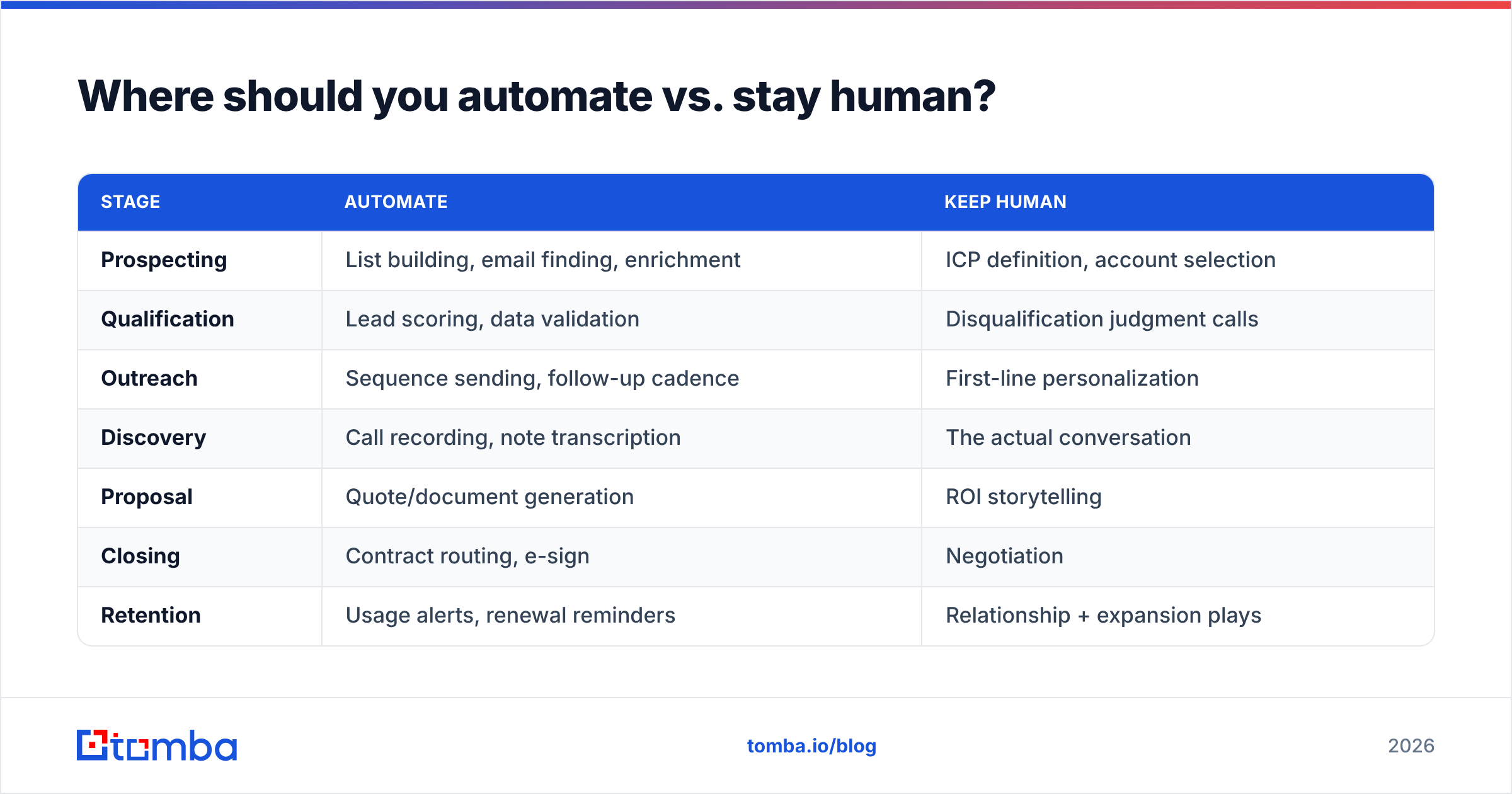
Automate the mechanical, keep humans on the relational. Here's a practical split.
| Stage | Automate | Keep human |
|---|---|---|
| Prospecting | List building, email finding, enrichment | ICP definition, account selection |
| Qualification | Lead scoring, data validation | Disqualification judgment calls |
| Outreach | Sequence sending, follow-up cadence | First-line personalization |
| Discovery | Call recording, note transcription | The actual conversation |
| Proposal | Quote/document generation | ROI storytelling |
| Closing | Contract routing, e-sign | Negotiation |
| Retention | Usage alerts, renewal reminders | Relationship + expansion plays |
The highest-ROI automation sits at the top of the funnel, where volume is highest and human time is most wasted. Pulling and verifying contact data by hand is the classic example — a rep doing it manually burns hours that should go to selling. Tools like Apollo, ZoomInfo, and Tomba handle that step in bulk so your team starts each day with a clean, contactable list. For teams comparing options, see how the Apollo alternative landscape stacks up on data accuracy and price.
For broader context on how AI is reshaping these stages, Gartner's sales technology research is a solid neutral reference.
What tools support a modern B2B sales process?#
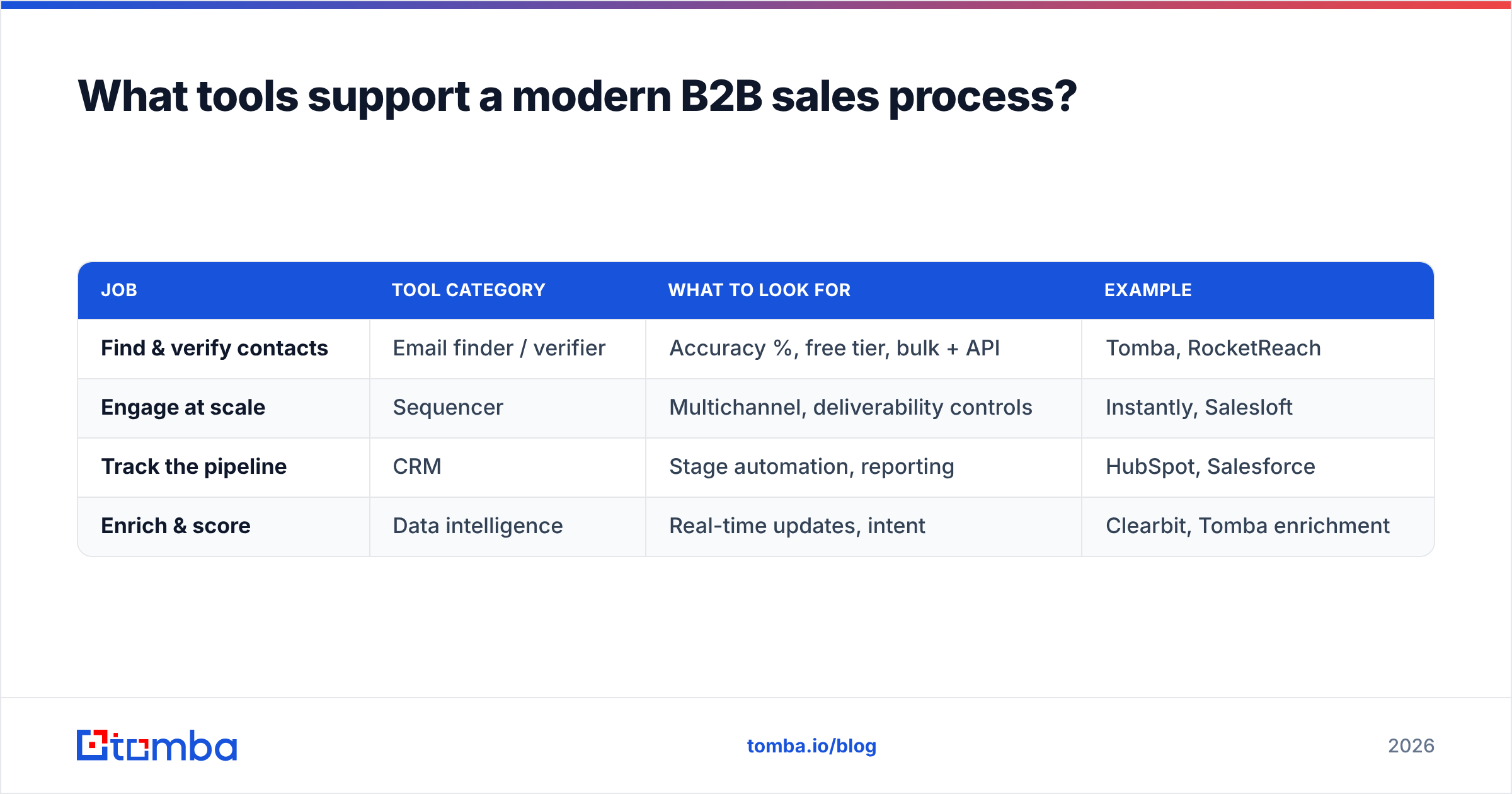
You don't need 20 tools. You need one reliable layer per job: data, engagement, CRM, and intelligence. Here's how a lean 2026 stack maps to the process.
| Job | Tool category | What to look for | Example |
|---|---|---|---|
| Find & verify contacts | Email finder / verifier | Accuracy %, free tier, bulk + API | Tomba, RocketReach |
| Engage at scale | Sequencer | Multichannel, deliverability controls | Instantly, Salesloft |
| Track the pipeline | CRM | Stage automation, reporting | HubSpot, Salesforce |
| Enrich & score | Data intelligence | Real-time updates, intent | Clearbit, Tomba enrichment |
The data layer is the foundation, and it's the one teams most often get wrong. If your email finder returns 60% valid addresses, every downstream metric inherits that 40% rot. Tomba's email finder is built around verified, source-cited data — and its pricing is transparent: a free tier with 25 searches/month, then Starter at $49/mo, Growth at $99/mo, and Pro at $249/mo. Full Tomba pricing lays out the per-credit math if you're forecasting volume. You can validate accuracy claims independently on G2 before committing.
For teams that live in spreadsheets or a CRM, the bulk email finder and native HubSpot integration keep the data layer flowing into your pipeline without copy-paste.
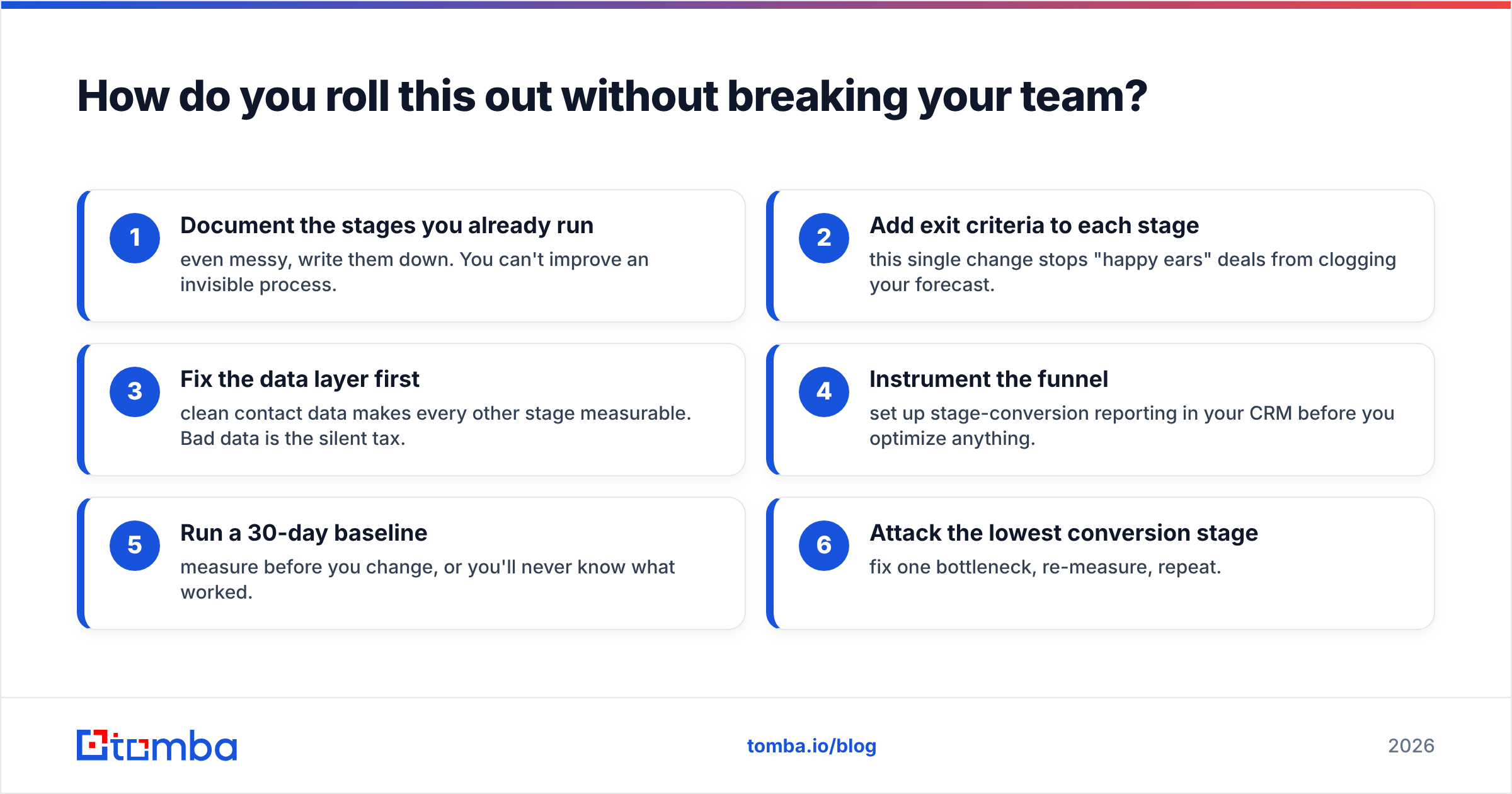
How do you roll this out without breaking your team?#
Don't boil the ocean. Sequence the rollout:
- Document the stages you already run — even messy, write them down. You can't improve an invisible process.
- Add exit criteria to each stage — this single change stops "happy ears" deals from clogging your forecast.
- Fix the data layer first — clean contact data makes every other stage measurable. Bad data is the silent tax.
- Instrument the funnel — set up stage-conversion reporting in your CRM before you optimize anything.
- Run a 30-day baseline — measure before you change, or you'll never know what worked.
- Attack the lowest conversion stage — fix one bottleneck, re-measure, repeat.
The teams that win aren't the ones with the fanciest methodology. They're the ones whose reps follow the same defined steps every single time, on top of data they can trust.
Closing: start with the step that compounds#
Every b2b sales process step depends on the one before it, and they all depend on the top of the funnel being right. If your reps are chasing contacts who don't exist or emails that bounce, no methodology downstream can save the forecast. Fix the data layer first.
Start free with the Tomba Email Finder — find and verify professional emails by name, domain, or company, with 25 searches a month on the free tier and source-cited accuracy you can audit. Build your prospecting list on data that holds up, and let your reps spend their hours selling instead of guessing.
Ready to find emails that actually work?
Join 150,000+ professionals who stopped guessing and started sending. Free credits on signup — no credit card required.
Get the Tomba newsletter
Practical outbound tactics and product updates — once every two weeks.
About the author