B2B Sales Reps in 2026: Skills, Tools, and Quota Playbook
What do B2B sales reps actually do in 2026? A clear-eyed look at the role, the daily workflow, the quotas that matter, and the tech stack that separates top closers from the pack.
TL;DR
- A B2B sales rep sells products or services from one business to another — longer cycles, multiple stakeholders, and bigger contract values than B2C.
- The role splits into two main flavors: SDR/BDR (pipeline creation) and AE (closing). Knowing which one you are changes everything about your day.
- Top reps in 2026 spend less time hunting for contact data and more time talking to buyers — because their stack does the grunt work.
- Quota attainment is hovering around 50% industry-wide, so the gap between "good" and "great" reps is mostly about pipeline quality and follow-through.
- The right tooling — accurate contact data, a clean CRM, and disciplined sequencing — is the cheapest lever you have to hit number.
What is a B2B sales rep?#
A B2B sales rep sells to other companies rather than to individual consumers. Think of the difference like cooking dinner for your family versus catering a corporate event: the family meal is quick and personal, while the catering job involves a planning committee, a budget approval, dietary restrictions, and three people who all have to sign off before anyone eats. B2B selling is the catering job.
Technically, a B2B sales rep manages relationships with business buyers across a deal cycle that can run from a few weeks to over a year. They identify prospects, qualify needs, present solutions, handle objections, negotiate terms, and close contracts — often coordinating with procurement, finance, legal, and an end-user champion along the way.
The defining traits of B2B selling are higher deal values, multi-threaded buying committees (Gartner pegs the typical B2B buying group at six to ten stakeholders), and a heavier reliance on data and process than on a single charismatic pitch. That last point is why the modern rep lives inside a CRM and a stack of prospecting tools instead of a Rolodex.
What are the main types of B2B sales reps?#
Not every rep does the same job. The two roles get blurred in casual conversation, but they require different muscles and get measured differently.
- SDR / BDR (Sales/Business Development Rep) — Front of the funnel. They prospect, run cold outreach, qualify inbound leads, and book meetings for closers. Success is measured in meetings booked and pipeline created.
- AE (Account Executive) — The closer. They take qualified opportunities, run demos, build business cases, and sign contracts. Measured on closed-won revenue and quota attainment.
- AM (Account Manager) — Owns existing accounts post-sale. Measured on retention, renewals, and expansion (upsell/cross-sell).
- Full-cycle rep — Common in startups and SMB segments. One person does everything from prospecting to close. High variance, high ownership.
- Sales engineer (SE) — Technical partner to the AE. Handles deep product questions, proof-of-concepts, and security reviews on complex deals.
If you are early in your career, you almost certainly start as an SDR. The skills you build there — research, list-building, cold outreach, objection handling — are the foundation for everything that comes later.
What skills separate top B2B sales reps?#
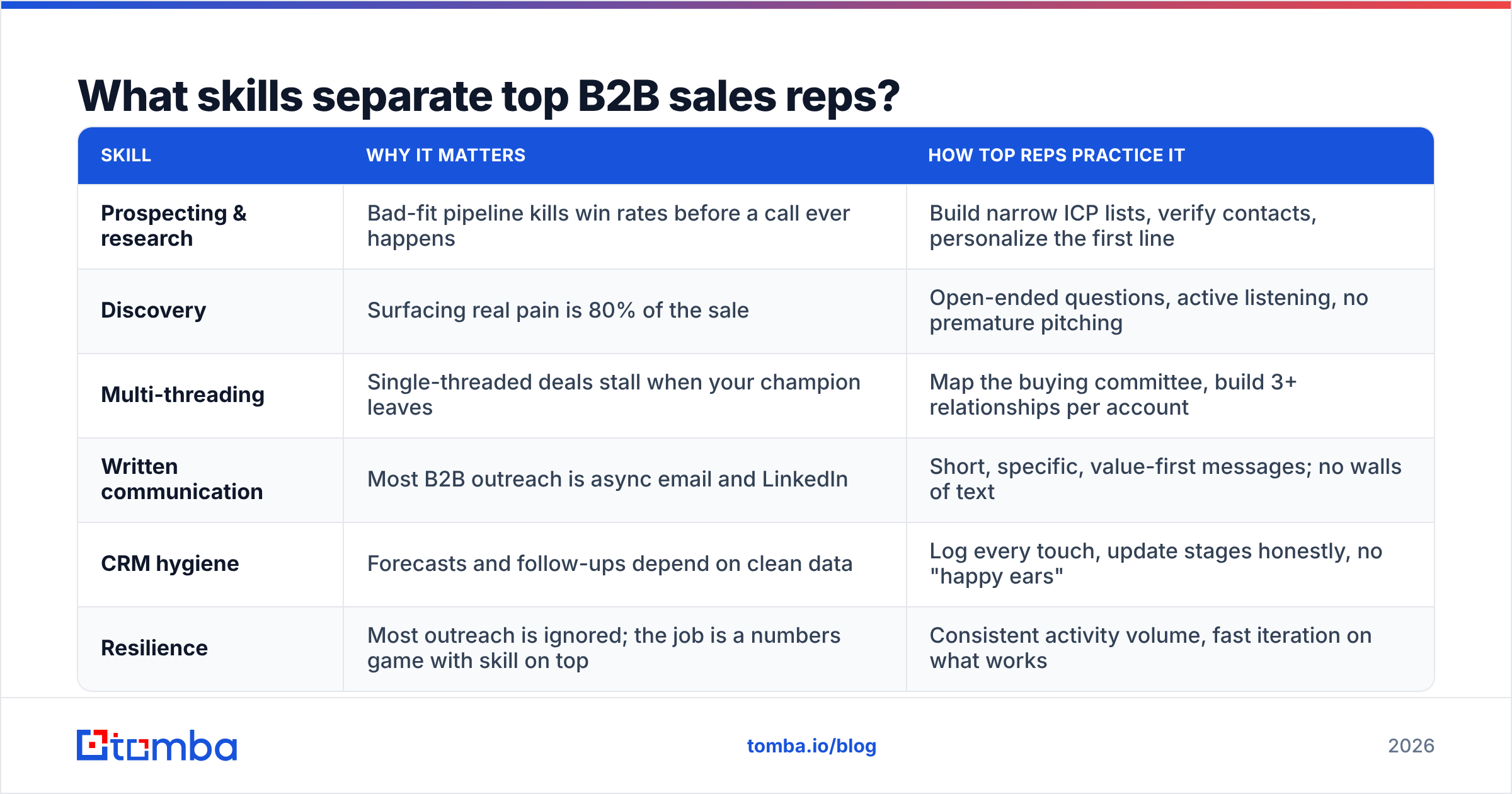
The best reps are not the smoothest talkers. They are the most disciplined operators. Here is what actually correlates with hitting number.
| Skill | Why it matters | How top reps practice it |
|---|---|---|
| Prospecting & research | Bad-fit pipeline kills win rates before a call ever happens | Build narrow ICP lists, verify contacts, personalize the first line |
| Discovery | Surfacing real pain is 80% of the sale | Open-ended questions, active listening, no premature pitching |
| Multi-threading | Single-threaded deals stall when your champion leaves | Map the buying committee, build 3+ relationships per account |
| Written communication | Most B2B outreach is async email and LinkedIn | Short, specific, value-first messages; no walls of text |
| CRM hygiene | Forecasts and follow-ups depend on clean data | Log every touch, update stages honestly, no "happy ears" |
| Resilience | Most outreach is ignored; the job is a numbers game with skill on top | Consistent activity volume, fast iteration on what works |
Notice that two of the six — prospecting and CRM hygiene — are about data quality, not charisma. A rep working from a list of verified, well-targeted contacts has an enormous head start over one grinding through a stale, error-riddled spreadsheet. This is where a good email finder and a reliable B2B database quietly do more for quota than any pep talk.
What does a B2B sales rep do all day?#
A realistic day is less glamorous than the movies and more rewarding than the burnout takes on LinkedIn suggest. A typical AE's day breaks down roughly like this:
- Pipeline review and prep (60–90 min): Check today's meetings, review account notes, prep custom demos or proposals.
- Active selling (3–4 hrs): Discovery calls, demos, negotiation conversations. This is the high-value block — protect it.
- Prospecting and follow-up (1–2 hrs): Personalized outreach to new accounts, nudges on open deals, multi-threading into new contacts.
- Admin and CRM (45–60 min): Logging activity, updating forecasts, sending recap emails, internal coordination.
The dirty secret of the role is how much time gets eaten by non-selling work. Studies consistently show reps spend only about a third of their time actually selling; the rest disappears into research, data entry, and chasing contact information. Every minute you claw back from manual list-building is a minute you can spend in front of a buyer.
How are B2B sales reps measured in 2026?#
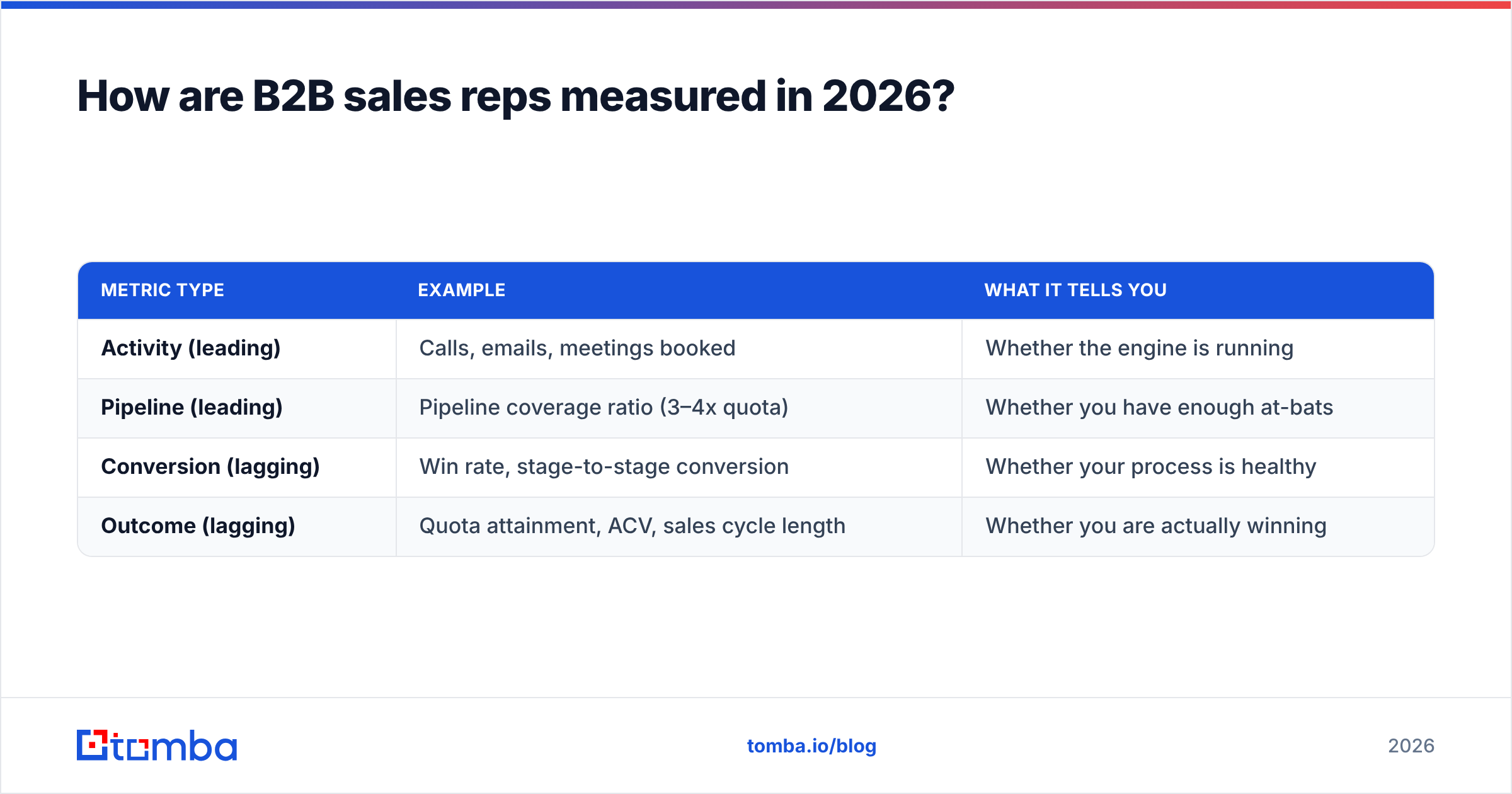
Quota is the headline number, but smart orgs track leading indicators that predict it. Here is the metrics hierarchy most teams use.
| Metric type | Example | What it tells you |
|---|---|---|
| Activity (leading) | Calls, emails, meetings booked | Whether the engine is running |
| Pipeline (leading) | Pipeline coverage ratio (3–4x quota) | Whether you have enough at-bats |
| Conversion (lagging) | Win rate, stage-to-stage conversion | Whether your process is healthy |
| Outcome (lagging) | Quota attainment, ACV, sales cycle length | Whether you are actually winning |
Two benchmarks worth internalizing for 2026: roughly half of reps hit full quota in a given year, and pipeline coverage below 3x quota is a reliable early warning sign. If you only obsess over the lagging numbers, you find out you missed quota when it is already too late. Watch the leading indicators — especially response rate and meeting-book rate — and you can course-correct mid-quarter.
What does the modern B2B sales rep's tech stack look like?#
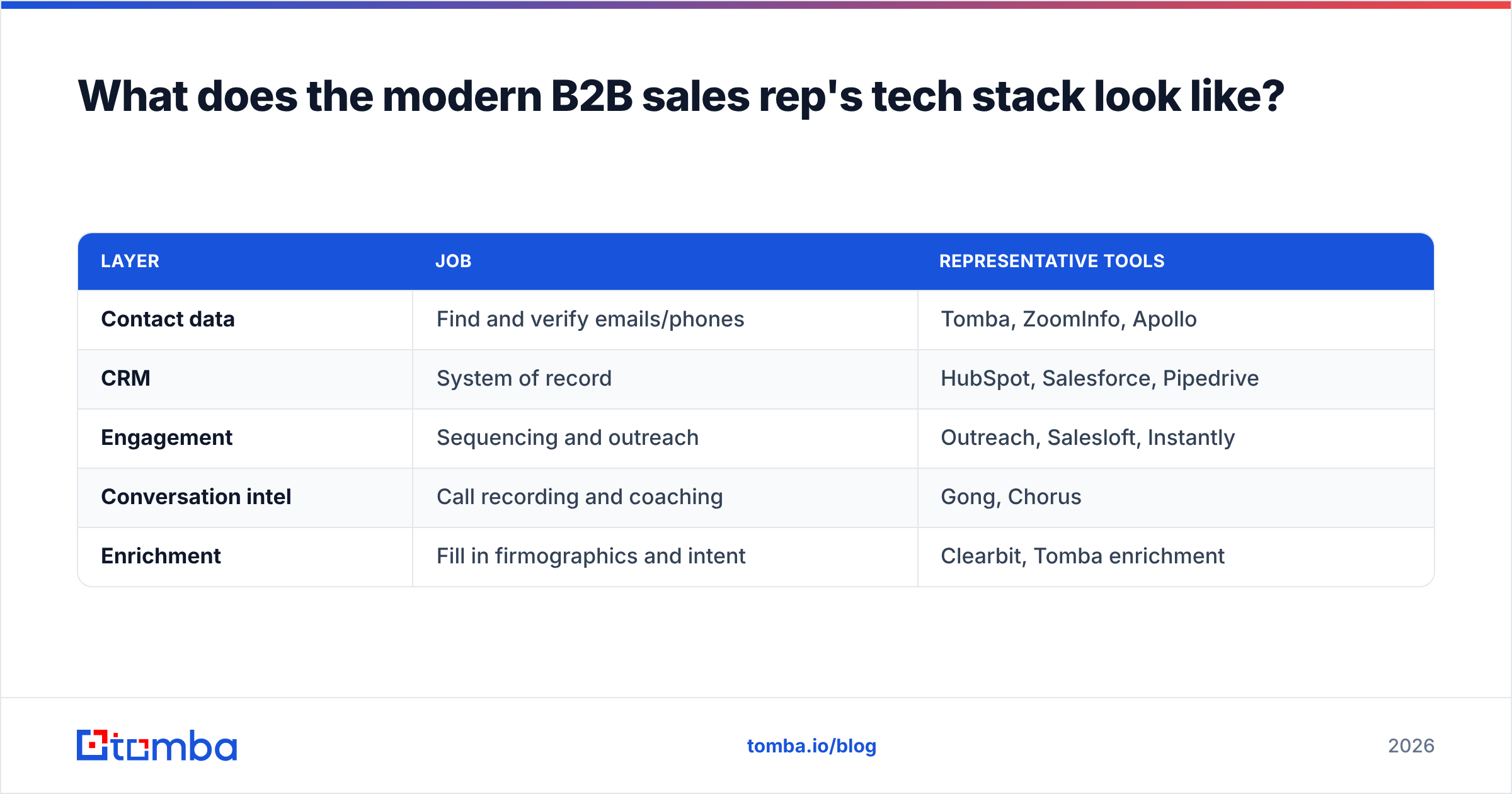
The 2026 stack is built around one principle: automate the low-value work so humans do the high-value work. A lean, effective stack looks like this.
| Layer | Job | Representative tools |
|---|---|---|
| Contact data | Find and verify emails/phones | Tomba, ZoomInfo, Apollo |
| CRM | System of record | HubSpot, Salesforce, Pipedrive |
| Engagement | Sequencing and outreach | Outreach, Salesloft, Instantly |
| Conversation intel | Call recording and coaching | Gong, Chorus |
| Enrichment | Fill in firmographics and intent | Clearbit, Tomba enrichment |
You do not need all of it. A focused rep with accurate data, a clean CRM, and a disciplined sequencing tool will out-perform a rep drowning in fifteen overlapping subscriptions. The expensive part is rarely the software license — it is the wasted hours when your data is wrong.
Data quality is the foundation everything else sits on. If your email finder returns a 30% bounce rate, your engagement tool sends into the void, your deliverability tanks, and your CRM fills with junk. That cascade is why reps increasingly start with verified data: a tight domain search to map a target account, an email verifier to keep bounce rates low, and a phone finder for the accounts that demand a live conversation. You can compare options on review sites like G2 before committing budget.
How do B2B sales reps build accurate prospect lists?#
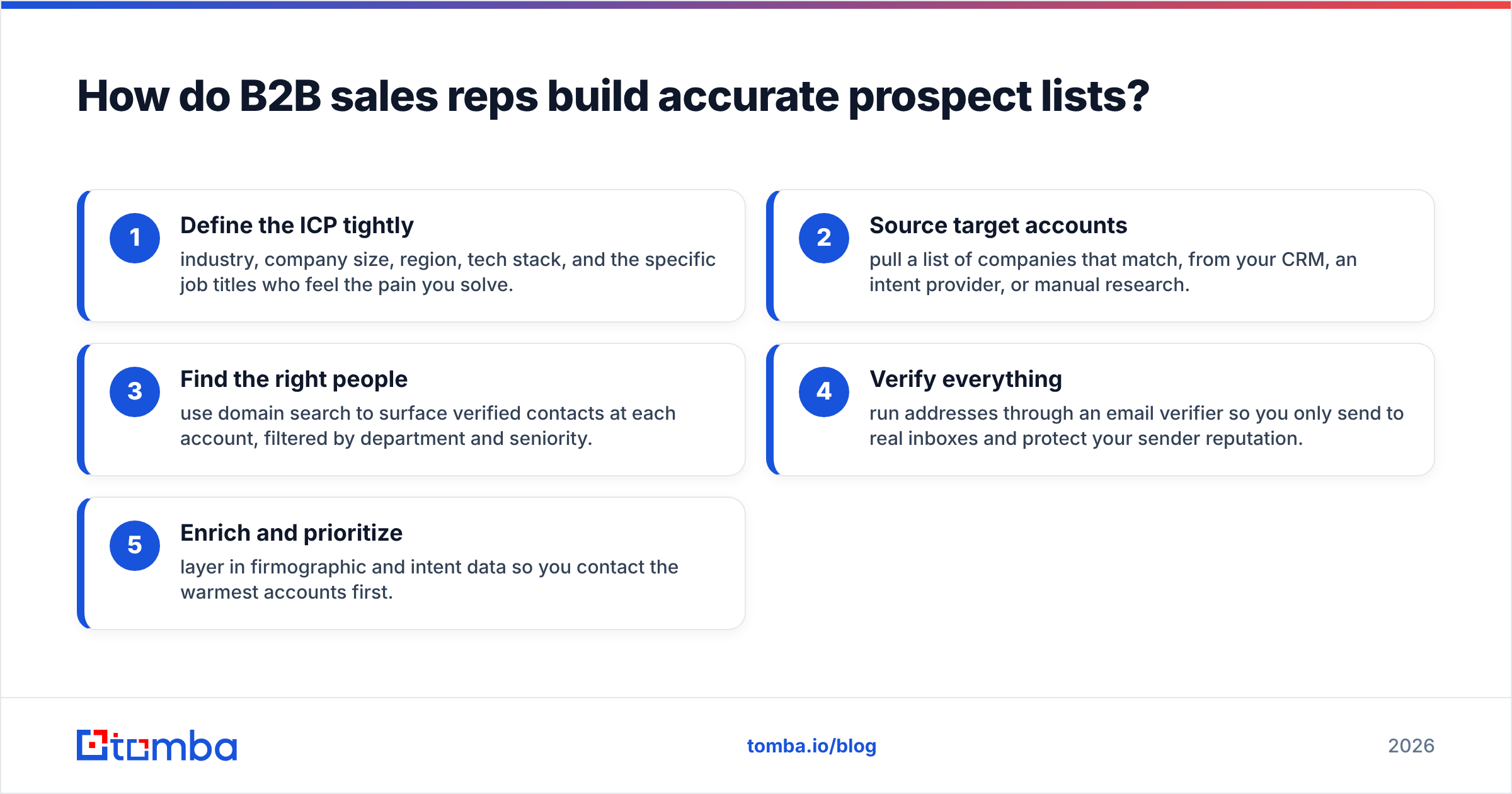
Conclusion first: good lists come from defining a narrow ICP, sourcing contacts at the right accounts, and verifying before you send. Skip the verification step and you pay for it in bounces and reputation damage.
A repeatable workflow looks like this:
- Define the ICP tightly — industry, company size, region, tech stack, and the specific job titles who feel the pain you solve.
- Source target accounts — pull a list of companies that match, from your CRM, an intent provider, or manual research.
- Find the right people — use domain search to surface verified contacts at each account, filtered by department and seniority.
- Verify everything — run addresses through an email verifier so you only send to real inboxes and protect your sender reputation.
- Enrich and prioritize — layer in firmographic and intent data so you contact the warmest accounts first.
Modern best practice (HubSpot's research backs this up) is quality over volume: a smaller list of well-targeted, verified contacts beats a massive purchased list every time. Purchased lists are the fast food of prospecting — cheap, convenient, and quietly bad for your numbers.
Is being a B2B sales rep a good career in 2026?#
Short answer: yes, if you are coachable and comfortable with rejection. B2B sales remains one of the few high-income careers open to people without a specialized degree, and the skills transfer across industries. Top reps clear well into six figures, and the path from SDR to AE to leadership or to RevOps is well-trodden.
The honest caveats: it is performance-based, the quota resets every quarter, and the bottom performers churn out fast. AI has automated parts of prospecting and admin, but it has not replaced the human work of running a complex, multi-stakeholder deal — it has raised the bar on what reps are expected to produce with the time they save. The reps who thrive treat tooling as leverage, not as a threat.
The bottom line for B2B sales reps#
The role rewards operators, not just talkers. Define your ICP, work from clean and verified data, protect your selling time, and watch the leading indicators so you never get surprised by a missed quota. Everything downstream — your win rate, your forecast, your commission — traces back to the quality of the pipeline you build at the top.
If contact data is the foundation, start there. The Tomba Email Finder lets you find and verify professional emails by name, company, or domain, so your sequences land in real inboxes instead of bouncing. Pair it with the email verifier and data enrichment, and check the full Tomba pricing — there is a free tier with 25 searches a month to test it, with paid plans starting at $49/mo. Spend less time hunting for emails and more time closing.
// get started
Find, verify and enrich your first contacts today
Start on the free plan with 25 searches a month, then scale when your team is ready.
Free plan · No credit card required · GDPR & CCPA
// about the author