How to Build a B2B Sales Team That Hits Quota in 2026
A practical 2026 guide to structuring, staffing, and tooling a B2B sales team that consistently hits quota — roles, ratios, comp, and the data stack that feeds it.
A B2B sales team is only as good as the structure behind it and the data feeding it. You can hire elite closers, but if your pipeline runs on stale contacts and unclear roles, quota becomes a coin flip. This guide breaks down how to build a team that wins predictably in 2026.
TL;DR#
- A modern B2B sales team splits work across SDRs, AEs, sales engineers, and customer success — specialization beats the "full-cycle rep does everything" model at scale.
- The three dominant structures are the assembly line, the pod, and the geographic/vertical split. Pick based on deal size and motion, not headcount alone.
- Healthy ratios: roughly 2-3 SDRs per AE, 1 sales engineer per 3-5 AEs, and a manager per 6-8 reps.
- Comp should tie 50-60% to base and the rest to variable, with accelerators above quota to keep top performers hungry.
- Your tooling stack — CRM, engagement, and a reliable contact-data layer like the Tomba Email Finder — determines how much time reps actually spend selling.
What is a B2B sales team?#
A B2B sales team is the group of people responsible for selling products or services to other businesses, rather than to individual consumers. The defining trait is complexity: B2B deals involve multiple stakeholders, longer cycles, higher contract values, and a buying committee that has to be navigated rather than persuaded one-on-one.
Think of it like a relay race instead of a sprint. In B2C, one runner often carries the baton from start to finish. In B2B, the baton passes through specialists — someone sources the lead, someone qualifies it, someone closes it, and someone keeps the customer renewing. Each handoff is a place to gain speed or drop the baton.
That specialization is why modern B2B teams rarely run on generalists past the early startup stage. As deal volume grows, splitting the funnel into stages — and assigning owners to each — almost always lifts conversion and forecasting accuracy.
What roles make up a B2B sales team?#
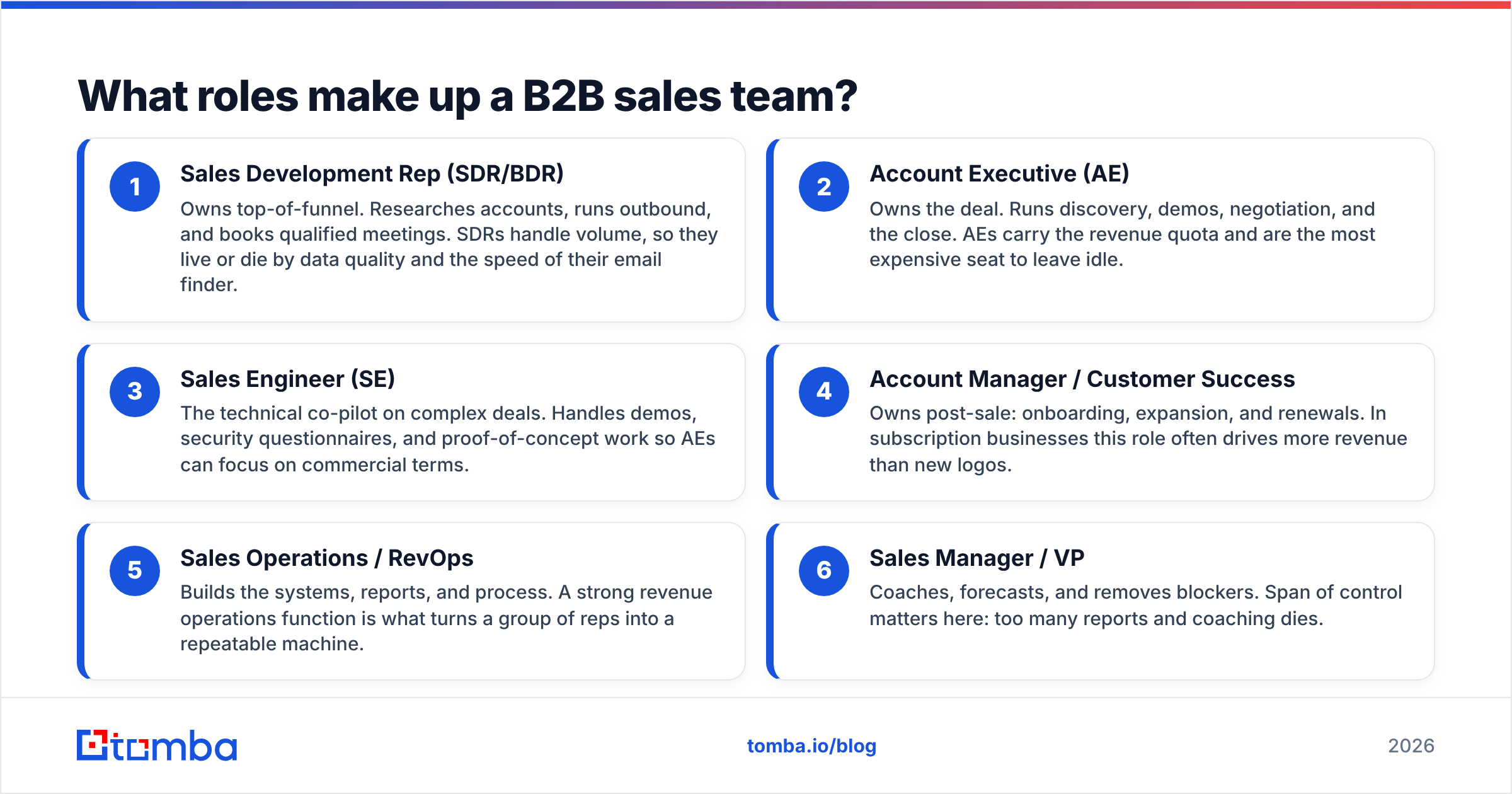
Most high-performing B2B sales teams are built from a recognizable set of roles. You don't need all of them on day one, but you should know where each fits as you scale.
- Sales Development Rep (SDR/BDR) — Owns top-of-funnel. Researches accounts, runs outbound, and books qualified meetings. SDRs handle volume, so they live or die by data quality and the speed of their email finder.
- Account Executive (AE) — Owns the deal. Runs discovery, demos, negotiation, and the close. AEs carry the revenue quota and are the most expensive seat to leave idle.
- Sales Engineer (SE) — The technical co-pilot on complex deals. Handles demos, security questionnaires, and proof-of-concept work so AEs can focus on commercial terms.
- Account Manager / Customer Success — Owns post-sale: onboarding, expansion, and renewals. In subscription businesses this role often drives more revenue than new logos.
- Sales Operations / RevOps — Builds the systems, reports, and process. A strong revenue operations function is what turns a group of reps into a repeatable machine.
- Sales Manager / VP — Coaches, forecasts, and removes blockers. Span of control matters here: too many reports and coaching dies.
The mistake most founders make is hiring AEs first because closing feels like the urgent job. In reality, AEs starve without a pipeline, so the SDR and data layer usually needs to come first — or in parallel.
How should you structure a B2B sales team?#
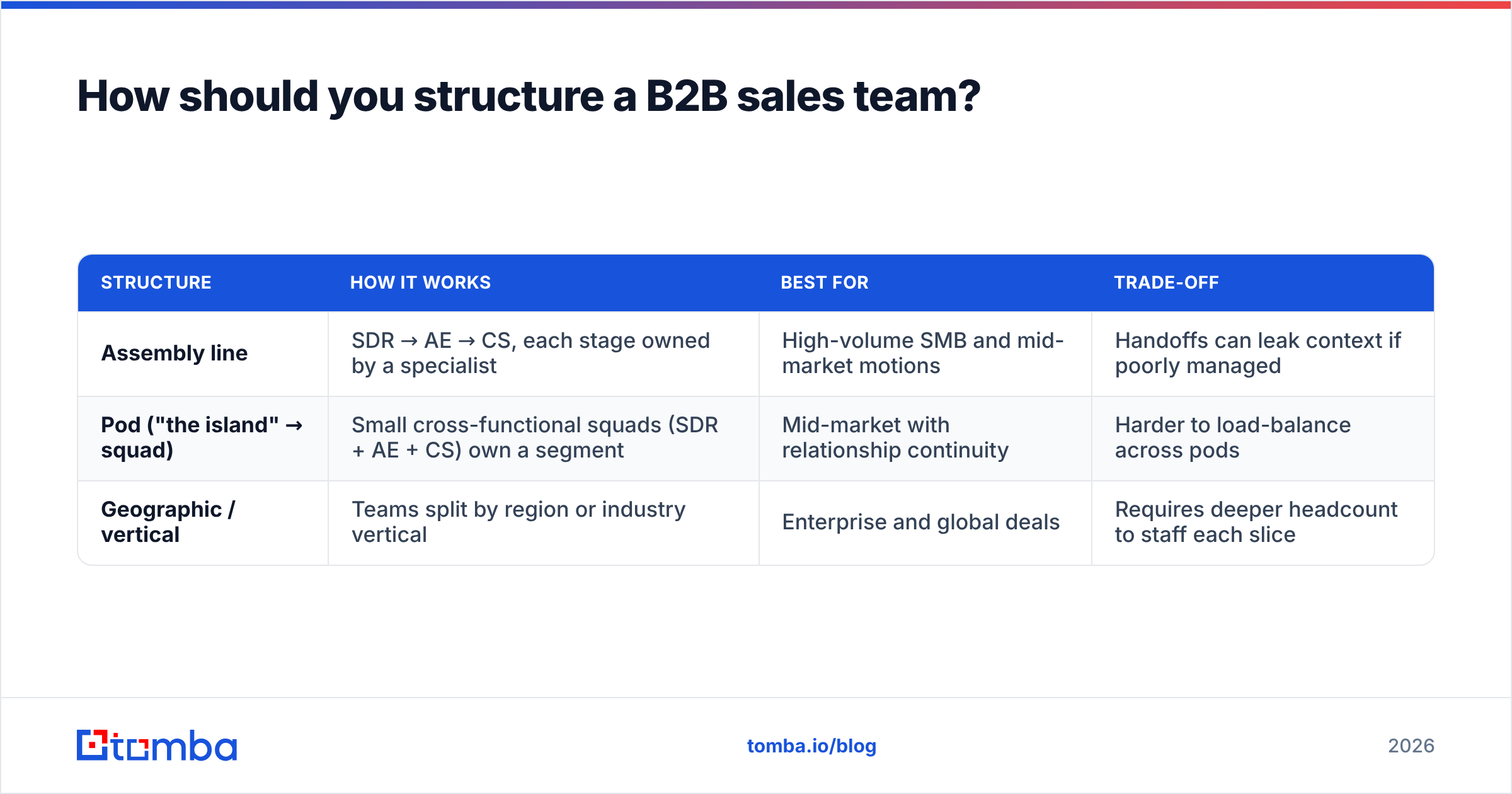
There are three structures that cover the vast majority of B2B teams. Each trades off speed, specialization, and account ownership differently.
| Structure | How it works | Best for | Trade-off |
|---|---|---|---|
| Assembly line | SDR → AE → CS, each stage owned by a specialist | High-volume SMB and mid-market motions | Handoffs can leak context if poorly managed |
| Pod ("the island" → squad) | Small cross-functional squads (SDR + AE + CS) own a segment | Mid-market with relationship continuity | Harder to load-balance across pods |
| Geographic / vertical | Teams split by region or industry vertical | Enterprise and global deals | Requires deeper headcount to staff each slice |
The assembly line (popularized by Aaron Ross in Predictable Revenue) maximizes efficiency through specialization — reps get very good at one stage. The pod model keeps a tight group attached to an account so context doesn't get lost between handoffs. The vertical split wins when your buyers in healthcare behave nothing like your buyers in fintech and you need reps who speak the language.
A useful rule: the larger and more consultative the deal, the more you favor pods or verticals over a pure assembly line. Small, transactional deals reward the assembly line's throughput.
What are healthy team ratios?#
Structure without ratios is just an org chart. As a starting point for 2026:
- 2-3 SDRs per AE for outbound-heavy motions; fewer if you're inbound-led.
- 1 sales engineer per 3-5 AEs, depending on technical complexity.
- 6-8 reps per front-line manager — beyond that, coaching quality drops sharply.
- 1 RevOps/SalesOps person per ~15-20 quota carriers to keep systems and reporting healthy.
Treat these as anchors, not laws. A product-led company with strong inbound can run leaner SDR ratios; a cold-outbound enterprise team needs more.
How do you compensate a B2B sales team?#
Compensation is the single strongest lever on rep behavior, so design it deliberately. The standard B2B framework is On-Target Earnings (OTE) split between base salary and variable commission.
- Base / variable split: A 50/50 or 60/40 split is common for AEs. SDRs often skew more toward base (e.g., 70/30) because they don't control the close.
- Quota multiple: Reps should be able to generate 4-5x their OTE in quota — if quota is too high, you'll churn good people; too low and you overpay for underperformance.
- Accelerators: Pay a higher commission rate above 100% of quota. This keeps your best closers pushing instead of sandbagging deals into next quarter.
- Clawbacks: Protect against churned or non-paying deals, especially in subscription models.
For deeper benchmarks, HubSpot publishes annual sales compensation data worth reviewing before you finalize plans, and Gartner's sales research tracks how comp structures are shifting toward retention and expansion.
What tools does a B2B sales team need?#
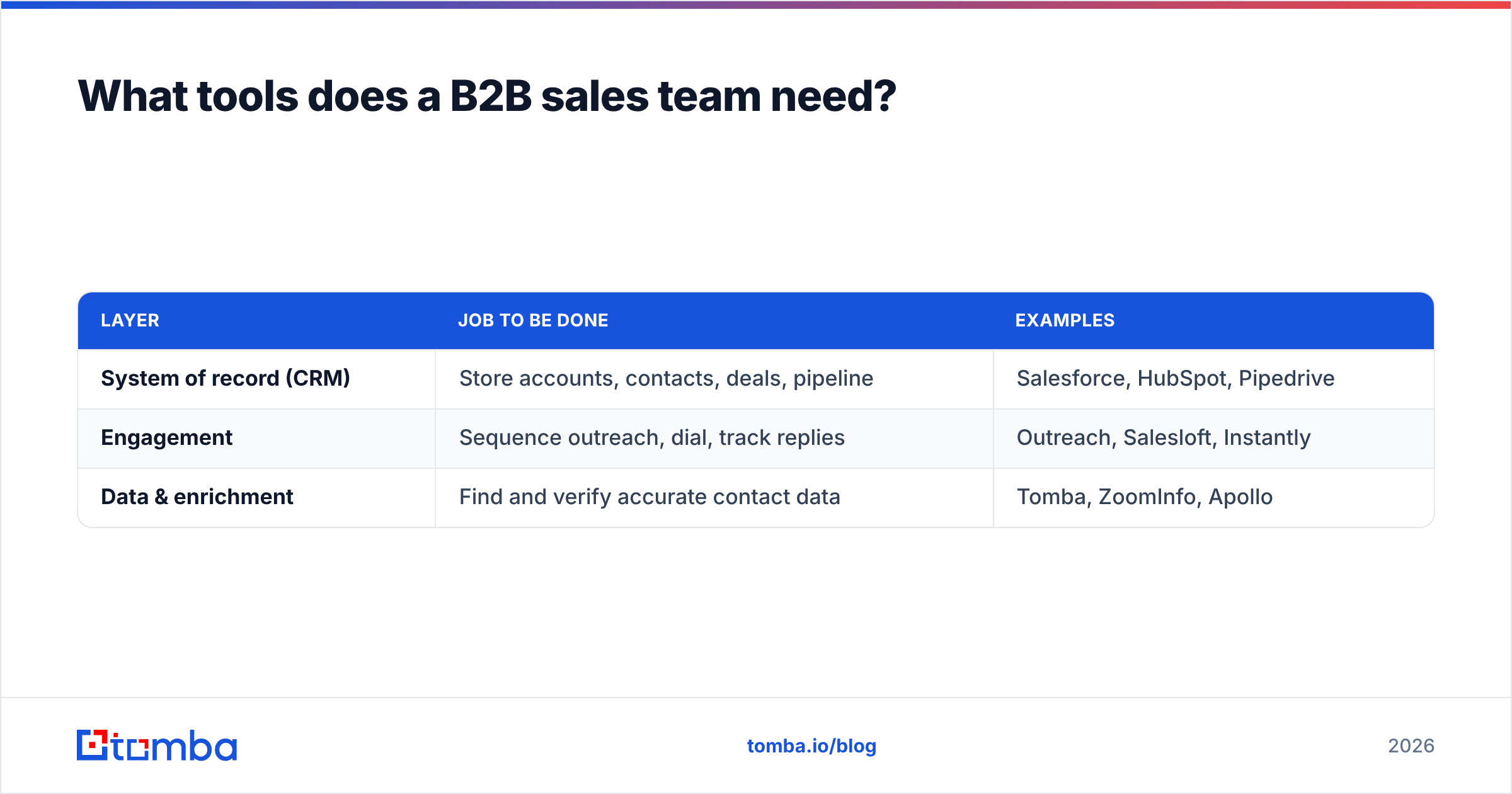
A modern B2B sales stack has three layers, and a gap in any one of them slows the whole team down.
| Layer | Job to be done | Examples |
|---|---|---|
| System of record (CRM) | Store accounts, contacts, deals, pipeline | Salesforce, HubSpot, Pipedrive |
| Engagement | Sequence outreach, dial, track replies | Outreach, Salesloft, Instantly |
| Data & enrichment | Find and verify accurate contact data | Tomba, ZoomInfo, Apollo |
Here's the part teams underinvest in: the data layer. Your reps can have the best CRM and the slickest sequencer, but if 30% of their contacts bounce, every downstream metric suffers — deliverability tanks, sender reputation erodes, and meetings dry up.
This is where a dedicated contact-data tool earns its keep. Instead of buying static lists that decay the moment you download them, your SDRs can pull fresh, verified emails on demand using the Tomba Email Finder, confirm them with the email verifier, and map out an entire account's contacts with domain search. Connect it to your CRM through the available integrations and the data stays current without manual scrubbing.
How does data quality affect quota?#
Directly. If an SDR sends 100 emails and 25 bounce, that's not just 25 wasted touches — it's a hit to your domain reputation that quietly suppresses the other 75. Compounded across a team, bad data is the difference between a healthy pipeline and a quarter spent firefighting deliverability.
Verified data also sharpens forecasting. When your contacts are real and reachable, reply rates become a reliable signal, and your response rate starts to mean something for the forecast instead of being noise.
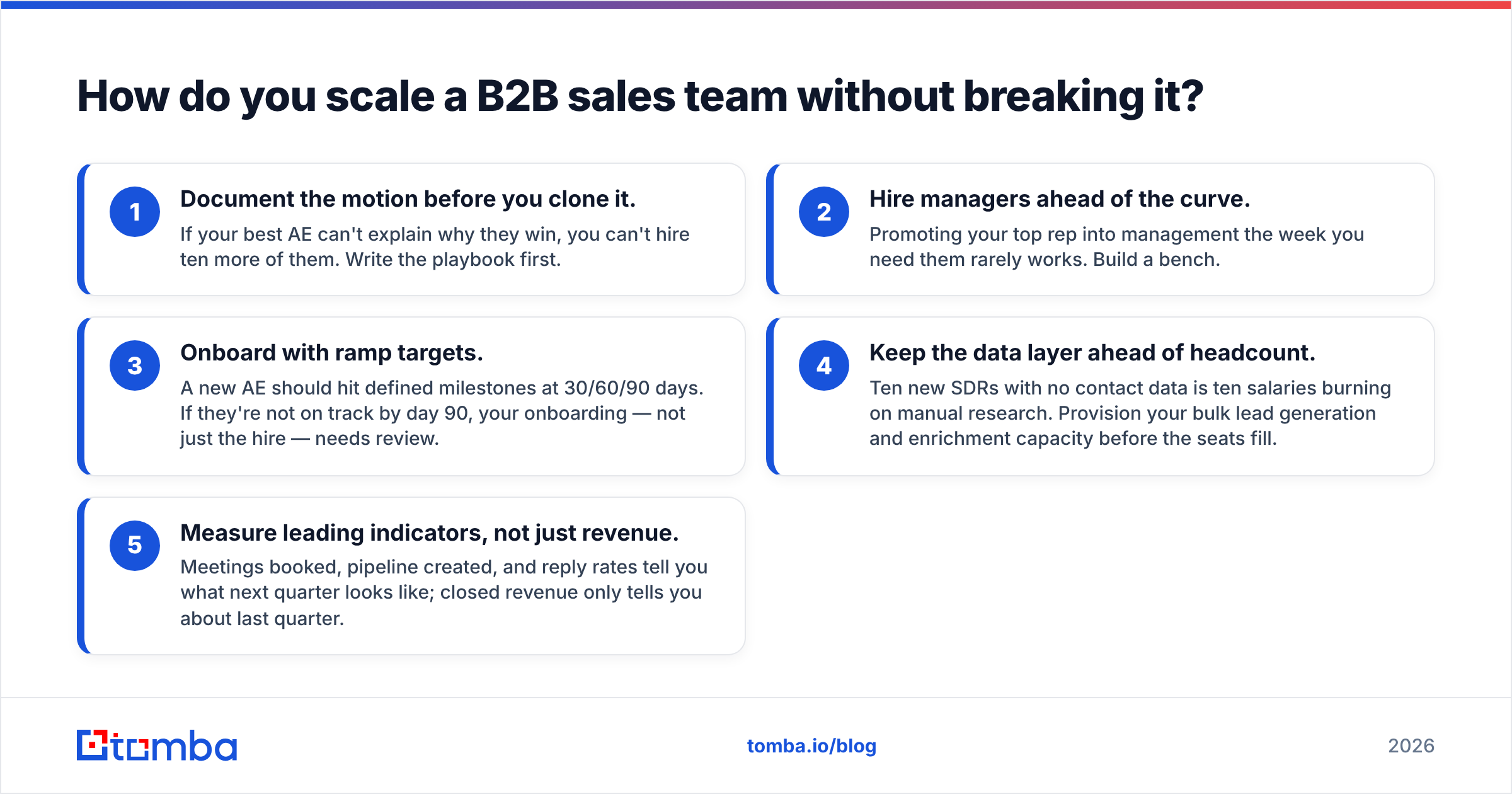
How do you scale a B2B sales team without breaking it?#
Scaling is where most teams stumble. Adding bodies to a broken process just produces more chaos, faster. A few principles keep growth healthy:
- Document the motion before you clone it. If your best AE can't explain why they win, you can't hire ten more of them. Write the playbook first.
- Hire managers ahead of the curve. Promoting your top rep into management the week you need them rarely works. Build a bench.
- Onboard with ramp targets. A new AE should hit defined milestones at 30/60/90 days. If they're not on track by day 90, your onboarding — not just the hire — needs review.
- Keep the data layer ahead of headcount. Ten new SDRs with no contact data is ten salaries burning on manual research. Provision your bulk lead generation and enrichment capacity before the seats fill.
- Measure leading indicators, not just revenue. Meetings booked, pipeline created, and reply rates tell you what next quarter looks like; closed revenue only tells you about last quarter.
For an outside benchmark on team maturity and process, G2's sales software category and peer reviews are a useful sanity check before committing budget to any tool.
What metrics should a B2B sales team track?#
Track a small set of numbers religiously rather than drowning in dashboards:
- Pipeline coverage — total open pipeline vs. quota (aim for 3-4x).
- Win rate — your sales win rate by stage and segment, to find where deals stall.
- Sales cycle length — trending up is an early warning sign.
- Activity-to-meeting ratio — how many touches convert to booked meetings (a proxy for data and messaging quality).
- Net revenue retention — for subscription models, expansion minus churn is often the truest health metric.
Is a specialized team always better than full-cycle reps?#
No — and this is worth saying plainly. For very early-stage companies still finding product-market fit, full-cycle reps who do everything are often the right call. They keep context tight and adapt fast while the motion is still being figured out.
Specialization pays off once the motion is repeatable and volume justifies the handoff overhead. The trigger to specialize is usually when your full-cycle reps spend so much time prospecting that closing suffers — that's the moment to peel off an SDR function and feed your AEs.
Build the team, then feed it#
A great B2B sales team is a system: the right roles in the right structure, paid to do the right things, running on tools that keep them selling instead of searching. Get the structure and comp right, and you have a machine. Feed that machine clean, verified contact data, and it actually scales.
If your reps are burning hours hunting for contacts or watching emails bounce, start at the data layer. The Tomba Email Finder gives your SDRs verified, on-demand email addresses by name, company, or domain — with a free tier (25 searches/mo) to test it and plans from $49/mo as you grow. Check the full Tomba pricing and let your team spend its time closing, not guessing.
// get started
Find, verify and enrich your first contacts today
Start on the free plan with 25 searches a month, then scale when your team is ready.
Free plan · No credit card required · GDPR & CCPA
// about the author