B2B Telemarketing Data in 2026: Sources, Costs & Compliance
Where to buy B2B telemarketing data in 2026, what accurate phone records actually cost, how to stay TCPA-compliant, and how to keep your lists clean enough to dial.
B2B Telemarketing Data in 2026: Sources, Costs & Compliance
Telemarketing still works in B2B — but only when the data behind the dial is good. The fastest way to burn a calling team is to hand them a list where half the numbers are disconnected, wrong, or belong to someone who left the company two years ago. This guide breaks down where B2B telemarketing data comes from, what accurate records actually cost in 2026, the compliance rules you cannot ignore, and how to keep a list clean enough that reps spend their hours talking instead of redialing dead lines.
TL;DR#
- B2B telemarketing data is the set of business phone numbers (direct dial, mobile, switchboard) plus the contact and firmographic context you need to dial decision-makers legally and efficiently.
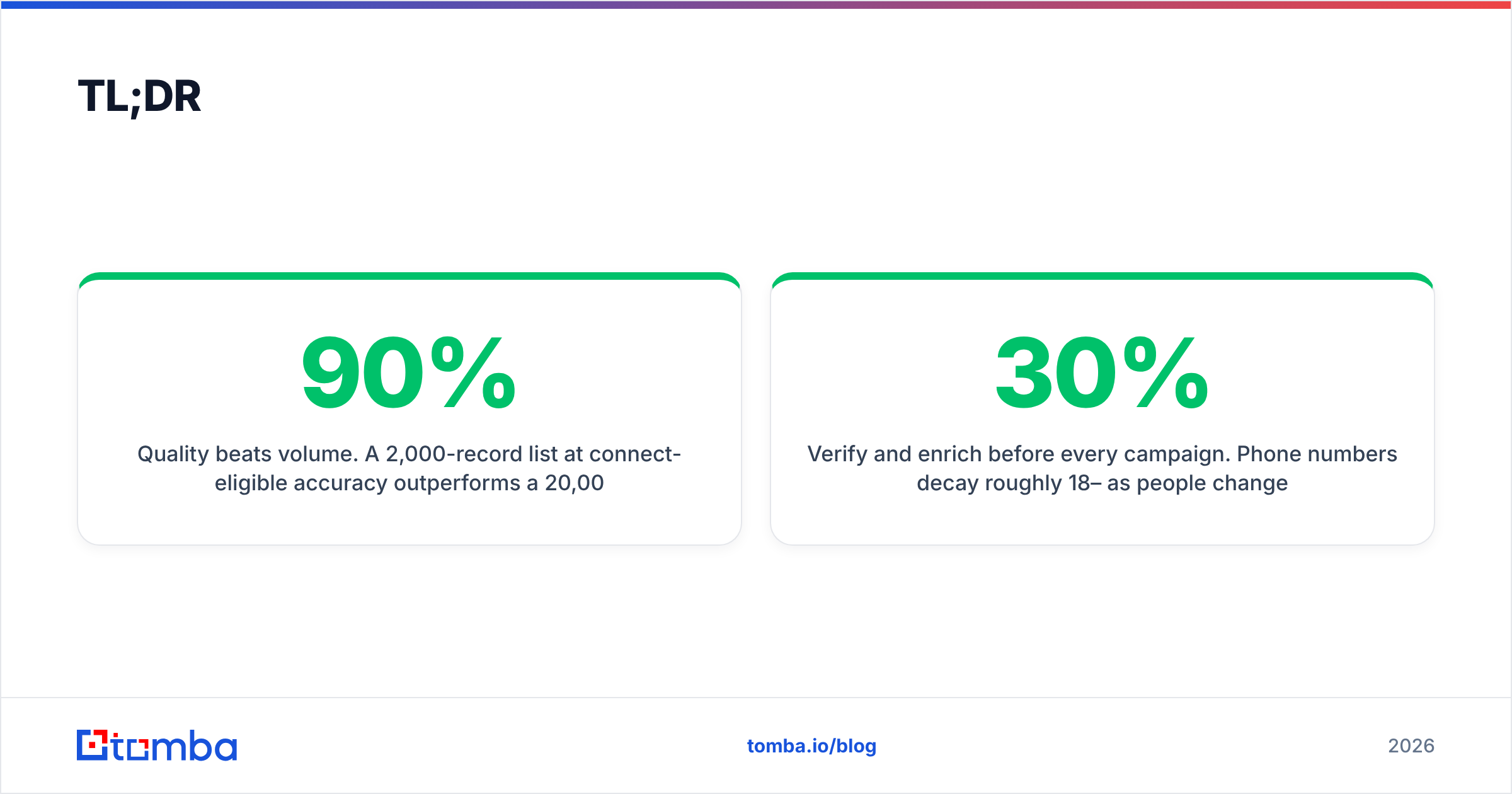
- Quality beats volume. A 2,000-record list at 90% connect-eligible accuracy outperforms a 20,000-record list that's 40% junk.
- Sources range from data marketplaces and providers to your own CRM and enrichment APIs — each with different freshness, price, and compliance profiles.
- In the US, the TCPA and DNC rules govern calling; in the EU/UK, GDPR and PECR apply. Have a documented legal basis before you dial.
- Verify and enrich before every campaign. Phone numbers decay roughly 18–30% per year as people change jobs and carriers.
What is B2B telemarketing data?#
B2B telemarketing data is a structured list of business contacts you intend to call, paired with enough surrounding information to make those calls land. In plain terms: it's a phone book for a specific buying audience, except a good one also tells you who the person is, what they do, which company they work for, and whether the number is still alive.
Think of it like a courier's address book. A street address alone gets a package roughly to the right block. The apartment number, buzzer code, and "leave with the front desk" note are what actually get it delivered. In telemarketing, the phone number is the street address — but job title, department, company size, and verification status are what get you a conversation instead of a voicemail loop.
A usable telemarketing record typically includes:
- Direct phone number — a direct dial or mobile, not just the corporate switchboard. Switchboard-only lists waste reps on gatekeepers.
- Contact identity — full name, job title, and seniority so reps can ask for the right person and tailor the pitch.
- Company firmographics — industry, headcount, revenue band, and location to confirm the account fits your ICP.
- Verification status — when the number was last validated, and whether it's a working line, so you're not paying for dial tones into the void.
- Compliance flags — DNC status, consent records, and region, so you know the call is legal before it's placed.
- Channel context — an associated work email or LinkedIn profile so you can follow up across channels after the call.
That last point matters more every year. Pure cold-call campaigns underperform multichannel ones, so most modern teams treat phone data as one column in a wider B2B database rather than a standalone list.

Where do you get B2B telemarketing data in 2026?#
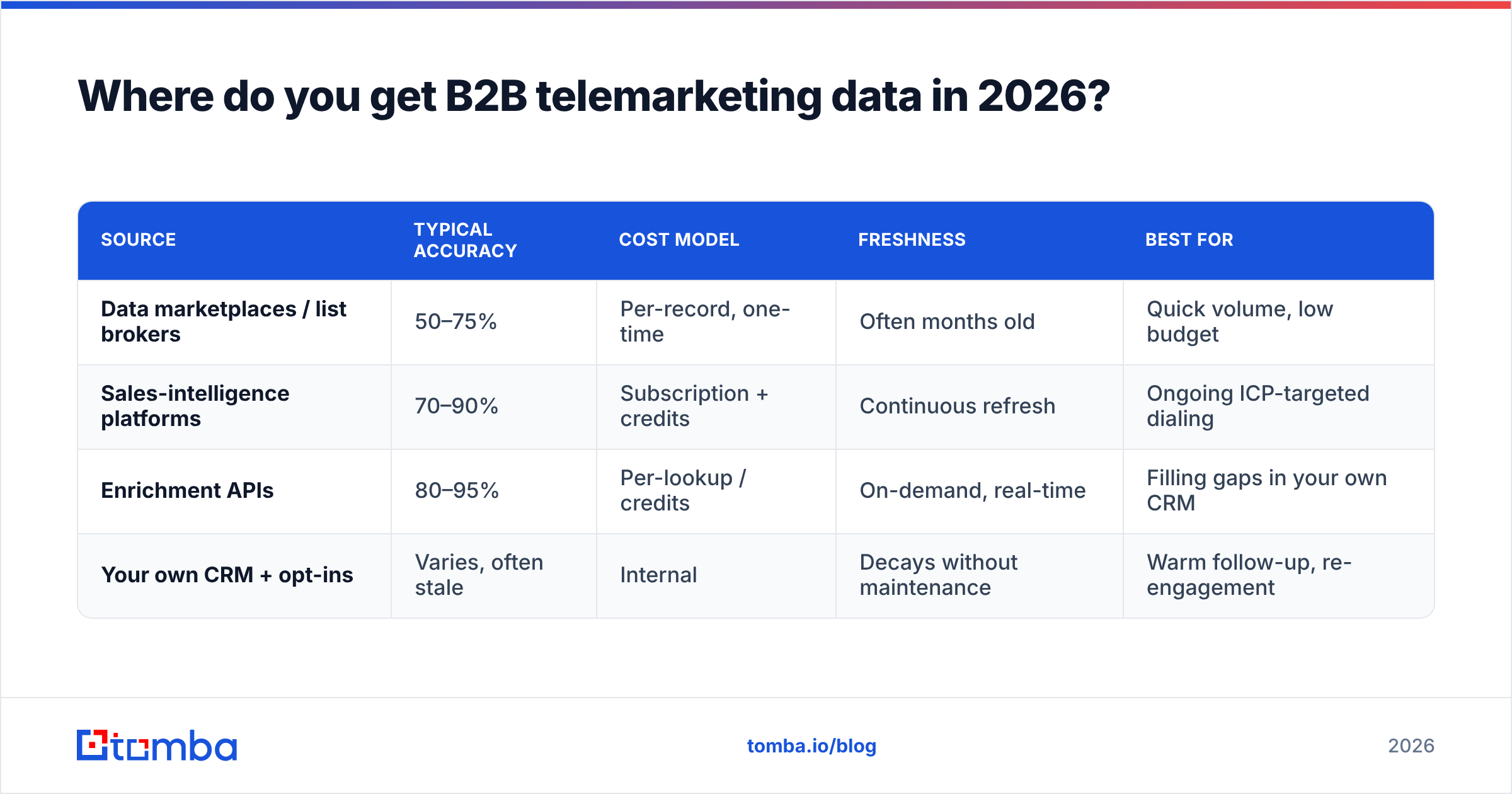
There are four practical sources, and most serious operations blend them. Here's how they compare on the attributes that actually affect your campaign.
| Source | Typical accuracy | Cost model | Freshness | Best for |
|---|---|---|---|---|
| Data marketplaces / list brokers | 50–75% | Per-record, one-time | Often months old | Quick volume, low budget |
| Sales-intelligence platforms | 70–90% | Subscription + credits | Continuous refresh | Ongoing ICP-targeted dialing |
| Enrichment APIs | 80–95% | Per-lookup / credits | On-demand, real-time | Filling gaps in your own CRM |
| Your own CRM + opt-ins | Varies, often stale | Internal | Decays without maintenance | Warm follow-up, re-engagement |
Data marketplaces and brokers sell bulk lists cheaply, but you're often buying records scraped or aggregated months ago. Treat any brokered list as a starting hypothesis, not a verified asset.
Sales-intelligence platforms keep data refreshed on a rolling basis and let you filter by ICP, which is why teams calling the same market repeatedly tend to live here. Review options on sites like G2 before committing to an annual contract.
Enrichment APIs are the surgical option: you feed in what you have (a name and company, or a website) and get back a current, validated direct number. Tomba's phone finder and data enrichment work this way, so you only pay to fill the specific gaps in records you already care about instead of buying a giant list you'll never finish dialing.
Your own CRM is the cheapest and most compliant source — these are people who already know you — but it decays fast. Re-verify before assuming last year's numbers still ring.
How much should B2B telemarketing data cost?#
Conclusion first: budget for accuracy, not for record count. A cheap list that's 40% wrong costs more in wasted rep hours than a verified list at three times the per-record price.
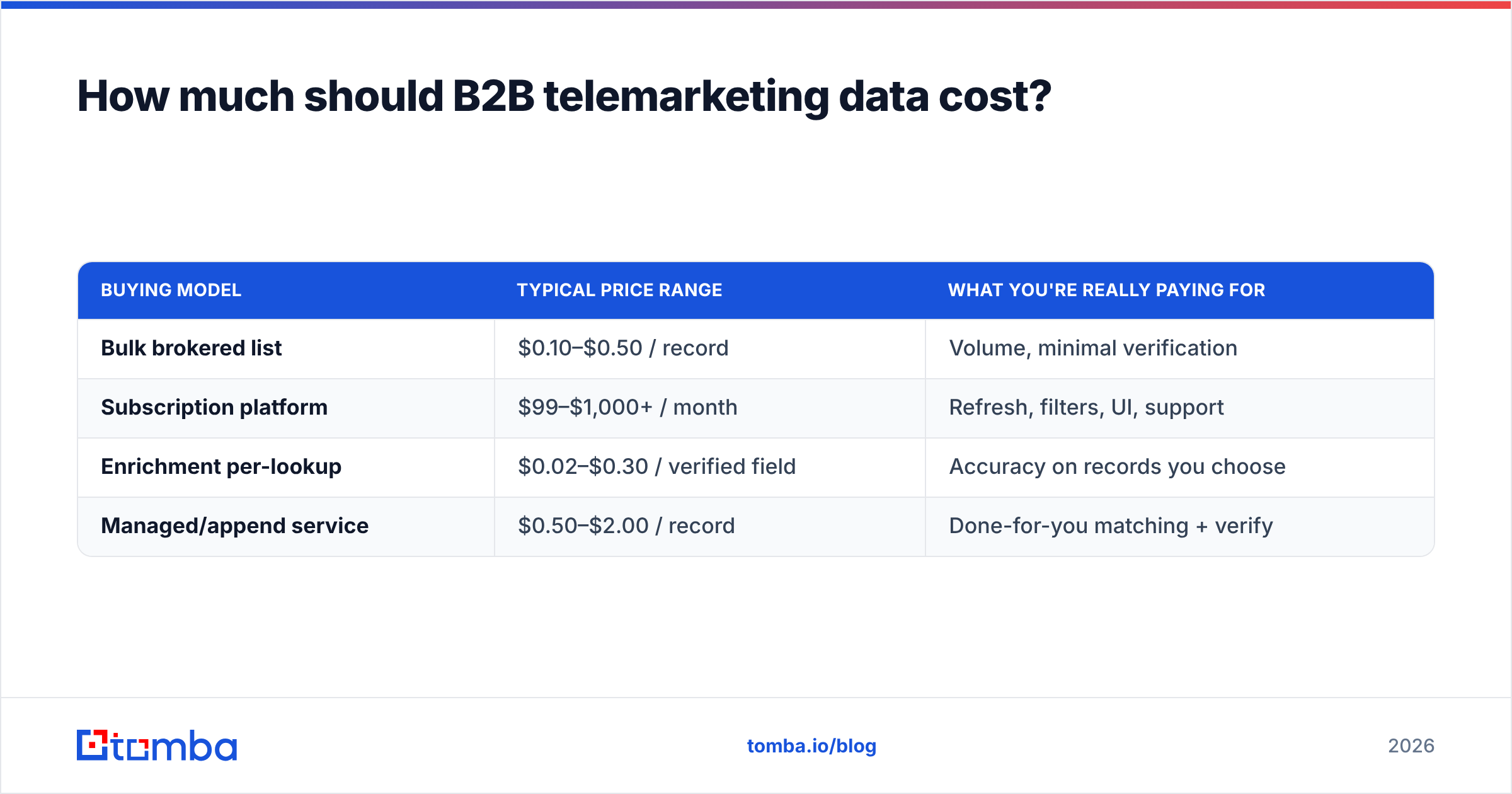
Here's a realistic 2026 cost picture across common buying models:
| Buying model | Typical price range | What you're really paying for |
|---|---|---|
| Bulk brokered list | $0.10–$0.50 / record | Volume, minimal verification |
| Subscription platform | $99–$1,000+ / month | Refresh, filters, UI, support |
| Enrichment per-lookup | $0.02–$0.30 / verified field | Accuracy on records you choose |
| Managed/append service | $0.50–$2.00 / record | Done-for-you matching + verify |
To make this concrete, do the math on rep time. If a rep costs $30/hour fully loaded and dials 25 numbers an hour, a list that's 50% wrong wastes roughly $15 of every hour on dead lines and wrong contacts. Across a 40-hour week that's $600 of pure waste — far more than the cost of verifying the list up front. For most teams, paying a little more for validated, recent data is the single highest-ROI decision in the campaign.
If you're comparing providers, look at Tomba pricing as a reference point: the Free tier covers 25 searches a month, Starter is $49/mo, Growth $99/mo, and Pro $249/mo, with credits that span phone, email, and enrichment rather than locking you into a single data type.

Is B2B telemarketing data legal? Compliance in 2026#
Yes — but only if you respect the rules for the regions you call into, and they've gotten stricter. Telemarketing compliance is not optional polish; a single FCC enforcement action or GDPR complaint can dwarf any revenue a sloppy campaign produces.
The core frameworks you need to know:
- TCPA (United States) — The Telephone Consumer Protection Act governs how you can call, especially mobiles and anything using automated dialing. Recent rule changes tightened consent requirements; review the current text on the FCC's TCPA page before launching.
- National & internal Do-Not-Call (DNC) — You must scrub against the national DNC registry where applicable and honor your own opt-out list. B2B-to-B2B direct dials have some carve-outs, but they're narrower than people assume.
- GDPR (EU) and PECR (UK) — Calling EU/UK contacts requires a lawful basis. "Legitimate interest" can apply to B2B outreach, but you must document it and offer an easy opt-out.
- State-level laws (US) — Several states layer their own calling-time, registration, and consent rules on top of federal law.
Practical rule of thumb: keep a defensible record of where each number came from, when it was verified, and the consent or legal basis attached to it. That provenance trail is exactly the kind of context a structured contact record should carry — see how Tomba documents its data sources for the model you want to replicate internally.
How do you keep a telemarketing list clean?#
Phone data rots. People change jobs, companies switch carriers, direct lines get reassigned. Industry estimates put B2B contact decay at 18–30% per year, which means a list you bought in January is meaningfully worse by summer. A clean-list workflow is what separates teams that dial all day from teams that talk all day.
A repeatable hygiene process looks like this:
- Deduplicate first. Remove repeat records before you spend a credit verifying them. Even a quick pass to remove duplicates can shrink a list 10–20%.
- Validate the numbers. Run records through a phone validator to confirm the line is active and correctly formatted for its country before reps ever dial.
- Enrich the gaps. Where you only have a name and company, use enrichment to append a current direct dial, title, and a backup email verifier-checked address for multichannel follow-up.
- Scrub for compliance. Cross-check against DNC and your internal suppression list, and flag region so reps follow the right calling-time rules.
- Re-verify on a schedule. Treat verification as recurring maintenance, not a one-time event. Quarterly re-checks keep decay from quietly killing connect rates.
Done consistently, this turns a noisy 20,000-row spreadsheet into a tight, dial-ready segment your reps can actually trust.
B2B telemarketing data vs. buying a generic list: which is better?#
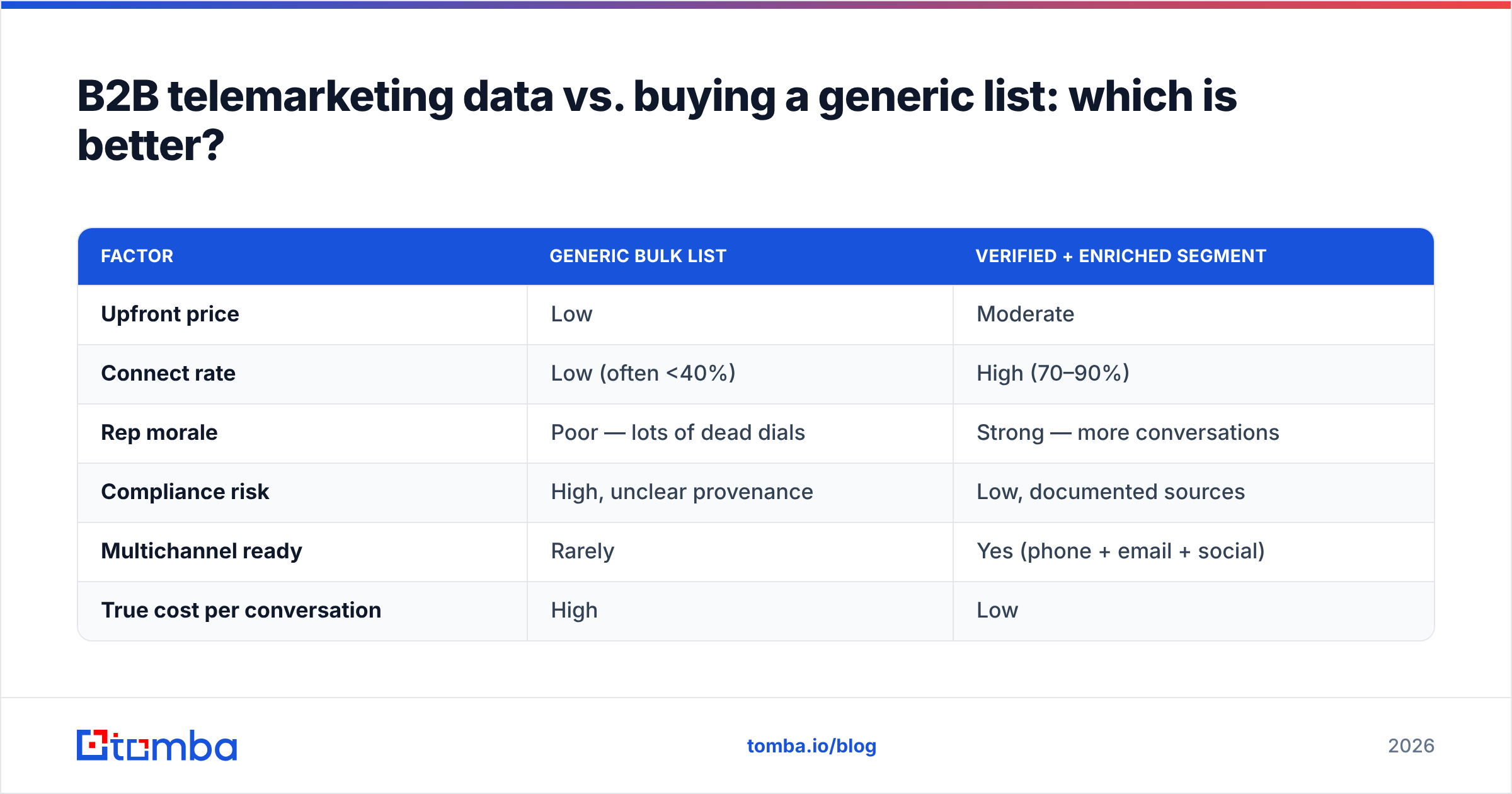
For almost every modern team, building a verified, enriched segment beats buying a generic bulk list outright. Here's the honest trade-off:
| Factor | Generic bulk list | Verified + enriched segment |
|---|---|---|
| Upfront price | Low | Moderate |
| Connect rate | Low (often <40%) | High (70–90%) |
| Rep morale | Poor — lots of dead dials | Strong — more conversations |
| Compliance risk | High, unclear provenance | Low, documented sources |
| Multichannel ready | Rarely | Yes (phone + email + social) |
| True cost per conversation | High | Low |
The generic list wins on one line only — upfront price — and loses on every line that affects results. Unless you're running a one-off, low-stakes blast, the verified-segment approach pays for itself within the first campaign through higher connect rates and fewer wasted rep hours.
What does a good telemarketing data workflow look like end to end?#
Pull it together and the workflow is straightforward:
- Define the ICP — industry, size, seniority, region. Narrow beats broad.
- Source the base records — pull from your CRM first, then fill with a platform or enrichment API rather than a blind bulk buy.
- Enrich and append — add direct dials, titles, and email/LinkedIn for follow-up. The phone finder and enrichment tools handle this in bulk.
- Clean and verify — dedupe, validate numbers, scrub against DNC.
- Document provenance — log source, date, and legal basis per record.
- Dial, then refresh — track connect rates, suppress opt-outs immediately, and re-verify quarterly.
That loop — source, enrich, verify, document, refresh — is the whole game. Skip the verify step and you're back to dialing dead lines.
Start with accurate data#
Telemarketing in 2026 rewards precision, not volume. The teams that win are the ones who treat phone records as a living, verified asset — sourced deliberately, enriched on demand, scrubbed for compliance, and refreshed on a schedule. Everything in this guide comes back to one principle: good conversations start with good data.
If you want to build that foundation without buying a giant stale list, start with the Tomba Email Finder and pair it with phone finding, enrichment, and verification under one roof. You get current direct contacts plus the email and firmographic context to follow up across channels — so your reps spend their hours talking to the right people instead of redialing numbers that no longer ring. Try the free tier, enrich a sample of your list, and compare connect rates before you commit a budget to any bulk provider.
// get started
Find, verify and enrich your first contacts today
Start on the free plan with 25 searches a month, then scale when your team is ready.
Free plan · No credit card required · GDPR & CCPA
// about the author