B2B Telesales in 2026: The Complete Playbook That Converts
B2B telesales is far from dead in 2026. Here's the data-backed playbook, scripts, metrics, and tools that turn dials into booked pipeline.
TL;DR
- B2B telesales still books pipeline in 2026 — but only when reps call the right people with verified direct-dial numbers, not stale switchboard lists.
- Connect rates live and die on data quality. Bad numbers waste 60–70% of dialing time before a rep ever opens their mouth.
- The winning stack is small: a clean phone dataset, a parallel or power dialer, a CRM for logging, and a tight script with a permission-based opener.
- Track connect rate, conversation rate, and meetings booked per 100 dials — not raw dial volume.
- Pair your dialer with a real data source like Tomba's phone finder so reps spend minutes on conversations, not on ringing dead lines.
What is B2B telesales in 2026?#
B2B telesales is the practice of selling to other businesses over the phone — booking meetings, qualifying leads, or closing deals through live voice conversations. Think of it like fishing: the phone is your rod, but the data is the water you cast into. A perfect cast into an empty lake catches nothing.
The discipline has changed. In 2026, "telesales" rarely means a room of reps reading a script off a card and dialing main switchboards. It means a focused motion where reps reach decision-makers on their mobile or direct line, often as one channel inside a multi-touch sequence that also uses email and LinkedIn.
The phone survived the "cold calling is dead" obituaries for one reason: it is still the fastest path to a real conversation. Email gets ignored, LinkedIn gets crowded, but a well-timed call to the right person at the right account still produces a two-way exchange in seconds. The catch is that "the right person" and "the right number" are now data problems, not dialing problems.
Is B2B telesales still effective, or is it dead?#
It is effective — for teams that fixed their data. It is dead for teams still buying generic lists.
Here is the honest version. Average cold-call connect rates sit in the low single digits when reps dial unverified numbers, and most of that loss happens before any selling occurs: disconnected lines, wrong contacts, gatekeepers, and switchboards that route nowhere. According to research compiled by HubSpot, the majority of buyers are still open to a phone conversation early in their journey — the problem is reaching them, not their willingness to talk.
When you strip out the wasted dials, the economics flip. A rep who reaches 20 right-fit decision-makers a day and converts even 10% into a conversation, and a third of those into a meeting, is building real pipeline. The same rep dialing 200 dead numbers to hit those same 20 connects is just burning hours.
So the question is not "does telesales work?" It is "are your reps spending their day talking or dialing?" That single ratio separates teams that scale phone outreach from teams that quietly abandon it.
What does a high-converting B2B telesales process look like?#
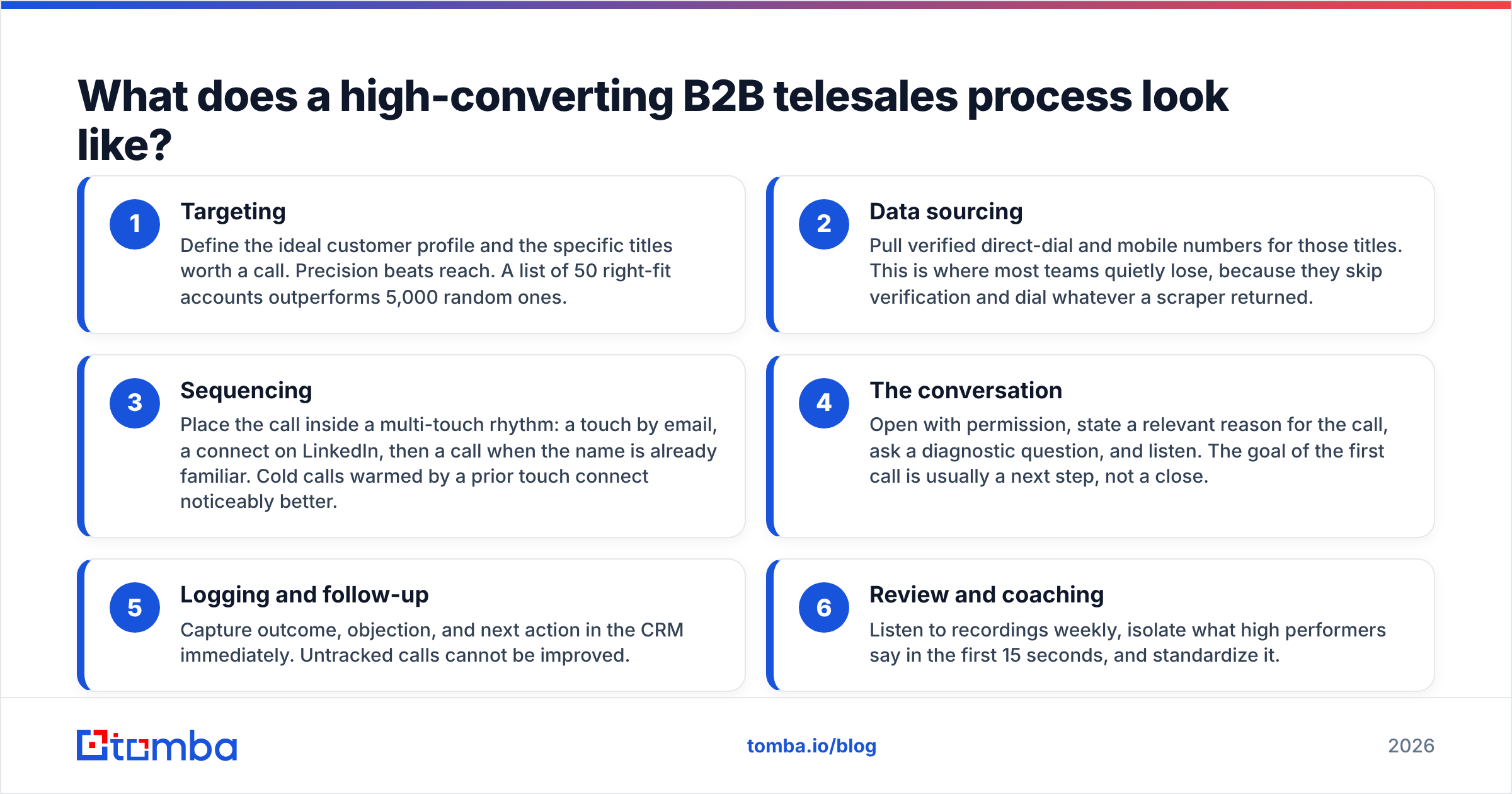
A modern telesales process has six repeatable stages. Treat them as a pipeline where each stage feeds the next:
- Targeting — Define the ideal customer profile and the specific titles worth a call. Precision beats reach. A list of 50 right-fit accounts outperforms 5,000 random ones.
- Data sourcing — Pull verified direct-dial and mobile numbers for those titles. This is where most teams quietly lose, because they skip verification and dial whatever a scraper returned.
- Sequencing — Place the call inside a multi-touch rhythm: a touch by email, a connect on LinkedIn, then a call when the name is already familiar. Cold calls warmed by a prior touch connect noticeably better.
- The conversation — Open with permission, state a relevant reason for the call, ask a diagnostic question, and listen. The goal of the first call is usually a next step, not a close.
- Logging and follow-up — Capture outcome, objection, and next action in the CRM immediately. Untracked calls cannot be improved.
- Review and coaching — Listen to recordings weekly, isolate what high performers say in the first 15 seconds, and standardize it.
The teams that win obsess over stage two. Everything downstream — script quality, rep morale, manager coaching — is wasted if the rep is dialing a number that rings into a void. Feed the process clean data and the rest of the playbook actually gets a chance to work.
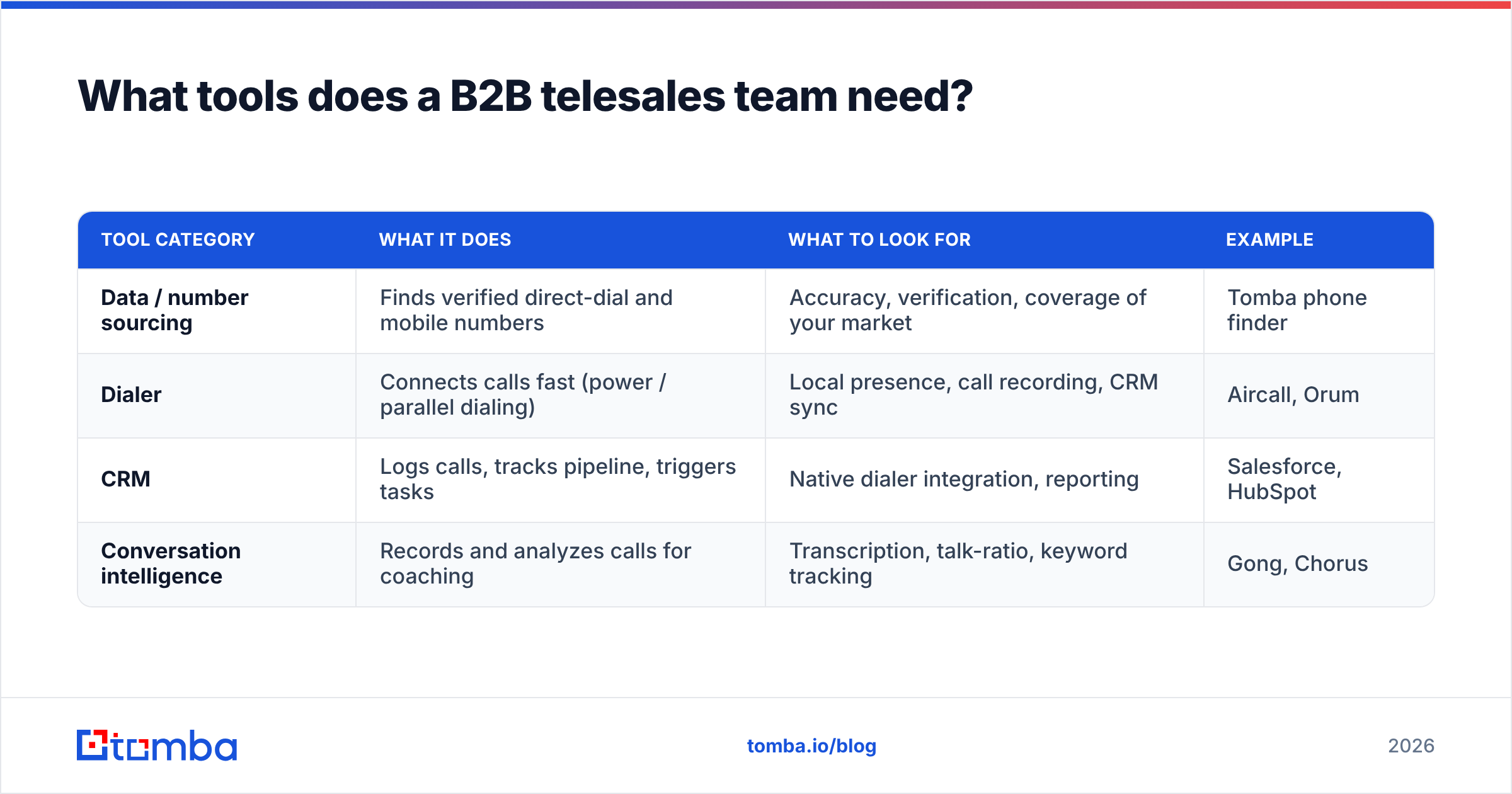
What tools does a B2B telesales team need?#
You need four categories of tool, and resisting the urge to over-buy is part of the skill. Most teams bolt on six overlapping platforms when they need a tight, well-integrated four.
| Tool category | What it does | What to look for | Example |
|---|---|---|---|
| Data / number sourcing | Finds verified direct-dial and mobile numbers | Accuracy, verification, coverage of your market | Tomba phone finder |
| Dialer | Connects calls fast (power / parallel dialing) | Local presence, call recording, CRM sync | Aircall, Orum |
| CRM | Logs calls, tracks pipeline, triggers tasks | Native dialer integration, reporting | Salesforce, HubSpot |
| Conversation intelligence | Records and analyzes calls for coaching | Transcription, talk-ratio, keyword tracking | Gong, Chorus |
The non-obvious priority order: data first, dialer second. A fast dialer pointed at bad numbers just helps you fail faster. Get the data right, then add speed.
It is also worth validating numbers before they ever hit the dialer. A quick pass through a phone validator strips disconnected and invalid lines, so your connect-rate metrics reflect reality and your reps stop getting demoralized by dead air.
How do you build a B2B telesales script that works?#
Build it around a permission-based opener, not a pitch. The first 10 seconds decide everything.
A reliable structure:
- Opener (earn the next 30 seconds): "Hi [Name], it's [You] from [Company] — I know I'm calling out of the blue, can I borrow 30 seconds and you can tell me to get lost at the end?" Honesty about the cold call disarms the reflex to hang up.
- Reason (make it about them): Reference a trigger — a hire, a funding round, a tech change, a peer using you. "I noticed your team just expanded the SDR org..."
- Diagnostic question (start a conversation): "How are you handling [specific problem] today?" Then stop talking. The rep who listens longest usually wins the meeting.
- The ask (small, specific): "Worth a 15-minute look next Tuesday?" Book the next step; do not try to close the deal on call one.
Scripts are a floor, not a ceiling. Give reps the structure, then coach them to sound like humans inside it. A script read robotically performs worse than a confident rep riffing on bullet points. For inbound and reply situations, an AI email response tool can keep the follow-up tight while the rep stays on the phones.
What metrics actually matter in B2B telesales?#
Stop reporting raw dials. Dial volume is an input, not a result, and obsessing over it pushes reps toward spray-and-pray behavior that lowers quality.
Track these instead:
- Connect rate — Conversations started ÷ dials. This is mostly a data-quality metric. If it is low, fix your numbers before coaching your script.
- Conversation-to-meeting rate — Meetings booked ÷ conversations. This is your script-and-skill metric.
- Meetings per 100 dials — The blended number that ties effort to output. It is the single best north star for a telesales rep.
- Show rate — Booked meetings that actually happen. A high book rate with a low show rate signals weak qualification.
- Pipeline sourced per rep — The number leadership actually cares about.
The diagnostic power here is in the sequence. If meetings per 100 dials is low, walk backward: is connect rate the problem (data) or conversation-to-meeting (script)? You cannot fix what you do not isolate. Gartner's research on sales productivity consistently points to the same lesson — rep time is the scarcest resource, so every metric should map back to protecting it.
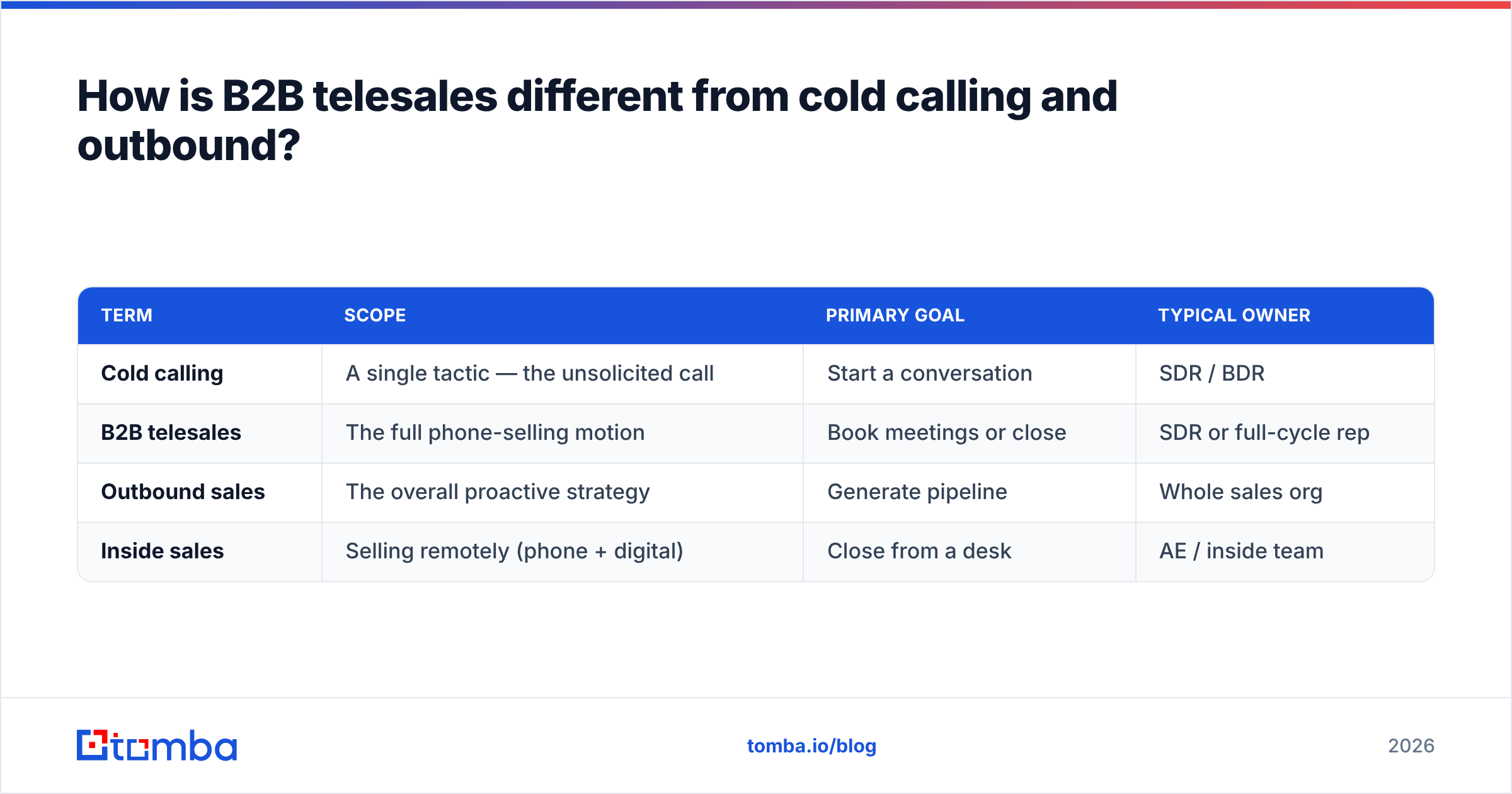
How is B2B telesales different from cold calling and outbound?#
They overlap, but they are not synonyms. Cold calling is one tactic; telesales is the whole phone-based selling motion; outbound is the broader strategy that contains both.
| Term | Scope | Primary goal | Typical owner |
|---|---|---|---|
| Cold calling | A single tactic — the unsolicited call | Start a conversation | SDR / BDR |
| B2B telesales | The full phone-selling motion | Book meetings or close | SDR or full-cycle rep |
| Outbound sales | The overall proactive strategy | Generate pipeline | Whole sales org |
| Inside sales | Selling remotely (phone + digital) | Close from a desk | AE / inside team |
Why it matters: leaders who conflate these set the wrong goals. You do not measure a telesales motion the way you measure a single cold-call blitz. Telesales lives inside a multi-channel sequence, and its job is sustained pipeline, not a one-day call sprint.
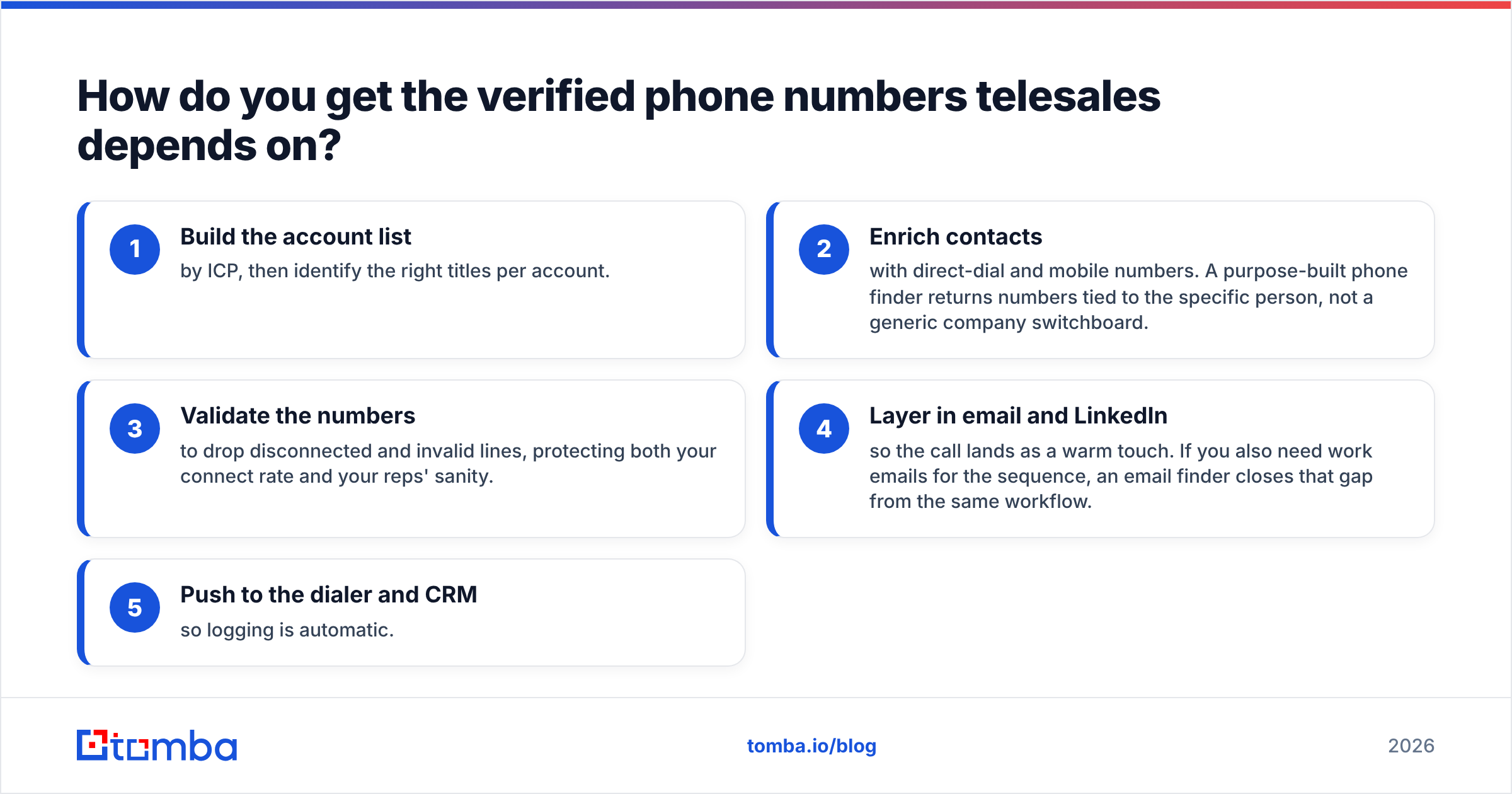
How do you get the verified phone numbers telesales depends on?#
You source them from a dedicated data provider and verify before dialing — never from a scraped list of unknown age.
The practical workflow most efficient teams run:
- Build the account list by ICP, then identify the right titles per account.
- Enrich contacts with direct-dial and mobile numbers. A purpose-built phone finder returns numbers tied to the specific person, not a generic company switchboard.
- Validate the numbers to drop disconnected and invalid lines, protecting both your connect rate and your reps' sanity.
- Layer in email and LinkedIn so the call lands as a warm touch. If you also need work emails for the sequence, an email finder closes that gap from the same workflow.
- Push to the dialer and CRM so logging is automatic.
This is the multiplier. Two SDRs with identical scripts and identical effort will produce wildly different pipeline if one dials verified mobiles and the other dials a switchboard list. The skill ceiling of telesales is capped by data quality — raise the data and you raise the whole team. Compare what verified sourcing costs against a wasted SDR salary and the math is not close; the full Tomba pricing starts free at 25 searches a month, with the Starter plan at $49/mo for teams ready to scale dialing volume.
What are the most common B2B telesales mistakes?#
Three mistakes account for most failed telesales programs:
- Dialing unverified data. The silent killer. Reps blame the script when the real problem is that 60% of their numbers never connect. Fix data first, always.
- Measuring activity instead of outcomes. Rewarding raw dials trains reps to rush, skip research, and leave voicemails into the void. Reward meetings per 100 dials.
- Pitching before earning attention. Launching into a feature dump in the first five seconds triggers an instant hang-up. Earn the next 30 seconds before you sell anything.
A fourth, quieter mistake: never listening to call recordings. Conversation intelligence is cheap now, and the gap between your best and worst rep is usually one specific habit in the opening line. Find it, teach it, and your whole floor improves.
The bottom line#
B2B telesales in 2026 is a data game wearing a phone-skills costume. The script matters, the dialer matters, the coaching matters — but all of it sits on top of whether your reps are reaching real people on real numbers. Get that foundation right and the phone is still one of the highest-leverage channels in B2B sales.
Start where the leverage is. Feed your reps verified direct-dial and mobile numbers with the Tomba phone finder, validate before you dial, and let your team spend their day in conversations instead of dial tones. You can try it free — 25 searches a month, no card — and see your connect rate climb before you ever change a word of your script.
// get started
Find, verify and enrich your first contacts today
Start on the free plan with 25 searches a month, then scale when your team is ready.
Free plan · No credit card required · GDPR & CCPA
// about the author