Sales Battle Card Template: Build Winning Cards in 2026
A battle card template turns scattered competitive intel into a one-page weapon your reps actually use. Here's how to build one that wins deals in 2026.
TL;DR
- A battle card template is a one-page, repeatable framework that arms reps with competitor intel, objection handling, and proof points at the exact moment they need it.
- The best cards are short, deal-stage specific, and updated quarterly — not 20-page PDFs that nobody opens.
- Every strong card answers five things: who the competitor is, why you win, why you lose, how to handle objections, and what to say next.
- You need three card types: competitor cards, persona cards, and product/feature cards. Don't cram them into one.
- Garbage in, garbage out: a battle card is only as good as the contact and account data feeding your outreach. Clean data is step zero.
If your reps freeze the second a prospect says "we're also looking at [Competitor X]," you don't have a talent problem. You have a content problem. A good battle card template fixes it.
What is a battle card template?#
A battle card template is a standardized layout that captures everything a rep needs to win a specific competitive or sales situation on a single, scannable page. Think of it like a chef's mise en place: before service starts, every ingredient is prepped, labeled, and within arm's reach so nobody scrambles when the orders fly in. A battle card does the same for a sales conversation — the objection responses, the differentiators, and the proof points are already chopped and ready.
The "template" part matters. Without a fixed structure, every product marketer builds cards differently, reps can't find what they need, and the whole library rots. A template forces consistency: same sections, same order, same length, every time. Reps learn the layout once and can read any card in fifteen seconds.
Battle cards live at the intersection of sales enablement and competitive intelligence. They're not training documents you read once. They're combat references you pull up live, often while a prospect is still talking.
Why do most battle cards fail?#
Most battle cards fail because they're written for the person who made them, not the person who uses them. Here's what goes wrong, and what to do instead.
- They're too long. A 12-page competitor teardown is a research report, not a battle card. Reps won't read it mid-call. Cap each card at one page — two absolute maximum.
- They're never updated. Competitors change pricing, ship features, and pivot messaging constantly. A card citing 2024 pricing actively loses deals. Assign an owner and a refresh cadence.
- They're all theory, no script. "Emphasize our superior integrations" is useless. "Say: 'Most teams switch from them because their Salesforce sync breaks on custom objects — here's how ours handles it'" is usable.
- They mix audiences. A card that tries to serve the CFO, the end user, and the IT admin at once serves none of them. Split by persona.
- They live where nobody looks. A card buried in a shared drive folder might as well not exist. Put cards in the CRM, the dialer, or wherever reps already work.
The fix for all five is discipline, not effort. A tight, current, scriptable, well-placed card beats an exhaustive one every time.
What sections belong in a battle card template?#
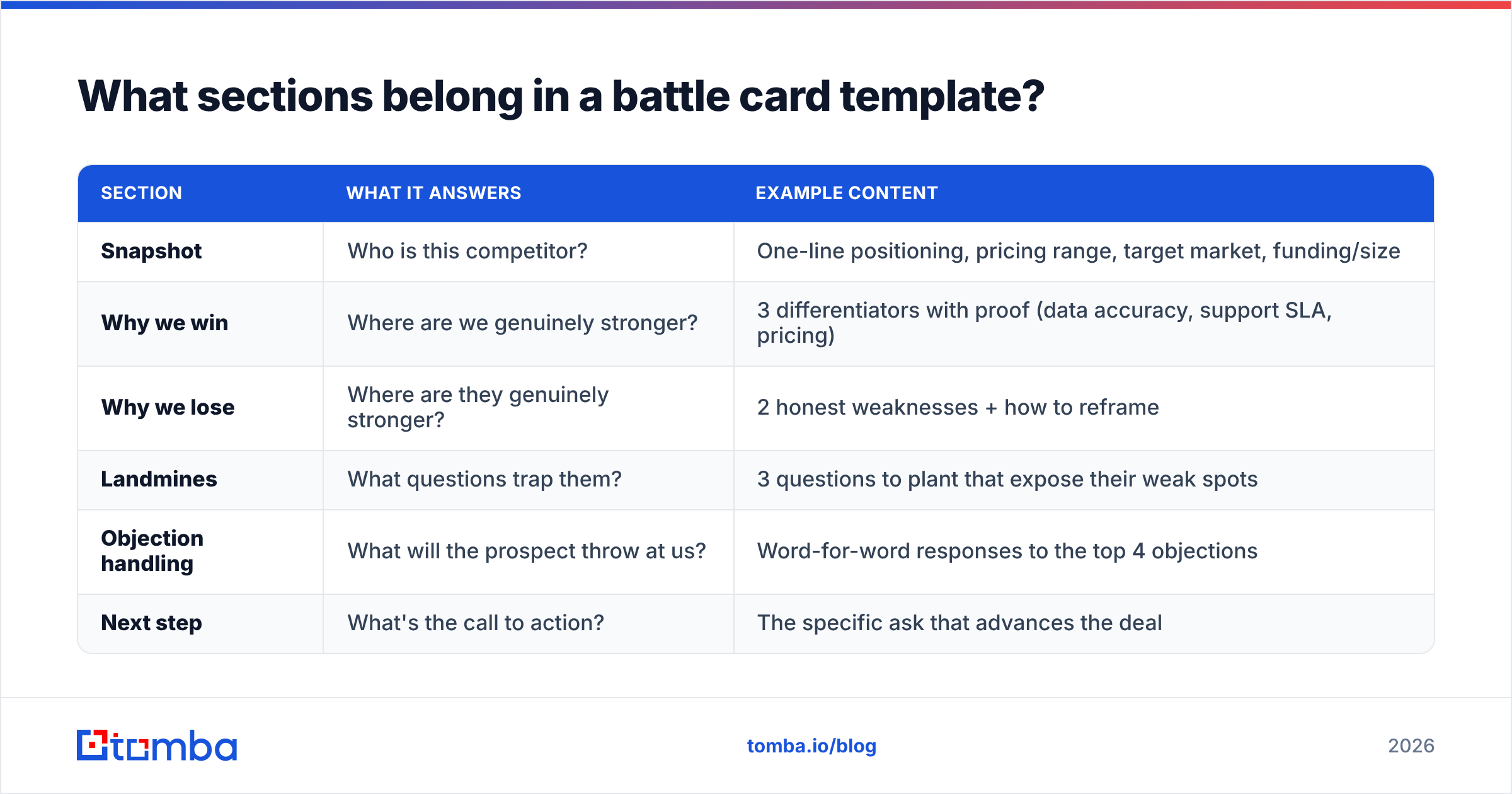
Every effective battle card template answers five core questions. Use these as your fixed section headers — this is the reusable skeleton you'll copy for every competitor.
| Section | What it answers | Example content |
|---|---|---|
| Snapshot | Who is this competitor? | One-line positioning, pricing range, target market, funding/size |
| Why we win | Where are we genuinely stronger? | 3 differentiators with proof (data accuracy, support SLA, pricing) |
| Why we lose | Where are they genuinely stronger? | 2 honest weaknesses + how to reframe |
| Landmines | What questions trap them? | 3 questions to plant that expose their weak spots |
| Objection handling | What will the prospect throw at us? | Word-for-word responses to the top 4 objections |
| Next step | What's the call to action? | The specific ask that advances the deal |
Two rules make this template work in the field.
First, be honest in the "why we lose" section. Reps trust a card that admits a competitor is cheaper or has a slicker UI far more than one that pretends you win on everything. Honesty is also a sales technique: acknowledging a real weakness builds credibility for everything else on the card.
Second, write landmines as questions, not claims. Instead of "we have better data coverage," give the rep a question to ask the prospect: "How do they handle catch-all domains in their verification?" A planted question the prospect later asks the competitor does more damage than any claim you make yourself.
What types of battle cards do you actually need?#
Don't build one mega-card. Build three focused types, each with its own template variant.
- Competitor cards — one per major competitor. The structure above. This is what most people mean by "battle card."
- Persona cards — one per buyer role (e.g., VP Sales, RevOps lead, founder). These capture pain points, language, and the metrics that persona cares about. A marketing qualified lead handed to sales should map to one of these personas.
- Product/feature cards — one per key feature or use case. Useful when the deal hinges on a specific capability rather than a head-to-head comparison.
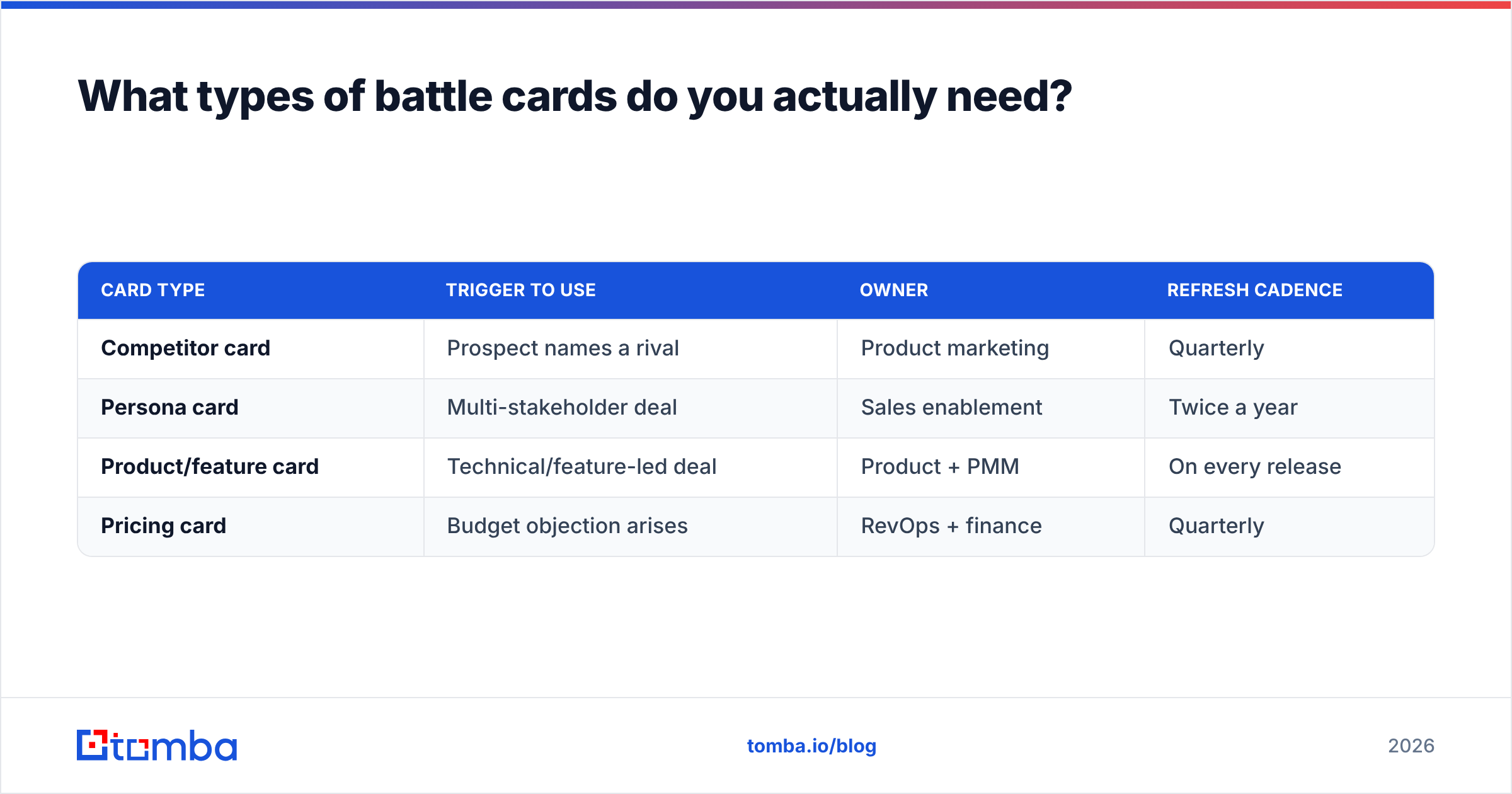
Here's how they compare and when to reach for each.
| Card type | Trigger to use | Owner | Refresh cadence |
|---|---|---|---|
| Competitor card | Prospect names a rival | Product marketing | Quarterly |
| Persona card | Multi-stakeholder deal | Sales enablement | Twice a year |
| Product/feature card | Technical/feature-led deal | Product + PMM | On every release |
| Pricing card | Budget objection arises | RevOps + finance | Quarterly |
A small team can start with just competitor cards for their top three rivals and expand from there. Don't let "we need all four types" stop you from shipping the first one this week.
How do you build a battle card from scratch?#
You build a battle card in four phases: gather, draft, pressure-test, and deploy. Treat it like writing a regression test — you don't trust it until you've seen it catch the bug it was made for.
Phase 1 — Gather intel. Pull from real sources, not assumptions:
- Win/loss interviews — the single richest source. Ask lost prospects why they chose the competitor.
- Public sources — the competitor's pricing page, G2 reviews, and their docs. Reviews are gold for "why we win/lose" because customers say the quiet part out loud.
- Your own CRM — filter closed-lost deals by competitor and read the notes.
- Rep debriefs — your front line hears objections daily. Run a 30-minute session and write down every recurring objection verbatim.
Phase 2 — Draft to the template. Fill in the six sections above. Keep every entry to one or two sentences. If a section needs a paragraph, you're writing a report, not a card.
Phase 3 — Pressure-test it. Have two reps role-play a deal using only the card. Where they hesitate, the card has a gap. This is your red-green check: if the card doesn't make a struggling rep more confident, it failed, and you rewrite it.
Phase 4 — Deploy where reps work. Embed cards in your CRM or sequencing tool. Tools like HubSpot let you attach playbooks directly to deal records so the card surfaces at the right stage.
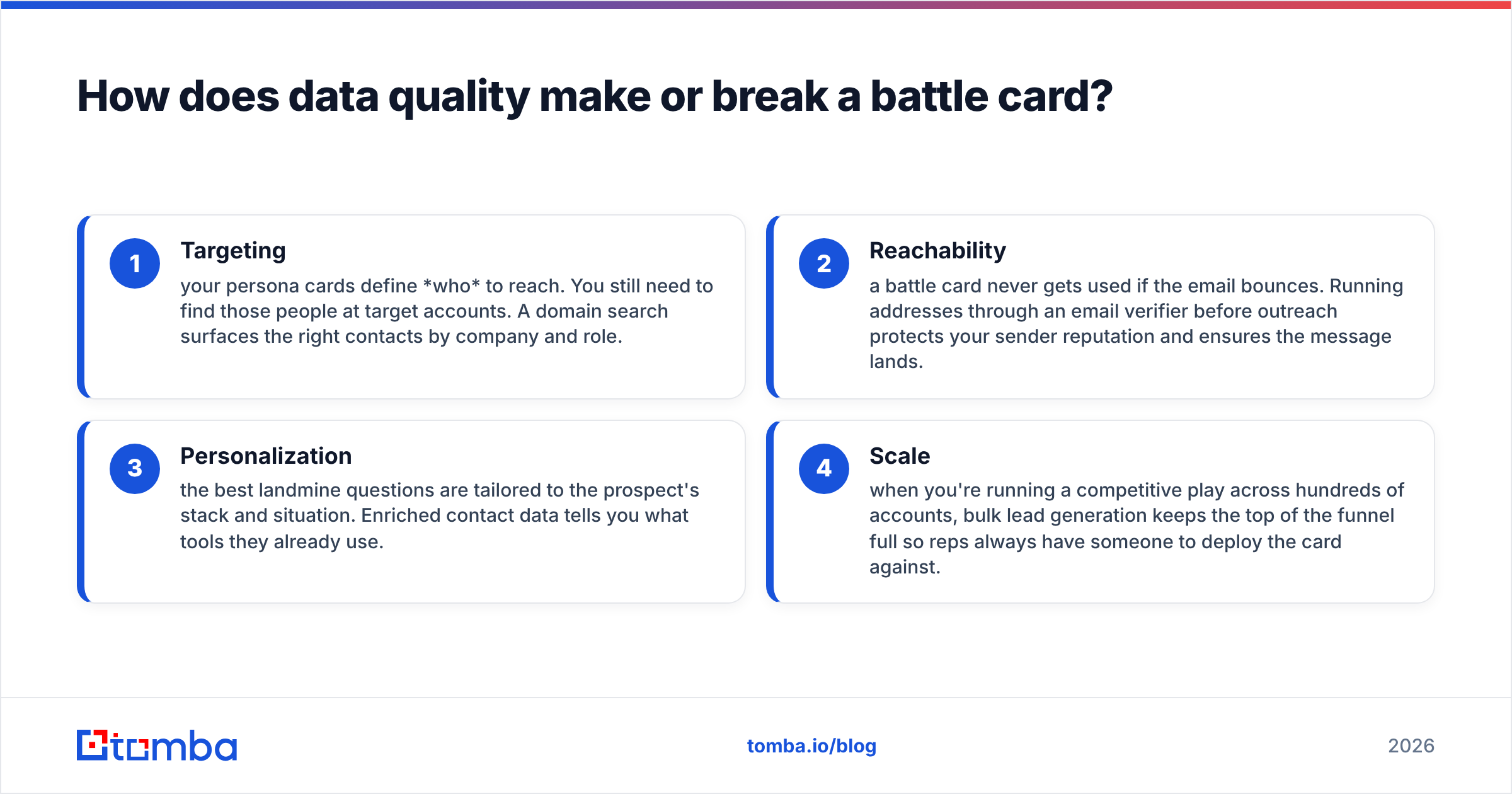
How does data quality make or break a battle card?#
A battle card is only as good as the prospect it reaches — and that comes down to data. The sharpest objection-handling script in the world is worthless if it lands in the inbox of someone who left the company eight months ago, or never arrives because the email bounced.
This is the part of competitive enablement nobody puts on the card: before a rep can deliver a single line of your carefully crafted positioning, they need a verified contact at the right account, on the right buying committee. That's where prospecting data feeds directly into battle-card effectiveness.
Consider the chain of dependencies:
- Targeting — your persona cards define who to reach. You still need to find those people at target accounts. A domain search surfaces the right contacts by company and role.
- Reachability — a battle card never gets used if the email bounces. Running addresses through an email verifier before outreach protects your sender reputation and ensures the message lands.
- Personalization — the best landmine questions are tailored to the prospect's stack and situation. Enriched contact data tells you what tools they already use.
- Scale — when you're running a competitive play across hundreds of accounts, bulk lead generation keeps the top of the funnel full so reps always have someone to deploy the card against.
Put plainly: battle cards win the conversation, but only if you can start the conversation. Clean, verified, enriched data is the on-ramp. Skip it and your enablement investment leaks out the bottom.
Battle card template vs. competitive intelligence platform: which do you need?#
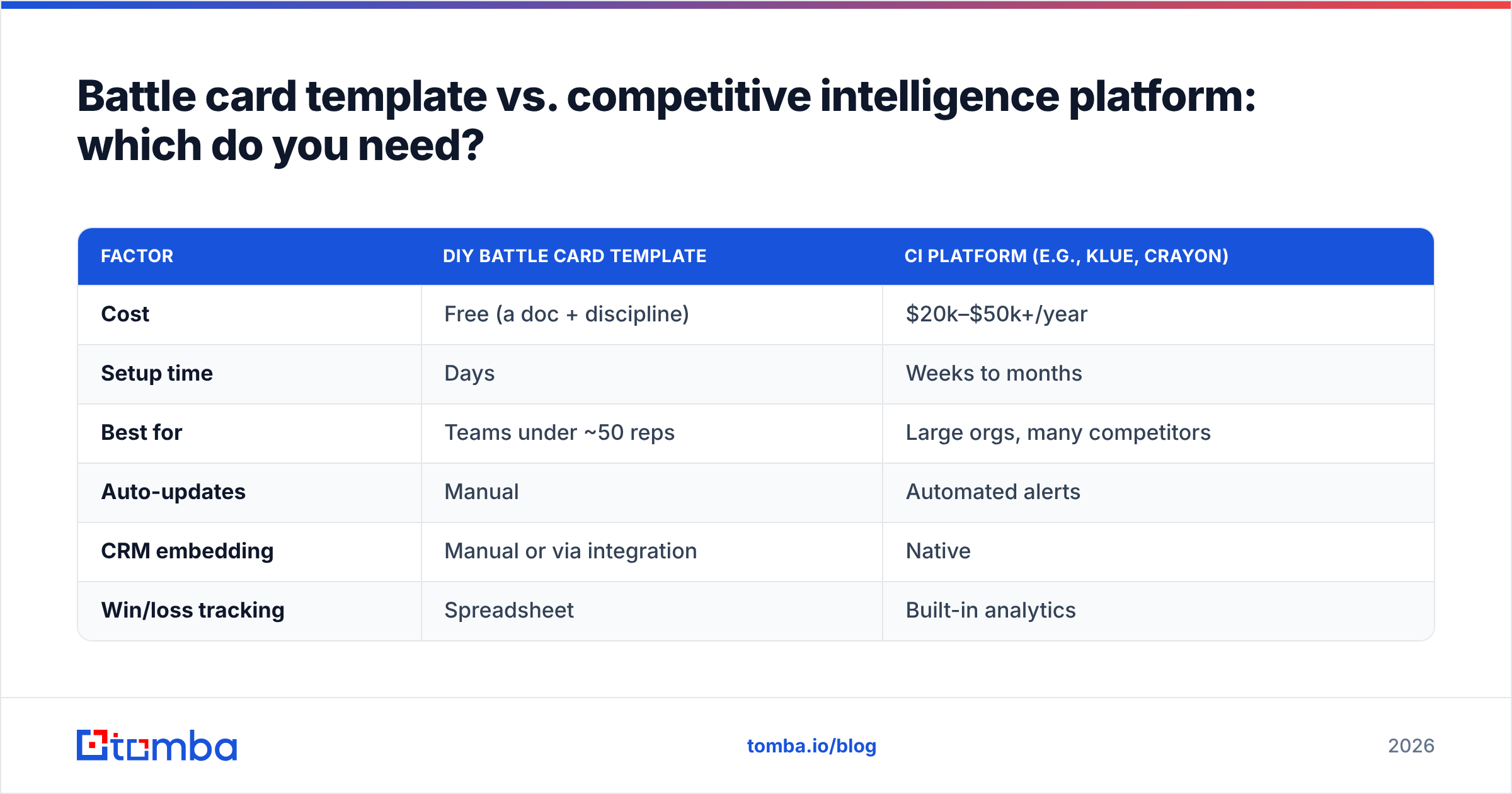
Teams often ask whether a simple template is enough or whether they need a dedicated competitive intelligence platform. Here's the honest comparison.
| Factor | DIY battle card template | CI platform (e.g., Klue, Crayon) |
|---|---|---|
| Cost | Free (a doc + discipline) | $20k–$50k+/year |
| Setup time | Days | Weeks to months |
| Best for | Teams under ~50 reps | Large orgs, many competitors |
| Auto-updates | Manual | Automated alerts |
| CRM embedding | Manual or via integration | Native |
| Win/loss tracking | Spreadsheet | Built-in analytics |
For most early- and mid-stage teams, a well-maintained template in a shared doc or your CRM beats an expensive platform you won't fully use. Buy the platform when you have a dedicated competitive intel role and more than a handful of active competitors to track. Don't buy tooling to compensate for a process you haven't built yet.
What does a filled-in battle card look like?#
Here's a condensed example using the template — a card for beating a generic, lower-accuracy email-finding competitor. Notice how every line is scriptable and honest.
Snapshot: Mid-market email tool, ~$79/mo entry tier, strong brand, known for broad database but inconsistent verification on catch-all domains.
Why we win:
- Higher verified-email accuracy on catch-all domains (lead with a specific number from your testing).
- Transparent pricing — Tomba starts at $49/mo with a real free tier of 25 searches; check Tomba pricing for current plans.
- Faster, human support.
Why we lose:
- They have a larger raw database. Reframe: "More records doesn't mean more usable records — what matters is verified deliverability, not list size."
Landmines (questions to plant):
- "What's their bounce rate on catch-all domains specifically?"
- "Do they charge for unverified results?"
Objection — 'They're cheaper at scale':
"Let's compare cost per verified contact, not per search. Unverified emails cost you sender reputation, which is far more expensive than the subscription difference."
Next step: Offer a side-by-side accuracy test on 100 of the prospect's own target accounts.
That's a full battle card in under 150 words. Reps can read it in fifteen seconds and use every line.
How often should you update battle cards?#
Update competitor and pricing cards quarterly at minimum, and immediately when a competitor makes a major move — a pricing change, a big feature launch, an acquisition, or a rebrand. Persona cards can run on a six-month cycle since buyer pain shifts more slowly.
Assign a single owner per card. Shared ownership means no ownership. The owner's job is to watch the competitor's pricing page, release notes, and review profiles, then push updates and notify reps in your team channel. A stale card is worse than no card because reps will trust it and get burned.
A simple trick: add a "last updated" date to your template header. Reps instinctively trust a card dated last month over one with no date, and the visible staleness pressures the owner to keep it fresh.
Put your battle cards to work#
A battle card template gives your team a repeatable way to win competitive deals — but only if the conversations actually start. The cleanest positioning in the world does nothing sitting in a doc; it has to reach a real, verified decision-maker at a real target account.
That's the gap the Tomba Email Finder closes. Find verified professional emails by name, company, or domain, so every battle card you've built actually lands in front of the right buyer instead of bouncing. Pair it with the email verifier to protect deliverability before you deploy a single objection-handling script. Start free with 25 searches a month, then scale up as your competitive plays expand. Build the cards, then make sure they reach someone who can say yes.
// get started
Find, verify and enrich your first contacts today
Start on the free plan with 25 searches a month, then scale when your team is ready.
Free plan · No credit card required · GDPR & CCPA
// about the author