The BDM Role in 2026: What a Business Development Manager Does
A clear, no-fluff breakdown of the BDM role in 2026: what a business development manager actually does, the skills and KPIs that matter, and how the job differs from sales.
The BDM Role in 2026: What a Business Development Manager Does
TL;DR
- The BDM role (Business Development Manager) owns top-of-funnel growth: opening new markets, sourcing partnerships, and building qualified pipeline — not closing every deal.
- It is distinct from an Account Executive or SDR. A BDM blends strategy, prospecting, and relationship-building across a longer time horizon.
- Core 2026 skills: market research, outbound prospecting, data fluency, partnership negotiation, and CRM discipline.
- KPIs center on qualified pipeline created, new logos, partnership revenue, and meeting-to-opportunity conversion — not just closed-won.
- The biggest productivity lever for a modern BDM is clean contact data. Tools like a reliable email finder turn a target list into reachable decision-makers.
If you are hiring for, interviewing for, or trying to define the BDM role, the title hides a lot of variation. At one company a Business Development Manager is a glorified SDR booking demos; at another, they negotiate channel partnerships worth seven figures. This guide draws the lines clearly so you know what the job is, what to measure, and how to do it well in 2026.
What is the BDM role?#
A Business Development Manager (BDM) is responsible for creating new revenue opportunities — finding markets, partners, and accounts that did not exist in the pipeline yesterday. Think of a BDM as the scout and the bridge-builder of a revenue team: while account executives work the deals already on the board, the BDM is out mapping new territory and laying the first plank across the river.
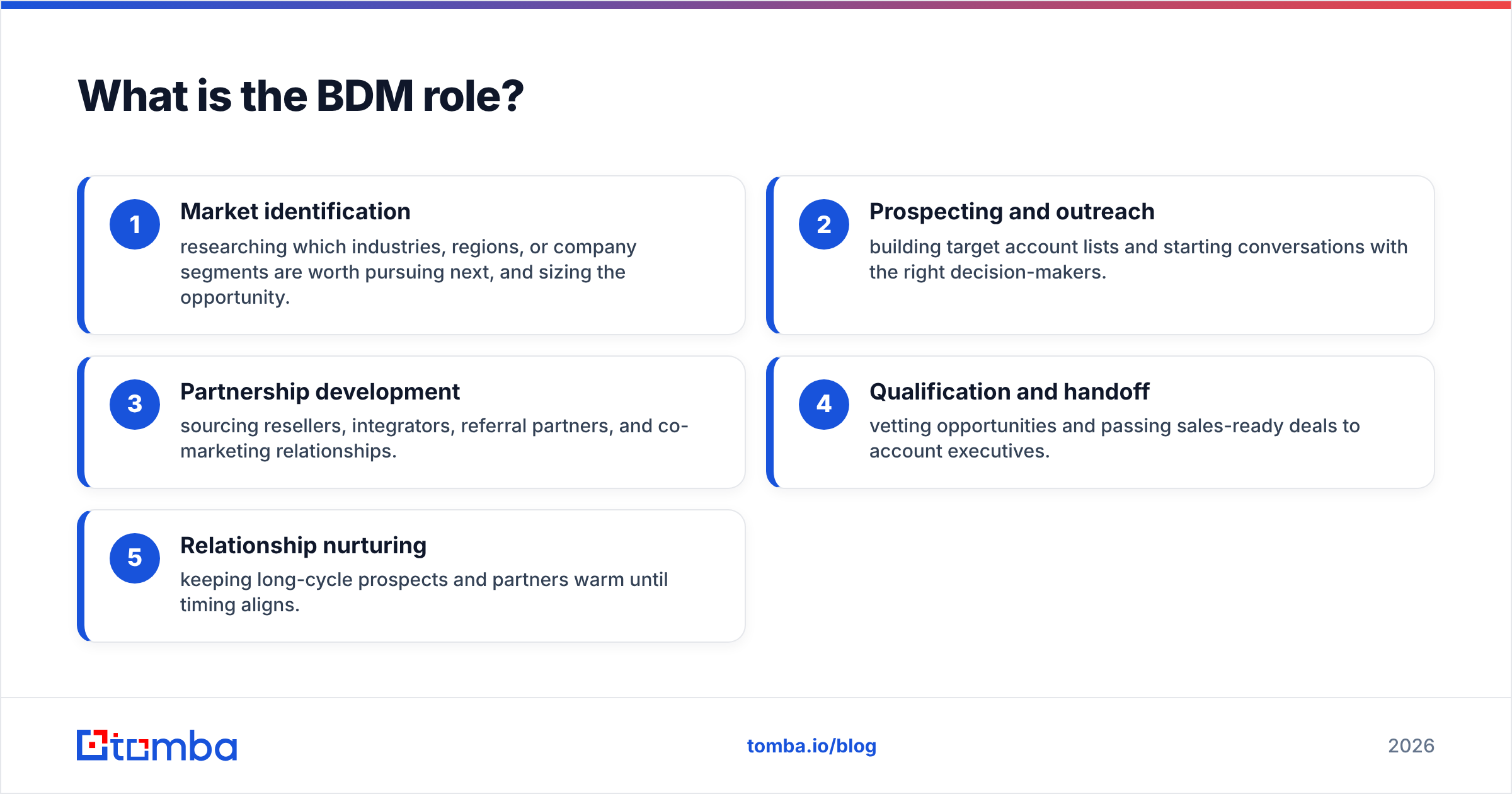
The role sits at the intersection of sales, marketing, and strategy. A BDM spends their week on a few distinct jobs:
- Market identification — researching which industries, regions, or company segments are worth pursuing next, and sizing the opportunity.
- Prospecting and outreach — building target account lists and starting conversations with the right decision-makers.
- Partnership development — sourcing resellers, integrators, referral partners, and co-marketing relationships.
- Qualification and handoff — vetting opportunities and passing sales-ready deals to account executives.
- Relationship nurturing — keeping long-cycle prospects and partners warm until timing aligns.
The common thread is that a BDM is measured on what they open, not only on what they close. That single distinction explains most of the confusion around the title.
How is the BDM role different from sales roles?#
A BDM is not an SDR and not an Account Executive, even though the responsibilities overlap. The simplest way to separate them is by time horizon and ownership: SDRs work the top of the funnel in volume, AEs own the close, and BDMs own new-market and partnership creation that feeds both.
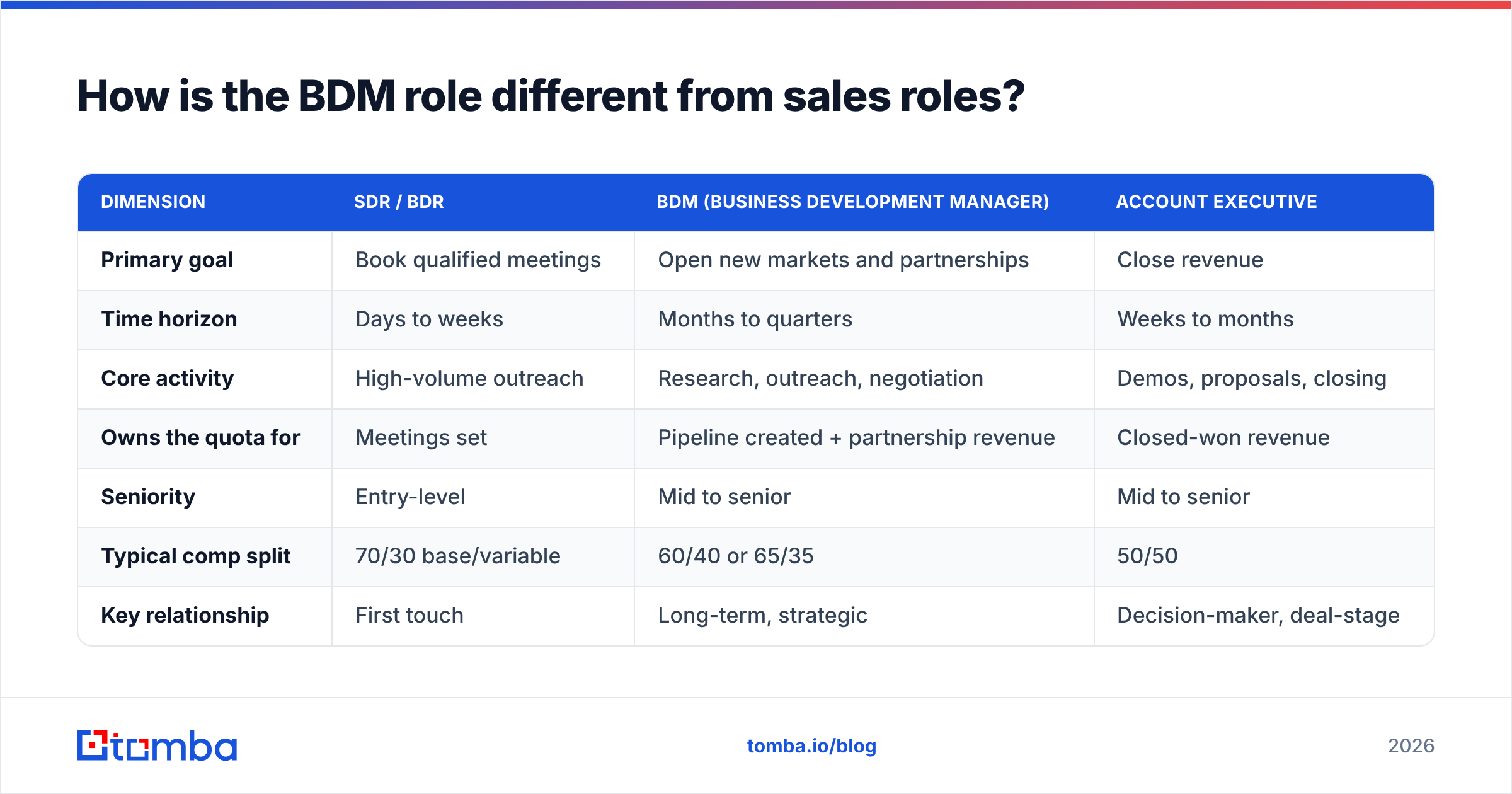
Here is how the three roles compare across the dimensions that matter when you are structuring a team:
| Dimension | SDR / BDR | BDM (Business Development Manager) | Account Executive |
|---|---|---|---|
| Primary goal | Book qualified meetings | Open new markets and partnerships | Close revenue |
| Time horizon | Days to weeks | Months to quarters | Weeks to months |
| Core activity | High-volume outreach | Research, outreach, negotiation | Demos, proposals, closing |
| Owns the quota for | Meetings set | Pipeline created + partnership revenue | Closed-won revenue |
| Seniority | Entry-level | Mid to senior | Mid to senior |
| Typical comp split | 70/30 base/variable | 60/40 or 65/35 | 50/50 |
| Key relationship | First touch | Long-term, strategic | Decision-maker, deal-stage |
In smaller companies, one person wears all three hats. In larger orgs, the BDM role becomes specialized — sometimes purely partnerships, sometimes purely new-logo hunting. When you read a job description, look past the title and check which row of that table the responsibilities actually map to.
What skills does a Business Development Manager need in 2026?#
The strongest BDMs in 2026 pair classic relationship skills with genuine data fluency. The market has changed: buyers research before they ever take a call, and generic outreach gets ignored. A modern BDM has to be sharp on a handful of competencies.
- Market research and segmentation. You need to identify which accounts are worth pursuing and why. That means reading industry signals, sizing total addressable market, and prioritizing ruthlessly instead of spraying outreach across everyone.
- Data and tooling fluency. A BDM who can build a clean target list, enrich it, and reach verified contacts moves three times faster than one who copies addresses off LinkedIn. Comfort with a CRM, enrichment tools, and data enrichment workflows is now table stakes.
- Outbound communication. Cold email, social selling, and calls still drive the role. Writing a message that earns a reply — concise, specific, and relevant — is the daily craft.
- Negotiation and partnership building. Channel and referral deals require structuring incentives, aligning interests, and managing relationships over months.
- Qualification discipline. Knowing when to walk away is as valuable as knowing when to push. Good BDMs protect AE time by passing only sales-ready opportunities.
- Resilience and follow-through. New-market work means more rejection and longer cycles. Consistency over a quarter beats intensity over a week.
Notice that half of these skills now depend on tools. The judgment is human; the leverage is technical. A BDM who treats prospecting as a manual chore burns hours that a good workflow would save — and that gap shows up directly in pipeline numbers. If you want a deeper view of where contact data comes from and why accuracy matters, Tomba documents its data sources openly.
What does a BDM's day actually look like?#
A BDM's calendar is a mix of deep research blocks and high-volume conversation. No two companies run it identically, but a productive day usually breaks down like this:
- Morning research and list-building (90 min): Reviewing target accounts, finding the right decision-makers, and verifying contact details before any outreach goes out.
- Outbound block (2-3 hrs): Sending personalized email sequences, LinkedIn messages, and follow-ups. Quality of targeting beats raw volume here.
- Live conversations (2-3 hrs): Discovery calls, partnership discussions, and qualification meetings.
- Pipeline hygiene (30-45 min): Updating the CRM, logging next steps, and grooming the long-term nurture list.
- Strategy and reporting (variable): Weekly, mapping new segments and reviewing what is converting.
The hidden tax in this day is bad data. Every bounced email, wrong number, or outdated title is wasted effort that compounds. This is exactly where the right stack pays for itself — and where it is tempting to keep chasing the next shiny tool instead of fixing the data underneath.
How is a BDM measured? Key KPIs and metrics#
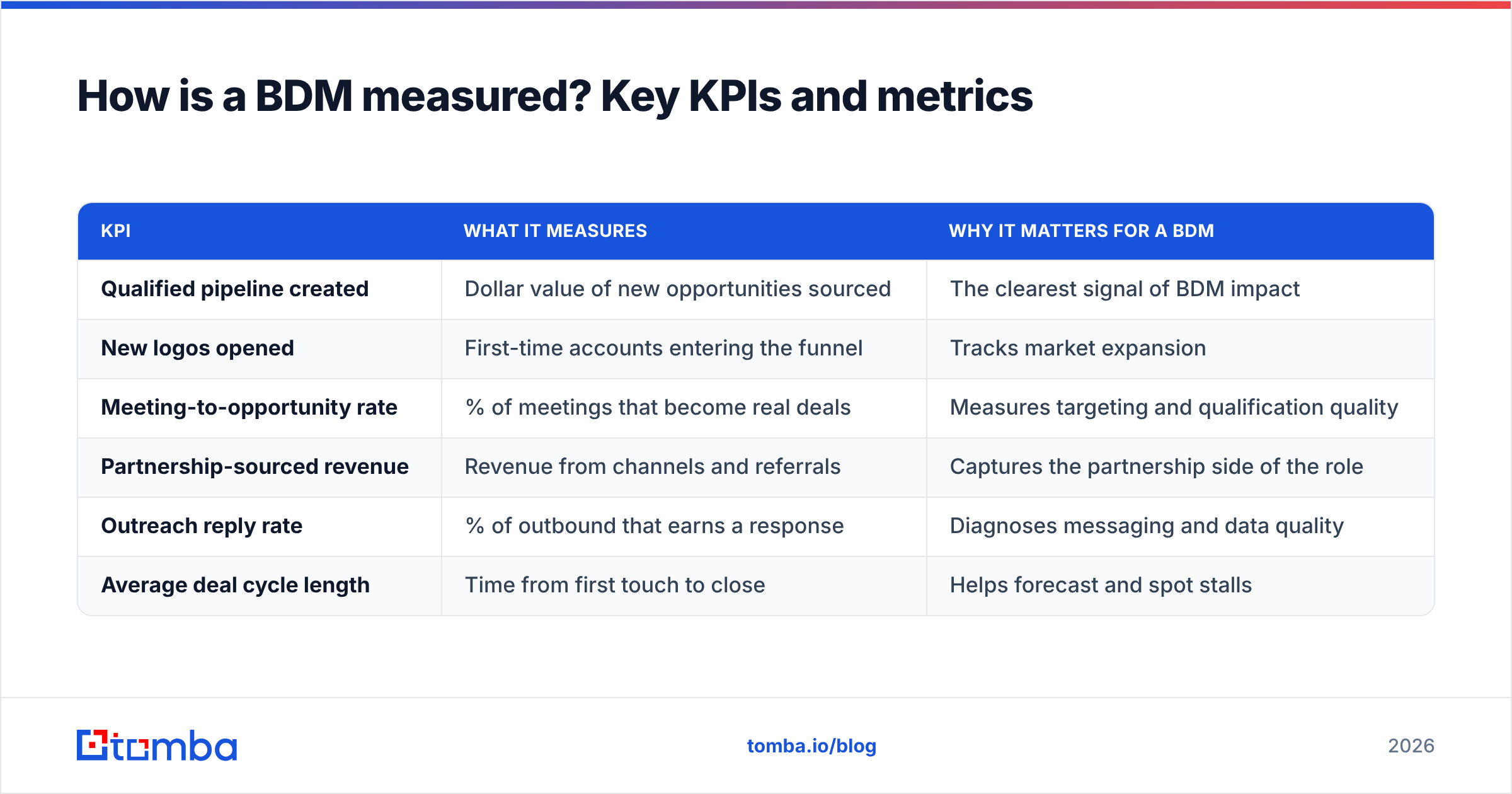
A BDM is measured on pipeline creation and new-business signals, not solely on closed revenue. Because the role works further up the funnel and over longer cycles, tying compensation purely to closed-won would punish the BDM for deals that take two quarters to land. The metrics below give a fairer, more accurate picture.
| KPI | What it measures | Why it matters for a BDM |
|---|---|---|
| Qualified pipeline created | Dollar value of new opportunities sourced | The clearest signal of BDM impact |
| New logos opened | First-time accounts entering the funnel | Tracks market expansion |
| Meeting-to-opportunity rate | % of meetings that become real deals | Measures targeting and qualification quality |
| Partnership-sourced revenue | Revenue from channels and referrals | Captures the partnership side of the role |
| Outreach reply rate | % of outbound that earns a response | Diagnoses messaging and data quality |
| Average deal cycle length | Time from first touch to close | Helps forecast and spot stalls |
The reply-rate metric is the canary in the coal mine. If outreach replies drop, the cause is usually one of two things: weak messaging or bad contact data. You can fix messaging with better copy and testing. You fix data quality by verifying addresses before you send — which is why an email verifier belongs in every BDM's workflow. According to deliverability research summarized by industry sources like HubSpot, bounce rates above a few percent actively damage sender reputation, which then drags down every future campaign.
What is the typical BDM salary and career path?#
Business Development Manager compensation varies widely by region, industry, and seniority, but the role generally lands in the mid-to-upper sales-comp band. Reviewing aggregated ranges on platforms like Glassdoor and G2 for vendor research, a few patterns hold:
- Junior BDM: Lower base, higher emphasis on activity metrics; often a step up from an SDR role.
- Mid-level BDM: Balanced base and variable, owning a pipeline-creation quota and some partnership targets.
- Senior BDM / Head of Business Development: Higher base, strategic ownership of new markets and channel programs, often managing a small team.
The career path typically runs SDR → BDM → senior BDM or AE → sales leadership or partnerships leadership. Because the role blends strategy and execution, it is a strong launchpad toward both revenue leadership and general management. BDMs who develop data and operations fluency often move into revenue operations or go-to-market strategy roles, where the same skills scale across the whole team.
How does a BDM build pipeline efficiently?#
The fastest BDMs treat pipeline-building as a repeatable system, not a daily scramble. The difference between a struggling BDM and a top performer is rarely effort — it is process. A clean, four-step loop looks like this:
- Define the target. Pick a tight segment (industry, company size, region, role) instead of casting wide. Specificity raises every downstream conversion rate.
- Find the people. Identify the actual decision-makers at each account and get verified contact details. A domain search turns a company name into a list of real people and email patterns in seconds.
- Verify before you send. Run addresses through verification to protect deliverability and your sender reputation.
- Reach out and follow up. Use personalized, multi-step sequences across email and social, and log everything in the CRM.
This loop is where tooling separates the pack. Doing steps two and three by hand — guessing email formats, copying numbers, eyeballing whether an address is real — eats hours and still produces bounces. Automating them with an accurate finder and verifier means a BDM spends their time on conversations, which is the only part of the job a machine cannot do for them.
What tools belong in a BDM's stack?#
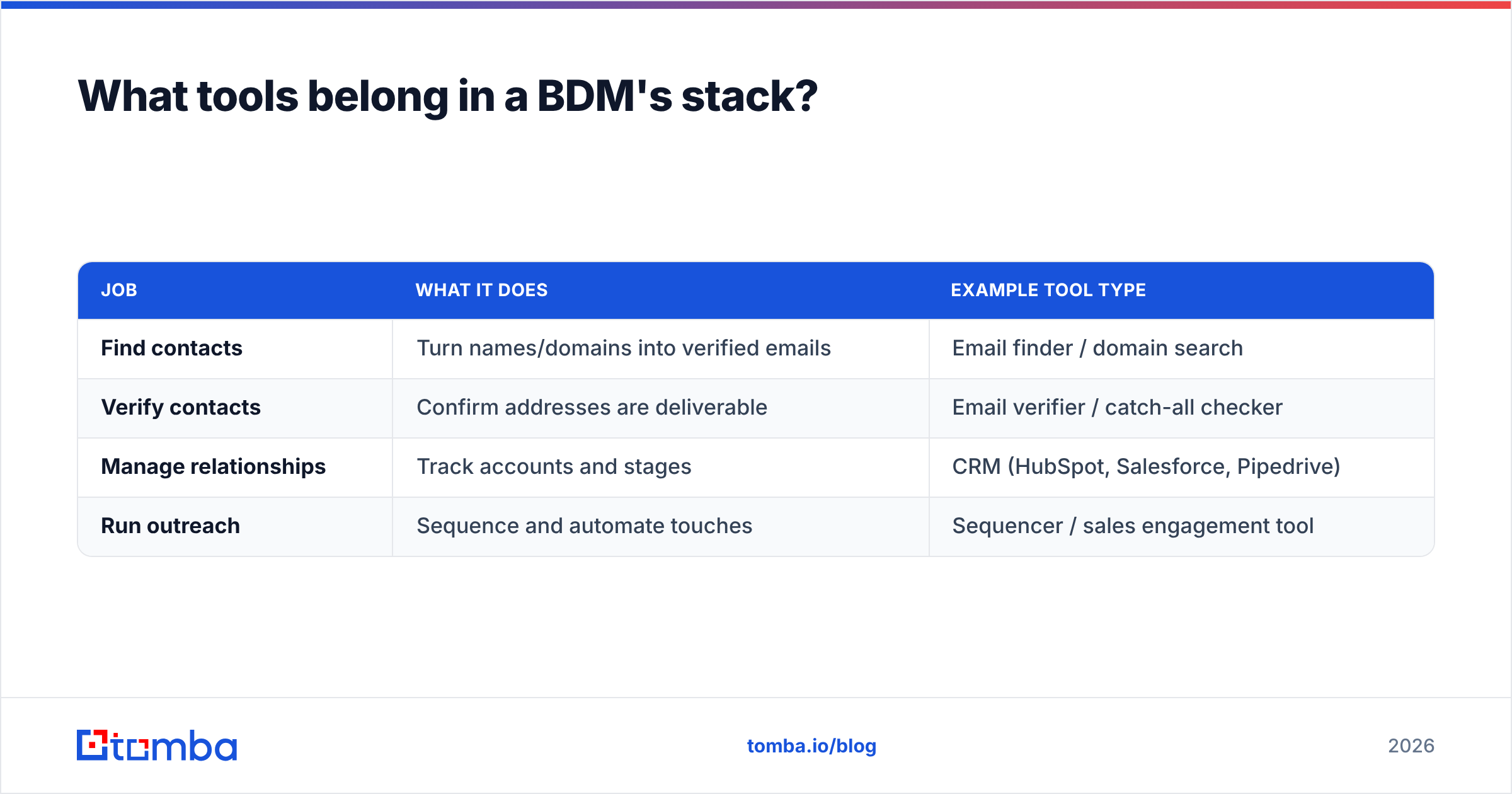
A lean, effective BDM stack covers four jobs: find contacts, verify them, manage relationships, and run outreach. You do not need a dozen subscriptions; you need one tool per job that actually works.
| Job | What it does | Example tool type |
|---|---|---|
| Find contacts | Turn names/domains into verified emails | Email finder / domain search |
| Verify contacts | Confirm addresses are deliverable | Email verifier / catch-all checker |
| Manage relationships | Track accounts and stages | CRM (HubSpot, Salesforce, Pipedrive) |
| Run outreach | Sequence and automate touches | Sequencer / sales engagement tool |
For the first two jobs — the data layer — Tomba covers the full set at a transparent price. The Tomba pricing runs from a free tier (25 searches/month) to Starter at $49/mo, Growth at $99/mo, and Pro at $249/mo, with custom Enterprise plans. That is meaningful for a BDM because data tools are often where stacks quietly overspend. You can connect it to your CRM through Tomba's integrations so verified contacts flow straight into your pipeline without manual copy-paste.
The point is not to buy more software. It is to make sure the foundation — accurate, reachable contact data — is solid before you spend money on fancier outreach automation. A great sequencer pointed at a bad list still fails.
Is the BDM role still relevant in 2026?#
Yes — and arguably more than ever, because automation has raised the floor on what counts as good outreach. When generic messages get filtered and buyers self-educate, the human judgment a BDM brings — knowing which markets to enter, which partners to court, which conversations to have — is the part that does not commoditize. AI drafts emails; it does not decide strategy or build trust with a channel partner over six months.
What has changed is the expectation of efficiency. A BDM in 2026 is expected to cover more accounts with the same hours, which is only possible when the repetitive parts — finding and verifying contacts — are automated. The role is not disappearing; it is shifting toward higher-leverage work, with software handling the grind underneath.
Final takeaway#
The BDM role is the engine of new growth: a Business Development Manager opens markets, sources partnerships, and builds the qualified pipeline that the rest of the revenue team converts. Measure it on what it opens, hire for data fluency alongside relationship skills, and give it a stack that removes the manual grind.
That grind almost always starts with finding the right people and reaching them reliably. If you are setting up a BDM — or you are one — start by fixing the data layer. The Tomba Email Finder turns your target account list into verified, reachable decision-makers, so your business development time goes into conversations and deals instead of guesswork. Try the free tier, point it at your next target segment, and see how much faster the pipeline fills.
// get started
Find, verify and enrich your first contacts today
Start on the free plan with 25 searches a month, then scale when your team is ready.
Free plan · No credit card required · GDPR & CCPA
// about the author