BDR Onboarding in 2026: A 30-Day Ramp Playbook That Works
A structured BDR onboarding plan beats sink-or-swim every time. Here's the 30-60-90 ramp, the tooling stack, and the metrics that get reps to quota faster.
Hiring a business development rep is the easy part. Getting that rep to book meetings that close is where most teams quietly bleed money. A weak onboarding process means a new BDR spends their first 90 days guessing at messaging, scraping bad contact data, and learning your ICP by accident. A strong one gets them to a predictable booking cadence in roughly half that time.
This guide lays out a practical BDR onboarding program you can run starting Monday — the 30-60-90 ramp, the tooling and data setup, the coaching cadence, and the metrics that tell you whether ramp is actually working.
TL;DR#
- BDR onboarding is a 90-day system, not a one-week orientation. Treat it as 30 days to competence, 60 to consistency, 90 to quota.
- Front-load product, ICP, and messaging in weeks 1-2, then move to live activity fast — reps learn by doing, not by watching.
- Data quality decides ramp speed. A rep with verified contacts books meetings; a rep with a stale CSV burns goodwill and sends bounces.
- Track leading indicators (activities, connect rate, meetings booked) before you judge anyone on closed pipeline.
- Document everything once so your second, fifth, and tenth hire ramp faster than your first.
What is BDR onboarding, and why does it deserve a real plan?#
BDR onboarding is the structured process of taking a newly hired business development rep from day one to full productivity — meaning they consistently hit their meeting or pipeline quota without hand-holding. Think of it like training a new line cook: you don't hand them the dinner rush on night one. You teach the stations, let them shadow, then give them a few tickets, and only then put them on the line solo.
The reason it deserves a documented plan is simple math. The average BDR tenure is short — often well under two years — and ramp time eats a big chunk of that. If a rep takes five months to ramp instead of three, you've lost two months of production on every hire, every time. Multiply that across a growing team and sloppy onboarding becomes one of the most expensive line items in your go-to-market budget.
Good onboarding also reduces early churn. Reps quit when they feel lost, unsupported, or set up to fail. A clear ramp plan with visible milestones gives them proof they're improving, which keeps them in the seat long enough to get good.
What does a 30-60-90 day BDR onboarding plan look like?#
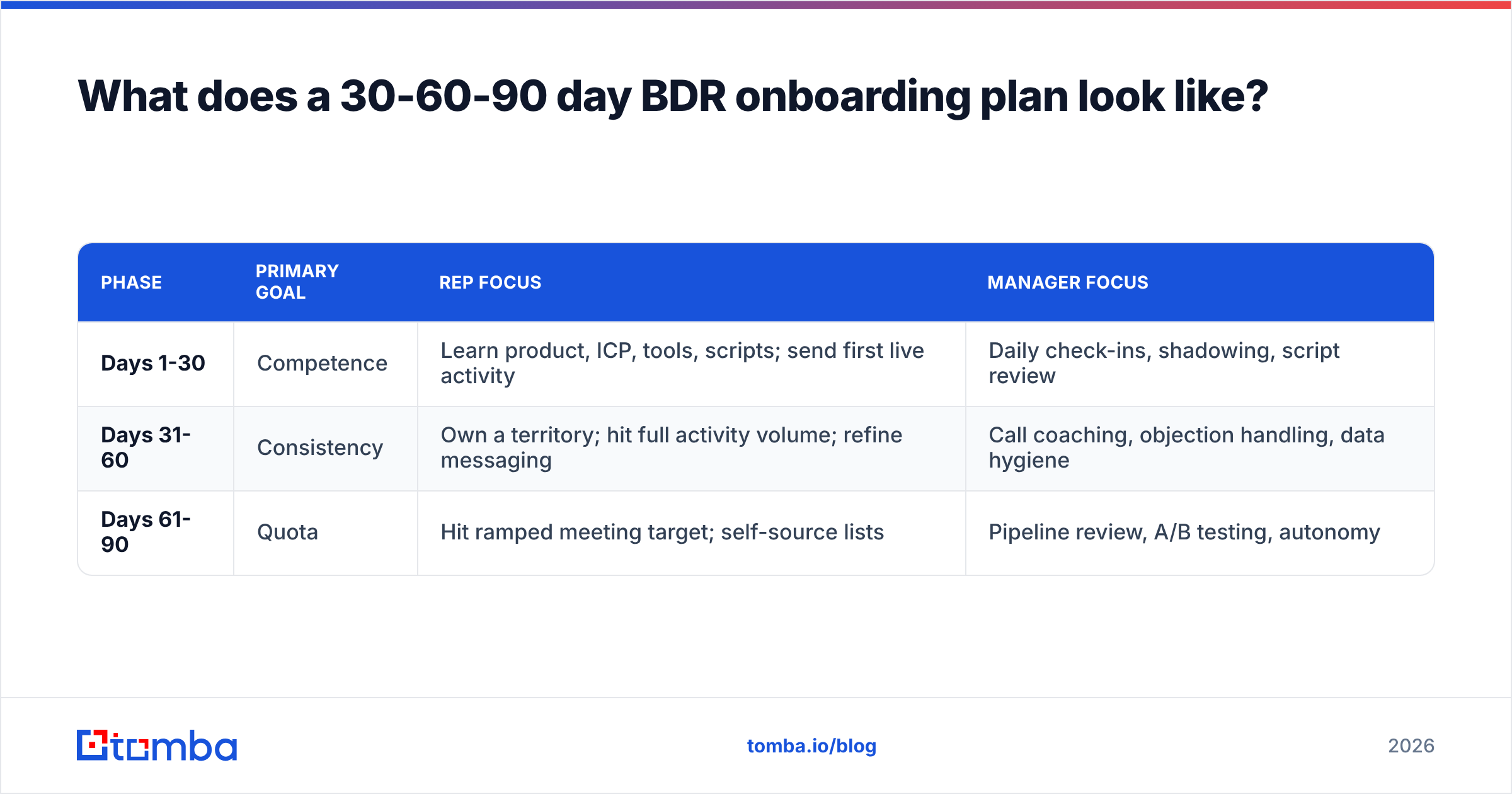
The cleanest framework is the classic 30-60-90, but the trick is assigning a single dominant theme to each phase so reps aren't trying to learn everything at once.
| Phase | Primary goal | Rep focus | Manager focus |
|---|---|---|---|
| Days 1-30 | Competence | Learn product, ICP, tools, scripts; send first live activity | Daily check-ins, shadowing, script review |
| Days 31-60 | Consistency | Own a territory; hit full activity volume; refine messaging | Call coaching, objection handling, data hygiene |
| Days 61-90 | Quota | Hit ramped meeting target; self-source lists | Pipeline review, A/B testing, autonomy |
Here is what each phase actually contains.
- Week 1 — Foundation. Company story, product walkthrough, ICP definition, buyer personas, and a tour of the tech stack. End the week with the rep able to explain what you sell and who you sell it to in plain language.
- Week 2 — Messaging and tooling. Email frameworks, call openers, objection responses, and hands-on practice with your sequencer, CRM, and data tools. The rep sends their first real (low-stakes) outreach by Friday.
- Weeks 3-4 — Supervised volume. The rep runs a small, real territory under close review. Every call gets reviewed, every email template gets edited together.
- Days 31-60 — Independent volume. Activity targets ramp to full. Coaching shifts from "how do I do this" to "how do I do this better."
- Days 61-90 — Performance. The rep self-sources lists, runs their own LinkedIn outreach, and is measured against a ramped quota that hits 100% by day 90.
The mistake most teams make is keeping reps in classroom mode too long. By the end of week two, a new BDR should be doing real work with real prospects. Confidence comes from reps, not from slides.
What tools and data does a new BDR need on day one?#
A BDR's day breaks down into three jobs: find the right people, reach them, and track what happens. Your stack should cover all three, and the data feeding it has to be clean — because nothing destroys a new rep's morale faster than a list that bounces.
Here is the baseline stack and what each piece does:
- CRM — the system of record for every account, contact, and activity. Salesforce, HubSpot, or Pipedrive. Learn the CRM fundamentals in week one; everything else plugs into it.
- Sequencer / engagement tool — runs multi-step email and call cadences so the rep isn't manually remembering follow-ups.
- Contact data and email finder — turns a name and company into a verified, reachable email address. This is the fuel for the whole engine.
- Phone data — direct dials for the accounts that warrant a call.
- Enrichment — fills in firmographic and role data so reps can prioritize and personalize.
On the data side, the single highest-leverage thing you can do for a new BDR is hand them accurate contacts from day one. A rep who spends an hour hunting for one email address learns to hate prospecting. A rep who pulls fifty verified contacts in that same hour learns that prospecting works.
This is where a dedicated email-finding workflow earns its keep. Tools like the Tomba Email Finder let a rep go from a name and domain to a verified professional email in seconds, and the built-in email verifier keeps bounce rates low so the rep's sending reputation stays intact during the fragile early weeks. Pair that with domain search to map every reachable contact at a target account, and a new rep can build a clean territory list on their first afternoon instead of their first month.
How should you compare BDR data tooling options?#
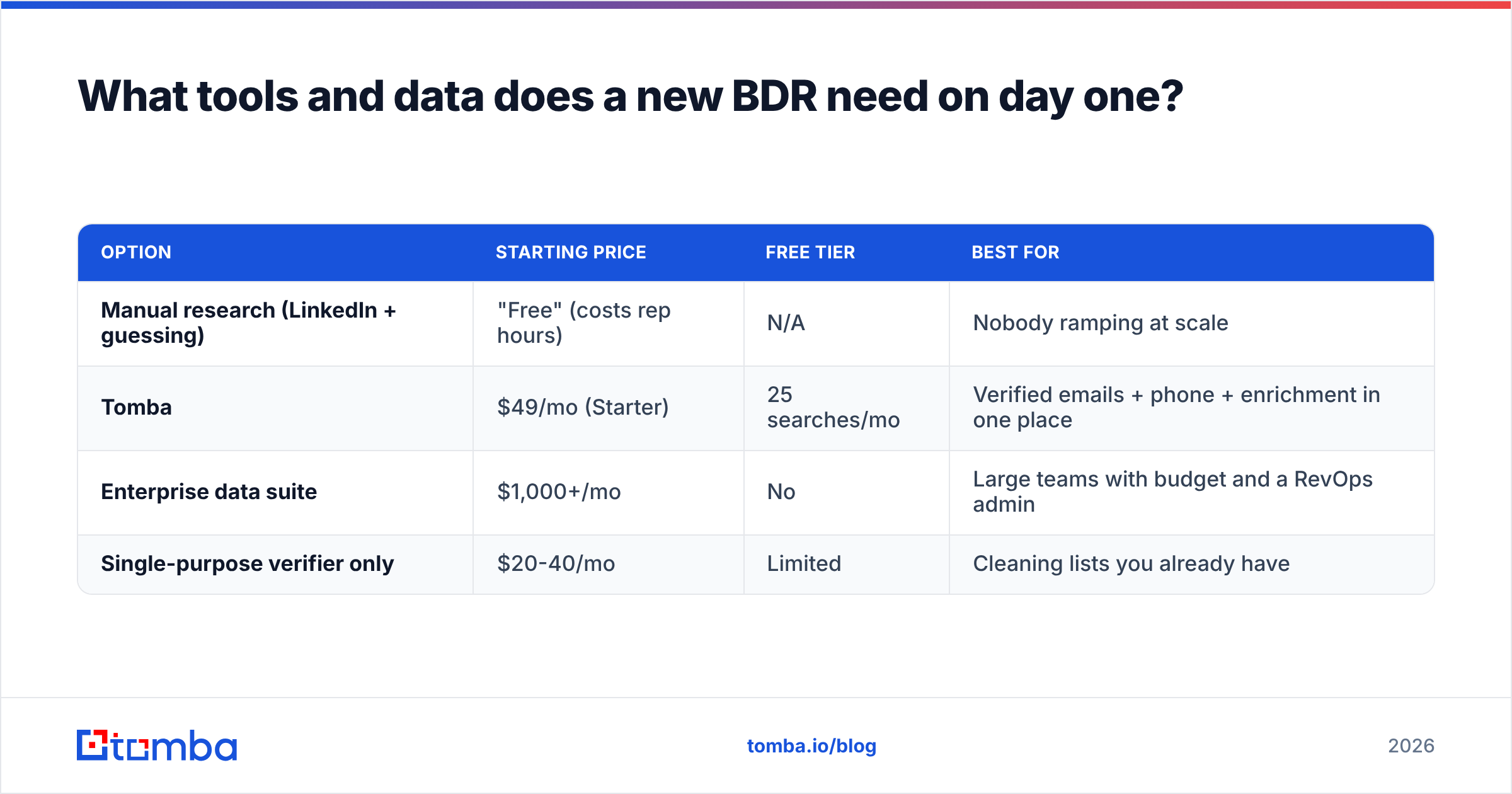
Not every team needs the most expensive enterprise platform. Match the tool to the motion and the headcount. Here is a simple comparison of common approaches a new BDR program might use for sourcing contacts.
| Option | Starting price | Free tier | Best for |
|---|---|---|---|
| Manual research (LinkedIn + guessing) | "Free" (costs rep hours) | N/A | Nobody ramping at scale |
| Tomba | $49/mo (Starter) | 25 searches/mo | Verified emails + phone + enrichment in one place |
| Enterprise data suite | $1,000+/mo | No | Large teams with budget and a RevOps admin |
| Single-purpose verifier only | $20-40/mo | Limited | Cleaning lists you already have |
For most growing teams, the sweet spot is a tool with a real free tier to test on, transparent per-seat pricing, and verification baked in. You can see how the tiers scale on the Tomba pricing page — a new rep can start on the free plan during week one and move to a paid seat once they're running full volume. Feeding clean records from a maintained B2B database and topping them up with data enrichment means your rep never opens a sequence with a guess.
What metrics actually tell you if onboarding is working?#
Don't judge a 30-day rep on closed pipeline. Pipeline lags weeks behind effort, so early on it tells you almost nothing except who got lucky. Instead, watch leading indicators that the rep controls directly, then let the lagging metrics catch up.
Track these in three buckets:
- Activity metrics (weeks 1-4): calls dialed, emails sent, sequences completed. These prove the rep is putting in reps. If activity is low, nothing downstream matters.
- Efficiency metrics (weeks 4-8): connect rate, response rate, positive reply rate, bounce rate. These prove the rep's messaging and data quality are working. A rising bounce rate is an early warning that their list hygiene slipped.
- Outcome metrics (weeks 8-12): meetings booked, meetings held, qualified opportunities created. This is the real scoreboard, and a healthy rep should be approaching full quota by day 90.
A useful benchmark: a ramped BDR's email bounce rate should sit below 3-5%. If a new rep's bounces spike, the problem is almost always the data, not the rep — which is exactly why verification belongs in the workflow before send, not after. The HubSpot sales statistics library and analyst research from Gartner are good external references for setting realistic activity and conversion targets by industry.
Set explicit numeric milestones for each week and review them in a shared doc. "You should be booking two meetings a week by week six" is coachable. "Do better" is not.
How do you coach a BDR through ramp without micromanaging?#
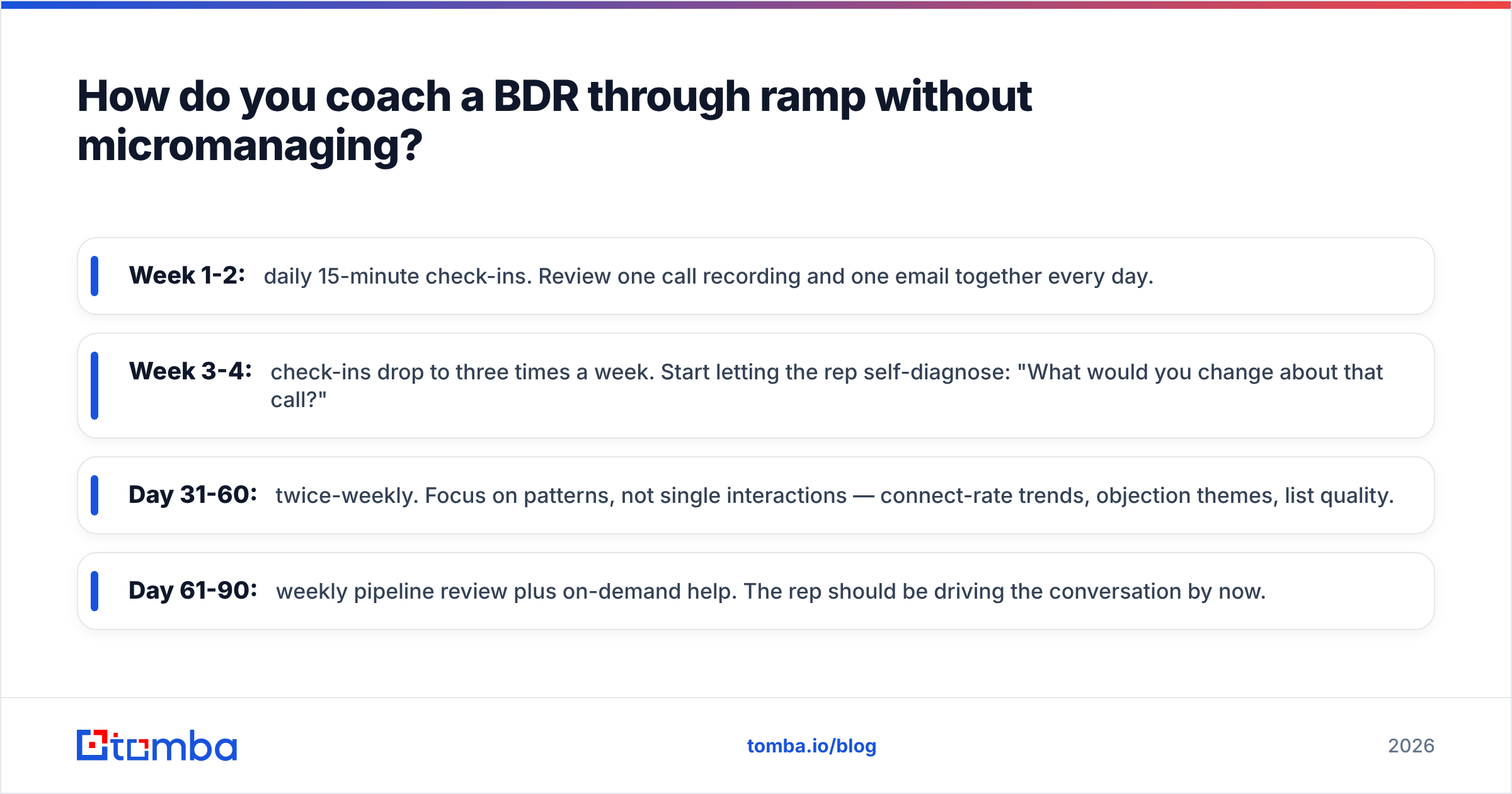
Coaching during ramp is about frequency early, autonomy later. The cadence should taper deliberately.
- Week 1-2: daily 15-minute check-ins. Review one call recording and one email together every day.
- Week 3-4: check-ins drop to three times a week. Start letting the rep self-diagnose: "What would you change about that call?"
- Day 31-60: twice-weekly. Focus on patterns, not single interactions — connect-rate trends, objection themes, list quality.
- Day 61-90: weekly pipeline review plus on-demand help. The rep should be driving the conversation by now.
The biggest coaching unlock is call and email review. Listening to a recording with a rep, pausing at the moment a deal went sideways, and role-playing the better version is worth more than any amount of generic feedback. Pair that with a tight library of proven cold email templates so reps aren't reinventing messaging from scratch — they start from what works and personalize from there.
One caution: resist the urge to fix everything at once. Pick one skill per week. A rep who masters their opener this week and objection handling next week ramps faster than one drowning in a twelve-point feedback list.
How long should BDR onboarding take?#
Plan for 90 days to full quota, with the rep showing real signal by day 30. Industry data generally puts SDR/BDR ramp somewhere in the three-to-five-month range, so a tight, well-documented program that hits full productivity at 90 days is genuinely above average — and most of the difference comes down to two things: how fast you get reps into live activity, and how clean their data is.
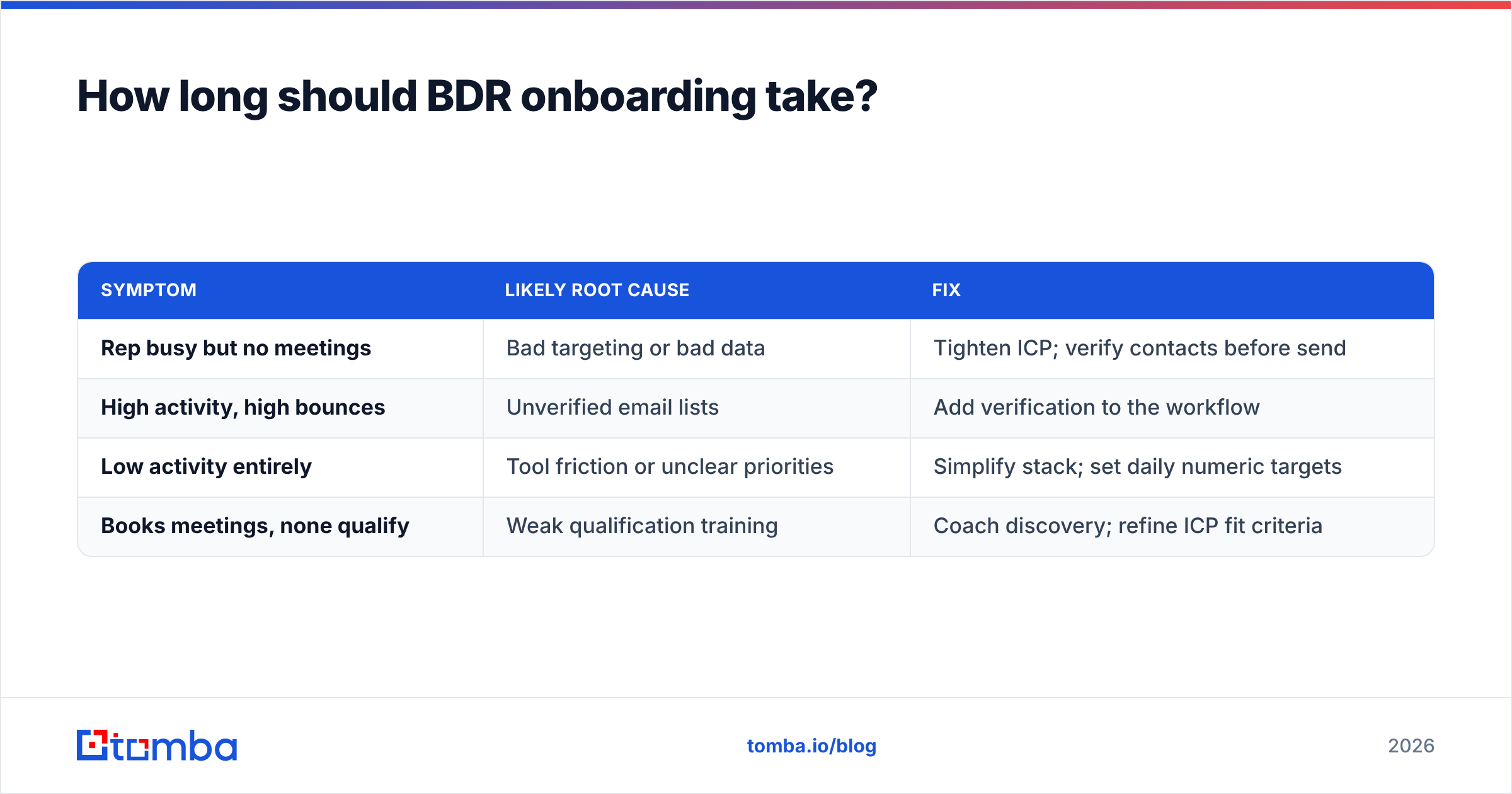
If your reps are consistently ramping slower than three months, the culprit is usually one of these:
| Symptom | Likely root cause | Fix |
|---|---|---|
| Rep busy but no meetings | Bad targeting or bad data | Tighten ICP; verify contacts before send |
| High activity, high bounces | Unverified email lists | Add verification to the workflow |
| Low activity entirely | Tool friction or unclear priorities | Simplify stack; set daily numeric targets |
| Books meetings, none qualify | Weak qualification training | Coach discovery; refine ICP fit criteria |
Notice how many rows trace back to data. Targeting, bounces, and qualification all improve when reps work from accurate, enriched records instead of scraped guesses. Onboarding speed is downstream of data quality more than almost anyone admits.
What's the fastest way to make onboarding repeatable?#
Document it once, the first time you do it well. The first hire's onboarding is a live experiment; the moment something works, write it down. Build a single onboarding hub that contains:
- The 30-60-90 plan with weekly milestones and numeric targets
- Product and ICP one-pagers
- The approved messaging library (openers, templates, objection responses)
- A tooling setup checklist — accounts, logins, and how to pull a clean list
- Recordings of great calls and great email threads as reference
This turns onboarding from a manager's full-time job into a self-serve runway, and it means hire number ten gets a better experience than hire number one. As your motion matures, you can wire your data tools directly into the rep's daily workflow through the Tomba API or a no-code Zapier integration, so list-building and CRM enrichment happen automatically instead of eating ramp time. G2 and Capterra reviews — for example the listings on G2's sales intelligence category — are a useful sanity check when you're choosing which tools to standardize on.
Get your new BDRs reaching real people on day one#
Onboarding speed comes down to a simple chain: clear plan, fast path to live activity, and clean data underneath all of it. You can control the plan and the cadence with the frameworks above. For the data — the part that decides whether your rep's first email lands or bounces — give them verified contacts from the start.
The Tomba Email Finder gets a new rep from a name and company to a verified, reachable email in seconds, with verification built in so their sender reputation survives the ramp. Start your team on the free tier (25 searches a month), let new reps build their first clean territory list before they finish week one, and scale to a paid seat once they're running full volume. Your reps will book meetings sooner — and stick around longer because the work actually works.
Ready to find emails that actually work?
Join 150,000+ professionals who stopped guessing and started sending. Free credits on signup — no credit card required.
Get the Tomba newsletter
Practical outbound tactics and product updates — once every two weeks.
About the author