BDR Performance Management in 2026: Metrics, Coaching & Tools
A practical 2026 framework for BDR performance management: the metrics that actually predict pipeline, how to coach without micromanaging, and the tooling that removes busywork.
TL;DR
- BDR performance management works when you measure leading inputs (quality conversations, valid contacts) alongside lagging outputs (booked meetings, pipeline) — not raw dial counts.
- The best managers run a fixed weekly coaching cadence, score a small number of metrics, and tie every number back to one question: are we generating qualified pipeline?
- Ramp expectations, not headcount, are the hidden lever. A clear 90-day ramp plan cuts early attrition and shortens time-to-quota.
- Bad data quietly destroys BDR productivity. If reps spend a third of their day hunting for valid emails and phone numbers, no coaching framework will save the quarter.
- Tooling should remove busywork, not add dashboards. Accurate contact data, verified before outreach, is the cheapest performance gain you can buy.
Business development reps sit at the front of your revenue engine, and they are also the easiest role to manage badly. You can drown a team in dashboards, stack-rank them on dials, and still miss pipeline targets by 40%. This guide lays out a BDR performance management system that holds up in 2026: what to measure, how to coach it, what to expect during ramp, and where tooling actually moves the needle.
What is BDR performance management?#
BDR performance management is the system you use to set targets, measure activity and outcomes, coach behavior, and improve the output of your business development team over time. Think of it like coaching a sales-floor version of a sports team: the box score (meetings booked) matters, but you win the season by improving the inputs that produce those scores — shot selection, conditioning, reps in practice.
The mistake most teams make is treating performance management as a reporting exercise. They build a dashboard, glance at it on Monday, and call it management. Real performance management is a loop: define the metric, observe the behavior behind it, coach the gap, and re-measure. A dashboard is a thermometer; performance management is the thermostat.
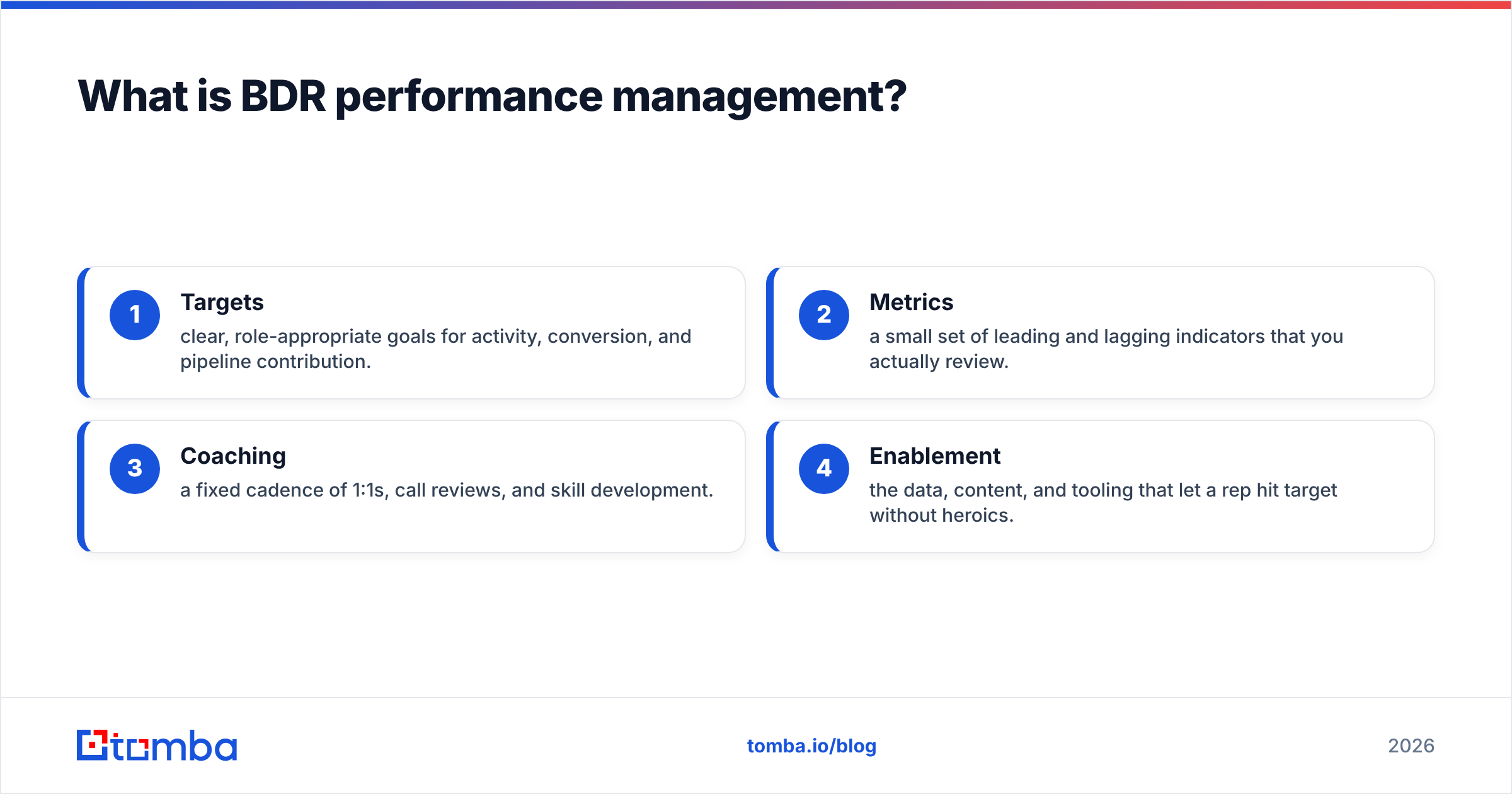
A complete system has four moving parts:
- Targets — clear, role-appropriate goals for activity, conversion, and pipeline contribution.
- Metrics — a small set of leading and lagging indicators that you actually review.
- Coaching — a fixed cadence of 1:1s, call reviews, and skill development.
- Enablement — the data, content, and tooling that let a rep hit target without heroics.
Skip any one of these and the other three sag. Great coaching against garbage data is wasted effort. Perfect data with no coaching cadence produces busy reps and flat pipeline.
Which BDR metrics actually matter in 2026?#
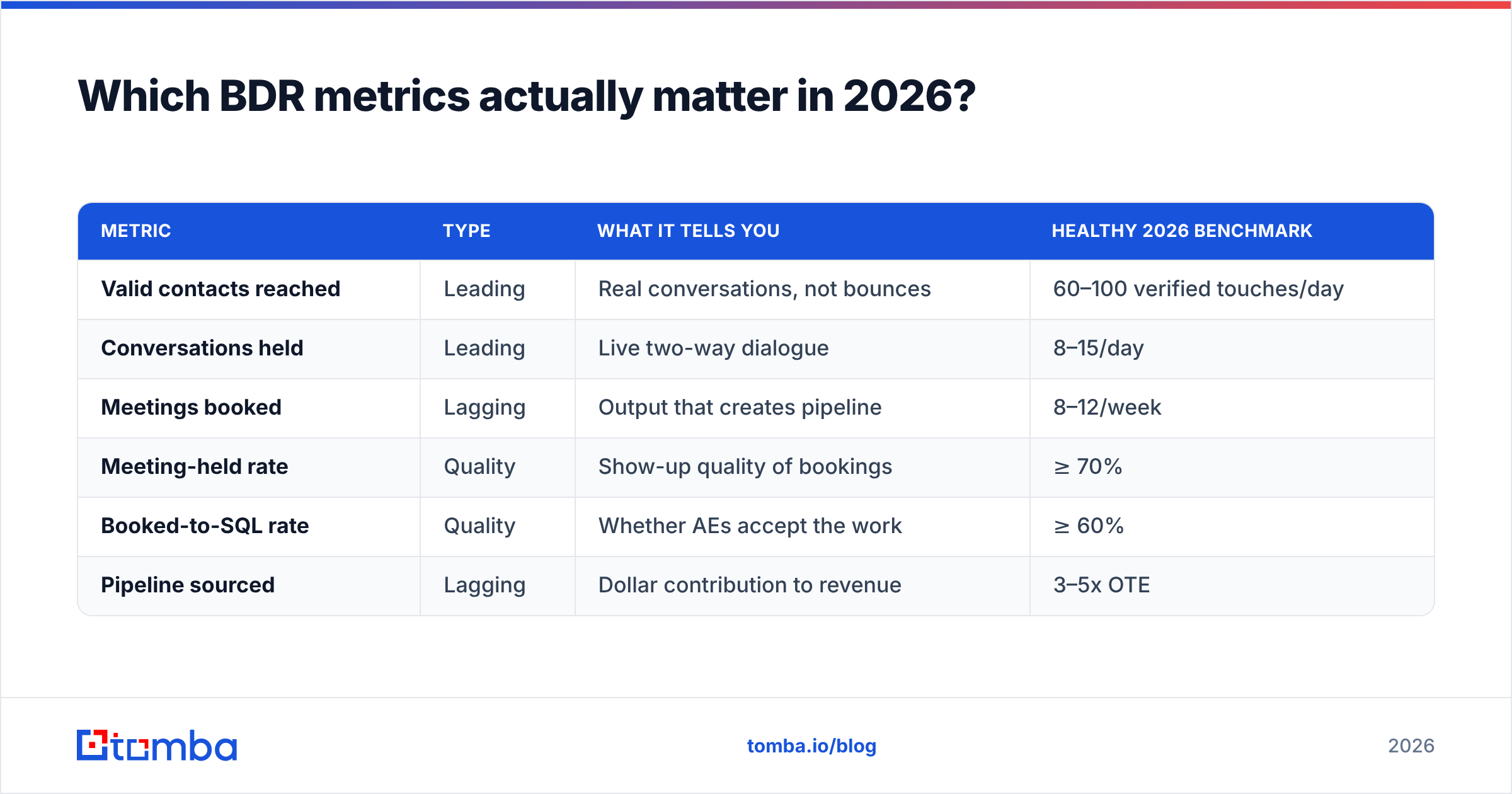
The short answer: measure the fewest metrics that still connect daily activity to booked pipeline. More metrics do not equal more control — they equal more noise and more arguments about whose number is "real."
Group your metrics into three layers. Leading indicators tell you what is happening today; lagging indicators tell you whether it worked; quality indicators stop reps from gaming the leading ones.
| Metric | Type | What it tells you | Healthy 2026 benchmark |
|---|---|---|---|
| Valid contacts reached | Leading | Real conversations, not bounces | 60–100 verified touches/day |
| Conversations held | Leading | Live two-way dialogue | 8–15/day |
| Meetings booked | Lagging | Output that creates pipeline | 8–12/week |
| Meeting-held rate | Quality | Show-up quality of bookings | ≥ 70% |
| Booked-to-SQL rate | Quality | Whether AEs accept the work | ≥ 60% |
| Pipeline sourced | Lagging | Dollar contribution to revenue | 3–5x OTE |
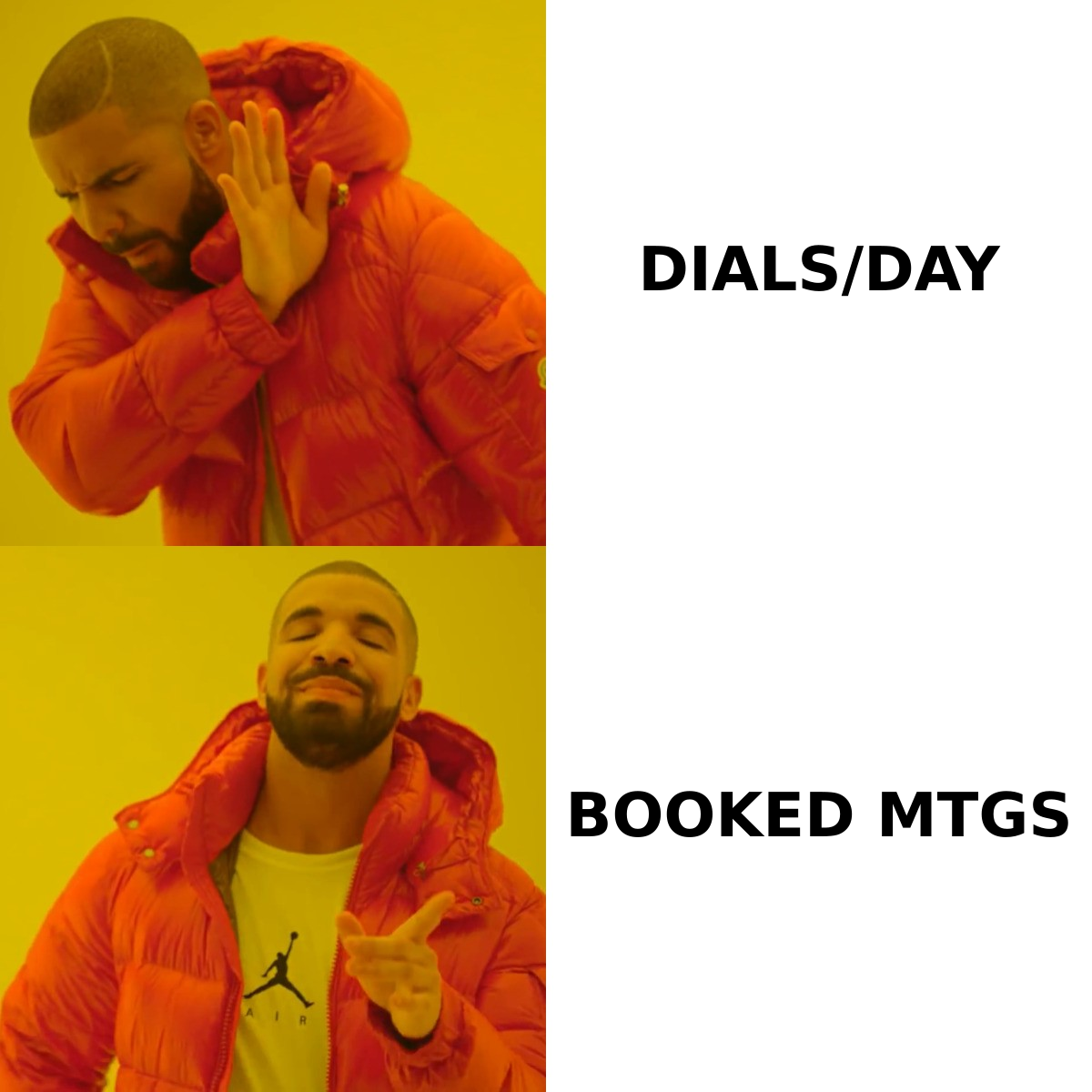
Notice what is missing: raw dials and raw emails sent. Those are effort proxies, and the moment you score them, reps optimize for the proxy. A rep who blasts 300 unverified emails looks productive on a dial-and-send dashboard and produces nothing. A rep who reaches 80 verified contacts with a researched message books meetings. The difference is data quality, which is why "valid contacts reached" belongs at the top of the table.
For a deeper definition of what counts as a qualified handoff, align your team on a shared marketing qualified lead standard before you argue about conversion rates. And track your team's response rate as a quality check — a falling response rate is an early warning that messaging or data has degraded, usually weeks before pipeline dips.
Leading vs lagging, in plain terms#
Lagging metrics are the scoreboard; you cannot coach them directly. You can only coach the leading behaviors that produce them. If meetings booked drop, the answer is never "book more meetings" — it is to find which leading input broke. Fewer conversations? A targeting problem. Same conversations, fewer bookings? A messaging or qualification problem. The metric framework exists so you can diagnose, not just observe.
How do you coach BDR performance without micromanaging?#
Coach the behavior, not the number — and do it on a fixed cadence so feedback is routine, not a fire alarm. Reps tolerate a lot of scrutiny when it is predictable and developmental. They resent surprise interrogations when a number dips.
A workable weekly cadence looks like this:
- Monday — number review (15 min): Look at last week's metrics together. The rep talks first; you ask questions. You are diagnosing, not lecturing.
- Midweek — call/email review (30 min): Pick two real conversations. Score them against a rubric (opener, discovery, objection handling, next-step). Specific beats general every time.
- Friday — skill block (30 min): Work one skill the call review surfaced. Roleplay it. Reps improve from reps, not from advice.
The micromanagement trap is checking activity hourly and reacting to every dip. Set the cadence, hold it, and let reps own their day between checkpoints. Your job is to make the rep better by Friday than they were on Monday — measured by behavior change you can see in call reviews, not by how many times you refreshed the dashboard.
One more rule: separate coaching conversations from accountability conversations. Coaching is "let's get you better." Accountability is "you are below the line and here is the plan." Blending them makes every 1:1 feel like a performance review, and reps stop being honest about where they struggle.
What should BDR ramp and quota look like?#
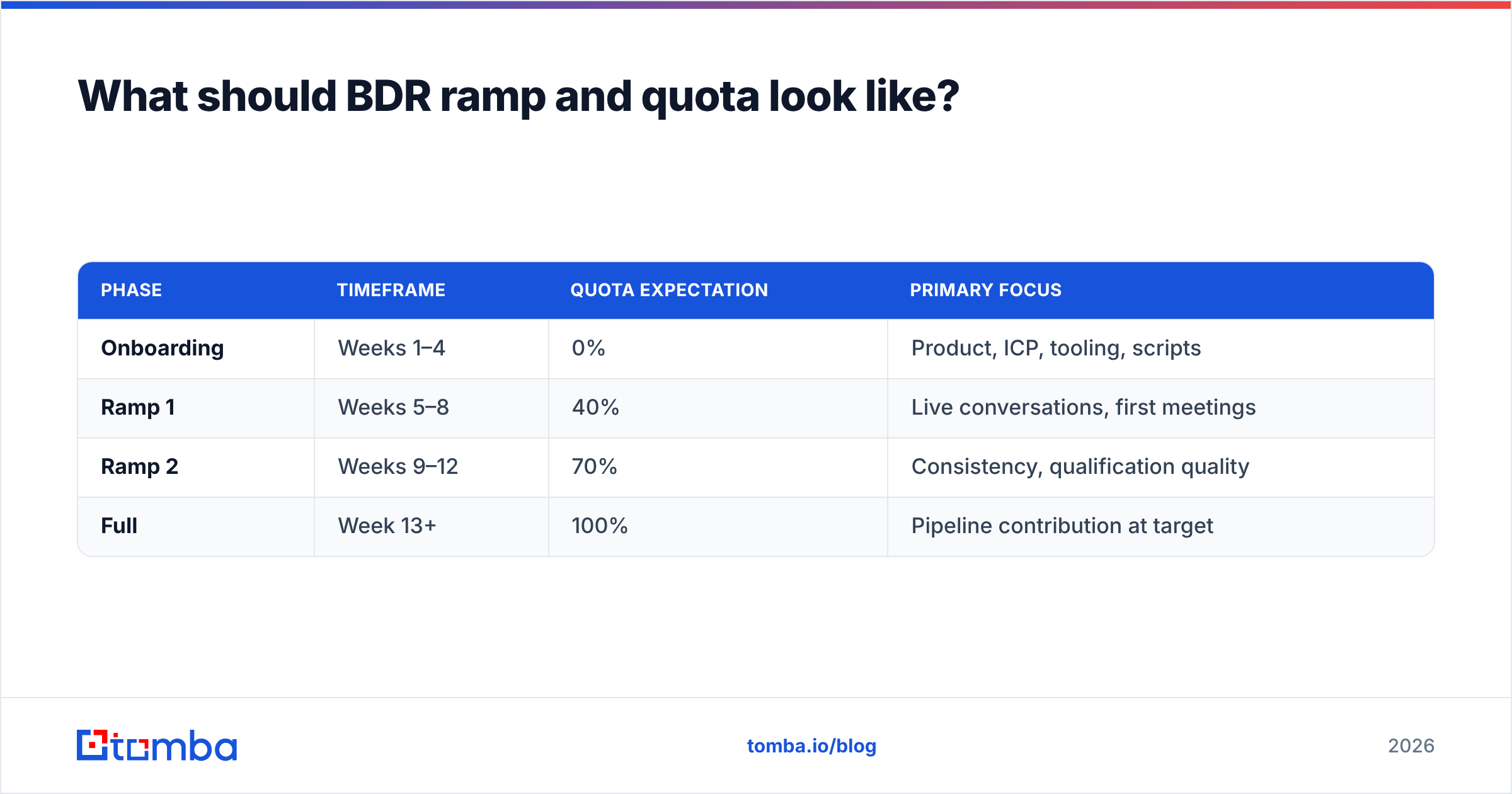
Ramp is the most under-managed lever in BDR performance, and the cheapest one to fix. A new rep who hits full quota in month two is rare; one who is told to hit it usually quits in month four. Set a staged ramp and hold the team to that, not to the senior-rep number.
| Phase | Timeframe | Quota expectation | Primary focus |
|---|---|---|---|
| Onboarding | Weeks 1–4 | 0% | Product, ICP, tooling, scripts |
| Ramp 1 | Weeks 5–8 | 40% | Live conversations, first meetings |
| Ramp 2 | Weeks 9–12 | 70% | Consistency, qualification quality |
| Full | Week 13+ | 100% | Pipeline contribution at target |
Two things make ramp work. First, front-load enablement so reps are not learning the product and the prospecting motion at the same time. Second, give them clean data from day one. A ramping rep with a verified contact list books meetings and builds confidence; a ramping rep handed a stale list bounces emails, gets demoralized, and confirms every doubt they had about leaving their last job.
Quota itself should ladder up from pipeline math, not down from a revenue wish. Start with the pipeline coverage your AEs need, divide by your booked-to-SQL and SQL-to-won rates, and you get the meetings each BDR must source. Build the number from the funnel and reps trust it. Hand them a number from a spreadsheet nobody can explain and they will treat it as fiction.

How does data quality drive BDR performance?#
Data quality is the silent variable in every BDR metric, and it usually explains more variance than talent does. A rep is only as productive as the list in front of them. If 30% of contacts are wrong, you have effectively cut that rep's selling time by a third before they say a word.
Here is how bad data leaks into every layer of the system:
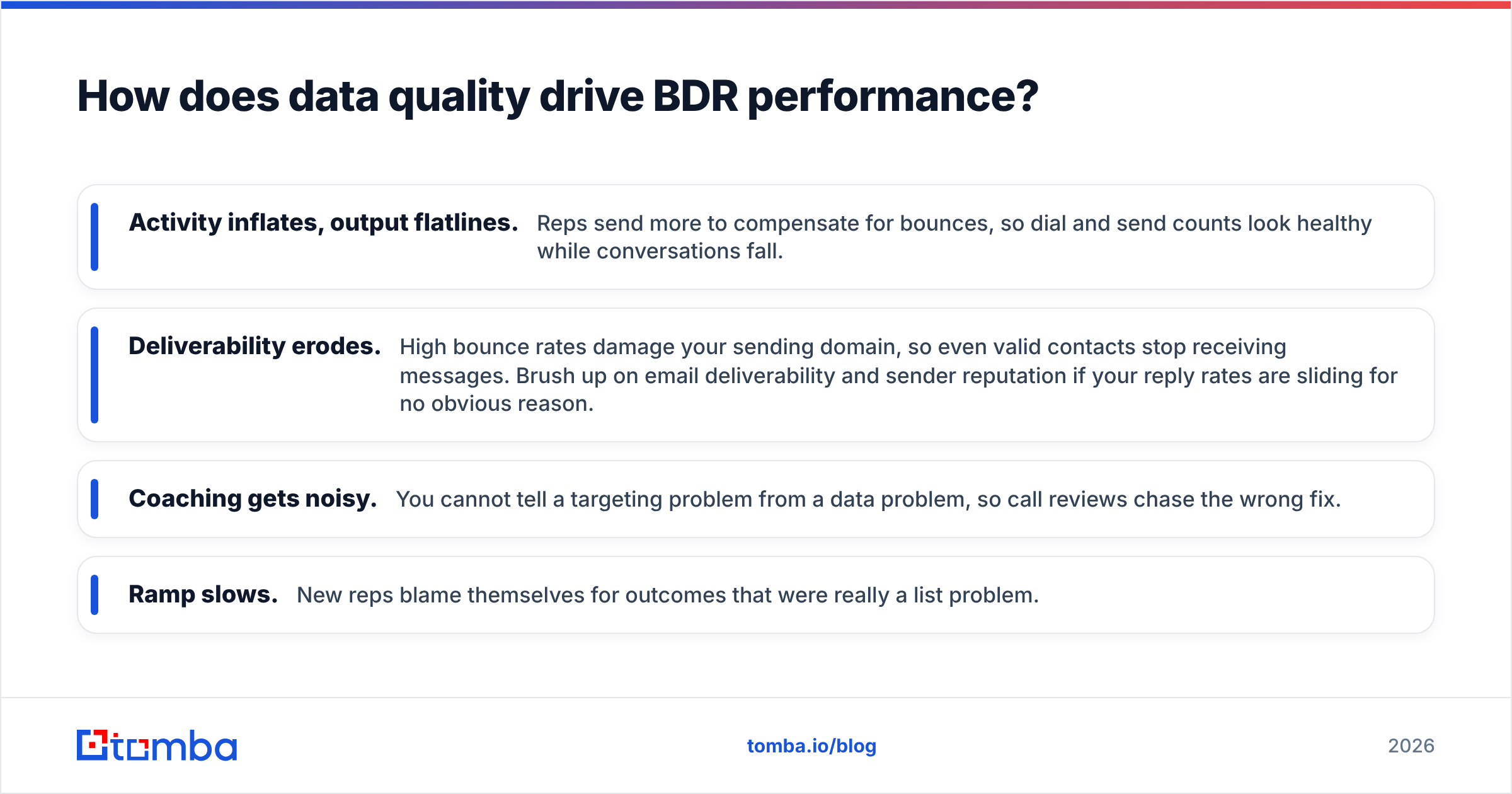
- Activity inflates, output flatlines. Reps send more to compensate for bounces, so dial and send counts look healthy while conversations fall.
- Deliverability erodes. High bounce rates damage your sending domain, so even valid contacts stop receiving messages. Brush up on email deliverability and sender reputation if your reply rates are sliding for no obvious reason.
- Coaching gets noisy. You cannot tell a targeting problem from a data problem, so call reviews chase the wrong fix.
- Ramp slows. New reps blame themselves for outcomes that were really a list problem.
The fix is unglamorous: verify contacts before reps touch them, and enrich records so reps personalize instead of research. When a BDR opens their queue and every email is verified and every record has a title, company, and a reason to reach out, they spend their hour selling. That is the entire game.
This is where tooling earns its keep. Instead of reps copy-pasting from LinkedIn and guessing email patterns, give them a system that returns verified contacts on demand. Tomba's email finder and email verifier exist precisely to take that 20–30% of a rep's day back. Pair them with data enrichment so every record arrives ready for a personalized first line, and use domain search when a rep needs the right contact at a specific account rather than a name they were handed. For independent reviews of contact-data tooling, G2's lead intelligence category is a reasonable neutral starting point.
A simple build-vs-buy check on tooling#
You do not need a 12-tool stack. You need accurate data, a place to sequence outreach, and a CRM that does not lie to you. Most BDR performance problems blamed on "the stack" are really one of two things: dirty data feeding the stack, or too many tools so reps live in tab-switching instead of conversations. Strip the stack to essentials, verify the data going in, and measure whether reps' selling time goes up. If a tool does not increase verified conversations per day, it is overhead.
How do you build a 90-day BDR performance plan?#
Run it in three thirty-day arcs, each with one dominant goal, so you fix the system in the right order instead of all at once.
- Days 1–30 — Instrument. Pick the six metrics from the table above and nothing more. Get them into one view. Establish your coaching cadence and run it even before the data is perfect. You are building the habit and the baseline.
- Days 31–60 — Clean the inputs. Audit data quality: measure bounce rate, contactability, and how much time reps spend researching. Verify and enrich the active list. Expect leading metrics to look worse briefly as reps stop blasting and start reaching real people — that is the system working.
- Days 61–90 — Coach the gaps. With clean data and a stable cadence, your call reviews finally isolate skill gaps instead of data noise. Now coaching compounds. Tighten ramp expectations, adjust quota off real funnel math, and promote what works across the team.
The order matters. Coaching before you clean the data is like tuning an engine that is out of oil. Instrument, then fix inputs, then coach — and the same reps you have today will outperform the team you had last quarter.
Conclusion: manage the system, not the dials#
BDR performance management is not a leaderboard and it is not a dashboard. It is a loop — targets, metrics, coaching, enablement — and the loop only spins as fast as your worst input allows. In 2026, the worst input on most teams is contact data: stale, unverified, and quietly cutting every rep's selling time. Fix that first, hold a real coaching cadence, ramp reps honestly, and measure the few metrics that connect activity to pipeline.
If your reps are losing a third of their day hunting for valid emails, start there. Tomba's Email Finder returns verified professional emails by name, company, or domain, so your BDRs reach real people instead of bouncing into spam folders — and your performance metrics finally measure selling, not searching. See the Tomba pricing plans, start free with 25 searches, and give your team a list worth working.
Ready to find emails that actually work?
Join 150,000+ professionals who stopped guessing and started sending. Free credits on signup — no credit card required.
Get the Tomba newsletter
Practical outbound tactics and product updates — once every two weeks.
About the author