How to Build a BDR Program That Books Meetings in 2026
A practical 2026 playbook for building a BDR program from scratch: structure, hiring, ramp, comp, metrics, and the data stack that keeps reps booking qualified meetings.
TL;DR
- A BDR program is the repeatable system — people, process, data, and metrics — that turns cold accounts into qualified pipeline. It is not "hire two reps and hope."
- The biggest lever isn't scripts or sequences; it's clean contact data. Reps who spend 40% of their day hunting for emails and phone numbers never hit quota.
- Ramp a new BDR over 90 days with clear weekly milestones, then hold them to a small set of leading and lagging metrics (activity, conversion, meetings held).
- Comp the role on meetings held and pipeline created, not raw dials. You get what you pay for.
- Tooling stack: a CRM, a sequencer, and a verified data layer. Get the data layer right first.
Building a business development representative (BDR) team is one of the highest-leverage moves in B2B go-to-market — and one of the easiest to botch. Most failed programs aren't killed by bad reps. They're killed by vague ownership, no ramp plan, fuzzy metrics, and garbage contact data that quietly drains every hour of selling time. This guide walks through how to build a BDR program in 2026 that actually produces predictable pipeline.
What is a BDR program?#
A BDR program is the operating system for outbound prospecting. Think of it like a kitchen in a busy restaurant: the recipes (playbooks), the stations (process stages), the ingredients (data), and the line cooks (reps) all have to work together, or the orders never go out. A BDR program is everything around the individual rep that makes their output repeatable and coachable.
The role itself sits at the top of the funnel. BDRs (sometimes called SDRs) identify target accounts, research contacts, run multi-channel outreach, qualify interest, and hand warm meetings to account executives. They are not closers. Their entire job is to manufacture qualified conversations.
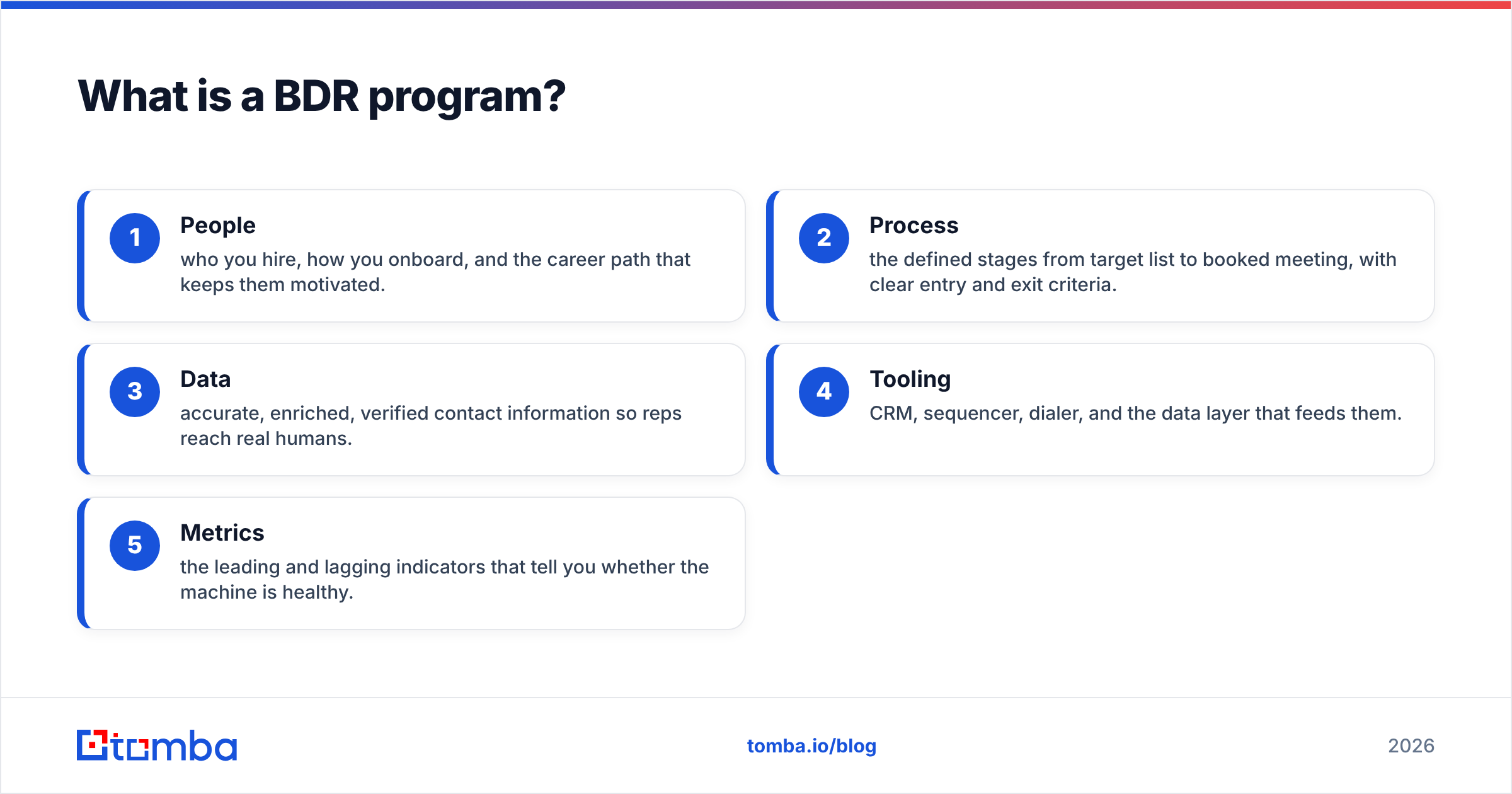
A real program has five components, not one:
- People — who you hire, how you onboard, and the career path that keeps them motivated.
- Process — the defined stages from target list to booked meeting, with clear entry and exit criteria.
- Data — accurate, enriched, verified contact information so reps reach real humans.
- Tooling — CRM, sequencer, dialer, and the data layer that feeds them.
- Metrics — the leading and lagging indicators that tell you whether the machine is healthy.
Skip any one of these and the others underperform. A great rep with bad data is a Ferrari with no fuel.
Why do most BDR programs fail?#
Most BDR programs fail for boringly predictable reasons. According to HubSpot's sales research, reps spend a large share of their week on non-selling tasks — admin, data entry, and prospecting research. When that research time balloons because contact data is wrong, the program quietly bleeds productivity.
Here are the failure patterns that show up again and again:
- No ramp plan. New hires are handed a quota in week two and burn out by month two.
- Vanity metrics. Leadership tracks dials and emails sent instead of meetings held and pipeline created.
- Dirty data. Bounced emails wreck sender reputation, and wrong phone numbers waste dial time. Bad data doesn't just slow reps — it actively damages email deliverability across the whole team.
- Misaligned comp. Paying on activity volume produces activity, not revenue.
- No feedback loop. AEs don't tell BDRs why meetings were disqualified, so the same low-quality meetings keep coming.
The single most fixable issue on that list is data. You can coach a script in a week. You cannot coach your way out of a list where one in three emails bounces.
How do you structure a BDR program?#
Structure decisions come down to three questions: who reports to whom, how reps specialize, and how territory gets divided.
Reporting line. Early-stage teams often have BDRs report into sales. As the team grows past roughly eight reps, many companies move BDR leadership under marketing or a dedicated revenue operations function to keep handoffs and data clean. There's no universal right answer — just pick an owner who is accountable for pipeline, not vanity activity.
Specialization. You can run BDRs as generalists (research + outreach + qualify) or split the motion. Some teams separate "list builders" from "closers of meetings." For most teams under 15 reps, keep it simple: one rep owns an account from research to booked meeting.
Territory. Divide by geography, industry vertical, account size, or named-account lists. Whatever you choose, make it explicit and stable. Reps shuffling territories every month never build account knowledge.
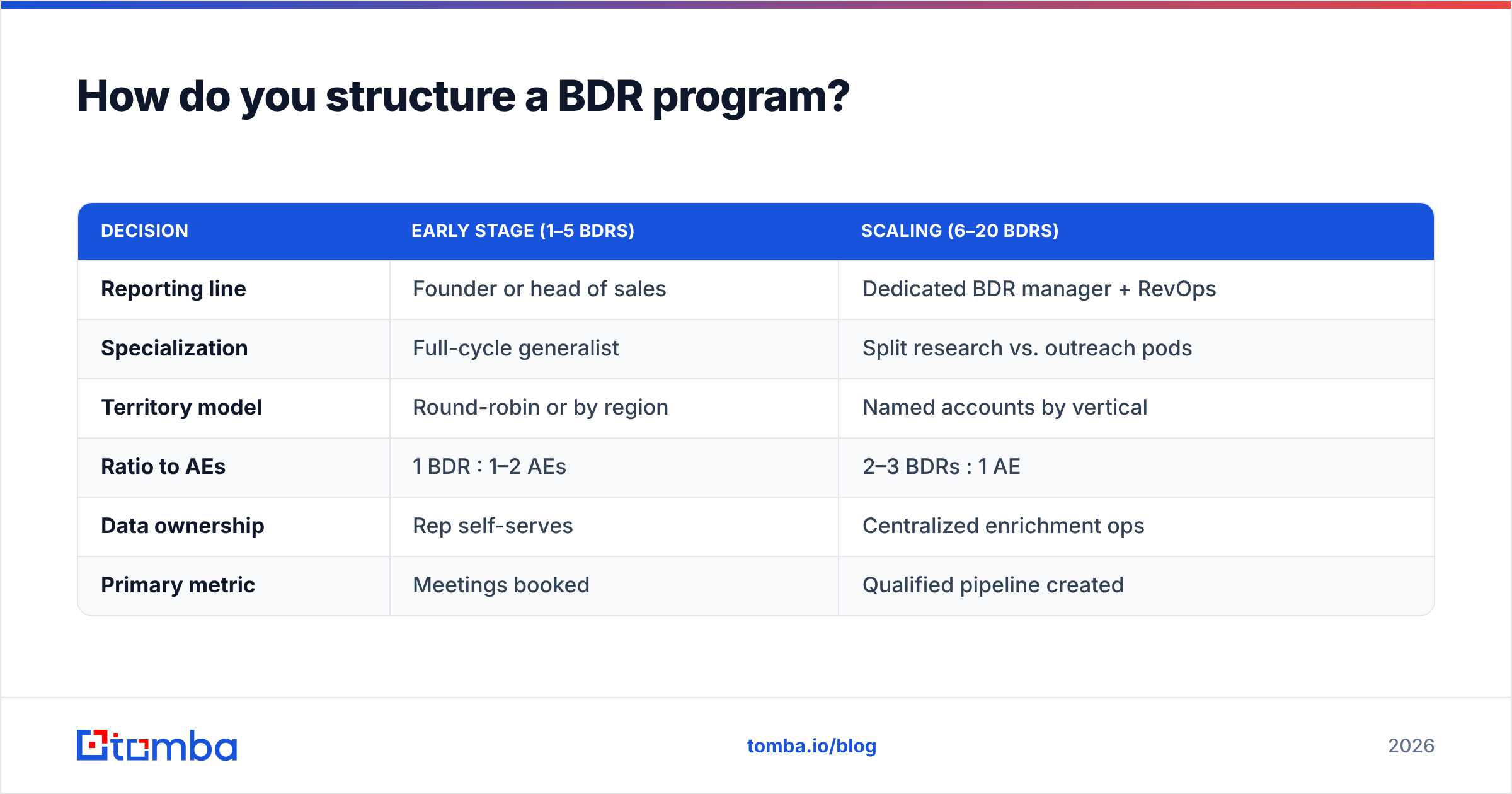
| Decision | Early stage (1–5 BDRs) | Scaling (6–20 BDRs) |
|---|---|---|
| Reporting line | Founder or head of sales | Dedicated BDR manager + RevOps |
| Specialization | Full-cycle generalist | Split research vs. outreach pods |
| Territory model | Round-robin or by region | Named accounts by vertical |
| Ratio to AEs | 1 BDR : 1–2 AEs | 2–3 BDRs : 1 AE |
| Data ownership | Rep self-serves | Centralized enrichment ops |
| Primary metric | Meetings booked | Qualified pipeline created |
The ratio of BDRs to AEs matters more than people expect. If your AEs can't work the meetings your BDRs book, you're paying to manufacture pipeline that rots. Start conservative and scale the ratio once close rates prove the meetings are good.
How do you hire and ramp a BDR?#
Hire for coachability, work ethic, and resilience over polished sales experience. The role is repetitive and rejection-heavy; raw talent matters less than the willingness to run the same play 80 times a day and improve a little each time.
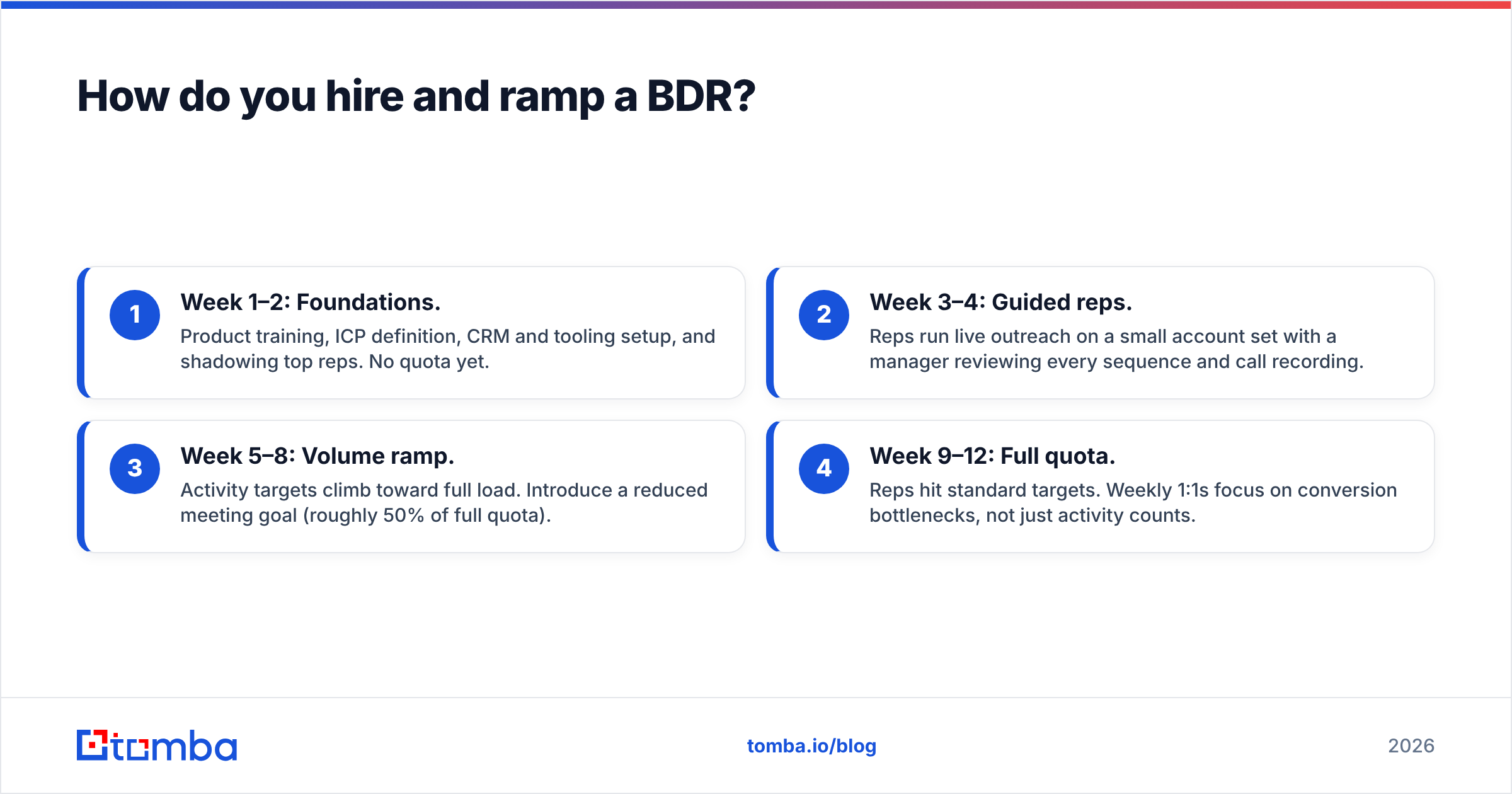
A 90-day ramp keeps new hires from drowning. Treat it like couch-to-5K — you don't run the race on day one; you build the base first.
- Week 1–2: Foundations. Product training, ICP definition, CRM and tooling setup, and shadowing top reps. No quota yet.
- Week 3–4: Guided reps. Reps run live outreach on a small account set with a manager reviewing every sequence and call recording.
- Week 5–8: Volume ramp. Activity targets climb toward full load. Introduce a reduced meeting goal (roughly 50% of full quota).
- Week 9–12: Full quota. Reps hit standard targets. Weekly 1:1s focus on conversion bottlenecks, not just activity counts.
Throughout ramp, the fastest accelerant is removing friction. The newest rep should never be the one manually guessing email formats. Give them a verified data source on day one so their first 100 sends actually land. A bulk email finder that returns verified contacts in minutes does more for ramp speed than another scripting session.
What metrics should a BDR program track?#
Track a tight set of leading and lagging metrics. Leading metrics (activity, connect rate) tell you what's happening now; lagging metrics (meetings held, pipeline, win contribution) tell you whether it's working.
- Activity volume — emails, calls, and social touches per day. A leading indicator, not a goal in itself.
- Connect / reply rate — the percentage of outreach that gets a human response. A direct read on list quality and messaging.
- Meetings booked vs. meetings held — the gap reveals show-rate and qualification problems.
- Meeting-to-opportunity conversion — are AEs accepting the meetings as real pipeline?
- Pipeline created — the dollar value of qualified opportunities sourced by BDRs.
- Cost per meeting — fully loaded program cost divided by qualified meetings.
A healthy program watches response rate closely because it's the earliest signal that data or messaging has drifted. If replies crater, check your bounce rate before you rewrite a single email. Rising bounces almost always mean the list got stale, not that the copy got worse.
What does the BDR tooling stack look like?#
Three layers, in order of importance: data, sequencing, and CRM. Most teams obsess over the sequencer and treat data as an afterthought. That's backwards.
The data layer is the foundation. Reps need verified emails, direct-dial phone numbers, and enriched account context. This is where programs live or die. A tool like Tomba's email finder returns professional addresses by name and domain, and pairing it with an email verifier before every send keeps bounce rates low and protects your domain's sender reputation. For accounts where email is saturated, a phone finder gives reps a second channel that competitors aren't crowding.
The sequencer automates multi-touch cadences across email, phone, and LinkedIn. It schedules follow-ups, tracks opens and replies, and keeps reps from forgetting touch 6.
The CRM is the system of record. Every account, contact, activity, and opportunity lives here. It's also where leadership pulls the metrics above.
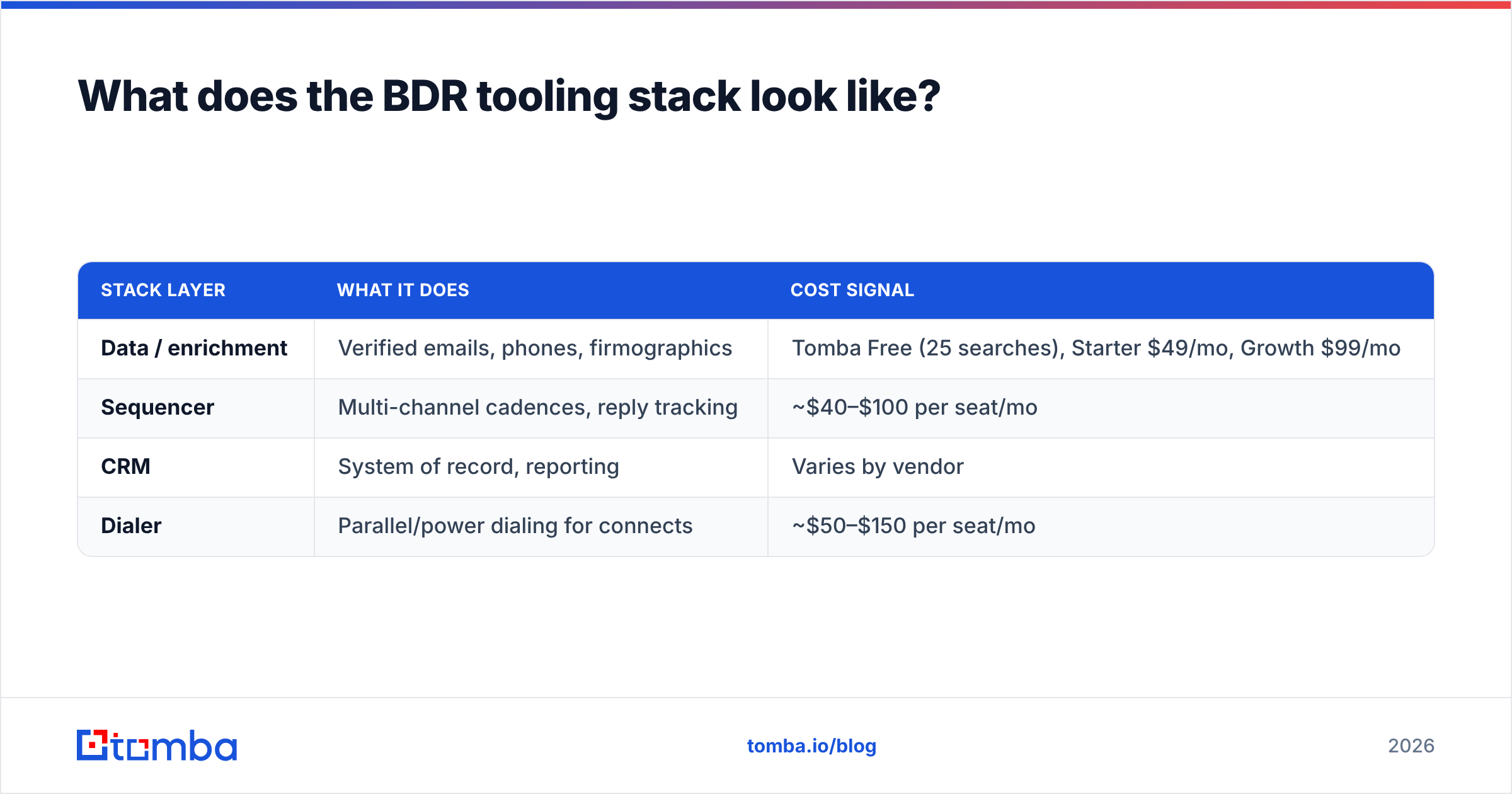
| Stack layer | What it does | Cost signal |
|---|---|---|
| Data / enrichment | Verified emails, phones, firmographics | Tomba Free (25 searches), Starter $49/mo, Growth $99/mo |
| Sequencer | Multi-channel cadences, reply tracking | ~$40–$100 per seat/mo |
| CRM | System of record, reporting | Varies by vendor |
| Dialer | Parallel/power dialing for connects | ~$50–$150 per seat/mo |
You don't need the most expensive option in each layer. You need the data layer to be accurate, because everything downstream amplifies whatever quality you feed in. Garbage in, garbage amplified. You can compare options on a marketplace like G2 before committing, and check Tomba's pricing to see where a verified data layer fits your budget.
How do you scale a BDR program?#
Scaling is where good programs become great or fall apart. The rule: don't scale headcount until the playbook is repeatable. If one rep hits quota and the rest don't, you have a talented individual, not a program. Fix the system first.
Signals you're ready to scale:
- At least two-thirds of reps are hitting quota on the current playbook.
- Cost per meeting is stable and predictable.
- Ramp time is consistent — new hires reliably hit full quota by day 90.
- AEs accept the majority of booked meetings as real pipeline.
When those hold, scaling is mostly a hiring and data problem. Each new rep needs the same clean data the team runs on, which is why centralizing enrichment beats letting every rep build lists their own way. Pushing verified contacts straight into your CRM through an integration — or enriching records in bulk with data enrichment — keeps quality consistent as the team grows. The alternative, where 12 reps each scrape lists differently, produces 12 different bounce rates and a reporting nightmare.
As Salesforce notes in its State of Sales research, the highest-performing teams standardize on shared data and process rather than relying on individual heroics. Standardization is what lets you predict next quarter's pipeline from this quarter's activity.
What's the biggest mistake to avoid?#
Underinvesting in data while overinvesting in everything else. Teams will happily pay for a premium sequencer, a fancy dialer, and a sales-enablement platform, then run all of it on a contact list that's 30% wrong. Every dollar spent on automation gets multiplied by your data quality — and when that quality is negative, automation just helps you send bad emails faster.
The fix is unglamorous but decisive: verify before you send, enrich before you call, and keep your lists fresh. A BDR who trusts their list moves faster, sends with confidence, and protects the whole team's deliverability. That trust is built one verified contact at a time.
Build your BDR program on data that actually lands#
A BDR program succeeds or fails on the quality of the conversations it manufactures — and you can't have a real conversation with a bounced email. Before you scale headcount, scale your data foundation. Start with the Tomba Email Finder to give every rep verified professional emails by name, company, or domain, then layer in verification so your sends land in the inbox and your sender reputation stays clean. The free tier gives you 25 searches a month to test the quality on your own ICP, and paid plans start at $49/mo when you're ready to equip the whole team. Build the program on data your reps can trust, and the meetings follow.
Ready to find emails that actually work?
Join 150,000+ professionals who stopped guessing and started sending. Free credits on signup — no credit card required.
Get the Tomba newsletter
Practical outbound tactics and product updates — once every two weeks.
About the author