BDR Sales Training in 2026: A Complete Ramp Framework
A practical, week-by-week BDR sales training framework that ramps new reps faster, lifts pipeline quality, and stops the guesswork that kills early-stage outbound.
Most BDR sales training programs fail for one boring reason: they teach scripts before they teach the system. A rep who memorizes a cold-call opener but can't build a clean list, research an account, or read a buying signal is just a faster way to burn your TAM. This guide fixes that with a ramp framework you can run next Monday.
TL;DR#
- Ramp is a system, not a pep talk. A good BDR sales training program moves a new hire from shadowing to self-sufficient pipeline in about 30 days using a fixed weekly curriculum.
- Data quality is half the job. Reps trained on bad contact data plateau no matter how good their messaging is — clean, verified data is the foundation.
- Certify, don't just train. Use call scorecards and email teardown rubrics so "trained" means "passed a bar," not "sat through slides."
- Measure leading indicators. Activity, connect rate, and meeting-held rate predict quota long before booked revenue does.
- Tooling matters. Pair training with an email finder, verification, and enrichment so reps spend time selling, not scrubbing spreadsheets.
What is BDR sales training, and why does it fail so often?#
BDR sales training is the structured process of turning a new business development representative into someone who can independently source, research, contact, and qualify prospects. Think of it like training a line cook: you don't hand them the full menu on day one. You teach knife skills, then one station, then the flow of a full service. Skip the fundamentals and every dish comes out late and inconsistent.
The reason programs fail is they front-load the glamorous part — the pitch — and ignore the unglamorous foundation: building a target list, verifying contacts, and understanding the buyer. A rep with a great script and a list full of bounced emails will hit a wall by week two. According to HubSpot's sales research, prospecting is consistently rated the hardest part of the job by reps, largely because the inputs are messy.
Good training treats the BDR as a full pipeline operator. They need to know where data comes from, how to tell a real contact from a guess, and how to sequence outreach across email, phone, and social. That's a wider scope than most onboarding decks assume.
What should a BDR ramp curriculum actually cover?#
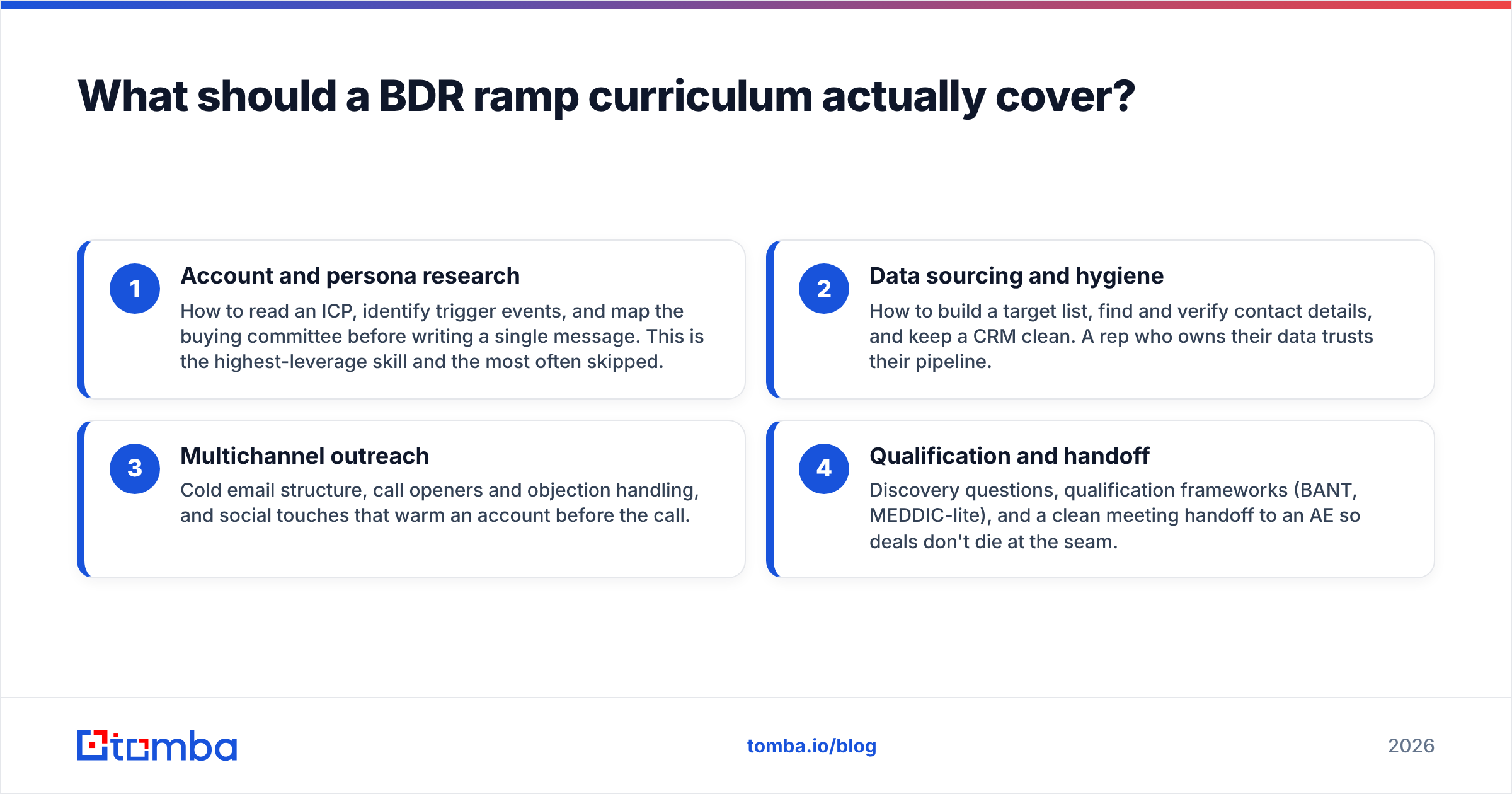
Break the program into four competency areas, then sequence them. Don't teach all four at once — layer them so each week builds on the last.
- Account and persona research — How to read an ICP, identify trigger events, and map the buying committee before writing a single message. This is the highest-leverage skill and the most often skipped.
- Data sourcing and hygiene — How to build a target list, find and verify contact details, and keep a CRM clean. A rep who owns their data trusts their pipeline.
- Multichannel outreach — Cold email structure, call openers and objection handling, and social touches that warm an account before the call.
- Qualification and handoff — Discovery questions, qualification frameworks (BANT, MEDDIC-lite), and a clean meeting handoff to an AE so deals don't die at the seam.
Each area gets a competency bar. A rep "passes" research when they can produce a 10-account plan that a manager approves. They pass data hygiene when their list verifies above a set deliverability threshold. Concrete bars beat vague "they seem ready" judgments every time.
What does a 4-week BDR training schedule look like?#
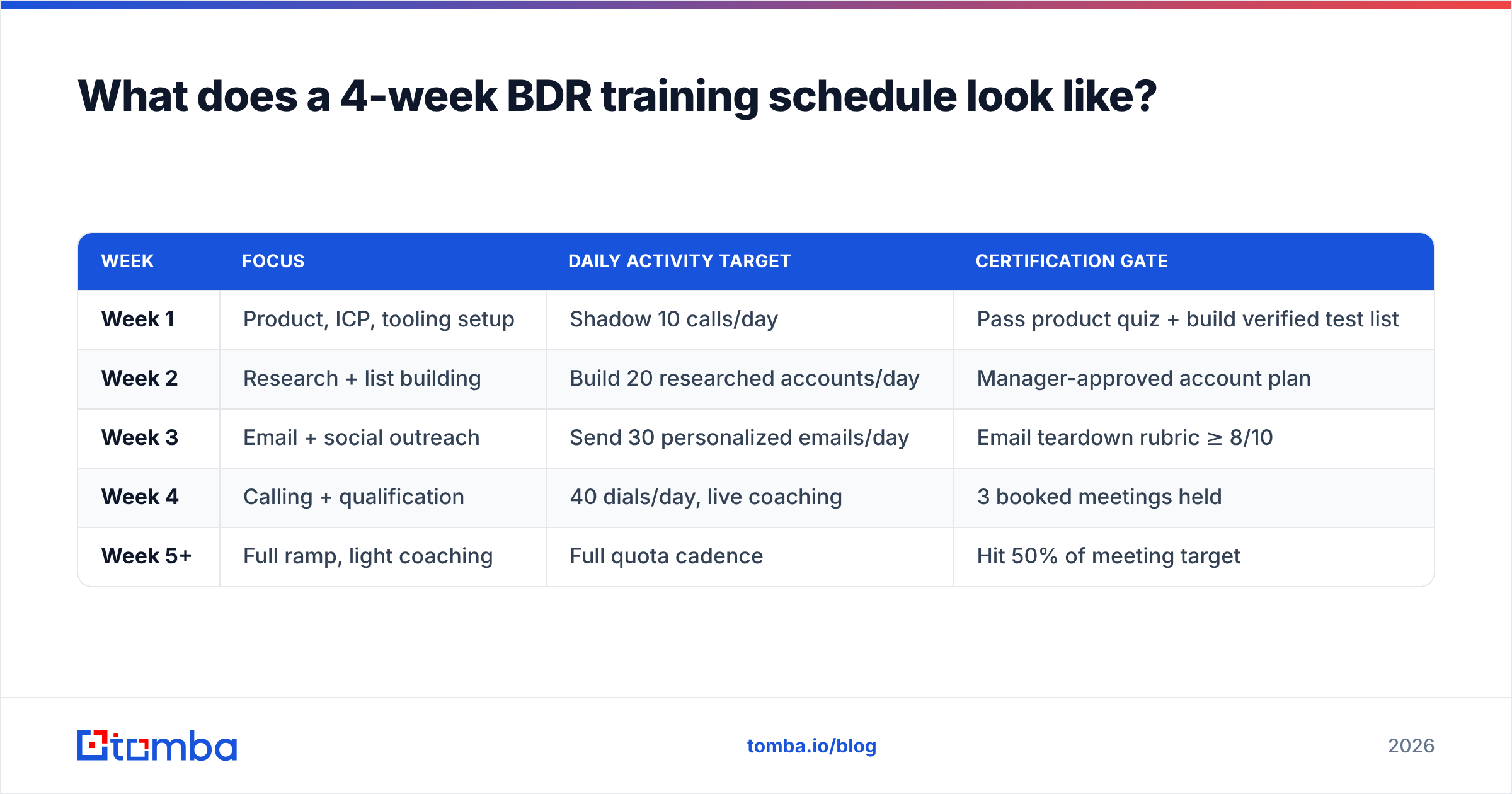
Here's a defensible default. Compress or extend based on deal complexity, but keep the sequence.
| Week | Focus | Daily activity target | Certification gate |
|---|---|---|---|
| Week 1 | Product, ICP, tooling setup | Shadow 10 calls/day | Pass product quiz + build verified test list |
| Week 2 | Research + list building | Build 20 researched accounts/day | Manager-approved account plan |
| Week 3 | Email + social outreach | Send 30 personalized emails/day | Email teardown rubric ≥ 8/10 |
| Week 4 | Calling + qualification | 40 dials/day, live coaching | 3 booked meetings held |
| Week 5+ | Full ramp, light coaching | Full quota cadence | Hit 50% of meeting target |
The gates are the point. Activity without a passed gate just produces confident reps doing the wrong thing at scale. The week-4 "meetings held" gate — not "meetings booked" — matters because booked-but-no-show is the most common vanity metric in early ramp.
Is internal training better than buying an external program?#
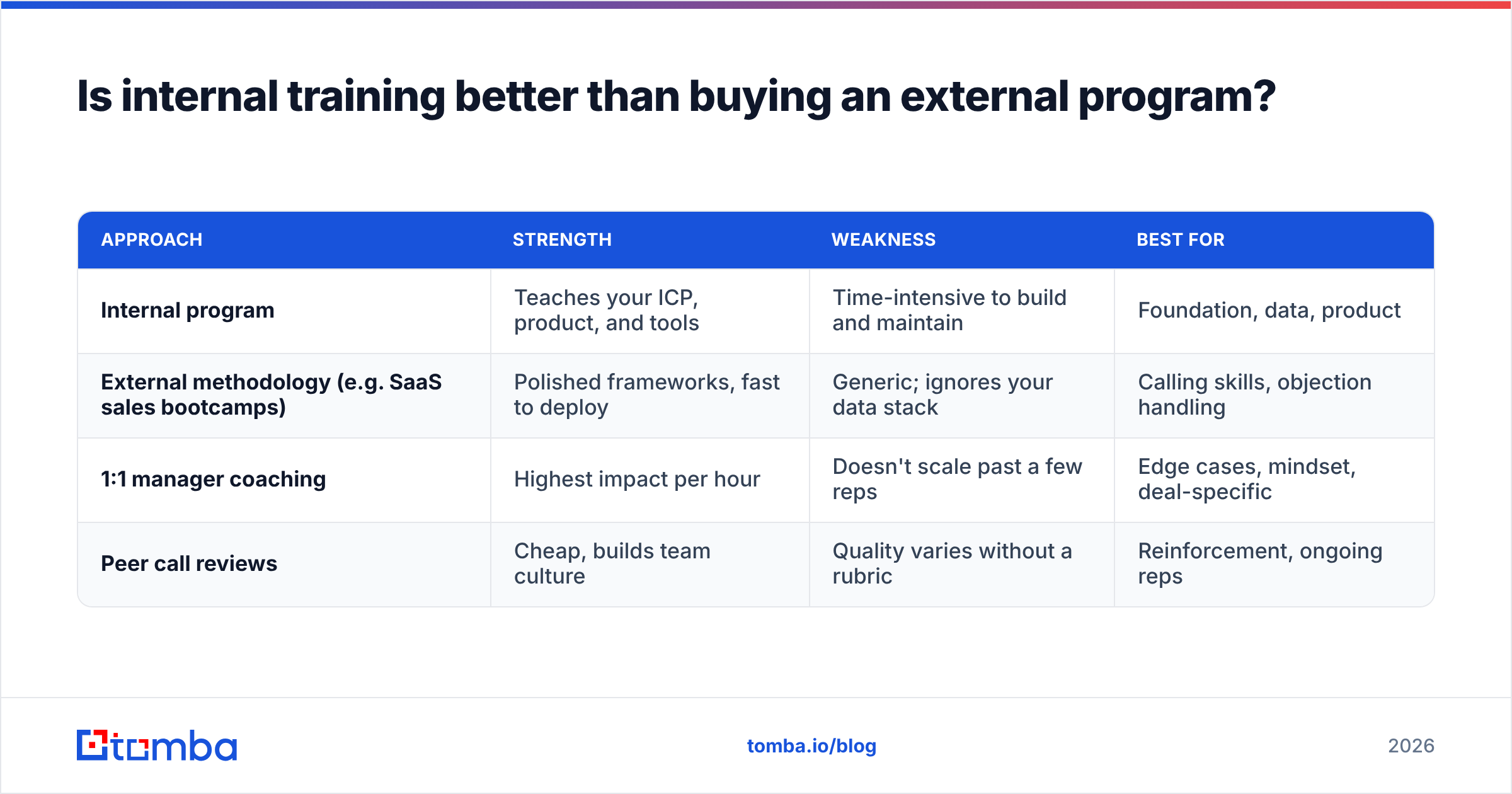
Both, but in a specific order: build your internal foundation first, then layer external sales methodology on top. The trade-off looks like this.
| Approach | Strength | Weakness | Best for |
|---|---|---|---|
| Internal program | Teaches your ICP, product, and tools | Time-intensive to build and maintain | Foundation, data, product |
| External methodology (e.g. SaaS sales bootcamps) | Polished frameworks, fast to deploy | Generic; ignores your data stack | Calling skills, objection handling |
| 1:1 manager coaching | Highest impact per hour | Doesn't scale past a few reps | Edge cases, mindset, deal-specific |
| Peer call reviews | Cheap, builds team culture | Quality varies without a rubric | Reinforcement, ongoing reps |
External programs are great at teaching the conversation. They are useless at teaching your data sources, your CRM hygiene rules, or which accounts fit your ICP. Buy the conversation, build the system. You can validate any external vendor on G2 before committing budget.
How does data quality change BDR training?#
Data quality is the hidden variable that decides whether training sticks. You can teach a perfect cold-email framework, but if the rep's list is 40% invalid addresses, their reply rate craters and they conclude — wrongly — that the framework doesn't work. They lose faith in the process during the most fragile part of ramp.
Train data hygiene as a first-class skill, not an afterthought. New reps should learn to:
- Source the right contacts using an email finder instead of guessing addresses from a name and domain.
- Verify before sending with an email verifier so bounces don't wreck sender reputation during ramp.
- Enrich thin records through data enrichment so every account has firmographics and a real persona attached.
- Reach decision-makers by phone using a phone finder when email alone stalls.
A rep who internalizes these habits in week one carries them for their whole tenure. Skip it, and you'll spend year two cleaning up the CRM they polluted in year one. Tools like a B2B database also let new reps build practice lists without depleting a shared prospecting budget.
What metrics should you track during ramp?#
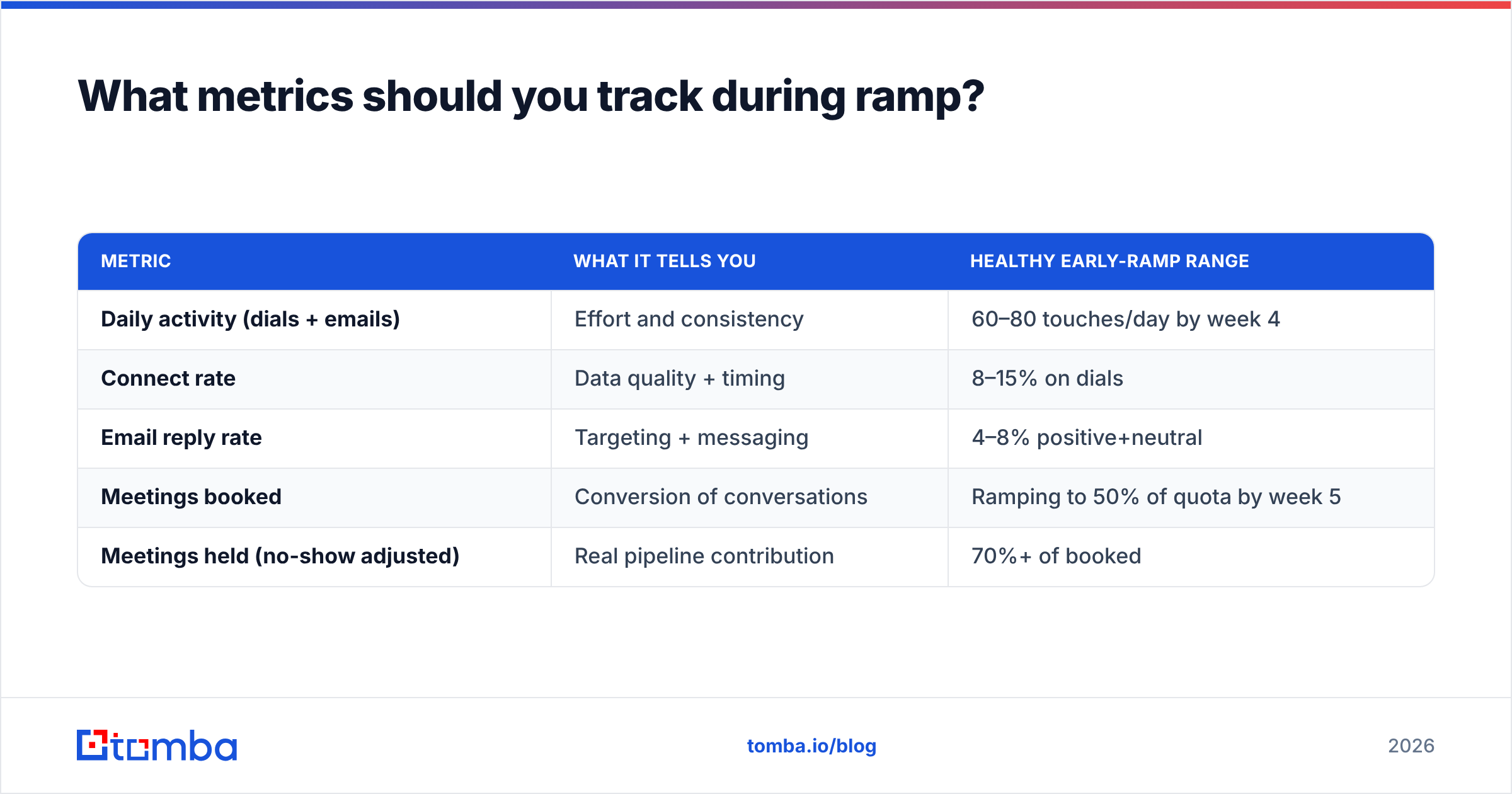
Track leading indicators, because lagging ones (closed revenue) arrive too late to coach against. The job during ramp is to confirm the behaviors that produce pipeline, then let pipeline follow.
| Metric | What it tells you | Healthy early-ramp range |
|---|---|---|
| Daily activity (dials + emails) | Effort and consistency | 60–80 touches/day by week 4 |
| Connect rate | Data quality + timing | 8–15% on dials |
| Email reply rate | Targeting + messaging | 4–8% positive+neutral |
| Meetings booked | Conversion of conversations | Ramping to 50% of quota by week 5 |
| Meetings held (no-show adjusted) | Real pipeline contribution | 70%+ of booked |
If connect rate is low, the problem is usually data or timing — not the script. If reply rate is low but connect rate is fine, it's messaging. Separating these lets you coach the actual gap instead of telling every struggling rep to "just make more calls." Salesforce's State of Sales reporting consistently shows reps spend less than a third of their time actually selling — so any metric that protects selling time is worth defending.
How do you coach a BDR who's stalling?#
Diagnose before you prescribe. Stalling almost always traces to one of three root causes, and each has a different fix.
- Volume problem — They aren't doing enough activity. Fix with calendar blocking and a visible activity dashboard. Easiest to spot, easiest to fix.
- Quality problem — Activity is high but conversion is low. Listen to five calls or read ten emails before saying anything. The issue is usually a weak opener, no clear value hypothesis, or talking past buying signals.
- Belief problem — They've stopped trusting the process, often after a bad data experience. Rebuild confidence with a clean, verified list and a few quick wins. Momentum is a real coaching tool.
The mistake managers make is prescribing more volume for what's actually a quality or belief problem. That just produces more bad calls and faster burnout. Watch the work first, then coach the specific gap.
What tools belong in a BDR's training stack?#
Keep it lean during ramp. Too many tools fragment attention and slow time-to-first-meeting. A new BDR needs four things: a place to find and verify contacts, a CRM, a sequencer, and a call tool. Everything else can wait until they've passed their gates.
For the data layer specifically, train reps on a single source of truth so they aren't toggling between five tabs to assemble one contact. A tool that combines finding, verifying, and enriching — and that plugs into your CRM — removes the most common ramp friction: the rep who spends an hour building a list that should take ten minutes. Compare options on Tomba pricing against whatever your team uses today; the free tier (25 searches/mo) is enough for a new hire to practice on before you commit a paid seat.
How long should a BDR take to fully ramp?#
Expect 30 days to self-sufficiency and 60–90 days to full quota for most B2B SaaS motions. Complex enterprise sales stretch this; transactional, high-volume motions compress it. The number matters less than whether your gates are being passed on schedule. A rep who's "ramped" by the calendar but hasn't held three meetings isn't ramped — they're just past day 30.
Document each rep's gate progress in a shared tracker. When someone falls behind, you'll know exactly which competency is lagging instead of discovering a quota miss a quarter later. The whole point of a gated framework is that failure surfaces early, while it's still cheap to fix.
The bottom line#
Treat BDR sales training as building an operator, not coaching a talker. Sequence the curriculum — research, data, outreach, qualification — gate each stage with a real bar, and protect data quality as a first-class skill. Reps trained this way ramp faster, trust their pipeline, and don't pollute your CRM on the way up.
The fastest lever you control is the data your new reps learn on. Give them clean, verified contacts from day one with the Tomba Email Finder — find professional emails by name, domain, or company, verify them before they send, and let your BDRs spend their ramp selling instead of scrubbing spreadsheets. Start on the free tier, prove it on a practice list, and scale the seats once your gates start passing.
// get started
Find, verify and enrich your first contacts today
Start on the free plan with 25 searches a month, then scale when your team is ready.
Free plan · No credit card required · GDPR & CCPA
// about the author