BDR Solutions in 2026: Tools, Stack & Strategy Guide
BDR solutions span people, process, and software. Here's how to build a high-output pipeline engine in 2026 without overspending on bloated platforms.
BDR Solutions in 2026: Tools, Stack & Strategy Guide
TL;DR
- "BDR solutions" is not one product — it's the stack of people, process, and software that turns a target market into booked meetings.
- The biggest lever isn't your sequencer or your dialer; it's contact data accuracy. Bad data wastes your most expensive resource: rep time.
- You have three structural choices: build in-house, outsource to an agency, or run a hybrid. Cost and control move in opposite directions.
- A lean modern BDR stack costs far less than the legacy "all-in-one" platforms — you can assemble data, sequencing, and enrichment for under $300/month per seat.
- Start with clean data and a tight ICP, then layer automation. Automating a broken process just produces failure faster.
If you run outbound, you have heard the pitch a hundred times: buy this one platform and your business development reps will magically book meetings. The reality is messier. BDR solutions are a system, and the system breaks at its weakest link — usually the data feeding it. This guide breaks down what actually belongs in a 2026 BDR stack, how to choose between building and buying, and where to spend versus save.
What are BDR solutions, exactly?#
BDR solutions are the combined people, processes, and tools that a company uses to generate qualified pipeline through proactive outreach. Think of a BDR function like a restaurant kitchen: the reps are the cooks, the process is the recipe, and the software is the equipment. A great cook with rotten ingredients still serves a bad meal — which is why data quality sits at the center of everything below.
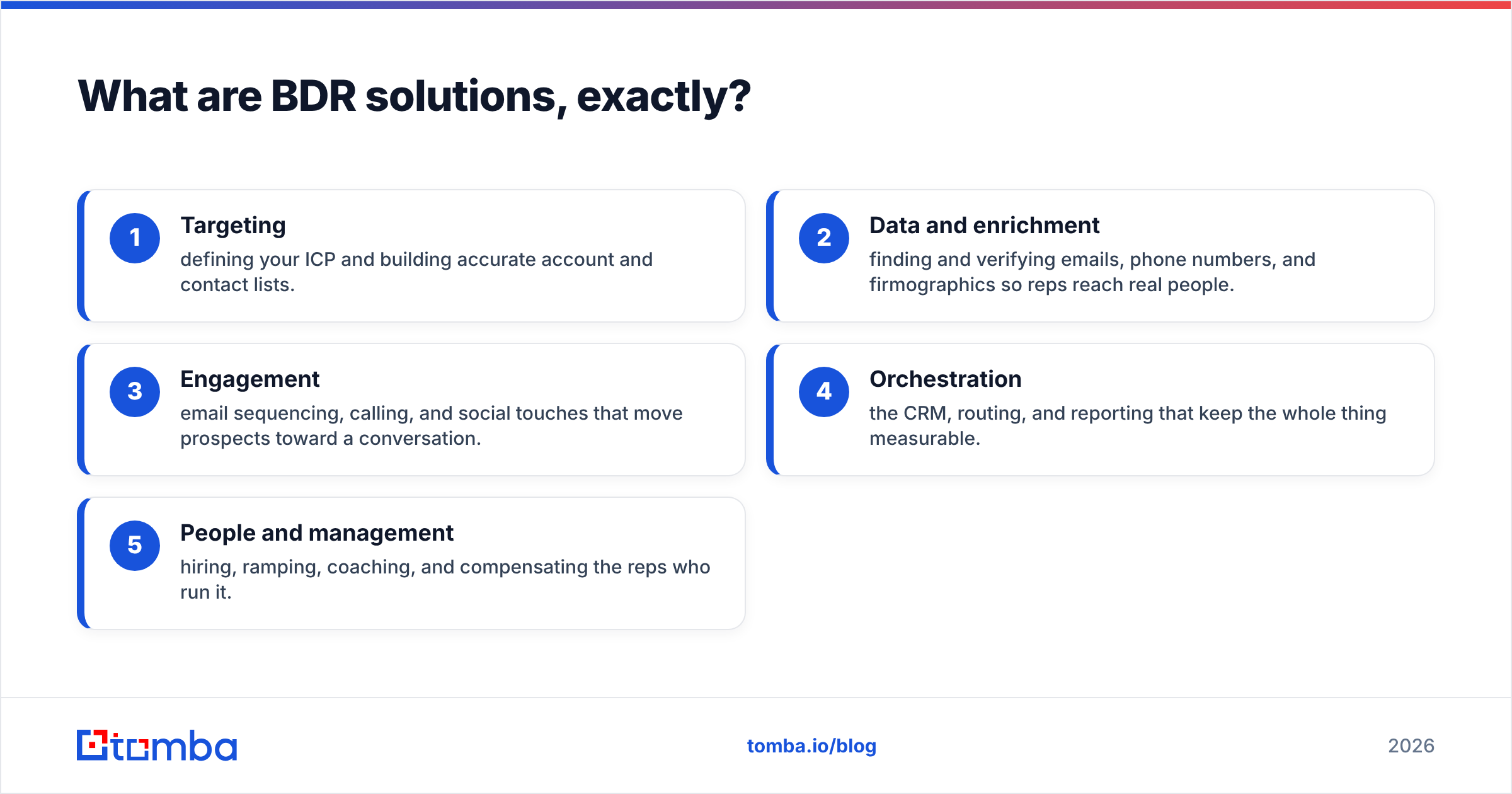
The term gets used loosely. Vendors sell "BDR solutions" that are really just one slice — a dialer, a sequencer, a database. To evaluate anything honestly, separate the function into its layers:
- Targeting — defining your ICP and building accurate account and contact lists.
- Data and enrichment — finding and verifying emails, phone numbers, and firmographics so reps reach real people.
- Engagement — email sequencing, calling, and social touches that move prospects toward a conversation.
- Orchestration — the CRM, routing, and reporting that keep the whole thing measurable.
- People and management — hiring, ramping, coaching, and compensating the reps who run it.
Most "BDR is broken" complaints trace back to layer 2. You can have the slickest sales automation in the world, but if 30% of your emails bounce, you are training mailbox providers to distrust your domain and burning rep hours on dead contacts.
In-house, outsourced, or hybrid: which BDR model wins?#
The first real decision isn't software — it's structure. Each model trades cost against control.
In-house gives you full control of messaging, brand, and feedback loops, but you carry hiring, ramp, and churn. A new BDR typically takes 3–4 months to reach full productivity, and SDR/BDR annual turnover routinely runs above 30% according to widely cited industry surveys.
Outsourced agencies promise speed — a team live in weeks — but you sacrifice control of quality and messaging, and the reps rarely understand your product as deeply.
Hybrid keeps strategy, messaging, and data in-house while outsourcing volume execution or specific channels. For most mid-market teams in 2026, this is the pragmatic middle.
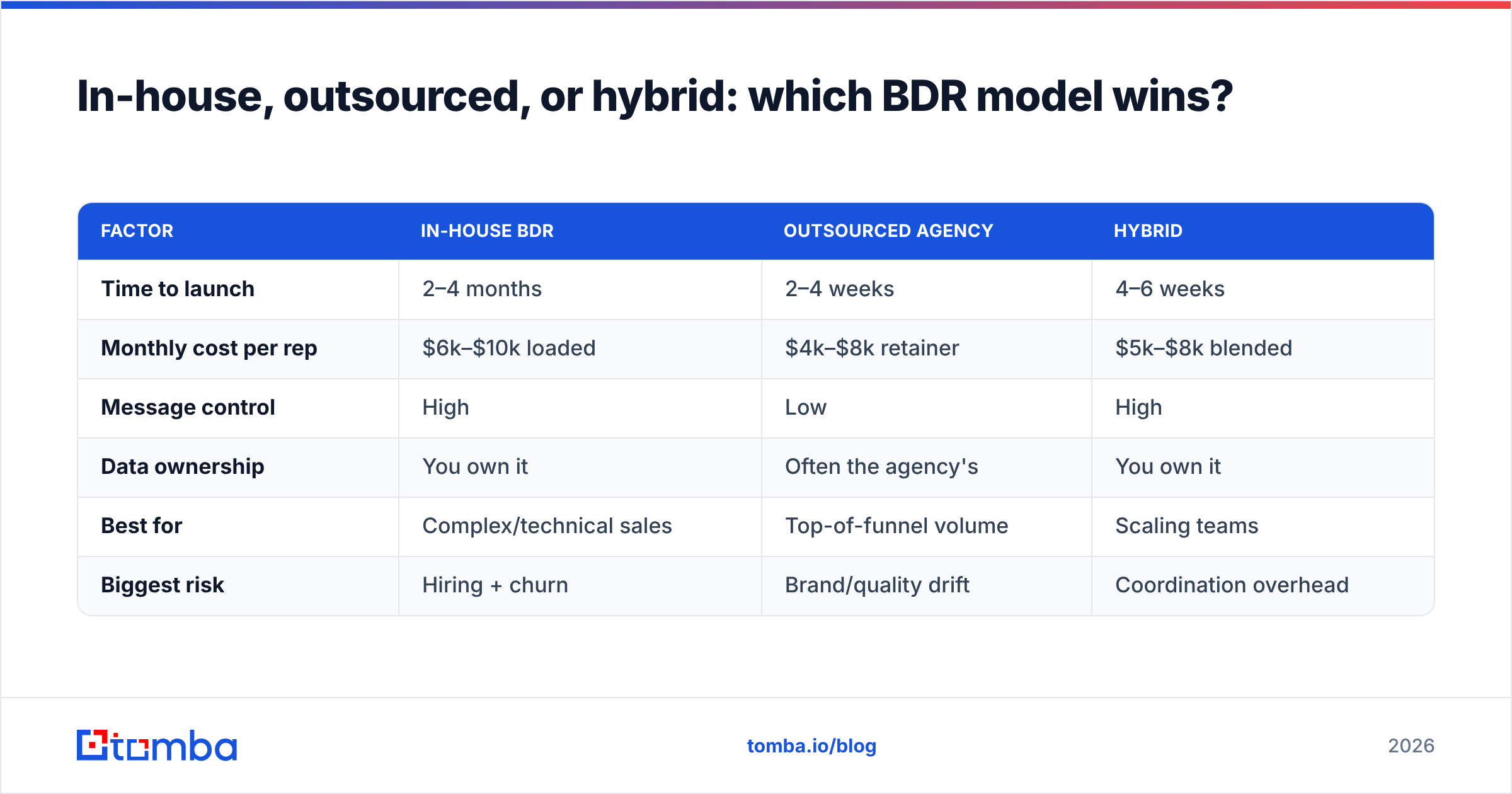
| Factor | In-house BDR | Outsourced agency | Hybrid |
|---|---|---|---|
| Time to launch | 2–4 months | 2–4 weeks | 4–6 weeks |
| Monthly cost per rep | $6k–$10k loaded | $4k–$8k retainer | $5k–$8k blended |
| Message control | High | Low | High |
| Data ownership | You own it | Often the agency's | You own it |
| Best for | Complex/technical sales | Top-of-funnel volume | Scaling teams |
| Biggest risk | Hiring + churn | Brand/quality drift | Coordination overhead |
There is no universally correct answer. If your sales motion is technical and consultative, keep BDRs in-house and invest in their tooling. If you need raw meeting volume in a well-understood market, an agency can work — but insist on owning the data and the sequences so you keep the asset when the contract ends.
What belongs in a modern BDR tech stack?#
A practical 2026 BDR stack has four spend categories. The mistake teams make is buying one bloated suite that does all four poorly. Best-of-breed, wired together, almost always beats the monolith on both cost and quality.
- Data layer — an email finder and verifier to source and validate contacts. This is the foundation; everything downstream inherits its quality.
- Engagement layer — a sequencer (email + tasks) and a dialer for phone-heavy motions.
- CRM layer — your system of record, where meetings and opportunities live.
- Intelligence layer — enrichment, intent signals, and website visitor reveal to prioritize who to contact first.
The data layer deserves the most scrutiny because its errors compound. A wrong email doesn't just fail to land — it can hit a spam trap, ding your sender reputation, and degrade deliverability for every other prospect in the batch. That is why teams increasingly verify contacts before sequencing, and use a catch-all verifier for the domains that don't return a clean SMTP response.
How much should a BDR stack actually cost?#
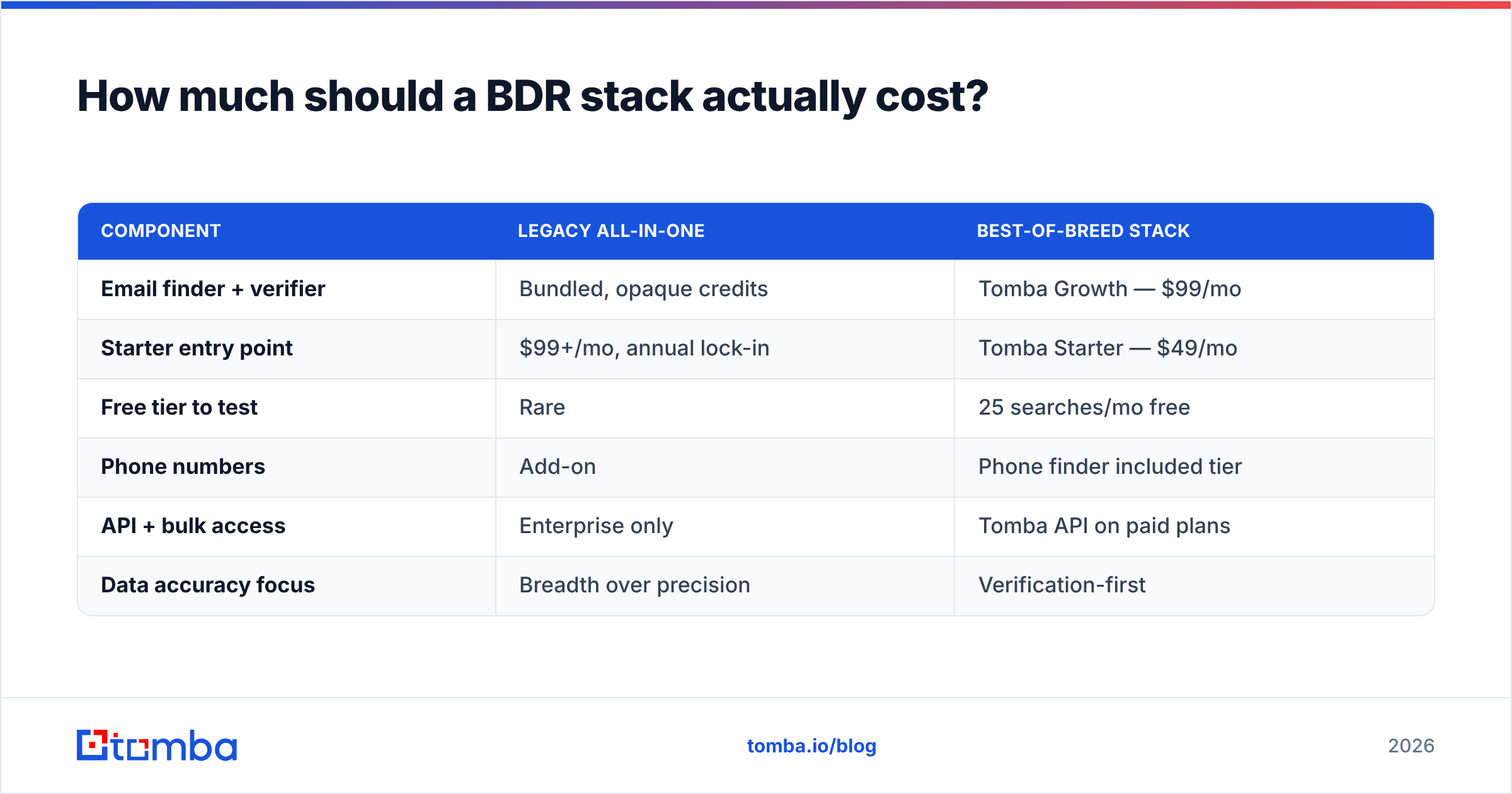
Less than you have been quoted. The legacy assumption that you need a $1,000+/month all-in-one seat is outdated. Here is a realistic comparison of how teams assemble the data layer, the single most important piece.
| Component | Legacy all-in-one | Best-of-breed stack |
|---|---|---|
| Email finder + verifier | Bundled, opaque credits | Tomba Growth — $99/mo |
| Starter entry point | $99+/mo, annual lock-in | Tomba Starter — $49/mo |
| Free tier to test | Rare | 25 searches/mo free |
| Phone numbers | Add-on | Phone finder included tier |
| API + bulk access | Enterprise only | Tomba API on paid plans |
| Data accuracy focus | Breadth over precision | Verification-first |
You can see full Tomba pricing for the current tiers, but the point stands: a verification-first data layer at $49–$99/month replaces the most expensive line item in most legacy contracts. Spend the savings on the engagement and intelligence layers, or on coaching your reps.
A quick note on the "$39 plan" you may see floating around in old comparison posts — that figure is stale. Tomba's entry paid plan is $49/month (Starter), with Growth at $99 and Pro at $249. Pricing pages change; always check the live page before budgeting.
Why is contact data the make-or-break layer?#
Because every other tool multiplies whatever data quality you feed it. Garbage in, garbage out — at scale, with automation, the garbage just arrives faster.
Consider the math. Say a BDR sends 1,000 emails a month. At a 5% bounce rate, that's 50 hard bounces. Mailbox providers like Gmail and Outlook read elevated bounce rates as a spam signal, and once your email deliverability drops, even your valid emails start landing in spam. Google's own Postmaster guidance is explicit that sender reputation and low spam rates gate inbox placement — see Google's bulk sender guidelines for the current bar. So the cost of bad data is not one wasted email; it's the silent suppression of your entire program.
This is where a verification-first workflow pays off:
- Find contacts by domain using domain search, or by name with the email finder.
- Verify each address with an email verifier before it ever enters a sequence.
- Enrich the surviving contacts with role, seniority, and firmographics via data enrichment.
- Segment so messaging matches the persona — generic blasts are what trained inboxes to filter outbound in the first place.
Run that loop and your bounce rate drops, your reply rate climbs, and your domain reputation stays clean. Skip it and no sequencer, dialer, or AI writer will save you.
How do you choose BDR software without getting burned?#
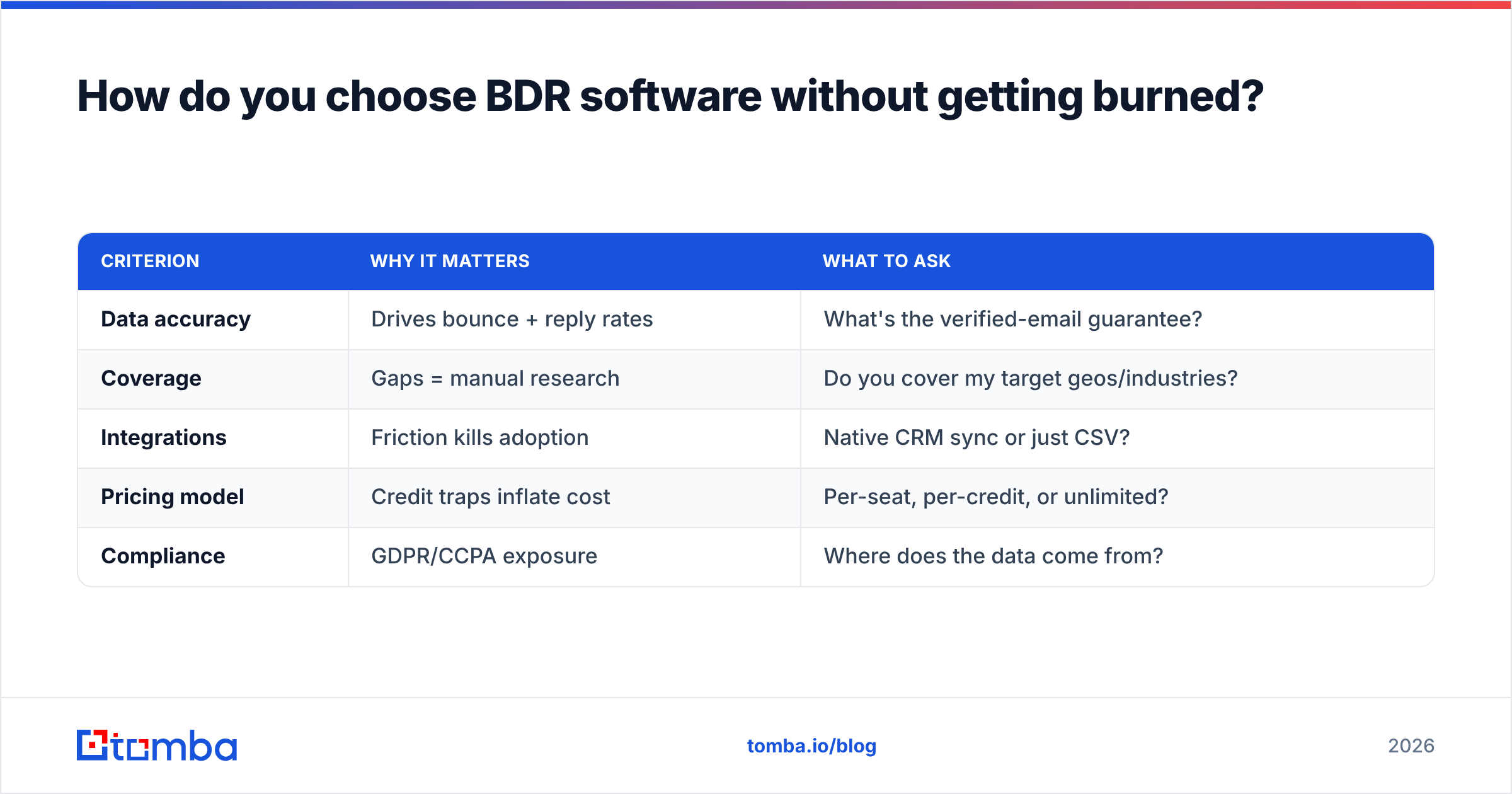
Score every tool against five criteria, and weight data accuracy highest. Most buyers over-index on UI polish and feature lists and under-index on the one thing that determines outcomes.
| Criterion | Why it matters | What to ask |
|---|---|---|
| Data accuracy | Drives bounce + reply rates | What's the verified-email guarantee? |
| Coverage | Gaps = manual research | Do you cover my target geos/industries? |
| Integrations | Friction kills adoption | Native CRM sync or just CSV? |
| Pricing model | Credit traps inflate cost | Per-seat, per-credit, or unlimited? |
| Compliance | GDPR/CCPA exposure | Where does the data come from? |
On that last point, transparency about data sources is not a nice-to-have in 2026 — it's a legal and reputational requirement. Vendors who can't tell you where their data originates are a risk you absorb. Independent review sites like G2's email-finder category and Capterra are useful for sanity-checking vendor claims against real user reviews before you commit.
For teams replacing an incumbent, the honest move is to run a head-to-head test on your list. Export 200 contacts you already know, run them through each candidate, and measure verified-match rate and bounce rate. Marketing copy doesn't survive contact with your actual ICP — your data does the talking. If you're evaluating against a specific incumbent, Tomba publishes direct comparisons like its Apollo alternative and RocketReach alternative pages.
What metrics tell you the BDR engine is working?#
Track leading and lagging indicators separately, and never optimize activity in isolation. Reps will happily hit a 100-email quota with terrible emails if that's what you measure.
- Deliverability rate — should sit above 95%. Below that, fix data before anything else.
- Reply rate — a healthy outbound program lands 5–10%+ positive-or-neutral replies; check the response rate benchmarks for your segment.
- Meetings booked per rep per month — the real output metric.
- Meeting-to-opportunity conversion — quality check on whether BDRs target the right people.
- Cost per meeting — total stack + people cost divided by meetings; this is how you compare in-house vs outsourced honestly.
If deliverability and reply rate are healthy but meetings are low, your problem is targeting or messaging, not tooling. If deliverability itself is poor, stop everything and fix the data layer first. The sequence of diagnosis matters as much as the metrics.
How do you roll out a new BDR solution?#
Phase it. Ripping out a stack and dropping in a new one overnight guarantees a productivity crater. A measured rollout protects pipeline while you migrate.
- Audit the current state — list every tool, its cost, and what it's actually used for. You'll find shelfware.
- Pilot the new data layer with one rep or one segment for two to three weeks. Measure bounce and reply rate against baseline.
- Integrate the winner into your CRM and sequencer; wire up enrichment so records stay current. Tools like Tomba's integrations plug into HubSpot, Salesforce, and Pipedrive without custom engineering.
- Train reps on the new workflow — especially the verify-before-send habit, which is the single highest-ROI behavior change.
- Scale once the pilot beats baseline, then layer in automation and intent signals.
The order is deliberate: data first, automation last. Automating a broken process just produces failures at machine speed.
The bottom line on BDR solutions#
Strong BDR solutions in 2026 are best-of-breed, not bloated all-in-ones — and they're anchored on accurate, verified contact data. Pick your structural model (in-house, outsourced, or hybrid) based on how technical your sale is, assemble a lean stack where the data layer is the priority, and measure deliverability before you measure activity. Do that and a modest budget outperforms a six-figure platform contract.
Ready to fix the layer that everything else depends on? Start with the Tomba Email Finder to source and verify contacts by name, company, or domain — there's a free tier with 25 searches a month so you can test it on your own ICP before spending a dollar. Clean data in, real meetings out. That's the whole game.
Ready to find emails that actually work?
Join 150,000+ professionals who stopped guessing and started sending. Free credits on signup — no credit card required.
Get the Tomba newsletter
Practical outbound tactics and product updates — once every two weeks.
About the author