BDR Support in 2026: How to Set Reps Up to Hit Quota
BDR support is the difference between reps who hit quota and reps who burn out. Here is the data, tooling, and coaching stack that actually moves pipeline in 2026.
BDR Support in 2026: How to Set Reps Up to Hit Quota
TL;DR
- BDR support is the system of data, tooling, coaching, and quota design that lets a business development rep spend time selling instead of scrubbing lists.
- The single biggest lever is clean contact data — reps who trust their data make 30-40% more dials and send more personalized emails.
- A modern support stack pairs an accurate email finder and verifier with a sequencer, a CRM, and a weekly coaching cadence.
- Quota and comp design matter as much as tooling: unrealistic ramp schedules cause the churn that kills BDR teams.
- Tomba's email finder, verifier, and enrichment tools remove the manual research tax so your BDRs can focus on conversations.
If your BDRs are missing quota, the instinct is to push harder — more dials, more emails, more pressure. That usually makes things worse. The teams that consistently hit number do something different: they remove friction. This guide breaks down what real BDR support looks like in 2026, what to budget for, and how to measure whether it is working.
What is BDR support, exactly?#
BDR support is the combined system of data, software, process, and coaching that lets a business development rep do their core job — booking qualified meetings — without drowning in manual research and admin work.
Think of a BDR like a delivery driver. You can hire the best driver in the city, but if you hand them a bad map, a van with a quarter tank, and no loading dock, they will spend their day stuck instead of delivering. BDR support is the map, the fuel, and the dock. The rep still has to drive, but everything around them is engineered so the driving is the only hard part.
In practice, BDR support breaks into four pillars:
- Data — accurate contact information (verified emails, direct dials, firmographics) so reps reach real people, not bounces.
- Tooling — the sequencer, dialer, CRM, and enrichment tools that automate the repetitive parts of outreach.
- Process — clear ICP definitions, messaging frameworks, qualification criteria, and handoff rules to AEs.
- Enablement — onboarding, call coaching, objection libraries, and a feedback loop that improves skills over time.
Get all four right and a BDR can spend the bulk of their day in active conversations. Get them wrong and your reps spend half their week copy-pasting from LinkedIn into a spreadsheet.
Why is data the foundation of BDR support?#
Bad data quietly destroys BDR productivity, and most leaders never see it on a dashboard. Every wrong email is a bounce that hurts your domain reputation. Every wrong phone number is a wasted dial. Every missing job title is a generic, ignorable email.
Industry research is consistent on this: B2B contact data decays roughly 30% per year as people change jobs, companies rebrand, and roles shift. That means a list you bought 12 months ago is already a third wrong. When a BDR doesn't trust their list, they hesitate before every send and every call — and hesitation kills activity volume.
This is where an accurate email finder and email verifier pay for themselves. Instead of guessing email patterns or buying stale lists, your BDRs pull verified addresses on demand, then enrich them with titles, company size, and direct dials. A clean record before the first touch changes the entire economics of a sequence.
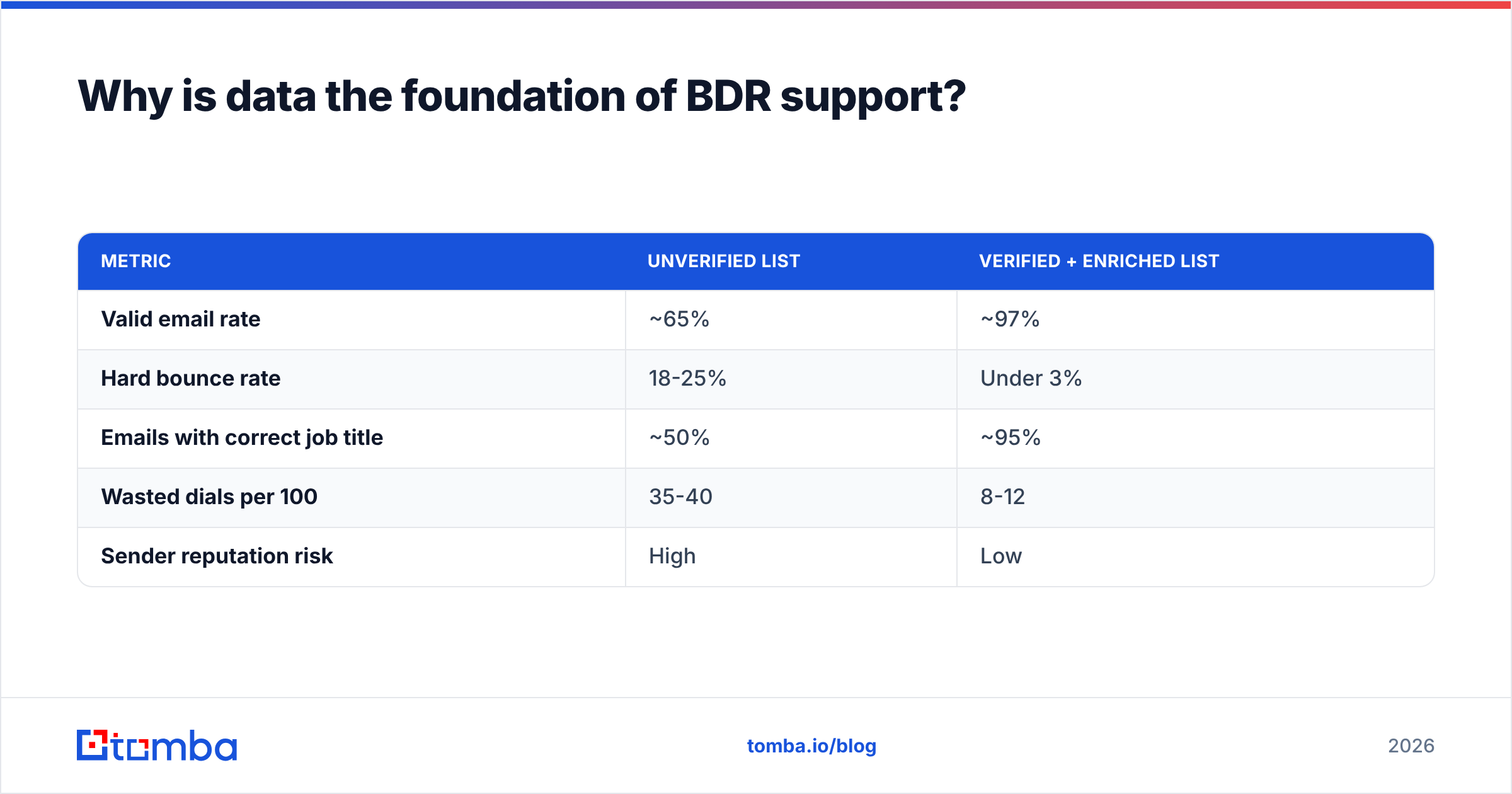
Here is what the data problem looks like in concrete terms across a 100-prospect list:
| Metric | Unverified list | Verified + enriched list |
|---|---|---|
| Valid email rate | ~65% | ~97% |
| Hard bounce rate | 18-25% | Under 3% |
| Emails with correct job title | ~50% | ~95% |
| Wasted dials per 100 | 35-40 | 8-12 |
| Sender reputation risk | High | Low |
The difference is not marginal. A list with a 20% bounce rate can land your sending domain in spam folders within weeks, which silently tanks the deliverability of every rep on the team. Investing in email verification is the cheapest insurance you can buy for a BDR program.
What does a modern BDR support stack look like?#
A good stack covers the full motion: find the contact, verify it, enrich it, sequence it, dial it, and log it. You do not need 15 tools. You need a tight set that hands data cleanly from one step to the next.
A practical 2026 stack looks like this:
- Data layer — an email finder, verifier, and data enrichment tool to build and clean target lists. This is where Tomba fits, and it also exposes a Tomba API so you can wire enrichment directly into your CRM or sequencer.
- Direct dials — a phone finder so SDRs can mix calls with email instead of relying on email alone.
- Engagement layer — a sequencer or sales engagement platform (Outreach, Salesloft, or similar) to run multi-touch cadences.
- CRM — Salesforce or HubSpot as the system of record, so every touch and reply is logged.
- Coaching layer — a conversation-intelligence tool to record and review calls for objection handling.
The trap teams fall into is buying the engagement layer first and the data layer last. That is backwards. A world-class sequencer firing at wrong addresses just sends bad emails faster. Build from the data outward.
How do you compare BDR support models?#
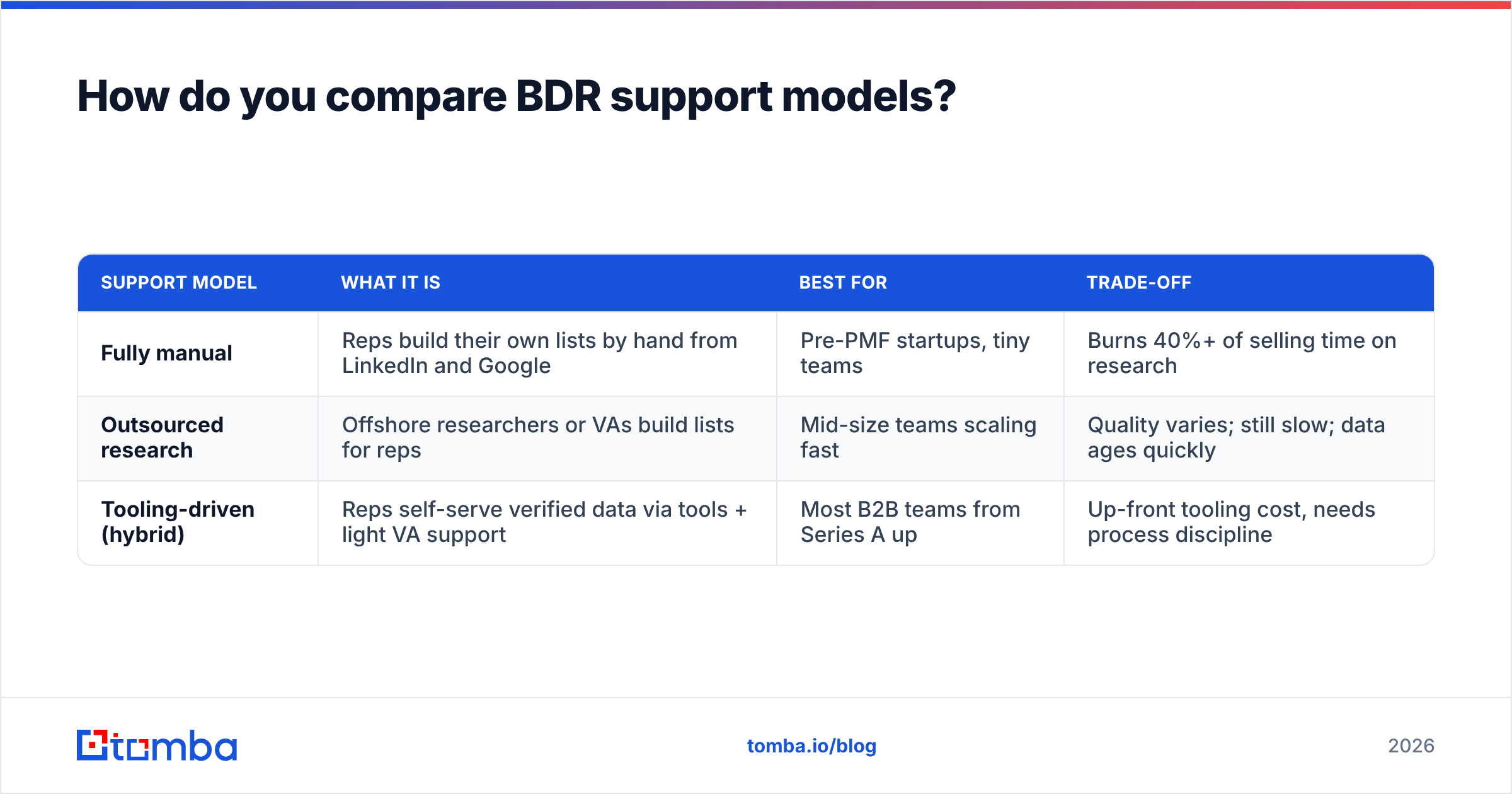
There are three common ways teams support BDRs, and they trade off cost against scale very differently. Most growing teams land on the hybrid model.
| Support model | What it is | Best for | Trade-off |
|---|---|---|---|
| Fully manual | Reps build their own lists by hand from LinkedIn and Google | Pre-PMF startups, tiny teams | Burns 40%+ of selling time on research |
| Outsourced research | Offshore researchers or VAs build lists for reps | Mid-size teams scaling fast | Quality varies; still slow; data ages quickly |
| Tooling-driven (hybrid) | Reps self-serve verified data via tools + light VA support | Most B2B teams from Series A up | Up-front tooling cost, needs process discipline |
The tooling-driven model wins for most teams because it scales without linearly adding headcount. A single BDR with a good bulk email finder and enrichment workflow can build in an hour what used to take an outsourced team a full day — and the data is fresher because it is pulled live, not from a months-old database.
The key insight: tooling does not replace the human. It replaces the boring parts of the human's job. Your BDR still writes the personalized opener, picks the trigger, and handles the objection. They just stop spending two hours a day hunting for email addresses.
How should you structure BDR coaching and enablement?#
Tools get a rep to the conversation; coaching wins the conversation. The highest-performing BDR teams run a tight, repeatable enablement loop rather than one-off training events.
A weekly cadence that works:
- Monday number review — each BDR commits to weekly activity and meeting targets out loud. Public commitment beats private goals.
- Mid-week call review — pull two real calls per rep, listen as a group, and dissect the opener and the first objection. This is where skills compound.
- Objection library upkeep — every new objection that stumps a rep becomes a documented response. Over a quarter this becomes your most valuable asset.
- Friday pipeline retro — what converted, what didn't, and which messaging angle is working this week. Feed wins back into the sequences everyone runs.
Notice none of this requires expensive software. It requires manager discipline and 3-4 focused hours a week. According to G2 reviews across sales engagement categories, teams consistently cite coaching cadence — not tool count — as the differentiator between BDR teams that ramp fast and teams that churn reps.
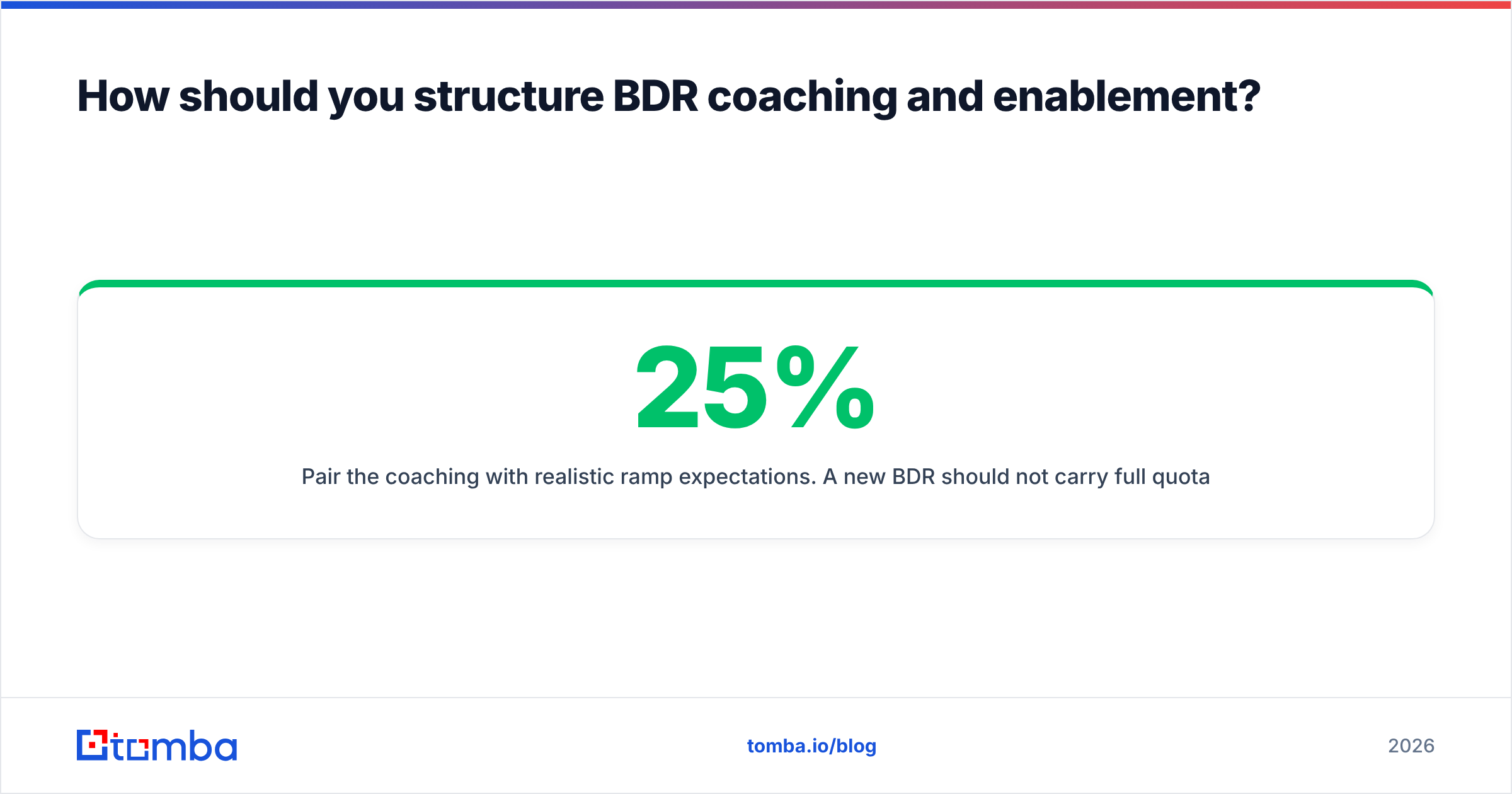
Pair the coaching with realistic ramp expectations. A new BDR should not carry full quota in month one. A standard ramp looks like 25% of quota in month one, 50% in month two, 75% in month three, and full quota by month four. Skipping ramp is the fastest way to create the early failure that drives BDR attrition — and replacing a BDR costs more than a year of tooling.
How do you measure whether BDR support is working?#
Track leading indicators, not just meetings booked. By the time "meetings booked" drops, the problem started weeks earlier upstream. The metrics below let you catch issues while you can still fix them.
- Research time per prospect — should fall sharply once a data tool is in place. If reps still spend more than a minute or two per contact, your workflow is broken.
- Email bounce rate — keep it under 3%. A rising bounce rate means your data source is stale or your email verification step is being skipped.
- Connect rate on calls — measures direct-dial data quality, not just rep effort.
- Reply rate and positive reply rate — measures messaging and targeting quality.
- Meetings held (not just booked) — no-shows reveal qualification and targeting problems.
- Ramp-to-quota time — the ultimate measure of whether your support system actually accelerates reps.
If research time is high and bounce rate is high, the fix is data tooling. If connect and reply rates are fine but meetings-held is low, the fix is qualification and coaching. The metrics tell you which pillar to invest in next.
What does BDR support cost, and is it worth it?#
The honest answer: a fraction of a single BDR's salary, for a productivity gain that often equals adding a rep. Let's put real numbers on it.
A fully loaded BDR in 2026 costs somewhere between $70,000 and $110,000 a year. If research and admin eat 40% of their week — a common figure on manual teams — you are paying $28,000 to $44,000 a year for that one rep to do data entry. A data and enrichment tool that automates most of that costs a tiny slice of the number.
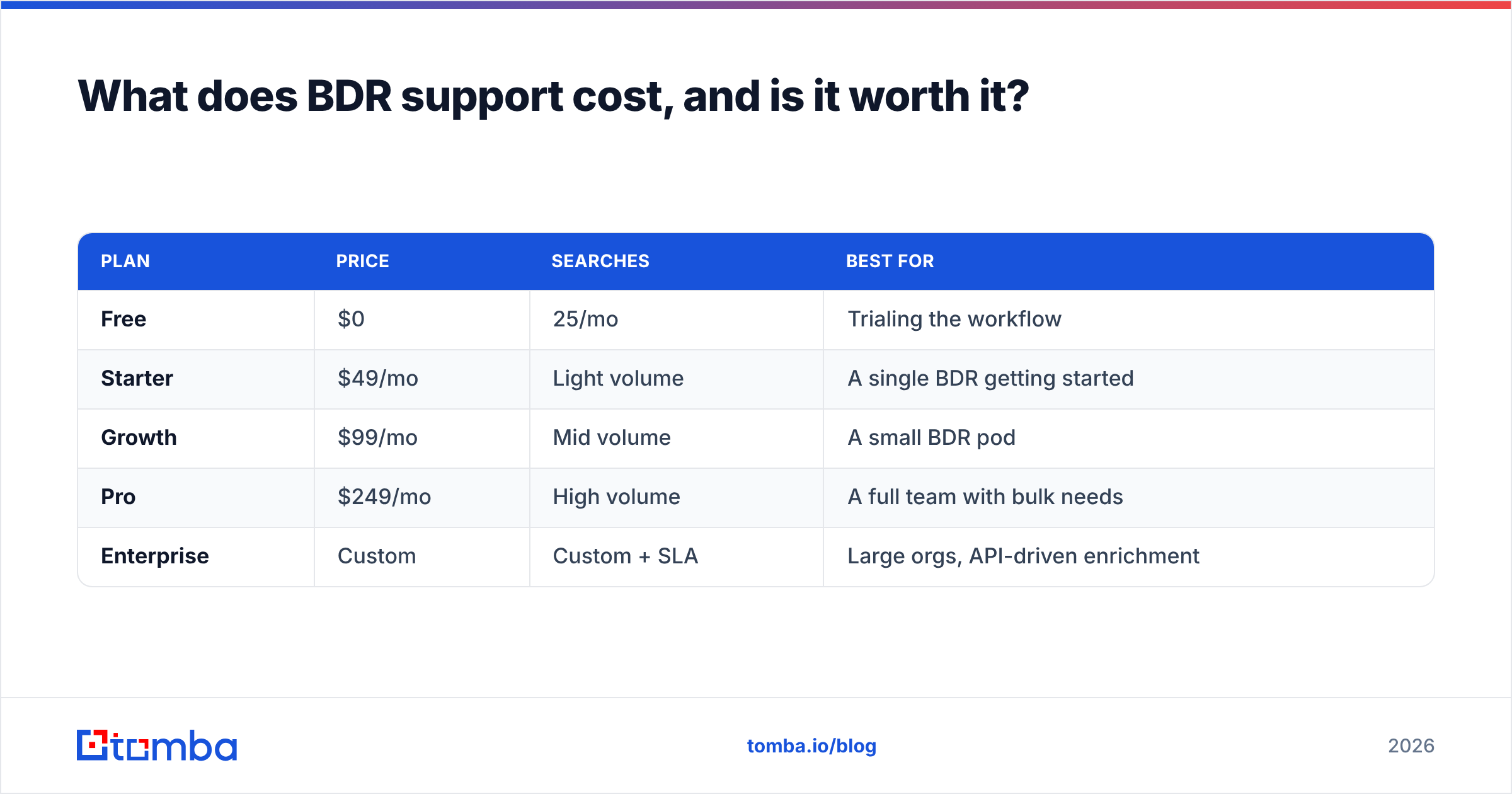
For comparison, here is where a tool like Tomba sits relative to the cost of the problem it solves. You can see full Tomba pricing for current tiers:
| Plan | Price | Searches | Best for |
|---|---|---|---|
| Free | $0 | 25/mo | Trialing the workflow |
| Starter | $49/mo | Light volume | A single BDR getting started |
| Growth | $99/mo | Mid volume | A small BDR pod |
| Pro | $249/mo | High volume | A full team with bulk needs |
| Enterprise | Custom | Custom + SLA | Large orgs, API-driven enrichment |
At $49 to $249 a month against a $28,000+ annual research tax, the math is not close. The question is not whether to fund BDR support tooling — it is whether you can afford to keep paying senior reps to copy-paste from LinkedIn.
What is the fastest way to improve BDR support this quarter?#
Start with data, because it is the cheapest fix with the largest blast radius. You do not need a six-month transformation. You need one clean change that compounds.
A 30-day plan:
- Week 1 — audit your current list quality. Run a sample through an email verifier and measure the real bounce rate. Most teams are shocked.
- Week 2 — wire an email finder and enrichment step into your prospecting workflow so reps pull verified data instead of guessing. Connect it to your CRM via the Tomba API or a native integration.
- Week 3 — set a weekly coaching cadence and build the first version of your objection library.
- Week 4 — measure research time and bounce rate again, and compare. The delta is your ROI.
Do this and you will free up hours of selling time per rep per week without hiring a single new person.
The bottom line#
BDR support is not a perk — it is the operating system your reps run on. The teams winning in 2026 are not the ones with the most aggressive activity targets. They are the ones who removed the friction between a BDR and a real conversation: clean data, a tight tool stack, realistic ramp, and a coaching loop that compounds.
If you only fix one thing this quarter, fix your data. Start with the Tomba Email Finder to give your BDRs verified, enriched contacts on demand — then layer the phone finder and data enrichment on top. Your reps stop hunting and start selling, and your pipeline follows. Spin up a free account, run your current list through it, and let the bounce rate make the case for you.
Ready to find emails that actually work?
Join 150,000+ professionals who stopped guessing and started sending. Free credits on signup — no credit card required.
Get the Tomba newsletter
Practical outbound tactics and product updates — once every two weeks.
About the author