Behavioral Intent Data in 2026: A B2B GTM Playbook
Behavioral intent data shows which accounts are researching a solution like yours right now. Here is how to capture it, score it, and turn signals into booked meetings in 2026.
Behavioral Intent Data in 2026: A B2B GTM Playbook
Most outbound still works like a weather forecast written a year in advance: you pick a list, you blast it, and you hope someone is in-market when your email lands. Behavioral intent data flips that. Instead of guessing who might buy, you watch who is actually researching a solution like yours right now — then you reach out while the window is open.
This guide breaks down what behavioral intent data is, where it comes from, how to score it, and how to wire it into a real go-to-market motion without drowning your reps in noise.
TL;DR#
- Behavioral intent data is the digital trail buyers leave while researching — content consumed, pages visited, searches run, tools compared — that signals active purchase interest.
- It splits into first-party (your own site/product) and third-party (off-site research captured by data networks).
- The value is timing: reaching an account in its 30-to-90-day buying window beats reaching a "perfect fit" account that is not looking.
- Intent without contact data and accurate verification is a dead end — you still need a real person and a deliverable email to act.
- Start small: one intent source, a simple three-tier score, and a fast handoff to a rep. Scale once the motion converts.
What is behavioral intent data?#
Behavioral intent data is information about the actions people and accounts take that reveal they are evaluating a purchase. Think of it like a librarian noticing which shelves a visitor keeps returning to. The visitor never says "I'm buying a book on tax law," but five visits to the tax-law aisle make the interest obvious.
In B2B, those "aisle visits" are things like:
- Reading multiple comparison or pricing pages
- Downloading a buyer's guide or watching a product demo
- Searching for category keywords ("best email finder," "Apollo alternative")
- Visiting a competitor's site, then yours
- Engaging repeatedly with a topic across review sites like G2 or Capterra
The key word is behavioral. Firmographic data tells you an account fits (industry, headcount, revenue). Intent data tells you an account is active. You want both, but activity is the part that decays — a signal three months old is often worthless.
What are the types of behavioral intent data?#
There are two big buckets, and they answer different questions. First-party tells you what people do on your property. Third-party tells you what they do everywhere else.
- First-party intent — Signals from your own channels: website visits, content downloads, email engagement, free-trial usage, and webinar attendance. It is the most accurate and the cheapest, because you already own it. The catch: most of that traffic is anonymous until you identify it.
- Second-party intent — Signals you get from a partner sharing its own first-party data with you, often through a review platform or a co-marketing arrangement. Narrow but high-quality.
- Third-party intent — Signals aggregated by a data network that tracks research activity across thousands of B2B sites and surfaces which accounts are "surging" on a topic. Broad reach, but noisier and account-level rather than person-level.
- Search and ad intent — Keyword research and ad interactions that indicate someone is actively shopping a category. High intent, but you usually only get it in aggregate.
A practical program blends at least two of these. First-party catches the people already circling you; third-party widens the net to in-market accounts who have not visited yet.
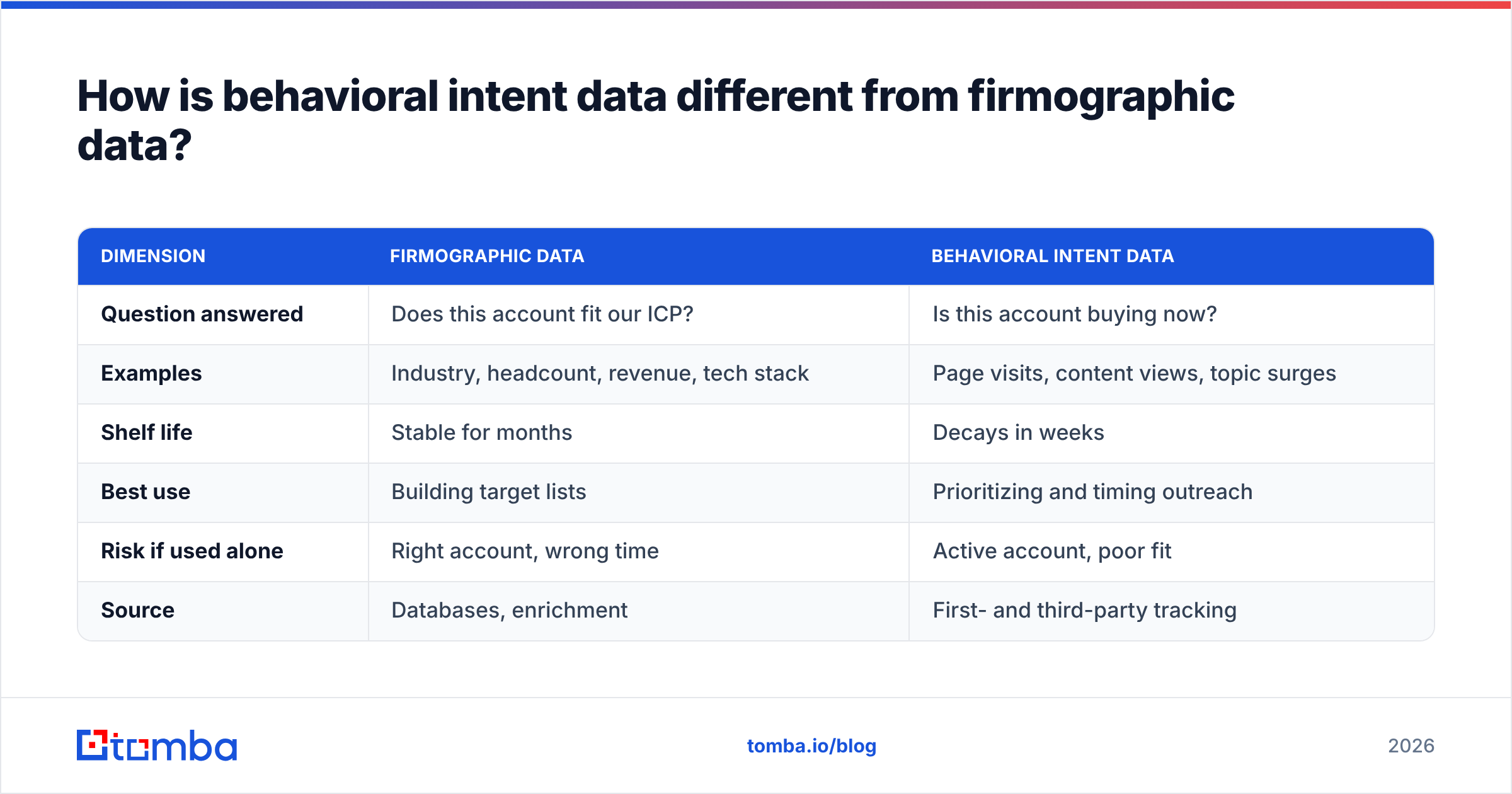
How is behavioral intent data different from firmographic data?#
Short answer: firmographic data is the who, behavioral intent data is the when. You need the who to target and the when to time it.
| Dimension | Firmographic data | Behavioral intent data |
|---|---|---|
| Question answered | Does this account fit our ICP? | Is this account buying now? |
| Examples | Industry, headcount, revenue, tech stack | Page visits, content views, topic surges |
| Shelf life | Stable for months | Decays in weeks |
| Best use | Building target lists | Prioritizing and timing outreach |
| Risk if used alone | Right account, wrong time | Active account, poor fit |
| Source | Databases, enrichment | First- and third-party tracking |
The mistake teams make is treating these as competing approaches. They are layers. Filter by firmographics first to define your serviceable market, then rank that market by intent so reps work the accounts most likely to respond this week. If you want to go deeper on the static layer, our breakdown of data enrichment covers how to fill in the firmographic and contact gaps once intent flags an account.
Where does behavioral intent data come from?#
Behavioral signals get collected through a handful of mechanisms, and knowing the plumbing helps you judge data quality.
- Pixels and tags on websites that log page views and content engagement.
- Reverse IP and de-anonymization that maps anonymous traffic back to a company. Tools like website visitor reveal turn unknown sessions into named accounts you can actually pursue.
- Bidstream and co-op networks where publishers share research activity, which is how most third-party providers build account-level surge scores.
- Review-site activity from platforms where buyers compare vendors.
- Product telemetry for product-led companies — feature usage, invite activity, and limits hit during a trial.
According to research summarized by Gartner, B2B buyers spend the majority of their journey researching independently before ever talking to sales. That is exactly the window intent data exposes — the silent middle of the funnel where buyers are deciding without you in the room.
How do you score behavioral intent signals?#
Scoring turns raw events into a priority list. Without it, you have a firehose and no faucet. The goal is a simple model your reps trust, not a 40-variable black box nobody can explain.
Start with three inputs:
- Signal strength — A pricing-page visit outweighs a single blog read. Weight actions by how close they sit to a buying decision.
- Recency — Apply decay. A signal from yesterday should outscore the same signal from last month. Many teams halve the weight every 7–14 days.
- Frequency and spread — One person hitting your pricing page is interesting. Three people from the same account hitting it in a week is a buying committee.
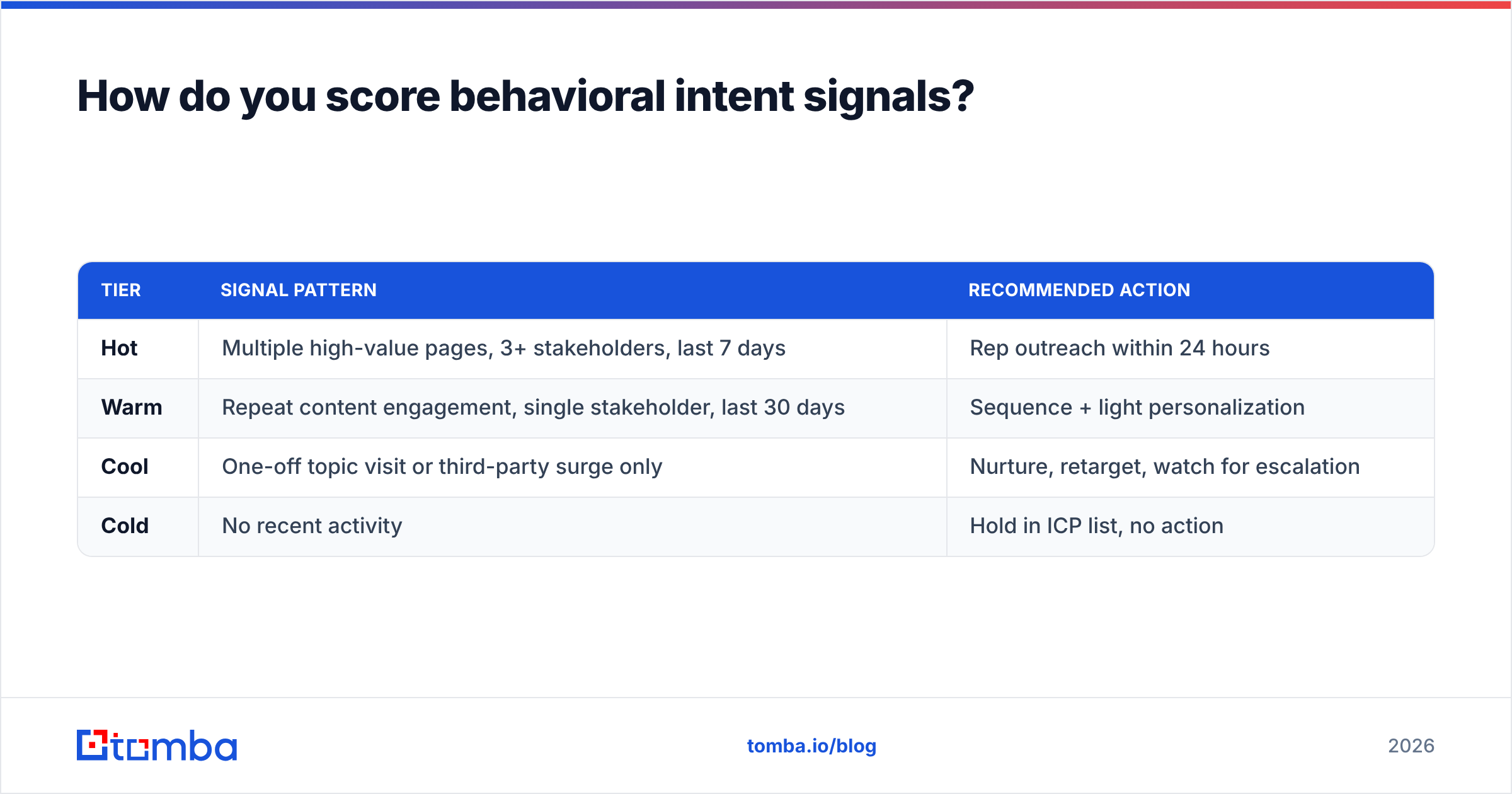
Combine those into a tiered score:
| Tier | Signal pattern | Recommended action |
|---|---|---|
| Hot | Multiple high-value pages, 3+ stakeholders, last 7 days | Rep outreach within 24 hours |
| Warm | Repeat content engagement, single stakeholder, last 30 days | Sequence + light personalization |
| Cool | One-off topic visit or third-party surge only | Nurture, retarget, watch for escalation |
| Cold | No recent activity | Hold in ICP list, no action |
Keep the model boring on purpose. A scoring system reps can explain in one sentence gets used; a "sophisticated" one gets ignored. You can always add weight to your lead scoring once the basic tiers prove out.
How do you turn intent data into pipeline?#
Here is where most programs stall. They buy a surge feed, admire the dashboard, and book zero extra meetings — because a flagged account is not a contact, and a contact is not a deliverable email.
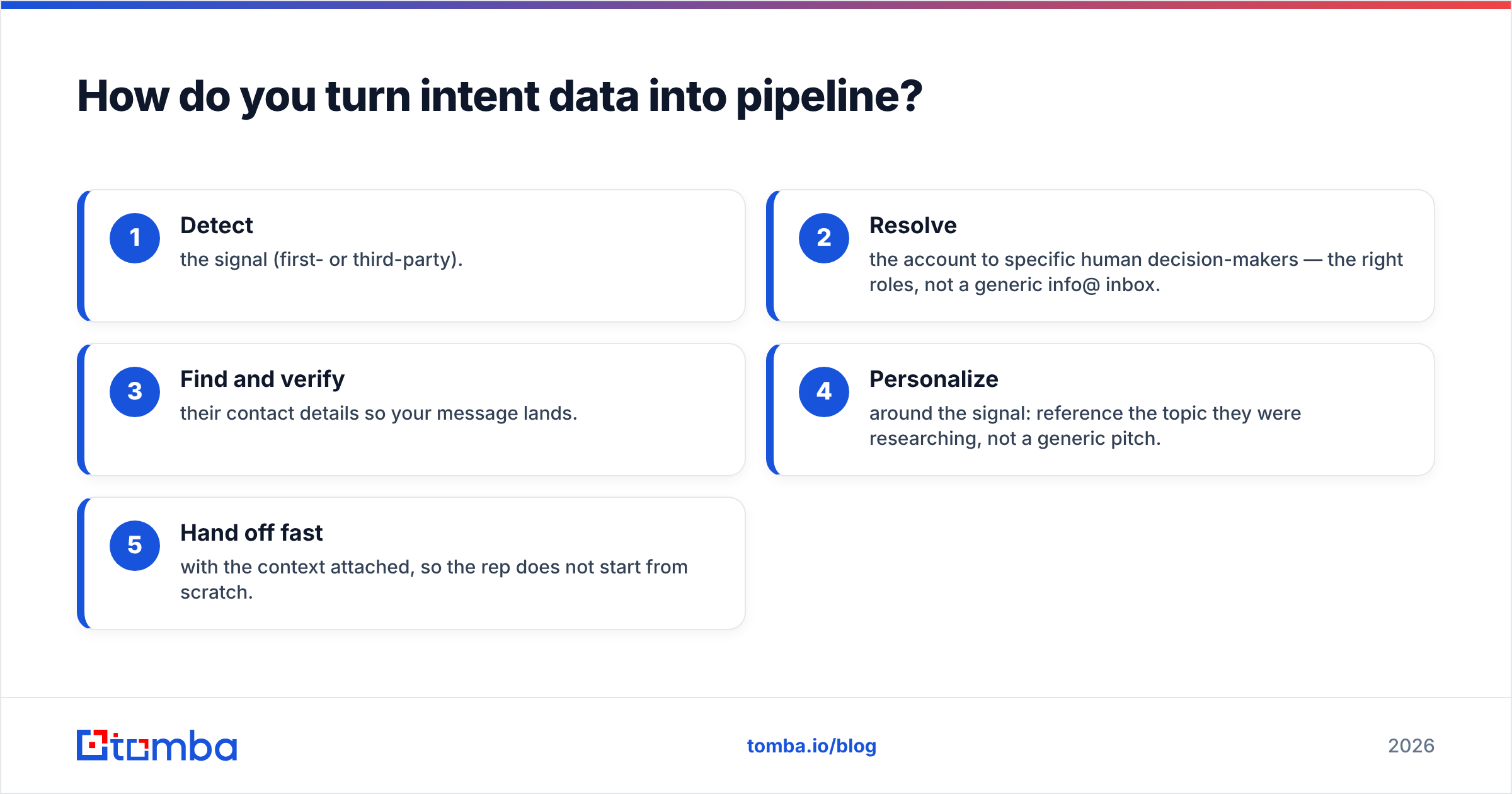
The workflow that actually converts looks like this:
- Detect the signal (first- or third-party).
- Resolve the account to specific human decision-makers — the right roles, not a generic info@ inbox.
- Find and verify their contact details so your message lands.
- Personalize around the signal: reference the topic they were researching, not a generic pitch.
- Hand off fast with the context attached, so the rep does not start from scratch.
Steps 2 and 3 are where intent quietly dies. A surging account is useless if you cannot reach the VP of Sales who triggered it. This is the bridge between signal and action: once intent flags an account, you use a domain search to pull the relevant contacts at that company, then run an email verifier so you are not burning your sender reputation on bounces. Intent tells you who to chase; contact data lets you actually chase them.
A quick note on deliverability: hitting a hot account with a message that bounces is worse than not reaching out at all, because bounces erode your domain reputation and shrink the inbox placement of every future send. Verify before you send, every time.
What tools provide behavioral intent data?#
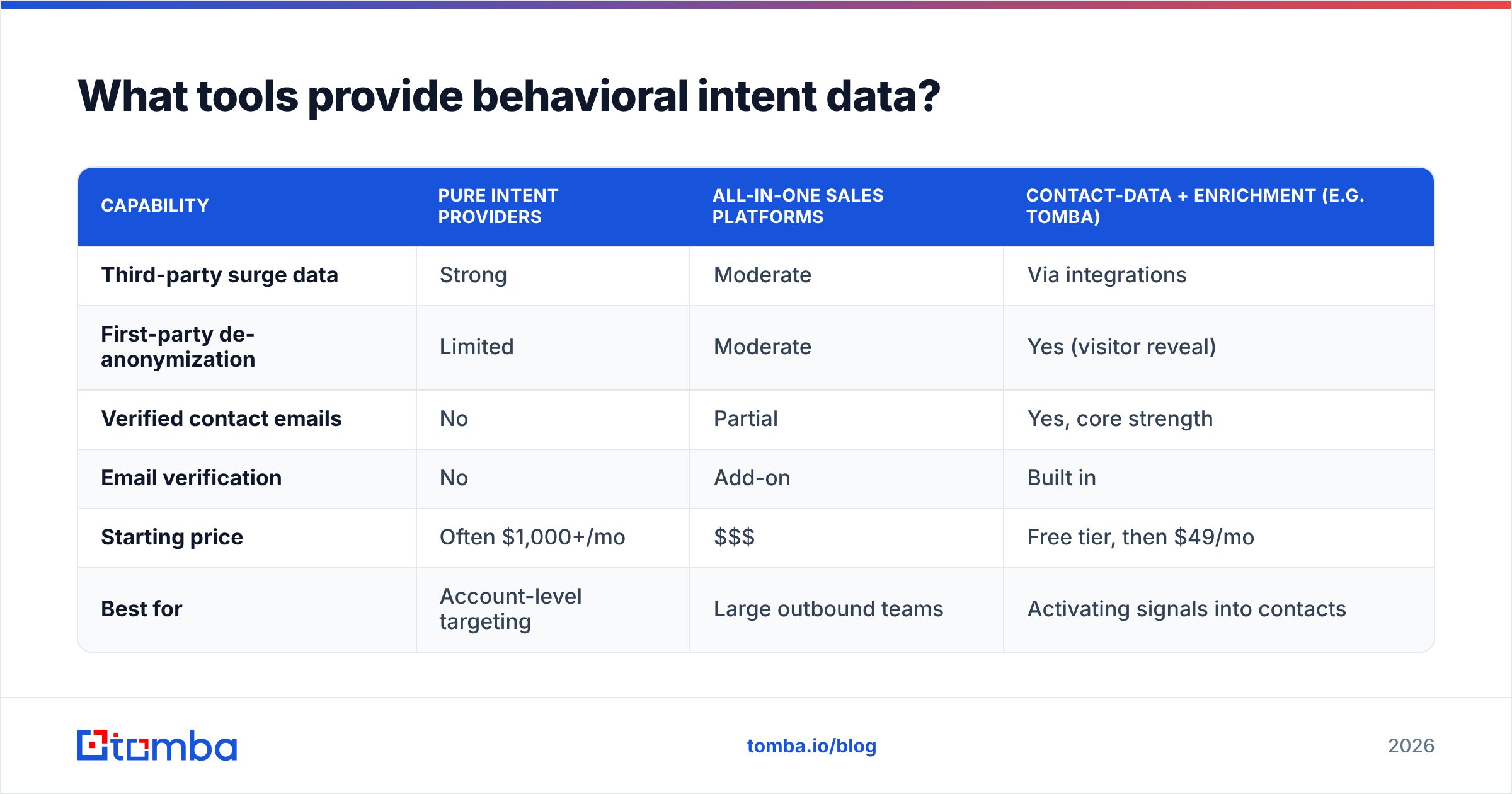
The market splits into pure intent providers, platforms that bundle intent with sales engagement, and contact-data tools that activate intent. Here is how the categories compare on what matters.
| Capability | Pure intent providers | All-in-one sales platforms | Contact-data + enrichment (e.g. Tomba) |
|---|---|---|---|
| Third-party surge data | Strong | Moderate | Via integrations |
| First-party de-anonymization | Limited | Moderate | Yes (visitor reveal) |
| Verified contact emails | No | Partial | Yes, core strength |
| Email verification | No | Add-on | Built in |
| Starting price | Often $1,000+/mo | $$$ | Free tier, then $49/mo |
| Best for | Account-level targeting | Large outbound teams | Activating signals into contacts |
No single tool does everything well, and you should be suspicious of any vendor that claims it does. A common, cost-effective stack is one intent source for detection plus a contact-data layer for activation. If you are weighing the bundled platforms, our Apollo alternative and RocketReach alternative breakdowns compare them on data accuracy and price. For Tomba's own plans, the pricing details lay out where the free tier ends and paid begins.
What are the common mistakes with behavioral intent data?#
- Acting on stale signals. If your handoff takes two weeks, the window has closed. Speed is the whole point.
- Confusing fit with intent. A surging account outside your ICP is a distraction, not a lead. Filter firmographics first.
- Skipping verification. Reaching a hot account with a bouncing email wastes the signal and damages your domain. Always verify.
- Over-engineering the score. A model nobody understands is a model nobody trusts. Start with three tiers.
- No feedback loop. If reps never tell you which "hot" accounts actually converted, your scoring never improves. Close the loop monthly.
- Treating third-party data as person-level. Most surge data is account-level. You still have to find the human inside it.
How do you get started with behavioral intent data?#
Pick one source, one score, one play. Resist the urge to buy three intent feeds before you have proven the motion with one.
A 30-day starter plan:
- Week 1 — Turn on first-party tracking and de-anonymize your highest-value pages (pricing, comparison, demo).
- Week 2 — Build a three-tier score and define exactly what "hot" triggers (e.g., 3+ stakeholders on pricing in 7 days).
- Week 3 — Wire the handoff: when an account goes hot, resolve contacts, verify emails, and route to a rep with the signal attached.
- Week 4 — Run the play, track reply and meeting rates against your baseline, and tune the weights.
If you want a reference point for how platforms structure intent and lifecycle stages, HubSpot's documentation on lead stages is a solid, vendor-neutral primer you can map your tiers against.
The bottom line#
Behavioral intent data is not magic — it is timing. It tells you which accounts moved from "someday" to "now," so your reps spend their hours on the people most likely to answer. But a signal is only as good as your ability to act on it, and acting means reaching a real, verified human inside that surging account before the window shuts.
That is the part Tomba is built for. When intent flags an account, the Tomba Email Finder turns that company into named decision-makers with verified, deliverable emails — so the signal becomes a conversation instead of a dashboard metric. Start on the free tier, prove the motion on a handful of hot accounts, and scale the play that works. Intent gets you the when; Tomba gets you the who.
Ready to find emails that actually work?
Join 150,000+ professionals who stopped guessing and started sending. Free credits on signup — no credit card required.
Get the Tomba newsletter
Practical outbound tactics and product updates — once every two weeks.
About the author