9 Benefits Of A Sales Funnel That Drive Revenue In 2026
A sales funnel is more than a diagram. Here are the concrete benefits of a sales funnel in 2026 — from forecasting accuracy to higher win rates — and how to build one.
TL;DR
- A sales funnel turns a messy pile of leads into a measurable, stage-by-stage process you can forecast, optimize, and scale.
- The biggest benefits of a sales funnel are predictable revenue, higher conversion rates, shorter sales cycles, and cleaner data for coaching.
- Funnels expose exactly where deals leak, so you fix the real bottleneck instead of guessing.
- A funnel is only as good as the contacts entering it — accurate emails and enriched data at the top decide everything downstream.
- You can build a working funnel in five stages without expensive software; the discipline matters more than the tooling.
What is a sales funnel?#
A sales funnel is the staged path a buyer travels from first hearing about you to signing a contract. Think of it like a kitchen during a dinner rush: orders come in at the top (leads), each ticket moves through prep, cooking, and plating (qualification, demo, proposal), and a finished plate goes out the door (closed deal). The funnel narrows because not every order makes it through — and that's the point. It lets you count how many tickets enter, how many drop, and where the line backs up.
Technically, a sales funnel is a model that maps your pipeline into discrete, measurable stages with conversion rates between each one. It's closely related to your sales pipeline, but the funnel emphasizes the math — the ratios — while the pipeline emphasizes the deals.
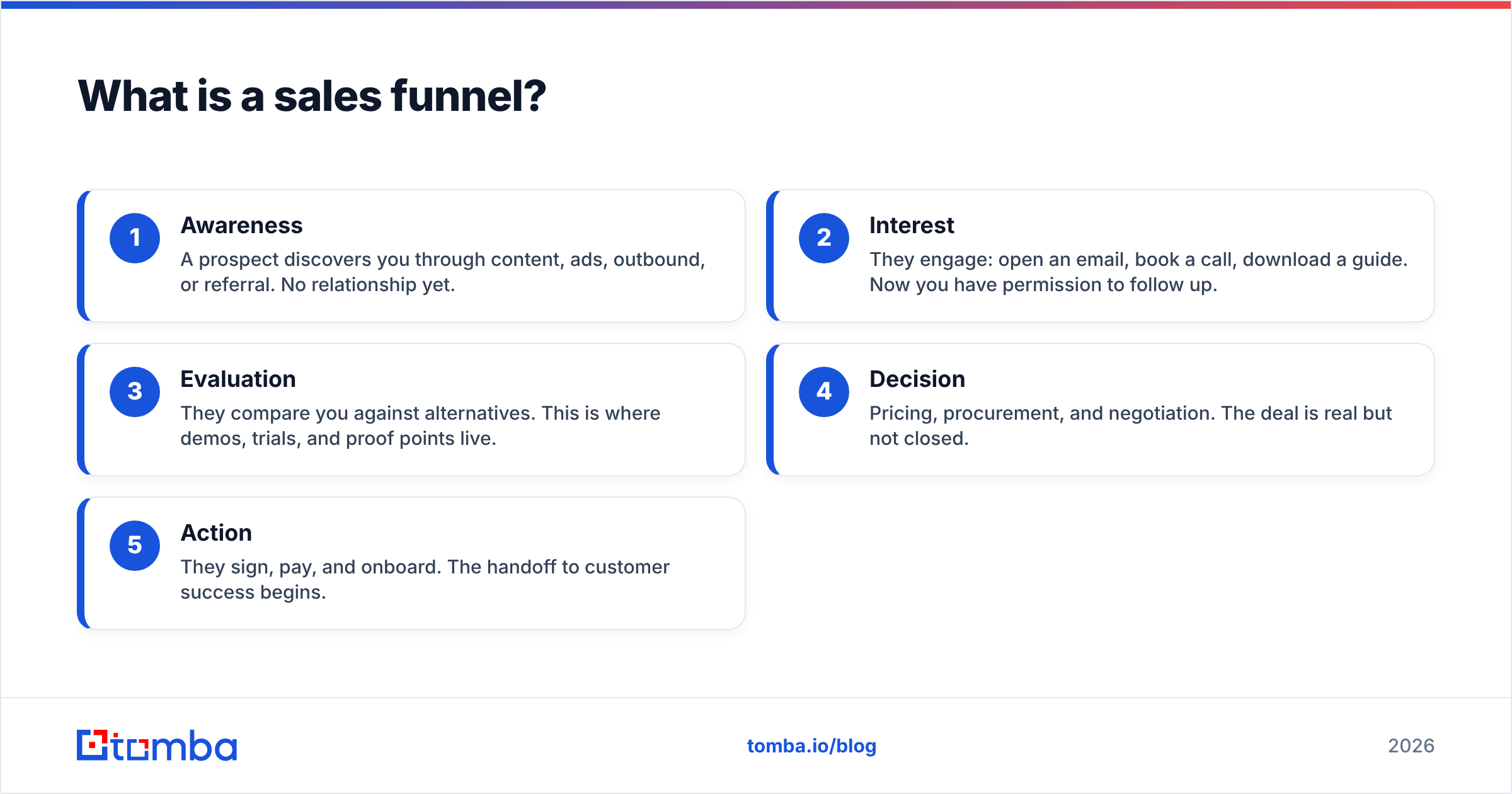
Here are the five stages most B2B funnels use:
- Awareness — A prospect discovers you through content, ads, outbound, or referral. No relationship yet.
- Interest — They engage: open an email, book a call, download a guide. Now you have permission to follow up.
- Evaluation — They compare you against alternatives. This is where demos, trials, and proof points live.
- Decision — Pricing, procurement, and negotiation. The deal is real but not closed.
- Action — They sign, pay, and onboard. The handoff to customer success begins.
Each stage has an entry count and an exit count. Divide one by the other and you get a conversion rate — the single number that makes a funnel useful.
What are the main benefits of a sales funnel?#
The main benefit of a sales funnel is predictability: once you know your stage-to-stage conversion rates, you can predict revenue from the number of leads at the top. Everything else flows from that.
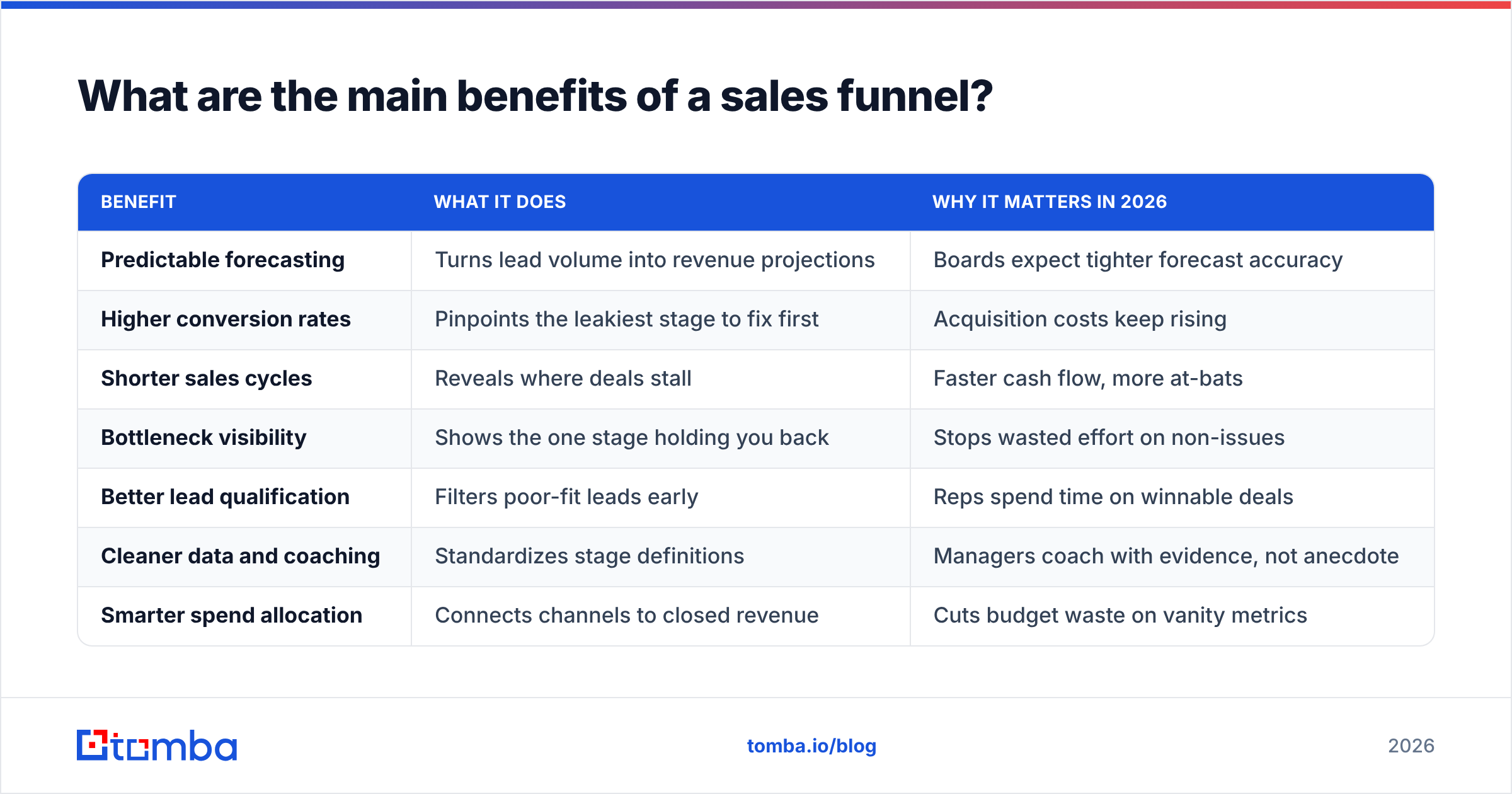
Below are the nine benefits that matter most in 2026, with the operational reason each one moves the needle.
| Benefit | What it does | Why it matters in 2026 |
|---|---|---|
| Predictable forecasting | Turns lead volume into revenue projections | Boards expect tighter forecast accuracy |
| Higher conversion rates | Pinpoints the leakiest stage to fix first | Acquisition costs keep rising |
| Shorter sales cycles | Reveals where deals stall | Faster cash flow, more at-bats |
| Bottleneck visibility | Shows the one stage holding you back | Stops wasted effort on non-issues |
| Better lead qualification | Filters poor-fit leads early | Reps spend time on winnable deals |
| Cleaner data and coaching | Standardizes stage definitions | Managers coach with evidence, not anecdote |
| Smarter spend allocation | Connects channels to closed revenue | Cuts budget waste on vanity metrics |
| Repeatable scaling | Documents what works | New reps ramp faster |
| Aligned marketing + sales | Shared funnel = shared goals | Ends the lead-quality blame game |
Let's unpack the ones that pay off fastest.
Predictable revenue forecasting#
If 1,000 leads enter your funnel and history says 2% close at an average deal size of $6,000, you can forecast roughly $120,000 — before a single rep picks up the phone. That's the difference between hoping and planning. According to HubSpot's sales research, companies with a defined, documented process consistently outperform those running on instinct. A funnel is what makes the process measurable.
Higher conversion rates#
You can't improve what you can't see. When you measure each stage, you might find that 60% of demos convert to proposals but only 20% of proposals convert to deals. That tells you the demo is doing its job and the proposal or pricing step is the problem — so you fix that instead of generating more leads you'll lose later.
Shorter sales cycles#
A funnel timestamps each stage transition. Once you see that deals sit in "Evaluation" for 22 days on average, you can attack that delay with better proof points, tighter follow-up, or a mutual action plan. Shaving a week off the cycle compounds across every deal you run.
How does a sales funnel improve win rate?#
A sales funnel improves your win rate by forcing qualification to happen early and explicitly, so reps stop pouring hours into deals that were never going to close. When every opportunity must meet defined criteria to advance, low-fit prospects exit at the top instead of the bottom — where they cost the most.
There are three mechanisms at work:
- Exit criteria per stage. A deal only moves to "Decision" if budget, authority, and timeline are confirmed. This kills happy-ears optimism.
- Forced honesty. Reps can't park a stalled deal in "Evaluation" forever; the funnel's aging reports surface zombies.
- Pattern recognition. Over dozens of deals, you learn which early signals predict a close — and you double down on sourcing those.
The result is fewer, better deals and a win rate calculated on opportunities you actually had a shot at. Gartner's research on B2B buying notes that buyers spend only a small fraction of their journey with any single vendor, which makes early qualification and disciplined stage progression more valuable than ever. (See Gartner's B2B buying journey research.)
Why does data quality decide funnel success?#
Data quality decides funnel success because a funnel is a ratio machine, and ratios built on bad inputs produce confident, wrong decisions. If half the contacts entering "Awareness" have invalid emails or wrong titles, your top-of-funnel volume is fiction — and every downstream forecast inherits the error.
This is the part most teams underinvest in. They obsess over the demo script and ignore the fact that 30% of their outbound bounces. Garbage at the top means garbage math throughout.
Two practical fixes:
- Find the right contact, not just any contact. Use an email finder to reach the actual decision-maker by name and domain, instead of blasting a generic info@ inbox that never converts.
- Enrich before you route. Layer in firmographic and role data with data enrichment so your qualification stage has something real to score against.
When the contacts entering your funnel are accurate and enriched, every conversion rate you measure becomes trustworthy — and trustworthy numbers are the entire reason to build a funnel in the first place. If you're running outbound at scale, a bulk email finder keeps top-of-funnel volume high without sacrificing accuracy.
Funnel vs. no funnel: what actually changes?#
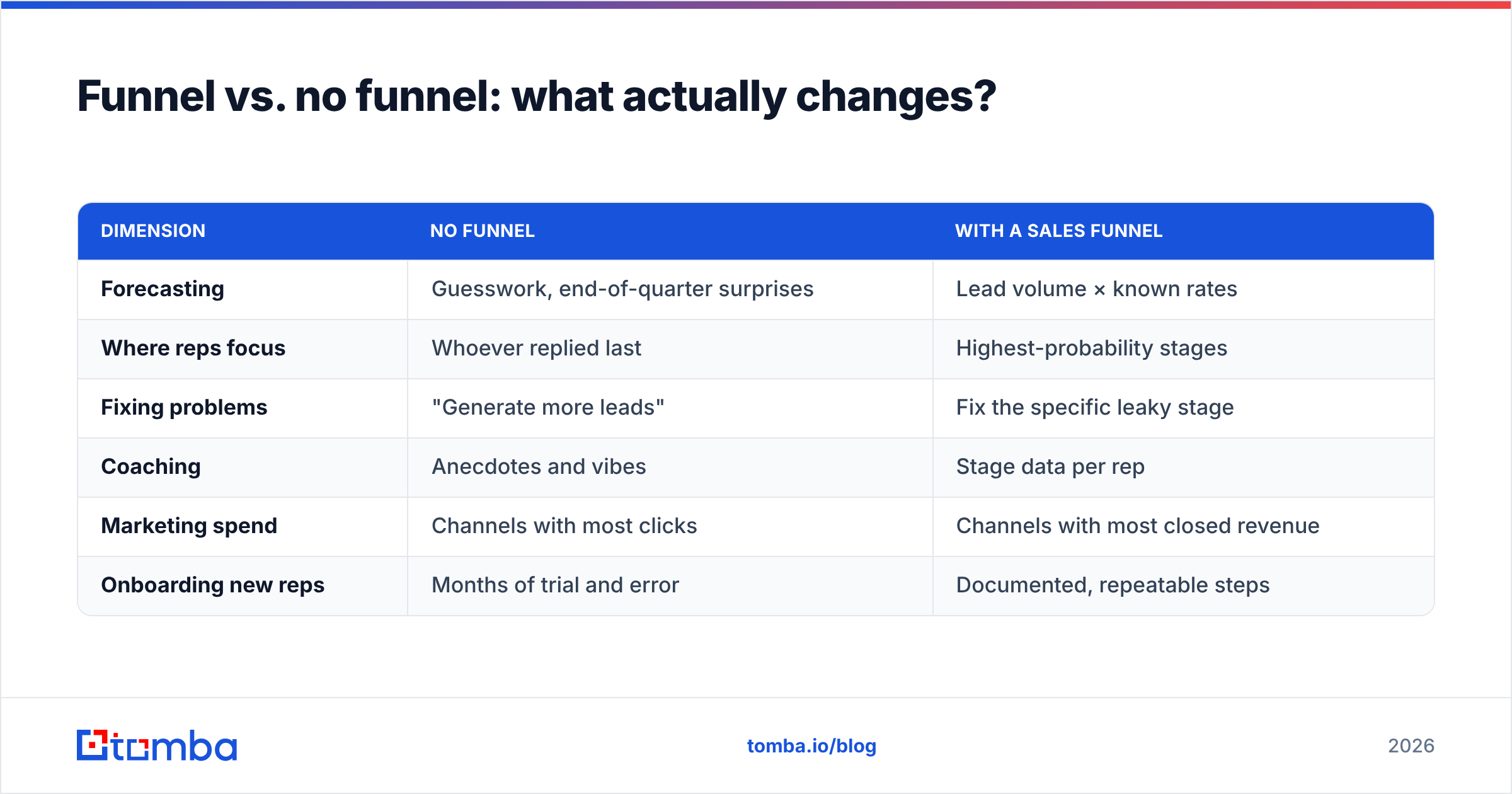
The difference between running a funnel and running on gut feel shows up in how you spend your week and where your revenue comes from.
| Dimension | No funnel | With a sales funnel |
|---|---|---|
| Forecasting | Guesswork, end-of-quarter surprises | Lead volume × known rates |
| Where reps focus | Whoever replied last | Highest-probability stages |
| Fixing problems | "Generate more leads" | Fix the specific leaky stage |
| Coaching | Anecdotes and vibes | Stage data per rep |
| Marketing spend | Channels with most clicks | Channels with most closed revenue |
| Onboarding new reps | Months of trial and error | Documented, repeatable steps |
The pattern is consistent: a funnel replaces opinion with measurement. You stop arguing about whether marketing's leads are bad and start looking at the awareness-to-interest conversion rate that settles it.
How do you build a sales funnel that delivers these benefits?#
Build a sales funnel in five steps, and resist the urge to buy software before you've defined the stages — the discipline is what creates the benefit, not the tool.
- Define your stages and exit criteria. Write down the five (or six) stages and the one thing that must be true for a deal to advance. Be specific: "verbal confirmation of budget," not "seems interested."
- Instrument the top. Decide how leads enter and make sure their contact data is accurate. This is where an email finder and enrichment earn their keep — a funnel fed by bad data fails quietly.
- Measure baseline conversion rates. Pull 90 days of deals and calculate the rate between every stage. This is your starting line.
- Find the biggest leak. The stage with the worst conversion rate, weighted by deal value, is your first project. Ignore the rest for now.
- Run one experiment, then re-measure. Change a single variable at the leaky stage, give it enough volume to read, and check whether the rate moved. Then repeat.
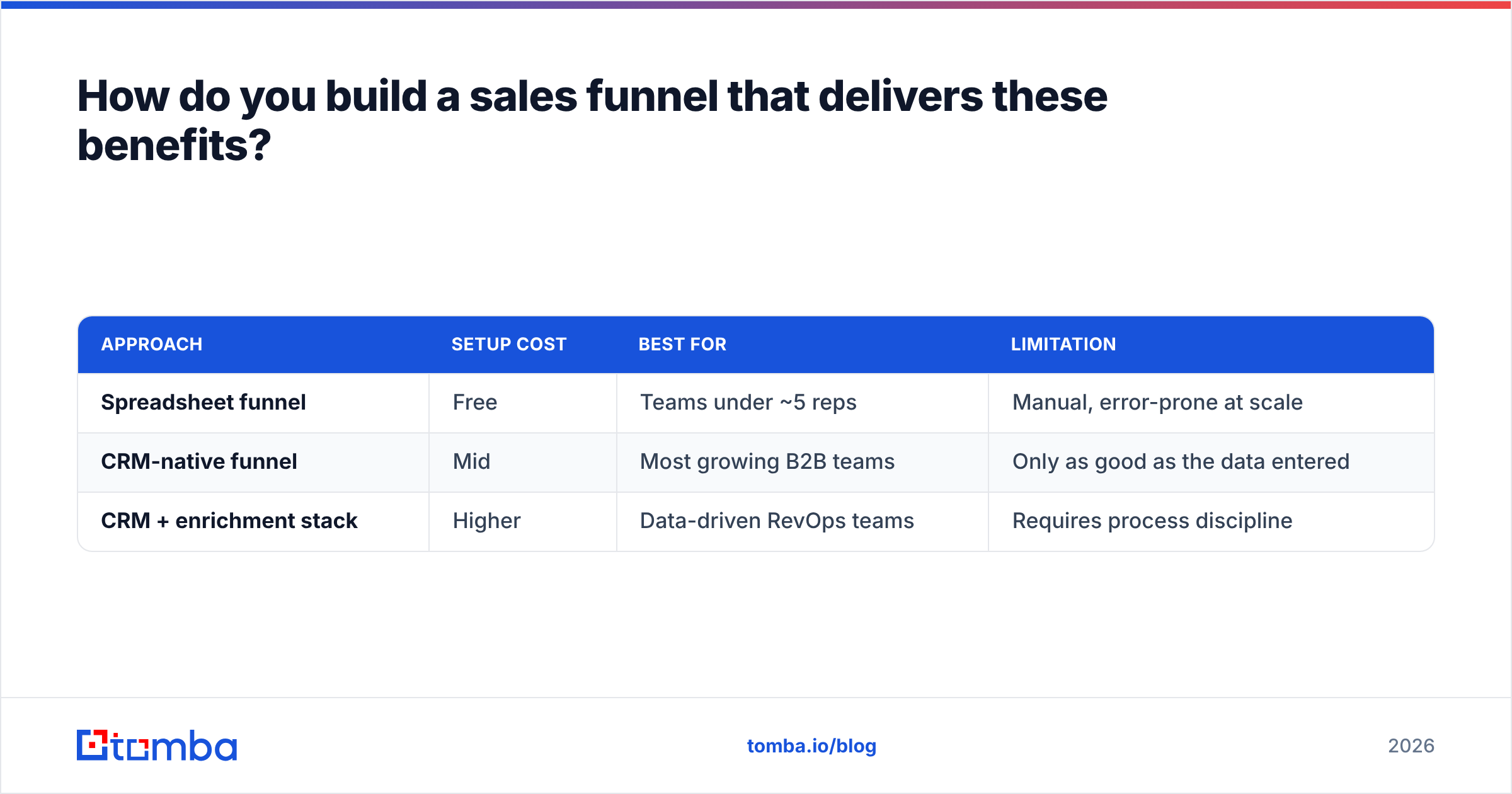
A quick comparison of how teams typically operate the funnel:
| Approach | Setup cost | Best for | Limitation |
|---|---|---|---|
| Spreadsheet funnel | Free | Teams under ~5 reps | Manual, error-prone at scale |
| CRM-native funnel | Mid | Most growing B2B teams | Only as good as the data entered |
| CRM + enrichment stack | Higher | Data-driven RevOps teams | Requires process discipline |
Notice that every approach lists data quality as the hidden dependency. You can run a perfectly good funnel in a spreadsheet if the contacts are accurate — and you can ruin an expensive CRM funnel with bad ones. The platform is negotiable; the data isn't. (For tooling depth, Salesforce's pipeline guidance is a solid neutral reference on stage design.)
What are the common mistakes that cancel out the benefits?#
The most common mistake is treating the funnel as a reporting dashboard instead of a decision tool — teams build it, admire it, and never act on what it shows.
Watch for these four traps:
- Too many stages. Eight micro-stages create noise, not insight. Five is plenty for most B2B motions.
- Vague exit criteria. If reps can't agree on when a deal moves, your data is meaningless.
- Optimizing the wrong stage. Pouring effort into top-of-funnel volume when the real leak is at proposal wastes everyone's time.
- Ignoring data hygiene. Stale or invalid contacts inflate the top and corrupt every ratio below it.
Each of these quietly cancels the benefits you built the funnel to capture. The fix for all four is the same: define clearly, measure honestly, and feed the funnel clean data.
Are the benefits of a sales funnel worth it for small teams?#
Yes — small teams often get the most value from a funnel because they have the fewest deals to waste. When you only run 30 opportunities a quarter, losing five winnable ones to poor qualification is a disaster. A funnel makes those five visible before they slip.
You don't need an enterprise stack. A clean spreadsheet, five defined stages, and accurate contact data will outperform a six-figure CRM that nobody updates. Start lean, prove the conversion math, and add tooling only when manual tracking genuinely breaks. As you scale, you can compare options with an honest Apollo alternative review or check transparent Tomba pricing before committing budget.
Put accurate contacts at the top of your funnel#
Every benefit in this article — forecasting, conversion, win rate, coaching — rests on one thing: the quality of the contacts entering your funnel. A perfectly designed funnel fed by bounced emails and wrong titles will still fail, because the math at the top is wrong.
That's where the Tomba Email Finder fits. Find verified, decision-maker email addresses by name, company, or domain so the leads entering your awareness stage are real, reachable, and worth qualifying. Pair it with enrichment, start on the free tier (25 searches a month), and scale to the Starter plan at $49/mo when your funnel proves its conversion rate. Build the funnel, feed it clean data, and let the numbers — not your gut — tell you where the next dollar comes from.
// get started
Find, verify and enrich your first contacts today
Start on the free plan with 25 searches a month, then scale when your team is ready.
Free plan · No credit card required · GDPR & CCPA
// about the author