Best AI Tools for Sales Prospecting in 2026 (Tested)
A neutral, hands-on breakdown of the best AI tools for sales prospecting in 2026 — what each does well, real pricing, and how to assemble a stack that actually books meetings.
TL;DR
- The "best AI tool for sales prospecting" is not one product — it's a stack of four jobs: find contacts, score intent, write outreach, and automate sequencing.
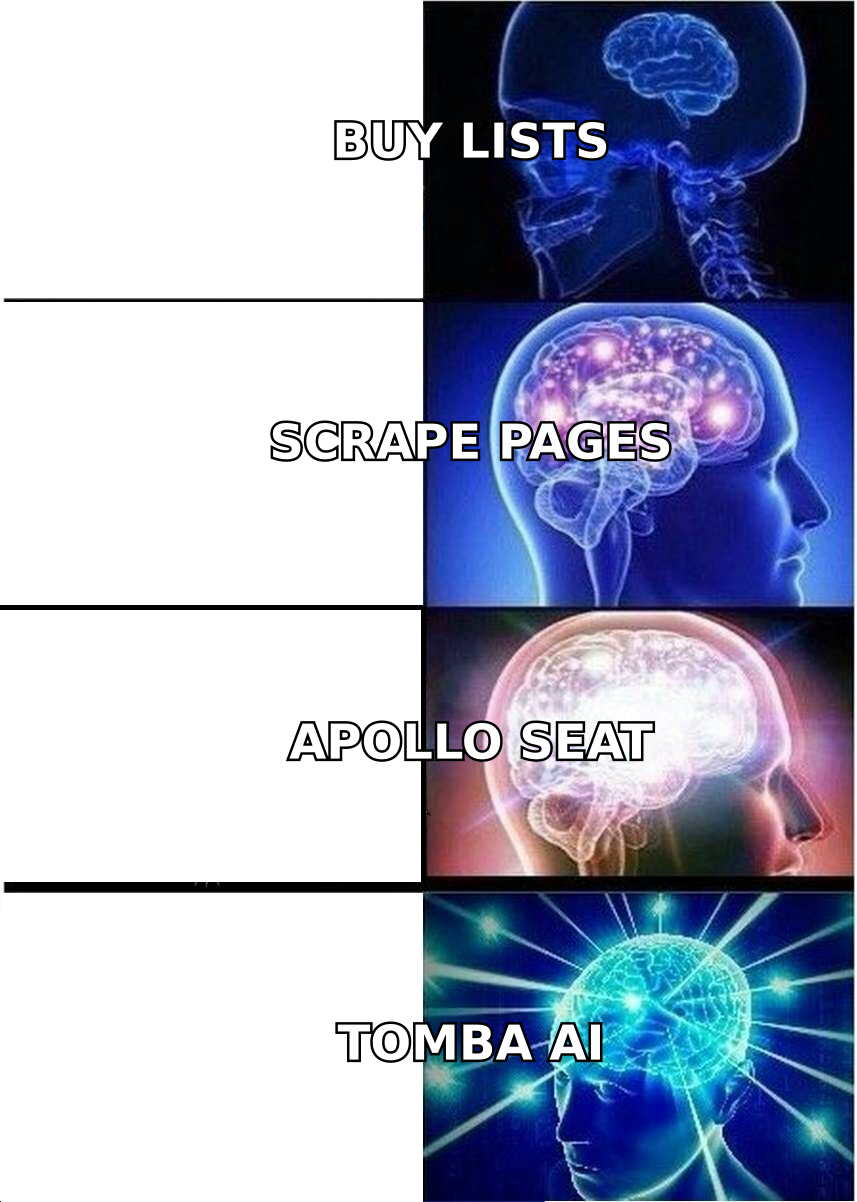
- AI is only as good as the data underneath it. Clean, verified contact data beats a clever model every time, which is why your finder/verifier layer matters most.
- Apollo, Clay, Instantly, and Tomba each win a different layer; picking by "which has AI" is the wrong question.
- Expect to spend $49–$249/mo per tool at the low end. Free tiers exist (Tomba gives 25 searches/mo) but are for testing, not scale.
- Start with verified data + one writing assistant before you buy a full automation platform. Most teams over-buy automation and under-buy data quality.
What counts as an "AI sales prospecting tool" in 2026?#
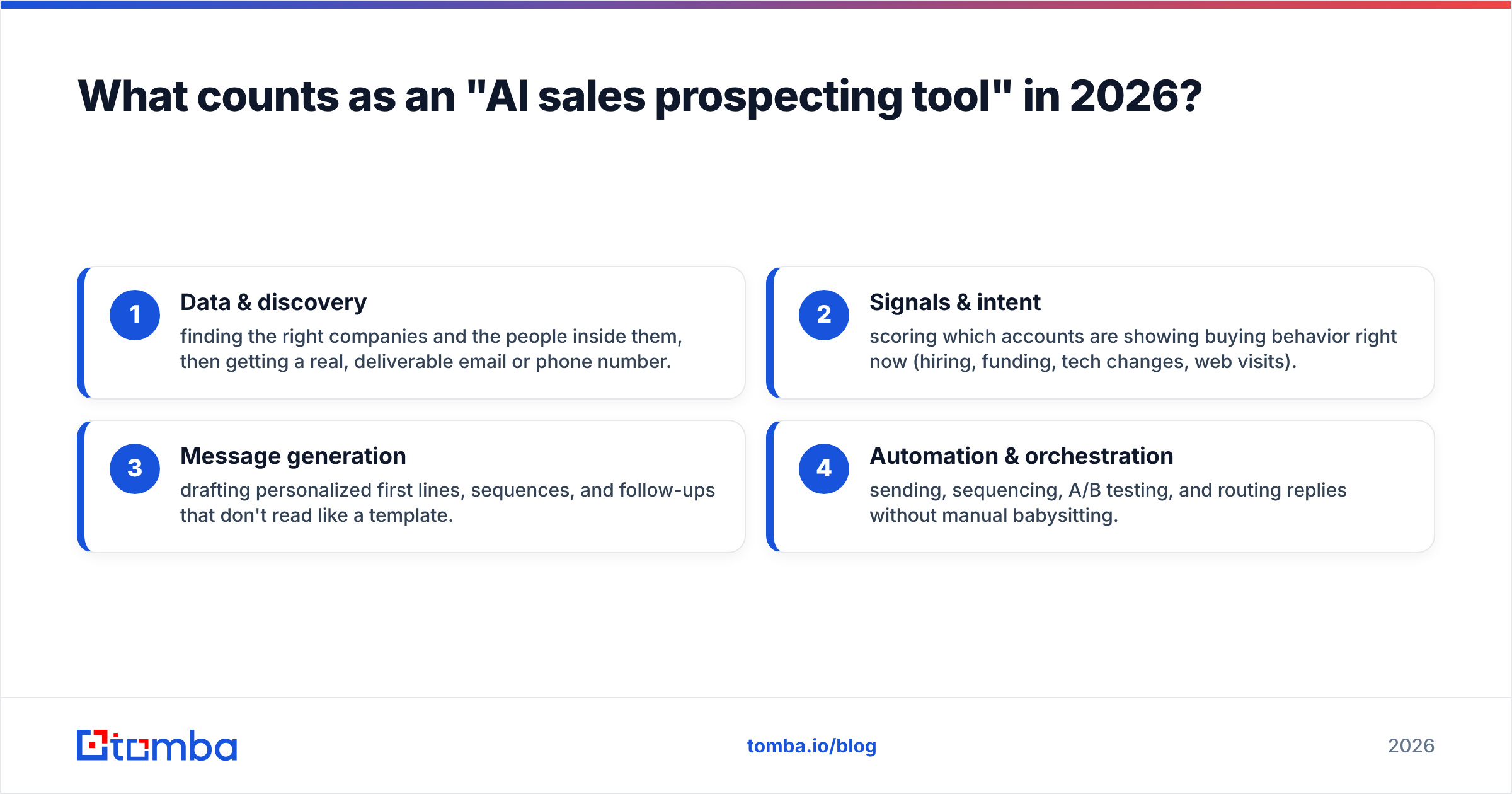
The short answer: any tool that uses machine learning to shorten the path from "I have an ICP" to "I have a booked meeting." That covers more ground than people assume, so it helps to split prospecting into four distinct jobs.
- Data & discovery — finding the right companies and the people inside them, then getting a real, deliverable email or phone number.
- Signals & intent — scoring which accounts are showing buying behavior right now (hiring, funding, tech changes, web visits).
- Message generation — drafting personalized first lines, sequences, and follow-ups that don't read like a template.
- Automation & orchestration — sending, sequencing, A/B testing, and routing replies without manual babysitting.
No single vendor is best at all four. The biggest mistake teams make is buying one "all-in-one" platform and assuming the AI inside each module is equally strong. It rarely is. A platform with a great sequencer often has mediocre data; a tool with excellent data may have a clunky writer.
What are the best AI tools for sales prospecting right now?#
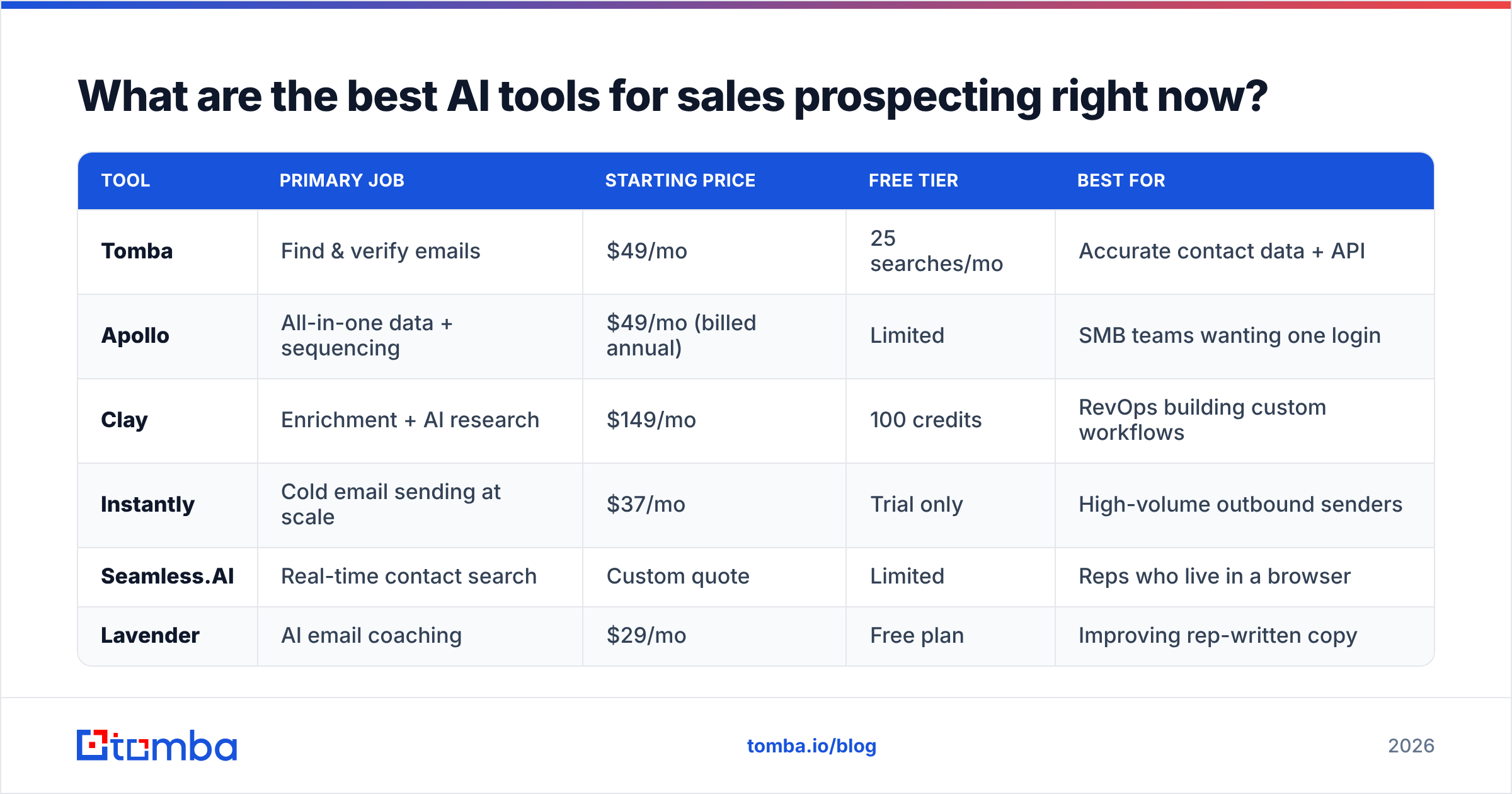
Here's how the leading options break down by the job they actually do best. Treat this as a "pick one per layer" menu, not a "pick one winner" list.
| Tool | Primary job | Starting price | Free tier | Best for |
|---|---|---|---|---|
| Tomba | Find & verify emails | $49/mo | 25 searches/mo | Accurate contact data + API |
| Apollo | All-in-one data + sequencing | $49/mo (billed annual) | Limited | SMB teams wanting one login |
| Clay | Enrichment + AI research | $149/mo | 100 credits | RevOps building custom workflows |
| Instantly | Cold email sending at scale | $37/mo | Trial only | High-volume outbound senders |
| Seamless.AI | Real-time contact search | Custom quote | Limited | Reps who live in a browser |
| Lavender | AI email coaching | $29/mo | Free plan | Improving rep-written copy |
A few honest notes on this table. Apollo's headline price looks close to Tomba's, but the cheaper tiers gate the data exports and enrichment that prospecting actually needs — read the fine print on credits. Clay is genuinely powerful but has a real learning curve and a per-credit cost model that can spike; it's a RevOps tool, not a rep tool. Instantly is excellent at sending but isn't where you source contacts. And "real-time search" tools tend to trade verification depth for speed.
If you want a deeper head-to-head on the data layer specifically, our Apollo alternative and Seamless.AI alternative breakdowns go tier by tier.
Why does data quality matter more than the AI itself?#
Because every downstream step inherits the errors of the step before it. AI personalization on a bounced email is wasted compute. Think of it like cooking: the fanciest technique can't rescue spoiled ingredients. Your contact data is the ingredient.
This is the layer most "AI prospecting" pitches gloss over. A model can write a beautiful first line, but if the email address is a guess, it bounces — and bounces hurt your sender reputation, which then tanks the deliverability of every good email you send afterward. The damage compounds.
So the non-negotiable foundation is:
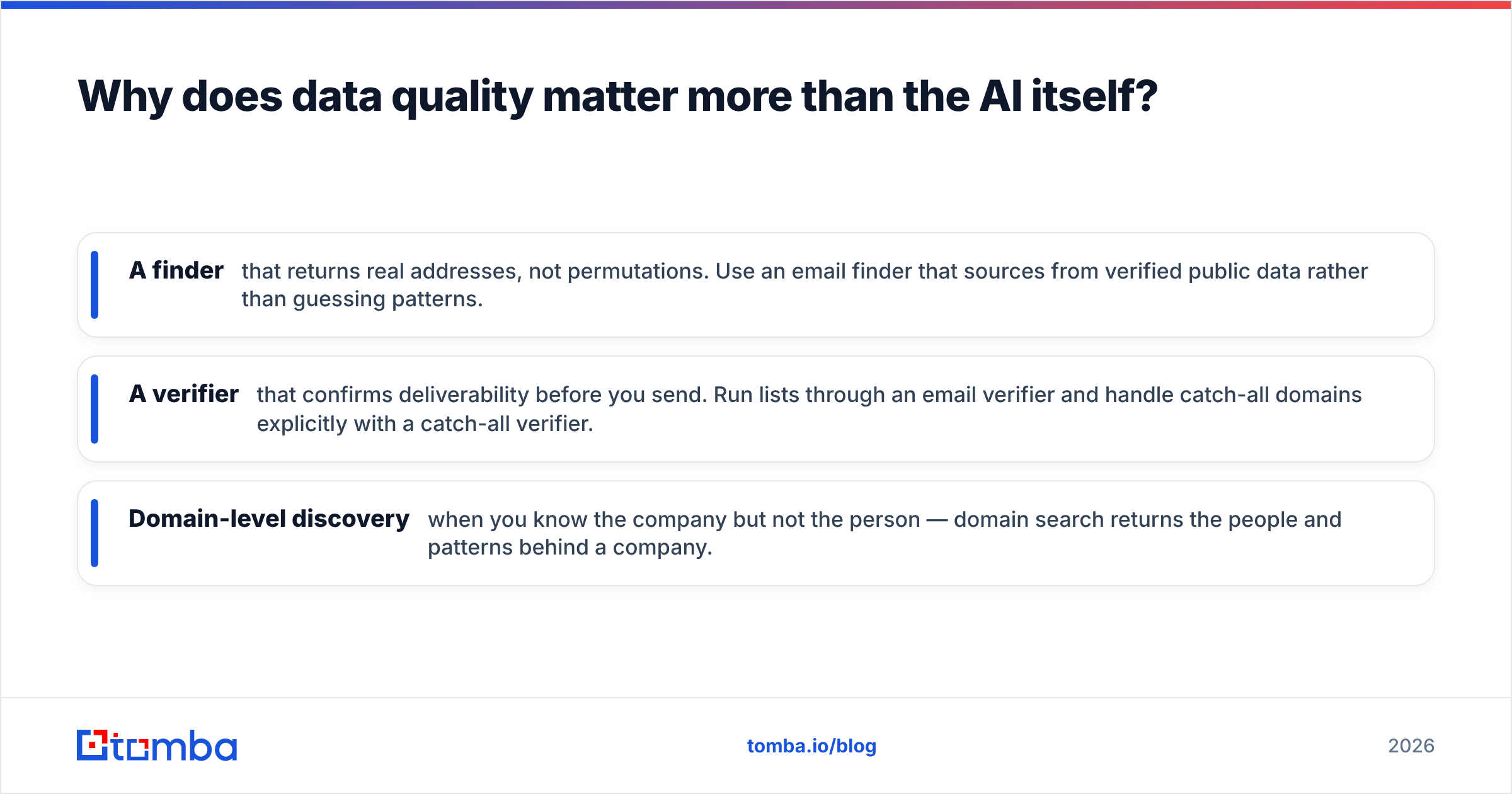
- A finder that returns real addresses, not permutations. Use an email finder that sources from verified public data rather than guessing patterns.
- A verifier that confirms deliverability before you send. Run lists through an email verifier and handle catch-all domains explicitly with a catch-all verifier.
- Domain-level discovery when you know the company but not the person — domain search returns the people and patterns behind a company.
Tomba sits in this layer. It's not trying to be your sequencer or your CRM; it's the contact-data engine that feeds them, with a Tomba API so you can wire verification directly into Clay, your CRM, or a custom workflow. That separation of concerns is a feature, not a limitation — you keep the best tool for each job.
How do I choose between an all-in-one platform and a best-of-breed stack?#
Pick all-in-one if you're a small team that values one login over peak quality. Pick best-of-breed if data accuracy and deliverability directly drive your revenue — which, for most outbound teams, they do.
Here's the trade-off in plain terms:
- All-in-one (Apollo, Seamless.AI): One bill, one UI, fast to onboard. The cost is that you're locked into whatever data and AI quality that single vendor offers, and switching any one layer means switching everything.
- Best-of-breed stack (Tomba + Clay + Instantly, or similar): You assemble the strongest tool per layer and swap pieces independently. The cost is more integration work and multiple bills — though integrations and a clean API make this far less painful than it used to be.
A practical hybrid most teams land on in 2026: a dedicated data/verification layer (Tomba) feeding an enrichment-and-research tool (Clay) feeding a sender (Instantly), with a writing assistant layered on top. You get accuracy where it matters and automation where it scales.
What about AI for writing and personalization?#
AI writing tools are now good enough to draft a competent first touch — but they are not good enough to send unsupervised. The winning pattern is "AI drafts, human edits, AI scores."
Treat AI copy tools as a junior SDR who writes fast but needs review. The current crop falls into three buckets:
- Coaches (like Lavender) that score your draft and suggest fixes in real time — best when reps still write the email.
- Generators that produce full sequences from a prompt — fast, but they drift into generic phrasing without good inputs.
- Embedded assistants inside your sequencer that personalize at send time using enrichment fields.
The common failure mode is feeding the generator nothing but a name and company. Personalization quality is a function of the data you pipe in — a recent funding round, a job change, a tech-stack signal. Garbage in, generic out. If you want to experiment without committing budget, a free cold email AI writer and a subject line generator are a low-risk way to see how much lift AI copy actually gives your replies.
One more deliverability note: AI-generated emails often trip spam filters with salesy phrasing. Run drafts through a spam checker before they go into a high-volume sequence.
How should a small team build an AI prospecting stack on a budget?#
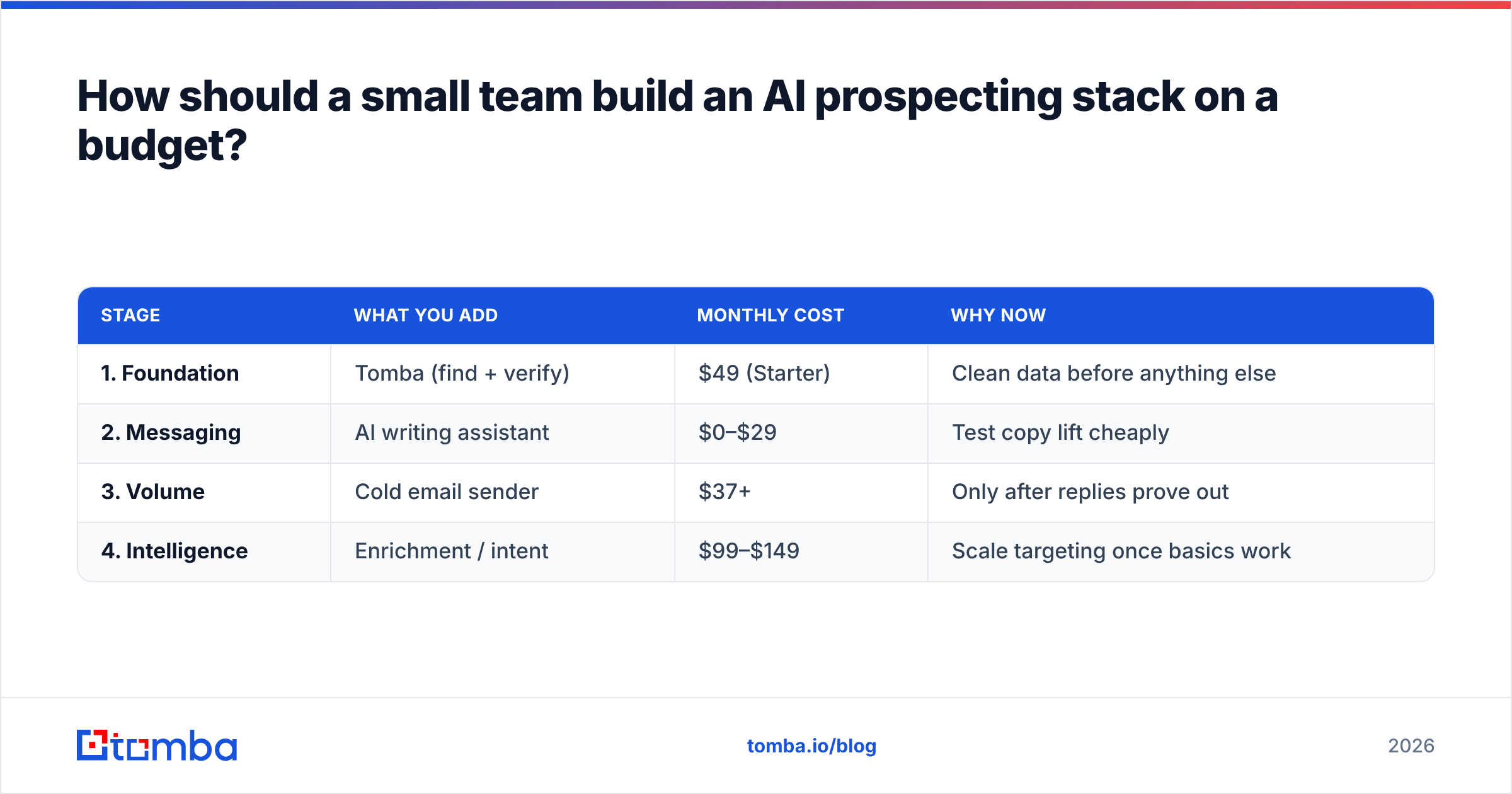
Start with data and one writing assistant. Add automation only once you have proof that your targeting and messaging convert. Here's a staged build that keeps spend sane:
| Stage | What you add | Monthly cost | Why now |
|---|---|---|---|
| 1. Foundation | Tomba (find + verify) | $49 (Starter) | Clean data before anything else |
| 2. Messaging | AI writing assistant | $0–$29 | Test copy lift cheaply |
| 3. Volume | Cold email sender | $37+ | Only after replies prove out |
| 4. Intelligence | Enrichment / intent | $99–$149 | Scale targeting once basics work |
Notice stage 1 starts at Tomba's $49/mo Starter plan, not the free tier. The free tier (25 searches/mo) is for kicking the tires; the Starter plan is the realistic floor for an active SDR. As you scale, the Growth plan at $99/mo and Pro at $249/mo add the search and verification volume a full team burns through.
The sequencing here is deliberate. Teams that buy a $149/mo enrichment platform on day one — before they've validated a single message — almost always churn it. Earn each layer.
How do I evaluate AI prospecting tools without wasting a month?#
Run a 10-day bake-off with one metric per layer. Don't evaluate on demos; evaluate on your own list.
- Data layer: Pull 100 contacts from your ICP through each finder, then verify with the same email verifier. Measure real bounce rate, not the vendor's claimed accuracy. This is the single most predictive test.
- Writing layer: Generate 20 first lines, have a rep blind-rank them against human-written ones. If reps can't tell, the tool is good enough.
- Automation layer: Send to two matched segments — AI-sequenced vs. your current process — and compare reply rate, not open rate. Opens are noisy in 2026.
- Cost reality: Total the per-credit and overage charges at your actual volume, not the sticker price. Credit-based tools surprise people here.
For the data test specifically, a bulk email finder plus verification gives you a clean apples-to-apples bounce comparison across vendors in an afternoon.
Common mistakes that waste your AI prospecting budget#
- Buying automation before data. A fast sequencer pointed at bad emails just damages your domain faster.
- Trusting vendor accuracy claims. Everyone claims 95%+. Verify on your own list.
- Over-personalizing low-value accounts. Reserve hand-crafted AI research for your top tier; templatize the long tail.
- Ignoring catch-all domains. A huge share of B2B domains are catch-all; without a catch-all verifier you're guessing on deliverability.
- Letting AI send unsupervised. Always keep a human in the loop on the first touch.
Most of these trace back to the same root cause: treating AI as a substitute for data quality and judgment rather than a multiplier on top of them. According to industry analysts like Gartner, the highest-performing sales orgs invest in data foundations before automation — the tooling order matters.
The bottom line#
There is no single "best AI tool for sales prospecting" — there's a best tool per layer, and a smart order to buy them in. Get your contact data accurate and verified first, layer in AI writing to scale personalization, then add automation once the fundamentals convert. Tools like Clay and Instantly earn their place once that foundation exists; platforms like Apollo make sense if you value one login over peak quality in each layer.
Whatever stack you assemble, the foundation is the same: real, deliverable contact data. That's the job Tomba's Email Finder is built for — find professional emails by name, domain, or company, verify them before you send, and pipe them into the rest of your stack via API. Start free with 25 searches, then move to the $49/mo Starter plan when you're ready to run a real outbound motion. Build on clean data, and every AI tool downstream gets better.
// get started
Find, verify and enrich your first contacts today
Start on the free plan with 25 searches a month, then scale when your team is ready.
Free plan · No credit card required · GDPR & CCPA
// about the author