Best B2B Data Providers in 2026: Ranked & Compared
A neutral, hands-on breakdown of the best B2B data providers in 2026 — accuracy, coverage, pricing, and which tool fits your GTM motion.
Picking a B2B data provider is the single decision that quietly decides whether your outbound works. Buy a stale list and every downstream metric — bounce rate, reply rate, sender reputation — degrades before your first send. This guide ranks the best B2B data providers in 2026 by the only things that matter: accuracy, coverage, refresh cadence, and price per usable record.
TL;DR#
- The "best" provider depends on your motion. Enterprise ABM teams lean ZoomInfo or Cognism; lean startups and developers get more value per dollar from Apollo or Tomba.
- Accuracy beats raw record count. A 200M-contact database is worthless if 30% of the emails bounce. Always test on your ICP before buying.
- Compliance is now a buying criterion. GDPR/CCPA coverage and a documented data-source trail separate the serious vendors from the list resellers.
- Verification is non-negotiable. Even the best database decays ~2.5% per month, so pair any provider with real-time email verification.
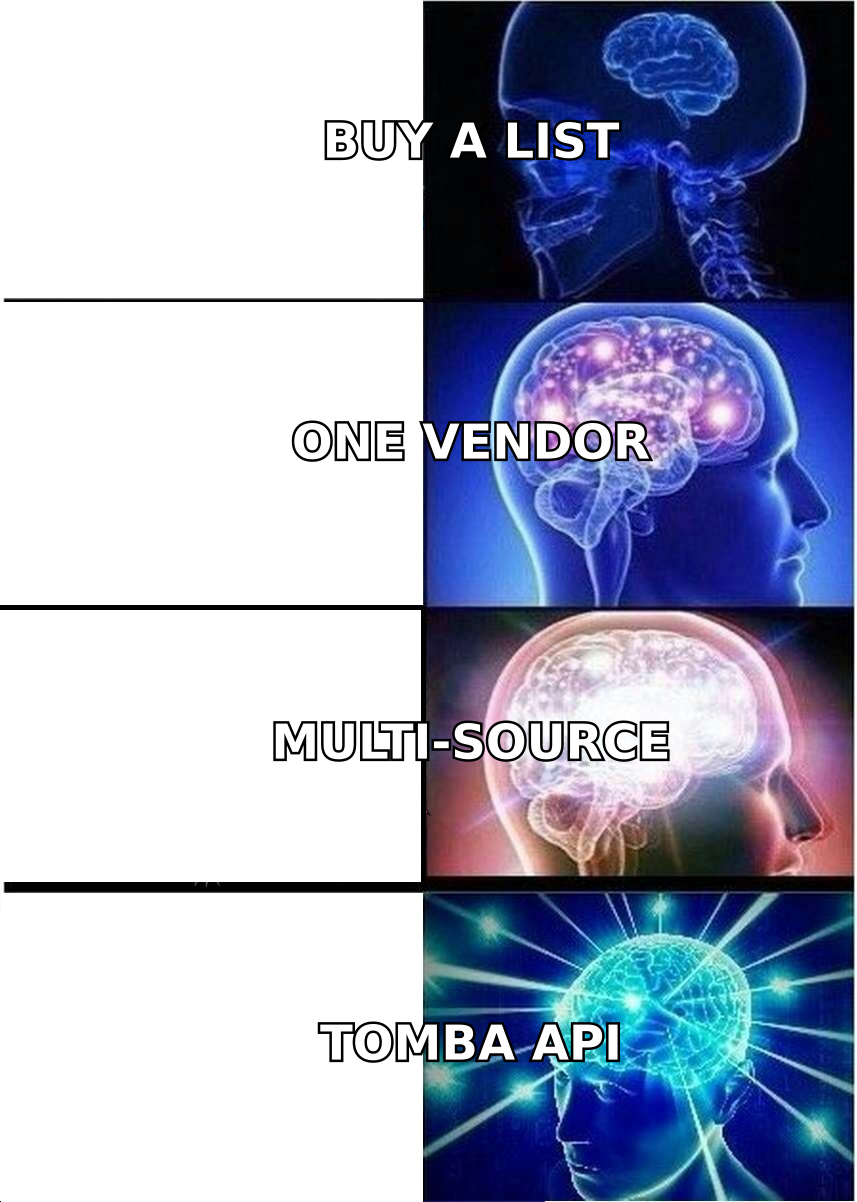
- Tomba is the value pick when you want verified emails, a clean email finder API, and transparent pricing without a sales call.
What is a B2B data provider?#
A B2B data provider is a company that collects, structures, and sells business contact and firmographic data — names, job titles, work emails, phone numbers, company size, tech stack, and intent signals. Think of it as the difference between a phone book and a living address book: the phone book was accurate the day it printed, while a good provider re-verifies entries continuously so the data is fresh when you use it.
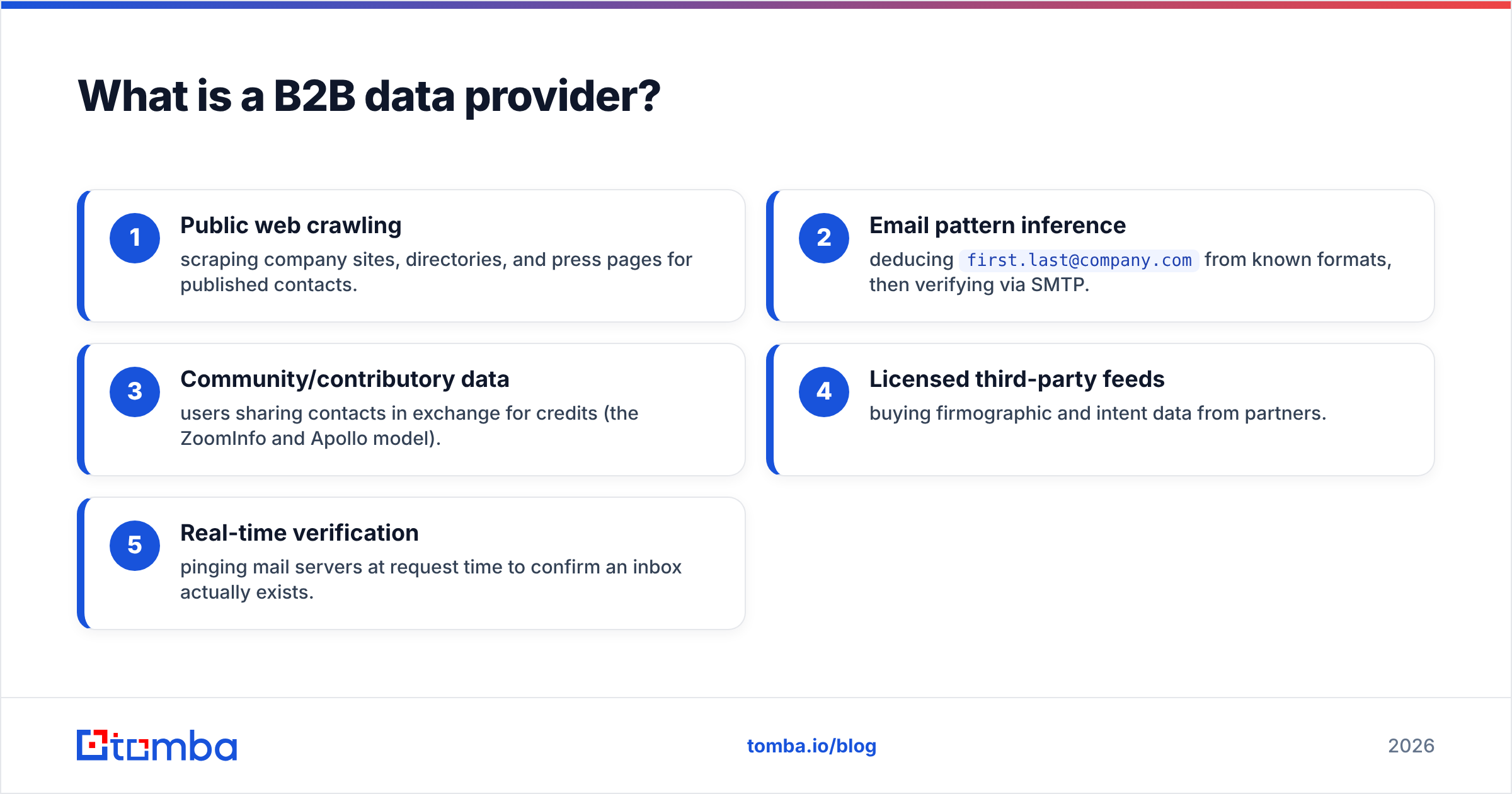
Most providers combine several sourcing methods, and the mix is what determines quality:
- Public web crawling — scraping company sites, directories, and press pages for published contacts.
- Email pattern inference — deducing
first.last@company.comfrom known formats, then verifying via SMTP. - Community/contributory data — users sharing contacts in exchange for credits (the ZoomInfo and Apollo model).
- Licensed third-party feeds — buying firmographic and intent data from partners.
- Real-time verification — pinging mail servers at request time to confirm an inbox actually exists.
The best B2B data providers blend all five and are transparent about it. Tomba, for example, publishes where its data comes from so you can audit the sourcing — a useful proxy for trust.
Who are the best B2B data providers in 2026?#
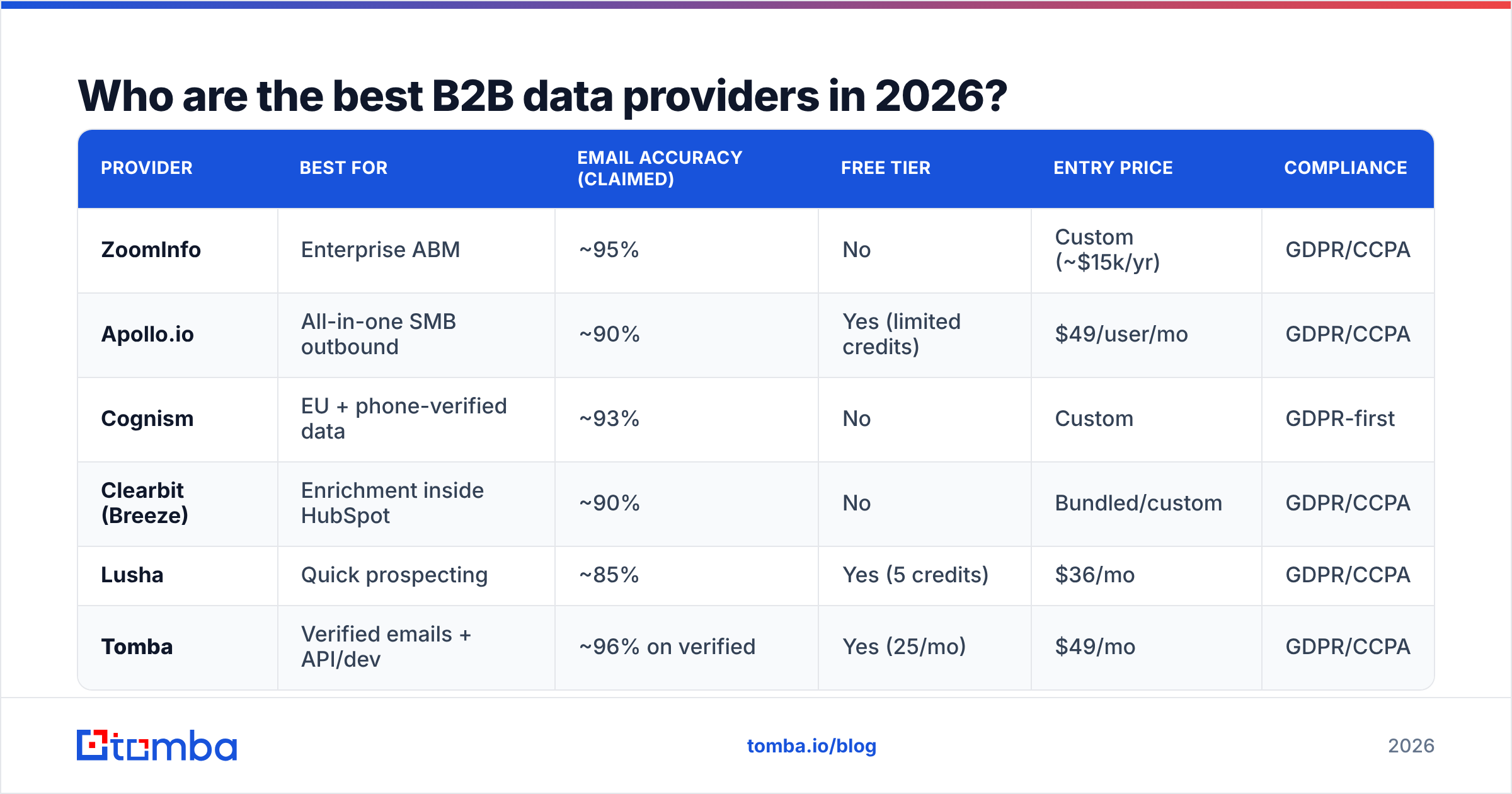
There is no single winner — there is a best fit per budget and use case. Here's how the major players compare on the attributes that actually affect pipeline.
| Provider | Best for | Email accuracy (claimed) | Free tier | Entry price | Compliance |
|---|---|---|---|---|---|
| ZoomInfo | Enterprise ABM | ~95% | No | Custom (~$15k/yr) | GDPR/CCPA |
| Apollo.io | All-in-one SMB outbound | ~90% | Yes (limited credits) | $49/user/mo | GDPR/CCPA |
| Cognism | EU + phone-verified data | ~93% | No | Custom | GDPR-first |
| Clearbit (Breeze) | Enrichment inside HubSpot | ~90% | No | Bundled/custom | GDPR/CCPA |
| Lusha | Quick prospecting | ~85% | Yes (5 credits) | $36/mo | GDPR/CCPA |
| Tomba | Verified emails + API/dev | ~96% on verified | Yes (25/mo) | $49/mo | GDPR/CCPA |
A few honest caveats on this table:
- "Claimed" is the operative word. Every vendor markets a headline accuracy number measured on their own sample. Treat them as ceilings, not guarantees, and always run a pilot on your target accounts.
- Pricing models differ wildly. ZoomInfo and Cognism quote annual contracts behind a sales process; Apollo and Tomba publish transparent pricing you can self-serve.
- "Best for" is about motion, not prestige. A 5-person agency doesn't need an enterprise ABM platform, and an enterprise can't run on free credits.
For a head-to-head on specific tools, see Tomba's Apollo alternative and Clearbit alternative breakdowns.
How do you measure B2B data accuracy?#
Accuracy is the deliverability problem in disguise — bad data is the number-one cause of bounces, and bounces wreck your sender reputation. Measure it on four axes:
- Validity — does the email address resolve to a real, active inbox? This is what an SMTP check confirms.
- Bounce rate — the practical outcome. Keep hard bounces under 2-3% to protect deliverability.
- Freshness — when was the record last verified? Job-change churn means a 12-month-old contact is a coin flip.
- Match rate — of the contacts you requested, how many did the provider actually return? High accuracy on a 40% match rate still leaves most of your list empty.

The trap most buyers fall into is judging a provider by database size. A vendor advertising "275M contacts" sounds dominant, but if those records were last verified 18 months ago, you're buying decay. Run a blind test: pull 200 contacts from your real ICP, push them through the provider, then validate the results with an independent email verifier and a small test send. The bounce rate you see is the only accuracy number that matters.
Is a bigger database always better?#
No — and this is the most expensive misconception in the category. Coverage and accuracy trade off against each other. A provider can win the "most contacts" headline by ingesting everything it crawls and verifying lazily, or it can win on accuracy by verifying aggressively and discarding stale records. You cannot maximize both at once.
What you actually want is usable records for your segment. For a niche play — say, CTOs at Series-B fintechs in the EU — a focused, well-verified database will beat a giant generalist one. For broad mid-market outbound across many industries, raw coverage matters more. Map the provider's strength to your segment instead of chasing the biggest number on the pricing page. When you need contacts for a whole company, a focused domain search often returns cleaner results than a broad export.
How should you choose a B2B data provider?#
Work through this checklist before you sign anything:
- Define your ICP precisely — region, company size, seniority, function. This decides which providers even have coverage.
- Run a paid pilot, not a demo — vendors curate demo data. Test on accounts you already know.
- Measure real bounce rate — verify a sample with an independent tool and a live send, don't trust the dashboard.
- Check the compliance trail — for EU outreach, confirm GDPR lawful basis and a documented opt-out/suppression process.
- Match the pricing model to usage — credit-based, seat-based, or API metered. Spiky usage favors credits; steady high volume favors flat or API.
- Confirm integration fit — native HubSpot or Salesforce sync, a clean API, or a Google Sheets add-on so the data lands where your team works.
If you're building automated enrichment into a product or workflow, the API quality is often more decisive than the database size. A well-documented email finder API with predictable rate limits and webhook support saves weeks of engineering versus a vendor that treats the API as an afterthought.
What about compliance and data sourcing?#
Compliance moved from a legal footnote to a frontline buying criterion. Under GDPR, processing EU personal data requires a lawful basis, and "we scraped it" is not one. The providers that survive scrutiny do three things: document where each data point originated, honor suppression and deletion requests promptly, and offer phone data that respects do-not-call regimes.
Cognism built its brand on being GDPR-first, which is why EU-heavy teams gravitate to it. But compliance isn't a single vendor's moat — any reputable provider should be able to show you its data sources and a data-processing agreement. If a vendor can't or won't explain its sourcing, that opacity is your answer. For background on the underlying mechanics, the Wikipedia overview of email verification and review aggregators like G2's data-provider category are useful neutral references when you're shortlisting.
How do the email-finder-focused providers compare?#
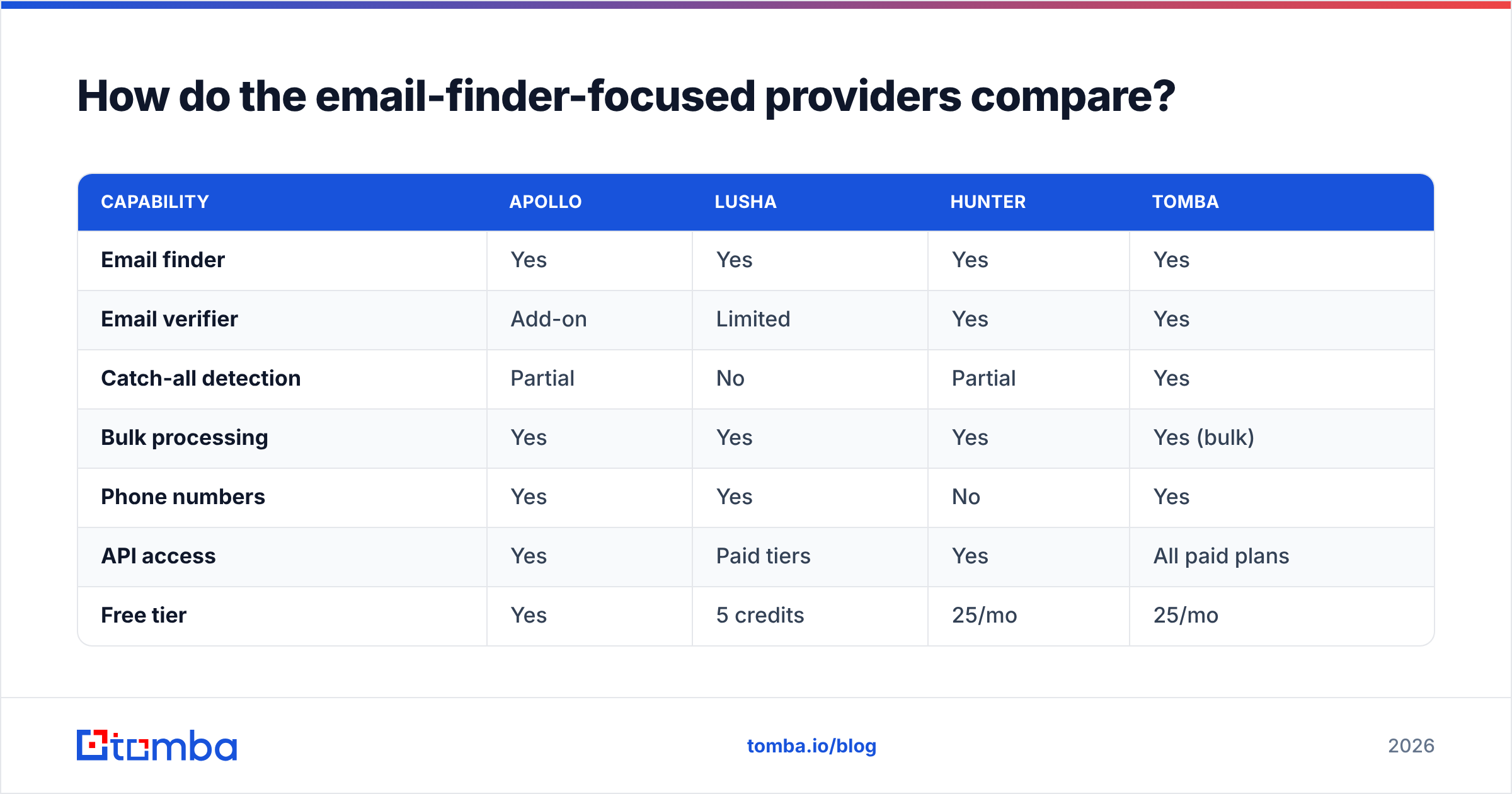
If your primary need is finding and verifying work emails — rather than a full sales-intelligence suite with intent data — the comparison narrows to the specialist tools. Here the metrics that matter are find rate, verification depth (including catch-all handling), and cost per verified email.

| Capability | Apollo | Lusha | Hunter | Tomba |
|---|---|---|---|---|
| Email finder | Yes | Yes | Yes | Yes |
| Email verifier | Add-on | Limited | Yes | Yes |
| Catch-all detection | Partial | No | Partial | Yes |
| Bulk processing | Yes | Yes | Yes | Yes (bulk) |
| Phone numbers | Yes | Yes | No | Yes |
| API access | Yes | Paid tiers | Yes | All paid plans |
| Free tier | Yes | 5 credits | 25/mo | 25/mo |
The specialists win on cost efficiency and integration depth for email-centric workflows, while the big platforms win when you also need intent signals and a sequencer in the same login. Tomba's edge in this group is verification depth — it ships a dedicated catch-all verifier, a bulk finder, and a Chrome extension so reps can pull verified emails directly from LinkedIn and company pages. For a deeper look at how it stacks up against the prospecting-suite players, the RocketReach alternative comparison is a good starting point.
What does a B2B data provider actually cost?#
Sticker price is misleading; cost-per-usable-record is the real number. Two ways to compute it:
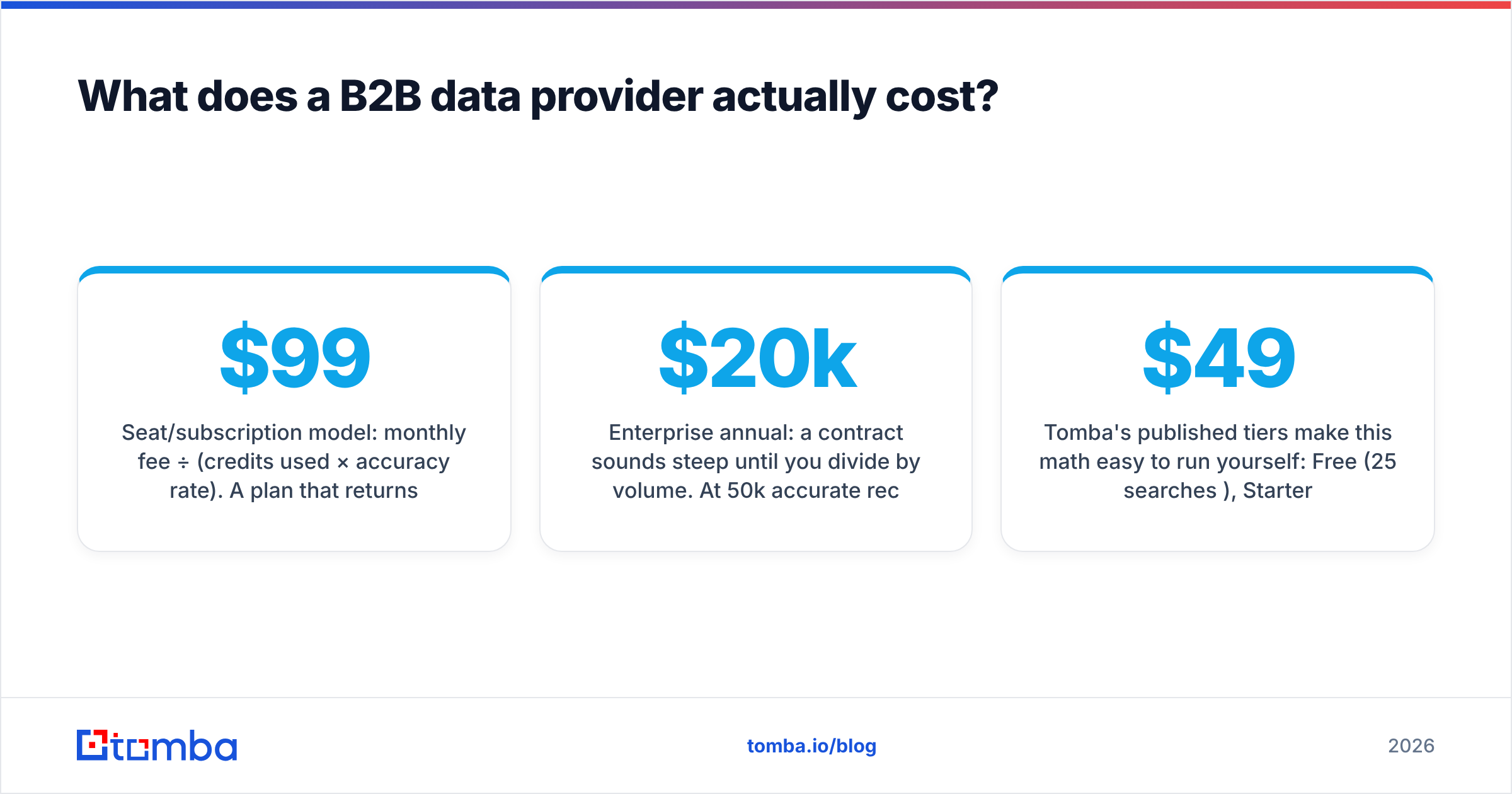
- Seat/subscription model: monthly fee ÷ (credits used × accuracy rate). A $99/mo plan that returns 1,000 verified contacts costs ~$0.10 per usable record. The same plan at 70% accuracy costs ~$0.14 — and that's before the deliverability damage from the bad 30%.
- Enterprise annual: a $20k/yr contract sounds steep until you divide by volume. At 50k accurate records a year, that's $0.40 each — fine for high-ACV enterprise sales, painful for transactional SMB outreach.
Tomba's published tiers make this math easy to run yourself: Free (25 searches/mo), Starter $49/mo, Growth $99/mo, Pro $249/mo, and custom Enterprise — all visible on the pricing page without a sales call. That transparency is itself a feature; vendors who hide pricing behind "contact us" are usually optimizing for negotiation, not for you.
Final recommendation#
Match the tool to the job. If you're an enterprise ABM team that needs intent data, deep firmographics, and a dedicated CSM, ZoomInfo or Cognism earn their premium. If you're running broad SMB outbound and want a sequencer in the same tool, Apollo is the pragmatic all-in-one. And if your priority is verified work emails, a developer-grade API, and honest pricing — without paying for a sales-intelligence suite you won't fully use — the value pick is clear.
Start with the Tomba Email Finder: the free tier gives you 25 searches a month to test accuracy on your own ICP before you commit a dollar. Pair it with the built-in email verifier to keep bounce rates low, wire it into your stack through the API or a native HubSpot integration, and scale up only when the data proves itself on your real pipeline. Test before you trust — that's the one rule that holds for every provider on this list.
// get started
Find, verify and enrich your first contacts today
Start on the free plan with 25 searches a month, then scale when your team is ready.
Free plan · No credit card required · GDPR & CCPA
// about the author