Best Cold Email Platform in 2026: Top 9 Tools Compared
Comparing the best cold email platforms of 2026 on deliverability, inbox rotation, warmup, and price — plus where to source the verified data that actually makes them work.
Picking the best cold email platform in 2026 is less about who has the prettiest sequence builder and more about who keeps you out of the spam folder. Sending tools have largely converged on the same feature list — multi-inbox rotation, AI personalization, unified inbox — so the real differences now live in deliverability infrastructure, warmup quality, and how cleanly they handle the data you feed them.
TL;DR — Which cold email platform wins in 2026?#
- Best overall for agencies and high volume: Smartlead and Instantly lead on inbox rotation and deliverability tooling.
- Best all-in-one (data + sending): Apollo.io if you want a built-in B2B database, though sending deliverability is weaker than the specialists.
- Best for simple, affordable outbound: Saleshandy and Lemlist for teams under 10 reps.
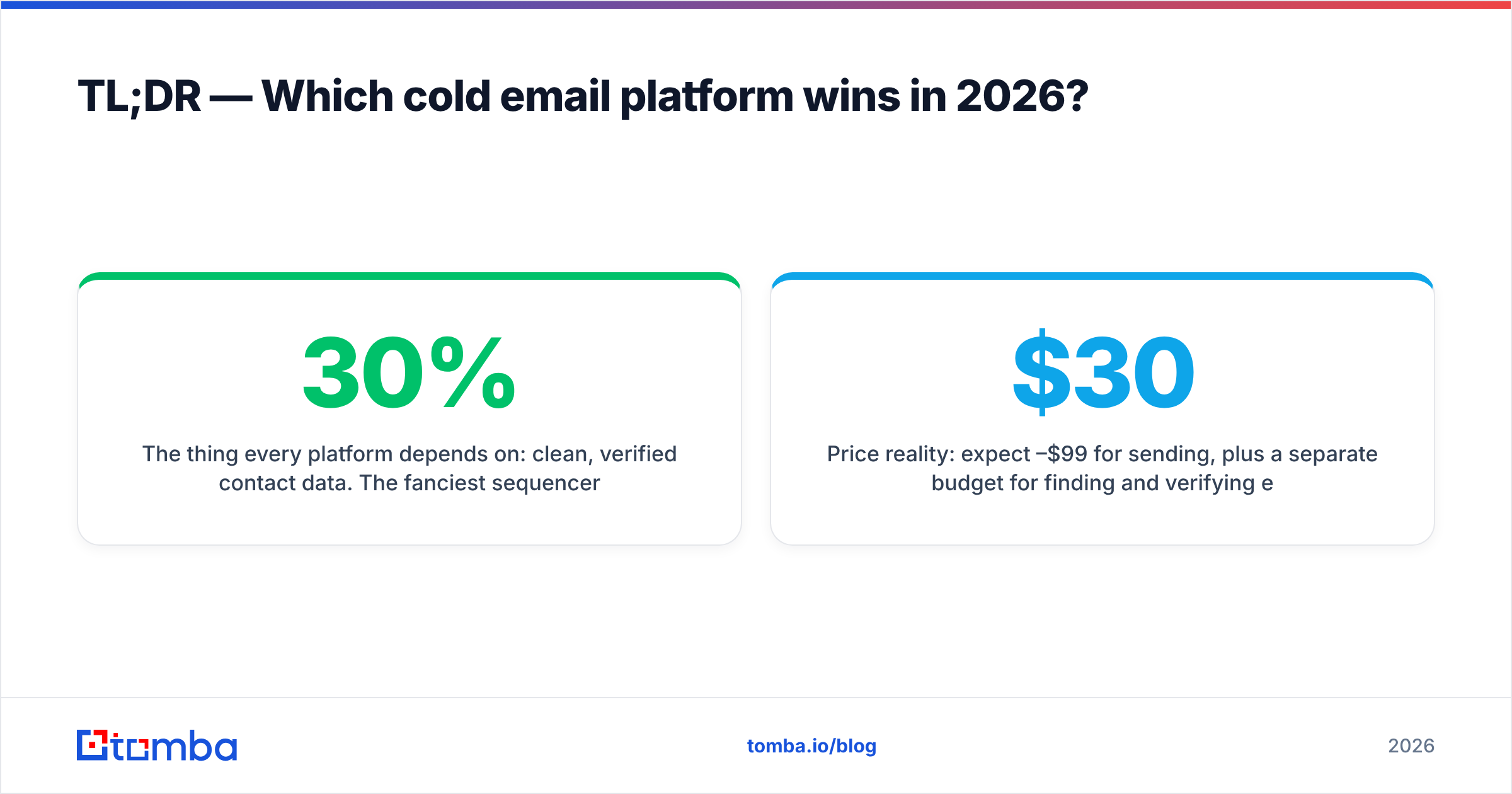
- The thing every platform depends on: clean, verified contact data. The fanciest sequencer can't fix a list that's 30% invalid.
- Price reality: expect $30–$99/mo per seat for sending, plus a separate budget for finding and verifying emails.
What is a cold email platform, and what should it actually do?#
A cold email platform is the software that sends, sequences, and tracks outbound emails at scale — think of it as the delivery truck for your outreach. It is not the warehouse (your contact data) and not the product (your offer and copy). It just moves messages from your mailboxes to your prospects' inboxes without getting flagged as spam along the way.
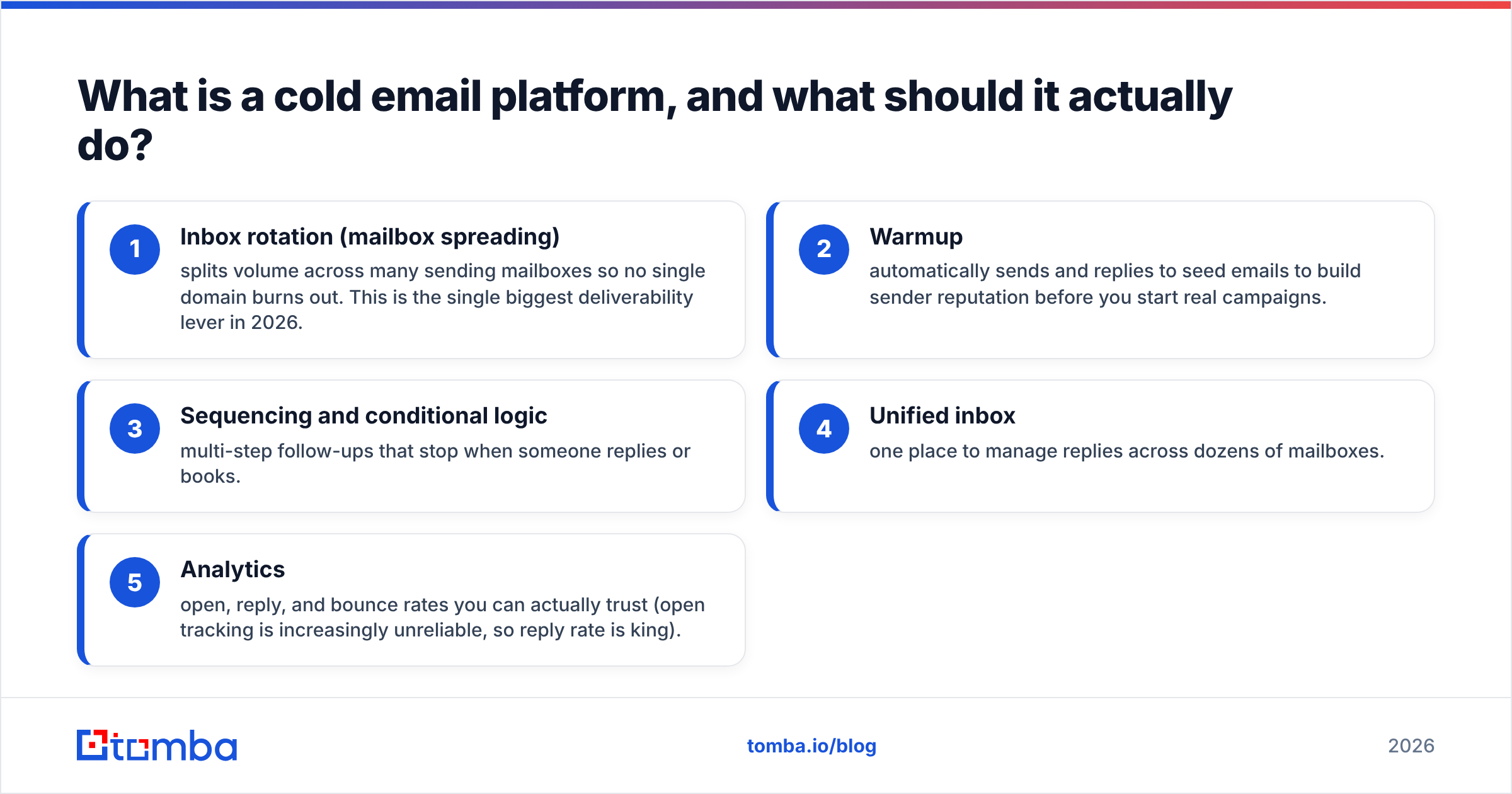
The best cold email platform for your team handles five jobs well:
- Inbox rotation (mailbox spreading) — splits volume across many sending mailboxes so no single domain burns out. This is the single biggest deliverability lever in 2026.
- Warmup — automatically sends and replies to seed emails to build sender reputation before you start real campaigns.
- Sequencing and conditional logic — multi-step follow-ups that stop when someone replies or books.
- Unified inbox — one place to manage replies across dozens of mailboxes.
- Analytics — open, reply, and bounce rates you can actually trust (open tracking is increasingly unreliable, so reply rate is king).
Notice what is not on that list: finding and verifying the emails themselves. Almost every sending platform assumes you arrive with a clean list. That assumption is where most cold email programs quietly fail.
/blog/generated/memes/2026-06-18/best-cold-email-platform-meme-1.png
Which is the best cold email platform? Full comparison table#
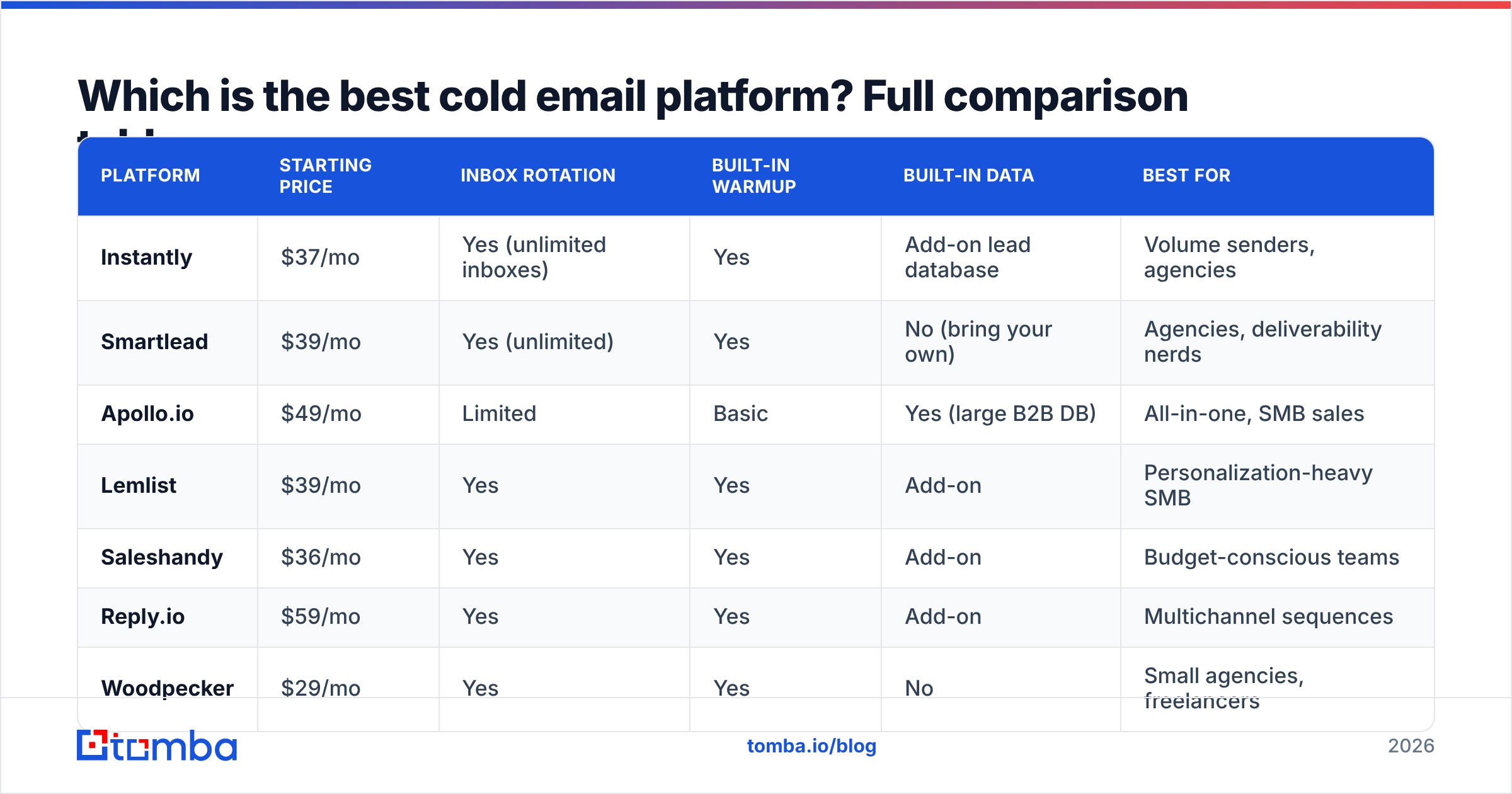
Here is how the major contenders stack up on the attributes that decide deliverability and cost. Prices are per-seat or entry-tier monthly figures as listed publicly in 2026 — always confirm on the vendor's pricing page before buying.
| Platform | Starting price | Inbox rotation | Built-in warmup | Built-in data | Best for |
|---|---|---|---|---|---|
| Instantly | $37/mo | Yes (unlimited inboxes) | Yes | Add-on lead database | Volume senders, agencies |
| Smartlead | $39/mo | Yes (unlimited) | Yes | No (bring your own) | Agencies, deliverability nerds |
| Apollo.io | $49/mo | Limited | Basic | Yes (large B2B DB) | All-in-one, SMB sales |
| Lemlist | $39/mo | Yes | Yes | Add-on | Personalization-heavy SMB |
| Saleshandy | $36/mo | Yes | Yes | Add-on | Budget-conscious teams |
| Reply.io | $59/mo | Yes | Yes | Add-on | Multichannel sequences |
| Woodpecker | $29/mo | Yes | Yes | No | Small agencies, freelancers |
A few honest takeaways from the table:
- The sending specialists (Smartlead, Instantly, Saleshandy, Woodpecker) win on deliverability because that is all they do. Unlimited inbox rotation at a flat price is the pattern that defines this tier.
- The all-in-ones (Apollo, Reply) trade some deliverability for convenience. Apollo's appeal is the bundled database — but bundled data is rarely as fresh or accurate as a dedicated provider, and bundled sending is rarely as robust as a dedicated sender.
- Price is not the deciding factor. The gap between $29 and $59 per seat is noise compared to the cost of a burned domain or a list full of bounces.
If you came here looking for an Instantly alternative or a Saleshandy alternative, the same evaluation logic applies: judge them on rotation, warmup, and how well they integrate with your data source — not the feature checklist.
Is Apollo a good cold email platform, or just a good database?#
Apollo is a better database than it is a sender. It bundles a large B2B contact database with a sequencer, which feels efficient — one login, one bill. But in practice, teams that scale outbound on Apollo's native sending tend to hit deliverability ceilings faster than teams on Smartlead or Instantly, because Apollo's infrastructure is built for breadth, not for the surgical inbox rotation that keeps cold domains healthy.
The common 2026 pattern is a hybrid: pull contacts from a data provider, then send through a deliverability-first platform. That separation lets each tool do its one job well. If you want to test the all-in-one route anyway, evaluate it honestly against an Apollo alternative or two before committing your whole motion to one vendor.
What actually decides cold email deliverability in 2026?#
Your data quality and your domain hygiene decide deliverability — the platform is downstream of both. Google and Microsoft tightened bulk-sender rules over the last two years, and the practical result is that bounce rate and spam-complaint rate now matter more than send volume. A single campaign blasted to an unverified list can tank a domain's reputation in hours.
Here is the order of operations that protects you, regardless of which sending tool you pick:
- Authenticate everything. SPF, DKIM, and DMARC on every sending domain. Use a free SPF checker to confirm your record resolves correctly before your first send.
- Verify before you send. Run every address through an email verifier to strip invalids, traps, and risky catch-alls. This is the highest-ROI 30 seconds in the entire workflow.
- Warm up gradually. Ramp new mailboxes over 2–4 weeks. Don't jump from zero to 200 sends a day.
- Keep lists fresh. B2B data decays roughly 2–3% per month as people change jobs. A list from six months ago is already meaningfully stale.
That second point is where most platforms leave you exposed. They will happily send to a garbage list and let your reputation absorb the damage. For a deeper checklist, the broader concept of email deliverability covers the technical and reputational signals mailbox providers weigh.
/blog/generated/memes/2026-06-18/best-cold-email-platform-meme-2.png
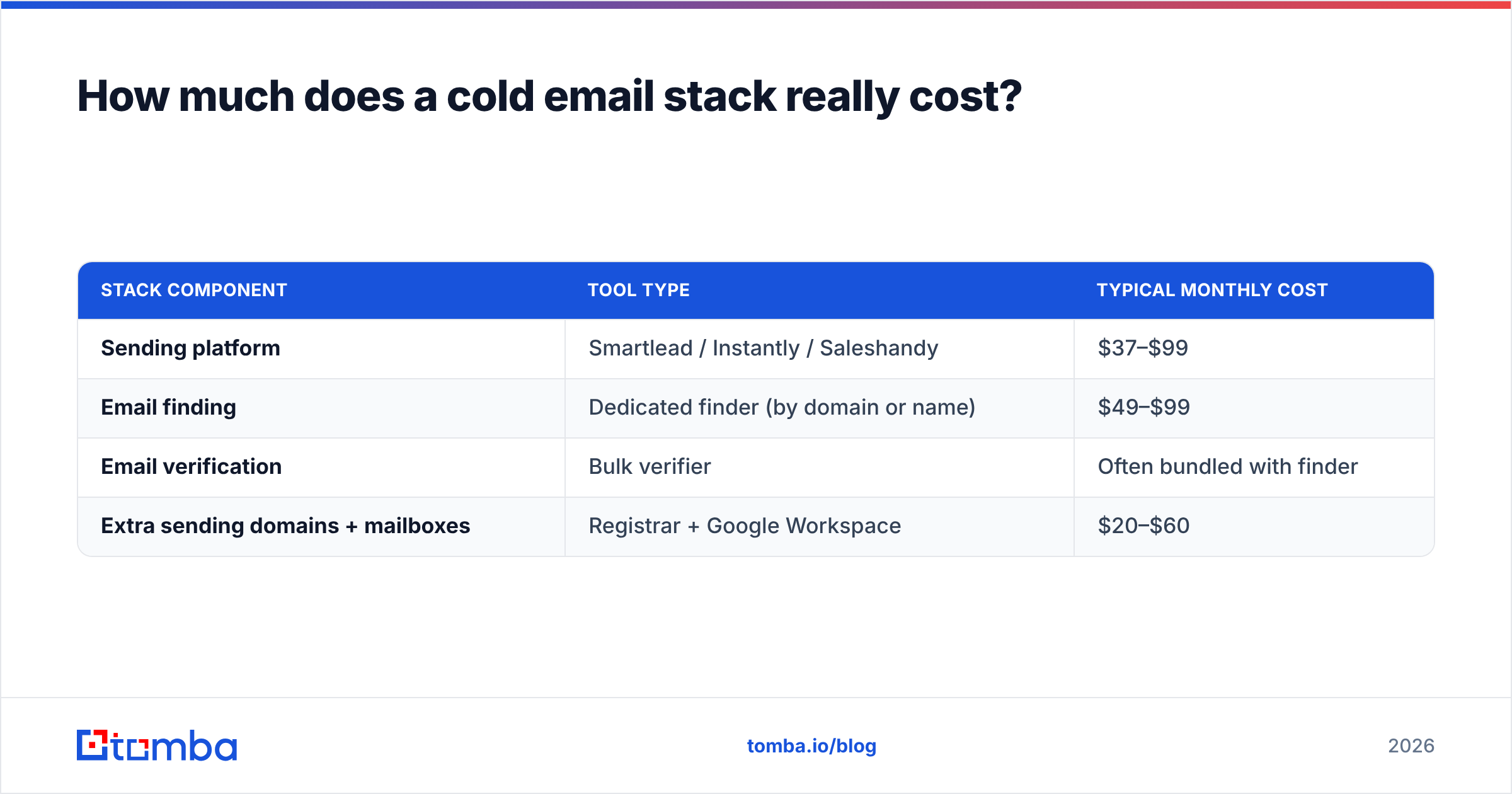
How much does a cold email stack really cost?#
Budget for two line items, not one. The sending platform is the cheap part; the data is where outbound budgets actually go. A realistic 2026 stack for a small team looks like this:
| Stack component | Tool type | Typical monthly cost |
|---|---|---|
| Sending platform | Smartlead / Instantly / Saleshandy | $37–$99 |
| Email finding | Dedicated finder (by domain or name) | $49–$99 |
| Email verification | Bulk verifier | Often bundled with finder |
| Extra sending domains + mailboxes | Registrar + Google Workspace | $20–$60 |
For the data half of that stack, Tomba pricing is representative of the category: a Free tier with 25 searches/month to test, Starter at $49/mo, Growth at $99/mo, and Pro at $249/mo for higher-volume teams. The point is not to push one vendor — it is to budget honestly. Teams that spend $40 on sending and $0 on data are the ones writing "why is my cold email not working" posts three months later.
What separates a good sequence from a deliverability disaster?#
Good sequences are short, verified, and human-paced; disasters are long, unverified, and machine-fast. Two campaigns can use the identical platform and get opposite results based entirely on inputs. Here is the contrast:
- Healthy campaign: 3–4 steps, sent to a verified list, spread across 8–10 warmed mailboxes, capped at ~30 sends per mailbox per day, with reply-stop logic and genuine personalization tokens that resolve correctly.
- Risky campaign: 7+ steps, sent to a scraped-and-unverified list, concentrated on 1–2 mailboxes, blasting 200+ per day, with broken merge tags that expose "Hi {{first_name}}" to half the recipients.
The platform can enforce the daily caps and the rotation. It cannot fix the list. That is why the most experienced outbound teams treat their data pipeline — finding, verifying, enriching — as the foundation and the sending tool as a commodity on top.
How do you feed a cold email platform with data it won't choke on?#
Pair your sender with a dedicated find-and-verify workflow, then push clean rows in. The cleanest pattern in 2026:
- Find decision-maker emails by company domain or by name using an email finder, rather than buying static lists that are already decaying.
- Pull whole companies at once with domain search when you want every relevant contact at a target account.
- Verify in bulk so your bounce rate stays under the ~2–3% threshold mailbox providers tolerate.
- Sync into your sender via native integrations, a Tomba API connection, or your CRM — for example through a HubSpot integration so your sales and marketing records stay aligned.
This is also where bundled-database platforms quietly fall short: their data is shared across thousands of senders hammering the same contacts. A dedicated finder that builds emails from live sources and verifies them at lookup time gives you addresses that are both fresher and less saturated. According to independent review sites like G2 and Capterra, data freshness is consistently the top complaint about all-in-one outbound suites — which is exactly the gap a focused data layer fills.
So what is the best cold email platform for you?#
The honest answer is "it depends on your volume, but the sending tool matters less than you think." Decision shortcuts:
- Agency or 50k+ sends/month: Smartlead or Instantly for unlimited inbox rotation and deliverability controls.
- Small team that wants simplicity: Saleshandy or Woodpecker — same fundamentals, lower price, gentler learning curve.
- You want personalization at the core: Lemlist.
- You want one tool for data and sending and accept the tradeoffs: Apollo, evaluated against alternatives first.
- Multichannel (email + LinkedIn + calls): Reply.io.
But whichever box you tick, the platform is only as good as the list you load into it. Senders are increasingly interchangeable; verified, fresh, deduplicated data is the real moat — and it always has been.
Start with the data your platform depends on#
Before you commit to any sending tool, fix the input. Use the Tomba Email Finder to source decision-maker emails by domain, name, or company, then verify them so your bounce rate stays low and your new domains stay healthy. The free tier gives you 25 searches a month to test the accuracy against your own target accounts — no card required. Find the right people first, pick your sending platform second, and you'll outperform teams paying twice as much for a prettier sequence builder loaded with a dirty list.
// get started
Find, verify and enrich your first contacts today
Start on the free plan with 25 searches a month, then scale when your team is ready.
Free plan · No credit card required · GDPR & CCPA
// about the author