Best Email Outreach Tools in 2026: 9 Platforms Compared
Compare the best email outreach tools of 2026 on sending limits, deliverability, data, and price — and learn which one fits cold email, warm follow-up, or full sequences.
Picking an email outreach tool feels simple until you actually open ten pricing pages. One platform charges by inbox, another by contact, a third by "credits" that mean something different on every tier. Meanwhile the thing that actually decides whether your campaign works — clean data and inbox placement — barely shows up in the marketing copy. This guide cuts through that.
TL;DR — Which outreach tool should you pick?#
- Best for scaled cold email: Instantly and Smartlead, thanks to unlimited inboxes and built-in warmup.
- Best all-in-one (data + sending): Apollo, if you want prospecting and sequences under one login.
- Best for enterprise sales teams: Outreach and Salesloft, where CRM depth and analytics matter more than price.
- Best for warm, multichannel sequences: lemlist and Reply.io.
- The non-negotiable: no outreach tool fixes bad data. Verify and enrich your list with a dedicated email finder before it ever touches a sending platform.
What counts as an "email outreach tool" in 2026?#
An email outreach tool is software that sends personalized email at scale and tracks what happens next. Think of it as the difference between mailing one handwritten letter and running a print shop: the print shop handles volume, templating, scheduling, and a log of every delivery — but it does not write your message or find the addresses for you.
In practice, the category now splits into three jobs, and most "best email outreach tools" lists confuse them:
- Sequencing and sending — multi-step campaigns, A/B testing, reply detection, inbox rotation. This is the core (Instantly, Smartlead, lemlist, Outreach, Salesloft).
- Data and prospecting — finding and verifying the contacts you send to. Some sending tools bundle this (Apollo); most do not, which is why a standalone email verifier sits upstream of almost every serious stack.
- Deliverability infrastructure — warmup, domain rotation, SPF/DKIM/DMARC, spam testing. Increasingly bundled into sending tools, but the quality varies wildly.
A tool that nails sequencing but feeds on a stale list will still land you in spam. That is the central trap, and it is why the data layer keeps showing up later in this article.
How should you evaluate the best email outreach tools?#
Score every candidate on six dimensions. The first two decide whether you make the inbox at all; the rest decide whether the tool is pleasant to live in.
- Deliverability tooling — Does it include warmup, inbox rotation, and spam-word checks? A great sequence builder is worthless if 40% of mail goes to spam.
- Sending capacity model — Per-inbox, per-contact, or per-credit? Unlimited-inbox pricing changed cold-email economics; per-contact pricing punishes large lists.
- Data quality and verification — Does it verify before send, or pass bounces straight through? Bounce rate above 3% is a sender-reputation killer.
- Personalization depth — Variables, conditional logic, AI copy, custom snippets. Spray-and-pray is dead; conditional sequences are table stakes.
- Multichannel — LinkedIn, calls, and SMS alongside email. Matters for warm/enterprise motions, less for high-volume cold.
- CRM and reporting — Native HubSpot/Salesforce sync, attribution, and pipeline reporting versus a flat open-rate dashboard.
Weight these by your motion. A solo founder running cold email cares most about deliverability and sending cost. A 40-rep enterprise team cares most about CRM depth and analytics. Keep that in mind as you read the table below — there is no single winner, only a best fit.
Which email outreach tools are best in 2026?#
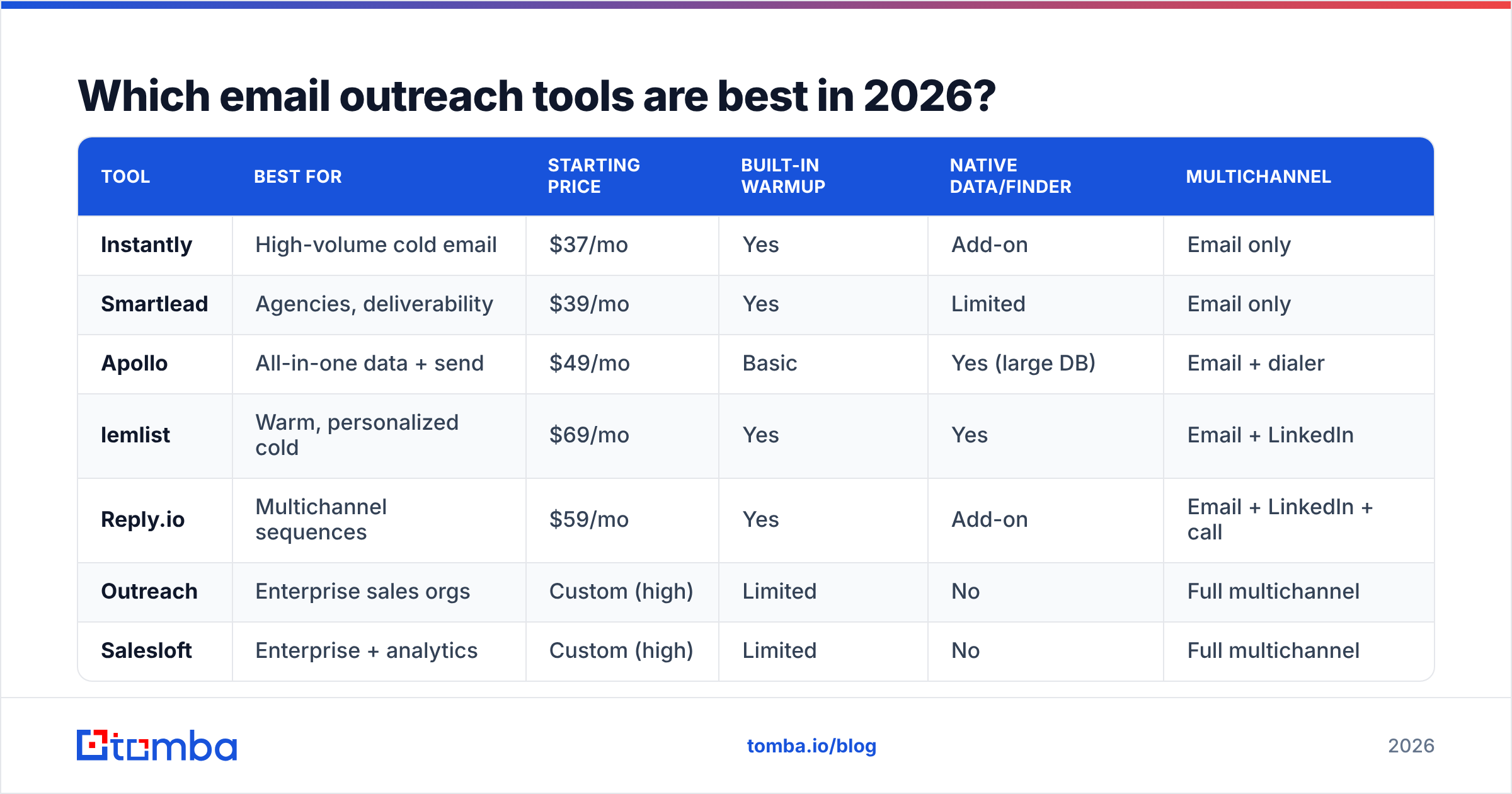
Here is the side-by-side. Prices are entry-level published rates as of 2026 and round to the nearest dollar; always confirm on the vendor's own page since tiers shift often.
| Tool | Best for | Starting price | Built-in warmup | Native data/finder | Multichannel |
|---|---|---|---|---|---|
| Instantly | High-volume cold email | $37/mo | Yes | Add-on | Email only |
| Smartlead | Agencies, deliverability | $39/mo | Yes | Limited | Email only |
| Apollo | All-in-one data + send | $49/mo | Basic | Yes (large DB) | Email + dialer |
| lemlist | Warm, personalized cold | $69/mo | Yes | Yes | Email + LinkedIn |
| Reply.io | Multichannel sequences | $59/mo | Yes | Add-on | Email + LinkedIn + call |
| Outreach | Enterprise sales orgs | Custom (high) | Limited | No | Full multichannel |
| Salesloft | Enterprise + analytics | Custom (high) | Limited | No | Full multichannel |
| Saleshandy | Budget cold email | $36/mo | Yes | Add-on | Email only |
| Woodpecker | SMB agencies | $29/mo | Yes | No | Email + some LinkedIn |
A few honest takeaways from that grid:
The cheap tier is crowded and good. Instantly, Smartlead, Saleshandy, and Woodpecker all do the core job — sequences plus warmup — for under $40/mo. For pure cold email, the differences are about UX, inbox-rotation quality, and support, not capability. You can read fuller breakdowns on our Instantly alternative and Saleshandy alternative pages.
All-in-one has a quality tax. Apollo bundles a contact database with sending, which is convenient, but bundled data is rarely as fresh as a dedicated provider's, and bundled warmup is rarely as aggressive as Instantly's. Convenience versus quality is the trade. See the Apollo alternative comparison for where that line falls.
Enterprise tools are sold on reporting, not sending. Outreach and Salesloft cost multiples of the cold-email crowd because they plug into Salesforce, forecast pipeline, and govern large teams. If you are a five-person startup, you are paying for a control plane you will not use.
Does the outreach tool or the data matter more?#
The data matters more. Every time. A truth most vendor demos quietly skip over.
Picture two teams sending the identical sequence from the identical tool. Team A blasts a scraped list with a 22% bounce rate. Team B sends to a verified list with a 1% bounce rate. Within two days, Team A's domain reputation tanks, their mail routes to spam, and even their good addresses stop landing. Same software, opposite outcome — because mailbox providers judge you on how clean your list is, not which dashboard you bought.
This is why your stack should put a verification and enrichment step before the sending tool, not inside it:
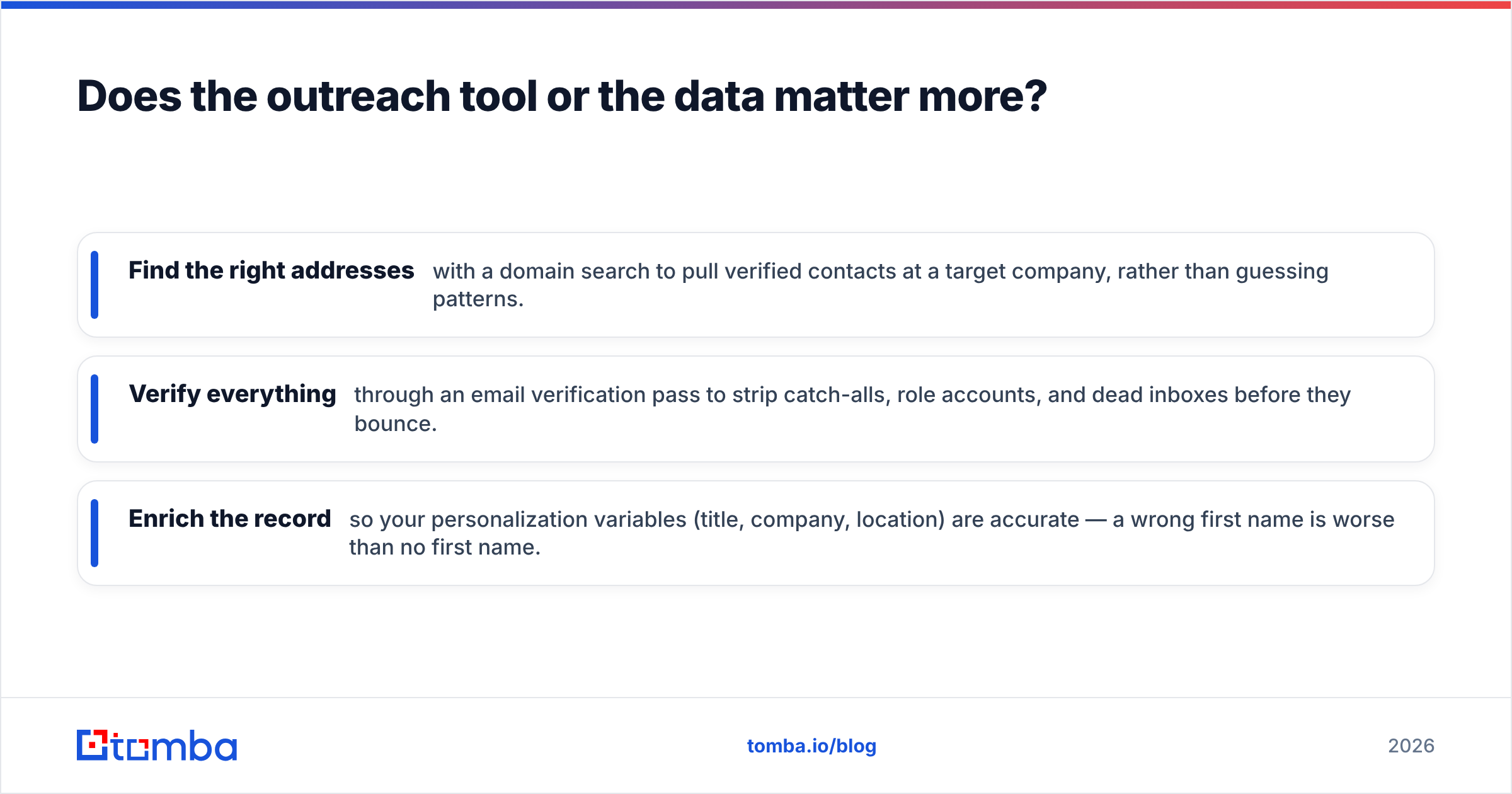
- Find the right addresses with a domain search to pull verified contacts at a target company, rather than guessing patterns.
- Verify everything through an email verification pass to strip catch-alls, role accounts, and dead inboxes before they bounce.
- Enrich the record so your personalization variables (title, company, location) are accurate — a wrong first name is worse than no first name.
According to Validity's deliverability research, sender reputation is the single biggest factor in inbox placement, and bounce rate is one of the fastest ways to wreck it. No sequence builder overrides that. Industry directories like G2 rank these platforms heavily on deliverability for the same reason.
Which tool fits cold email versus warm outreach?#
Match the tool to the temperature of your list.
Cold email at volume (hundreds per day): You want unlimited inboxes, domain rotation, and the most aggressive warmup you can get — Instantly or Smartlead. The economics only work when you can spin up many sending domains cheaply, which per-inbox pricing punishes and unlimited-inbox pricing rewards. Pair either with a bulk email finder and verification run so the volume is clean, not just large.
Warm and semi-warm (inbound leads, event lists, past contacts): Personalization beats volume. lemlist and Reply.io let you layer LinkedIn touches and conditional logic, which lifts reply rates on audiences that already half-know you. Deliverability risk is lower here because engagement is higher.
Enterprise / named-account selling: Outreach and Salesloft, full stop — not because they send better email, but because they coordinate reps, calls, and CRM stages around each account. The email is one channel in a governed play.
A quick gut check: if your reply problem is "not enough people," fix the data and the volume tooling. If your reply problem is "people open but don't respond," fix the copy and the targeting — and consider a free subject line tester before you blame the platform.
What about deliverability features specifically?#
Warmup and inbox rotation are now the headline features, and for good reason. Warmup simulates natural sending and engagement so a new domain builds trust gradually instead of triggering spam filters on day one. Most tools in the table include it; the quality gap is in how realistic the engagement looks and how many seed inboxes feed it.
But warmup is downstream of fundamentals you must set up yourself, regardless of tool:
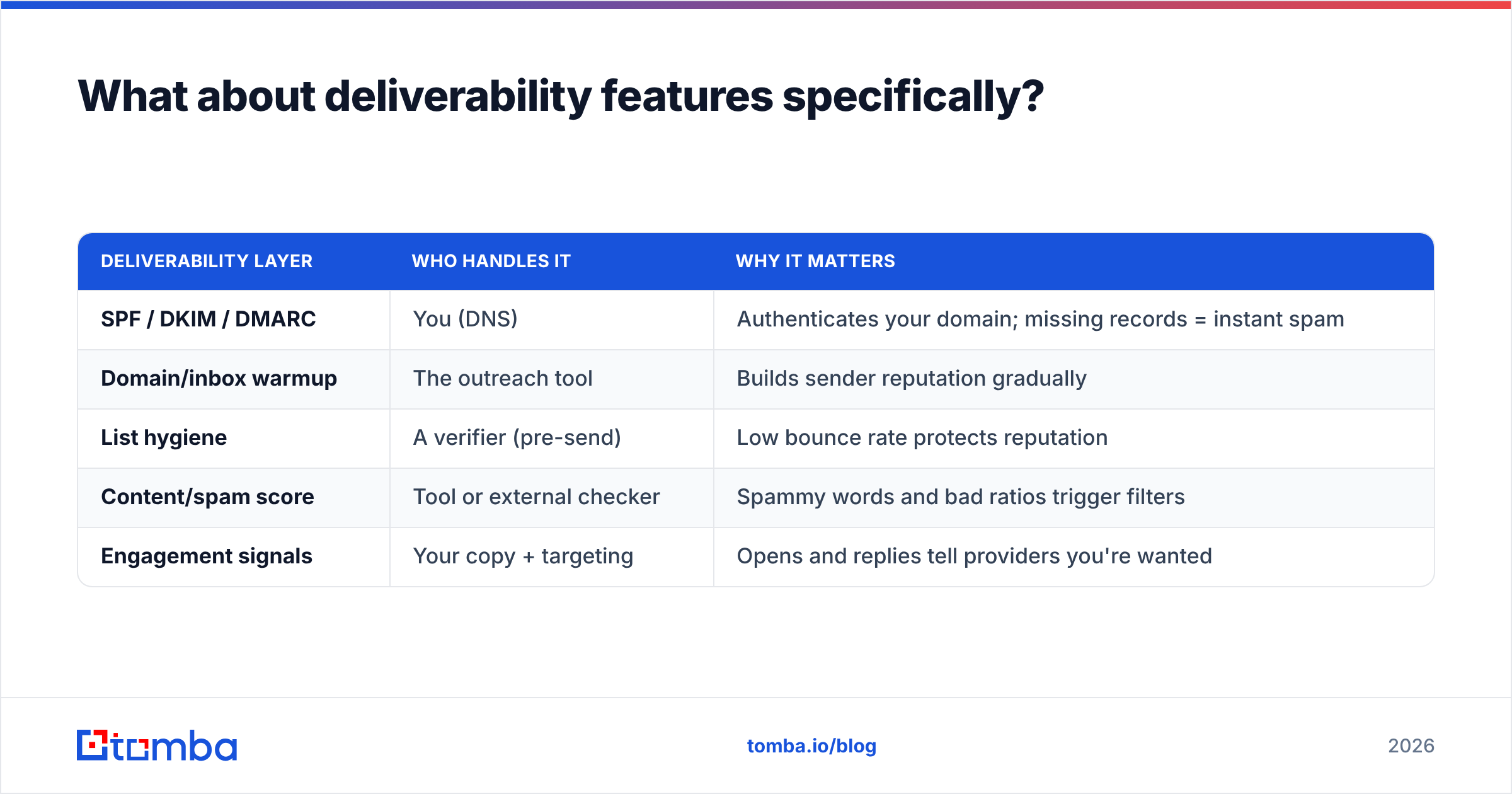
| Deliverability layer | Who handles it | Why it matters |
|---|---|---|
| SPF / DKIM / DMARC | You (DNS) | Authenticates your domain; missing records = instant spam |
| Domain/inbox warmup | The outreach tool | Builds sender reputation gradually |
| List hygiene | A verifier (pre-send) | Low bounce rate protects reputation |
| Content/spam score | Tool or external checker | Spammy words and bad ratios trigger filters |
| Engagement signals | Your copy + targeting | Opens and replies tell providers you're wanted |
Run an SPF record check and a spam score check before your first send — both are free, and skipping them is the most common reason a "good" outreach tool underperforms. HubSpot's own email deliverability documentation walks through the authentication setup if you want a vendor-neutral reference.
How much should you budget for an outreach stack?#
Budget for two line items, not one: the sending tool and the data layer. Counting only the sending tool is the most common budgeting mistake, and it is why so many teams are surprised when results lag.
A realistic small-team monthly stack in 2026 looks like:
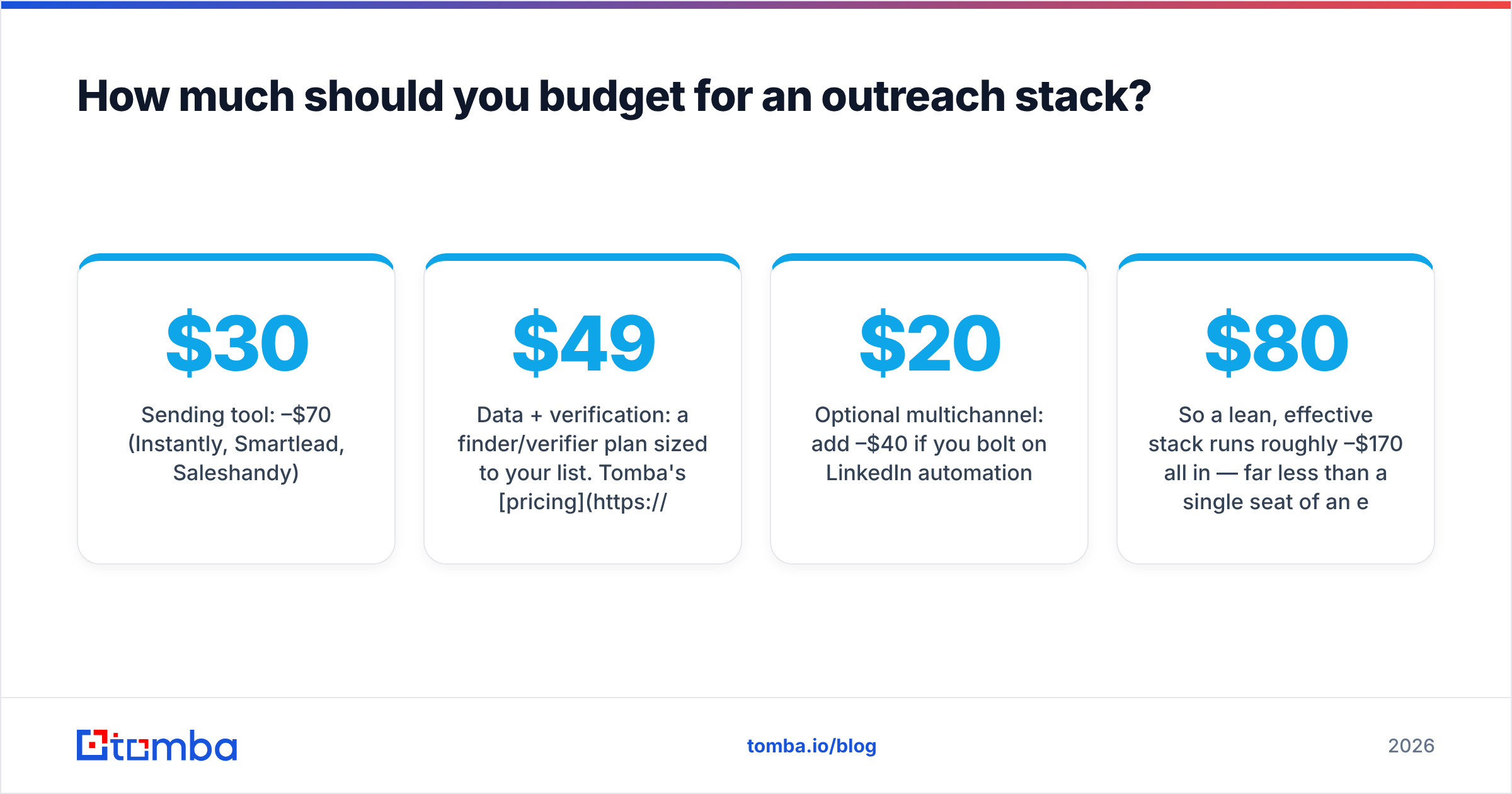
- Sending tool: $30–$70/mo (Instantly, Smartlead, Saleshandy).
- Data + verification: a finder/verifier plan sized to your list. Tomba's pricing starts free at 25 searches/month, with the Starter plan at $49/mo and Growth at $99/mo for higher volume.
- Optional multichannel: add $20–$40/mo if you bolt on LinkedIn automation.
So a lean, effective stack runs roughly $80–$170/mo all in — far less than a single seat of an enterprise platform, and with better data hygiene than any all-in-one bundle. Scale the data plan with your sending volume, not the other way around: it is cheaper to verify 10,000 contacts than to burn a sending domain on them.
What's the verdict on the best email outreach tools?#
There is no universal winner, and any list that names one is selling something. Match the tool to your motion:
- Cold email, high volume, tight budget: Instantly or Smartlead.
- One login for data and sending: Apollo (accepting the data-freshness trade).
- Warm, personalized, multichannel: lemlist or Reply.io.
- Enterprise team with CRM and forecasting needs: Outreach or Salesloft.
But whichever sending tool you choose, the variable that most reliably moves reply rates is the one most lists ignore: the quality of the list you send to. A verified, enriched contact list lifts deliverability, personalization, and reply rate at the same time — and it does so no matter which platform sends the mail.
That is the part Tomba handles. Use the Tomba Email Finder to source accurate, verified professional emails by name, company, or domain, then push that clean list into whichever outreach tool you picked above. Start free with 25 searches a month, confirm the data quality yourself, and let your sending platform do what it is actually good at — sending to people who exist. Your bounce rate, your domain reputation, and your reply rate will all thank you.
// get started
Find, verify and enrich your first contacts today
Start on the free plan with 25 searches a month, then scale when your team is ready.
Free plan · No credit card required · GDPR & CCPA
// about the author