Best Lead Generation Companies in 2026: A Buyer's Guide
Comparing the best lead generation companies in 2026 — agencies, data vendors, and self-serve tools — so you can pick the model that actually fills your pipeline without burning budget.
Picking the "best" lead generation company is less about a leaderboard and more about matching a buying model to your motion. A done-for-you agency, a B2B data vendor, and a self-serve email-finder tool all promise "more leads," but they bill differently, scale differently, and fail differently. This guide breaks down the real options in 2026 so you can choose without overpaying for the wrong shape of help.
TL;DR#
- There are three buying models, not one ranking: managed agencies, B2B data providers, and self-serve prospecting tools. Each wins in a different situation.
- Agencies (Belkins, CIENCE, Martal) are best when you have budget but no SDR team; expect $3k–$15k/mo retainers.
- Data vendors (ZoomInfo, Apollo, Cognism, Lusha) sell contact data and intent at platform scale, with platform pricing to match.
- Self-serve tools like Tomba Email Finder give you verified contact data on demand for a flat low monthly cost — best for teams that already own their outbound.
- The decision rule: buy the layer you can't build. Don't pay agency margins for data you can pull yourself.
What does a "lead generation company" actually mean in 2026?#
The term covers three very different businesses, and conflating them is how teams overspend.
- Managed lead-gen agencies run outbound for you — they build lists, write sequences, send email and LinkedIn touches, and book meetings onto your calendar. You buy outcomes (or activity) and a retainer.
- B2B data and intelligence platforms sell you the raw material: company firmographics, contact emails and phones, technographics, and buying-intent signals. You run the outreach yourself.
- Self-serve prospecting tools are narrow, fast utilities — an email finder, a bulk email finder, a verifier — that slot into your existing workflow and charge by usage or a flat plan.
A useful analogy: an agency is hiring a catering company, a data platform is a wholesale food supplier, and a self-serve tool is a really sharp chef's knife. All three "help you eat," but you'd never confuse paying for one with paying for another.

How should you compare the best lead generation companies?#
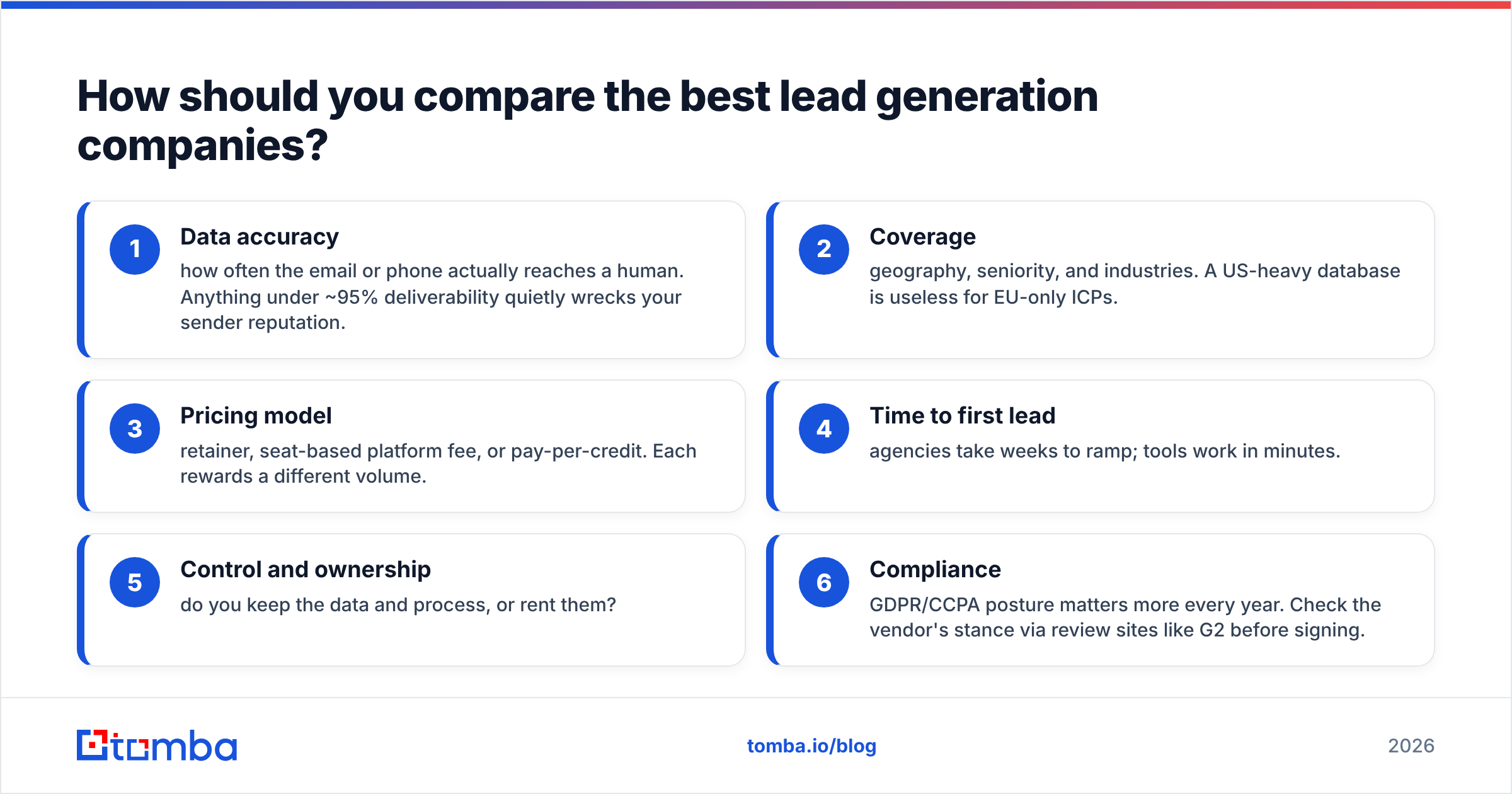
Score every vendor on the same six axes instead of trusting category labels:
- Data accuracy — how often the email or phone actually reaches a human. Anything under ~95% deliverability quietly wrecks your sender reputation.
- Coverage — geography, seniority, and industries. A US-heavy database is useless for EU-only ICPs.
- Pricing model — retainer, seat-based platform fee, or pay-per-credit. Each rewards a different volume.
- Time to first lead — agencies take weeks to ramp; tools work in minutes.
- Control and ownership — do you keep the data and process, or rent them?
- Compliance — GDPR/CCPA posture matters more every year. Check the vendor's stance via review sites like G2 before signing.
Which are the best lead generation companies by category?#
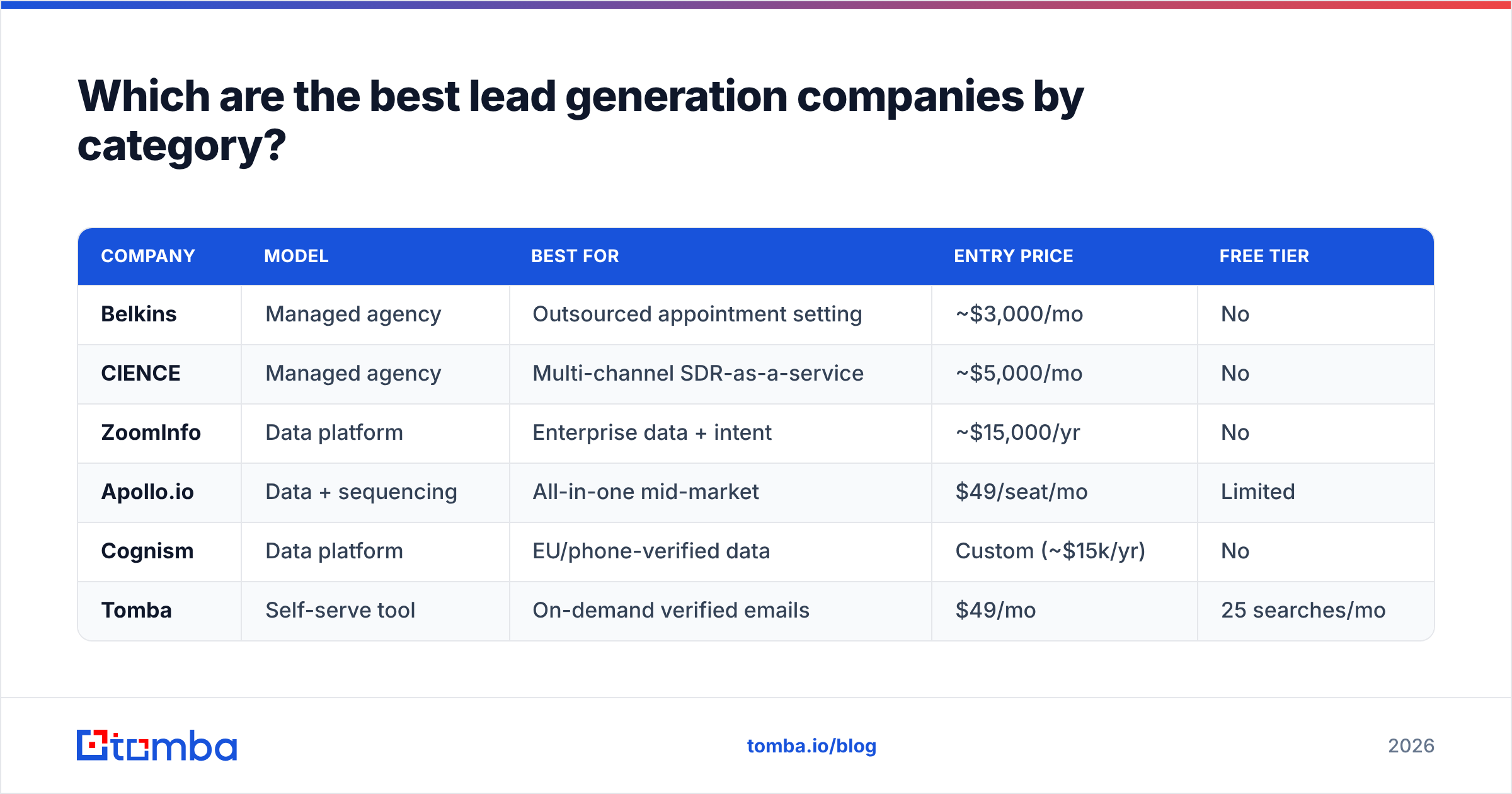
Here's a concrete side-by-side of representative options across all three models. Prices are public list pricing or typical market ranges as of 2026 and round to the nearest sensible figure.
| Company | Model | Best for | Entry price | Free tier |
|---|---|---|---|---|
| Belkins | Managed agency | Outsourced appointment setting | ~$3,000/mo | No |
| CIENCE | Managed agency | Multi-channel SDR-as-a-service | ~$5,000/mo | No |
| ZoomInfo | Data platform | Enterprise data + intent | ~$15,000/yr | No |
| Apollo.io | Data + sequencing | All-in-one mid-market | $49/seat/mo | Limited |
| Cognism | Data platform | EU/phone-verified data | Custom (~$15k/yr) | No |
| Tomba | Self-serve tool | On-demand verified emails | $49/mo | 25 searches/mo |
A few honest takeaways from that table:
- Agencies have no free tier and high floors. You're buying a team, so the minimum check is large. If you can't keep them fed with a clear ICP, you'll pay for idle capacity.
- Enterprise data platforms hide their pricing and negotiate annual contracts. Powerful, but heavy for a 3-person team.
- Self-serve tools are the only model you can try for free and scale linearly. Tomba pricing starts at a Free tier (25 searches/mo), then Starter $49/mo, Growth $99/mo, and Pro $249/mo.
When is a lead generation agency the right call?#
Choose an agency when you have demand-gen budget but no outbound team — and no appetite to build one this quarter.
Agencies earn their margin when:
- You lack SDR headcount and hiring/ramping would take longer than the agency's setup.
- Your ICP is clear and stable, so the agency isn't burning your retainer on discovery.
- You value calendar meetings over data ownership. You're buying booked calls, not a database you keep.
- Your ACV is high enough that a handful of meetings pays back a $3k–$15k monthly retainer.
The trade-off is control. When the contract ends, the playbook, the warmed domains, and often the data leave with the agency. You also inherit their deliverability hygiene — if they over-send from shared infrastructure, your brand wears the spam complaints. Vet that hard.
Are B2B data platforms better than agencies?#
Neither is "better" — data platforms win when you already own the outreach and just need fuel.
Platforms like ZoomInfo, Apollo, Cognism, and Lusha shine when you have SDRs or a marketer who can run sequences but lacks reliable contact data. You get firmographics, verified contacts, and increasingly buying-intent signals in one login. The catch is cost and lock-in: enterprise platforms price on annual seats and bundle features you may not touch.
If you're evaluating one of these and the price tag stings, the smarter move is often to unbundle. You don't always need a full intelligence suite — sometimes you need accurate emails and phones on demand. That's exactly where a focused Apollo alternative or Clearbit alternative earns its place: same core contact data, a fraction of the commitment.

Where do self-serve email-finder tools fit?#
Self-serve tools are the best fit for teams that own their outbound and want to stop renting data they could pull themselves.
This is the fastest-growing slice of the market for good reason. Instead of a five-figure annual contract, you pay a flat monthly fee and get verified contact data through a UI, a Chrome extension, a Google Sheets add-on, or an email finder API. The workflow is simple:
- Find — enter a name + company or a domain and get the verified work email.
- Verify — run addresses through an email verifier before you send, so bounces stay near zero.
- Scale — push a list through the bulk email finder or wire the API into your CRM.
Tomba sits here. Its core is the email finder, with an email verifier, domain search, catch-all verifier, phone finder, and data enrichment alongside it. The pitch isn't "replace your whole GTM stack" — it's "stop paying platform rents for the one thing you actually use every day: accurate contact data."
Self-serve vs. agency vs. platform: who owns what?#
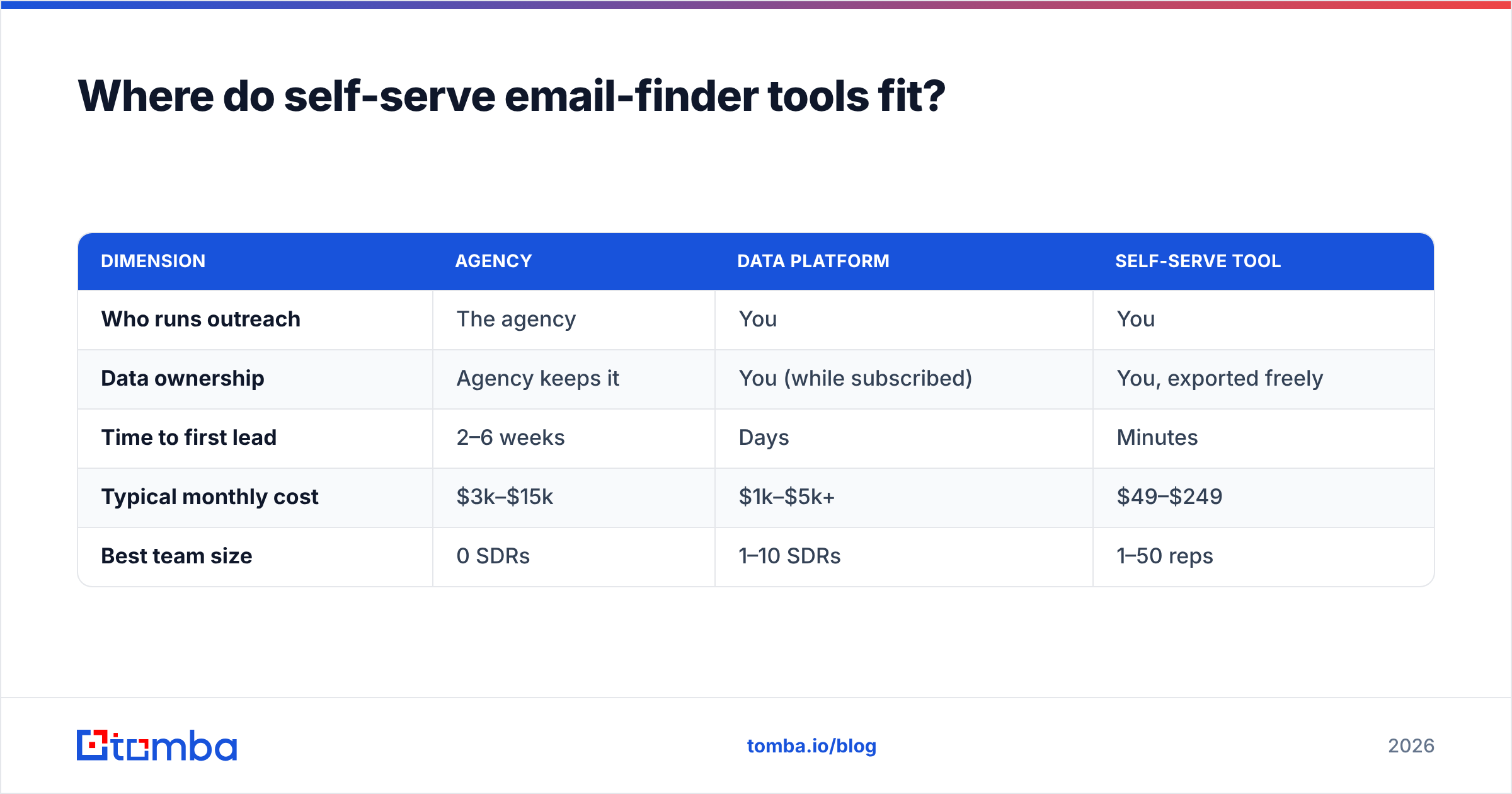
| Dimension | Agency | Data platform | Self-serve tool |
|---|---|---|---|
| Who runs outreach | The agency | You | You |
| Data ownership | Agency keeps it | You (while subscribed) | You, exported freely |
| Time to first lead | 2–6 weeks | Days | Minutes |
| Typical monthly cost | $3k–$15k | $1k–$5k+ | $49–$249 |
| Best team size | 0 SDRs | 1–10 SDRs | 1–50 reps |
How do you choose the best lead generation company for your team?#
Buy the layer you can't build, and never pay agency margins for data you can self-serve.
Run this quick decision tree:
- No team, budget to spend, clear ICP → hire a vetted agency (Belkins/CIENCE/Martal). Audit their deliverability practices first.
- You have reps but bad data → license a data platform, or unbundle to a self-serve tool if you mostly need emails and phones.
- You have reps and a working motion → start with a self-serve tool. It's the cheapest way to test whether better data alone lifts your reply rate before you commit to anything bigger.
- You're not sure → start at the bottom. A free tier costs nothing to test; a $5k retainer does not.
One more guardrail: whatever you choose, protect your domain. Even perfect lists bounce if your contacts are stale, so verification is non-negotiable. Tools like a blacklist checker and an SPF checker keep the sending side healthy while your data vendor keeps the targeting side accurate.
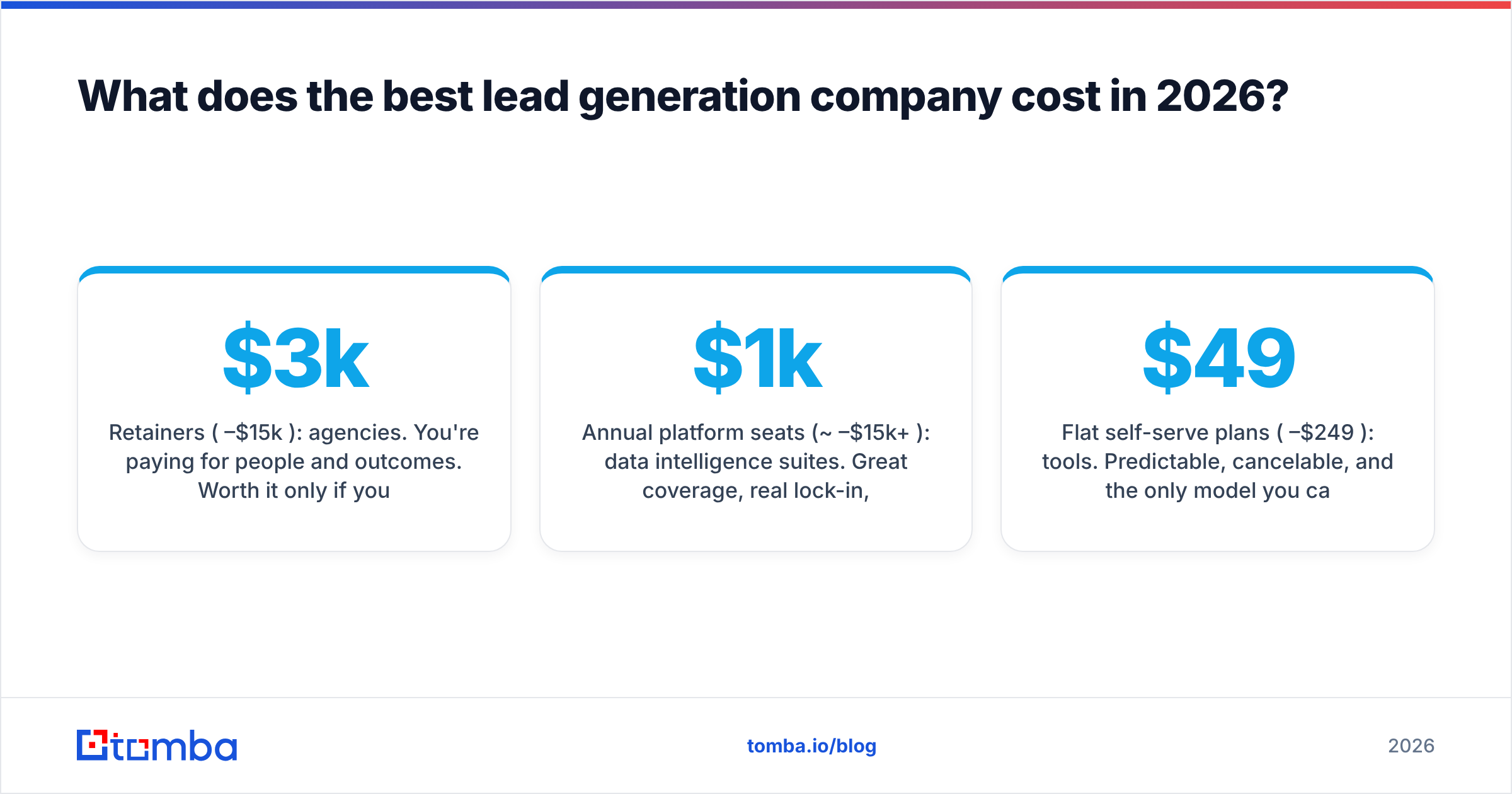
What does the best lead generation company cost in 2026?#
Expect three pricing shapes, and match the shape to your volume.
- Retainers ($3k–$15k/mo): agencies. You're paying for people and outcomes. Worth it only if your ACV and pipeline gap justify it.
- Annual platform seats (~$1k–$15k+/yr): data intelligence suites. Great coverage, real lock-in, opaque negotiation.
- Flat self-serve plans ($49–$249/mo): tools. Predictable, cancelable, and the only model you can fully trial for free. See Tomba pricing for the exact tiers.
The most common 2026 buying pattern is a hybrid: a lean team uses a self-serve email finder for day-to-day prospecting and only layers in an agency for a specific campaign or a platform for enterprise-account intent. That keeps fixed costs low and spend tied to results.
Final verdict: which lead generation company should you pick?#
There is no single best lead generation company — there's the best model for your stage. Pre-team and well-funded: an agency buys you a pipeline you can't yet staff. Mid-market with SDRs: a data platform fuels them. Everyone else, and especially anyone testing whether better data lifts results: start self-serve, prove it cheaply, and scale up only when the numbers demand it.
If your bottleneck is simply reaching the right people with addresses that don't bounce, start where the leverage is highest and the cost is lowest. Try the Tomba Email Finder free — 25 searches a month, no card — and see how many verified contacts you can pull before you ever sign a retainer. When it works, the Tomba API and bulk tools scale with you on the same flat, predictable pricing.
// get started
Find, verify and enrich your first contacts today
Start on the free plan with 25 searches a month, then scale when your team is ready.
Free plan · No credit card required · GDPR & CCPA
Get the Tomba newsletter
Product and data updates
// about the author