The Best Sales Decks in 2026: Examples, Structure & Templates
What separates the best sales decks from the slides buyers forget in five minutes? A look at structure, real examples, and the data that makes a pitch land in 2026.
The best sales decks do not win on design polish. They win because they tell one buyer one story, backed by the right data, in the right order. Below is what actually separates a deck that closes from a deck that gets a polite "thanks, we'll circle back."
TL;DR#
- A great sales deck is a narrative, not a feature list. Lead with the buyer's problem, not your logo wall.
- Structure beats decoration. The highest-converting decks follow a predictable 9–11 slide arc: hook, problem, stakes, solution, proof, pricing, ask.
- Personalization is the multiplier. Decks built around the prospect's own account data outperform generic templates by a wide margin.
- Proof slides do the heavy lifting. Specific numbers, named customers, and before/after metrics carry more weight than adjectives.
- The deck is only as good as the list behind it. You can't personalize a pitch to a contact you can't reach — accurate prospect data is the unglamorous foundation.
What makes a sales deck "the best"?#
The best sales decks share three traits: they are buyer-centric, evidence-led, and tightly sequenced. Everything else — fonts, animations, brand color — is secondary.
Think of a sales deck like a courtroom closing argument. The lawyer who wins doesn't read the entire case file aloud. They pick the three facts that matter, arrange them so each one sets up the next, and land on a single ask. A weak deck dumps every feature on the jury and hopes something sticks. A strong deck builds tension and resolves it.
Here is the slide arc that the best B2B sales decks tend to follow:
- Hook — A provocative stat or question that names the buyer's world, not your product.
- Problem — The specific pain this buyer feels, framed in their language.
- Stakes — What it costs to do nothing (lost revenue, wasted hours, risk).
- Solution — Your product as the bridge from problem to outcome.
- How it works — Three steps max. Clarity over completeness.
- Proof — Customer logos, case-study numbers, third-party validation.
- Differentiation — Why you, not the alternative they're also evaluating.
- Pricing — Transparent, anchored to value, easy to act on.
- The ask — One clear next step.
Notice that "About Us" and the founder photo are not on that list. The best decks earn the right to talk about themselves only after they've proven they understand the buyer.
)
What does the best sales deck structure look like?#
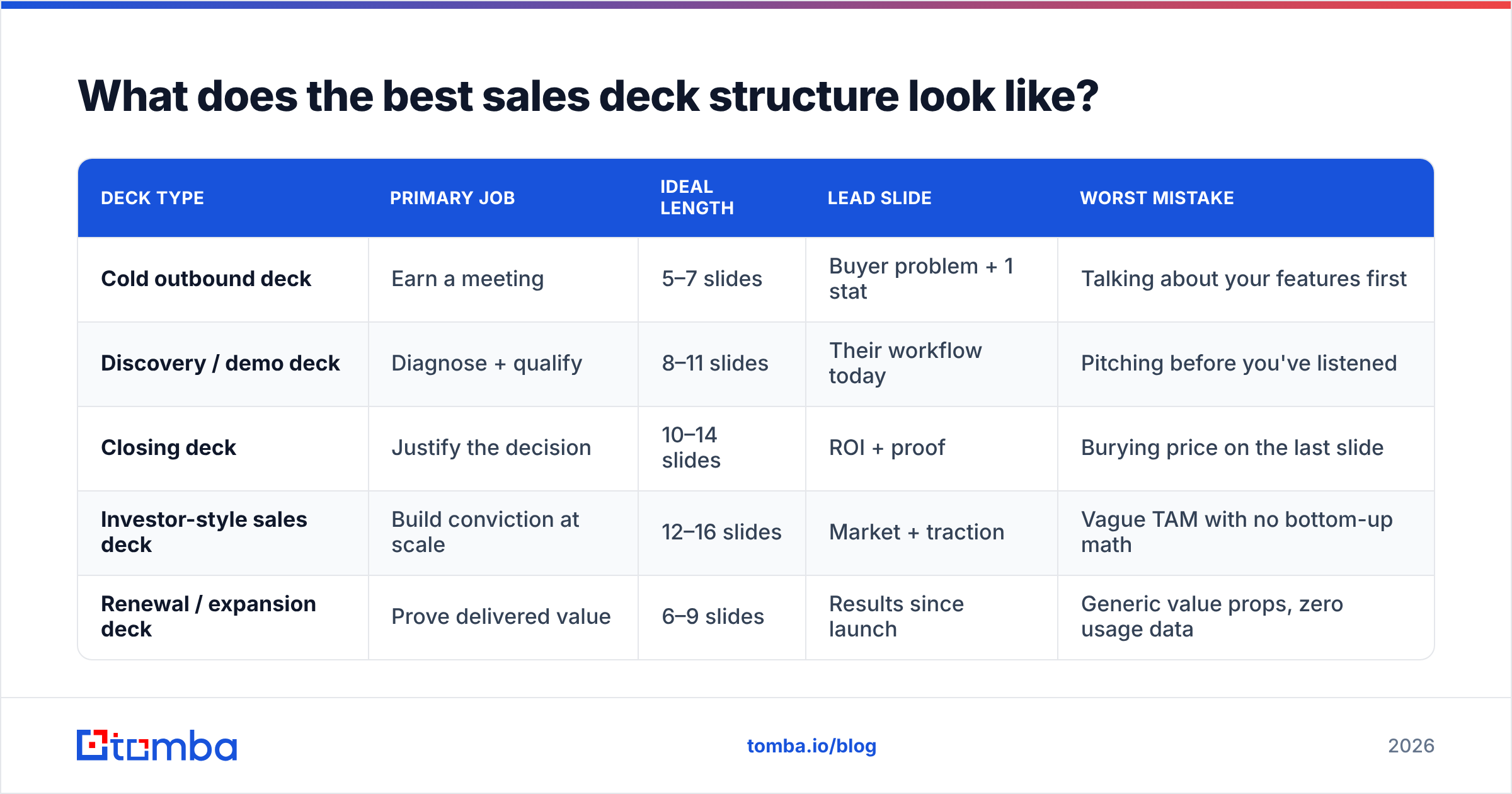
Different deck types exist for different moments in the funnel, and the best structure depends on which job the deck is doing. A cold outbound deck that rides along with an email is not the same artifact as the deck a rep screen-shares on a discovery call.
| Deck type | Primary job | Ideal length | Lead slide | Worst mistake |
|---|---|---|---|---|
| Cold outbound deck | Earn a meeting | 5–7 slides | Buyer problem + 1 stat | Talking about your features first |
| Discovery / demo deck | Diagnose + qualify | 8–11 slides | Their workflow today | Pitching before you've listened |
| Closing deck | Justify the decision | 10–14 slides | ROI + proof | Burying price on the last slide |
| Investor-style sales deck | Build conviction at scale | 12–16 slides | Market + traction | Vague TAM with no bottom-up math |
| Renewal / expansion deck | Prove delivered value | 6–9 slides | Results since launch | Generic value props, zero usage data |
The pattern across every row: the best version of each deck opens on the buyer's reality and saves the self-promotion for after trust is built. According to HubSpot's sales research, reps who frame the conversation around the prospect's goals consistently see higher reply and close rates than those who lead with capabilities.
Why do the best sales decks rely on data, not adjectives?#
Because buyers have heard "industry-leading" a thousand times and it now means nothing.
Compare two versions of the same proof slide:
- Weak: "Our platform dramatically improves sales productivity."
- Strong: "Acme cut prospecting time from 6 hours to 40 minutes per rep per week — a 2.4x increase in dials within 30 days."
The second version is unforgettable because it's specific, attributable, and quantified. The best sales decks are full of slides like that. And every one of those numbers comes from somewhere: real customers, real usage, real outcomes.
This is also where the deck quietly depends on your data infrastructure. To personalize the problem slide for a prospect, you need to know their company size, tech stack, and team structure. To reach the right decision-maker with that deck in the first place, you need a verified contact. A beautiful deck sent to a bounced email closes nothing.
That foundation is exactly why teams pair their pitch with tools like an email finder and proper contact enrichment — so the deck reaches a real human and opens on a slide that reflects their world.
)
What are examples of the best sales decks to learn from?#
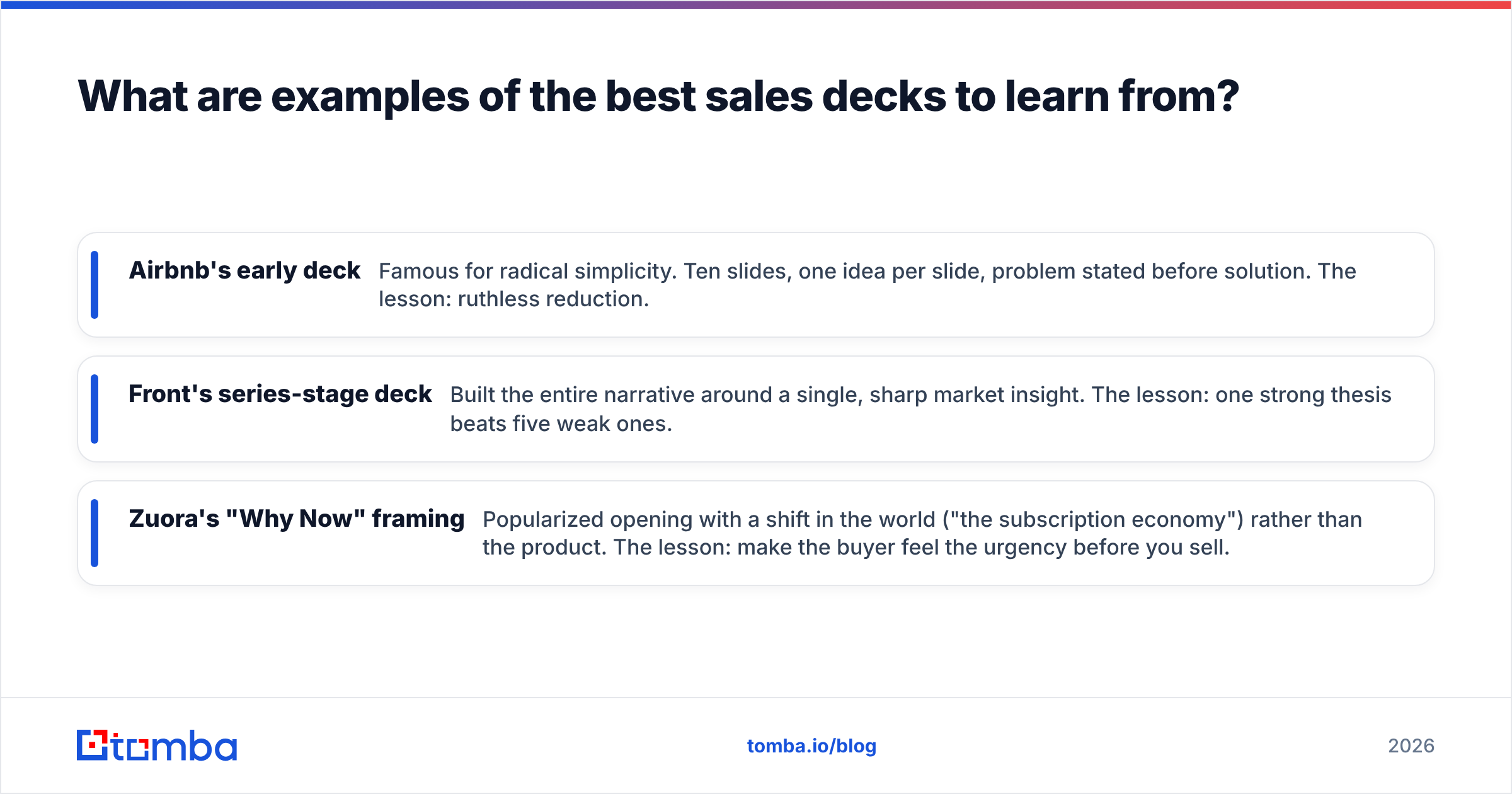
You don't need to copy a famous deck — you need to copy the principles behind it. A few widely studied, publicly referenced examples:
- Airbnb's early deck — Famous for radical simplicity. Ten slides, one idea per slide, problem stated before solution. The lesson: ruthless reduction.
- Front's series-stage deck — Built the entire narrative around a single, sharp market insight. The lesson: one strong thesis beats five weak ones.
- Zuora's "Why Now" framing — Popularized opening with a shift in the world ("the subscription economy") rather than the product. The lesson: make the buyer feel the urgency before you sell.
What unites all three is sequencing. They earn attention, build tension, then resolve it with the product. Tools like Pitch and Gamma have made it easier to design decks that look like these, but design was never the bottleneck — narrative discipline is.
If you want to see how deck-driven demos perform in real revenue settings, conversation-intelligence vendors such as Gong publish ongoing research on which demo and pitch patterns correlate with closed deals. The recurring finding is the same one above: tighter, problem-first, data-backed pitches win.
How do you build the best sales deck for your own team?#
Work backward from the buyer, then forward through the funnel. Here's a practical build order.
Step 1 — Define one buyer per deck. A deck that speaks to "SMBs and enterprises and agencies" speaks to no one. Pick a single segment, even a single persona.
Step 2 — Write the story before you open the slide tool. Draft the nine-beat arc as plain sentences. If it doesn't persuade as text, no animation will save it.
Step 3 — Gather real proof. Pull two or three quantified outcomes from existing customers. Specific beats impressive.
Step 4 — Personalize the open. Insert the prospect's metrics, logo, or workflow into the problem and stakes slides. This is where generic templates lose and tailored decks win.
Step 5 — Make the ask unmissable. One next step, one button, one date. Remove every competing call to action.
Step 6 — Pressure-test the length. If a slide doesn't move the buyer closer to "yes," cut it.
The bottleneck most teams hit at Step 4 is not creativity — it's data. You can't tailor a deck to a prospect you can't identify or reach. That's why high-output sales teams wire their deck workflow to a reliable B2B database and run target accounts through a bulk email finder before personalization even starts. The deck is the last mile; clean contact and account data is the road that gets you there.
Best sales decks: free template vs. custom build#
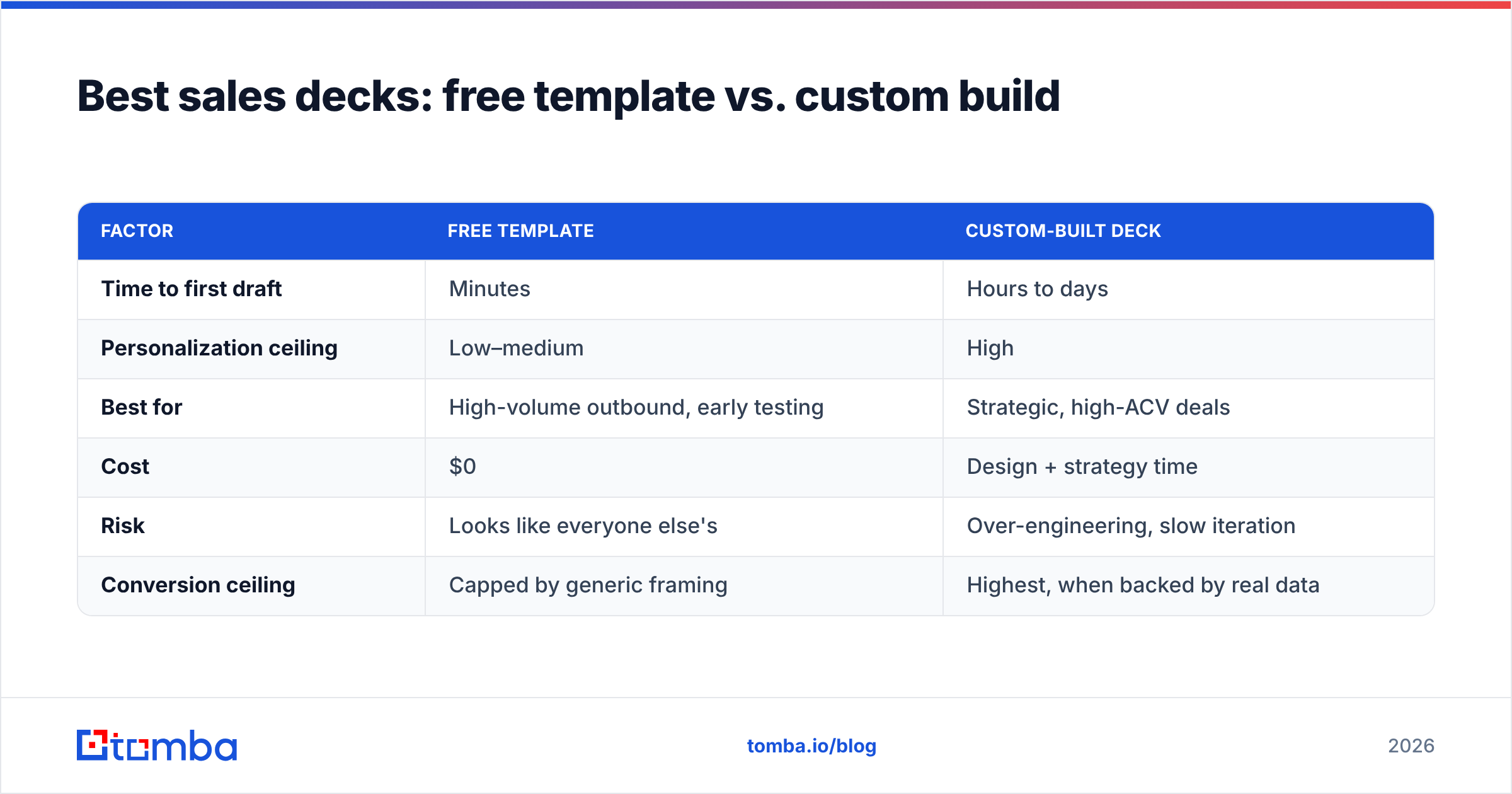
Should you start from a template or build from scratch? It depends on volume and stage.
| Factor | Free template | Custom-built deck |
|---|---|---|
| Time to first draft | Minutes | Hours to days |
| Personalization ceiling | Low–medium | High |
| Best for | High-volume outbound, early testing | Strategic, high-ACV deals |
| Cost | $0 | Design + strategy time |
| Risk | Looks like everyone else's | Over-engineering, slow iteration |
| Conversion ceiling | Capped by generic framing | Highest, when backed by real data |
The smart move for most teams: start from a proven template to lock the structure, then invest custom effort only on the slides that change per buyer — the open, the proof, and the pricing. Reserve hand-crafted decks for your largest, most strategic opportunities where the deal size justifies the hours.
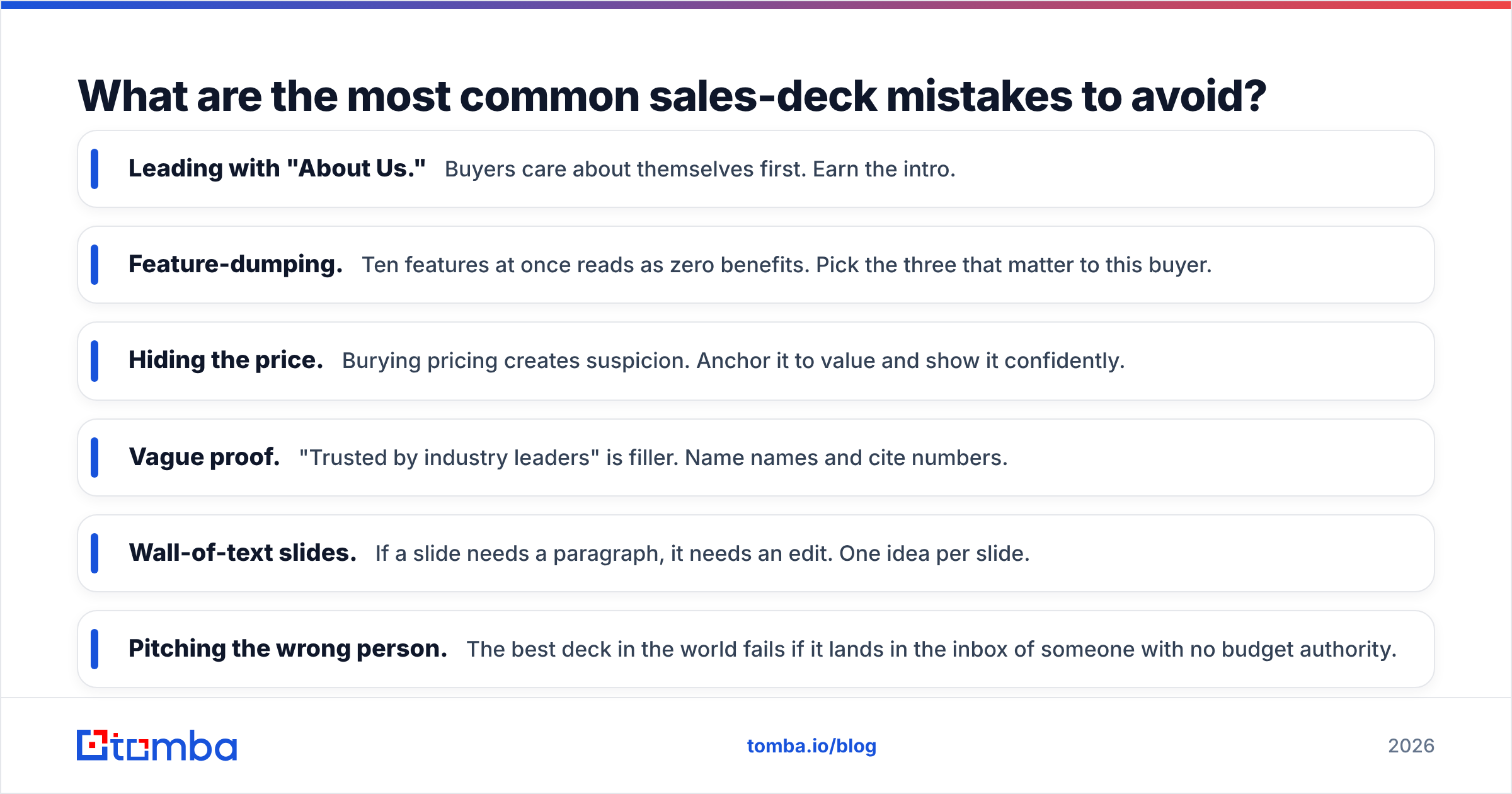
What are the most common sales-deck mistakes to avoid?#
Even strong teams sabotage good decks with avoidable errors:
- Leading with "About Us." Buyers care about themselves first. Earn the intro.
- Feature-dumping. Ten features at once reads as zero benefits. Pick the three that matter to this buyer.
- Hiding the price. Burying pricing creates suspicion. Anchor it to value and show it confidently.
- Vague proof. "Trusted by industry leaders" is filler. Name names and cite numbers.
- Wall-of-text slides. If a slide needs a paragraph, it needs an edit. One idea per slide.
- Pitching the wrong person. The best deck in the world fails if it lands in the inbox of someone with no budget authority.
That last point is worth dwelling on. Reaching the actual decision-maker is a data problem, not a design problem. Verifying that a contact is real and current — with an email verifier — protects your deliverability and ensures your carefully built deck reaches a person who can say yes.
How do you measure whether your sales deck is working?#
Treat your deck like a product and instrument it. Track:
- Meeting-to-deck rate — Are decks getting opened and presented, or dying in inboxes?
- Slide drop-off — In screen-share or sent decks, where do buyers disengage? That slide needs work.
- Deck-to-next-step rate — The truest signal. Does the deck advance the deal?
- Win rate by deck version — A/B your open and your proof slides; keep what converts.
When a deck underperforms, the failure is usually upstream: wrong buyer, wrong open, or weak proof. Fix those before touching the design.
The bottom line on the best sales decks#
The best sales decks in 2026 are not the prettiest — they're the most relevant. They open on the buyer's problem, prove value with hard numbers, and close with one clear ask. Design supports the story; it never replaces it. And underneath every personalized, data-led pitch is a simple requirement: reaching the right person with the right context.
That's where your pipeline actually begins. Before you build the perfect slide, make sure you can find and verify the people who should see it. The Tomba Email Finder helps you locate accurate, verified professional emails by name, company, or domain — so the deck you worked hard on lands in front of a real decision-maker, not a dead address. Start free with 25 searches a month, and check Tomba pricing when you're ready to scale your outreach. The best deck only matters if it gets opened.
// get started
Find, verify and enrich your first contacts today
Start on the free plan with 25 searches a month, then scale when your team is ready.
Free plan · No credit card required · GDPR & CCPA
// about the author