Best Sales Enablement Software in 2026: Top 9 Tools Ranked
A neutral, hands-on breakdown of the best sales enablement software in 2026 — pricing, use cases, and how to pick the platform that actually lifts win rates.
Sales enablement used to mean a shared drive full of slide decks nobody opened. In 2026 it means a connected stack that arms reps with the right content, the right coaching, and — critically — the right contact data at the moment they need it. The market is crowded, the pricing is opaque, and most "best of" lists are thinly disguised affiliate pages. This one is not.
Below is a working buyer's guide to the best sales enablement software this year: what each platform is actually good at, what it costs, and where it falls down.
TL;DR#
Best for enterprise content management: Highspot and Seismic dominate, but you pay for it ($75–$150+ per user/month, annual contracts).
Best for mid-market all-in-one: HubSpot Sales Hub bundles enablement into a CRM you may already own.
Best for rep coaching and readiness: Mindtickle and Gong lead on conversation intelligence and training.
The hidden dependency: No enablement platform fixes bad contact data. Pair your stack with an accurate email finder so reps act on real addresses, not guesses.
How to choose: Match the tool to your biggest leak — content chaos, ramp time, or pipeline accuracy — not to the longest feature list.
What is sales enablement software?#
Think of sales enablement software as the pit crew for your revenue team. The reps are the drivers, but the crew decides which tires (content), which coaching (training), and which telemetry (analytics) reach the car at exactly the right lap. Technically, it's a category of tools that centralizes sales content, automates training and onboarding, surfaces the right collateral inside the CRM, and measures what content and behavior actually move deals forward.
The category overlaps with sales automation and revenue intelligence, which is why buyers get confused. Here is the clean split:
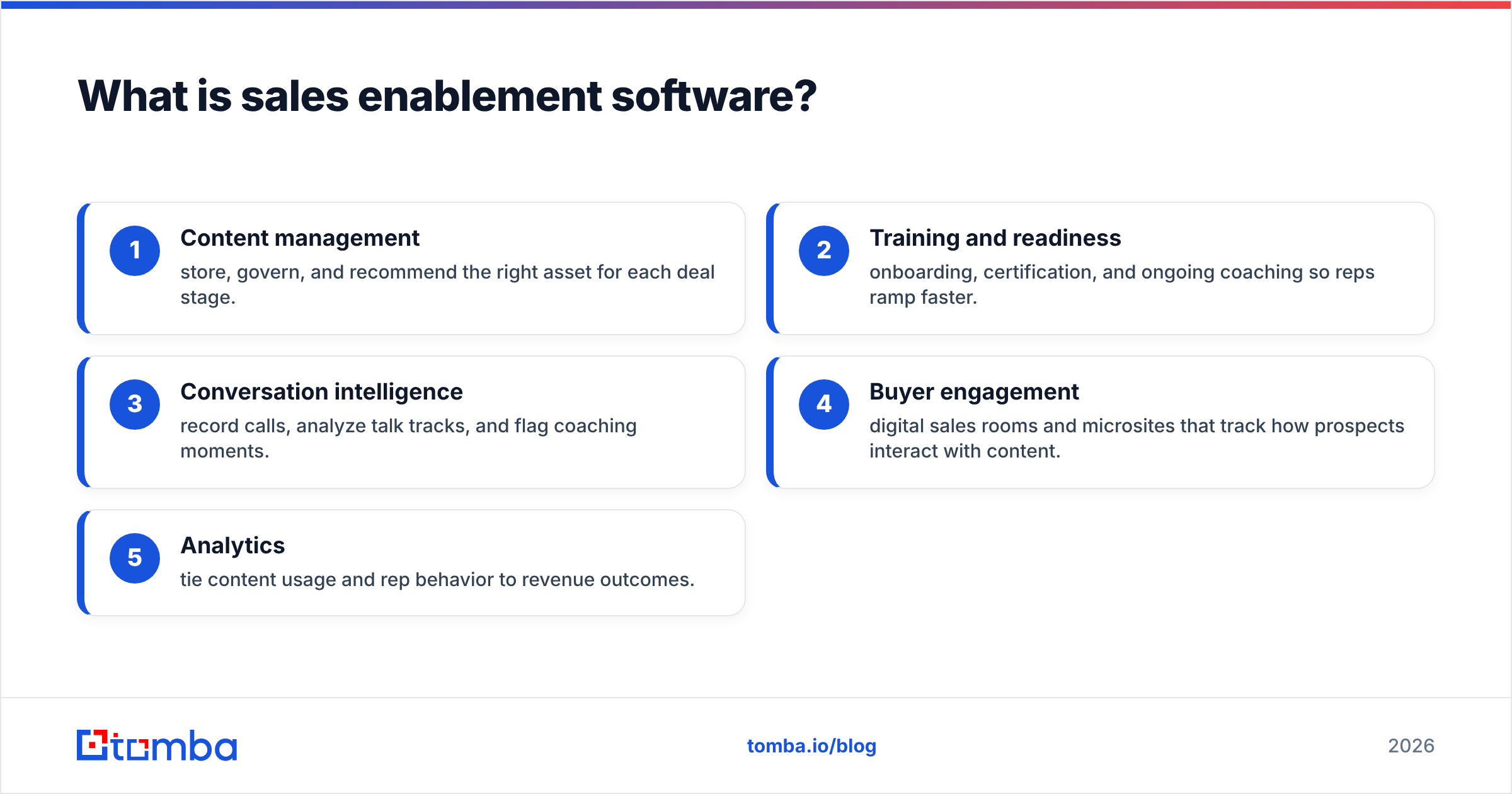
Content management — store, govern, and recommend the right asset for each deal stage.
Training and readiness — onboarding, certification, and ongoing coaching so reps ramp faster.
Conversation intelligence — record calls, analyze talk tracks, and flag coaching moments.
Buyer engagement — digital sales rooms and microsites that track how prospects interact with content.
Analytics — tie content usage and rep behavior to revenue outcomes.
A "best sales enablement software" pick usually nails two or three of these, not all five. Vendors that claim all five tend to be average at each.
Which is the best sales enablement software in 2026?#
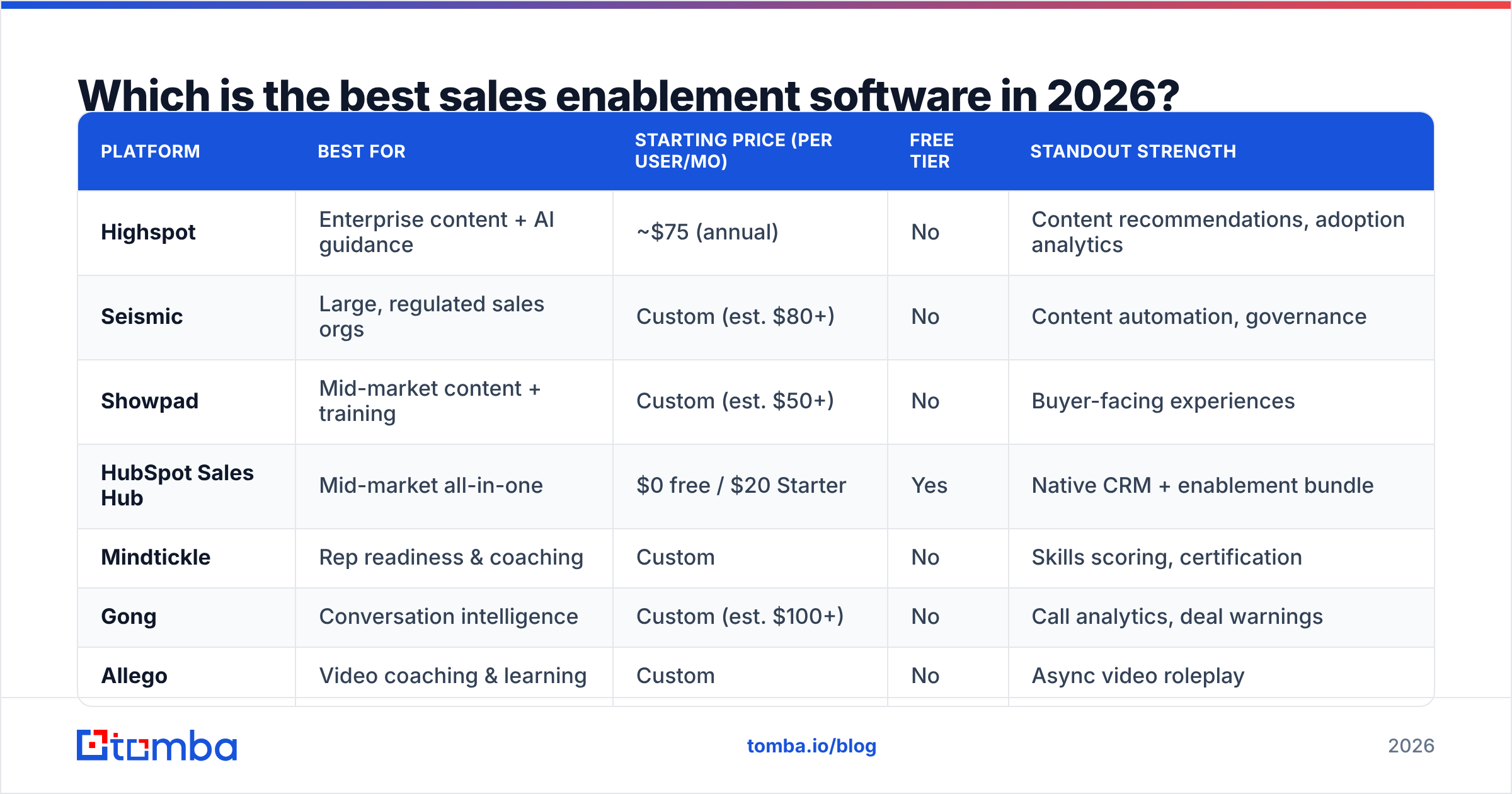
There is no single winner — the right tool depends on your team size and biggest bottleneck. Here is how the leading platforms compare on the attributes that matter to a buyer.
Platform
Best for
Starting price (per user/mo)
Free tier
Standout strength
Highspot
Enterprise content + AI guidance
~$75 (annual)
No
Content recommendations, adoption analytics
Seismic
Large, regulated sales orgs
Custom (est. $80+)
No
Content automation, governance
Showpad
Mid-market content + training
Custom (est. $50+)
No
Buyer-facing experiences
HubSpot Sales Hub
Mid-market all-in-one
$0 free / $20 Starter
Yes
Native CRM + enablement bundle
Mindtickle
Rep readiness & coaching
Custom
No
Skills scoring, certification
Gong
Conversation intelligence
Custom (est. $100+)
No
Call analytics, deal warnings
Allego
Video coaching & learning
Custom
No
Async video roleplay
Guru
Knowledge management
$0 free / ~$15
Yes
In-workflow knowledge cards
In-app guidance & adoption
Custom
No
Governed content library, MCP for AI agents
Prices shift constantly and most enterprise vendors hide them behind a sales call, so treat the figures above as directional. Always validate on G2 and in your own procurement conversation. Gartner's Magic Quadrant for revenue enablement is another sanity check if you have analyst access.
Is Highspot better than Seismic?#
For most enterprise buyers it's a coin flip decided by your content governance needs. Both are mature, expensive, and genuinely capable.
Highspot leans into AI-driven content recommendations and "plays" — guided selling motions that tell a rep exactly what to send at each stage. Adoption analytics are best in class, which matters because enablement tools die when reps ignore them.
Seismic wins on content automation and governance at scale. If you're in financial services, pharma, or anywhere with compliance review on every asset, Seismic's controls are hard to beat.
If your pain is "reps can't find or don't use our content," Highspot's recommendation engine usually shows faster adoption. If your pain is "we have 4,000 assets and legal needs to approve each variant," Seismic's automation pays for itself. Neither is cheap, and both require annual contracts plus an implementation budget.
What about HubSpot and the all-in-one approach?#
If you already run HubSpot as your CRM, its Sales Hub is the most cost-effective enablement on-ramp in 2026. You get document tracking, playbooks, sequences, call recording, and reporting without bolting on a separate platform or paying a second login fee.
The trade-off is depth. HubSpot's content recommendation and coaching analytics are good, not great — you won't get Highspot-grade content guidance or Mindtickle-grade skills scoring. But for teams under ~50 reps, the integration tax of a standalone enablement suite often outweighs the extra features. One system, one source of truth, one bill.
This is also where data quality quietly decides everything. An enablement platform routes content to the contacts already in your CRM. If those records are stale or invented, your best play lands in a spam folder. Plugging a data enrichment layer into HubSpot keeps the underlying records accurate, which is what makes the enablement on top of them worth anything.

How do I choose the best sales enablement software for my team?#
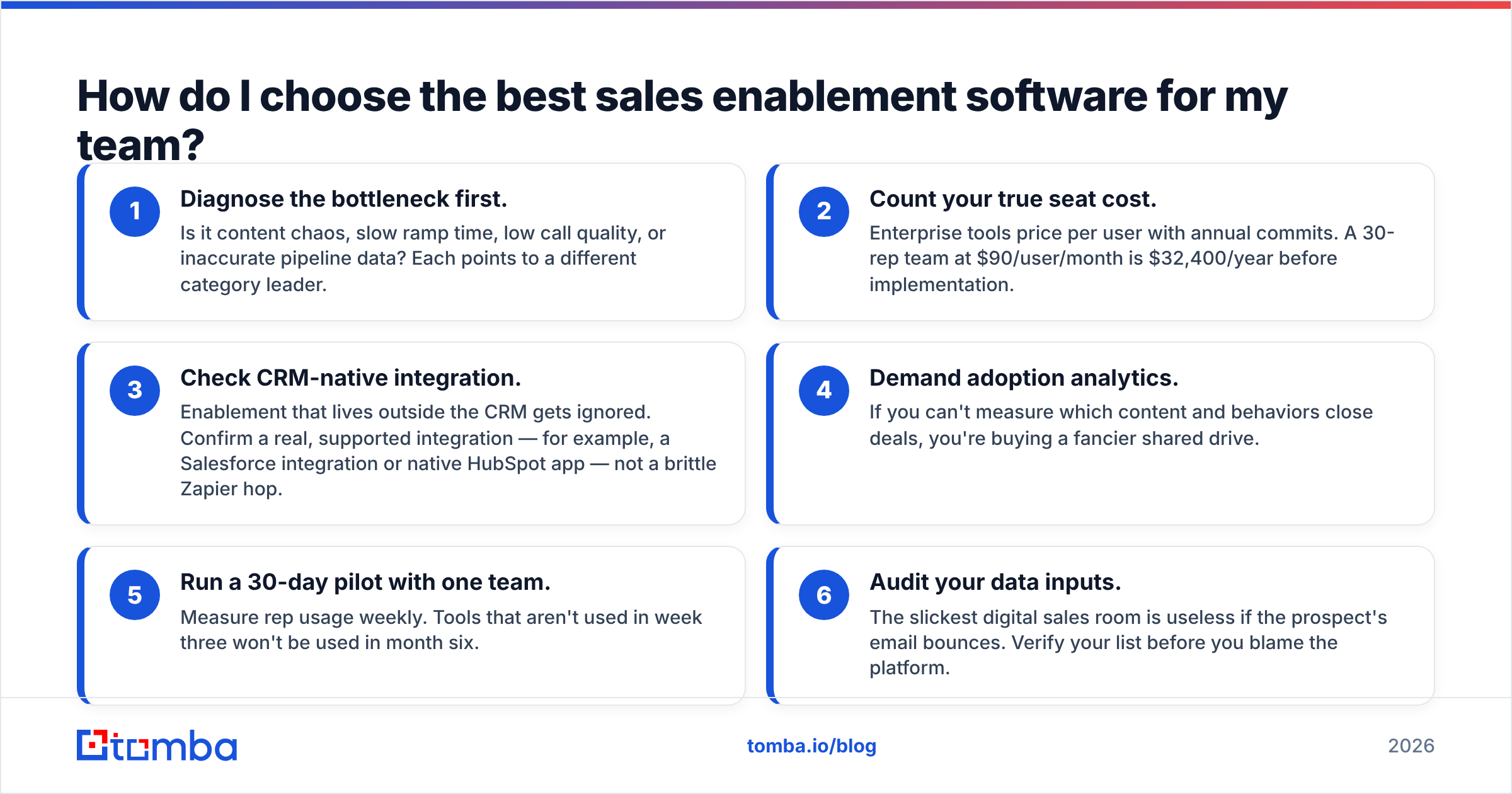
Pick the tool that fixes your single biggest leak — not the one with the most features. Run your decision through this checklist:
Diagnose the bottleneck first. Is it content chaos, slow ramp time, low call quality, or inaccurate pipeline data? Each points to a different category leader.
Count your true seat cost. Enterprise tools price per user with annual commits. A 30-rep team at $90/user/month is $32,400/year before implementation.
Check CRM-native integration. Enablement that lives outside the CRM gets ignored. Confirm a real, supported integration — for example, a Salesforce integration or native HubSpot app — not a brittle Zapier hop.
Demand adoption analytics. If you can't measure which content and behaviors close deals, you're buying a fancier shared drive.
Run a 30-day pilot with one team. Measure rep usage weekly. Tools that aren't used in week three won't be used in month six.
Audit your data inputs. The slickest digital sales room is useless if the prospect's email bounces. Verify your list before you blame the platform.
Sales enablement vs. sales engagement — don't confuse them#
Buyers often shortlist the wrong category. Sales enablement prepares reps (content, training, readiness). Sales engagement executes outreach (sequences, dialers, cadences). Gong and Mindtickle sit closer to enablement and intelligence; tools like Outreach and Salesloft are engagement platforms. Many teams need one of each, and the overlap is exactly why the market feels so noisy.
Does sales enablement software actually improve win rates?#
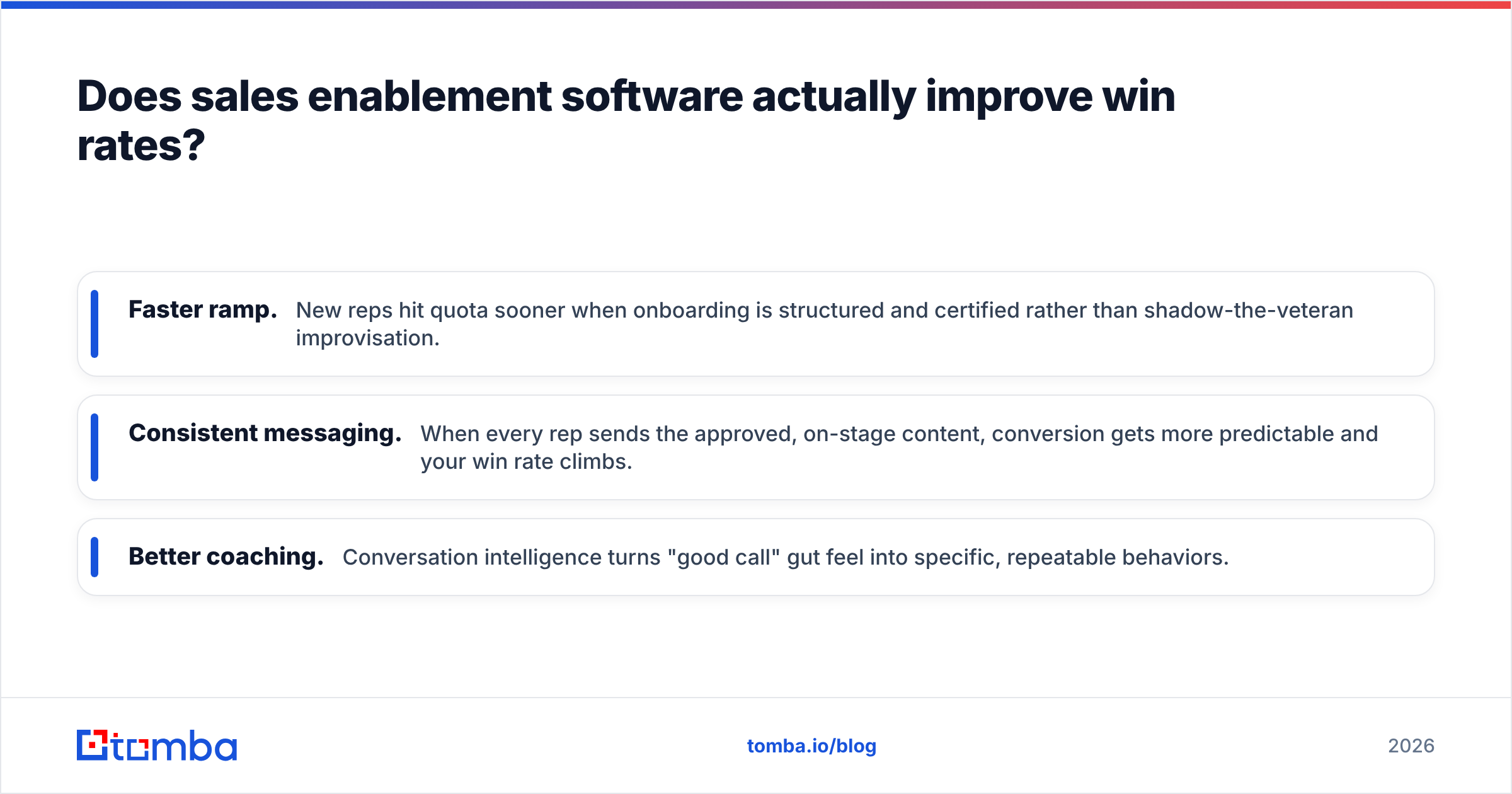
Yes — but only when adoption is real and the underlying data is clean. Vendors love to quote double-digit win-rate lifts, and those numbers are achievable. They are also conditional. The improvement comes from three compounding effects:
Faster ramp. New reps hit quota sooner when onboarding is structured and certified rather than shadow-the-veteran improvisation.
Consistent messaging. When every rep sends the approved, on-stage content, conversion gets more predictable and your win rate climbs.
Better coaching. Conversation intelligence turns "good call" gut feel into specific, repeatable behaviors.
What enablement software does not do is manufacture pipeline or fix a broken contact list. The most polished play in Highspot still needs a real human at a real email address. That's the unglamorous foundation under every enablement ROI story — and the part most "best software" guides skip entirely.
Where does contact data fit in the enablement stack?#
At the very bottom — which is to say, it holds everything else up. Your enablement platform decides what to send and how to coach the send. It assumes you already know who to send it to and that the address is valid.
That assumption breaks constantly. Contacts change jobs, company domains shift, and purchased lists rot at roughly 22–30% per year. When that happens, your beautifully governed content bounces, your sequences hit dead inboxes, and your adoption analytics quietly lie to you because "content sent" never became "content seen."
The fix is to treat contact data as a first-class layer of the stack:
Use a reliable email finder to source verified professional addresses by name and domain.
Enrich existing CRM records so reps work from current titles, companies, and emails.
Verify before you send so your sender reputation — and your enablement metrics — stay honest.
Get that layer right and every dollar you spend on enablement works harder, because the content actually reaches a person who can buy.
Final recommendation#
Match the platform to your bottleneck: Highspot or Seismic for enterprise content governance, HubSpot Sales Hub for mid-market teams that want enablement inside their CRM, and Mindtickle or Gong when rep readiness and call quality are what's holding you back. Then pilot it for 30 days and watch weekly usage before you sign anything annual.
But before you optimize how your reps sell, make sure they're selling to real people. Even the best sales enablement software is only as good as the contact data feeding it. Start with Tomba Email Finder to source and verify accurate, professional emails by domain, name, or company — then let your enablement stack do what it does best on a foundation that won't bounce. The free tier gives you 25 searches a month to test it against your current list; paid plans start at $49/month when you're ready to scale.
// get started
Find, verify and enrich your first contacts today
Start on the free plan with 25 searches a month, then scale when your team is ready.
Free plan · No credit card required · GDPR & CCPA
// about the author