Best Sales Enablement Tools in 2026: The Complete Guide
A neutral, hands-on breakdown of the best sales enablement tools in 2026 — what each category does, where they overlap, and how to build a stack that actually moves win rate.
TL;DR
- "Sales enablement" isn't one product — it's four overlapping categories: content management, training/coaching, conversation intelligence, and the contact data that feeds all three.
- The best sales enablement tools in 2026 win on adoption, not feature count. A platform reps ignore is worth $0 regardless of its G2 rating.
- Highline platforms (Highspot, Seismic, Showpad) are powerful but heavy; point tools (Gong, Mindtickle) go deep on one job; data tools (Tomba) make every other layer accurate.
- Budget realistically: a mid-market team spends $30–$150 per rep per month on enablement software before data costs.
- Start with the bottleneck — bad data, weak coaching, or lost content — instead of buying the biggest suite.
Most teams buy a sales enablement platform the way they buy a gym membership: with optimism, a big annual commitment, and a quiet hope that owning it will change behavior. Then the seats go unused. This guide skips the brochure language and breaks down what the best sales enablement tools actually do in 2026, where they overlap, and how to assemble a stack that reps will open on a Tuesday afternoon when no one is watching.
What are sales enablement tools, exactly?#
Sales enablement tools are the software your revenue team uses to get the right content, training, and customer intelligence in front of the right rep at the right moment in a deal. Think of it like a pit crew for a race car: the driver (your rep) still wins the race, but the crew makes sure the tires, fuel, and data are ready before each lap so no time is lost fumbling.
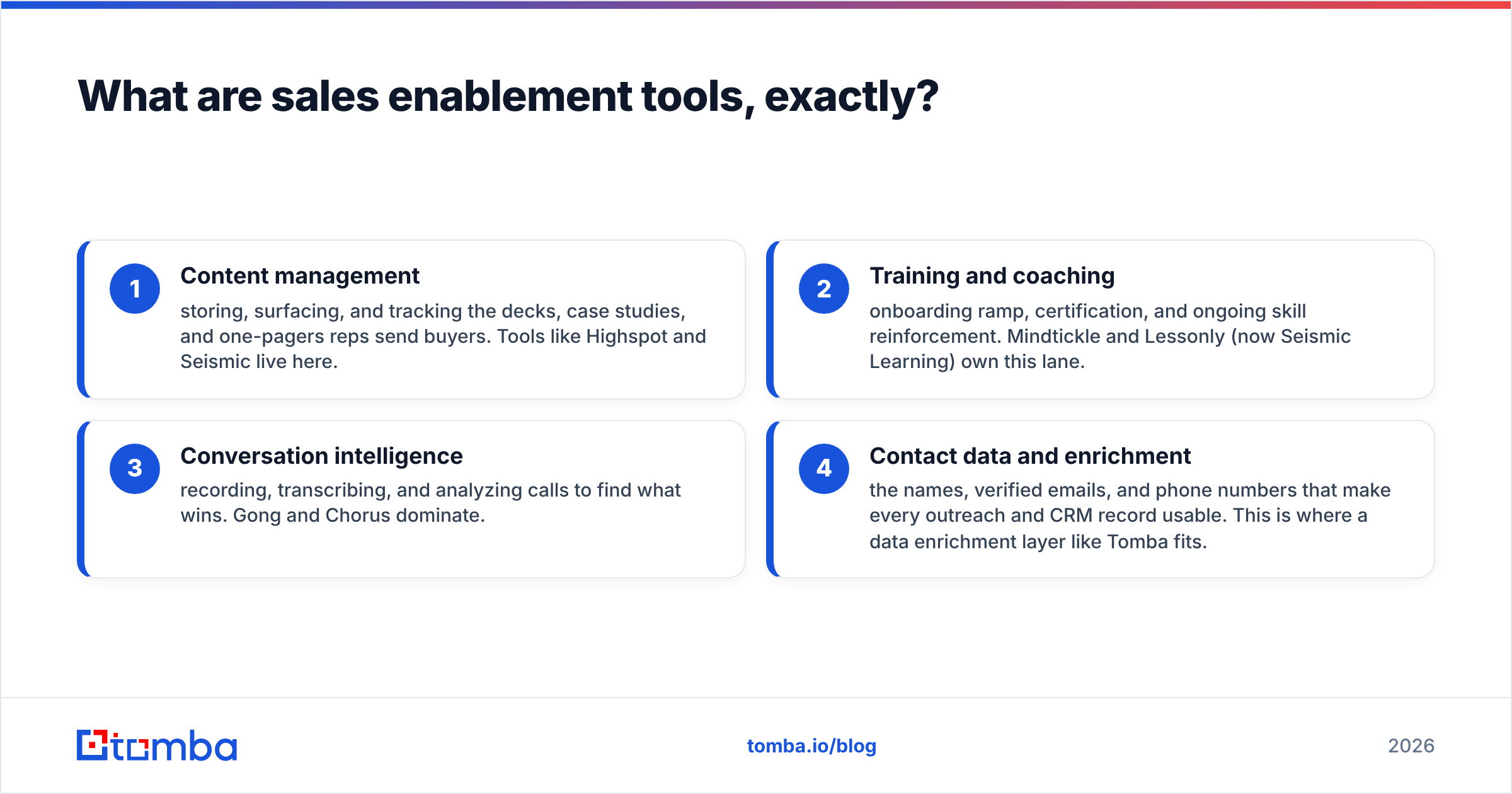
In practice the category splits into four jobs, and almost every "platform" is really strong at one or two of them and adequate at the rest.
- Content management — storing, surfacing, and tracking the decks, case studies, and one-pagers reps send buyers. Tools like Highspot and Seismic live here.
- Training and coaching — onboarding ramp, certification, and ongoing skill reinforcement. Mindtickle and Lessonly (now Seismic Learning) own this lane.
- Conversation intelligence — recording, transcribing, and analyzing calls to find what wins. Gong and Chorus dominate.
- Contact data and enrichment — the names, verified emails, and phone numbers that make every outreach and CRM record usable. This is where a data enrichment layer like Tomba fits.
The mistake teams make is treating these as interchangeable. A conversation-intelligence tool will not fix a CRM full of bounced emails, and the slickest content portal cannot coach a rep who keeps talking over prospects.

What categories of sales enablement tools should you compare?#
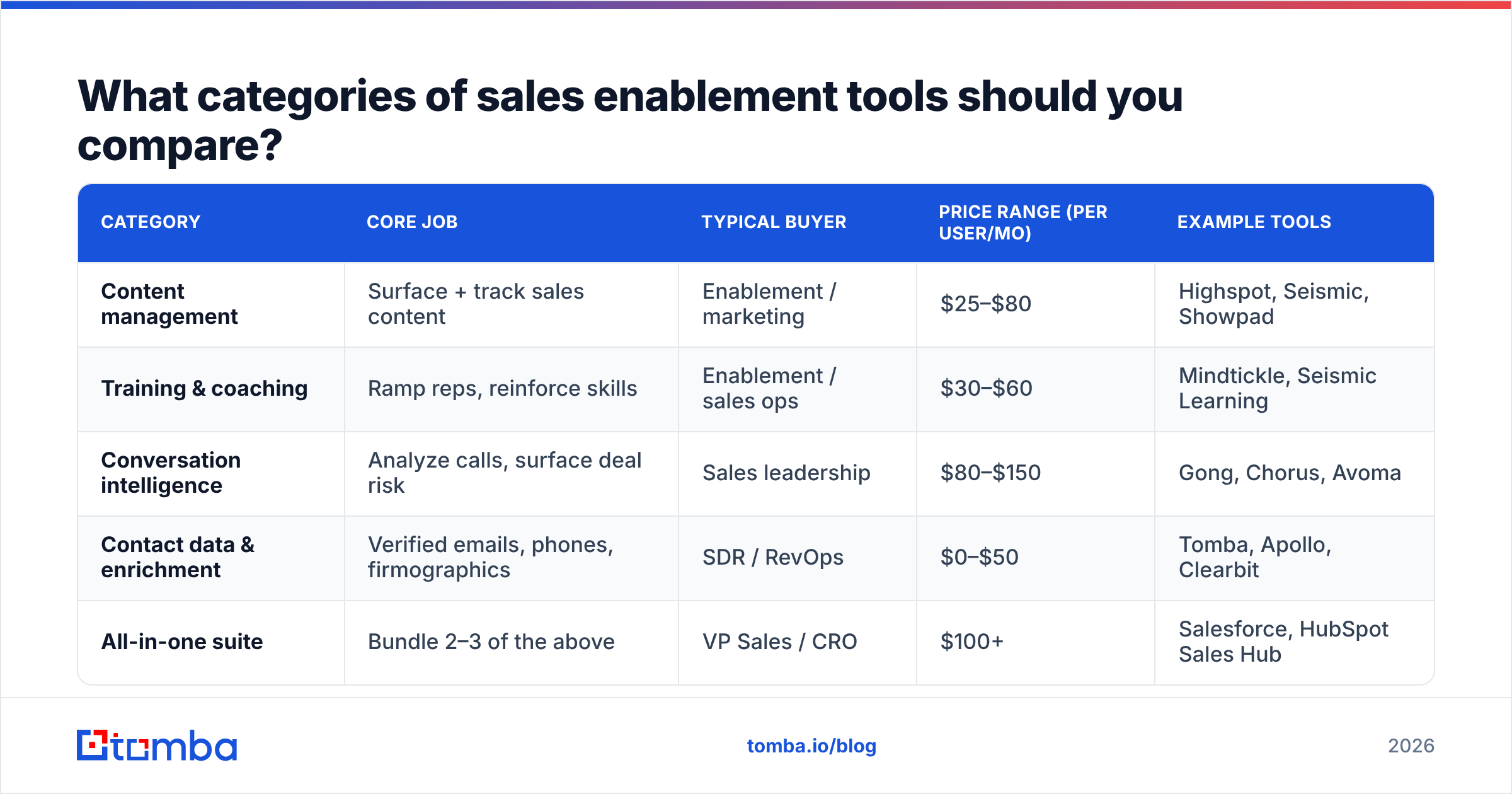
Before you compare individual brands, decide which job you are solving. Here is how the four categories stack up on what they do, who buys them, and roughly what they cost.
| Category | Core job | Typical buyer | Price range (per user/mo) | Example tools |
|---|---|---|---|---|
| Content management | Surface + track sales content | Enablement / marketing | $25–$80 | Highspot, Seismic, Showpad |
| Training & coaching | Ramp reps, reinforce skills | Enablement / sales ops | $30–$60 | Mindtickle, Seismic Learning |
| Conversation intelligence | Analyze calls, surface deal risk | Sales leadership | $80–$150 | Gong, Chorus, Avoma |
| Contact data & enrichment | Verified emails, phones, firmographics | SDR / RevOps | $0–$50 | Tomba, Apollo, Clearbit |
| All-in-one suite | Bundle 2–3 of the above | VP Sales / CRO | $100+ | Salesforce, HubSpot Sales Hub |
A few patterns fall out of this table. Conversation intelligence is the most expensive per seat and the hardest to roll out, because it touches every call. Contact data is the cheapest to start and the highest leverage, because it makes the other three categories accurate — a coaching insight about "follow-ups" means nothing if half the follow-up emails never land.
What are the best sales enablement tools in 2026?#
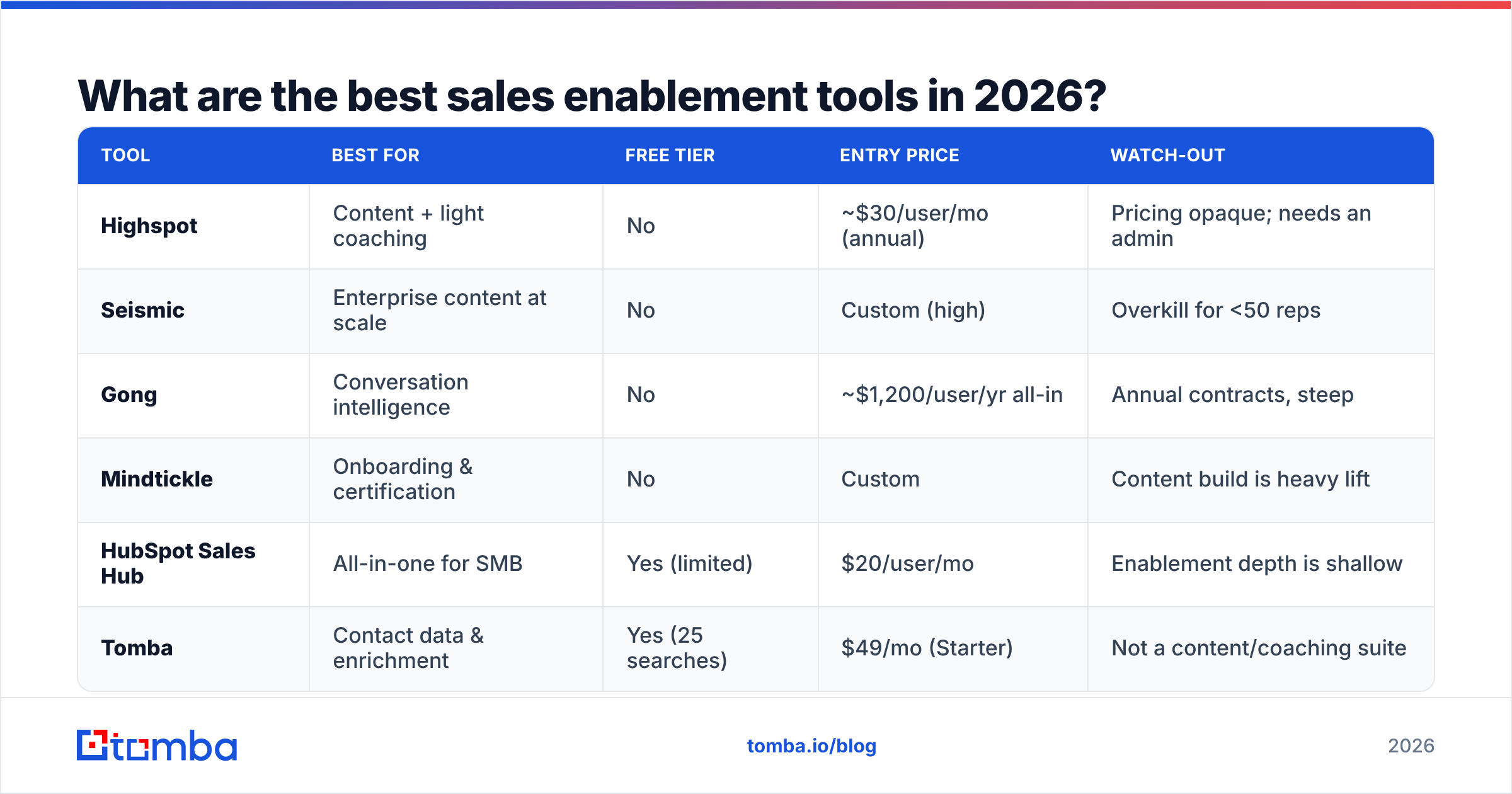
Here is a neutral head-to-head of the platforms teams shortlist most often. No single tool wins every row; the right pick depends on which job from the section above is your bottleneck.
| Tool | Best for | Free tier | Entry price | Watch-out |
|---|---|---|---|---|
| Highspot | Content + light coaching | No | ~$30/user/mo (annual) | Pricing opaque; needs an admin |
| Seismic | Enterprise content at scale | No | Custom (high) | Overkill for <50 reps |
| Gong | Conversation intelligence | No | ~$1,200/user/yr all-in | Annual contracts, steep |
| Mindtickle | Onboarding & certification | No | Custom | Content build is heavy lift |
| HubSpot Sales Hub | All-in-one for SMB | Yes (limited) | $20/user/mo | Enablement depth is shallow |
| Tomba | Contact data & enrichment | Yes (25 searches) | $49/mo (Starter) | Not a content/coaching suite |
A note on reading this table honestly: Tomba is not competing with Gong or Highspot — it sits underneath them. The other tools assume you already have a clean, reachable list of decision-makers. Tomba is how you build and maintain that list. If your reps are coached perfectly but emailing addresses that bounce, you have an expensive coaching tool and a deliverability problem, not an enablement stack.
You can see the full breakdown of Tomba pricing — the Free tier covers 25 searches a month, Starter is $49/mo, Growth is $99/mo, and Pro is $249/mo, which keeps the data layer affordable next to the four-figure-per-seat platforms above.
How do you choose the right sales enablement stack?#
Choose based on your single biggest bottleneck, not on which vendor has the best analyst rating. Run your team through these five questions in order and stop at the first "yes."
- Are reps reaching the wrong or unreachable people? Fix data first. A bad list poisons every downstream metric. Start with an email finder and an email verifier before you spend on anything else.
- Do reps waste time hunting for content? You need content management (Highspot, Seismic, Showpad).
- Do new hires take more than 90 days to ramp? You need training and coaching (Mindtickle, Seismic Learning).
- Do deals stall for reasons leadership can't see? You need conversation intelligence (Gong, Chorus).
- Is the problem "all of the above" and you're enterprise-sized? Only then does an all-in-one suite or multi-tool platform pay off.
This order matters because the categories compound downward. According to Gartner's research on sales enablement, the highest-performing teams treat enablement as a system tied to the buyer's journey, not a pile of tools. And the system breaks at its weakest input — which is almost always data quality, since contact records decay roughly 30% per year as people change jobs.

Why does contact data sit at the bottom of every enablement stack?#
Because every other tool's output is only as good as the contact record it runs on. This is the part vendors skip in their demos.
Consider the chain of events in a normal outbound motion:
- Marketing hands sales a list of target accounts.
- An SDR needs a verified work email and phone for each decision-maker.
- The content tool tracks whether the buyer opened the deck — but only if the email reached them.
- The conversation-intelligence tool logs the call — but only if the phone number connected.
- The CRM reports pipeline — but only if the records aren't duplicates of bounced ghosts.
Break the first link and the whole chain produces garbage analytics. This is why a data layer belongs in any honest list of the best sales enablement tools, even though it is not a "platform" in the Highspot sense. Tools like Tomba's domain search (find every email pattern at a target company), bulk email finder (build whole lists at once), and Tomba API (enrich records automatically inside your CRM) are the plumbing the flashier tools assume already exists.
For teams comparing data vendors specifically, it's worth checking independent reviews on G2 rather than trusting any vendor's own accuracy claims, including ours.
How much should you budget for sales enablement tools?#
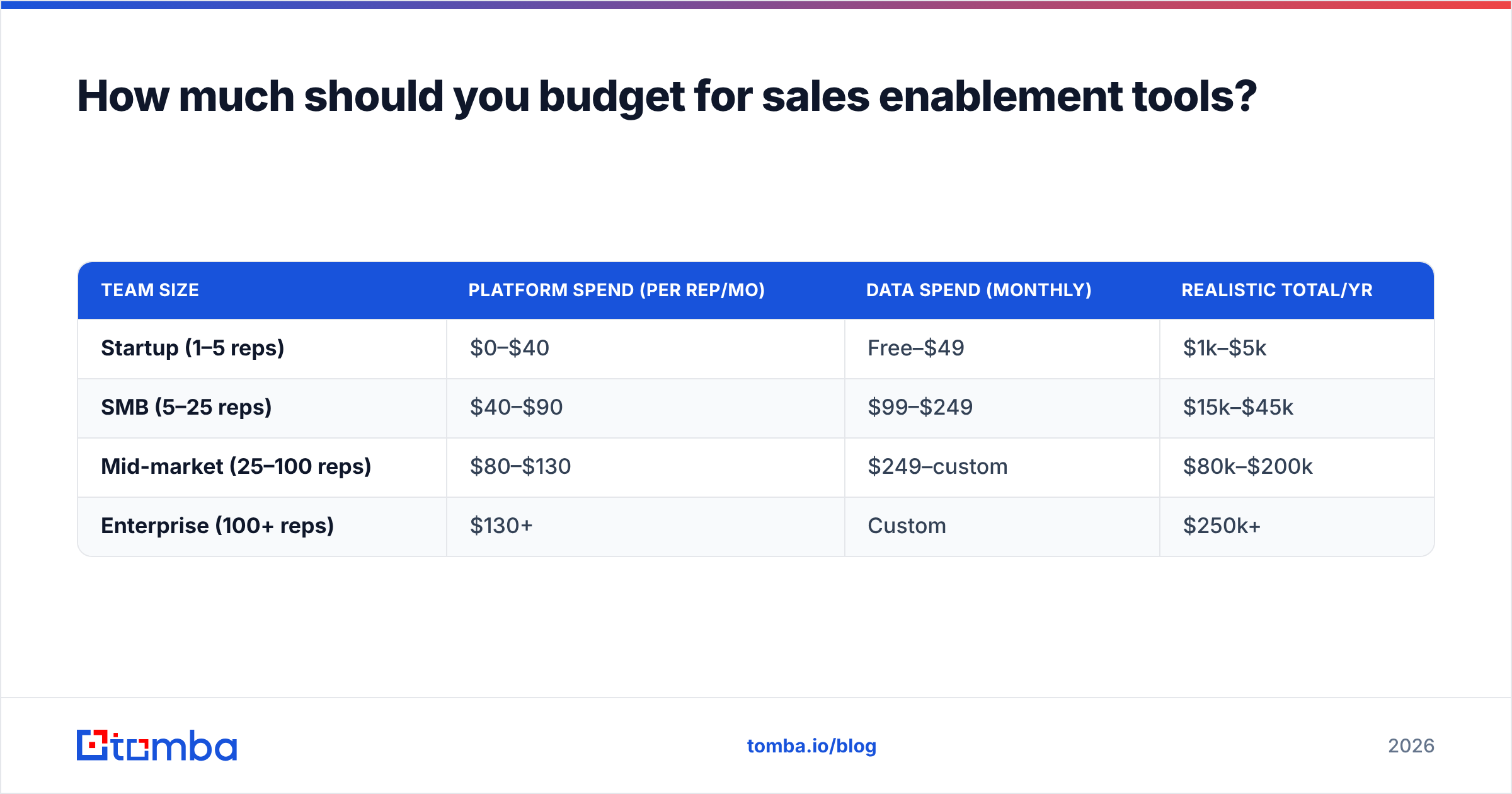
Plan for two separate line items: platform seats and data volume. They scale differently and confusing them wrecks budgets.
| Team size | Platform spend (per rep/mo) | Data spend (monthly) | Realistic total/yr |
|---|---|---|---|
| Startup (1–5 reps) | $0–$40 | Free–$49 | $1k–$5k |
| SMB (5–25 reps) | $40–$90 | $99–$249 | $15k–$45k |
| Mid-market (25–100 reps) | $80–$130 | $249–custom | $80k–$200k |
| Enterprise (100+ reps) | $130+ | Custom | $250k+ |
Two budgeting rules that hold up:
- Platform seats scale with headcount; data scales with activity. Five reps making 200 touches a day need more data volume than 20 reps making 20 touches each. Buy data by usage, not by seat.
- Don't annual-contract a platform reps haven't adopted in a 30-day pilot. The most common waste in enablement is a multi-year Gong or Seismic contract running at 40% seat utilization.
What's the difference between a sales enablement platform and a point tool?#
A platform tries to do several enablement jobs in one login; a point tool does one job extremely well. Neither is automatically better — it depends on your team's maturity.
Platforms (Seismic, Highspot, HubSpot Sales Hub) reduce tool sprawl and give leadership one dashboard. The trade-off is depth: a suite's coaching module rarely matches a dedicated tool, and you pay for modules you don't use. Platforms make sense once you have a dedicated enablement hire to administer them.
Point tools (Gong for calls, Mindtickle for training, Tomba for data) go deeper and integrate with everything else. The trade-off is integration overhead — you're stitching the stack together yourself. Point tools make sense for fast-moving teams that want best-in-class in each lane and have a RevOps person to wire them up.
A useful gut check: if your team is under ~25 reps, a few sharp point tools plus a CRM almost always beats a heavyweight suite. Above that, the admin cost of point tools starts to justify a platform. HubSpot publishes a reasonable primer on this trade-off in its sales enablement guide if you want a second opinion.
What features actually drive adoption?#
Adoption — not capability — is the metric that separates the best sales enablement tools from shelfware. The features that drive it are unglamorous:
- It lives where reps already work. A content tool inside Gmail or the CRM gets used; one behind a separate login does not. Check for native integrations with your CRM, a Chrome extension, and Google Sheets or Excel support.
- It removes a step, not adds one. If a tool makes the rep do extra logging for the benefit of a dashboard, expect quiet sabotage.
- It produces a result the rep feels this week. Data tools win adoption fast because a verified email and a connected call are immediate, personal wins.
- It surfaces, not searches. The best content and intelligence tools push the right asset to the rep; they don't make the rep go hunting.
Run any shortlisted tool against those four criteria during a pilot. A platform that fails three of them will not survive contact with a busy sales floor, no matter how it demos.
Which sales enablement tools should you start with?#
Start with the cheapest, highest-leverage layer and work up. For most teams in 2026 that order is: clean contact data, then conversation intelligence, then content management, then formal training — adding each only when the previous layer is solid.
If your current pain is "we don't have reliable contacts to enable in the first place," fix that before spending five figures on a coaching suite that will coach reps on emails that bounce. Tomba's Email Finder gives you verified, deliverable addresses by name, company, or domain, with a free tier to test against your own list and an email verification layer to keep your CRM clean as it grows. It's the foundation the rest of your enablement stack quietly depends on — wire it in first, then build the flashier layers on top. Start free, confirm the data holds up on accounts you already know, and scale into a paid plan only once the deliverability gain is obvious in your own numbers.
// get started
Find, verify and enrich your first contacts today
Start on the free plan with 25 searches a month, then scale when your team is ready.
Free plan · No credit card required · GDPR & CCPA
// about the author