17 Best Sales Leadership Podcasts to Follow in 2026
A no-fluff guide to the best sales leadership podcasts in 2026 — who they're for, episode length, and how to turn the lessons into pipeline.
(title rendered separately)
Sales leadership is a lonely job. You are squeezed between a number you did not set and a team that needs answers you do not always have. The fastest, cheapest way to borrow judgment from people who have already solved your problem is to put a podcast in your ears on the commute. The hard part is choosing — there are hundreds of shows and most of them are recycled motivation.
This guide cuts through that. Below are the best sales leadership podcasts in 2026, sorted by who they actually help, with a comparison table so you can pick in 30 seconds instead of 30 minutes.
TL;DR#
- Best overall for frontline managers: The Sales Management. Simplified. Podcast — short, tactical, zero fluff.
- Best for VPs and CROs: 30 Minutes to President's Club and Revenue Builders — strategy, comp, and scaling.
- Best for skill-building you can coach to: The Advanced Selling Podcast and Sales Gravy.
- Best for RevOps-minded leaders: Topline and The GTM Podcast.
- A podcast only pays off when the lesson hits your pipeline — pair every episode with clean contact data so your team can act on what you learn.
What makes a sales leadership podcast worth your time?#
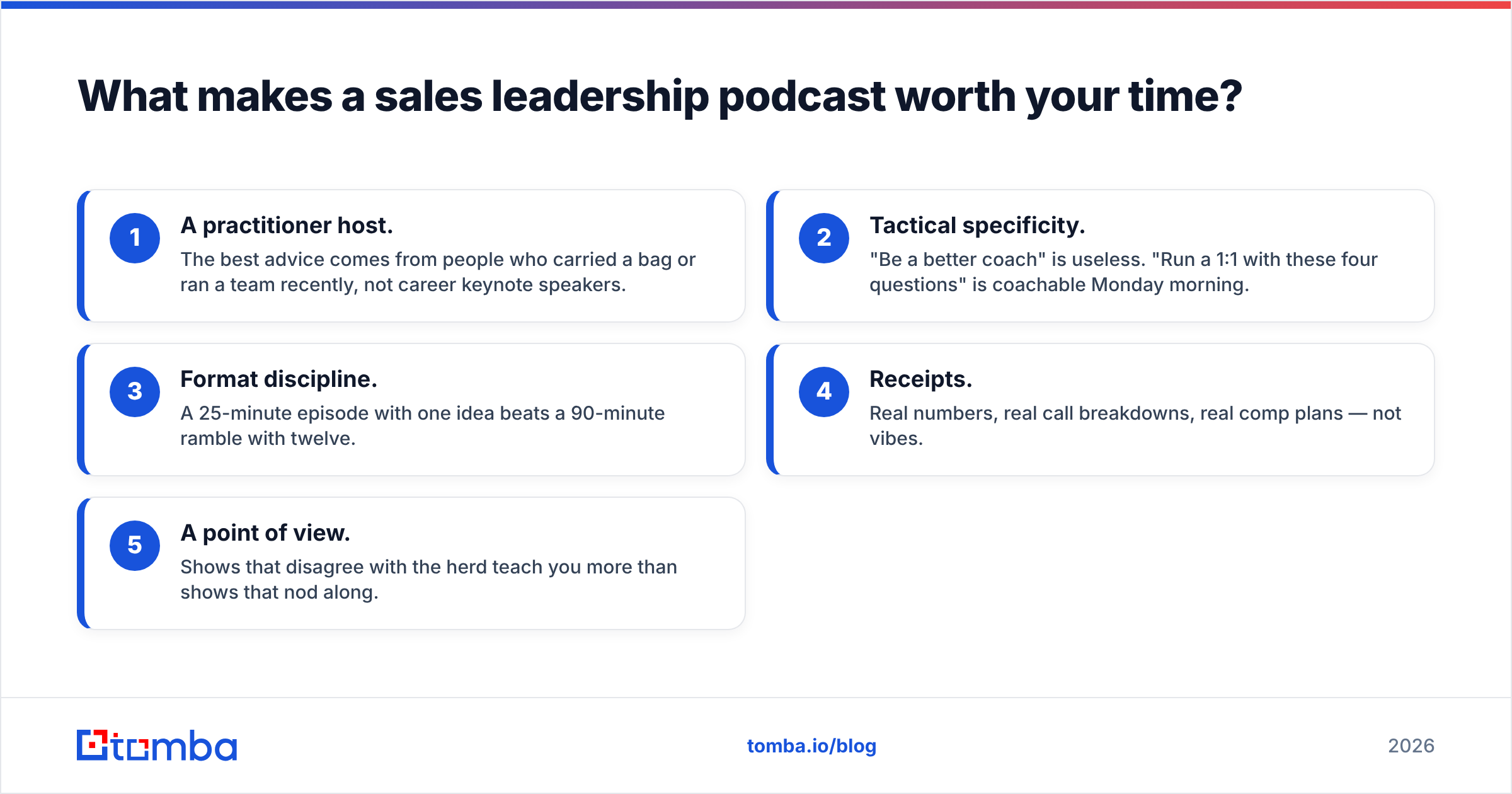
A good show respects three things: your time, your skepticism, and your team. The motivational-quote shows fail all three. The best sales leadership podcasts share a few traits you can screen for.
- A practitioner host. The best advice comes from people who carried a bag or ran a team recently, not career keynote speakers.
- Tactical specificity. "Be a better coach" is useless. "Run a 1:1 with these four questions" is coachable Monday morning.
- Format discipline. A 25-minute episode with one idea beats a 90-minute ramble with twelve.
- Receipts. Real numbers, real call breakdowns, real comp plans — not vibes.
- A point of view. Shows that disagree with the herd teach you more than shows that nod along.
If a podcast hits four of those five, subscribe. If it hits two, skip it — your attention is the scarcest resource you manage.
What are the best sales leadership podcasts in 2026?#
Here is the shortlist, grouped by the job you are trying to do. Every one is free and active as of 2026.
For frontline sales managers#
1. The Sales Management. Simplified. Podcast (Mike Weinberg). The gold standard for new and overwhelmed managers. Episodes are short, blunt, and built around the daily reality of running a team. Weinberg is allergic to fluff, which is exactly why busy managers keep him on repeat.
2. The Advanced Selling Podcast (Bill Caskey & Bryan Neale). One of the longest-running shows in the category. The two hosts coach real reps and managers through real situations, so you get coaching language you can lift straight into your own 1:1s.
3. Sales Gravy (Jeb Blount). Tactical, high-energy, and focused on the fundamentals — prospecting discipline, objection handling, and building a team that does the unglamorous work. Great for managers rebuilding a slumping team's activity.
For VPs, CROs, and second-line leaders#
4. 30 Minutes to President's Club (Nick Cegelski & Armand Farrokh). Arguably the most actionable B2B sales show running. Every episode delivers concrete tactics with timestamps, and the leadership episodes on coaching and forecasting are standouts.
5. Revenue Builders (Force Management). Deep interviews with CROs and founders on scaling revenue orgs, comp design, and the operational mechanics of going from $10M to $100M. Long-form, strategy-heavy, worth the runtime.
6. The GTM Podcast (GTMnow / Scott Barker). Go-to-market leaders dissecting what is actually working in pipeline generation and team structure right now. Strong for leaders who own the whole funnel, not just closing.
For RevOps-minded and data-driven leaders#
7. Topline (Asad Zaman, AJ Bruno, Sam Jacobs). A weekly read on the B2B revenue market — hiring, board pressure, and the macro forces shaping quotas. Less tactical, more "how to think like an executive."
8. The Brutal Truth About Sales & Selling (Brian Burns). Process-obsessed, methodology-driven, and refreshingly contrarian about what actually moves enterprise deals.
The rest of the shortlist — Sell or Die, Make It Happen Mondays, The Sales Hacker Podcast, Outbound Squad, Coffee Is for Closers, The Other Side of Sales, Sales Logic, Selling Made Simple, and B2B Revenue Vitals — round out a strong rotation depending on your niche.
How do the top sales leadership podcasts compare?#
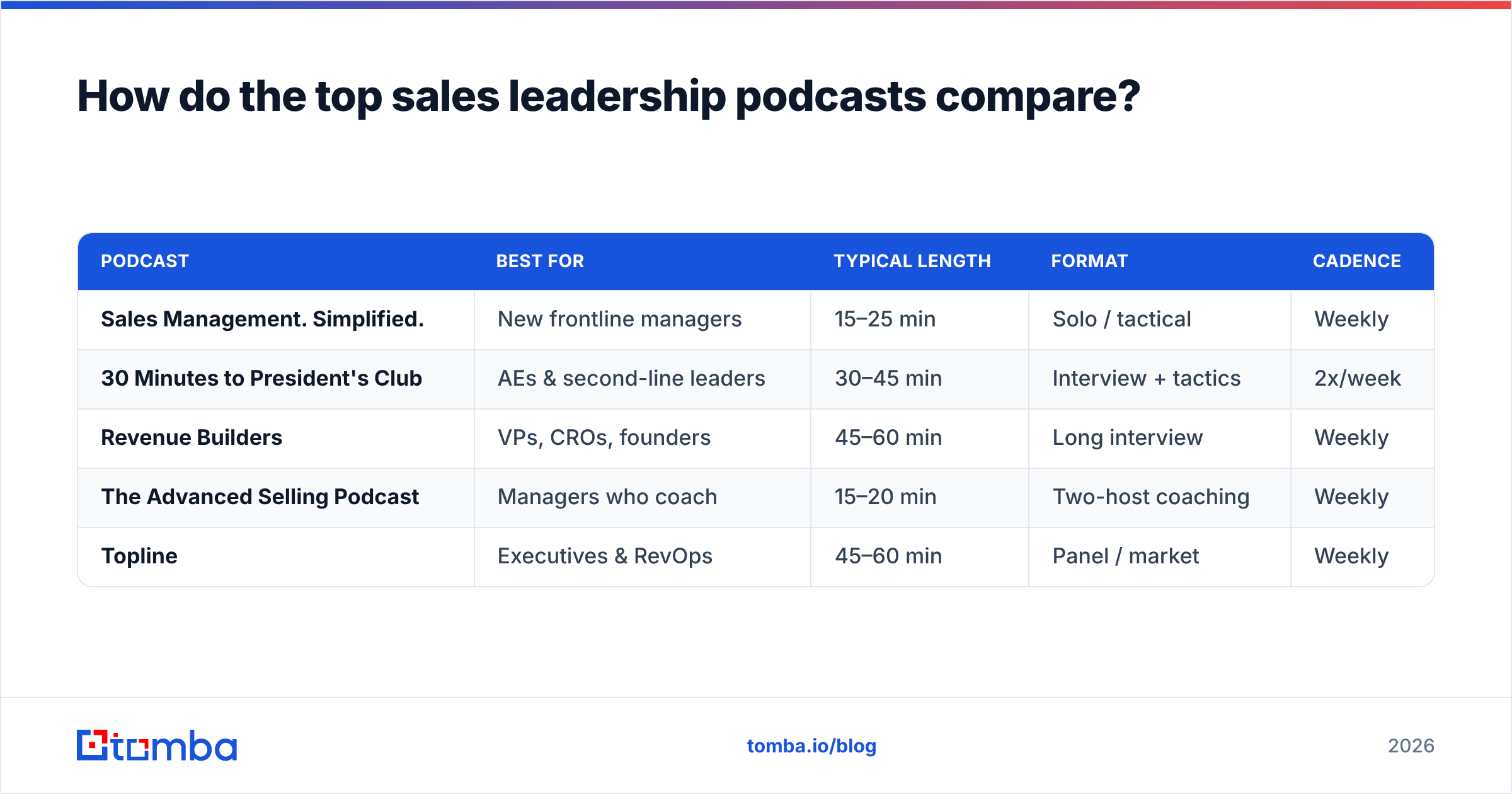
Pick by format and by the seat you sit in. Here is the head-to-head on the five shows most leaders ask about.
| Podcast | Best for | Typical length | Format | Cadence |
|---|---|---|---|---|
| Sales Management. Simplified. | New frontline managers | 15–25 min | Solo / tactical | Weekly |
| 30 Minutes to President's Club | AEs & second-line leaders | 30–45 min | Interview + tactics | 2x/week |
| Revenue Builders | VPs, CROs, founders | 45–60 min | Long interview | Weekly |
| The Advanced Selling Podcast | Managers who coach | 15–20 min | Two-host coaching | Weekly |
| Topline | Executives & RevOps | 45–60 min | Panel / market | Weekly |
A simple way to use this table: keep one short tactical show for daily reps, one long strategic show for the weekend, and rotate the rest. Trying to follow all 17 every week is how you end up following none.
Are sales podcasts actually worth it for a busy leader?#
Yes — but only if you close the loop between listening and doing. A podcast is professional development you can do while doing something else, which makes it one of the highest-ROI habits in sales management. The risk is that it becomes passive entertainment: you nod along, feel productive, and change nothing.
Think of a podcast like a gym membership. Owning the card does nothing. The value shows up only when you act on it. So treat every episode as an input to a decision, not a substitute for one.
Three habits separate leaders who compound from podcasts versus those who just consume them:
- Capture one action per episode. Not five. One. A single tactic you will run this week — a new discovery question, a different forecast cadence, a tweaked comp accelerator.
- Coach it, don't hoard it. If you learned a framework, teach it in your next team meeting within seven days or it evaporates.
- Tie it to a metric. Decide which number the change should move — win rate, reply rate, ramp time — and check it in 30 days.
How do you turn podcast lessons into actual pipeline?#
The best leadership advice in the world dies if your team cannot reach the right people. This is the gap nobody on a podcast mentions: most "leadership" problems are downstream of a data problem. Your reps are not lazy — they are working a list full of bad numbers and dead inboxes.
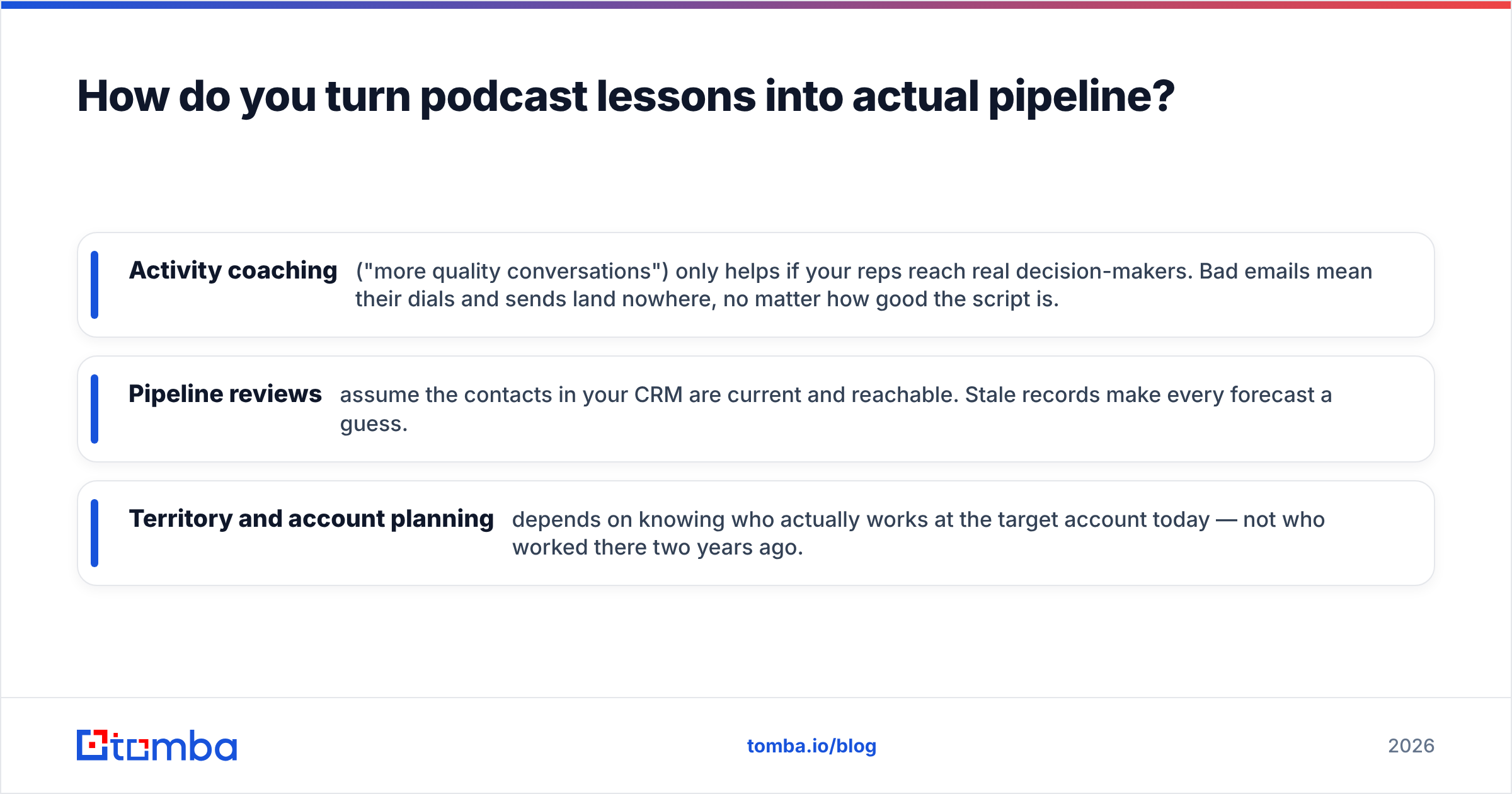
Most leadership tactics you will hear fall into one of three buckets, and each one needs reliable contact data underneath it to work:
- Activity coaching ("more quality conversations") only helps if your reps reach real decision-makers. Bad emails mean their dials and sends land nowhere, no matter how good the script is.
- Pipeline reviews assume the contacts in your CRM are current and reachable. Stale records make every forecast a guess.
- Territory and account planning depends on knowing who actually works at the target account today — not who worked there two years ago.
That is where tooling matters more than another motivational episode. When a podcast teaches you a sharper outbound motion, your team needs to find the right contacts fast to execute it. A verified email finder turns a target account list into reachable humans, a phone finder backs up the email channel for the leaders who still close on the phone, and a clean B2B database keeps territory planning grounded in reality instead of a CRM full of bounced addresses.
The leaders who win in 2026 are not the ones who listen to the most podcasts. They are the ones who turn one good idea per week into a repeatable motion their team can run — on top of data that actually connects.
How should you build a weekly listening routine?#
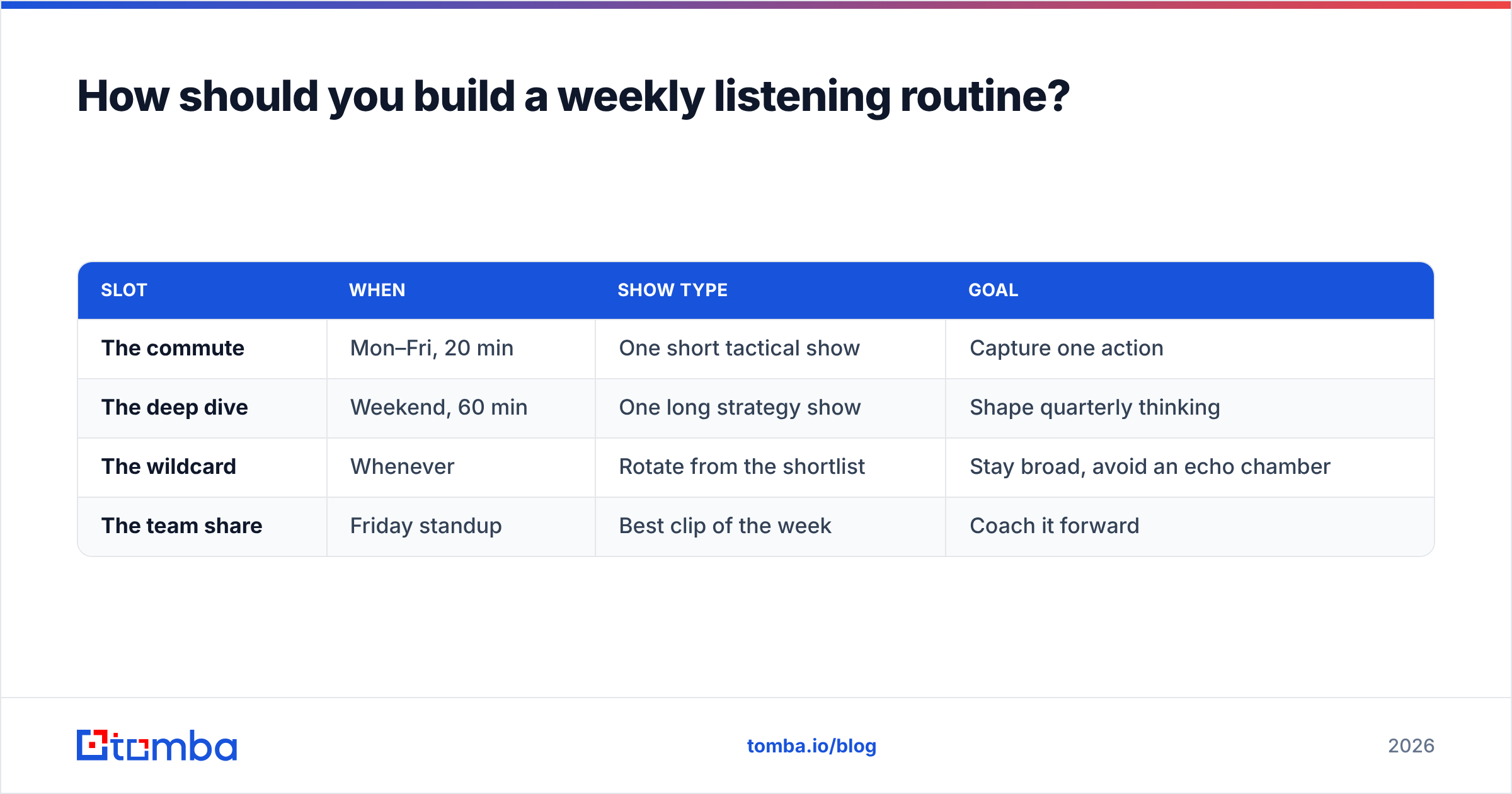
Keep it small and consistent. A bloated subscription list is a to-do list you will quietly abandon. Here is a routine that survives a real calendar.
| Slot | When | Show type | Goal |
|---|---|---|---|
| The commute | Mon–Fri, 20 min | One short tactical show | Capture one action |
| The deep dive | Weekend, 60 min | One long strategy show | Shape quarterly thinking |
| The wildcard | Whenever | Rotate from the shortlist | Stay broad, avoid an echo chamber |
| The team share | Friday standup | Best clip of the week | Coach it forward |
Notice the "team share" slot. The multiplier on a podcast is not what you learn — it is what your whole team learns because you packaged one insight and handed it to them. That single habit turns your personal listening time into org-wide development for free.
Where do podcasts fit in a modern sales stack?#
Podcasts are the cheapest layer of your enablement stack, but they sit on top of everything else. Audio teaches the judgment; your tools execute it. A leader who pairs the right show with the right data and the right process compounds faster than one relying on any single piece.
If you want to go deeper on the data side of that stack, our breakdowns of sales automation and how teams use data enrichment to keep records current are a useful next read. And if you want to benchmark your own tools against the market, third-party review sites like G2 and resources from HubSpot are reliable, vendor-neutral starting points. For the broader history and definition of the medium itself, even Wikipedia's overview of podcasting is a fair primer on why audio learning stuck.
Frequently asked questions#
What is the single best sales leadership podcast for a brand-new manager? The Sales Management. Simplified. Podcast. It is short, tactical, and built specifically for the leap from rep to manager, which is the hardest transition in the profession.
How many sales podcasts should I follow? Two to four. One short daily show, one long weekend show, and one or two wildcards you rotate. More than that and you will retain less, not more.
Are paid courses better than free podcasts? For frameworks and accountability, courses win. For staying current and absorbing judgment passively, podcasts win at a fraction of the cost. Most strong leaders use both.
How do I make podcast advice stick with my team? Capture one action per episode, coach it in your next team meeting within a week, and attach it to a metric you check in 30 days. Consumption without a decision is just entertainment.
The bottom line#
The best sales leadership podcasts in 2026 are the ones you actually act on. Pick a short tactical show, a long strategic show, and one wildcard — then turn one idea per week into a motion your team can run.
But the smartest leadership lesson you will ever hear still needs reachable people on the other end. Before your next outbound push, make sure your team is working live, verified contacts instead of a list of bounces. Start free with the Tomba Email Finder — find the right decision-makers by name, company, or domain — and check Tomba pricing when you are ready to scale it across the team. Plans start at $49/mo, and the free tier lets you test it on your current target list today.
// get started
Find, verify and enrich your first contacts today
Start on the free plan with 25 searches a month, then scale when your team is ready.
Free plan · No credit card required · GDPR & CCPA
// about the author