Best Sales Pitch Decks in 2026: Examples, Structure & Templates
A breakdown of what makes the best sales pitch decks convert in 2026 — real examples, the 10-slide structure, length rules, and how to back every claim with data.

You can have a beautiful deck and still lose the deal. You can also win with eight plain slides. The difference is almost never the template — it's whether the story is built around the buyer and backed by something real. This guide breaks down what the best sales pitch decks of 2026 actually do, with concrete examples, a slide-by-slide structure, and a few rules that keep a deck short enough to survive a busy buyer's attention.
TL;DR#
- The best sales pitch decks lead with the buyer's problem, not your logo or your funding round.
- A 10–12 slide structure (problem → stakes → solution → proof → ask) outperforms the 40-slide "everything deck" almost every time.
- Proof beats adjectives: one verified metric or named customer outweighs five slides of "industry-leading."
- Length matters — aim for 10–15 slides for a first meeting, and cut anything that doesn't move the deal forward.
- A pitch is only as good as the person you're pitching. Reaching the right decision-maker with accurate contact data is half the battle.
What makes the best sales pitch decks work?#
The best sales pitch decks share one trait: they are about the buyer, not the seller. Weak decks open with "Founded in 2014, headquartered in Austin." Strong decks open with a tension the buyer feels on Monday morning — "Your reps spend 11 hours a week building lists by hand."
Three things separate a deck that closes from a deck that gets "let me think about it":
- A sharp problem. If the prospect doesn't nod at slide two, nothing after it lands.
- Stakes. Cost of inaction. What does staying still actually cost in revenue, time, or risk?
- Proof, not promises. Specific numbers, named customers, and screenshots beat superlatives. A higher sales win rate comes from removing doubt, and doubt dies when claims are verifiable.
Everything else — fonts, transitions, gradients — is polish. Polish helps, but it can't rescue a deck with no story.

What are the best sales pitch deck examples in 2026?#
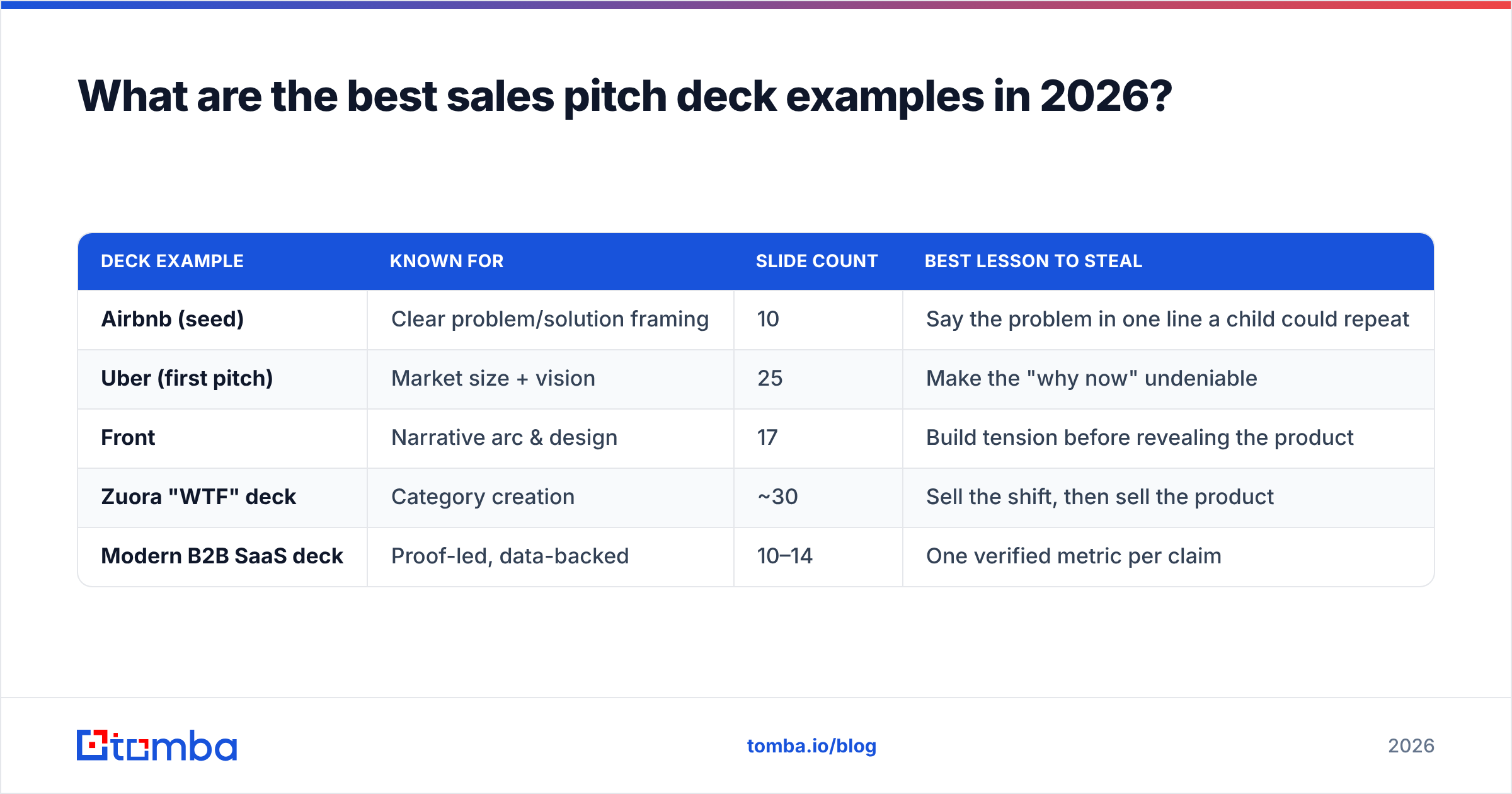
You don't need to reinvent structure. Several public decks have become reference points because they nailed one part of the formula. Here's how a few well-known examples stack up against the qualities that matter in a real sales conversation.
| Deck example | Known for | Slide count | Best lesson to steal |
|---|---|---|---|
| Airbnb (seed) | Clear problem/solution framing | 10 | Say the problem in one line a child could repeat |
| Uber (first pitch) | Market size + vision | 25 | Make the "why now" undeniable |
| Front | Narrative arc & design | 17 | Build tension before revealing the product |
| Zuora "WTF" deck | Category creation | ~30 | Sell the shift, then sell the product |
| Modern B2B SaaS deck | Proof-led, data-backed | 10–14 | One verified metric per claim |
The pattern across all of them: a tight problem, a believable market, and proof that the team can deliver. None of them win because of animation. For a broader teardown of presentation frameworks, HubSpot's sales resources and reviews on G2 are useful sanity checks before you copy any template wholesale.
What is the ideal sales pitch deck structure?#
The best sales pitch decks follow a story arc, not a feature list. Here's the 10-slide spine that works for most B2B first meetings — adjust order to fit your buyer, but keep the logic.
- Hook / problem — Open with the buyer's pain in their words. No company history.
- Stakes — Quantify the cost of doing nothing. This creates urgency without pressure.
- The shift — Why the old way is breaking now (market change, regulation, AI, cost).
- Solution — Your product as the answer to slides 1–3, in one clear sentence.
- How it works — Three steps maximum. Show, don't tell — use a real screenshot.
- Proof — Customer logos, a case study, and one hard number you can defend.
- Differentiation — Why you, not the two alternatives the buyer is already weighing.
- Pricing / packaging — Anchor value before price. Tie the number to the stakes on slide 2.
- Objection pre-empt — Answer the "yeah, but…" before they say it.
- The ask — One clear next step. Not "any questions?" — a specific call to action.
Notice that seven of the ten slides are about the buyer or the proof, and only three are about your product. That ratio is what separates a pitch from a brochure. If you want to operationalize the flow across a team, map each slide to a stage in your sales process so reps know exactly which slide does which job.
How long should a sales pitch deck be?#
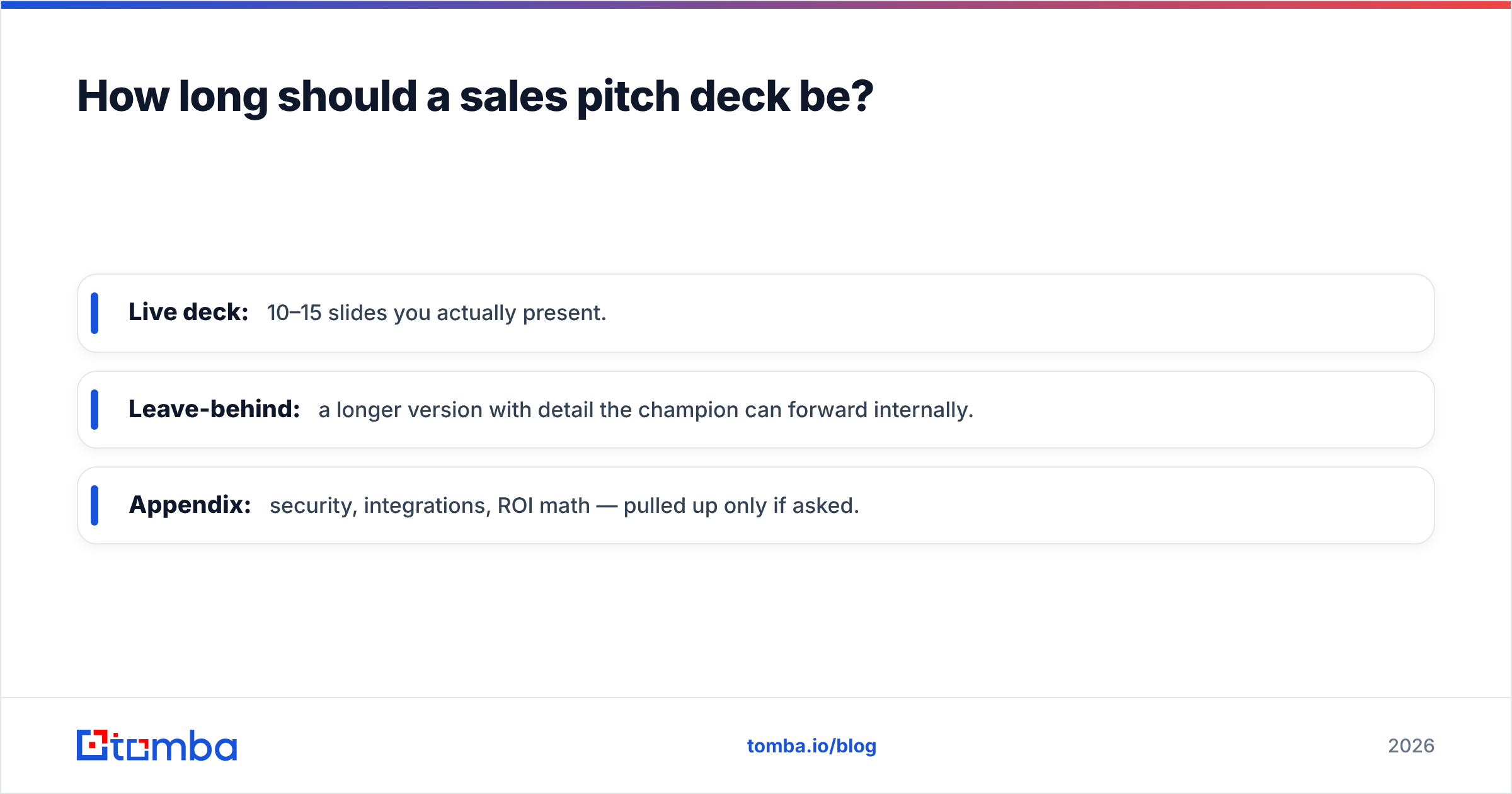
Short answer: 10–15 slides for a first meeting, and never more than you can present in 20 minutes with time left for conversation.
Decks balloon for predictable reasons — a product team adds a feature slide, marketing adds an awards slide, legal adds a disclaimer. By demo day you have 38 slides and a buyer checking email. The fix is brutal editing. For every slide, ask: "If I delete this, does the deal stall?" If the answer is no, it goes in the appendix.
A useful split:
- Live deck: 10–15 slides you actually present.
- Leave-behind: a longer version with detail the champion can forward internally.
- Appendix: security, integrations, ROI math — pulled up only if asked.
This way the buyer who wants depth gets it, and the buyer who wants speed isn't punished. The same principle applies to follow-up email: a tight message with one proof point earns a higher response rate than a wall of text.
How do you build a data-backed pitch deck?#
This is where most decks quietly fail. A claim like "companies save 30%" with no source is wallpaper — the buyer mentally discounts it. The best sales pitch decks attach every important number to something real: a named customer, a third-party study, or the prospect's own data.

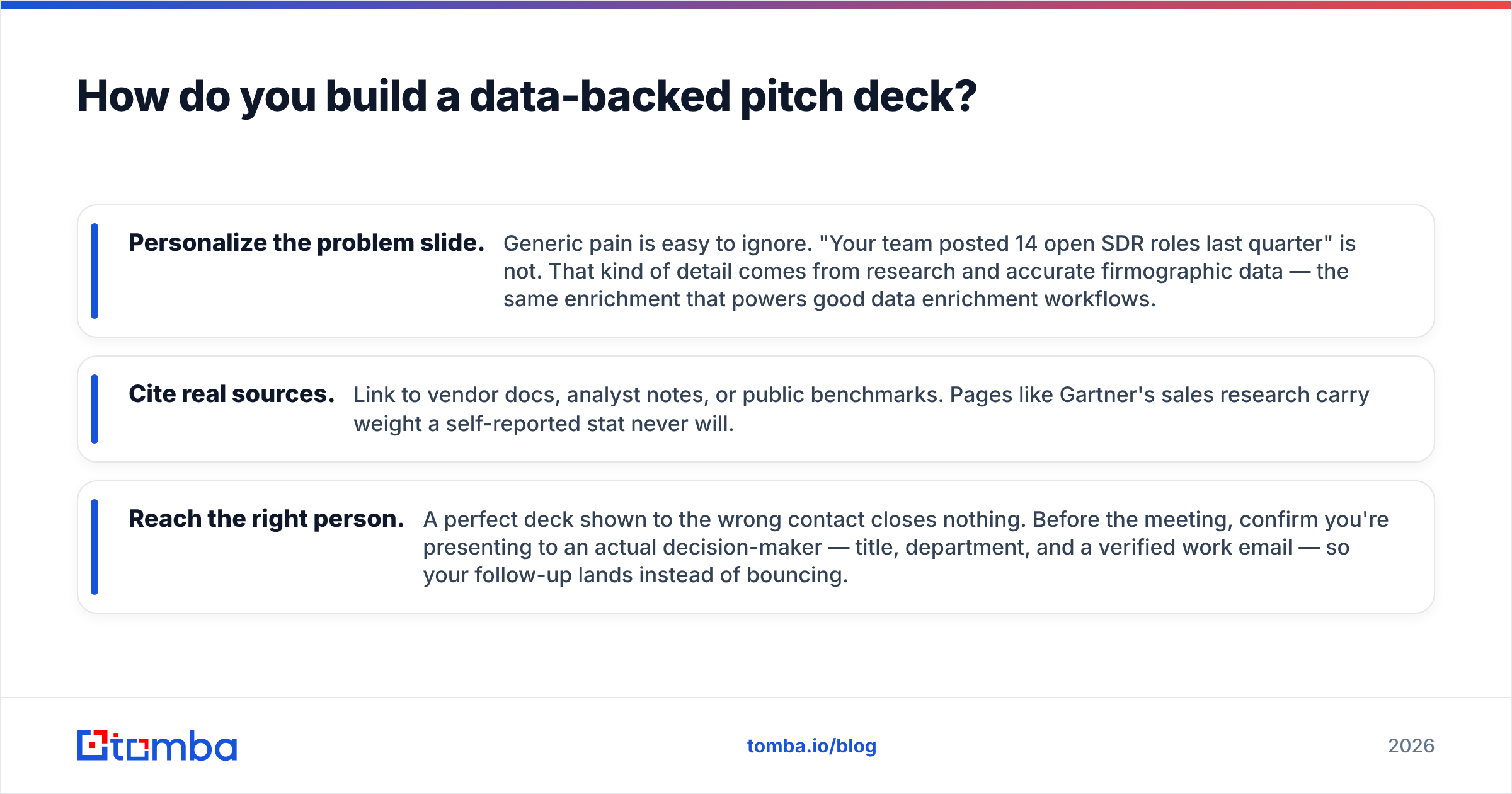
Three ways to make a deck credible instead of decorative:
- Personalize the problem slide. Generic pain is easy to ignore. "Your team posted 14 open SDR roles last quarter" is not. That kind of detail comes from research and accurate firmographic data — the same enrichment that powers good data enrichment workflows.
- Cite real sources. Link to vendor docs, analyst notes, or public benchmarks. Pages like Gartner's sales research carry weight a self-reported stat never will.
- Reach the right person. A perfect deck shown to the wrong contact closes nothing. Before the meeting, confirm you're presenting to an actual decision-maker — title, department, and a verified work email — so your follow-up lands instead of bouncing.
That last point is the unglamorous half of pitching. Teams obsess over slide design and ignore the fact that 20–30% of B2B contact data goes stale every year. If your champion's email bounces after the meeting, the deck dies in an inbox that no longer exists. This is why pairing a strong deck with a reliable email finder and verification step quietly raises close rates more than another design pass ever will.
What are the most common pitch deck mistakes?#
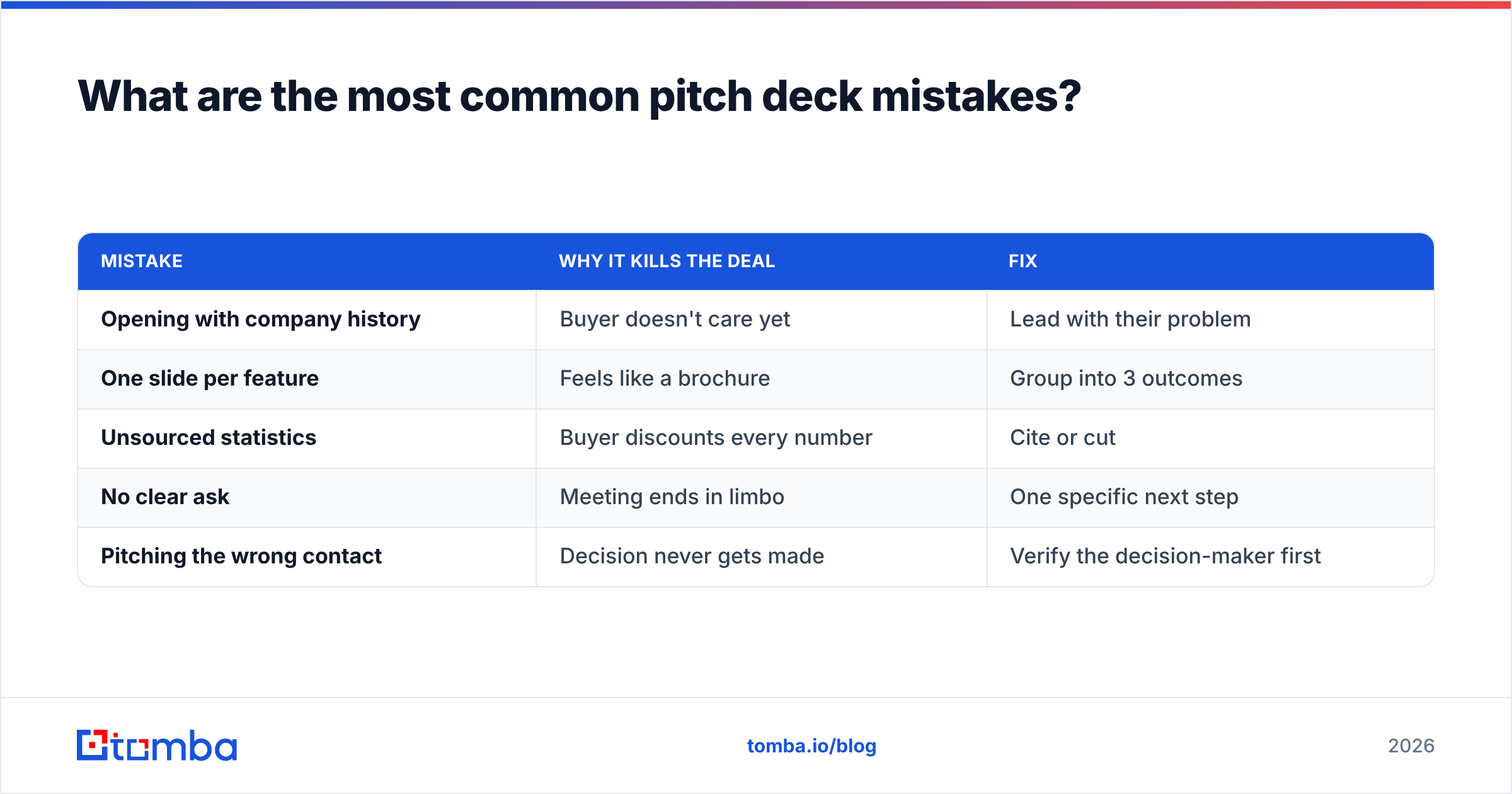
Even experienced reps repeat the same errors. Watch for these:
| Mistake | Why it kills the deal | Fix |
|---|---|---|
| Opening with company history | Buyer doesn't care yet | Lead with their problem |
| One slide per feature | Feels like a brochure | Group into 3 outcomes |
| Unsourced statistics | Buyer discounts every number | Cite or cut |
| No clear ask | Meeting ends in limbo | One specific next step |
| Pitching the wrong contact | Decision never gets made | Verify the decision-maker first |
The thread connecting these is discipline. A pitch deck is a tool for a conversation, not a document to be read aloud. The moment you're reading slides instead of talking to a person, you've lost the room.
How do you tailor a deck for different buyers?#
One deck rarely fits every account. The best teams keep a master deck and swap three things per prospect:
- The problem slide — reflect the buyer's industry and their specific trigger event.
- The proof slide — show a customer from the same segment or size band.
- The pricing slide — anchor to the buyer's scale, not a generic list price.
Doing this at volume requires knowing who you're selling to before you build. Pulling accurate company and contact details — headcount, tech stack, the right buyer's email — turns a generic template into a deck that feels handmade. That research layer, not the slide design, is what makes personalization scale. Tools that combine domain search with enrichment let one rep prep ten tailored decks in the time it used to take to prep one.
The bottom line#
The best sales pitch decks in 2026 win on story and proof, not on slide count or animation. Keep it to 10–15 slides, lead with the buyer's problem, back every claim with something verifiable, and end with a single clear ask. Then make sure the deck actually reaches a real decision-maker — because the most persuasive presentation in the world is worthless if the follow-up email bounces.
Want your tailored decks to land in front of the right buyer every time? Use the Tomba Email Finder to find and verify decision-maker emails by name, company, or domain — so the deal you pitched on Tuesday gets a reply on Wednesday. Start free with 25 searches a month, and check Tomba pricing when you're ready to scale your outreach.
// get started
Find, verify and enrich your first contacts today
Start on the free plan with 25 searches a month, then scale when your team is ready.
Free plan · No credit card required · GDPR & CCPA
// about the author