The Best Sales Presentation Ever: A 2026 Playbook & Examples
What separates a forgettable pitch from the best sales presentation ever? A repeatable structure, real buyer data, and a story your prospect can't ignore. Here's the 2026 playbook.
The Best Sales Presentation Ever: A 2026 Playbook & Examples
You have seen the slide-by-slide horror show: 47 slides, a logo wall nobody reads, and a "comprehensive feature overview" that puts the buyer to sleep before the price reveal. Then, once a quarter, you watch a rep deliver a pitch so tight the prospect signs before the demo is over. That second one is not luck. It is structure.
This guide breaks down what actually makes the best sales presentation ever — not as an abstract idea, but as a repeatable framework you can copy this week.
TL;DR#
- The best sales presentation ever is not about you, your logo wall, or your feature list. It is a story about the buyer's problem with your solution as the turning point.
- A winning structure is roughly 5 acts: hook, problem, stakes, solution, proof. Discovery comes first, slides come second.
- Data beats adjectives. Specific, accurate numbers about the prospect's own world out-persuade every superlative in your deck.
- Personalization is the multiplier — and personalization at scale requires accurate contact and company data, which is where tools like the Tomba Email Finder and data enrichment earn their keep.
- Measure presentations like you measure email: track a response rate equivalent — advance rate to next step — and iterate.
What makes a sales presentation actually "the best"?#
The best sales presentation ever is the one that gets the deal moving, full stop. Not the prettiest deck, not the one with the slickest animations. A pitch wins when the buyer leaves thinking "this team understands my problem better than I do."
Three things consistently separate top-decile pitches from the median:
- It is about the buyer, not the seller. Weak decks open with company history and a funding announcement. Strong decks open with a tension the buyer feels every day.
- It earns the right to talk product. You do not get to demo features until you have proven you understand the problem. Discovery is the price of admission.
- It is specific. "We help companies grow faster" is noise. "Teams like yours waste 9 hours a week on manual list-building" is signal.
According to Gong's analysis of sales calls, the top performers talk less and listen more — a 43/57 talk-to-listen ratio in winning demos versus near-even splits in losing ones. The best presentation is partly a conversation, not a monologue.
What is the structure of the best sales presentation ever?#
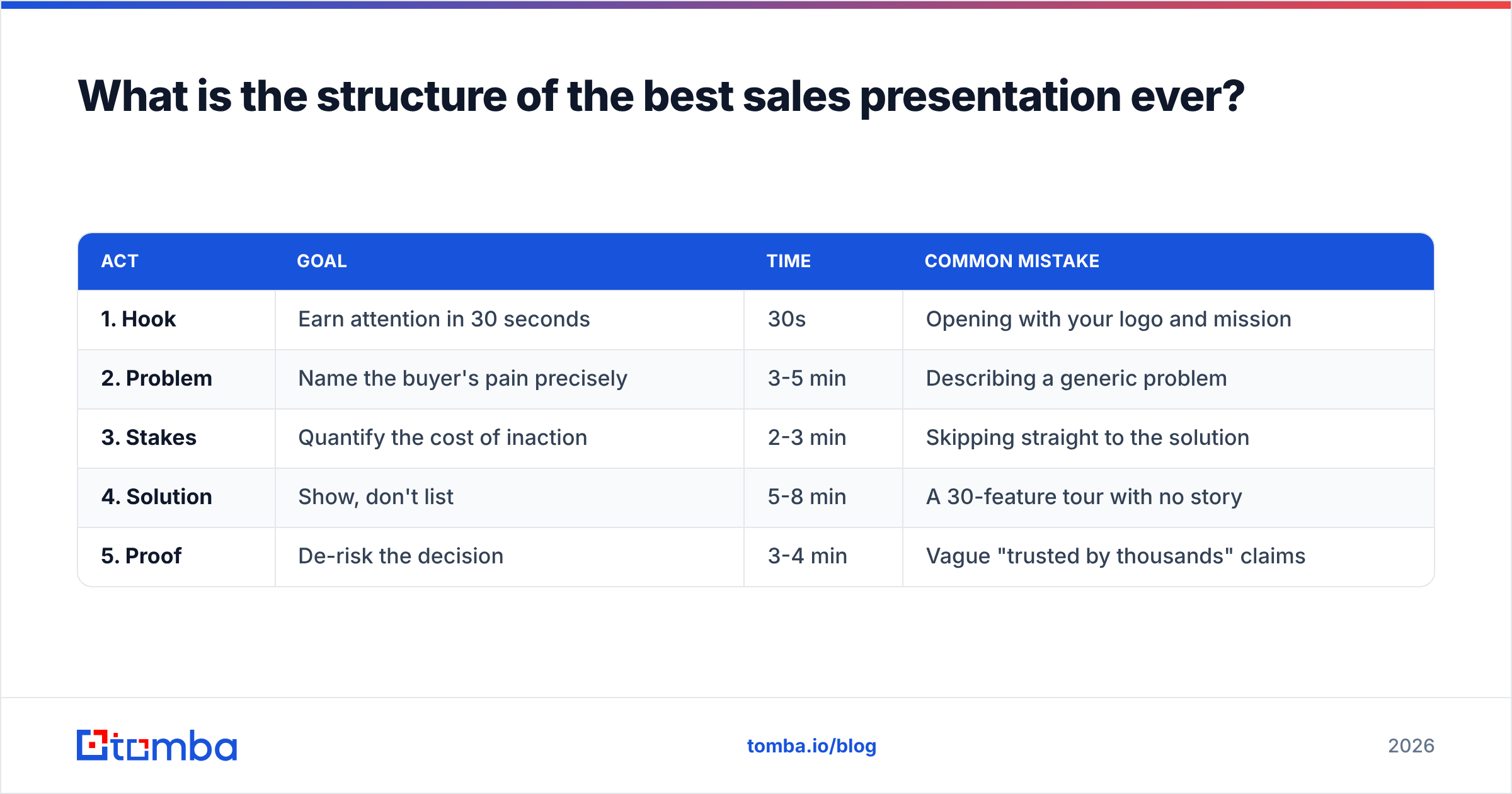
Great pitches follow a narrative arc, not a feature outline. Here is the five-act structure that consistently outperforms the "agenda → about us → features → pricing" template.
| Act | Goal | Time | Common mistake |
|---|---|---|---|
| 1. Hook | Earn attention in 30 seconds | 30s | Opening with your logo and mission |
| 2. Problem | Name the buyer's pain precisely | 3-5 min | Describing a generic problem |
| 3. Stakes | Quantify the cost of inaction | 2-3 min | Skipping straight to the solution |
| 4. Solution | Show, don't list | 5-8 min | A 30-feature tour with no story |
| 5. Proof | De-risk the decision | 3-4 min | Vague "trusted by thousands" claims |
The discipline here is timing. Most reps blow the budget in Act 4, demoing every feature they are proud of. The buyer does not care about 90% of them. Show the three that solve the problem you named in Act 2, then stop.
Why the hook decides everything#
You have about 30 seconds before the buyer mentally files you as "another vendor." A strong hook is a sharp, specific observation about their world:
- A surprising stat: "Reps at companies your size spend a third of their week not selling."
- A contrarian claim: "Most of your pipeline problem isn't volume — it's data decay."
- A mirrored pain: "You told me last week that your list-building is the bottleneck. Let's start there."
Notice the third one only works if you did discovery. That is the point.
How do you personalize a pitch at scale?#
Personalization is the single biggest lever on win rate — and the hardest to do at volume. The answer is not writing 50 bespoke decks. It is building one strong template and swapping in accurate, specific data per account.
That breaks down into three layers:
- Account-level data — industry, headcount, tech stack, recent funding. This shapes which problem you lead with.
- Contact-level data — the right decision-maker, their role, their priorities. Pitching the wrong persona is the fastest way to stall a deal.
- Trigger-level data — a new hire, a product launch, an expansion. This is your "why now."
The bottleneck is almost always getting accurate contact data fast. If your rep spends 9 hours a week hunting for verified emails and the right stakeholder, that is 9 hours not spent rehearsing the pitch. This is where a bulk email finder and reliable phone finder compress prep time from hours to minutes — feeding clean, current data into the deck instead of guesses.
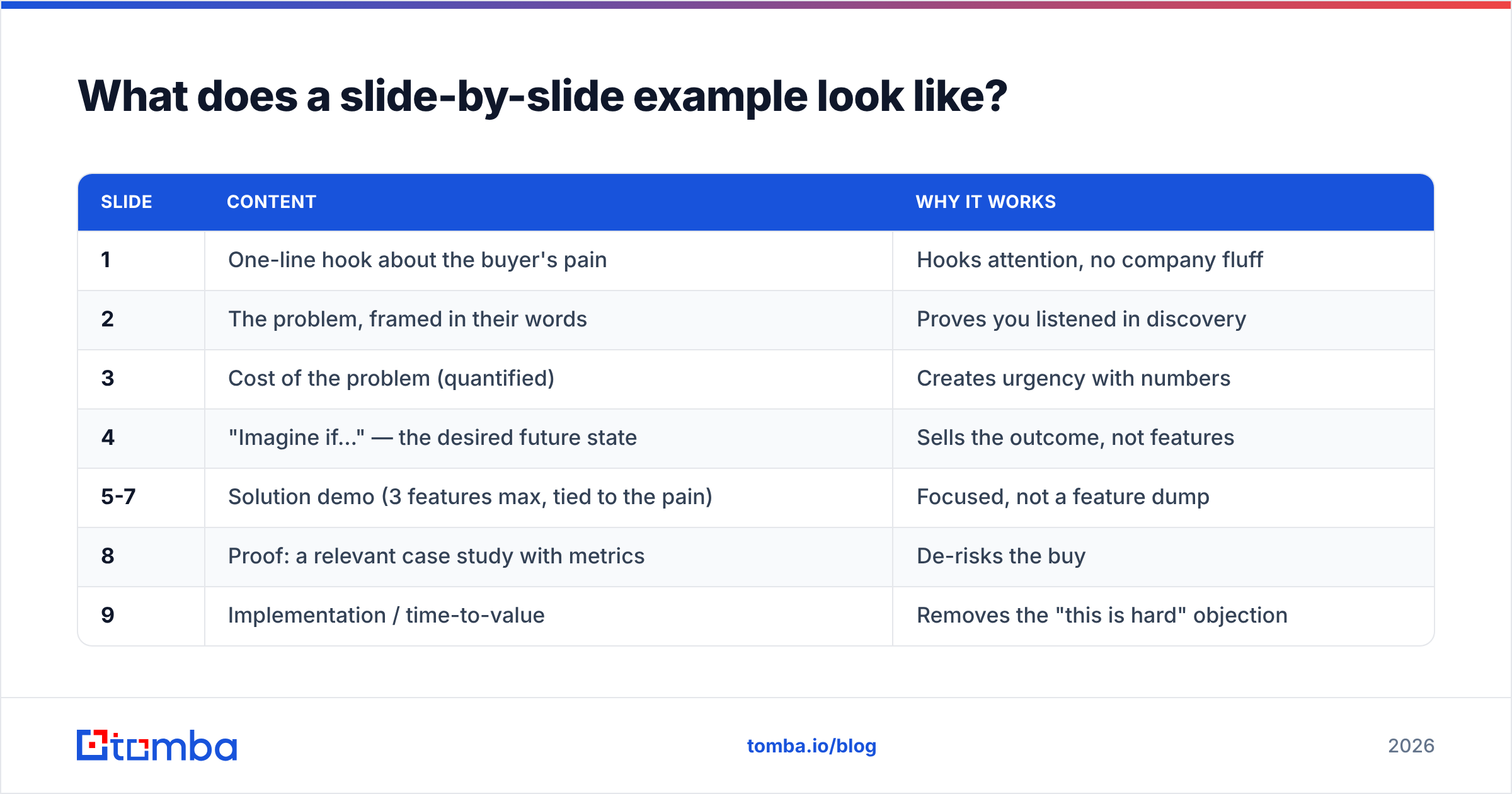
What does a slide-by-slide example look like?#
Here is the best sales presentation ever, mapped to actual slides for a B2B SaaS deal. Keep the total to 10-12 slides — anything longer signals you do not know what matters.
| Slide | Content | Why it works |
|---|---|---|
| 1 | One-line hook about the buyer's pain | Hooks attention, no company fluff |
| 2 | The problem, framed in their words | Proves you listened in discovery |
| 3 | Cost of the problem (quantified) | Creates urgency with numbers |
| 4 | "Imagine if…" — the desired future state | Sells the outcome, not features |
| 5-7 | Solution demo (3 features max, tied to the pain) | Focused, not a feature dump |
| 8 | Proof: a relevant case study with metrics | De-risks the buy |
| 9 | Implementation / time-to-value | Removes the "this is hard" objection |
| 10 | Pricing tied to ROI | Anchors price against the cost on slide 3 |
| 11 | Clear next step (one ask) | Advances the deal |
The most common fix I give reps: delete half your slides. If a slide does not move the buyer from "I have a problem" toward "you solve it," cut it.
Is data really more persuasive than design?#
Yes — and it is not close. A clean deck helps, but specificity wins deals. Compare these two claims on the same slide:
- "We help sales teams find more leads." (Forgettable.)
- "Reps using verified email data hit a 23% higher reply rate because their messages actually reach inboxes." (Persuasive.)
The second works because it is concrete and tied to an outcome the buyer cares about. The catch: data only persuades if it is accurate. Pitching a stat built on a bounced contact list undermines your credibility the moment the buyer fact-checks it.
This is why deliverability and data quality sit upstream of presentation quality. Bad data does not just waste sends — it poisons the trust your pitch depends on. Running prospects through an email verifier before they enter your sequence keeps your numbers — and your reputation — clean. As HubSpot's sales research repeatedly shows, response rates collapse when outreach is generic or mistargeted. Accurate data is the cheapest insurance against both.
How do you handle objections inside the presentation?#
The best presentations pre-empt objections instead of waiting to get hit with them. Map the three objections you hear most and bake the answers into the flow:
- "This looks hard to implement." → Add a time-to-value slide. Show a 7-day onboarding, not a vague "we'll get you set up."
- "You're more expensive than X." → Anchor price against the cost of the problem (slide 3), not against the competitor's sticker price.
- "We already use a tool for this." → Position around the gap, not a feature-by-feature war. Lead with the one thing their current tool cannot do.
When you do compare yourself to an incumbent, be honest and specific. Buyers trust a rep who concedes a competitor's strength and then explains the trade-off. They distrust a rep who claims to win on every axis. The same neutrality that makes a good comparison article credible makes a comparison slide credible.
What tools support a data-driven sales presentation?#
Building the best sales presentation ever is part craft, part supply chain. The craft is the story. The supply chain is the data and tooling that feeds it. Here is how the pieces fit:
- Find the right people: Use the email finder and domain search to reach verified decision-makers, not generic info@ inboxes.
- Enrich the account: Contact enrichment fills in role, company size, and tech stack so you lead with the right problem.
- Verify before you pitch: Clean lists protect your sender reputation and keep your stats honest.
- Integrate into your CRM: Push enriched data straight into your pipeline so the deck practically writes itself.
You do not need a 12-tool stack. You need accurate data, a tight narrative, and the discipline to cut everything that does not move the deal. Many of these capabilities are available on the free tier or the $49/mo Starter plan — see the full Tomba pricing to match a plan to your volume. Note that Tomba's entry plan is $49/mo, not the $39 figure you will sometimes see misquoted.
How do you measure if your presentation is working?#
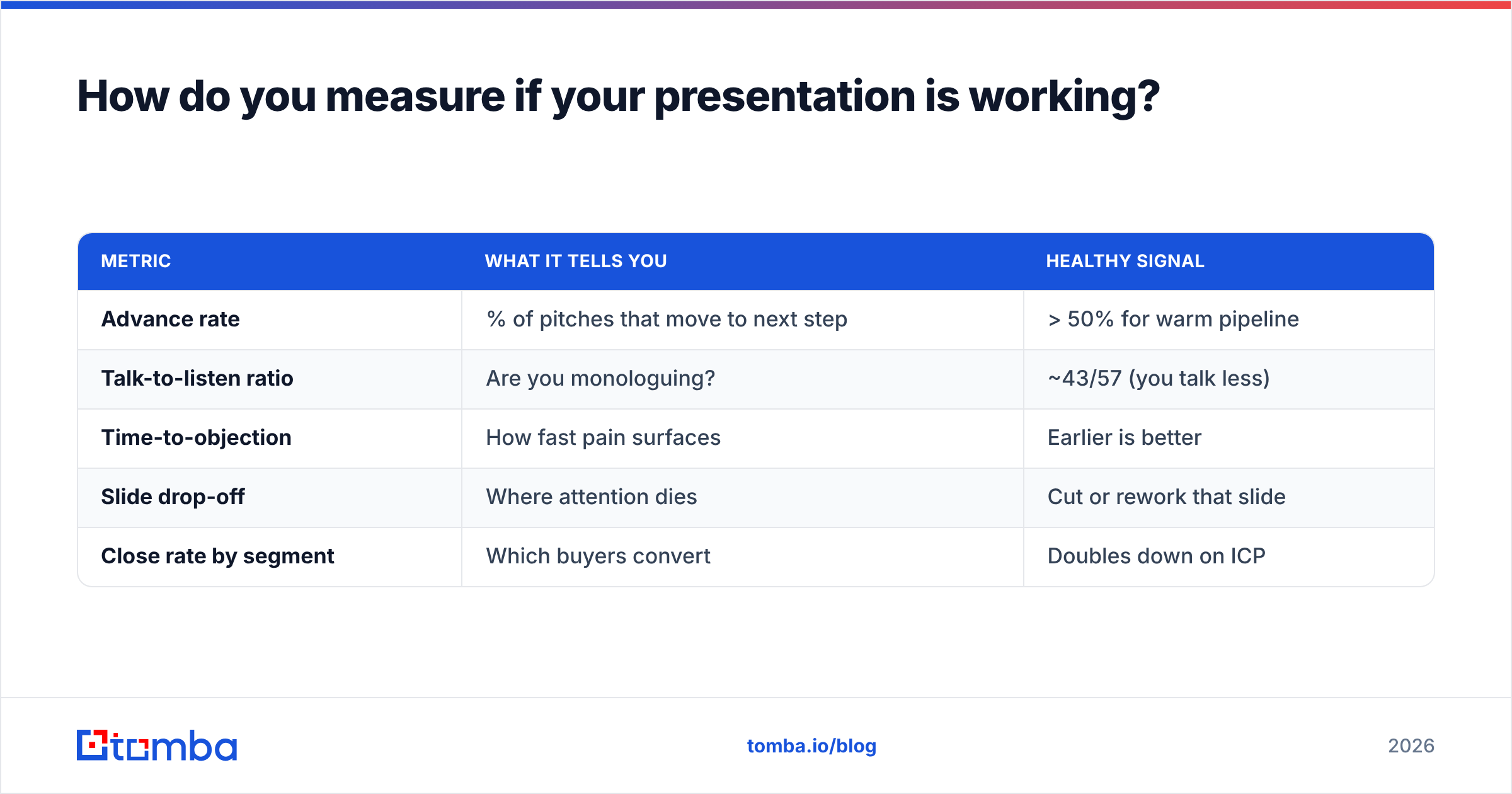
Treat your pitch like a campaign you optimize, not a script you memorize once. Track these:
| Metric | What it tells you | Healthy signal |
|---|---|---|
| Advance rate | % of pitches that move to next step | > 50% for warm pipeline |
| Talk-to-listen ratio | Are you monologuing? | ~43/57 (you talk less) |
| Time-to-objection | How fast pain surfaces | Earlier is better |
| Slide drop-off | Where attention dies | Cut or rework that slide |
| Close rate by segment | Which buyers convert | Doubles down on ICP |
If your advance rate is low, the problem is usually Act 2 — you have not named the buyer's problem precisely enough. If you win meetings but lose at price, fix the stakes slide so the cost of inaction is undeniable.
Common mistakes that kill an otherwise great pitch#
Even strong reps sabotage good decks with avoidable errors:
- Leading with "About Us." Nobody buys because you were founded in 2014. Cut it or move it to the appendix.
- Demoing every feature. Three relevant features beat thirty impressive ones.
- Reading the slides. Slides are a backdrop. If you read them aloud, you are redundant.
- No clear ask. End with one specific next step, not "let us know if you have questions."
- Stale or wrong data. A single bounced contact or outdated stat erodes the trust the whole pitch is built on.
The bottom line#
The best sales presentation ever is not a deck — it is a disciplined story built on accurate data and aimed squarely at the buyer's problem. Get the structure right (hook, problem, stakes, solution, proof), personalize with real account and contact data, and measure it like a campaign. Do that, and you stop being "another vendor" and start being the team that obviously gets it.
The foundation under all of it is data you can trust. Before your next pitch, spend ten minutes pulling verified decision-maker contacts with the Tomba Email Finder — start free with 25 searches a month, scale up when it pays for itself, and build every presentation on data that actually holds up when the buyer checks.
// get started
Find, verify and enrich your first contacts today
Start on the free plan with 25 searches a month, then scale when your team is ready.
Free plan · No credit card required · GDPR & CCPA
// about the author