How to Build the Best Sales Team in 2026: A Field Guide
What separates the best sales team from a roster of busy reps? Structure, clean data, coaching, and a tech stack that compounds. Here's the 2026 playbook.
The best sales team in your market is not the one with the most reps, the loudest war room, or the flashiest CRM. It's the one that turns repeatable inputs — clean data, sharp process, real coaching — into predictable revenue. Most teams confuse activity with performance. This guide separates the two.
TL;DR#
- The best sales team is a system, not a collection of stars. Process, data quality, and coaching beat individual talent over any 12-month window.
- Specialize roles early. SDRs, AEs, and CS each own one job. Full-cycle "do everything" reps cap your scale.
- Data quality is the silent multiplier. Reps waste 27% of their week on bad contact data; fixing that is cheaper than hiring.
- Coach the pipeline, not the person. Weekly deal reviews and call scoring move win rates more than any pep talk.
- Comp drives behavior. If your plan rewards activity instead of outcomes, you'll get activity.
What actually defines the best sales team?#
Conclusion first: the best sales team is the one with the highest revenue per rep per quarter, sustained across hires and market cycles. Everything else is a vanity metric.
Think of a sales org like a restaurant kitchen. A single brilliant chef can plate ten great dishes a night. But a well-run kitchen — stations, prep lists, a head chef calling the pass — serves three hundred consistent plates without burning out. Stars don't scale. Systems do.
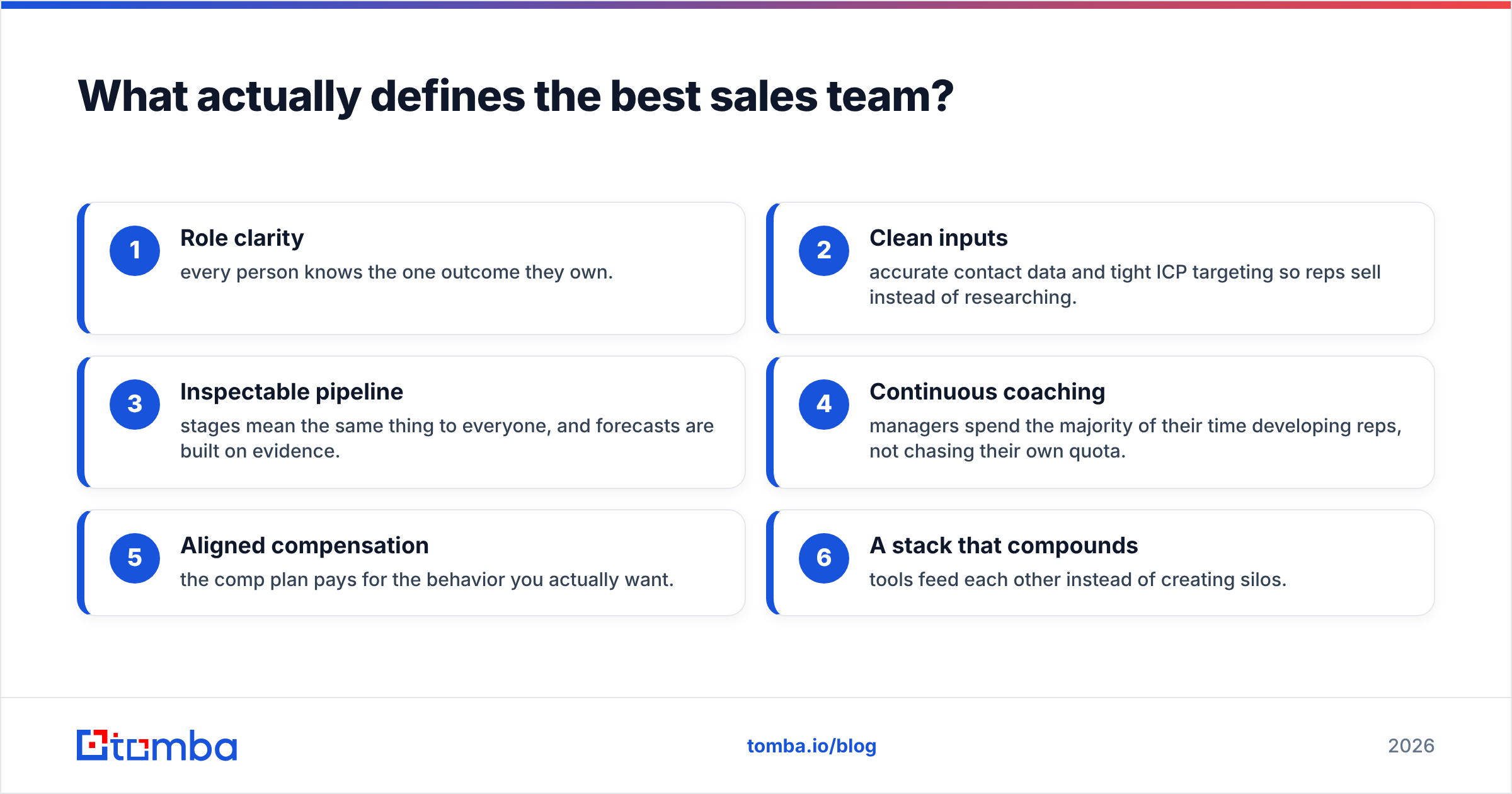
When you benchmark high-performing teams against average ones, a handful of traits repeat:
- Role clarity — every person knows the one outcome they own.
- Clean inputs — accurate contact data and tight ICP targeting so reps sell instead of researching.
- Inspectable pipeline — stages mean the same thing to everyone, and forecasts are built on evidence.
- Continuous coaching — managers spend the majority of their time developing reps, not chasing their own quota.
- Aligned compensation — the comp plan pays for the behavior you actually want.
- A stack that compounds — tools feed each other instead of creating silos.
Miss any one of these and you get a team that looks busy and forecasts poorly. Nail all six and you get a machine.
How should you structure a high-performing sales team?#
Specialize. The single biggest structural lever for a growing team is splitting the funnel into dedicated roles instead of asking everyone to prospect, close, and renew.
The classic model — popularized in Aaron Ross's Predictable Revenue and still the backbone of most modern orgs — breaks into four functions:
- SDRs / BDRs generate and qualify pipeline (outbound and inbound).
- Account Executives run discovery through close.
- Customer Success / Account Managers retain and expand.
- Sales / RevOps owns data, tooling, forecasting, and enablement.
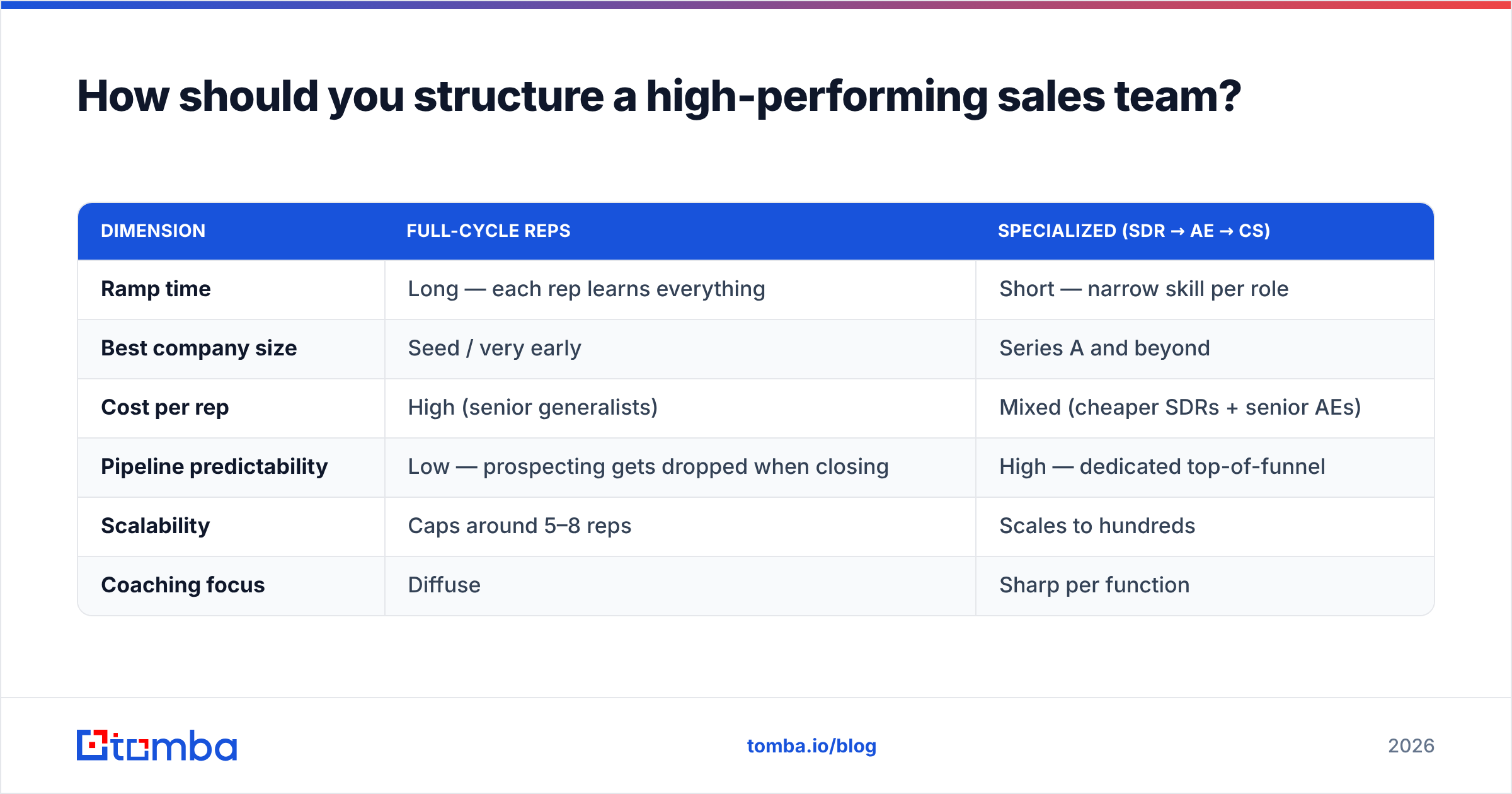
Here's how the two dominant structures compare:
| Dimension | Full-cycle reps | Specialized (SDR → AE → CS) |
|---|---|---|
| Ramp time | Long — each rep learns everything | Short — narrow skill per role |
| Best company size | Seed / very early | Series A and beyond |
| Cost per rep | High (senior generalists) | Mixed (cheaper SDRs + senior AEs) |
| Pipeline predictability | Low — prospecting gets dropped when closing | High — dedicated top-of-funnel |
| Scalability | Caps around 5–8 reps | Scales to hundreds |
| Coaching focus | Diffuse | Sharp per function |
For a team past its first few hires, specialization wins almost every time. The exception is a brand-new motion where you genuinely don't yet know who buys — there, a few full-cycle "founder-led" sellers help you learn fast before you split roles.
A practical ratio to start with: roughly 2–3 SDRs per AE for high-volume outbound motions, and 1 RevOps hire once you cross five reps. Don't let process live in someone's head past that point.
Why is data quality the make-or-break factor?#
Because reps can't sell to contacts they can't reach. Decision-maker data decays fast — somewhere around 22–30% of B2B contact records go stale every year as people change jobs, titles, and companies. A list you bought in January is meaningfully wrong by summer.
The cost is brutal and invisible. When a rep works from bad data, they:
- Burn hours researching instead of selling.
- Email addresses that bounce, dragging down sender reputation and hurting every future campaign.
- Call wrong numbers and log "no answer" as if the prospect ghosted them.
- Forecast deals against contacts who left the company months ago.
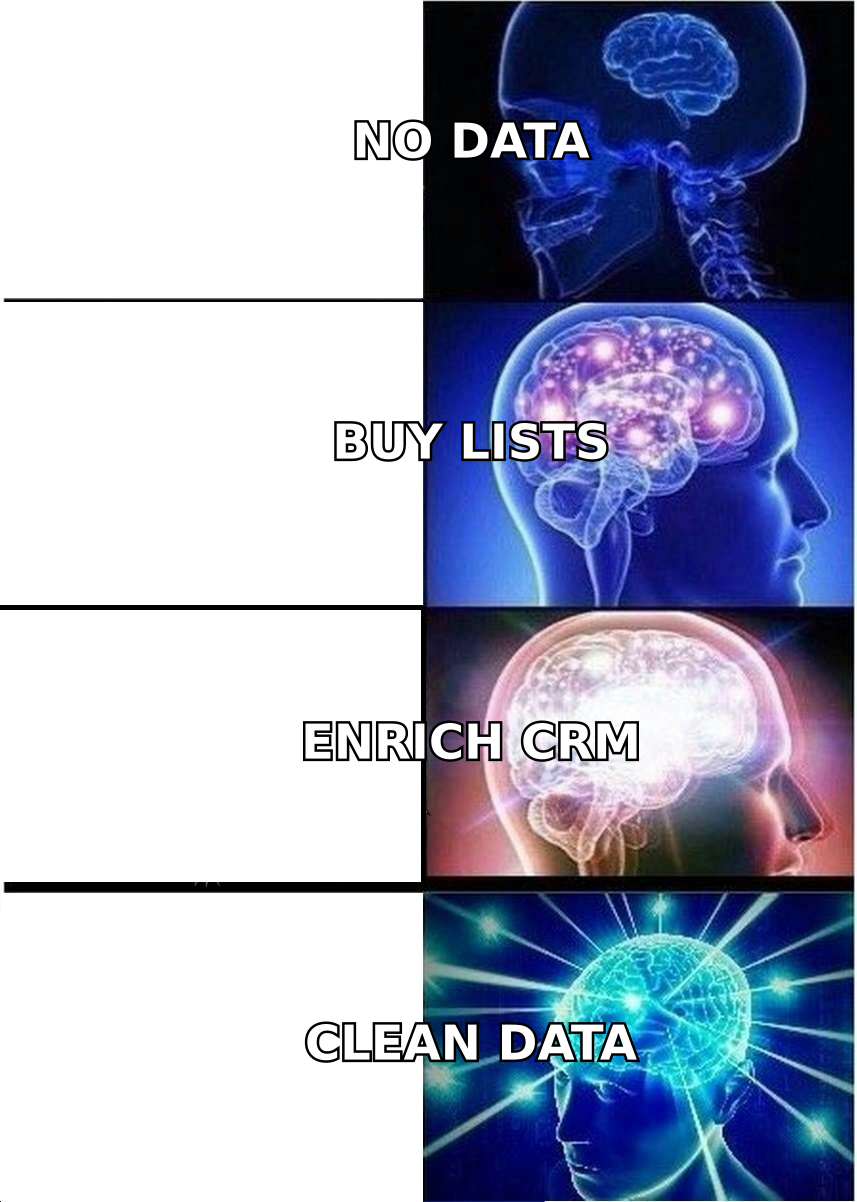
This is where the best teams quietly separate themselves. They treat contact data as infrastructure, not a one-time purchase. That means verifying emails before send, enriching records continuously, and pulling fresh contacts at the moment of outreach rather than from a stale spreadsheet.
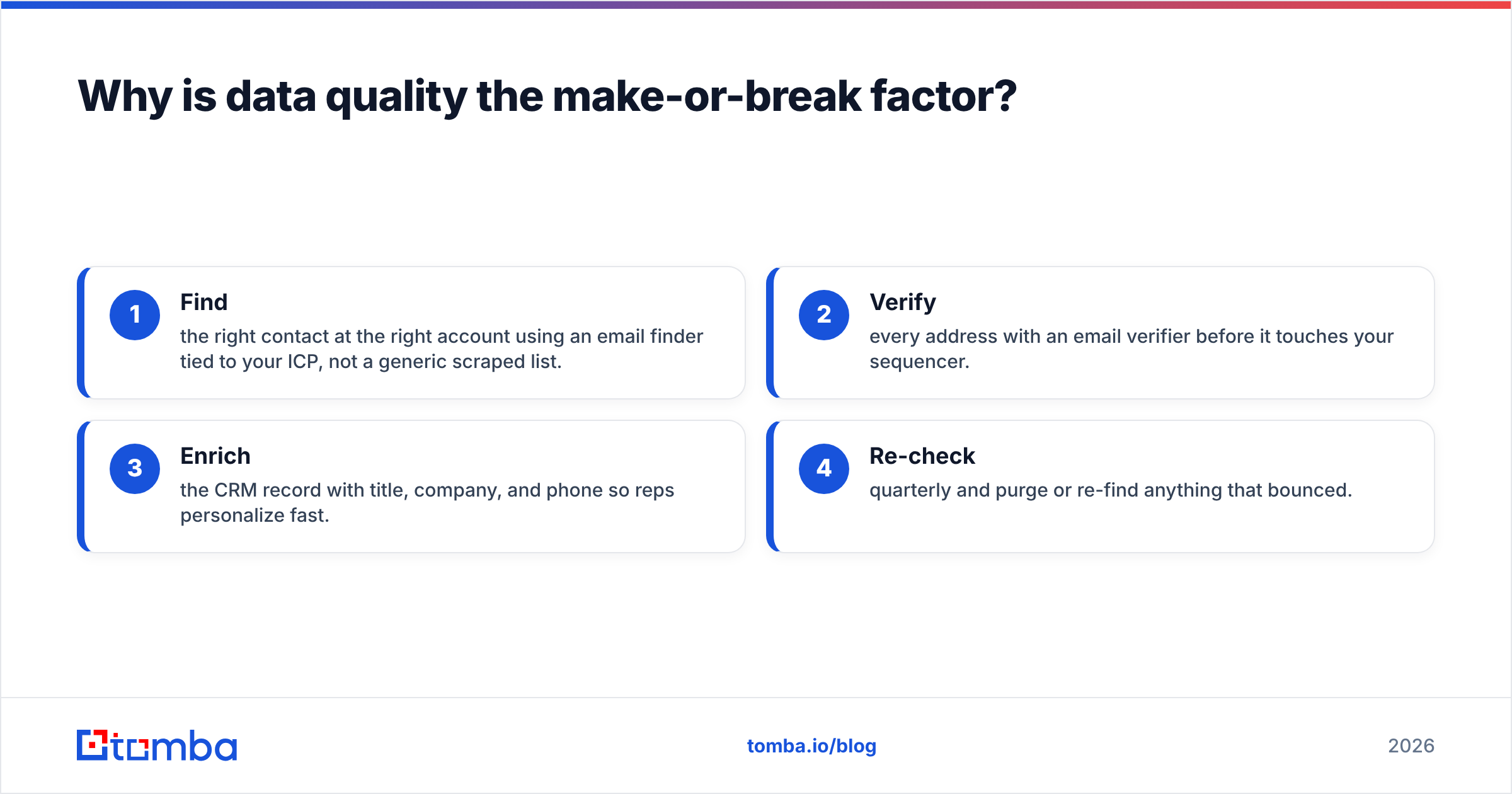
A simple data-hygiene loop the best teams run:
- Find the right contact at the right account using an email finder tied to your ICP, not a generic scraped list.
- Verify every address with an email verifier before it touches your sequencer.
- Enrich the CRM record with title, company, and phone so reps personalize fast.
- Re-check quarterly and purge or re-find anything that bounced.
Tools like ZoomInfo and Tomba sit at the front of this loop. The point isn't which logo you pick — it's that the loop exists at all. Teams without one are sprinting in shoes two sizes too small.

How do you coach a sales team to actually improve?#
Coach the deals and the calls, not the personality. The best sales managers spend the majority of their week in the work — reviewing real pipeline and real conversations — instead of delivering motivational speeches.
Three coaching rituals show up on nearly every elite team:
Weekly 1:1 deal reviews. Not "how's it going?" but a stage-by-stage walk through the rep's top five open deals. What's the next step? Who's the economic buyer? What evidence supports the close date? This turns a hopeful forecast into an inspectable one.
Call and email scoring. Pull two recorded calls or sequences per rep per week and score them against a rubric — discovery depth, objection handling, next-step clarity. Conversation-intelligence platforms like Gong make this scalable, but a manager with a notepad and a scorecard captures 80% of the value.
Skill-specific reps. Once you've scored, you've found the gap. Drill that — a discovery framework, a pricing objection, a multi-threading play — in short, repeated practice. Generic training sticks far less than fixing one named weakness.
The metric that proves coaching works is win rate trending up across the team, not just the top performer. If only your best rep is improving, you're admiring talent, not building a system.
What does the best sales team's tech stack look like?#
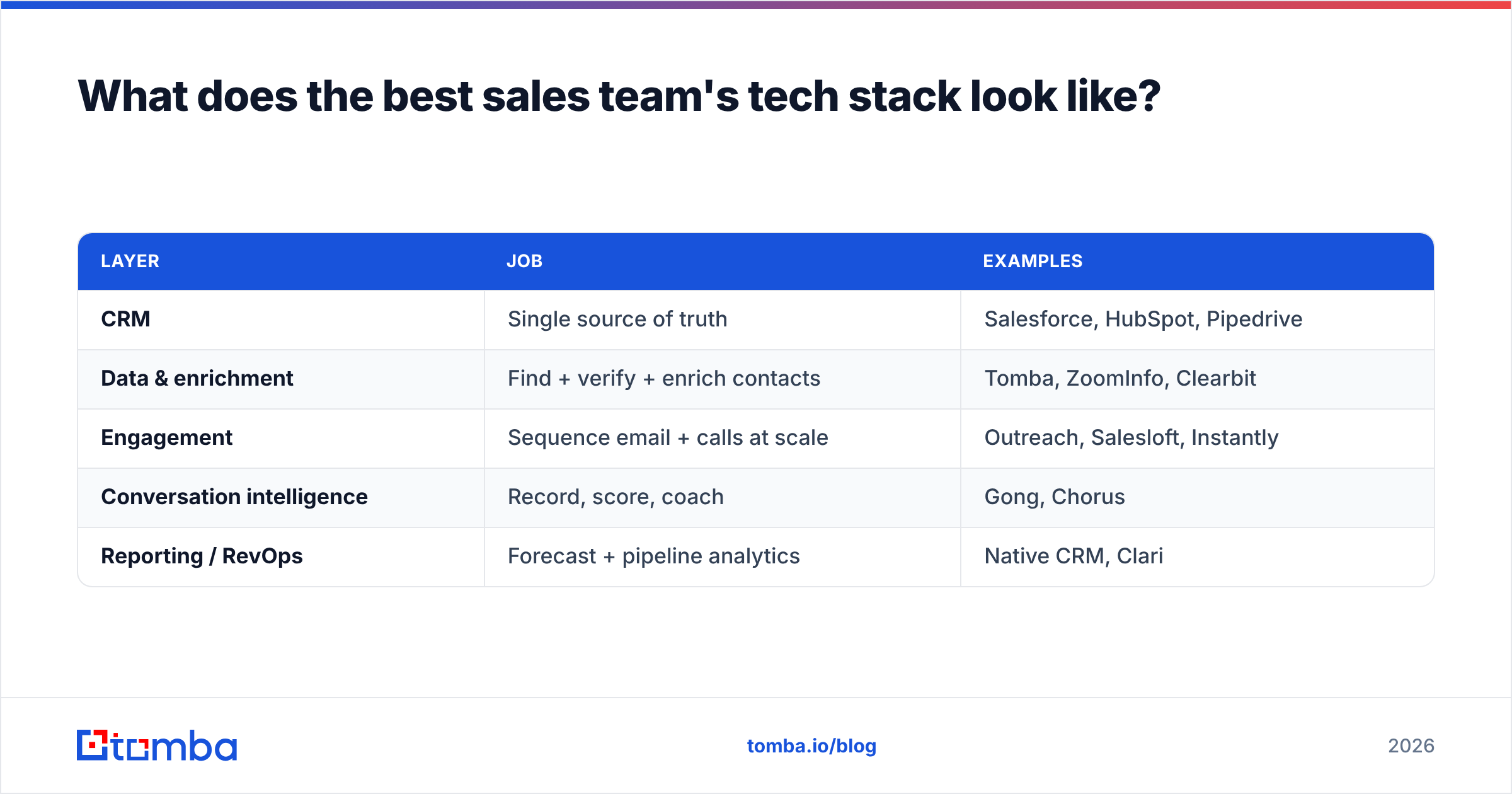
A stack that compounds: every tool makes the next one more effective, and data flows between them without manual re-entry. A great stack is boring and connected; a bad one is a museum of single-purpose apps nobody opens.
The core layers, in priority order:
| Layer | Job | Examples |
|---|---|---|
| CRM | Single source of truth | Salesforce, HubSpot, Pipedrive |
| Data & enrichment | Find + verify + enrich contacts | Tomba, ZoomInfo, Clearbit |
| Engagement | Sequence email + calls at scale | Outreach, Salesloft, Instantly |
| Conversation intelligence | Record, score, coach | Gong, Chorus |
| Reporting / RevOps | Forecast + pipeline analytics | Native CRM, Clari |
You do not need all five on day one. The non-negotiable foundation is CRM + data. Without a clean source of truth and accurate contacts feeding it, every layer above inherits garbage. The best teams wire enrichment directly into the CRM — via native integrations or the Tomba API — so a rep never copy-pastes a contact again.
One rule that saves teams from stack bloat: a new tool earns its place only if it either replaces two existing tools or feeds data into the ones you already trust. Otherwise it's another login and another silo.
How do you measure whether your sales team is actually the best?#
Track a small set of leading and lagging indicators, and refuse to celebrate activity that doesn't convert.
The metrics that matter:
- Revenue per rep — the headline efficiency number.
- Win rate by stage — where deals die tells you what to coach.
- Sales cycle length — shrinking it is pure leverage.
- Pipeline coverage — typically 3–4x quota in open pipeline to hit number.
- Ramp time to first deal — how fast a new hire becomes productive.
- Data accuracy rate — bounce rate and connect rate as a proxy for input quality.
Notice what's missing: raw call volume, emails sent, "activities logged." Those are inputs, not outcomes. The best teams watch them only to diagnose a broken funnel, never to declare victory. A rep who sends 40 well-targeted emails and books five meetings beats one who blasts 400 and books two — every time.
A 90-day plan to level up your team#
If you're starting from an average team and want to compound toward elite, here's a concrete sequence:
- Days 1–15: Fix the data. Audit your CRM, purge dead records, and stand up a find-verify-enrich loop. This is the fastest ROI available to any sales org.
- Days 16–30: Define your stages. Write one-sentence exit criteria for each pipeline stage so the forecast becomes inspectable.
- Days 31–60: Install coaching rituals. Weekly deal reviews and call scoring, every rep, no exceptions.
- Days 61–90: Align comp and roles. Make sure the plan pays for outcomes and that role boundaries are clear. Adjust ratios where the funnel is starved.
Do these in order. Coaching a team that's working from broken data is like teaching someone to drive a car with no fuel — the lesson is fine, the engine just won't move.
Build the engine, not the hero#
The best sales team in 2026 isn't built on a few exceptional closers. It's built on clean inputs, clear roles, relentless coaching, and a stack that compounds. Stars leave. Systems stay.
The cheapest, highest-leverage place to start is your data — because every other improvement multiplies off accurate, reachable contacts. Stop letting reps waste a quarter of their week chasing bounced emails and dead numbers. Use the Tomba Email Finder to put verified, ICP-matched contacts in front of your team, wire it into your CRM, and let your reps spend their time doing the one thing they were hired for: selling. Check Tomba pricing — the free tier lets you test the find-verify loop before you commit a dollar.
// get started
Find, verify and enrich your first contacts today
Start on the free plan with 25 searches a month, then scale when your team is ready.
Free plan · No credit card required · GDPR & CCPA
// about the author