Best Time to Send Marketing Email in 2026: A Data Guide
Sending great copy at the wrong hour wastes it. Here's the data on the best time to send marketing email in 2026 — by day, by hour, and by audience segment.
You wrote a sharp subject line, tightened the body, cleaned the list — then hit send at 4:47 p.m. on a Friday and watched the open rate sink. Timing is the cheapest lever in email marketing, and most teams pull it by accident.
TL;DR — When Should You Actually Send?#
- Best days: Tuesday, Wednesday, and Thursday consistently beat Monday and Friday for opens and clicks across B2B and most B2C lists.
- Best hours: Late morning (9–11 a.m.) and a smaller early-afternoon window (1–3 p.m.) in the recipient's local time zone.
- Worst windows: Late Friday afternoon, weekends for B2B, and the 5–8 a.m. inbox flood.
- The real answer is your data. Benchmarks point you to a starting hypothesis; your own A/B tests and engagement history decide the winner.
- Timing only works on a clean, deliverable list. A perfectly timed email to a dead inbox earns zero. Verify first, then optimize send time.
Why Does Send Time Matter So Much?#
Think of your email like a flyer handed out on a busy street. Hand it over when people are rushing to lunch and it goes straight in the bin. Hand it over when they're strolling with a coffee and they actually read it. The flyer didn't change — the moment did.
Inboxes work the same way. An email sent at 6 a.m. sits buried under 40 newer messages by the time your prospect opens their laptop. An email that lands at 9:50 a.m. — right as they finish their first coffee and triage their inbox — sits near the top, gets opened, and gets a reply.
Send time influences three things that compound:
- Open rate — proximity to the moment of inbox-checking.
- Click and reply rate — whether the reader has the mental bandwidth to act, not just glance.
- Sender reputation — mailbox providers watch engagement signals. Consistent opens and replies in a tight window tell Gmail and Outlook your mail is wanted, which protects future email deliverability.
That last point is the one most marketers miss. Timing isn't only about a single campaign — it trains the algorithm that decides whether your next campaign hits the inbox or the promotions tab.
)
What Is the Best Time to Send Marketing Email in 2026?#
The short answer: Tuesday through Thursday, mid-to-late morning, in the recipient's local time zone. That window has held up across HubSpot, Mailchimp, and Campaign Monitor send-time studies for years, and it remains the safest default for 2026.
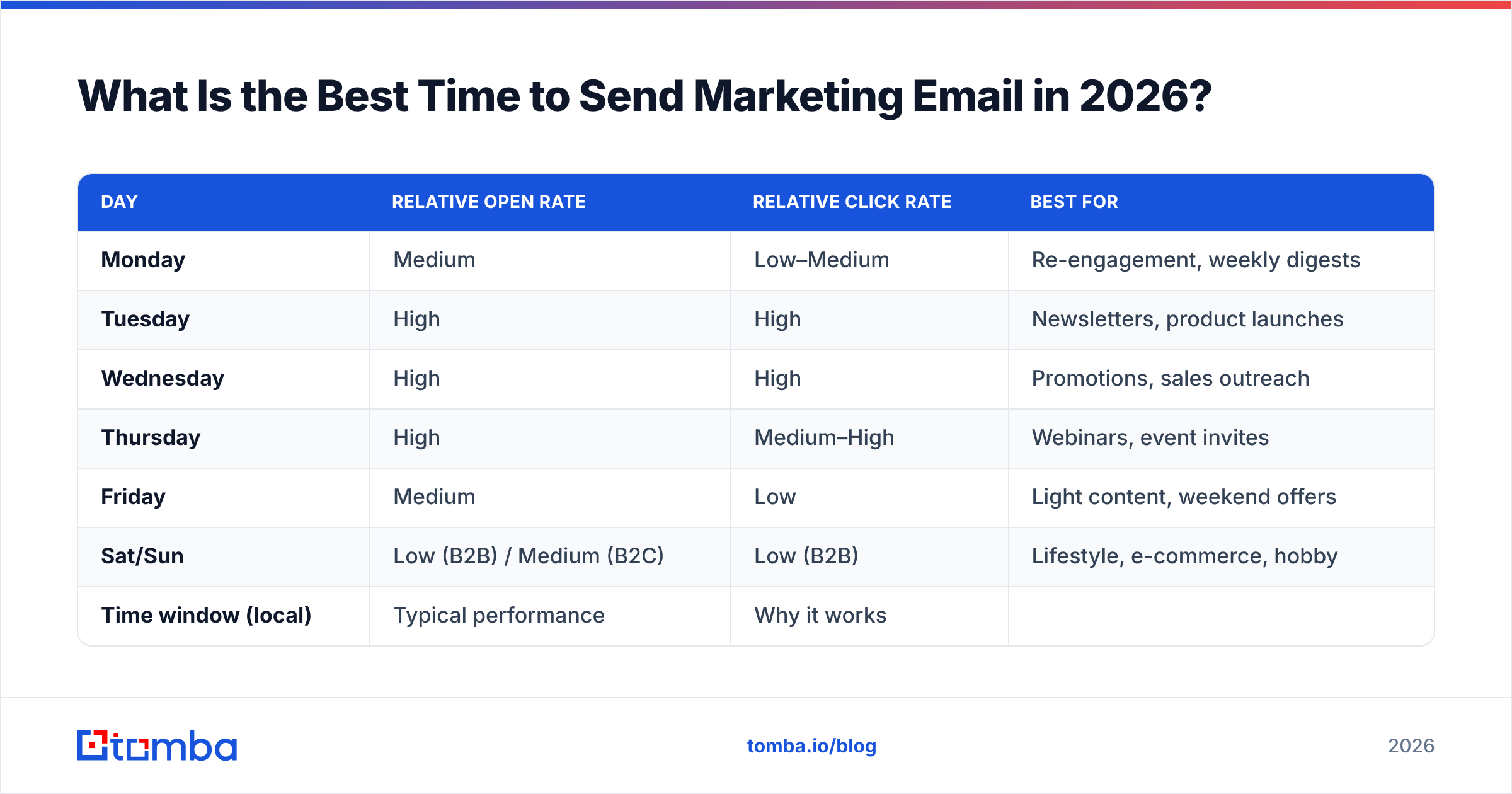
Here's the day-by-day picture pulled from aggregate industry benchmarks. Treat these as starting hypotheses, not laws.
| Day | Relative open rate | Relative click rate | Best for |
|---|---|---|---|
| Monday | Medium | Low–Medium | Re-engagement, weekly digests |
| Tuesday | High | High | Newsletters, product launches |
| Wednesday | High | High | Promotions, sales outreach |
| Thursday | High | Medium–High | Webinars, event invites |
| Friday | Medium | Low | Light content, weekend offers |
| Sat/Sun | Low (B2B) / Medium (B2C) | Low (B2B) | Lifestyle, e-commerce, hobby |
For the time of day, the pattern is just as consistent. The hours below assume you've segmented by time zone — sending to a U.S. national list at "10 a.m." means 10 a.m. Eastern is 7 a.m. Pacific, which dilutes results.
| Time window (local) | Typical performance | Why it works |
|---|---|---|
| 5–8 a.m. | Weak | Inbox flood, pre-work chaos |
| 9–11 a.m. | Strongest | First inbox triage of the day |
| 11 a.m.–1 p.m. | Good | Pre-lunch downtime |
| 1–3 p.m. | Strong | Post-lunch second wind |
| 3–5 p.m. | Fading | Meetings, end-of-day rush |
| After 6 p.m. | Weak (B2B) | Inbox closed for the day |
Does the Best Send Time Change by Audience?#
Yes — and this is where generic benchmarks stop being useful. The "best time to send marketing email" depends heavily on who you're emailing and what you're asking them to do.
- B2B / SaaS buyers check email during work hours. Tuesday–Thursday, 9–11 a.m. local is the sweet spot. Avoid weekends entirely.
- B2C / e-commerce audiences buy on their own time. Evenings (6–9 p.m.) and weekends often outperform weekday mornings, because that's when people browse and shop.
- Executives and founders open early — 6–8 a.m. before the day fills up — and late, after 8 p.m. They live outside the standard window.
- Shift workers, healthcare, hospitality break the rules entirely. Their "morning" might be 2 p.m. Survey or test rather than assume.
- Global lists require time-zone segmentation. One blast at a single UTC hour will be perfect for one region and terrible for three others.
The practical takeaway: build at least three or four send-time segments, not one. Even a rough split — by region and by buyer type — will outperform a single mass send.
How Do You Find Your Best Send Time?#
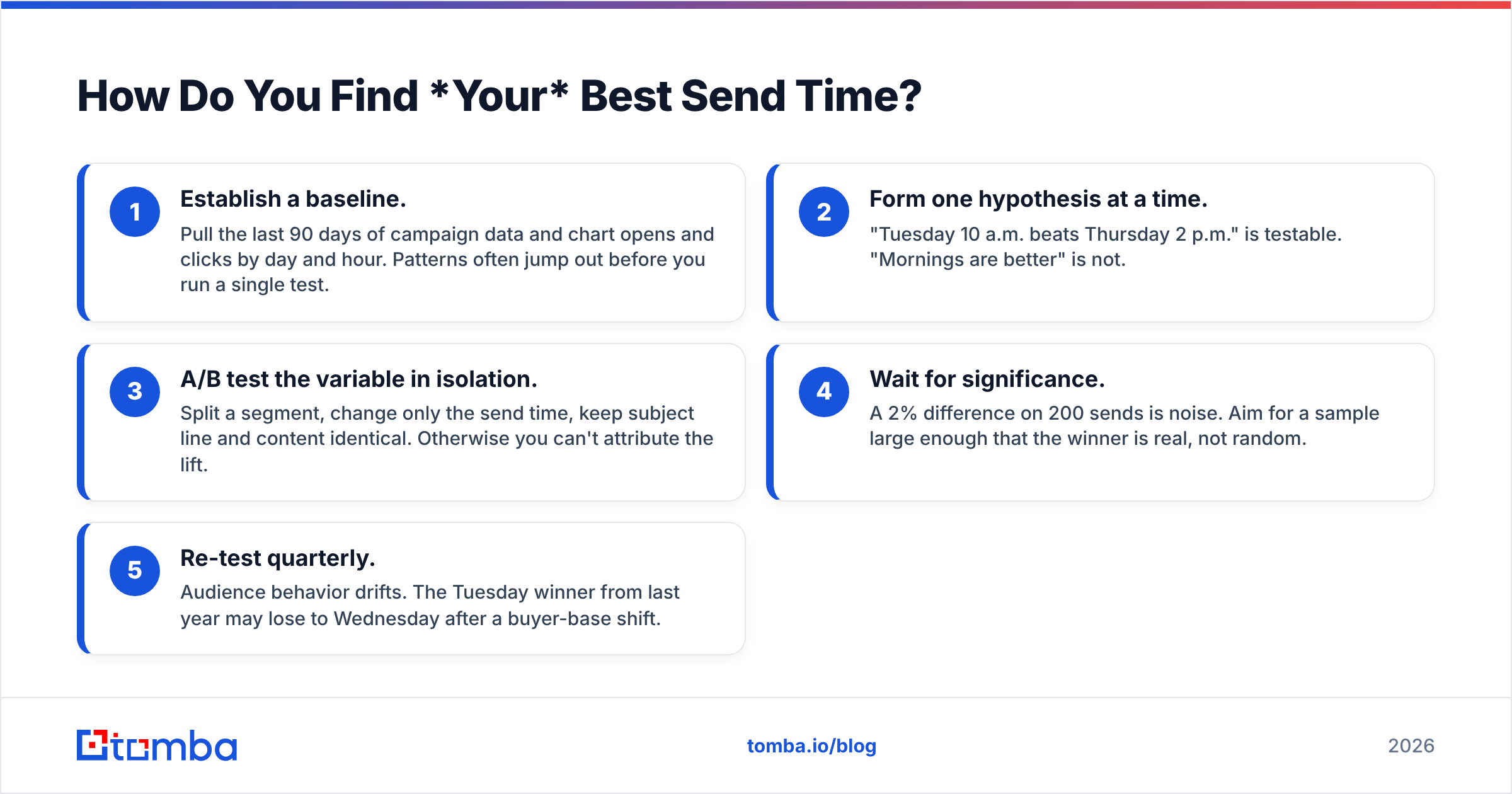
The benchmarks above get you to a confident starting point. Your own data gets you to the actual answer. Here's a repeatable process.
- Establish a baseline. Pull the last 90 days of campaign data and chart opens and clicks by day and hour. Patterns often jump out before you run a single test.
- Form one hypothesis at a time. "Tuesday 10 a.m. beats Thursday 2 p.m." is testable. "Mornings are better" is not.
- A/B test the variable in isolation. Split a segment, change only the send time, keep subject line and content identical. Otherwise you can't attribute the lift.
- Wait for significance. A 2% difference on 200 sends is noise. Aim for a sample large enough that the winner is real, not random.
- Re-test quarterly. Audience behavior drifts. The Tuesday winner from last year may lose to Wednesday after a buyer-base shift.
If your sending platform offers send-time optimization (Mailchimp, HubSpot, and others ship machine-learning versions), use it as a tie-breaker — but audit its picks against your own numbers. Automated optimization is only as good as the engagement data it learns from, which brings us to the part nobody wants to hear.
Why Does List Quality Beat Perfect Timing?#
Because the cleanest signal in the world is useless if it's pointed at a dead inbox. You can nail Tuesday at 10 a.m. and still flop if a third of your list bounces, sits in spam traps, or never existed.
)
Here's the order of operations that actually moves numbers:
- A valid, verified list — every send reaches a real person. Run addresses through an email verifier before any campaign to strip bounces and traps.
- Strong sender reputation — protected by low bounce rates and high engagement, which is exactly what good timing produces. Check yours with a sender reputation checker.
- Then send-time optimization — once the first two are solid, timing compounds your gains instead of fighting a deliverability hole.
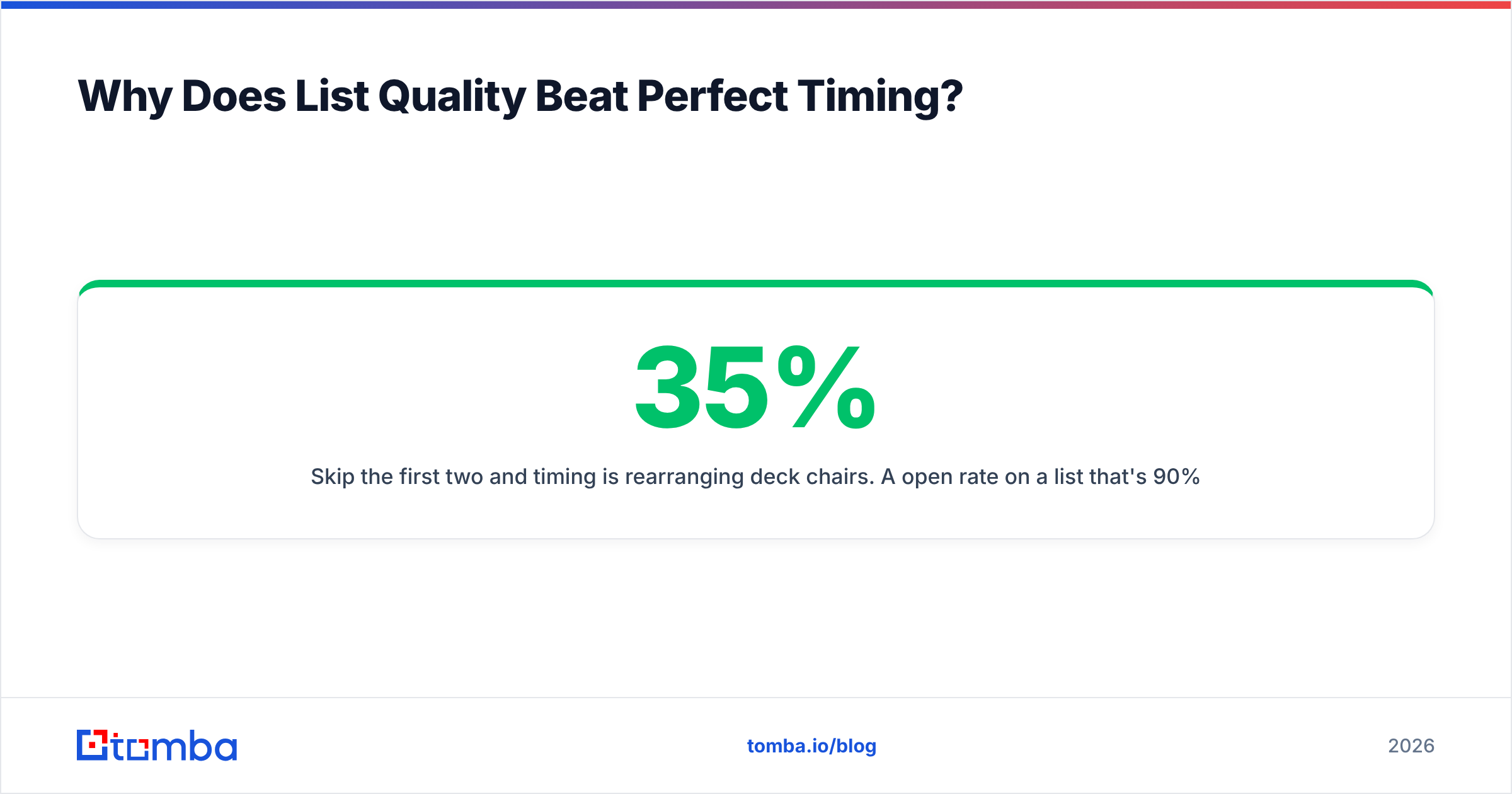
Skip the first two and timing is rearranging deck chairs. A 35% open rate on a list that's 90% deliverable beats a "perfectly timed" 35% on a list that's 60% deliverable — because the second one is quietly torching your domain reputation with every bounce.
This is also why list sourcing matters. If you're building outreach lists, pull verified, current addresses from a tool like the Tomba Email Finder rather than scraping stale data — the freshest list reacts to your timing the way the benchmarks predict.
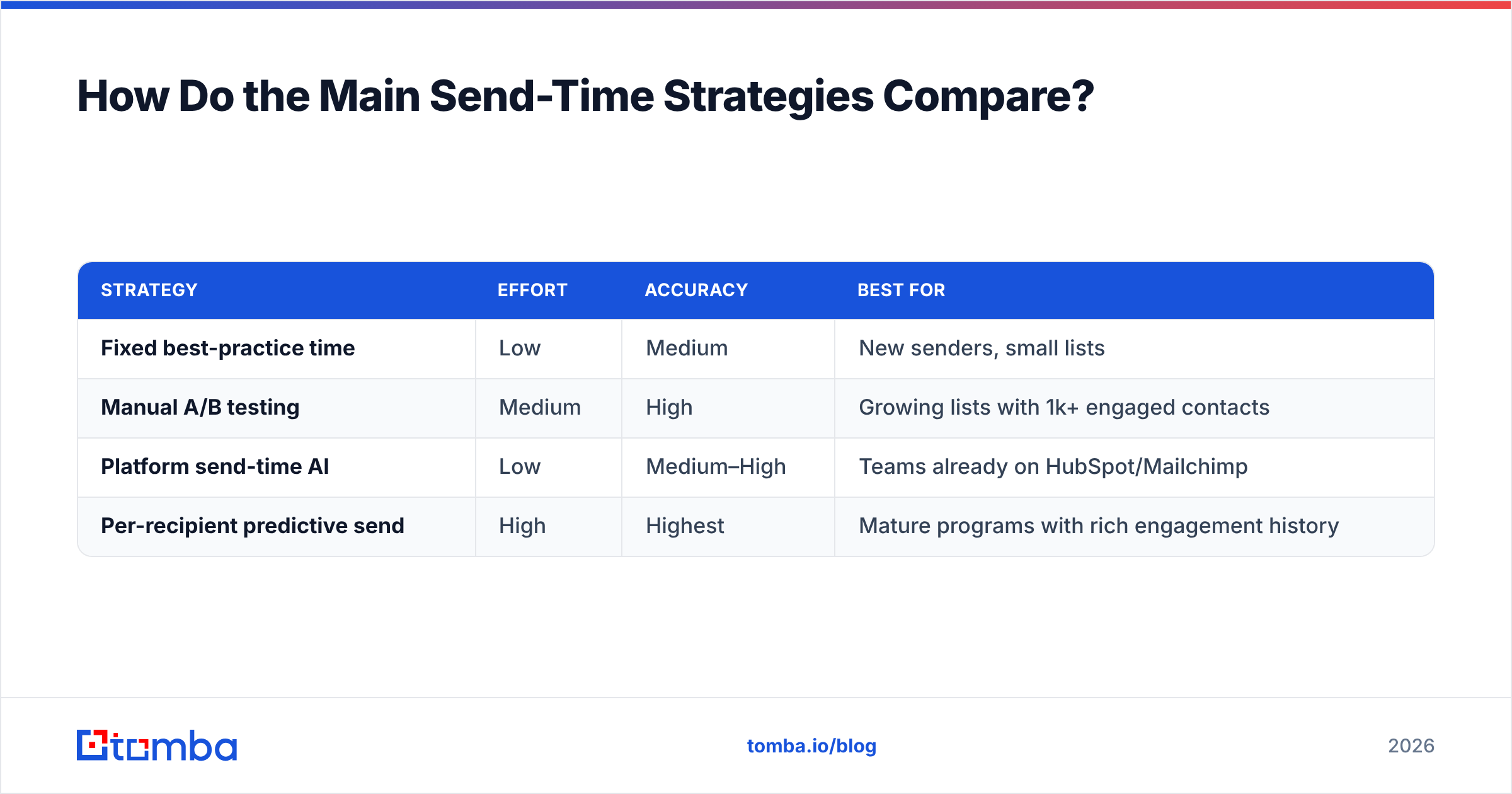
How Do the Main Send-Time Strategies Compare?#
There are four common approaches to deciding when to hit send. Each fits a different stage of maturity.
| Strategy | Effort | Accuracy | Best for |
|---|---|---|---|
| Fixed best-practice time | Low | Medium | New senders, small lists |
| Manual A/B testing | Medium | High | Growing lists with 1k+ engaged contacts |
| Platform send-time AI | Low | Medium–High | Teams already on HubSpot/Mailchimp |
| Per-recipient predictive send | High | Highest | Mature programs with rich engagement history |
Most teams should start at row one, graduate to row two within a quarter, and only invest in predictive sending once they have enough per-contact history to make it worthwhile. Don't pay for sophistication your data can't feed.
What About Cold Outreach vs. Marketing Newsletters?#
They're not the same game. A newsletter goes to people who opted in and expect you. A cold email goes to someone who's never heard of you — so timing serves a different purpose.
For cold outreach, the goal is landing when your prospect is in "work mode" and likely to reply, not just open. Tuesday–Thursday, 8–10 a.m. local tends to win because it catches them before the day's meetings swallow their attention. Pair the timing with a tested subject line — run candidates through a subject line tester — and a warmed-up sending domain so you actually reach the inbox.
For marketing newsletters, the audience already knows you, so consistency matters more than precision. Showing up the same day and hour every week builds a habit. Readers start to expect "the Thursday-morning email," and that anticipation lifts opens more than chasing the theoretically optimal minute.
One rule applies to both: warm up new sending domains and mailboxes before scaling volume. A cold domain blasting hundreds of messages — even at the perfect hour — looks like spam to mailbox providers. Use an email warmup calculator to ramp safely before you lean on send-time tactics.
Common Send-Time Mistakes to Avoid#
- Sending in one time zone for a global list. Segment by region or your "10 a.m." is someone else's midnight.
- Changing send time and content at once. You'll never know which variable drove the result.
- Treating benchmarks as gospel. They're a starting line, not a finish line. Your audience is the authority.
- Ignoring the unsubscribe and bounce trend. A creeping bounce rate quietly drags every send down, regardless of timing.
- Optimizing timing before fixing deliverability. Clean the list and warm the domain first — then timing pays off.
- Never re-testing. Last year's winner can become this year's average. Re-run tests each quarter.
Frequently Asked Questions#
What is the single best time to send a marketing email? If you have to pick one slot with no data of your own, send Tuesday at 10 a.m. in the recipient's local time zone. It's the most reliable default across studies, but treat it as a hypothesis to test, not a guarantee.
Is it bad to send marketing emails on weekends? For B2B, usually yes — open and reply rates drop because inboxes go quiet. For B2C and e-commerce, weekends can outperform weekdays since people shop on their own time. Test it against your own list.
How many emails should I test before trusting a send time? Enough that the difference is statistically meaningful — generally several hundred to a few thousand sends per variant. A 1–2% gap on a tiny sample is noise, not a winner.
Does send time affect deliverability or just open rates? Both. Strong engagement in a tight window signals to Gmail and Outlook that your mail is wanted, which protects inbox placement for future sends. Poorly timed sends with low engagement erode reputation over time.
The Bottom Line#
The best time to send marketing email in 2026 starts with Tuesday-through-Thursday mornings — but ends with your own tested data on a clean, deliverable list. Timing is a multiplier, not a fix: it amplifies a healthy list and exposes a broken one.
Before you fine-tune the hour, make sure every address is real and reachable. Build your outreach lists with verified, current contact data using the Tomba Email Finder — find professional emails by name, domain, or company, then verify them so your perfectly timed campaign actually lands. Start free with 25 searches a month, and check the full Tomba pricing when you're ready to scale. Get the list right first, and the timing finally pays.
Ready to find emails that actually work?
Join 150,000+ professionals who stopped guessing and started sending. Free credits on signup — no credit card required.
Get the Tomba newsletter
Practical outbound tactics and product updates — once every two weeks.
About the author