BetterMerge vs Apollo.io 2026: Which B2B Data Tool Wins?
BetterMerge runs waterfall enrichment; Apollo.io bundles a database into a sales engine. Here's how they compare on accuracy, pricing, and fit in 2026 — plus a leaner third option.
Choosing between BetterMerge and Apollo.io comes down to one question: do you want a focused data layer that stitches providers together, or an all-in-one sales engine that happens to ship its own database? BetterMerge vs Apollo.io is not a feature-for-feature fight — they solve adjacent problems, and picking the wrong one means paying for seats you don't use or accuracy you can't trust.
This guide breaks down where each tool wins, where each leaks budget, and how a leaner email-finder approach often beats both for pure prospecting.
TL;DR#
- BetterMerge is a waterfall enrichment tool: it queries multiple data vendors per contact and returns the best hit, so you pay for coverage breadth rather than a single source.
- Apollo.io is an all-in-one sales platform — a 270M+ contact database bundled with sequences, a dialer, and CRM-style workflows, priced per seat.
- Apollo is cheaper to start but locks core data behind annual seats; BetterMerge bills closer to actual enrichment volume.
- For teams that only need accurate, verified emails, a dedicated email finder like Tomba avoids per-seat pricing and waterfall markup entirely.
- Verify before you send. No database — Apollo, BetterMerge, or otherwise — is fresh enough to skip email verification.
What is BetterMerge?#
BetterMerge positions itself as a waterfall enrichment layer. Instead of relying on one data provider, it sends each contact request through a sequence of vendors and returns the first (or best-scoring) match. Think of it like a travel meta-search: rather than checking one airline, it pings several and hands you the best fare.
That model has a clear strength — coverage. If provider A misses a contact's work email, provider B or C might have it. For lists where hit rate matters more than anything, waterfall enrichment lifts your match percentage versus any single source.
The trade-off is cost and complexity. You're effectively renting access to multiple databases, and the markup on that convenience shows up in per-credit pricing. You also inherit every provider's staleness; merging three mediocre sources doesn't always beat one well-maintained one. That's why data accuracy and the freshness of underlying sources matter more than raw provider count.

What is Apollo.io?#
Apollo.io is a sales intelligence and engagement platform. Its pitch is breadth: a contact database (Apollo cites 270M+ contacts), plus sequences, email sending, a dialer, LinkedIn extension, and lightweight CRM features — all in one login. You can build a list, enrich it, and fire a cadence without leaving the tool.
For full-cycle reps and small teams that want one subscription instead of a stack, that consolidation is genuinely useful. The catch is the pricing model: meaningful data access and automation live in paid, per-seat, annually-billed tiers. Add five reps and the bill scales linearly, whether or not all five hammer the database equally. You can confirm current tiers on Apollo's own pricing page — they revise it often.

BetterMerge vs Apollo.io: how do they compare?#
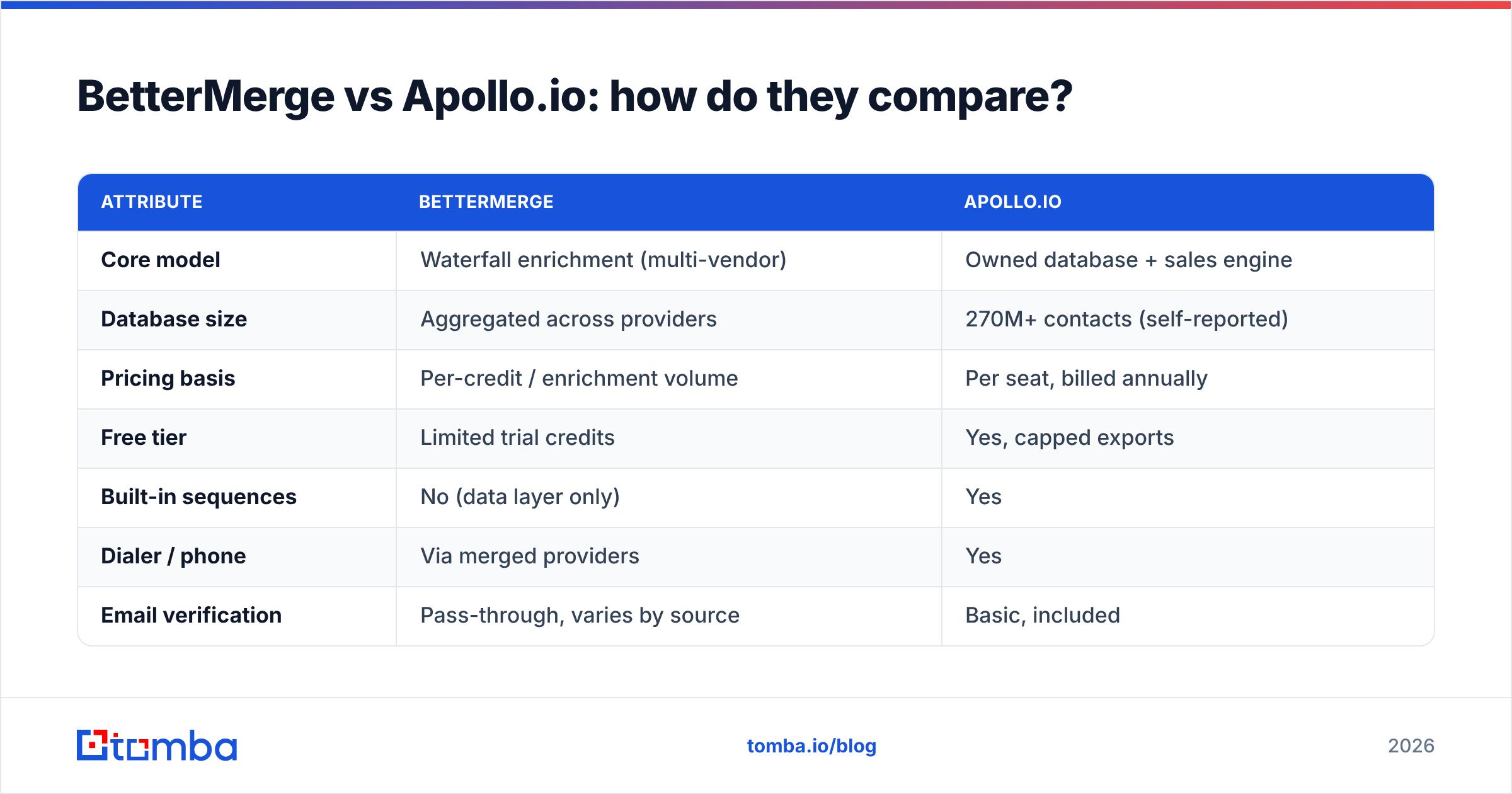
Here's the head-to-head on the attributes that actually change your monthly invoice and your bounce rate.
| Attribute | BetterMerge | Apollo.io |
|---|---|---|
| Core model | Waterfall enrichment (multi-vendor) | Owned database + sales engine |
| Database size | Aggregated across providers | 270M+ contacts (self-reported) |
| Pricing basis | Per-credit / enrichment volume | Per seat, billed annually |
| Free tier | Limited trial credits | Yes, capped exports |
| Built-in sequences | No (data layer only) | Yes |
| Dialer / phone | Via merged providers | Yes |
| Email verification | Pass-through, varies by source | Basic, included |
| Best for | Lifting match rate on existing lists | All-in-one outbound for full-cycle reps |
The pattern is clear: BetterMerge is a component, Apollo is a platform. If you already run Outreach, Salesloft, or your own sequencer, BetterMerge slots in as the data engine. If you have nothing, Apollo gives you a workable stack in one buy — at the cost of per-seat lock-in.

Which one is more accurate?#
Accuracy is where both models get tested, and neither owns it outright.
Waterfall enrichment (BetterMerge) maximizes coverage — the share of your list you get any answer for. But coverage is not correctness. A merged result is only as fresh as the vendor that supplied it, and people change jobs constantly. Without a verification step, a high match rate can still produce a high bounce rate.
Apollo's owned database is large and self-refreshing, but community-sourced data ages fast, and Apollo's included verification is basic. Reps routinely report needing a second verification pass before loading Apollo exports into a sending tool.
The reliable move with either tool is the same: treat the data source as a candidate generator, then verify independently. Running results through a dedicated email verifier — including a proper catch-all verifier for domains that accept everything — is what protects your sender reputation. Skipping it is how teams torch a domain in a week.
According to peer reviews on G2, the most common complaint across this category isn't missing data — it's confidently wrong data. That's a verification problem, not a coverage problem.
What does each cost in practice?#
Sticker price and real cost diverge fast here.
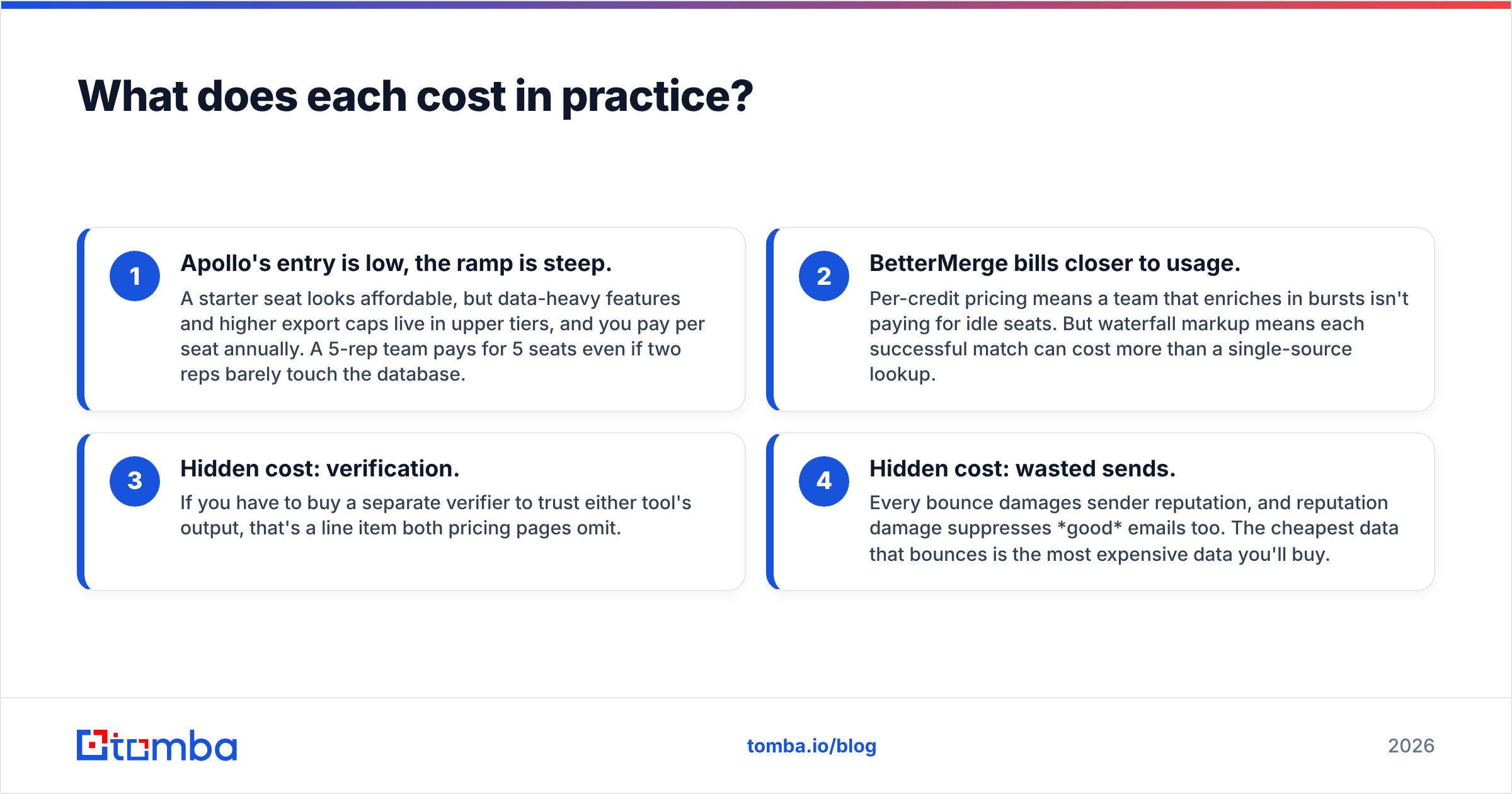
- Apollo's entry is low, the ramp is steep. A starter seat looks affordable, but data-heavy features and higher export caps live in upper tiers, and you pay per seat annually. A 5-rep team pays for 5 seats even if two reps barely touch the database.
- BetterMerge bills closer to usage. Per-credit pricing means a team that enriches in bursts isn't paying for idle seats. But waterfall markup means each successful match can cost more than a single-source lookup.
- Hidden cost: verification. If you have to buy a separate verifier to trust either tool's output, that's a line item both pricing pages omit.
- Hidden cost: wasted sends. Every bounce damages sender reputation, and reputation damage suppresses good emails too. The cheapest data that bounces is the most expensive data you'll buy.
For teams whose real need is "accurate emails for a target list," paying for a full engine (Apollo) or a multi-vendor merge (BetterMerge) is often overkill. A focused tool with transparent pricing covers the same job without per-seat math.
Where does Tomba fit in this comparison?#
Tomba is the third option that reframes the question. Instead of "platform vs waterfall," Tomba is a focused data layer built around accuracy and verification — closer to BetterMerge's role than Apollo's, but without renting a stack of third-party vendors.
- Email Finder returns a professional email by name + domain, with a confidence score and source attribution, so you know why a result was returned.
- Domain search maps every public email pattern at a company in one query — useful for account-based prospecting.
- Bulk email finder processes whole lists, and the Tomba API drops the same engine into your own enrichment flow — effectively letting you build your own waterfall step with verification baked in.
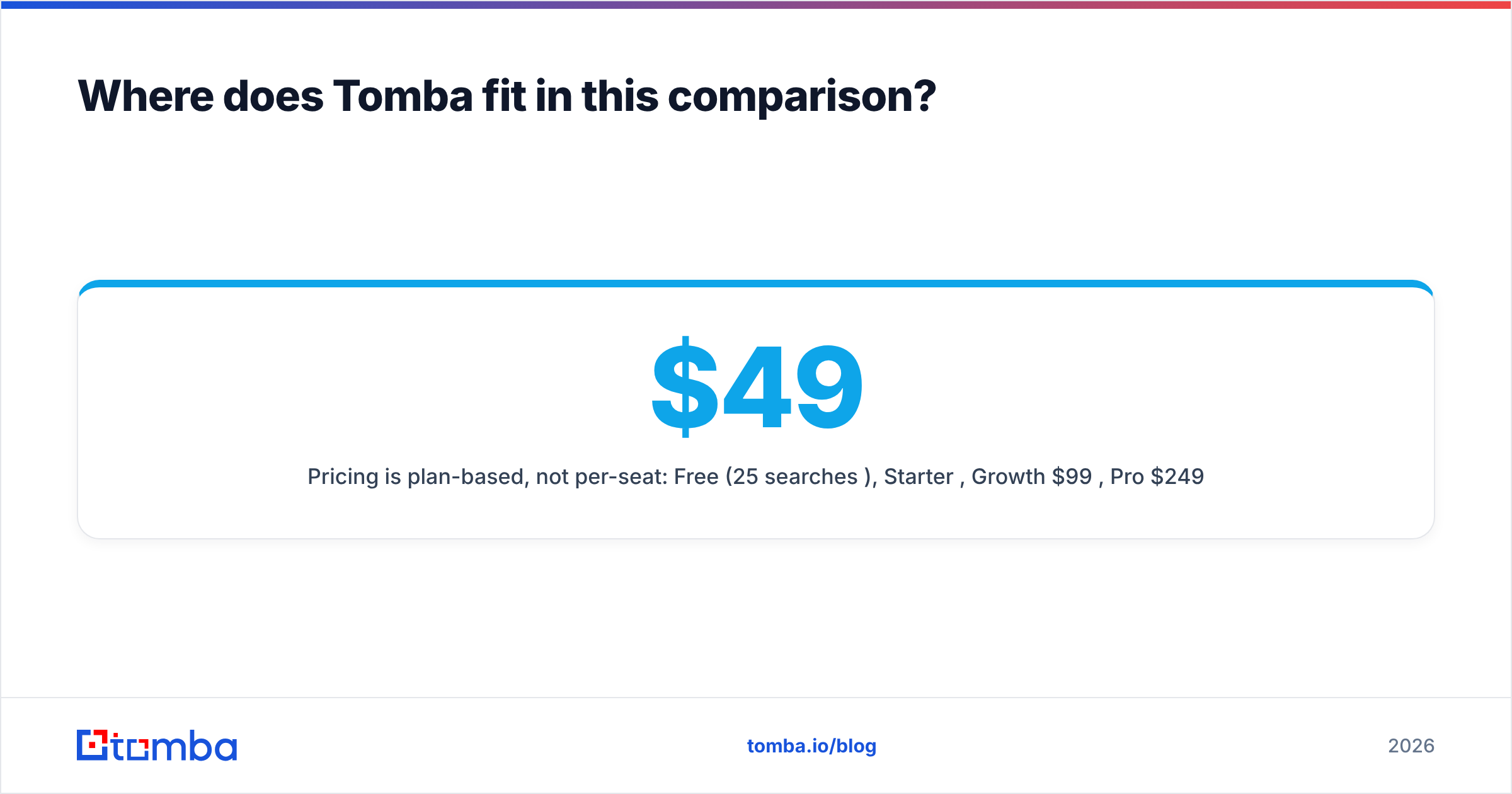
- Pricing is plan-based, not per-seat: Free (25 searches/mo), Starter $49/mo, Growth $99/mo, Pro $249/mo, Enterprise custom.
Where Apollo wins is consolidation — if you want sequences, dialer, and CRM in one tab, Tomba doesn't replace that. Where BetterMerge wins is raw multi-vendor coverage on hard-to-find contacts. But for the most common job — find verified emails for a defined list of people, without paying for five seats or three vendors — a dedicated finder is the lean answer. If you're specifically evaluating the all-in-one route, see the deeper breakdown on the Apollo alternative page.
How should you choose between BetterMerge and Apollo.io?#
Match the tool to the bottleneck, not the brand:
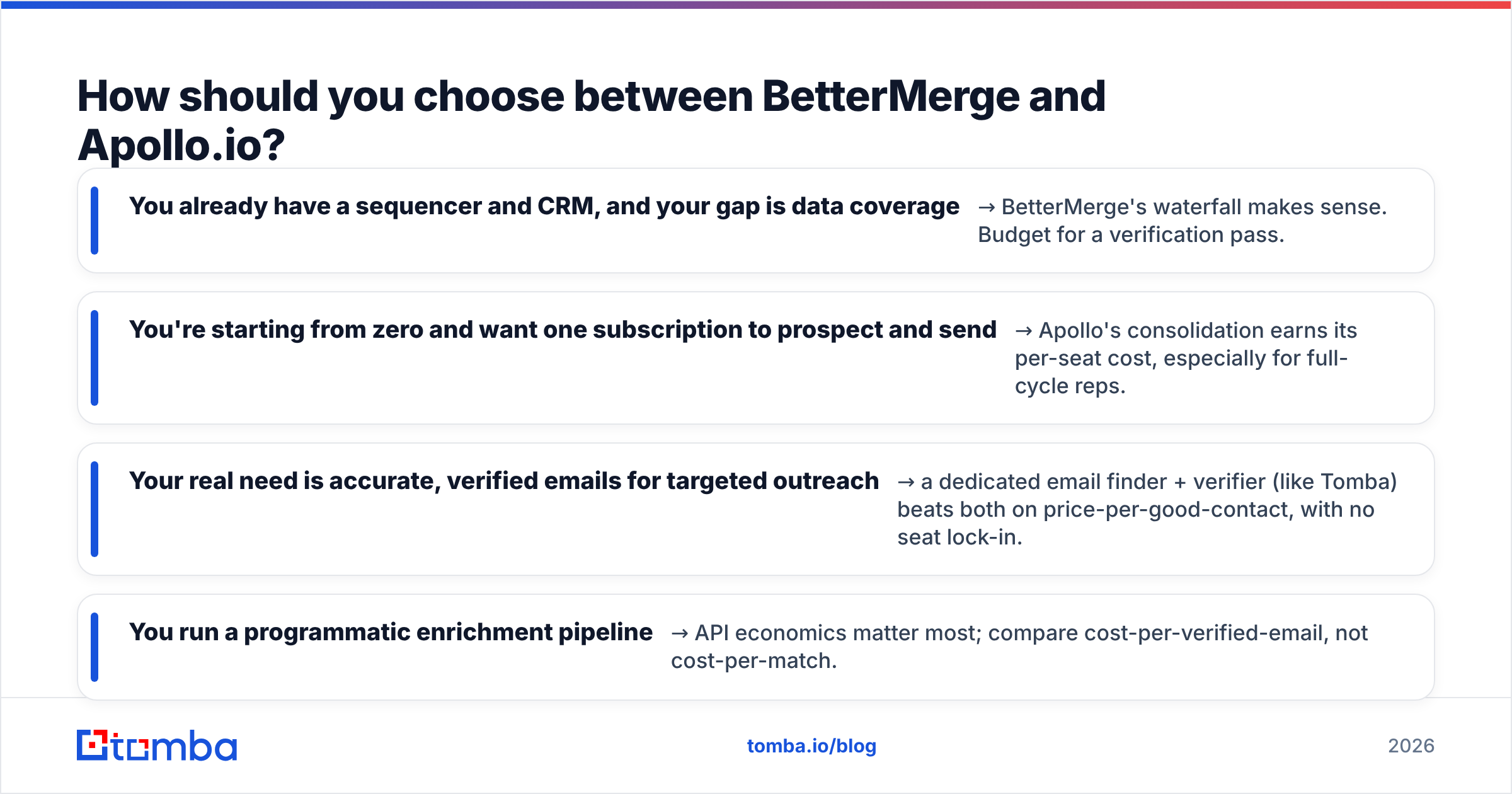
- You already have a sequencer and CRM, and your gap is data coverage → BetterMerge's waterfall makes sense. Budget for a verification pass.
- You're starting from zero and want one subscription to prospect and send → Apollo's consolidation earns its per-seat cost, especially for full-cycle reps.
- Your real need is accurate, verified emails for targeted outreach → a dedicated email finder + verifier (like Tomba) beats both on price-per-good-contact, with no seat lock-in.
- You run a programmatic enrichment pipeline → API economics matter most; compare cost-per-verified-email, not cost-per-match.
One rule survives every choice: verification is non-negotiable. Whether your data comes from Apollo's database, BetterMerge's merge, or Tomba's finder, validate before you send. Tools like HubSpot's guidance on email deliverability all converge on the same point — list hygiene, not list size, drives results.
The bottom line#
BetterMerge and Apollo.io are both legitimate, and the "winner" depends entirely on what you're missing. BetterMerge buys you coverage through multiple vendors; Apollo buys you a full outbound stack at the price of per-seat billing. Neither removes the need to verify.
If your goal is simply to find and confirm professional emails for the people you actually want to reach — without a five-seat minimum or a multi-vendor markup — start with a focused tool. Try the Tomba Email Finder free for 25 searches a month, pair it with the built-in email verifier, and pay only for the data you'll actually send to. That's the cheapest path to a clean list and a healthy domain in 2026.
// get started
Find, verify and enrich your first contacts today
Start on the free plan with 25 searches a month, then scale when your team is ready.
Free plan · No credit card required · GDPR & CCPA
// about the author