11 Best Bigtincan Alternatives for Sales Enablement in 2026
Bigtincan is powerful but pricey and complex. Here are 11 sales enablement alternatives compared on pricing, features, and the contact data that actually powers your reps.
Bigtincan helped define modern sales enablement, but it is not the only — or the best — fit for every team. If the contracts feel heavy, the onboarding feels endless, or the per-seat price keeps climbing, you have options. This guide breaks down the strongest Bigtincan alternatives for 2026 and, just as importantly, the data layer that decides whether any enablement platform actually moves revenue.
TL;DR#
- Bigtincan is a full enablement suite (content management, training, coaching, and AI), which makes it powerful for large orgs but heavy and expensive for smaller teams.
- Highspot and Seismic are the closest enterprise-grade replacements; Showpad, Allego, and Mindtickle win on specific angles like coaching or readiness.
- Guru and Spekit are lighter, cheaper picks for teams that mostly need knowledge in the flow of work.
- Enablement only pays off if reps reach the right people. A content library is worthless if your prospect emails bounce — so pair any tool with accurate contact data from a source like Tomba Email Finder.
- Best fit depends on team size and budget, not brand name. The comparison table below maps each option to a use case.
What is Bigtincan and why look for alternatives?#
Bigtincan is a sales enablement platform that bundles content management, sales training, buyer engagement, and AI-assisted recommendations into one suite. Think of it as a smart filing cabinet, a coaching gym, and a buyer-facing microsite all welded together. For a 500-rep organization with a dedicated enablement team, that consolidation is genuinely useful.
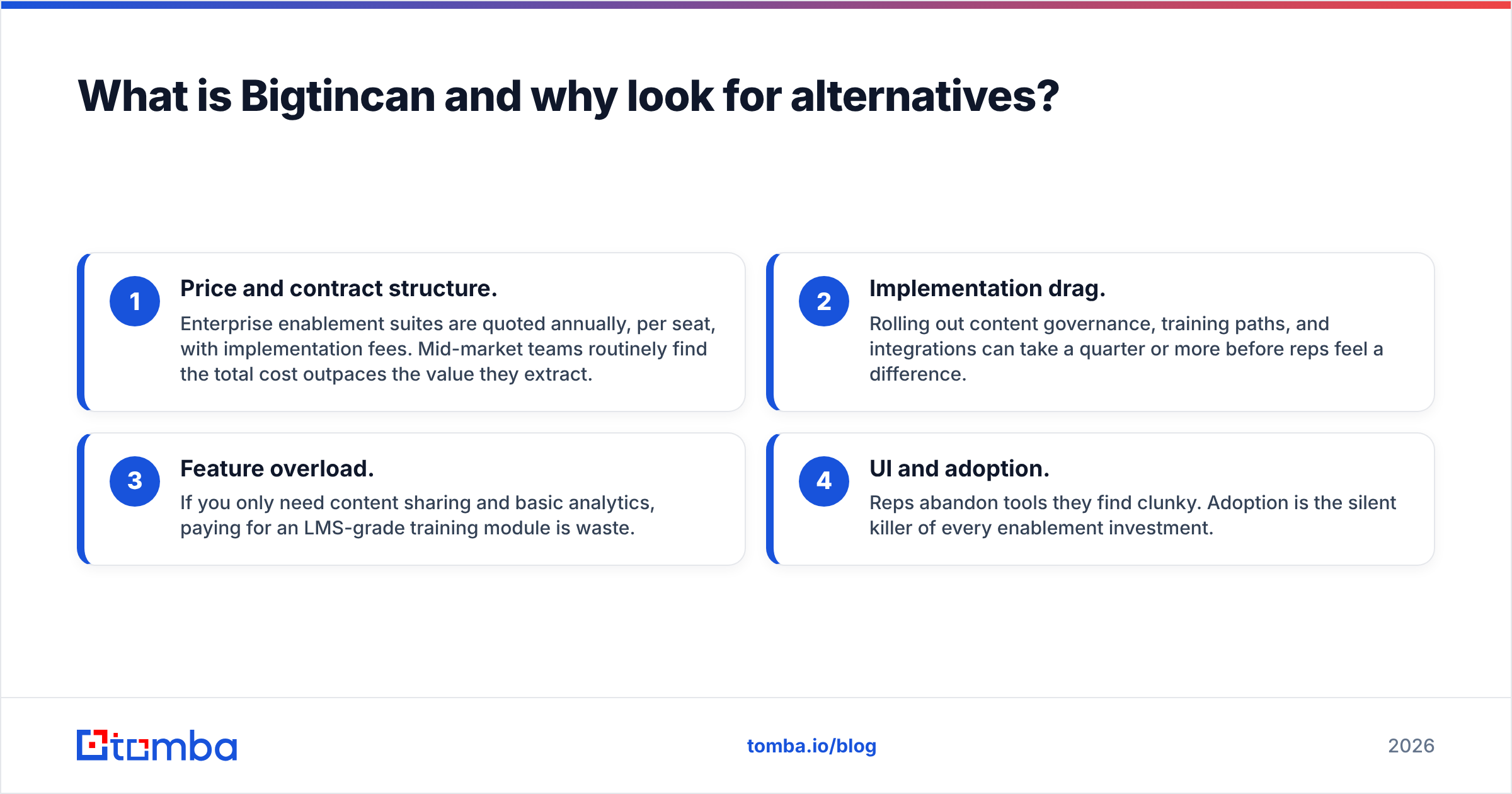
The trouble starts when your needs are narrower than the suite. Teams switch away from Bigtincan for a handful of recurring reasons:
- Price and contract structure. Enterprise enablement suites are quoted annually, per seat, with implementation fees. Mid-market teams routinely find the total cost outpaces the value they extract.
- Implementation drag. Rolling out content governance, training paths, and integrations can take a quarter or more before reps feel a difference.
- Feature overload. If you only need content sharing and basic analytics, paying for an LMS-grade training module is waste.
- UI and adoption. Reps abandon tools they find clunky. Adoption is the silent killer of every enablement investment.
You can read independent reviews on G2 and Gartner Peer Insights to sanity-check any vendor's marketing, but the short version is this: the right alternative depends on whether you need the whole suite or just one part of it.
How do the top Bigtincan alternatives compare?#
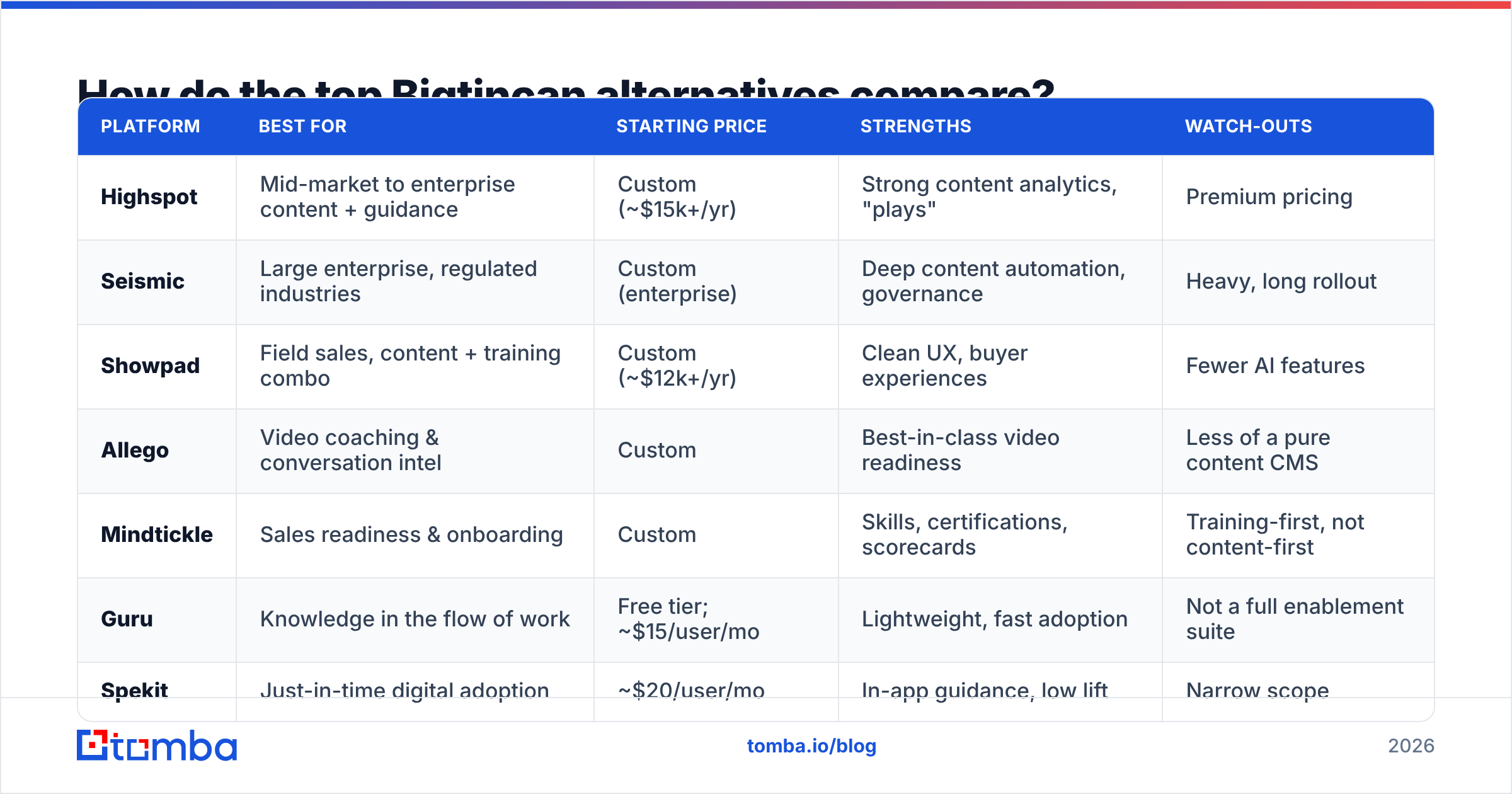
Here is a head-to-head on the attributes that actually drive a buying decision. Pricing reflects publicly available starting points and common quote ranges as of 2026; enterprise pricing is custom for nearly every vendor in this category.
| Platform | Best for | Starting price | Strengths | Watch-outs |
|---|---|---|---|---|
| Highspot | Mid-market to enterprise content + guidance | Custom (~$15k+/yr) | Strong content analytics, "plays" | Premium pricing |
| Seismic | Large enterprise, regulated industries | Custom (enterprise) | Deep content automation, governance | Heavy, long rollout |
| Showpad | Field sales, content + training combo | Custom (~$12k+/yr) | Clean UX, buyer experiences | Fewer AI features |
| Allego | Video coaching & conversation intel | Custom | Best-in-class video readiness | Less of a pure content CMS |
| Mindtickle | Sales readiness & onboarding | Custom | Skills, certifications, scorecards | Training-first, not content-first |
| Guru | Knowledge in the flow of work | Free tier; ~$15/user/mo | Lightweight, fast adoption | Not a full enablement suite |
| Spekit | Just-in-time digital adoption | ~$20/user/mo | In-app guidance, low lift | Narrow scope |
The 11 alternatives, briefly#
- Highspot — The most common like-for-like swap. Excellent content scoring and "sales plays" that tell reps what to send and when. If you want Bigtincan's breadth with a cleaner analytics story, start here.
- Seismic — The enterprise heavyweight, especially for financial services and other regulated verticals that need airtight content governance and personalization at scale.
- Showpad — A strong balance of content management and training with a UX reps actually like. Good for field and channel sales.
- Allego — Built around video, role-play, and conversation intelligence. Pick it when coaching and rep readiness matter more than a content portal.
- Mindtickle — Readiness-first. Onboarding, certifications, and skill scorecards. Best when ramp time is your bottleneck.
- Guru — A wiki and knowledge layer that surfaces answers inside Slack, Chrome, and your CRM. Light, cheap, and fast to adopt.
- Spekit — In-app, just-in-time guidance and digital adoption. Ideal if your real problem is "reps don't know how to use our tools."
- Salesforce Enablement (formerly myTrailhead) — If you live in Salesforce, native enablement keeps everything in one platform. See Salesforce for the current packaging.
- Brainshark (now part of Bigtincan's competitive set under Mindtickle) — Readiness and video coaching for teams that prioritize practice.
- Paperflite — A nimble content management and tracking tool for smaller teams that want engagement analytics without enterprise overhead.
- Enablix — Budget-friendly content enablement aimed squarely at mid-market and startups.
Is Highspot or Seismic the better Bigtincan replacement?#
Choose Highspot if you lead with content guidance; choose Seismic if you lead with governance and scale. That is the cleanest way to split the two.
Highspot's reputation rests on its content analytics and "sales plays" — packaged recommendations that nudge a rep toward the right asset for a given deal stage. It tends to win mid-market and upper-mid-market evaluations where adoption and usability are weighted heavily.
Seismic is the choice when you have thousands of seats, strict compliance requirements, and a content operation that needs automated personalization (think dynamic decks assembled per account). It is more platform than tool, which is both its strength and its rollout cost.
Bigtincan sits between them with a broader bundle. If you are leaving Bigtincan specifically because the bundle was too much, Highspot or a lighter pick like Guru will feel like relief. If you are leaving because Bigtincan was not enough at enterprise scale, Seismic is the upgrade path. Cross-check both on Gartner before committing — analyst quadrants shift year to year.
What about lighter, cheaper alternatives?#
Not every team needs a suite. If your reps mostly need the right answer at the right moment, the lightweight tier delivers most of the value at a fraction of the cost.
- Guru shines as a knowledge base that lives inside the tools reps already use. Verification workflows keep answers current, and adoption is high because nobody has to leave Slack or their CRM.
- Spekit overlays guidance on top of your existing apps. When a rep opens an unfamiliar field in Salesforce, Spekit explains it inline. That is digital adoption, not content management — match the tool to the actual problem.
- Paperflite and Enablix give you content tracking and engagement analytics without enterprise pricing, which is often all a 10–50 rep team needs.
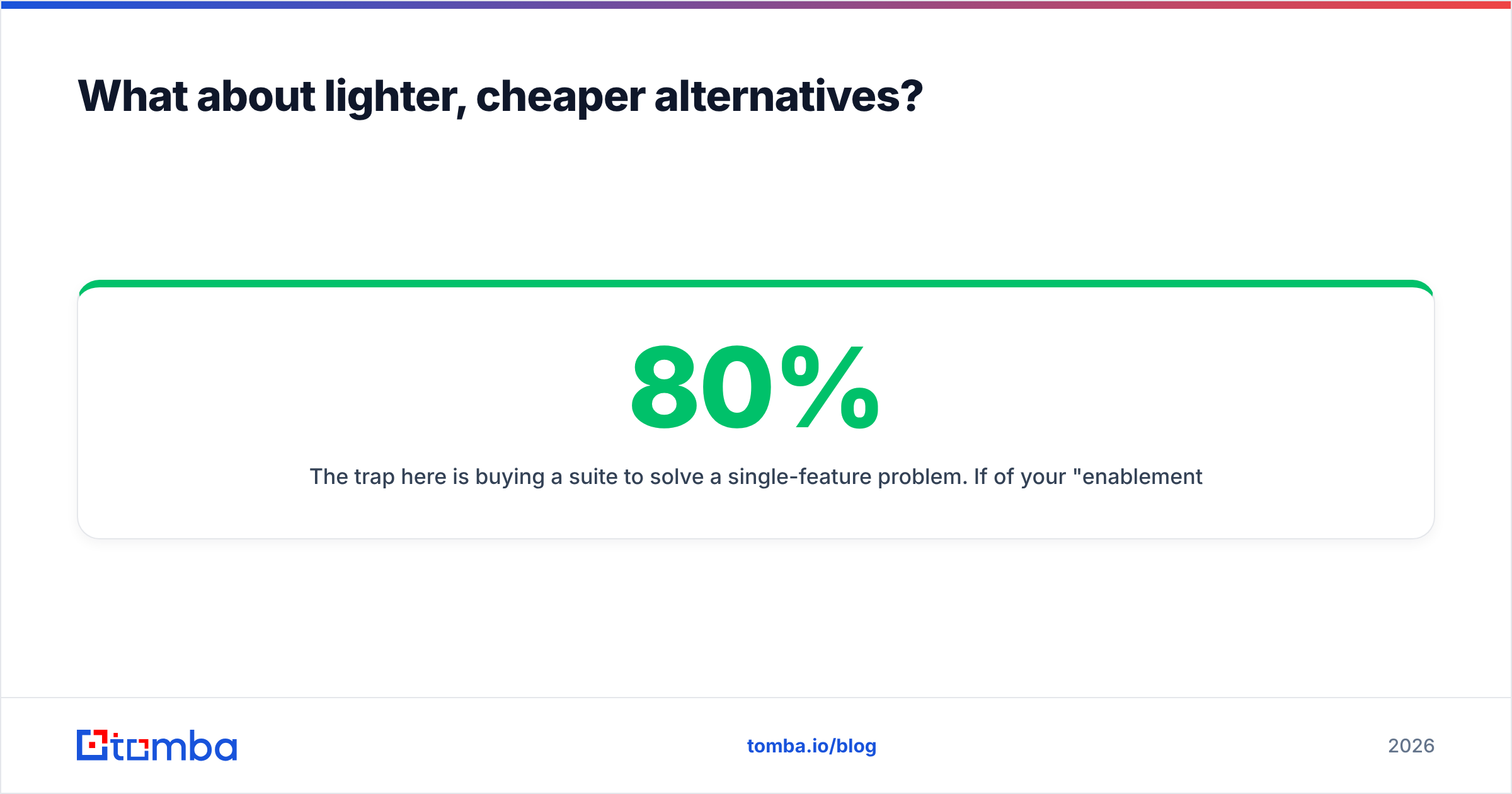
The trap here is buying a suite to solve a single-feature problem. If 80% of your "enablement gap" is reps not finding answers, a $15/user knowledge tool beats a $15,000/year platform.
Why does contact data decide whether enablement works?#
Here is the part most enablement comparisons skip: the best content in the world is wasted if it never reaches a real inbox. Enablement platforms optimize the message. They assume you already have an accurate, deliverable list of recipients. That assumption is usually wrong.
Picture a perfectly built sales play — the right one-pager, the right case study, the right follow-up cadence — sent to an email address that bounces. The enablement tool reports the asset as "shared." Your rep reports activity. But the buyer never saw a thing. Garbage data quietly defeats a five-figure enablement investment, and the dashboards won't tell you.

This is where a data enrichment and email-finding layer earns its place alongside — not instead of — your enablement stack. Before a single asset goes out, you want to:
- Find the right contact at the target account using a domain search to surface the people who match your buyer persona.
- Verify deliverability with an email verifier so your perfectly enabled reps aren't burning sends on dead addresses.
- Enrich the record with job title, seniority, and company data so the content recommendations your enablement tool makes are actually relevant.
Sales enablement and sales data are two halves of the same engine. One tells the rep what to say; the other ensures there is a real human on the other end to hear it.
Where does Tomba fit alongside an enablement tool?#
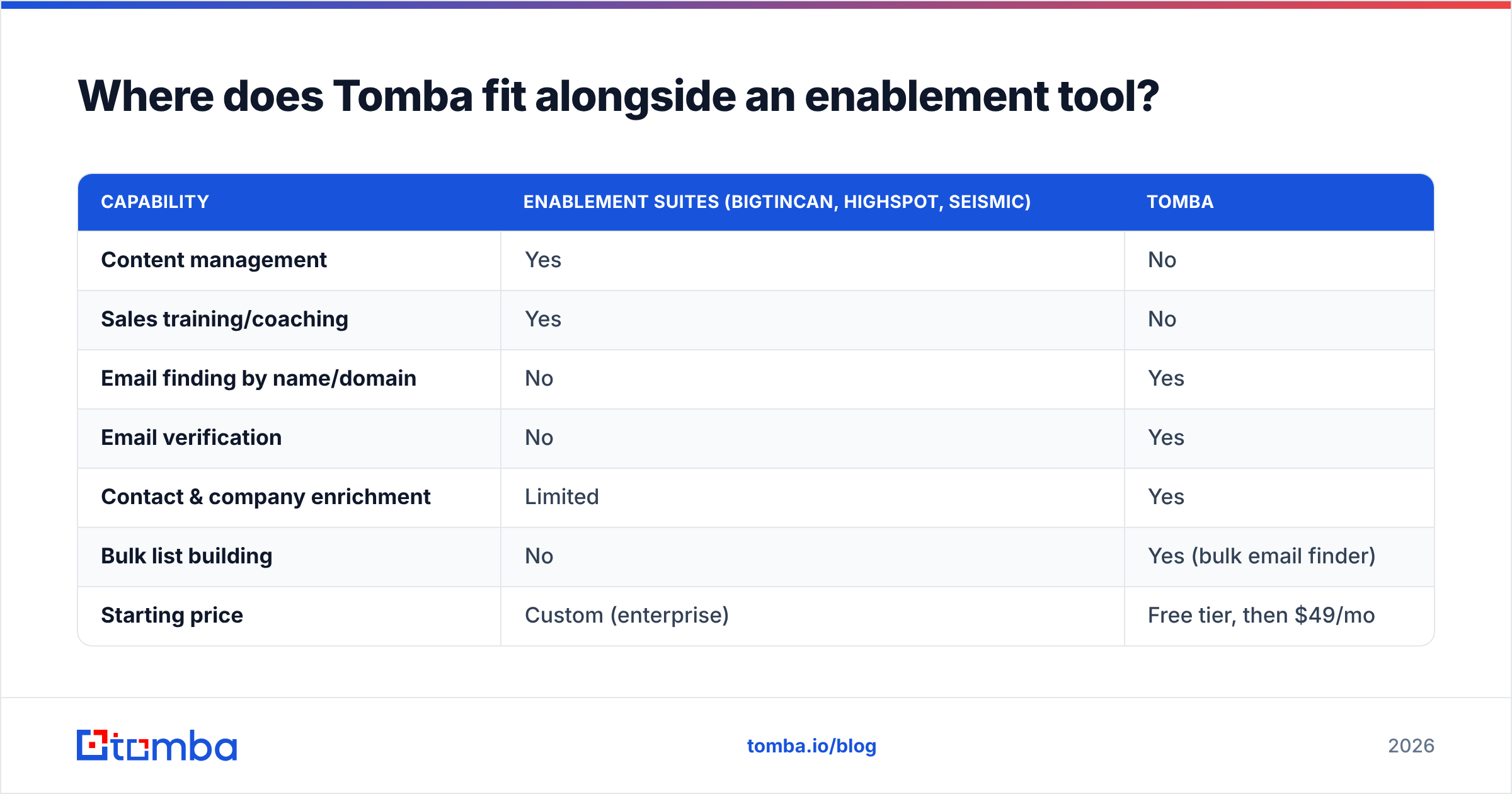
Tomba is not a Bigtincan competitor — it sits one layer earlier in the workflow and feeds clean data into whatever enablement and CRM stack you choose. Where Bigtincan, Highspot, or Seismic manage your content and coaching, Tomba makes sure the contacts those assets target are real and reachable.
| Capability | Enablement suites (Bigtincan, Highspot, Seismic) | Tomba |
|---|---|---|
| Content management | Yes | No |
| Sales training/coaching | Yes | No |
| Email finding by name/domain | No | Yes |
| Email verification | No | Yes |
| Contact & company enrichment | Limited | Yes |
| Bulk list building | No | Yes (bulk email finder) |
| Starting price | Custom (enterprise) | Free tier, then $49/mo |
Tomba's plans are transparent and built to scale with you: a Free tier (25 searches/month), Starter at $49/mo, Growth at $99/mo, Pro at $249/mo, and custom Enterprise. You can see the full breakdown on the Tomba pricing page. Compared to negotiating a custom enablement contract, the data layer is the easy, low-risk part of the stack to get right first.
A practical sequence for a team re-evaluating Bigtincan:
- Pick your enablement tier (suite vs. lightweight) from the table above based on team size and the problem you're actually solving.
- Audit your contact data quality. If bounce rates are above 3–5%, your data — not your content — is the bottleneck.
- Layer in finding and verification so every enabled message lands. Run new lists through verification before they enter sequences.
- Connect the pieces. Tomba pushes verified contacts into your CRM and enablement workflow via native integrations like HubSpot, Salesforce, and Pipedrive.
How should you choose the right Bigtincan alternative?#
Work backward from the problem, not the brand:
- You need the full suite at scale → Seismic or Highspot.
- You want the suite but lighter and cleaner → Showpad.
- Your bottleneck is ramp and readiness → Mindtickle or Allego.
- You just need answers in the flow of work → Guru or Spekit.
- You're Salesforce-native → Salesforce Enablement.
- You're a lean team on a budget → Paperflite or Enablix.
Then, regardless of which platform you land on, fix the data underneath it. The most sophisticated enablement program still depends on reaching a real person — and that has, quietly, always been the deciding factor.
The bottom line#
Bigtincan is a capable platform, but "capable" and "right for you" are different questions. For most teams, a more focused alternative — Highspot for guidance, Seismic for scale, Guru for lightweight knowledge — delivers better adoption at a saner price. Whatever you choose, remember that enablement and accurate prospect data are partners, not substitutes.
Start with the layer that gives you the fastest, lowest-risk win: clean, verified contact data. Spin up a free account and use the Tomba Email Finder to find and verify the right buyers by name, company, or domain — then let your enablement platform do what it does best, knowing every message is reaching a real inbox.
// get started
Find, verify and enrich your first contacts today
Start on the free plan with 25 searches a month, then scale when your team is ready.
Free plan · No credit card required · GDPR & CCPA
// about the author