Bigtincan vs Brainshark: Pricing, Reviews, Pros & Cons 2026
A neutral 2026 breakdown of Bigtincan and Brainshark pricing, real user reviews, and the honest pros and cons before you sign a sales enablement contract.
Bigtincan vs Brainshark: Pricing, Reviews, Pros & Cons 2026
If you are shortlisting sales enablement software in 2026, Bigtincan and Brainshark show up on almost every list. This guide breaks down Bigtincan Brainshark pricing, real user reviews, and the honest pros and cons. The two are closely tied. Bigtincan acquired Brainshark in 2021, so you are often choosing between two product lines under one roof. Below we cover what each costs and what users actually say. You can decide without sitting through three demo calls first.
TL;DR#
- Bigtincan is a broad sales enablement and content management suite (Bigtincan Hub) with AI-driven content recommendations, learning, and document automation. Brainshark is its readiness and coaching specialist — video coaching, scorecards, and training.
- Neither publishes public pricing. Both run quote-based, annual contracts. Real-world Bigtincan deals commonly start around $25–$39 per user/month (annual, minimum seat counts apply); Brainshark is typically bundled or quoted separately at a similar per-seat range.
- Reviews on G2 and Capterra put both in the 4.0–4.4 range: praised for content control and coaching, dinged for setup complexity, search, and support responsiveness.
- Pick Bigtincan if you want one platform for content + enablement at scale. Pick Brainshark if coaching, certification, and rep readiness are your primary pain.
- Enablement only pays off when reps reach the right contacts. Clean, verified contact data — via tools like the Tomba Email Finder — is the input that makes any enablement stack worth the spend.
What are Bigtincan and Brainshark?#
Think of Bigtincan as the warehouse-plus-concierge for your sales content, and Brainshark as the coach who makes sure reps can actually use it.
Bigtincan Hub is a sales enablement platform. It stores, organizes, and surfaces sales content. It then uses AI to recommend the right asset for a given deal stage or buyer. It also adds document automation, internal communications, and learning modules. Its pitch is "one platform" for content, training, and engagement.
Brainshark, now part of the Bigtincan family, focuses on sales readiness — onboarding, ongoing training, video coaching where reps record practice pitches, and AI-scored assessments. Managers build certification tracks and watch scorecards to spot who is ramp-ready and who is not.
Because Bigtincan owns Brainshark, you will sometimes be sold them together. Treat them as separate capabilities with overlapping logins, not a single seamless product.
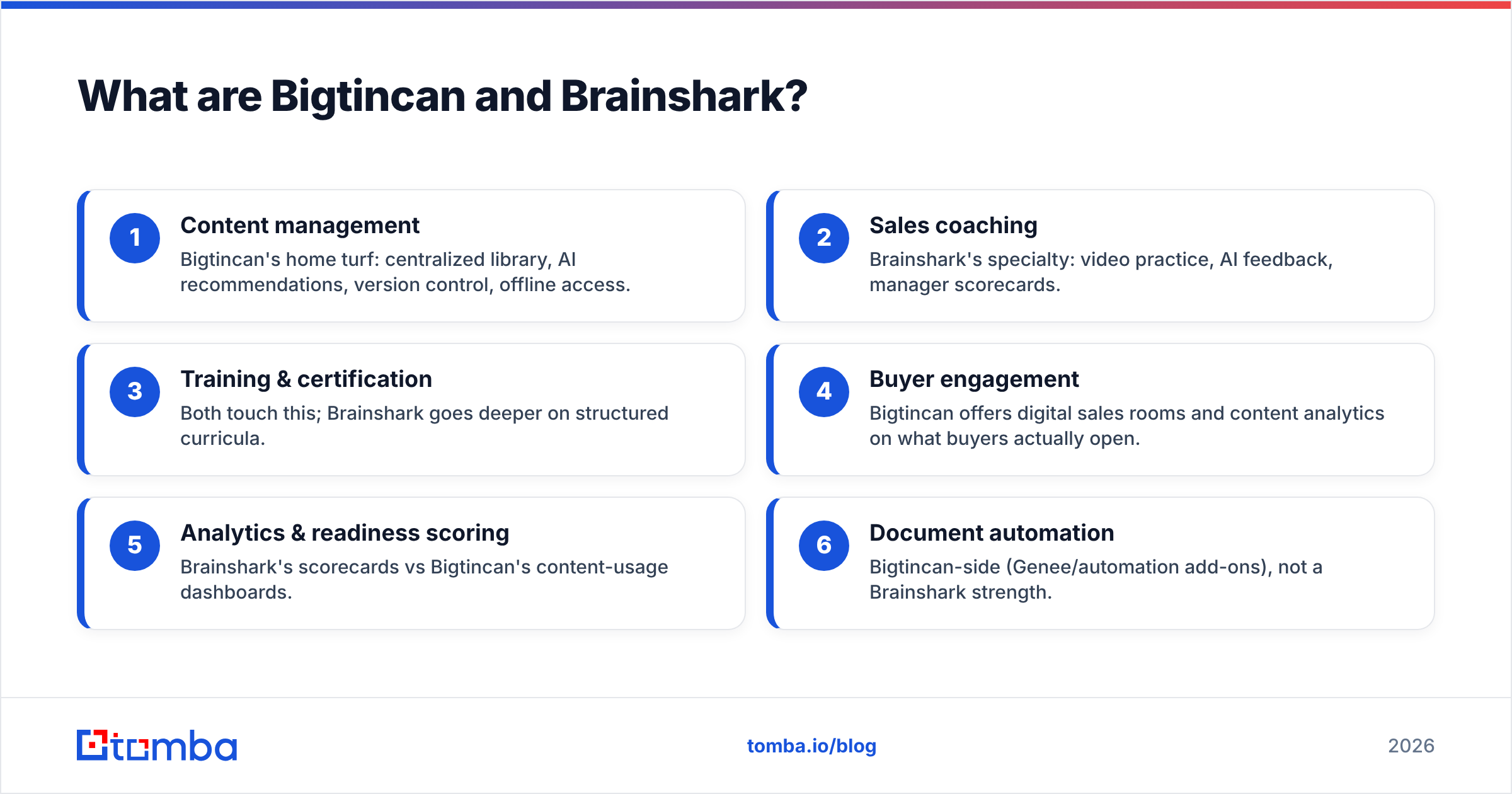
Here is the core split at a glance:
- Content management — Bigtincan's home turf: centralized library, AI recommendations, version control, offline access.
- Sales coaching — Brainshark's specialty: video practice, AI feedback, manager scorecards.
- Training & certification — Both touch this; Brainshark goes deeper on structured curricula.
- Buyer engagement — Bigtincan offers digital sales rooms and content analytics on what buyers actually open.
- Analytics & readiness scoring — Brainshark's scorecards vs Bigtincan's content-usage dashboards.
- Document automation — Bigtincan-side (Genee/automation add-ons), not a Brainshark strength.
Bigtincan Brainshark pricing: how much does each cost in 2026?#
Short answer: Bigtincan Brainshark pricing is not public, so you have to ask. Expect an annual contract with seat minimums. Neither vendor lists transparent rates on its site. That is normal for enterprise enablement, but it makes budgeting harder.
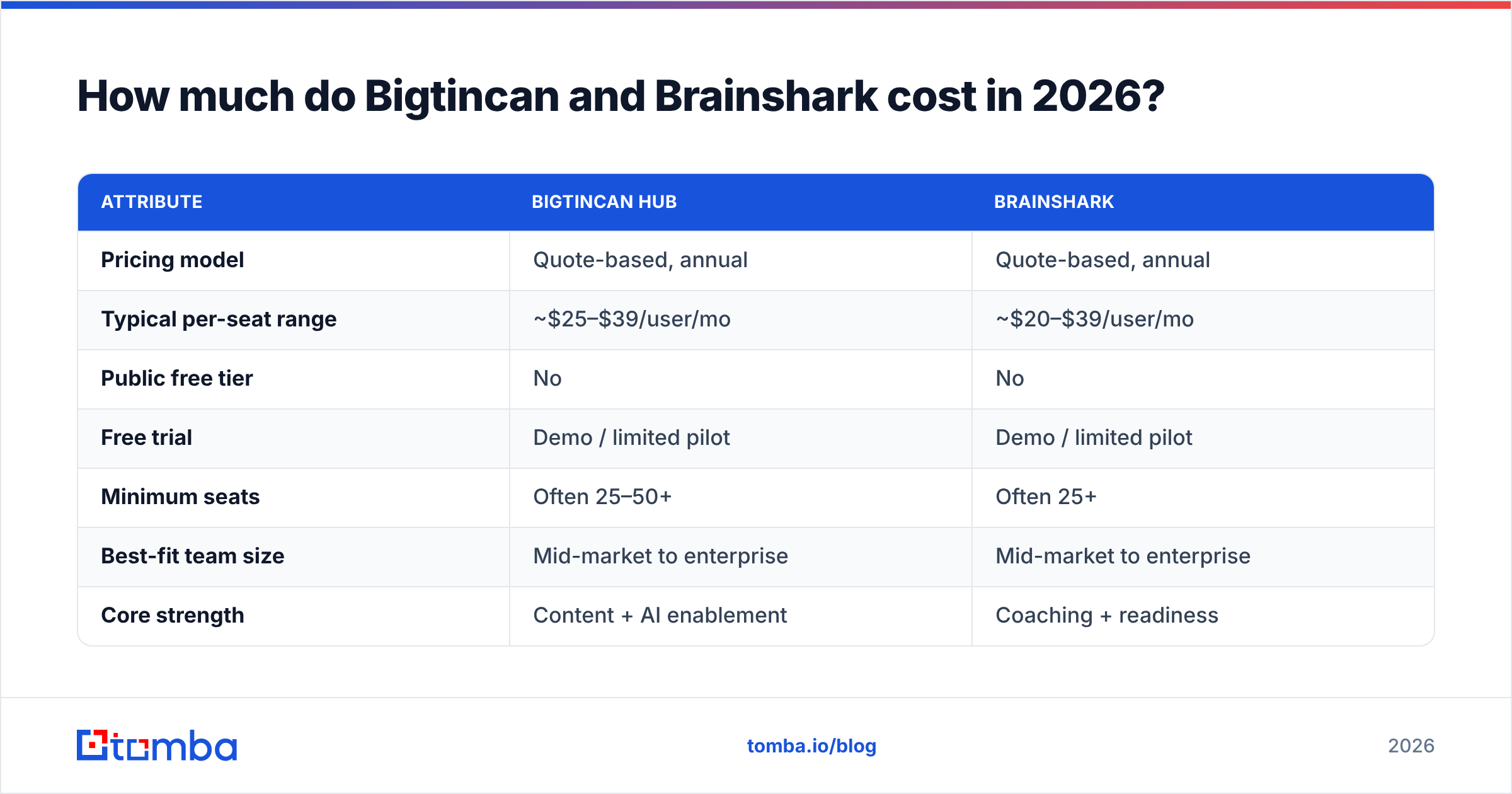
Based on aggregated buyer reports, review-site data, and reseller listings, here is a realistic picture. Treat these as directional ranges for negotiation, not quotes.
| Attribute | Bigtincan Hub | Brainshark |
|---|---|---|
| Pricing model | Quote-based, annual | Quote-based, annual |
| Typical per-seat range | ~$25–$39/user/mo | ~$20–$39/user/mo |
| Public free tier | No | No |
| Free trial | Demo / limited pilot | Demo / limited pilot |
| Minimum seats | Often 25–50+ | Often 25+ |
| Best-fit team size | Mid-market to enterprise | Mid-market to enterprise |
| Core strength | Content + AI enablement | Coaching + readiness |
| Implementation | Weeks; can need a CSM | Weeks; curriculum setup |
| Contract length | Typically 12 months | Typically 12 months |
A few honest caveats:
- Add-ons inflate the number. Document automation, learning, and premium analytics are frequently separate line items. The "per seat" figure is rarely the all-in cost.
- Negotiation matters more than the rate card. Annual prepay, multi-year terms, and seat volume move the price significantly.
- Implementation and CSM fees can be a meaningful one-time add for larger rollouts.
For context, leading analysts like Gartner and peer reviews on G2 track this category if you want validation beyond a sales deck.
What do real reviews say about Bigtincan and Brainshark?#
Both products sit in the "solid but not flawless" zone — roughly 4.0 to 4.4 stars across G2 and Capterra, depending on the month and product line.
What reviewers consistently praise:
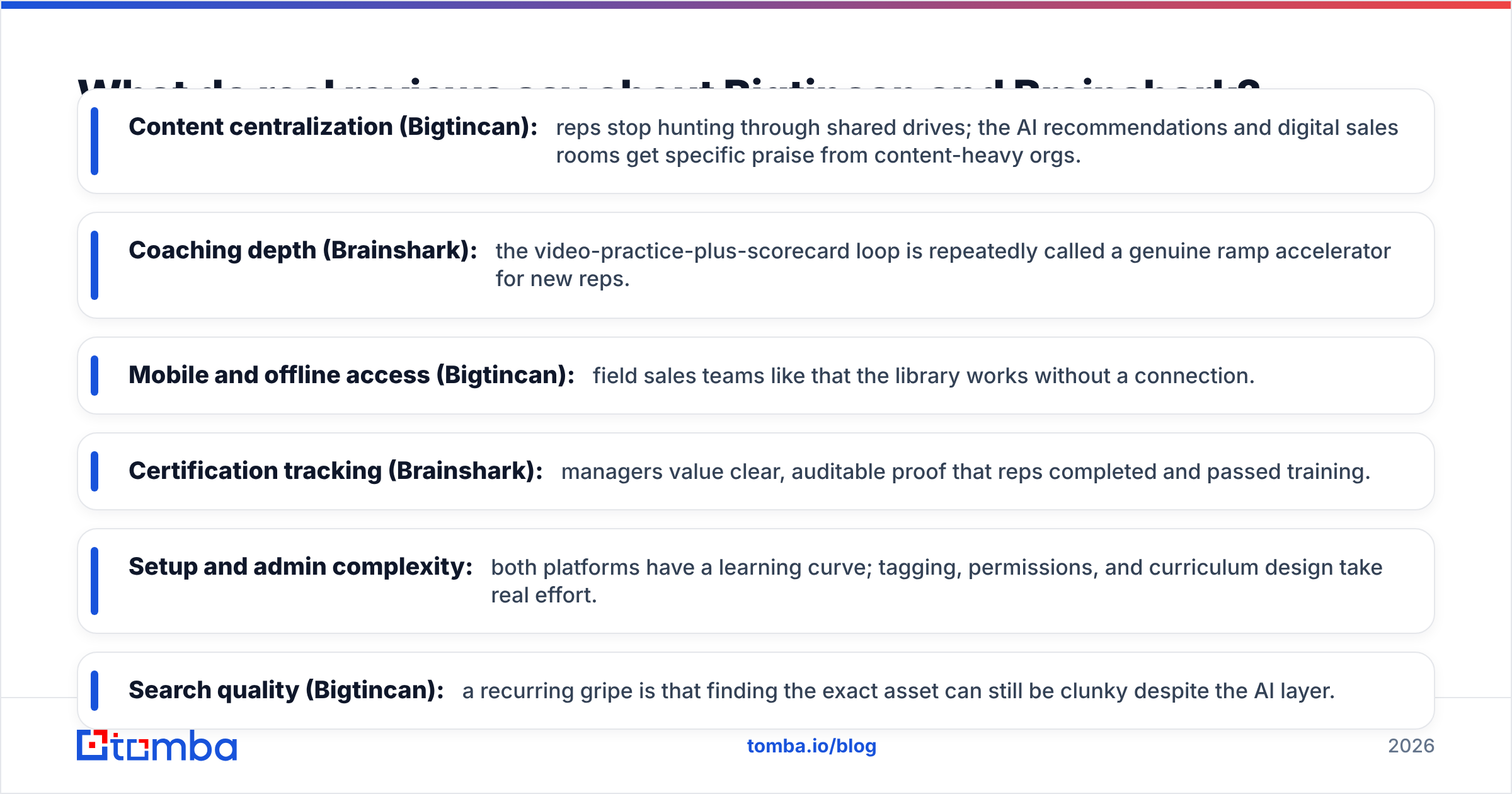
- Content centralization (Bigtincan): reps stop hunting through shared drives; the AI recommendations and digital sales rooms get specific praise from content-heavy orgs.
- Coaching depth (Brainshark): the video-practice-plus-scorecard loop is repeatedly called a genuine ramp accelerator for new reps.
- Mobile and offline access (Bigtincan): field sales teams like that the library works without a connection.
- Certification tracking (Brainshark): managers value clear, auditable proof that reps completed and passed training.
What reviewers consistently complain about:
- Setup and admin complexity: both platforms have a learning curve; tagging, permissions, and curriculum design take real effort.
- Search quality (Bigtincan): a recurring gripe is that finding the exact asset can still be clunky despite the AI layer.
- Support responsiveness: mixed reports, with some accounts citing slow ticket resolution post-sale.
- Price-to-value at the low end: smaller teams sometimes feel they are paying enterprise rates for features they do not use.
The pattern is clear. These are powerful tools. They reward teams that invest in setup, and they let down teams that buy without a rollout plan.
Is Bigtincan better than Brainshark?#
Neither is "better" — they answer different questions. Use this decision frame.
Choose Bigtincan if:
- Your biggest pain is content chaos: scattered decks, outdated one-pagers, no visibility into what buyers open.
- You want digital sales rooms and buyer engagement analytics.
- You need one platform spanning content, enablement, and some learning.
Choose Brainshark if:
- Your biggest pain is rep readiness: slow onboarding, inconsistent pitches, no objective coaching.
- You want structured certification and AI-scored practice video.
- Coaching ROI is easier for you to justify than a full content overhaul.
Choose both (or the bundle) if: you are a larger org that needs content management and a formal readiness program, and you have the admin capacity to run them.
| Use case | Best fit |
|---|---|
| Centralize and recommend sales content | Bigtincan |
| Coach reps with practice video + scoring | Brainshark |
| Buyer-facing digital sales rooms | Bigtincan |
| Structured onboarding & certification | Brainshark |
| Document automation | Bigtincan (add-on) |
| Small team, tight budget | Neither — consider lighter tools |

What are the pros and cons of each platform?#
Here is the unvarnished list.
Bigtincan — pros
- Deep, mature content management with AI recommendations.
- Strong mobile and offline experience for field teams.
- Digital sales rooms and content-engagement analytics.
- One vendor for content, learning, and (via Brainshark) coaching.
Bigtincan — cons
- No public pricing; expect annual contracts and seat minimums.
- Search can frustrate despite the AI layer.
- Admin setup and tagging are non-trivial.
- Cost-to-value feels steep for very small teams.
Brainshark — pros
- Best-in-class video coaching and AI scoring.
- Clear certification and readiness tracking for managers.
- Proven onboarding accelerator for new-rep ramp.
Brainshark — cons
- Narrower than a full enablement suite on its own.
- Curriculum design takes upfront work.
- Also quote-based; bundling can complicate the line items.
- Overlap with Bigtincan can confuse buyers on what they actually own.
What should you check before signing a contract?#
Before you commit to a 12-month enablement deal, run this short due-diligence list:
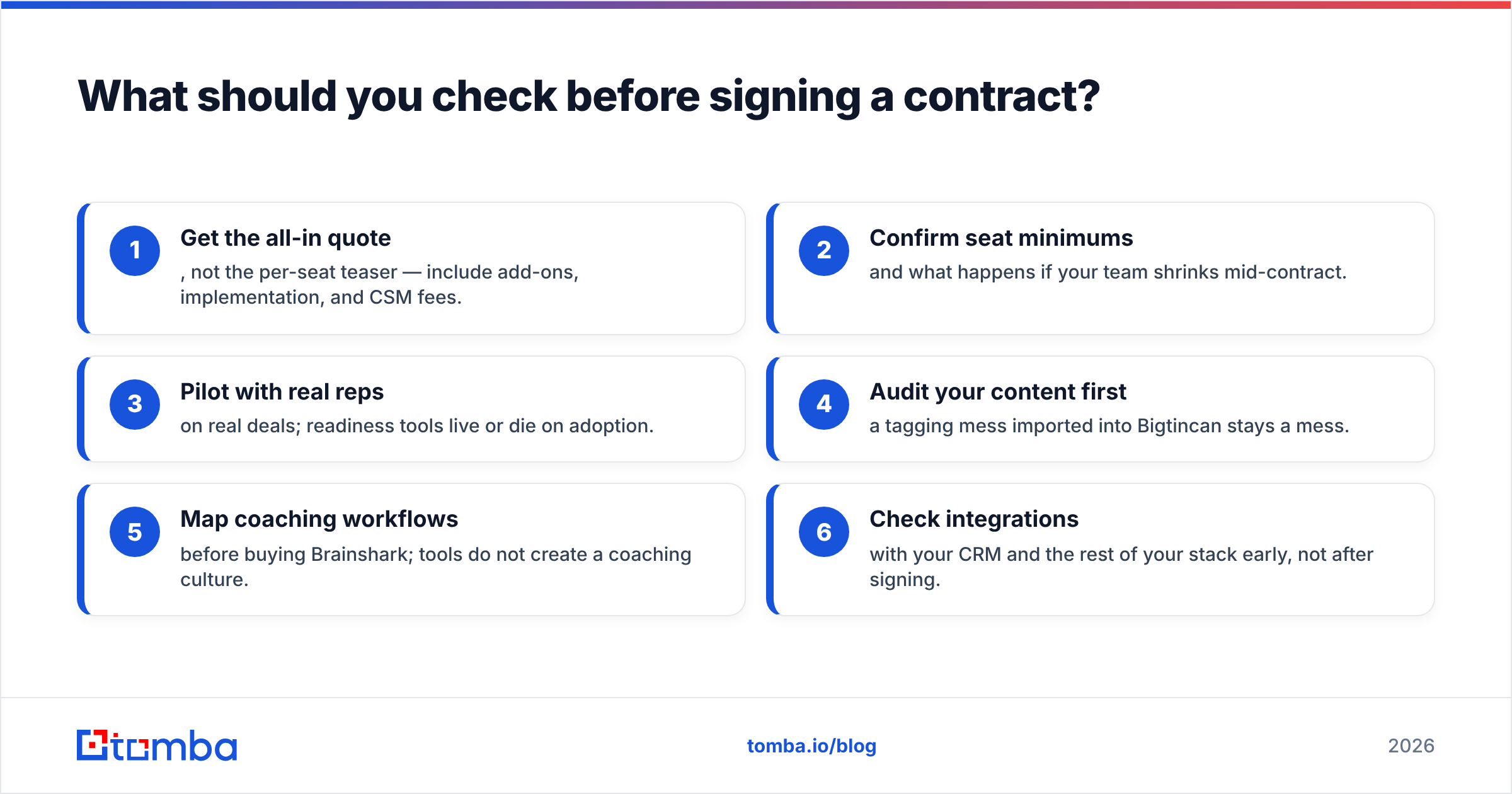
- Get the all-in quote, not the per-seat teaser — include add-ons, implementation, and CSM fees.
- Confirm seat minimums and what happens if your team shrinks mid-contract.
- Pilot with real reps on real deals; readiness tools live or die on adoption.
- Audit your content first — a tagging mess imported into Bigtincan stays a mess.
- Map coaching workflows before buying Brainshark; tools do not create a coaching culture.
- Check integrations with your CRM and the rest of your stack early, not after signing.
That last point matters more than buyers expect. Enablement platforms sit downstream of your CRM and prospecting data. Stale or wrong contact records break the whole flow. Even the slickest digital sales room is just pitching to a dead inbox.
Where does data quality fit into sales enablement?#
Enablement makes reps better at selling — it does not find them someone to sell to. That is a separate, upstream job.
Analogy: Bigtincan and Brainshark are like a world-class kitchen and a Michelin training program. They make your chefs excellent. But if the ingredients are spoiled, dinner still fails. Your "ingredients" are accurate prospect contact data — verified emails, direct phone numbers, and enriched company records.
This is where a lot of enablement investments quietly underperform. Reps trained to perfection still waste hours on bounced emails and wrong numbers. The fix is to pair your stack with reliable email verification and a fast way to find email addresses by domain or name. For teams running outbound at volume, a bulk email finder keeps lists clean before they ever hit a sequence. Trained reps then spend their time selling, not scrubbing data.
Frequently asked questions#
Is Brainshark the same company as Bigtincan? Yes — Bigtincan acquired Brainshark in 2021. Brainshark continues as the readiness and coaching product within the Bigtincan portfolio.
Does Bigtincan or Brainshark publish pricing? No. Both use quote-based, annual contracts with seat minimums. Bigtincan Brainshark pricing usually lands around $20–$39 per user per month before add-ons. Always negotiate the all-in figure.
Is there a free trial? Neither offers a self-serve free tier. You get a demo and, for serious buyers, a limited pilot.
Which is better for onboarding new reps? Brainshark, thanks to its video coaching, AI scoring, and certification tracking.
Which is better for managing sales content? Bigtincan, with its AI-driven content library, digital sales rooms, and engagement analytics.
The bottom line#
Bigtincan and Brainshark are credible, mature picks. Bigtincan leads on content-led enablement, and Brainshark leads on coaching and readiness. Since they share a parent, you can buy the pieces you need. Just go in knowing the pricing is opaque, the setup is real work, and value depends on adoption.
But remember the upstream truth: enablement only converts when reps reach real, reachable people. Before you spend five figures making reps better, make sure their target list is accurate. Start with the Tomba Email Finder to find and verify professional emails by domain, name, or company. Feed clean records into your CRM and enablement stack, and let your coached reps spend their time closing instead of chasing bounces. Check Tomba pricing (free tier included) and turn your enablement investment into actual pipeline.
// get started
Find, verify and enrich your first contacts today
Start on the free plan with 25 searches a month, then scale when your team is ready.
Free plan · No credit card required · GDPR & CCPA
// about the author