Bigtincan Pricing, Reviews, Pros and Cons (2026 Guide)
A neutral 2026 breakdown of Bigtincan pricing, real user reviews, and the pros and cons sales teams weigh before buying this enablement platform.
Bigtincan is one of the better-known sales enablement platforms, but its pricing is famously opaque and its reviews are split. If you are evaluating it in 2026, you need the unvarnished version: what it costs, what it actually does well, and where buyers get frustrated after signing.
TL;DR: Is Bigtincan worth it in 2026?#
- Pricing is quote-only. Bigtincan does not publish list prices. Most teams report effective costs in the $25–$45 per user per month range, billed annually, with platform fees and onboarding on top.
- Strongest for content management and readiness. Its sweet spot is governing a large content library and running sales training/coaching at scale — not lead generation.
- Reviews are polarized. Users praise the unified hub and AI features; they criticize the learning curve, admin overhead, and rigid annual contracts.
- Best fit: mid-market and enterprise teams with a big content problem and a budget for onboarding. Overkill for small teams.
- It is not a data tool. Bigtincan helps you use content with prospects you already have. To find those prospects, you still need a prospecting and email finder layer.
What is Bigtincan and what does it actually do?#
Bigtincan is a sales enablement platform — think of it as a smart filing cabinet plus a coaching gym for your revenue team. The filing cabinet keeps every pitch deck, case study, and one-pager in one searchable place so reps stop emailing each other for "the latest version." The gym handles training, certification, and call coaching so reps actually get better over time.
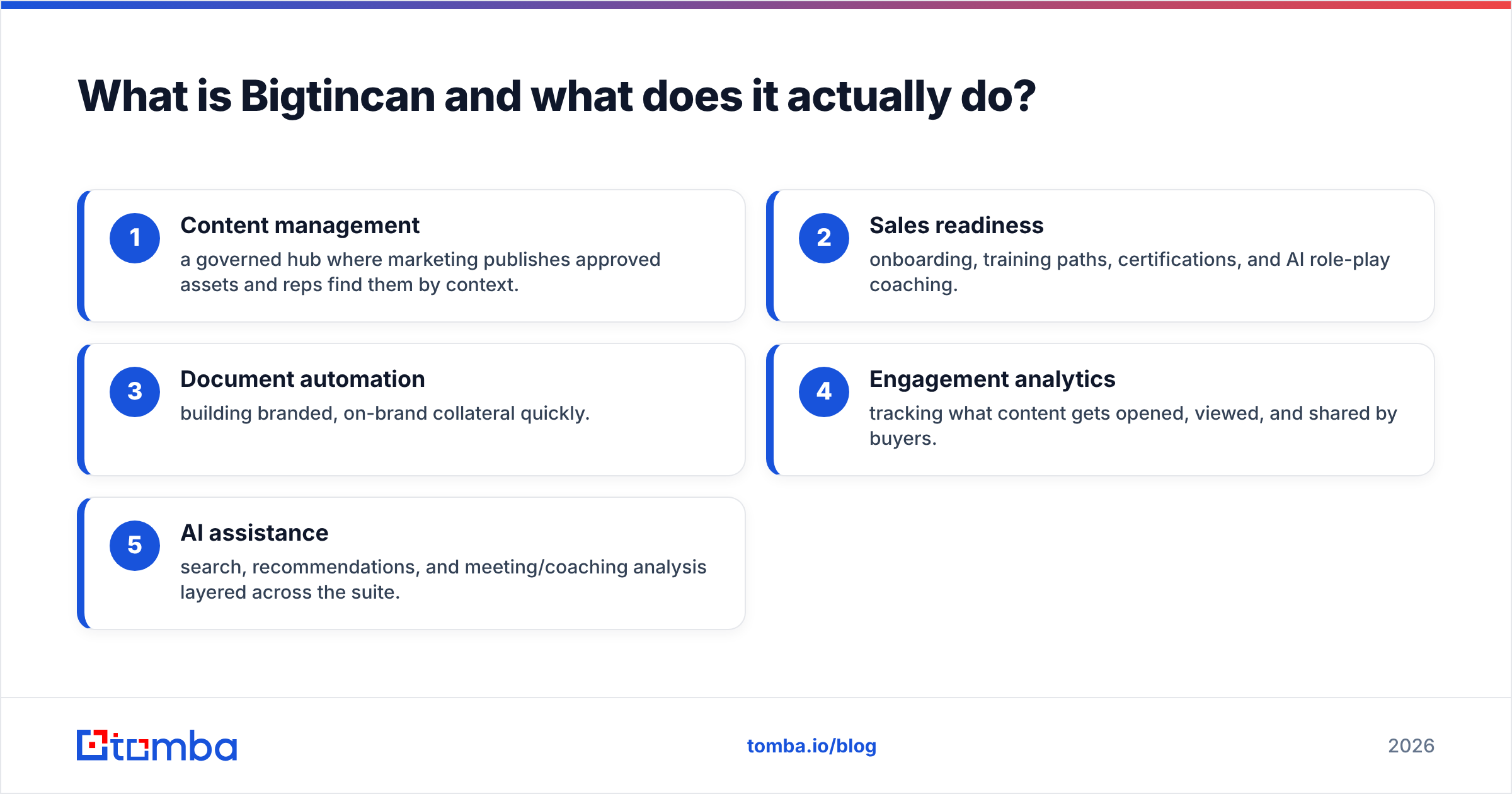
Technically, the product is a suite assembled partly through acquisitions (including Brainshark for readiness and several content and engagement tools). The core modules most buyers care about are:
- Content management — a governed hub where marketing publishes approved assets and reps find them by context.
- Sales readiness — onboarding, training paths, certifications, and AI role-play coaching.
- Document automation — building branded, on-brand collateral quickly.
- Engagement analytics — tracking what content gets opened, viewed, and shared by buyers.
- AI assistance — search, recommendations, and meeting/coaching analysis layered across the suite.
The platform competes with Highspot, Seismic, Showpad, and Mindtickle. Where it differentiates is breadth: it tries to be the single hub for content and readiness rather than specializing in one.
How much does Bigtincan cost in 2026?#
Short answer: Bigtincan does not publish pricing, so the only honest number is "it depends on your seat count and modules." You request a quote, sit through a demo, and negotiate.
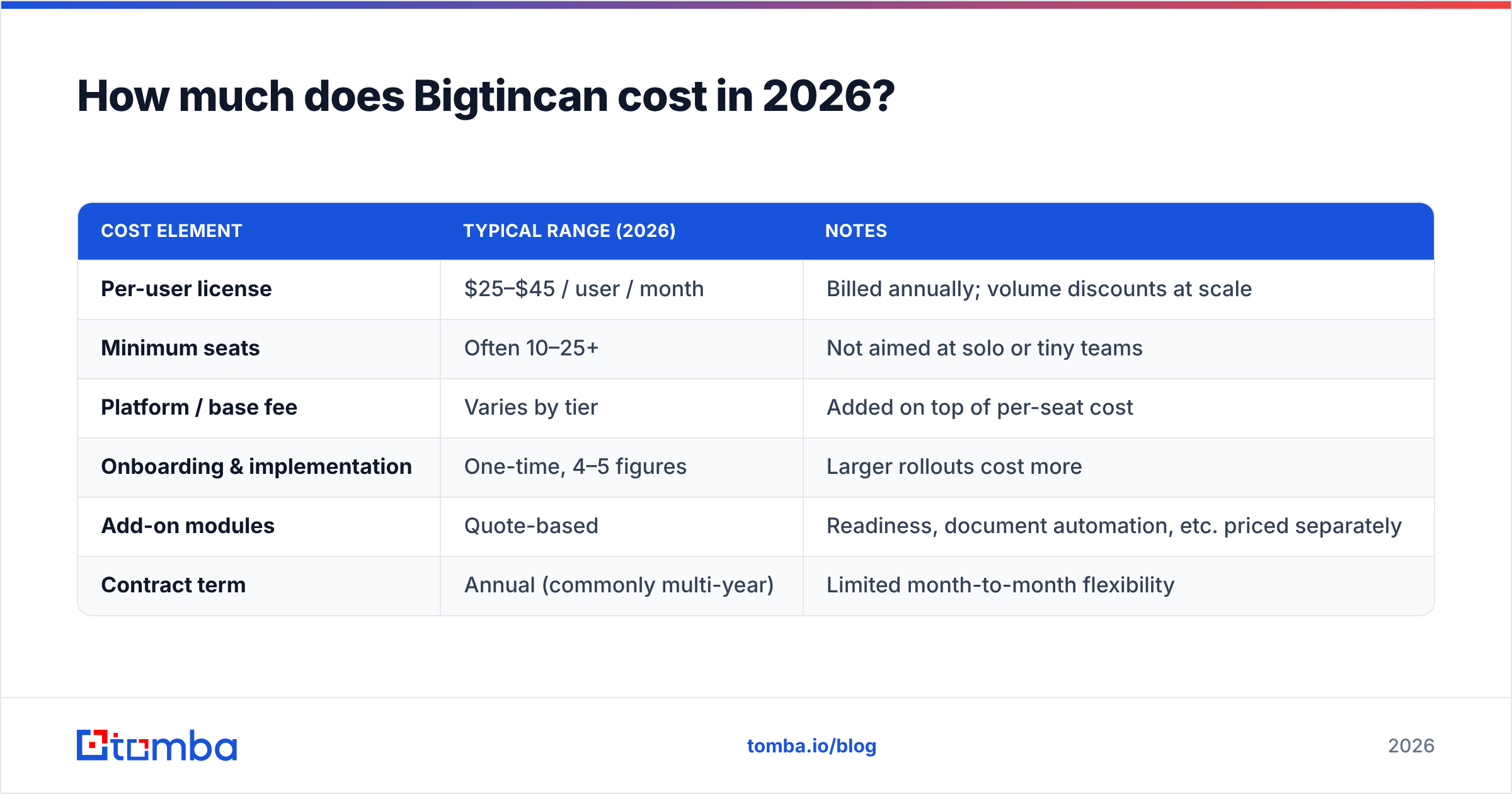
Based on user-reported figures and analyst summaries, here is a realistic picture. Treat these as directional, not official.
| Cost element | Typical range (2026) | Notes |
|---|---|---|
| Per-user license | $25–$45 / user / month | Billed annually; volume discounts at scale |
| Minimum seats | Often 10–25+ | Not aimed at solo or tiny teams |
| Platform / base fee | Varies by tier | Added on top of per-seat cost |
| Onboarding & implementation | One-time, 4–5 figures | Larger rollouts cost more |
| Add-on modules | Quote-based | Readiness, document automation, etc. priced separately |
| Contract term | Annual (commonly multi-year) | Limited month-to-month flexibility |
A few things buyers consistently report:
- No free plan. There is a demo and sometimes a trial, but no perpetual free tier.
- Annual commitment is the norm. Budgeting for a one-month pilot is hard.
- The sticker is the start. Implementation, premium modules, and added seats move the real number well above the headline per-user figure.
If transparent, self-serve pricing matters to you, that opacity is a genuine con. It is the opposite philosophy from tools that publish flat tiers — for example, you can read Tomba pricing on the page without booking a call.
What do Bigtincan reviews say — the real pros and cons?#
Across G2 and other review sites, Bigtincan lands in respectable-but-mixed territory. The pattern is consistent: people who fully adopt it like it, and people who treat it as a glorified Dropbox feel the cost.
Pros buyers mention most#
- One hub for everything. Content, training, and analytics under one login reduces tool sprawl.
- Powerful search and recommendations. Reps find the right asset by context instead of digging through folders.
- Strong readiness/coaching. The Brainshark-derived training and AI role-play features are genuine strengths.
- Engagement tracking. Seeing which content a buyer actually opened helps reps follow up with intent.
- Mobile experience. Field and frontline teams rate the mobile apps well.
Cons buyers mention most#
- Learning curve. Both admins and reps report a steep ramp; full value needs real change management.
- Admin overhead. Keeping the library governed and tidy is ongoing work, not set-and-forget.
- Opaque, rigid pricing. Quote-only sales and annual lock-in frustrate buyers who want flexibility.
- Breadth over depth. Because it spans many modules, some feel less polished than best-of-breed point tools.
- Support variance. Experiences range from excellent to slow depending on plan and account team.

Is Bigtincan better than Highspot or Seismic?#
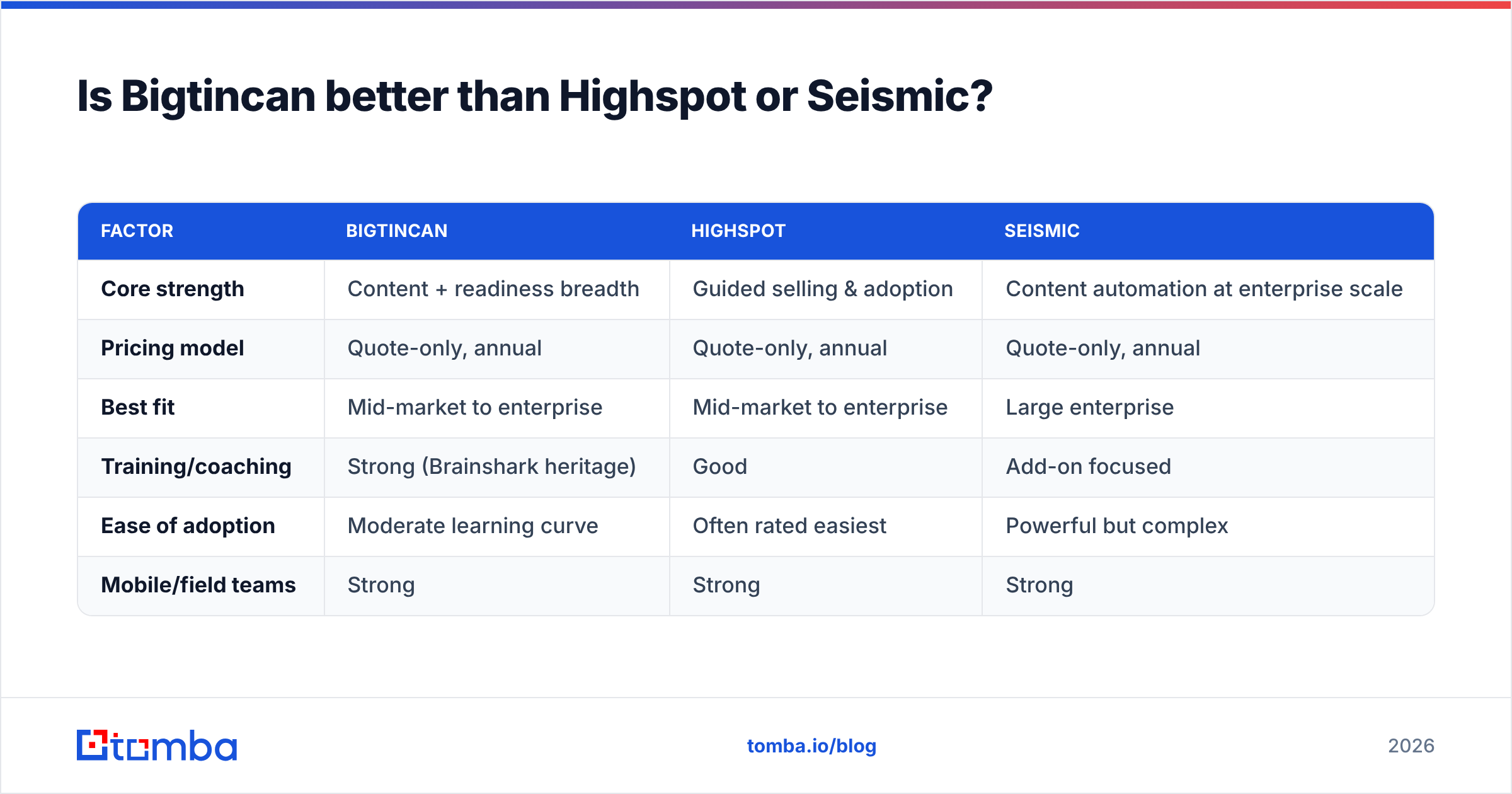
It depends on what problem dominates your quarter. Here is how the big three commonly get positioned.
| Factor | Bigtincan | Highspot | Seismic |
|---|---|---|---|
| Core strength | Content + readiness breadth | Guided selling & adoption | Content automation at enterprise scale |
| Pricing model | Quote-only, annual | Quote-only, annual | Quote-only, annual |
| Best fit | Mid-market to enterprise | Mid-market to enterprise | Large enterprise |
| Training/coaching | Strong (Brainshark heritage) | Good | Add-on focused |
| Ease of adoption | Moderate learning curve | Often rated easiest | Powerful but complex |
| Mobile/field teams | Strong | Strong | Strong |
None of them publishes prices, and all three sell annually through a sales motion. The practical decision usually comes down to: do you need the deepest training layer (lean Bigtincan), the smoothest rep adoption (lean Highspot), or the heaviest enterprise content engine (lean Seismic)? Analyst grids from Gartner and peer reviews are worth scanning before you commit.
Who should buy Bigtincan — and who should skip it?#
Buy it if:
- You have a real content-chaos problem: many assets, multiple teams, version-control pain.
- You run formal onboarding and ongoing rep certification and want it in the same place.
- You are mid-market or enterprise with budget for onboarding and change management.
- You have an admin or enablement owner who will maintain the library.
Skip it (for now) if:
- You are a small team that needs flat, transparent, month-to-month pricing.
- Your bigger gap is pipeline, not content. Enablement polishes how you sell to known buyers; it does not create new ones.
- You want to pilot in 30 days without an annual commitment.
That second point is the one teams underestimate. A sales enablement platform makes your existing conversations sharper. It does nothing if your reps have no one to talk to. Before you spend $30+ per seat governing content, make sure the top of your funnel is full.
Where does prospecting data fit around a tool like Bigtincan?#
Enablement and prospecting are two different jobs. Bigtincan answers "what do I show this buyer and how do I get better at selling?" It does not answer "who should I be selling to, and how do I reach them?"
That second question is where a data layer earns its keep, and it is far cheaper to run:
- Find the contacts. Use a domain search to pull verified work emails for a target company, or a bulk email finder to build a list from a named-account plan.
- Enrich what you have. Run data enrichment to fill in titles, companies, and contact details on partial CRM records before they ever hit your enablement workflow.
- Reach decision-makers directly. A phone finder adds dialable numbers for the accounts that matter most.
- Tap a B2B database. A maintained B2B database means you are not scraping from scratch every campaign.
The economics are different too. A full prospecting stack can cost less per month than a single Bigtincan seat, because it is priced transparently in published tiers rather than negotiated annually. You feed clean, verified contacts into your CRM, then let the enablement platform do what it is good at: helping reps win those conversations.
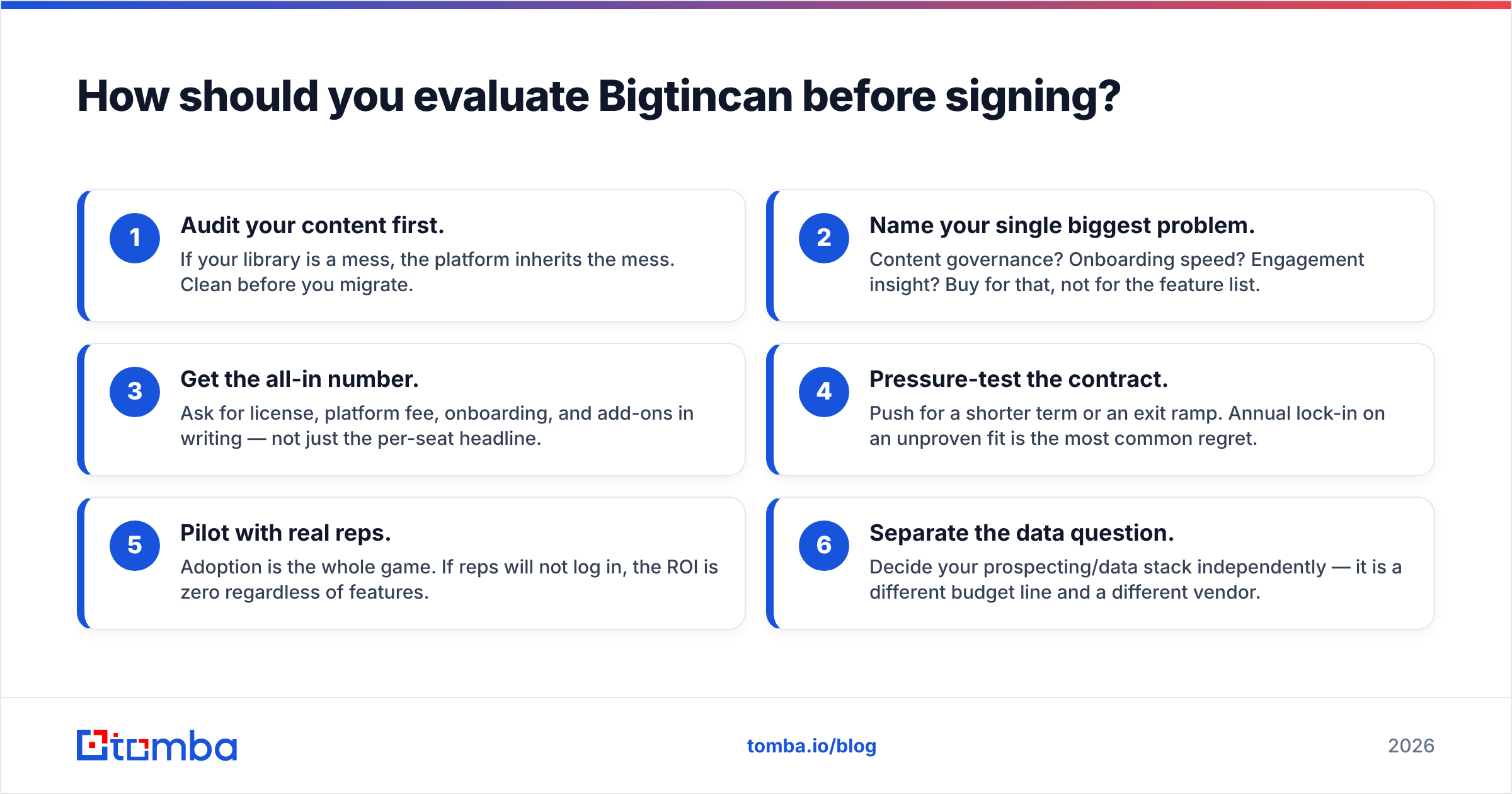
How should you evaluate Bigtincan before signing?#
Run a structured trial instead of trusting the demo. The demo always looks great; your data and your reps are the real test.
- Audit your content first. If your library is a mess, the platform inherits the mess. Clean before you migrate.
- Name your single biggest problem. Content governance? Onboarding speed? Engagement insight? Buy for that, not for the feature list.
- Get the all-in number. Ask for license, platform fee, onboarding, and add-ons in writing — not just the per-seat headline.
- Pressure-test the contract. Push for a shorter term or an exit ramp. Annual lock-in on an unproven fit is the most common regret.
- Pilot with real reps. Adoption is the whole game. If reps will not log in, the ROI is zero regardless of features.
- Separate the data question. Decide your prospecting/data stack independently — it is a different budget line and a different vendor.
Do this and you will know within a quarter whether Bigtincan is a strategic hub or an expensive content folder for your team.
The bottom line on Bigtincan pricing, reviews, pros and cons#
Bigtincan is a capable, broad sales enablement platform that rewards teams willing to invest in onboarding and governance. Its pros — unified content, strong readiness, solid analytics — are real. Its cons — opaque pricing, annual lock-in, and a learning curve — are equally real. For mid-market and enterprise teams with a genuine content problem, it can be worth the spend. For everyone else, the honest answer is "probably more platform than you need right now."
Whichever enablement tool you choose, the foundation underneath it is data. A great pitch deck means nothing without the right person to send it to. Tomba's Email Finder fills that gap — find and verify professional email addresses by name, company, or domain so your reps always have qualified, reachable contacts to enable. Start free with 25 searches a month, then scale on transparent plans starting at $49/mo. Build the pipeline first; let the enablement platform polish the close.
// get started
Find, verify and enrich your first contacts today
Start on the free plan with 25 searches a month, then scale when your team is ready.
Free plan · No credit card required · GDPR & CCPA
// about the author