Bizkonnect vs Bytemine: Which B2B Data Tool Wins in 2026?
BizKonnect sells actionable org charts; Bytemine sells a lead database. We compare data freshness, pricing, accuracy, and fit so you pick the right B2B data engine in 2026.
You are choosing between two B2B data tools that sound similar on a feature grid but solve different problems. This guide cuts through the overlap so you stop comparing apples to spreadsheets.
TL;DR — Bizkonnect vs Bytemine at a glance#
- BizKonnect is built around actionable org charts and account intelligence — visual maps of who reports to whom inside a target account, aimed at account-based marketing (ABM) and enterprise sellers.
- Bytemine is positioned as a lightweight B2B lead and prospecting database — pull company and contact lists, filter, and export for outbound.
- Neither tool's headline feature is verified, deliverable email at the moment you need it; both lean on periodically refreshed datasets that drift.
- If your real bottleneck is reaching the contacts you already know about, a dedicated finder-and-verifier stack beats either tool on freshness and cost.
- Our pick for most teams: use an org-chart or list tool for targeting, then layer a real-time email finder and email verifier for contact data you can actually send to.
What is BizKonnect?#
BizKonnect is a sales intelligence platform whose signature product is the actionable org chart. Instead of handing you a flat CSV of contacts, it tries to render the reporting structure of a target company — departments, hierarchy, and the people who sit in each box — so an account-based seller can see a buying committee at a glance.
That visual angle is genuinely useful for enterprise ABM, where a single deal touches eight to twelve stakeholders and you need to map champions, blockers, and economic buyers. BizKonnect also bundles company profiles, email campaign support, and account-mapping services, often delivered with a managed-service component rather than pure self-serve software.
The tradeoff: org charts are expensive to build and even more expensive to keep current. People change roles constantly, and a chart that was accurate last quarter quietly rots. BizKonnect's strength — structured, human-curated account maps — is also the thing most likely to be stale by the time you act on it.
What is Bytemine?#
Bytemine sits at the other end of the spectrum: a database-first prospecting tool. You filter by industry, geography, size, or role, and it returns lists of companies and contacts you can export into your sequencer or CRM. The promise is speed and volume — get a usable list in minutes without a research team.
That model is familiar from dozens of list providers, and the same caveats apply. Database tools win on breadth and price-per-record but lose on precision. Coverage varies wildly by region and seniority, and the contact fields you care about most — a current, mailbox-valid email — are exactly the fields that decay fastest in a static dataset.
So the honest framing of bizkonnect vs bytemine is not "which is better" but "which problem are you solving": account mapping (BizKonnect) or list volume (Bytemine). Many teams discover they actually need a third thing — accurate, on-demand contact data — that neither tool was designed to guarantee.
Bizkonnect vs Bytemine: how do they compare?#
Here is the side-by-side on the attributes that actually change your pipeline. Where public pricing is not transparent, treat figures as directional and confirm on a sales call.
| Attribute | BizKonnect | Bytemine | What it means for you |
|---|---|---|---|
| Primary job | Actionable org charts + ABM | B2B lead/list database | Targeting vs volume |
| Best fit | Enterprise ABM teams | SMB outbound, broad lists | Match to your motion |
| Data model | Curated, periodically refreshed | Database snapshot | Both drift over time |
| Email verification | Not the core focus | Limited / bulk export | Verify before you send |
| Self-serve vs managed | Often managed-service | Mostly self-serve | Speed vs hand-holding |
| Pricing transparency | Quote-based | Tiered/quote-based | Budget predictability |
| Real-time lookup | No | No | Freshness gap |
| API access | Limited | Limited | Automation ceiling |
The pattern is clear: both tools are good at finding accounts and names and weak at guaranteeing the email lands. That second job is where deals are won or lost, because a beautifully mapped buying committee is worthless if your message bounces.
Which tool has more accurate data?#
Accuracy depends on what you measure. For structure — who reports to whom — BizKonnect's curated charts can be more accurate than a raw database dump, because a human (or assisted process) built the hierarchy. For coverage — how many contacts exist for a given filter — a database tool like Bytemine usually returns more rows.
But the metric that pays your salary is deliverability: does the email you export actually reach an inbox? On that axis, both tools share the static-dataset problem. Independent reviews on sites like G2 repeatedly flag the same complaint across this category — bounce rates climb when contact records aren't re-verified at the moment of export.
This is why serious teams decouple targeting from contact data. You use an org chart or a list to decide who to reach, then you run those names through a live finder and verifier to get an address that's valid today. A static record that was correct six months ago is a coin flip now.
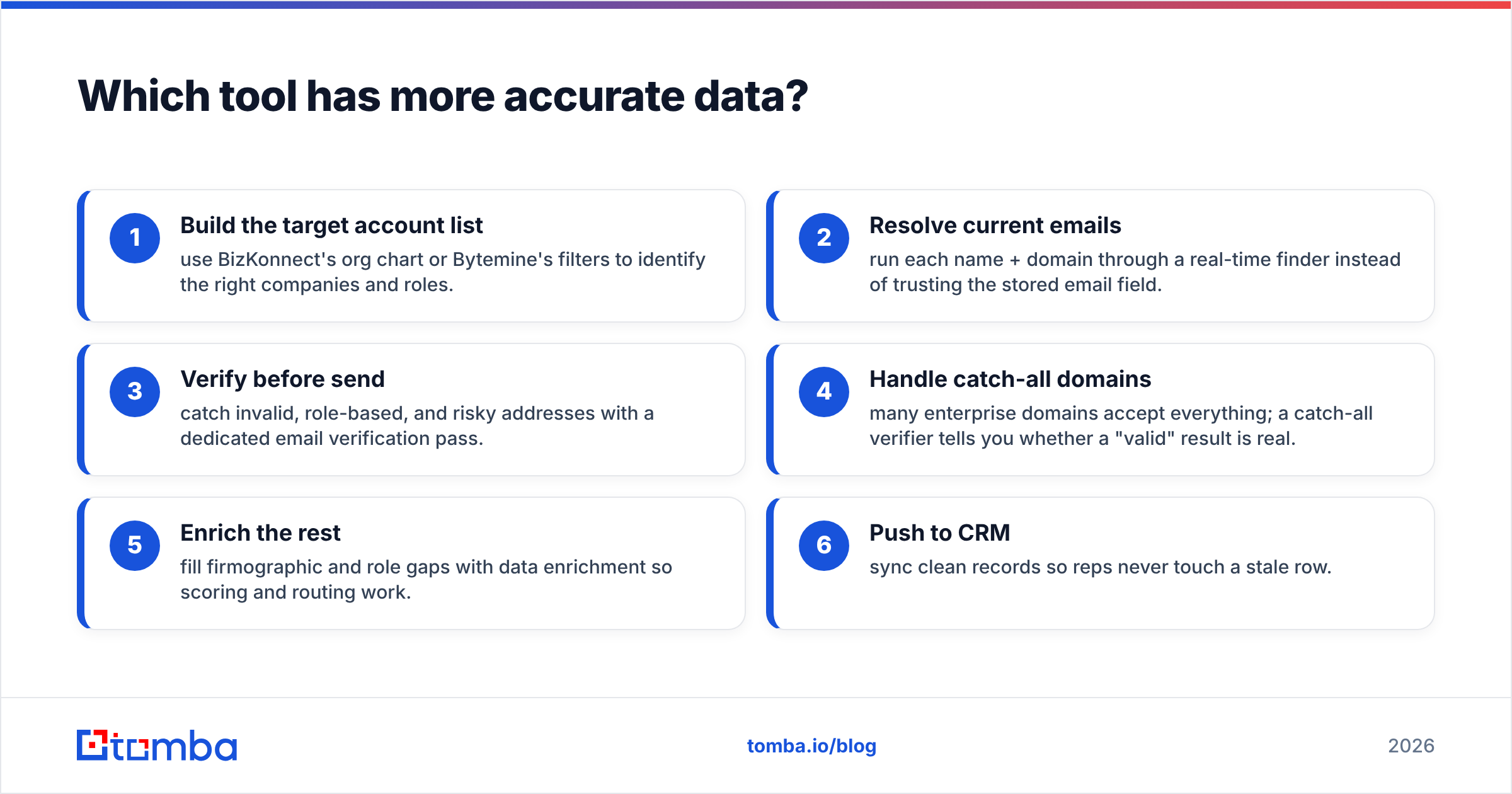
A practical accuracy workflow looks like this:
- Build the target account list — use BizKonnect's org chart or Bytemine's filters to identify the right companies and roles.
- Resolve current emails — run each name + domain through a real-time finder instead of trusting the stored email field.
- Verify before send — catch invalid, role-based, and risky addresses with a dedicated email verification pass.
- Handle catch-all domains — many enterprise domains accept everything; a catch-all verifier tells you whether a "valid" result is real.
- Enrich the rest — fill firmographic and role gaps with data enrichment so scoring and routing work.
- Push to CRM — sync clean records so reps never touch a stale row.
Do those six steps and your bounce rate drops regardless of which targeting tool you started with.
Bizkonnect vs Bytemine: which is better for ABM vs volume outbound?#
Pick by motion, not by feature count.
Choose BizKonnect if you run enterprise ABM, sell into large buying committees, and need to visualize hierarchy and influence. The org chart is its moat, and for a named-account seller chasing twenty logos, that visual context is worth more than another 10,000 rows of contacts. You're paying for structure and account strategy, often with managed-service help.
Choose Bytemine if you run high-volume SMB outbound and want lists fast and cheap. When your motion is "load 5,000 contacts into a sequence and let the funnel sort it out," breadth and price-per-record matter more than a polished hierarchy. You're paying for volume and self-serve speed.
Choose neither as your contact-data source if deliverability is the constraint. In both cases the email field is the weakest link, and that's the field everything downstream depends on. The smarter architecture is targeting tool plus a finder-verifier engine — and at that point you should compare what you're paying for the targeting layer against the cost of getting contact data right.
How does Tomba compare to Bizkonnect and Bytemine?#
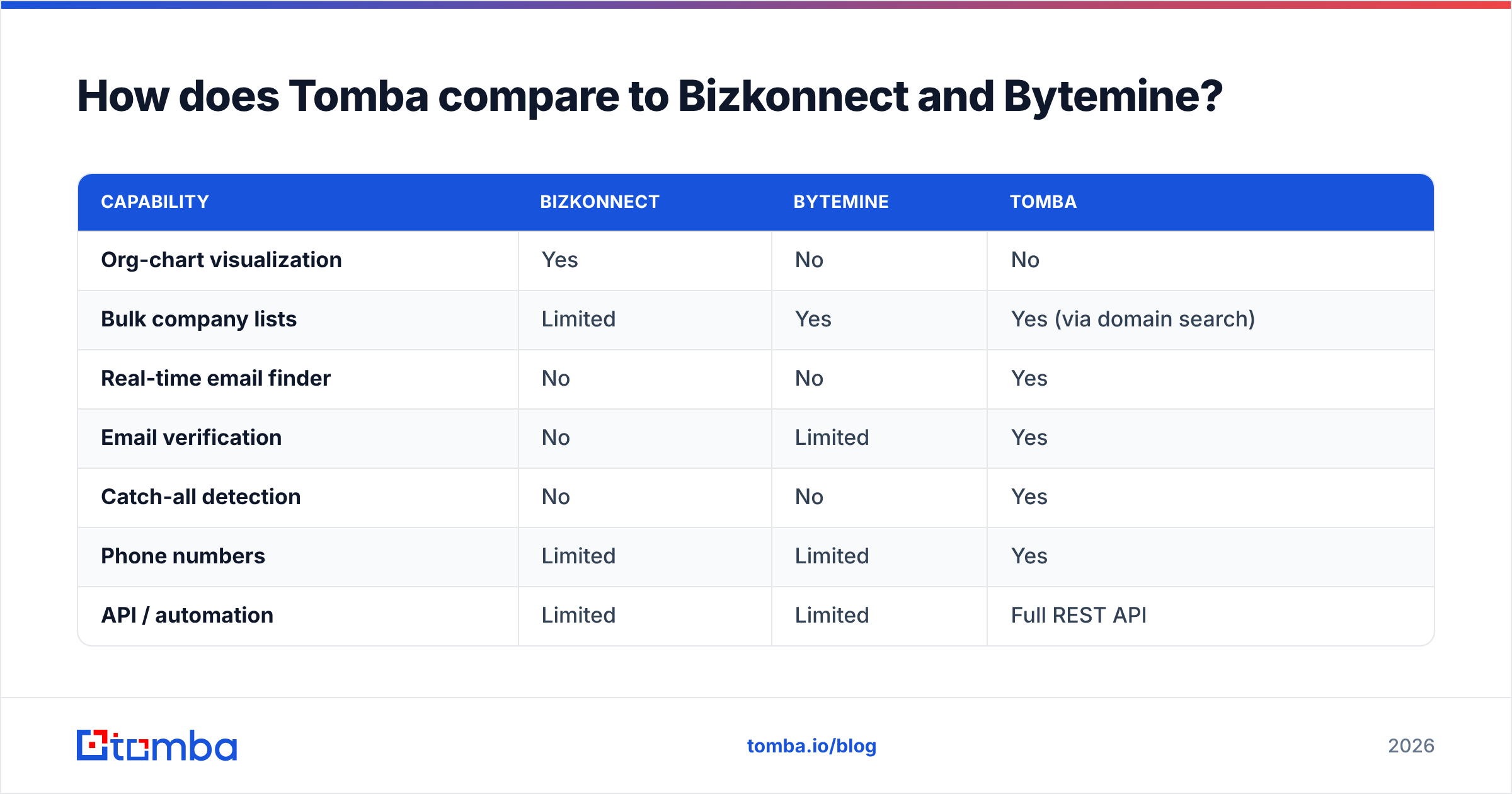
Tomba doesn't try to be an org-chart drawing tool or a giant static list. It's the contact-data layer both of those tools quietly depend on — built to return a current, verified email the moment you ask, not whatever was scraped last quarter.
Here's where the three approaches land:
| Capability | BizKonnect | Bytemine | Tomba |
|---|---|---|---|
| Org-chart visualization | Yes | No | No |
| Bulk company lists | Limited | Yes | Yes (via domain search) |
| Real-time email finder | No | No | Yes |
| Email verification | No | Limited | Yes |
| Catch-all detection | No | No | Yes |
| Phone numbers | Limited | Limited | Yes |
| API / automation | Limited | Limited | Full REST API |
| Free tier | No | Varies | 25 searches/mo |
| Entry price | Quote | Quote | $49/mo |
Tomba's domain search returns every public email pattern for a company, the B2B database covers contacts at scale, and the whole thing is reachable through the Tomba API so you can wire it directly behind whichever targeting tool you keep. You can run a free tier (25 searches/month), then move to Starter at $49/mo, Growth at $99/mo, or Pro at $249/mo — see full Tomba pricing for the breakdown. That transparency alone is a contrast with the quote-only pricing common in this category.
The point isn't that Tomba replaces account mapping or list building. It's that the email — the thing that determines whether any of that targeting work converts — should come from a tool engineered for freshness and verification, not bolted onto a dataset built for a different job.
What about pricing and ROI?#
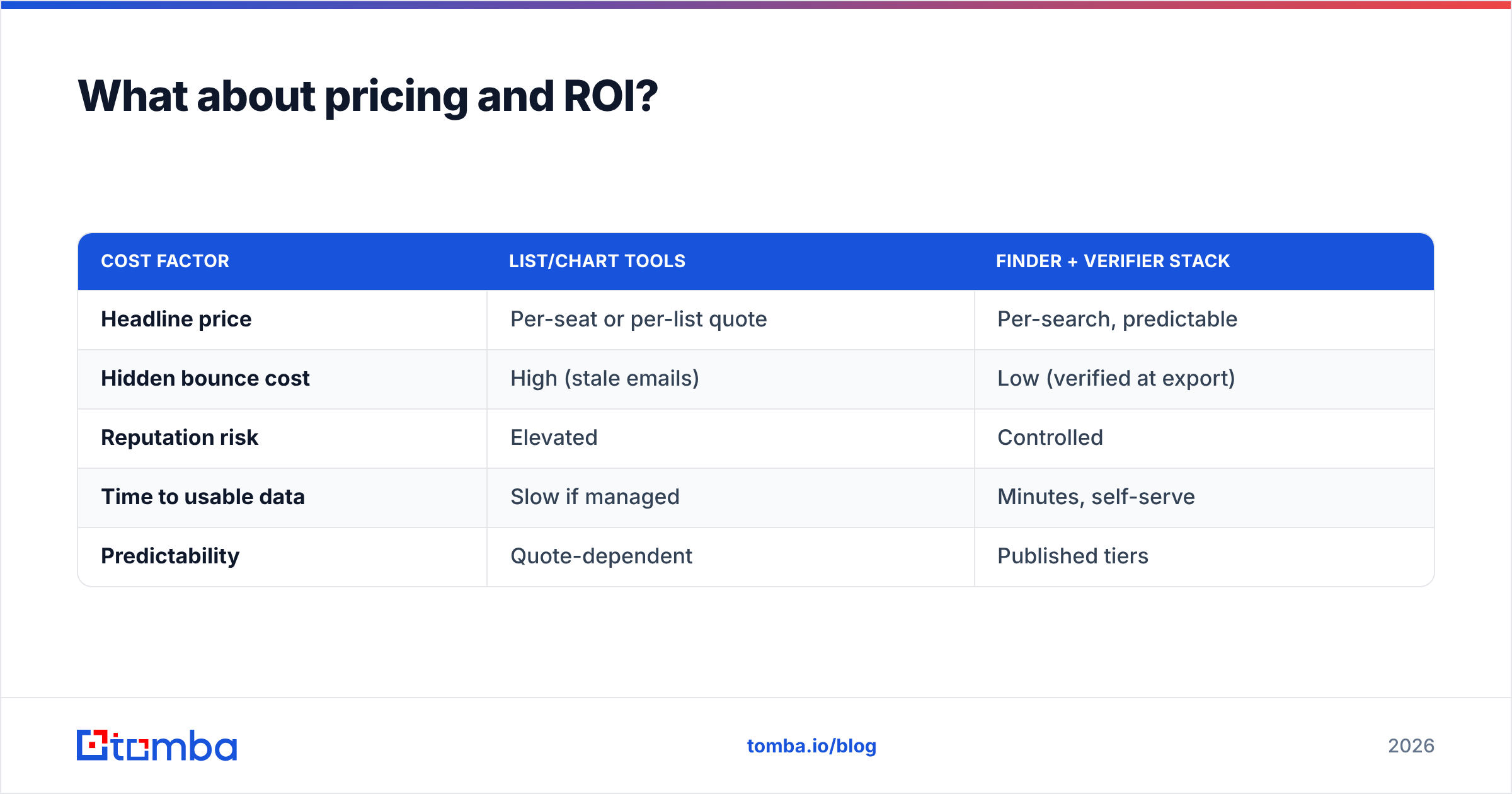
Run the math on cost-per-usable-contact, not cost-per-record. A list of 10,000 contacts at a low price-per-row looks cheap until 30% bounce, your domain reputation drops, and your sequencer throttles you. Suddenly that "cheap" list cost you deliverability across every campaign.
| Cost factor | List/chart tools | Finder + verifier stack |
|---|---|---|
| Headline price | Per-seat or per-list quote | Per-search, predictable |
| Hidden bounce cost | High (stale emails) | Low (verified at export) |
| Reputation risk | Elevated | Controlled |
| Time to usable data | Slow if managed | Minutes, self-serve |
| Predictability | Quote-dependent | Published tiers |
For most teams the winning combination is a lean targeting layer plus a transparent, verification-first contact engine. You stop paying for rows you can't email and start paying for emails that actually send. If you're comparing this category broadly, you can also weigh dedicated Apollo alternatives and other data tools the same way — by deliverable contacts, not by raw database size. For background on the ABM motion these tools serve, Wikipedia's overview of account-based marketing is a clean primer, and BizKonnect's own positioning is on bizkonnect.com.
Frequently asked questions#
Is BizKonnect or Bytemine better for finding email addresses? Neither is purpose-built for that. BizKonnect focuses on org charts and Bytemine on list volume; both store emails that decay over time. For deliverable addresses, pair either with a real-time finder and verifier.
Can I use these tools together? Yes, and many teams do. Use BizKonnect or Bytemine to decide who to target, then resolve and verify the actual email with a dedicated finder. They solve different stages of the same workflow.
Why do exported emails bounce even from a paid database? Because static datasets are snapshots. People change jobs, domains migrate, and mailboxes get deactivated. Without verification at the moment of export, a stored email is a guess.
What's the cheapest way to get accurate B2B emails? Start with a free or low-cost finder tier, verify in bulk, and only pay for contacts that pass. That's almost always cheaper per usable contact than buying large static lists.
The bottom line#
BizKonnect wins on org-chart visualization for enterprise ABM. Bytemine wins on fast, broad list building for volume outbound. But in the bizkonnect vs bytemine matchup, both share the same blind spot — the email field, the one thing your whole pipeline depends on, isn't guaranteed fresh.
If your goal is contacts you can actually reach, lead with verification. Find current emails by name, company, or domain and confirm they're deliverable before a single send with the Tomba Email Finder — start free with 25 searches a month, scale to $49/mo when you're ready, and stop paying for rows that bounce. Map the account however you like; just make sure the address is real.
Ready to find emails that actually work?
Join 150,000+ professionals who stopped guessing and started sending. Free credits on signup — no credit card required.
Get the Tomba newsletter
Practical outbound tactics and product updates — once every two weeks.
About the author