Best Books for Sales Managers in 2026: 12 Must-Reads
The best books for sales managers in 2026, ranked by what they actually fix — coaching, forecasting, hiring, and pipeline. A practical reading list with a comparison table.
You manage a quota now, not just carry one. That switch breaks most reps, and no one hands you a manual for it. The right book is the cheapest mentor you will ever buy — but only if it matches the problem you actually have this quarter.
TL;DR — The short version#
- The best books for sales managers in 2026 are skill-specific, not generic. Pick by the gap you're closing — coaching, forecasting, hiring, or pipeline math — not by Amazon rank.
- Coaching first. The Sales Acceleration Formula and Coaching Salespeople into Sales Champions fix more quota gaps than any "motivation" title.
- Forecasting and process belong to The Sales Manager's Guide to Greatness and Cracking the Sales Management Code.
- Read in order of pain. New to management? Start with onboarding and coaching. Stalled team? Go to process and metrics.
- Books set the strategy; your data executes it. A coaching framework is worthless if reps waste hours hunting contact info instead of selling.
Why do sales managers need books at all?#
Because the skills that made you a top rep are not the skills that make you a good manager — and the gap is wider than most people admit.
Think of it like a great chef being promoted to kitchen owner. Cooking brilliantly and running a profitable kitchen with twelve cooks are different jobs. One is execution; the other is systems, hiring, and coaching. A book is a compressed apprenticeship: you get a veteran operator's twenty years of mistakes in eight hours of reading.
The research backs the instinct. According to Gartner, sales organizations consistently rank front-line manager effectiveness as one of the highest-leverage drivers of quota attainment — and most managers are promoted with zero formal training. Books close that gap faster and cheaper than a $15,000 leadership seminar.
The catch: there are thousands of sales titles, and most are recycled motivational fluff. The list below is filtered to books that change what you do on Monday.
What are the best books for sales managers in 2026?#
Here are the twelve that earn their place, grouped by the problem they solve. You don't need all twelve. You need the two or three that match your current bottleneck.
The core shortlist, ranked by what they fix:
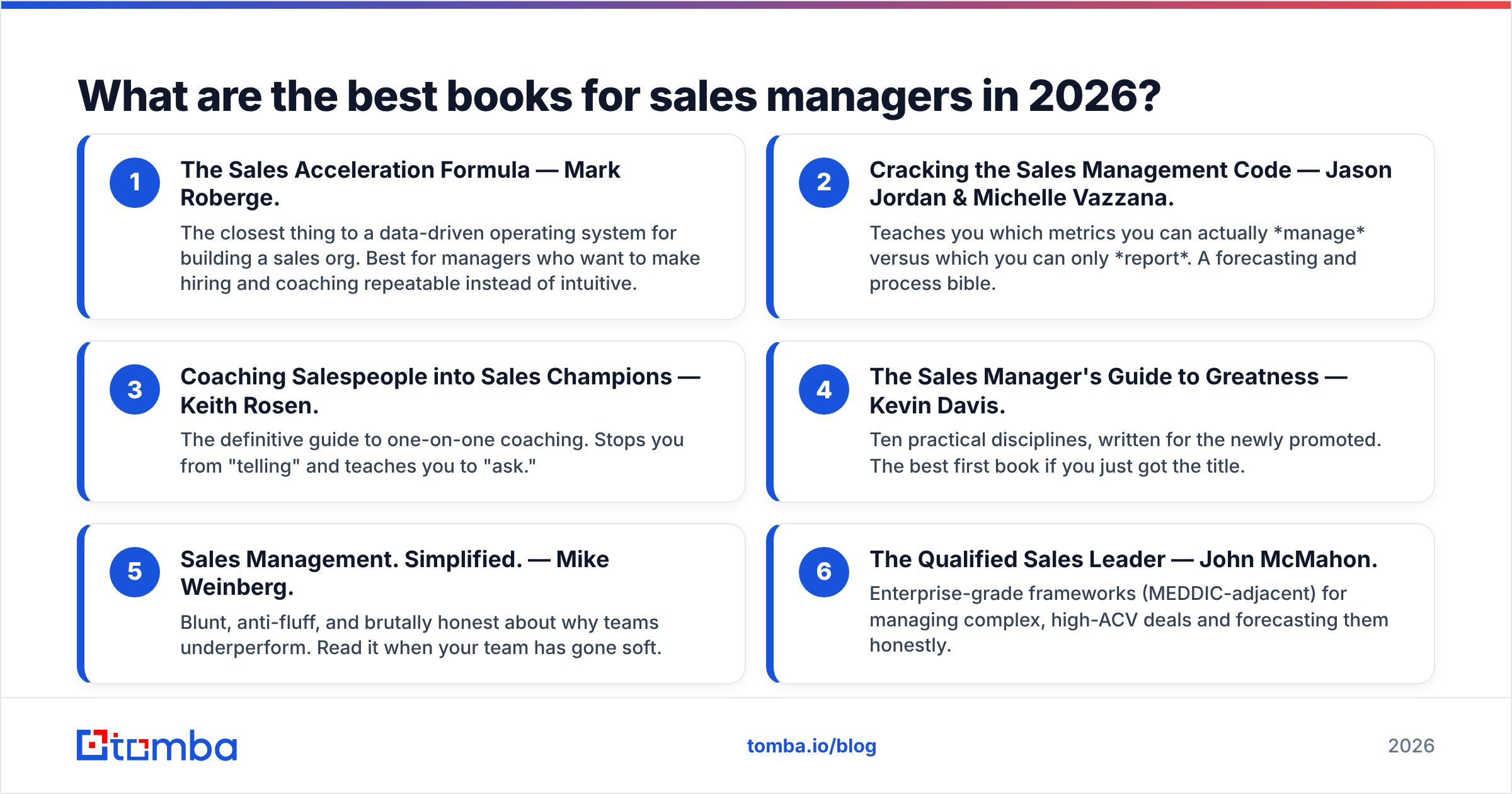
- The Sales Acceleration Formula — Mark Roberge. The closest thing to a data-driven operating system for building a sales org. Best for managers who want to make hiring and coaching repeatable instead of intuitive.
- Cracking the Sales Management Code — Jason Jordan & Michelle Vazzana. Teaches you which metrics you can actually manage versus which you can only report. A forecasting and process bible.
- Coaching Salespeople into Sales Champions — Keith Rosen. The definitive guide to one-on-one coaching. Stops you from "telling" and teaches you to "ask."
- The Sales Manager's Guide to Greatness — Kevin Davis. Ten practical disciplines, written for the newly promoted. The best first book if you just got the title.
- Sales Management. Simplified. — Mike Weinberg. Blunt, anti-fluff, and brutally honest about why teams underperform. Read it when your team has gone soft.
- The Qualified Sales Leader — John McMahon. Enterprise-grade frameworks (MEDDIC-adjacent) for managing complex, high-ACV deals and forecasting them honestly.
The next six round out the bench: Predictable Revenue (Aaron Ross) for outbound structure, The Challenger Sale (Dixon & Adamson) for deal strategy, Radical Candor (Kim Scott) for feedback culture, High Output Management (Andy Grove) for management fundamentals, Pipeline Generation thinking from Fanatical Prospecting (Jeb Blount), and Never Split the Difference (Chris Voss) for negotiation coaching.
How do these books compare?#
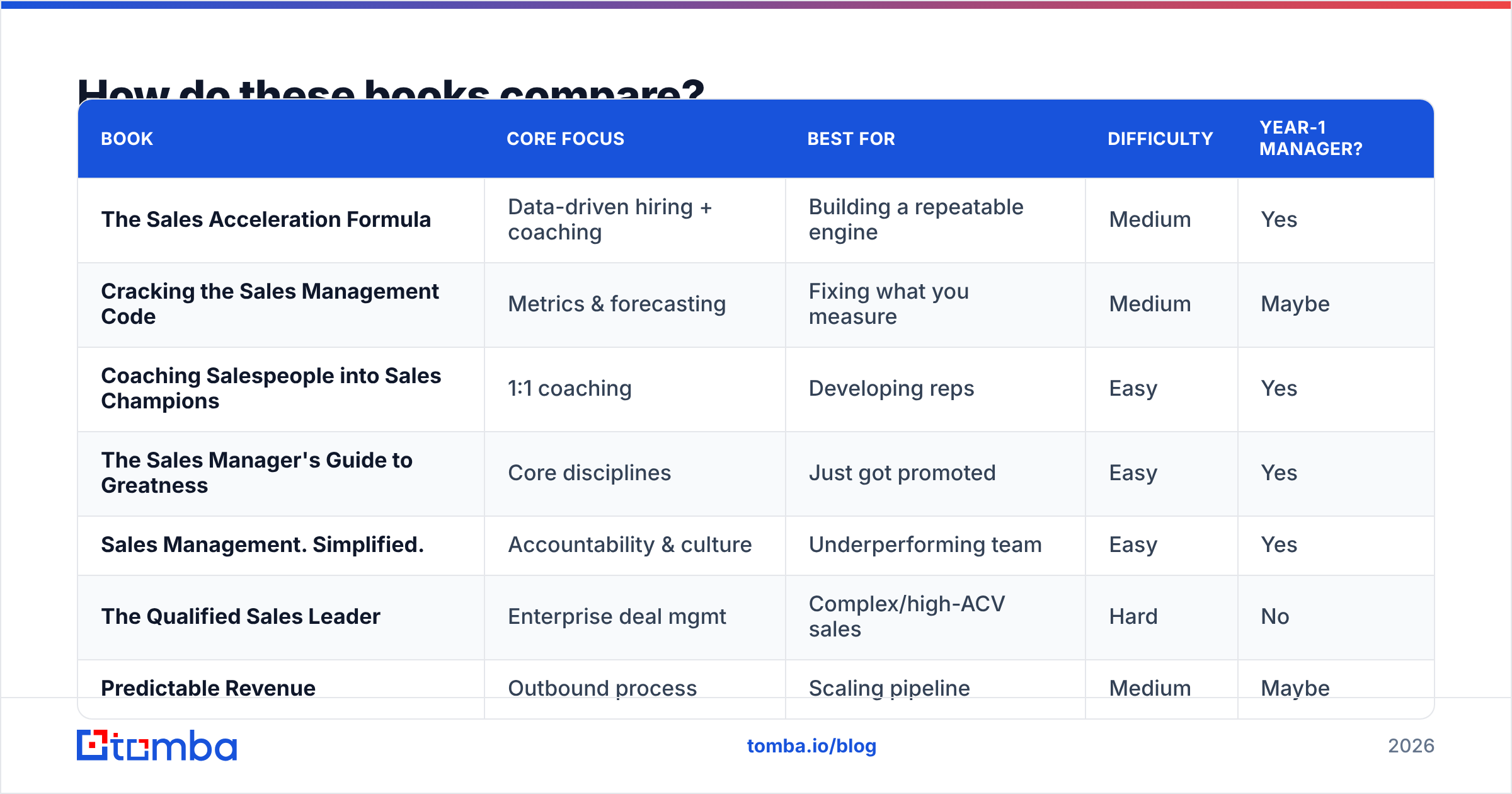
Use this table to pick by situation, not by hype. "Best for" is the single scenario where each book outperforms the rest.
| Book | Core focus | Best for | Difficulty | Year-1 manager? |
|---|---|---|---|---|
| The Sales Acceleration Formula | Data-driven hiring + coaching | Building a repeatable engine | Medium | Yes |
| Cracking the Sales Management Code | Metrics & forecasting | Fixing what you measure | Medium | Maybe |
| Coaching Salespeople into Sales Champions | 1:1 coaching | Developing reps | Easy | Yes |
| The Sales Manager's Guide to Greatness | Core disciplines | Just got promoted | Easy | Yes |
| Sales Management. Simplified. | Accountability & culture | Underperforming team | Easy | Yes |
| The Qualified Sales Leader | Enterprise deal mgmt | Complex/high-ACV sales | Hard | No |
| Predictable Revenue | Outbound process | Scaling pipeline | Medium | Maybe |
| High Output Management | Management fundamentals | First leadership role | Medium | Yes |
The pattern: if you're in year one, the "Easy" rows are your starting line. If your problem is a stalled forecast or a messy pipeline, jump to the metrics and process titles regardless of difficulty.
Which book should you read first?#
Read the book that matches your loudest problem this quarter — not the one with the most reviews.
- "I was just promoted and feel lost." Start with The Sales Manager's Guide to Greatness, then High Output Management. They give you the operating fundamentals before you touch tactics.
- "My reps are busy but not closing." Coaching Salespeople into Sales Champions. The issue is almost always coaching depth, not effort.
- "My forecast is fiction." Cracking the Sales Management Code and The Qualified Sales Leader. You'll learn to manage leading activities instead of praying over a lagging number.
- "My team has gotten comfortable." Sales Management. Simplified. It's the cold shower a soft team needs.
- "We can't generate enough pipeline." Predictable Revenue and Fanatical Prospecting for the philosophy — then fix the data layer so prospecting actually scales.
That last point is where most reading lists quietly fail. A book can teach your reps to prospect fanatically, but if they spend half their day digging for a decision-maker's email, the framework dies on contact with reality.
What do these books leave out?#
Execution infrastructure. Almost every great sales-management book assumes your team already has clean, reachable contact data — and most don't.
Here's the honest gap. Predictable Revenue preaches specialized outbound roles. Fanatical Prospecting demands high activity volume. Both are right. But both assume a rep can instantly find a verified email or direct dial for the right person. In practice, reps burn 20–30% of their selling time on manual research, and that number rarely shows up in any book's ROI math.
This is the difference between strategy and operations. The book gives you the playbook; your tooling determines whether the plays are even runnable. A coaching framework that frees up rep time means nothing if that time gets re-absorbed by data hunting.
If you want to see how much time data friction actually costs, audit one rep's week. Count the minutes spent copying names off LinkedIn, guessing email patterns, and pasting into a verifier. That's the tax no book mentions. Closing it is where tools like a dedicated email finder and data enrichment pay for themselves — they turn "go find the contact" into a one-click step so coaching time stays coaching time.
How should a sales manager actually use a sales book?#
Stop reading for inspiration and start reading for installation. A book you finish and feel good about changed nothing. A book you turn into a team habit changes your number.
Use this four-step loop on every title:
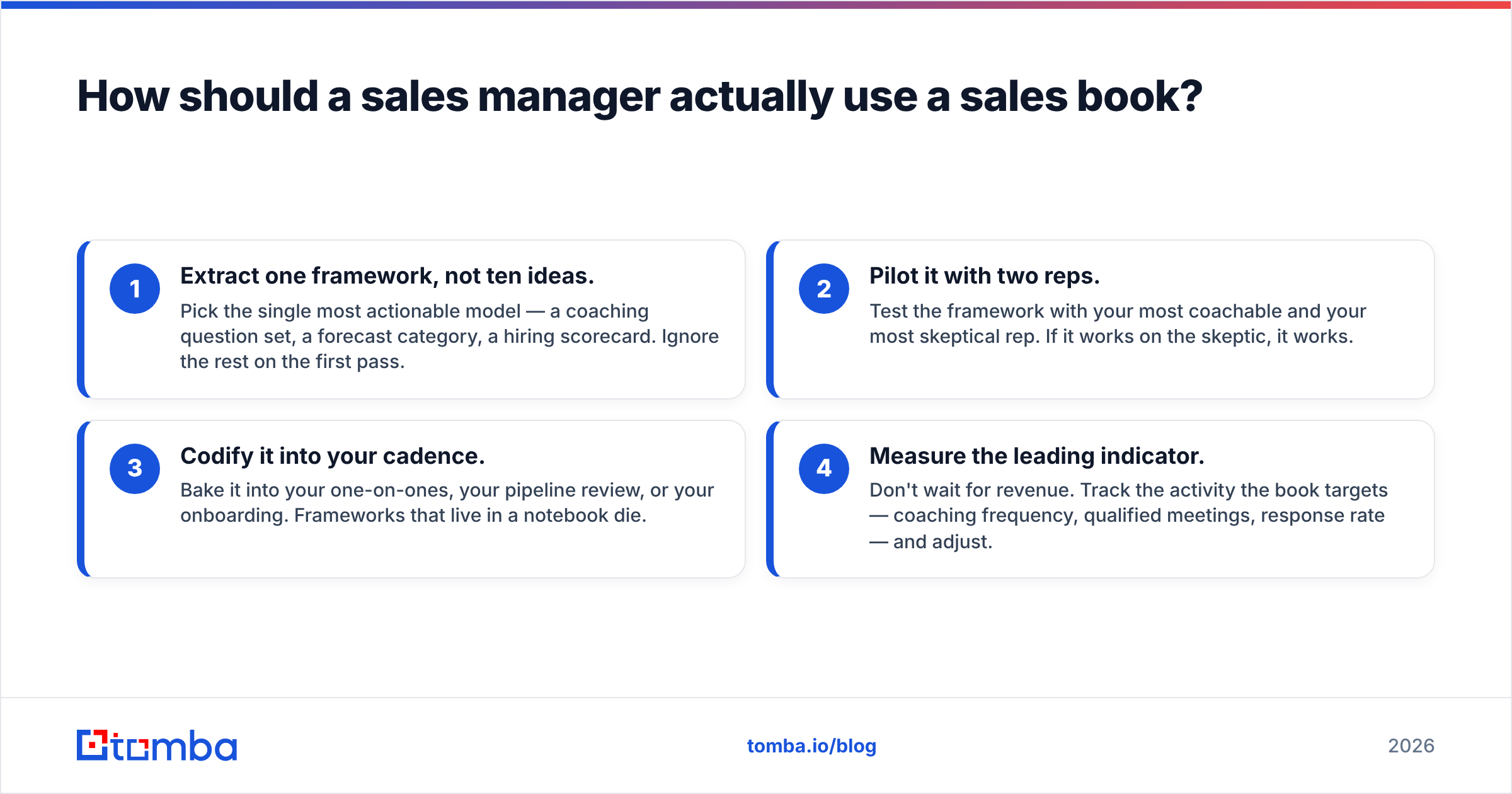
- Extract one framework, not ten ideas. Pick the single most actionable model — a coaching question set, a forecast category, a hiring scorecard. Ignore the rest on the first pass.
- Pilot it with two reps. Test the framework with your most coachable and your most skeptical rep. If it works on the skeptic, it works.
- Codify it into your cadence. Bake it into your one-on-ones, your pipeline review, or your onboarding. Frameworks that live in a notebook die.
- Measure the leading indicator. Don't wait for revenue. Track the activity the book targets — coaching frequency, qualified meetings, response rate — and adjust.
That last metric matters more than people think. If you're coaching reps to improve outreach, your team's response rate is the early signal that the coaching is landing — long before it shows up in closed-won.
Are sales-management books worth it versus courses or coaches?#
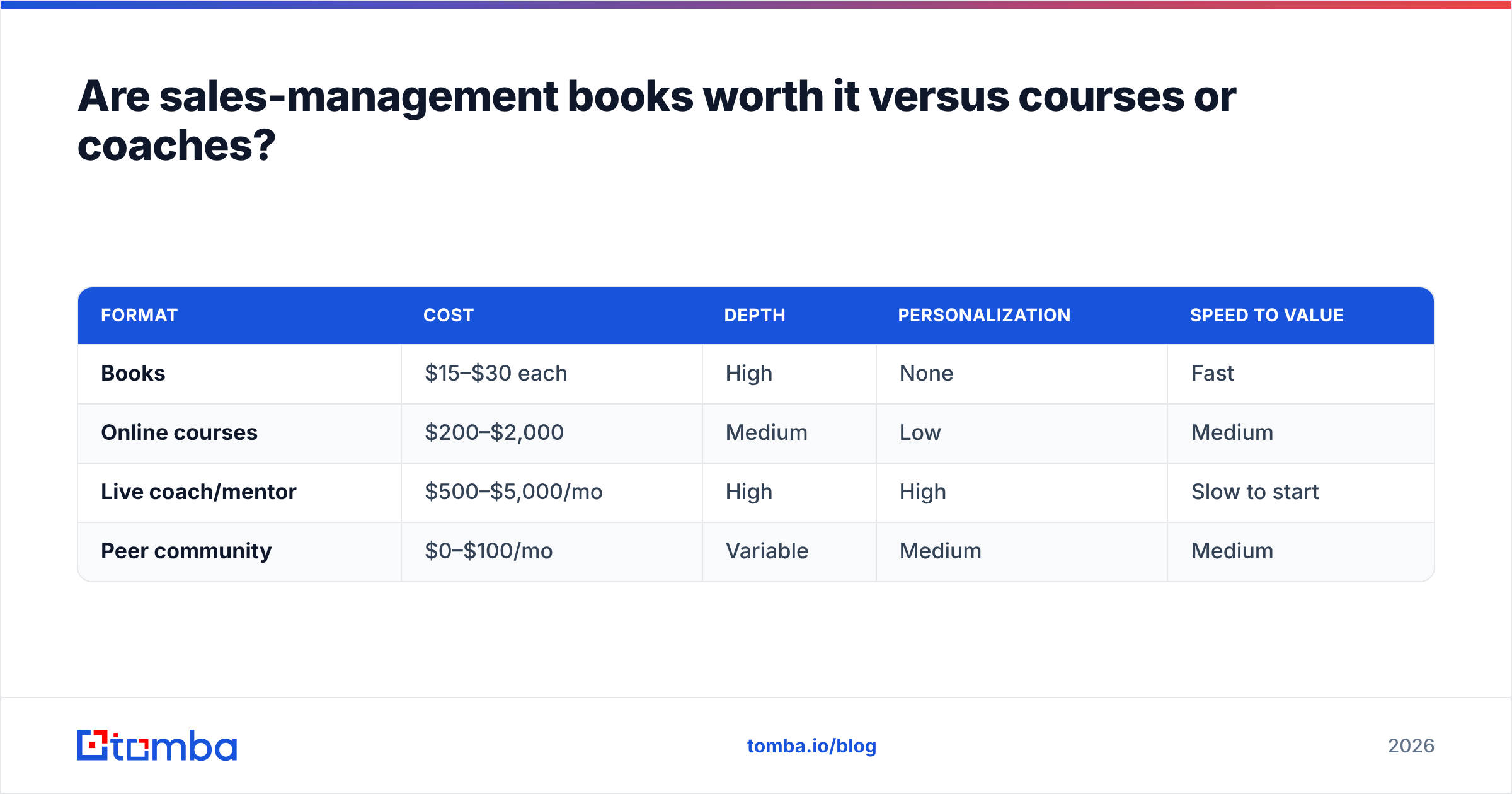
For most managers, books win on cost-per-insight — but the three formats solve different problems. Here's the honest comparison.
| Format | Cost | Depth | Personalization | Speed to value |
|---|---|---|---|---|
| Books | $15–$30 each | High | None | Fast |
| Online courses | $200–$2,000 | Medium | Low | Medium |
| Live coach/mentor | $500–$5,000/mo | High | High | Slow to start |
| Peer community | $0–$100/mo | Variable | Medium | Medium |
The smart move is layered: books to build your foundational knowledge cheaply, a community (like Pavilion or a G2 review-sourced peer group) for accountability, and a coach only once you know exactly what you're trying to fix. Reverse that order and you'll pay a coach $2,000 to teach you what a $20 book already covers.
What about books for building the data and prospecting side?#
There isn't a great single book for it — the field moves too fast — which is exactly why managers underinvest here. The strategy books are timeless; the data tactics aren't, so they stay out of print.
Fill that gap with operator resources instead of books. Vendor documentation, methodology guides, and tool-specific playbooks update continuously where a 2019 book can't. For the data foundation specifically, focus your team on three capabilities:
- Finding the right contact fast. A reliable domain search turns "who do we even email at this account?" into a 10-second answer.
- Keeping the list clean. An email verifier protects your sender reputation so the outreach your reps were coached to send actually lands.
- Scaling without burning hours. Bulk and API workflows mean prospecting volume doesn't require proportional rep time.
The principle from every process book — make the right behavior the easy behavior — applies directly. If finding a verified contact is hard, reps will avoid prospecting no matter how well you coach. If it's one click, your coaching compounds.
Frequently asked questions#
How many sales-management books should I read per year? Four well-applied beats twenty skimmed. Pick one per quarter, install one framework from each, and you'll outperform the manager who reads a book a week and changes nothing.
Are older sales books still relevant in 2026? The fundamentals are — High Output Management is from 1983 and still elite. Human motivation and management don't change. Tactics and tooling do, so pair timeless books with current operator resources.
What's the single best book for a brand-new sales manager? The Sales Manager's Guide to Greatness. It's written specifically for the year-one transition and won't overwhelm you with enterprise complexity you don't need yet.
Do these books help with remote or hybrid teams? Yes — coaching and accountability frameworks translate directly. The mechanics shift to async and video, but the principles in Radical Candor and Coaching Salespeople into Sales Champions hold regardless of where your team sits.
The bottom line#
Books make you a sharper sales manager. Clean, reachable data makes that sharpness pay. The best coaching framework in the world can't help a rep who's stuck guessing email addresses instead of selling — so once you've picked your reading list, close the operational gap underneath it.
Give your team back the hours that books assume they already have. Start free with the Tomba Email Finder — 25 searches a month at no cost — and scale up through Tomba pricing (Starter at $49/mo) only when the time savings prove themselves. Read the strategy. Then make sure your reps can actually execute it.
// get started
Find, verify and enrich your first contacts today
Start on the free plan with 25 searches a month, then scale when your team is ready.
Free plan · No credit card required · GDPR & CCPA
// about the author