Best Books for Salespeople in 2026: 14 Reps' Must-Reads
The 14 best books for salespeople in 2026, sorted by what you actually need — prospecting, negotiation, mindset, or closing — plus how to turn pages into pipeline.
You can have the sharpest CRM, the cleanest data, and a full calendar of demos and still lose deals you should win. The gap is almost never tooling. It's the thinking behind the conversation — how you frame value, handle a stall, and decide who to call in the first place. That's exactly what the right book fixes.
This is a working reading list for 2026, not a nostalgia tour. Every pick below maps to a specific skill you can practice on your next call.
TL;DR: Which Sales Books Should You Read First?#
- New to sales or rebuilding pipeline? Start with Fanatical Prospecting (Blount) and New Sales. Simplified. (Weinberg) — they fix the activity problem first.
- Losing deals late in the cycle? Read The Challenger Sale and Gap Selling — both attack weak discovery and value framing.
- Negotiation and pricing pressure? Never Split the Difference (Voss) is the single highest-ROI read for handling objections.
- Mindset and consistency issues? Atomic Habits and Mindset beat any "motivation" book for actually changing behavior.
- Books don't close deals — systems do. Pair what you read with a real prospecting list, a clean CRM, and verified contact data so the skills have something to act on.
What Makes a Sales Book Worth Your Time in 2026?#
A useful sales book passes three tests. First, it's specific — it gives you words to say, not just a philosophy. Second, it's testable — you can run the idea on Monday and see the result by Friday. Third, it ages well — the principle survives even when the channel (email, LinkedIn, phone) changes.
Think of a sales book like a recipe, not a documentary. A documentary about food is interesting; a recipe gets dinner on the table. The books below are recipes. You should finish a chapter and immediately know what to change about your next conversation.
That filter matters because the genre is crowded with airport-bookstore filler — 200 pages that could have been a blog post. The 14 titles here earned their place by being repeatedly cited by quota-carrying reps and managers, not just reviewers.
)
What Are the Best Books for Salespeople by Skill?#
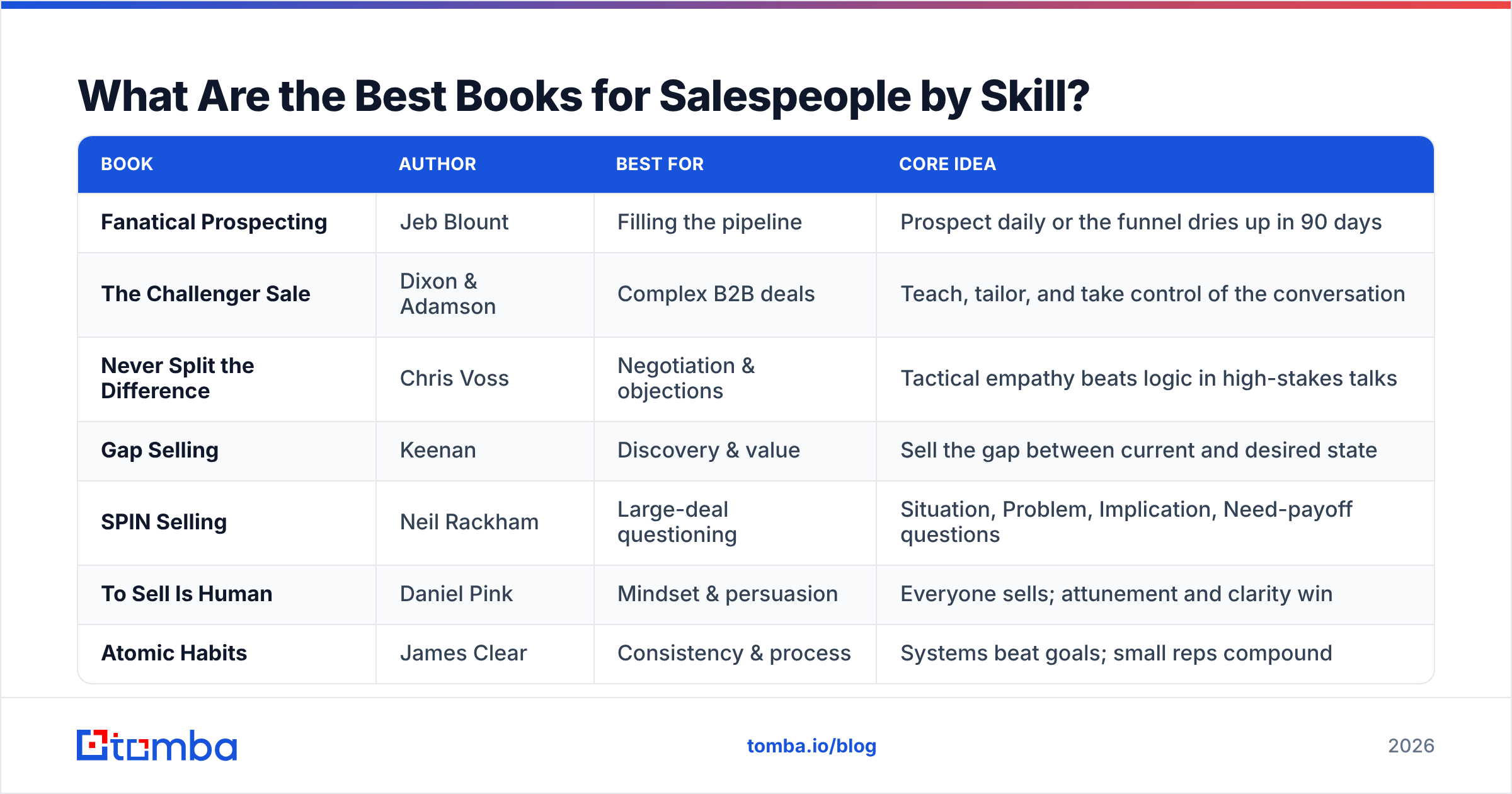
Rather than rank books 1 through 14 (a ranking nobody agrees on), sort them by the problem you're trying to solve. Here's the core list mapped to skill:
| Book | Author | Best for | Core idea |
|---|---|---|---|
| Fanatical Prospecting | Jeb Blount | Filling the pipeline | Prospect daily or the funnel dries up in 90 days |
| The Challenger Sale | Dixon & Adamson | Complex B2B deals | Teach, tailor, and take control of the conversation |
| Never Split the Difference | Chris Voss | Negotiation & objections | Tactical empathy beats logic in high-stakes talks |
| Gap Selling | Keenan | Discovery & value | Sell the gap between current and desired state |
| SPIN Selling | Neil Rackham | Large-deal questioning | Situation, Problem, Implication, Need-payoff questions |
| To Sell Is Human | Daniel Pink | Mindset & persuasion | Everyone sells; attunement and clarity win |
| Atomic Habits | James Clear | Consistency & process | Systems beat goals; small reps compound |
The prospecting tier#
- Fanatical Prospecting (Jeb Blount) — The cure for the "I'll prospect later" reflex. Blount's argument is blunt: the pipeline you build today pays you in 60-90 days, so an empty calendar now is a commission cut later. Best paired with a disciplined daily block and a fresh contact list.
- New Sales. Simplified. (Mike Weinberg) — A no-nonsense framework for opening new accounts, including how to write a sales story that doesn't bore the buyer.
- Smart Calling (Art Sobczak) — Kills the "cold" in cold calling by front-loading research, so you sound like a peer, not a telemarketer.
The deal-control tier#
- The Challenger Sale — Data from thousands of reps showing that the highest performers challenge the buyer's assumptions rather than just build rapport. Essential for complex, multi-stakeholder deals.
- Gap Selling (Keenan) — The discovery bible. If you've ever lost a deal to "no decision," this book explains why your problem diagnosis was too shallow.
- SPIN Selling (Neil Rackham) — Older, research-backed, and still the foundation for question-based selling in large accounts. See the SPIN Selling overview on Wikipedia for the framework's origin in Huthwaite's research.
The negotiation and psychology tier#
- Never Split the Difference (Chris Voss) — A former FBI negotiator's playbook. The "tactical empathy" and calibrated-question techniques translate directly to pricing pushback and procurement.
- Influence (Robert Cialdini) — The academic backbone behind every persuasion tactic you've ever used. Reciprocity, scarcity, social proof — named and explained.
- To Sell Is Human (Daniel Pink) — Reframes selling as a universal human skill and backs it with behavioral science.
The mindset and habit tier#
- Atomic Habits (James Clear) — Not a sales book, but the best book on doing the boring activity consistently, which is 80% of sales.
- Mindset (Carol Dweck) — The growth-vs-fixed mindset research that explains why some reps plateau and others keep climbing.
- Can't Hurt Me (David Goggins) — For the resilience and rejection tolerance the job demands.
The modern-GTM tier#
- The Qualified Sales Leader (John McMahon) — For reps eyeing management and anyone selling into enterprise; MEDDIC-flavored deal qualification done right.
- Predictable Revenue (Aaron Ross) — The "Cold Calling 2.0" book that shaped modern SDR/AE specialization and outbound motion design.
Is It Better to Read Classics or New Sales Books?#
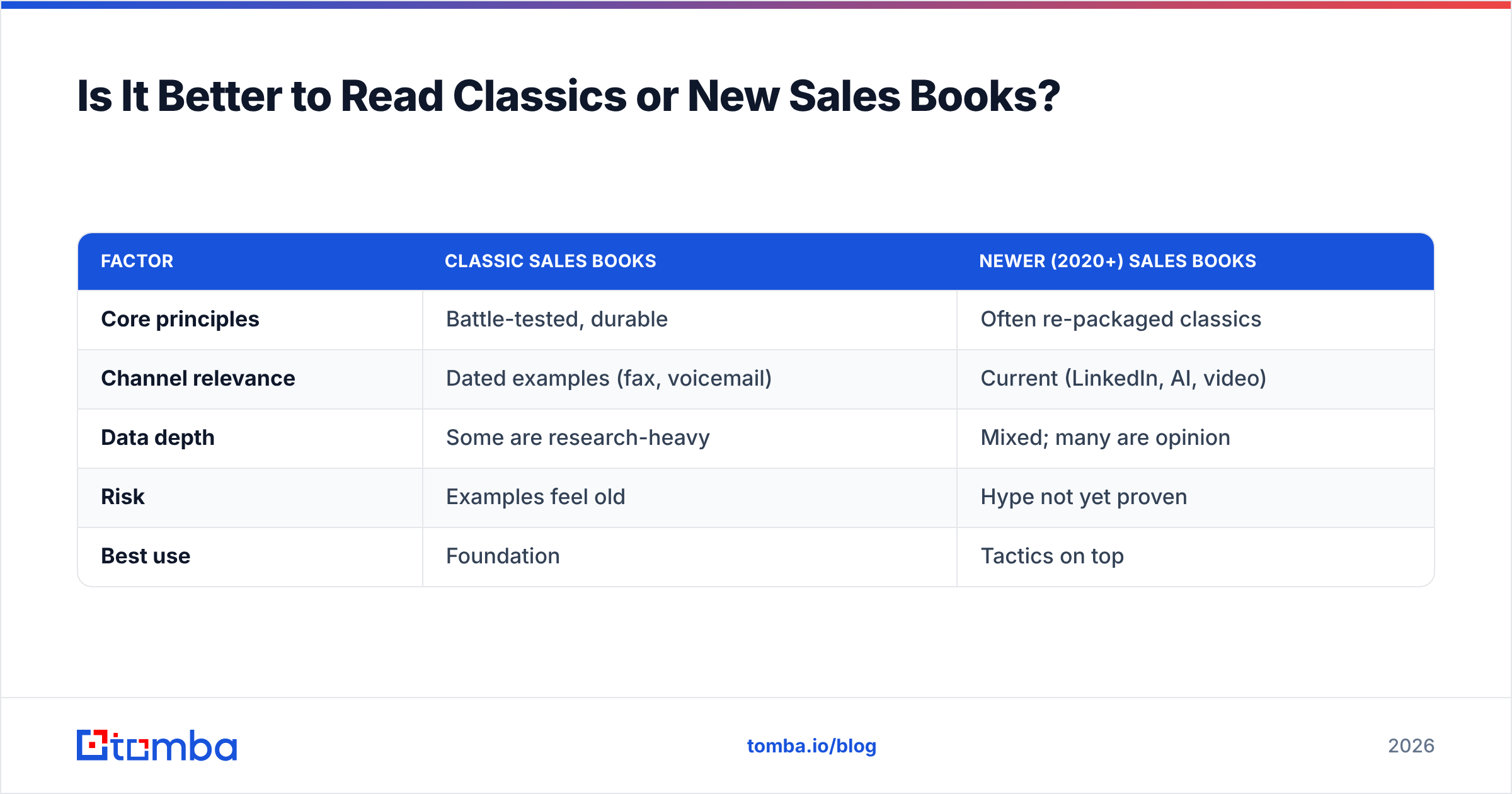
Read the classics first, then the new ones. The fundamentals of human persuasion — trust, framing, loss aversion — haven't changed since Influence came out. What changes is the channel: cold calling gave way to email, email to LinkedIn, and now AI-assisted outreach. A book like SPIN Selling still teaches you what to ask; a 2024 release teaches you where to ask it.
Here's the honest tradeoff:
| Factor | Classic sales books | Newer (2020+) sales books |
|---|---|---|
| Core principles | Battle-tested, durable | Often re-packaged classics |
| Channel relevance | Dated examples (fax, voicemail) | Current (LinkedIn, AI, video) |
| Data depth | Some are research-heavy | Mixed; many are opinion |
| Risk | Examples feel old | Hype not yet proven |
| Best use | Foundation | Tactics on top |
The trap is chasing every shiny new release while skipping the foundation. A rep who has internalized Cialdini and Rackham will out-sell one who's read twelve LinkedIn-influencer books but never learned to ask an implication question.
How Do You Turn a Sales Book Into Pipeline?#
Reading is input. Quota is output. The bridge between them is a deliberate practice loop, because a highlighted Kindle does nothing for your win rate on its own.
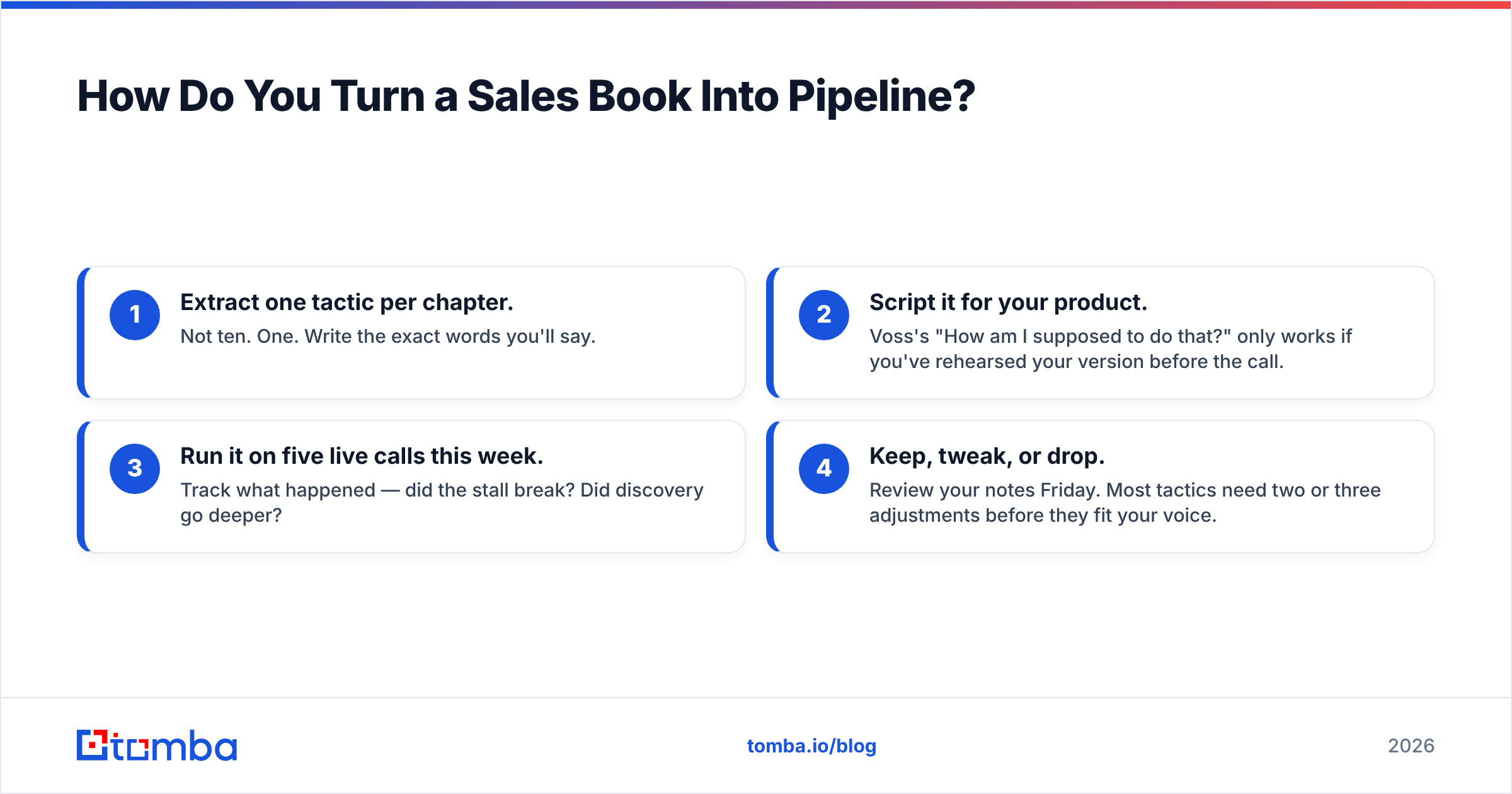
Use this four-step method on every book:
- Extract one tactic per chapter. Not ten. One. Write the exact words you'll say.
- Script it for your product. Voss's "How am I supposed to do that?" only works if you've rehearsed your version before the call.
- Run it on five live calls this week. Track what happened — did the stall break? Did discovery go deeper?
- Keep, tweak, or drop. Review your notes Friday. Most tactics need two or three adjustments before they fit your voice.
A book that changes one behavior is worth more than ten books that change none. The reps who compound fastest treat each title like a sprint backlog, not a trophy.
)
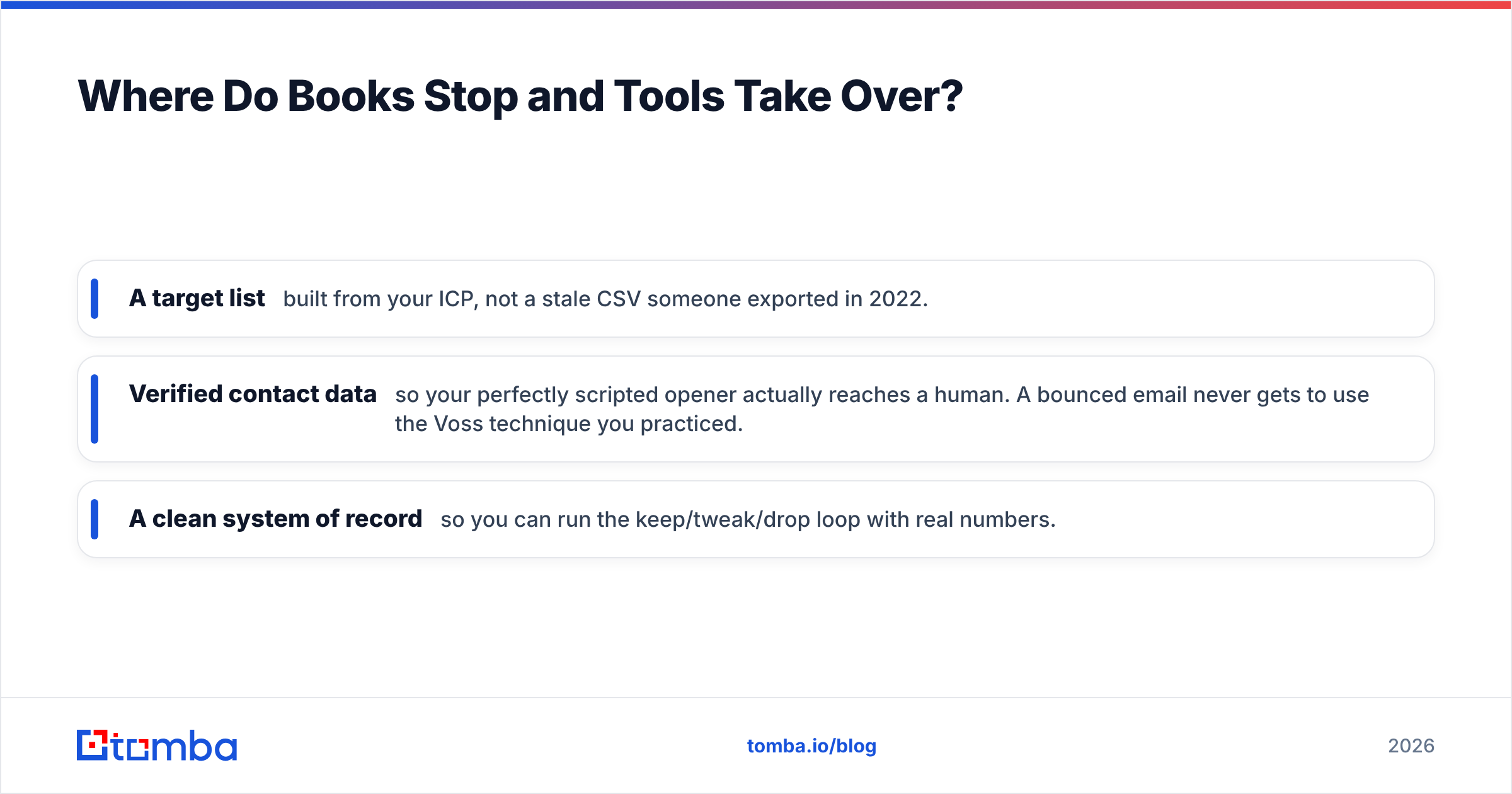
Where Do Books Stop and Tools Take Over?#
Books sharpen the conversation. They can't find the person to have it with. This is the boundary most reading lists ignore: Fanatical Prospecting tells you to make 50 dials a day, but it assumes you already have 50 accurate, reachable contacts. In 2026, sourcing and verifying those contacts is its own discipline.
That's the handoff point. Once a book convinces you to prospect daily, you need:
- A target list built from your ICP, not a stale CSV someone exported in 2022.
- Verified contact data so your perfectly scripted opener actually reaches a human. A bounced email never gets to use the Voss technique you practiced.
- A clean system of record so you can run the keep/tweak/drop loop with real numbers.
This is where a sourcing layer earns its place. Tomba's email finder turns a name and company into a verified professional email, and the cold email AI helps you draft the first-touch message the books taught you to structure. The skill comes from the page; the reach comes from the data.
For broader context on building a modern sales motion around these skills, HubSpot's sales blog and peer reviews on G2's sales software category are worth a regular skim alongside your reading.
What Should a Sales Manager Have the Team Read?#
If you run a team, don't assign all 14. Pick three and build a quarter around them. A focused book club beats a sprawling reading list every time.
A simple rollout that works:
- Quarter 1 — Activity: Fanatical Prospecting. Everyone commits to a daily prospecting block. Measure dials and connects.
- Quarter 2 — Discovery: Gap Selling. Score every deal review on problem depth, not features pitched.
- Quarter 3 — Negotiation: Never Split the Difference. Role-play pricing objections weekly.
- Quarter 4 — Self-coaching: Atomic Habits. Each rep designs one system to fix their weakest stage.
Tie each book to one metric and one weekly ritual. The point isn't to "read more" — it's to change one behavior per quarter and watch it show up in the response rate and the forecast.
Frequently Asked Questions#
What is the single best book for a new salesperson? Fanatical Prospecting by Jeb Blount. It fixes the most common rookie failure — an empty pipeline — before you worry about advanced closing techniques.
Are sales books still relevant with AI selling tools? Yes, more than ever. AI accelerates outreach, but it can't decide what makes a buyer trust you or how to frame value. Books teach judgment; tools execute it.
How many sales books should I read per year? Quality over volume. Four books deeply applied — one per quarter — will move your numbers more than twenty skimmed. Apply the keep/tweak/drop loop to each.
Do I need to read in order? No. Start with the skill you're weakest at. If you lose deals in discovery, start with Gap Selling, not a prospecting book.
Start With the Skill, Then Feed It With Data#
The best book for you is the one that fixes your weakest stage — prospecting, discovery, negotiation, or consistency. Pick one, extract one tactic per chapter, and run it on live calls this week. That's how reading becomes revenue.
Then give those new skills something to work on. A sharpened opener is wasted on a bad list, so build your daily prospecting block on verified contacts: use the Tomba Email Finder to turn your target accounts into reachable, accurate emails, and check Tomba pricing — there's a free tier with 25 searches a month to start before the $49/mo Starter plan. Read the book, then go fill the pipeline it told you to build.
// get started
Find, verify and enrich your first contacts today
Start on the free plan with 25 searches a month, then scale when your team is ready.
Free plan · No credit card required · GDPR & CCPA
// about the author