Bounceban vs Apollo.io 2026: Email Finder & Verifier Compared
Bounceban verifies catch-all emails; Apollo.io is a full prospecting database. Here is an honest 2026 breakdown of accuracy, pricing, and which one your team actually needs.
You typed "Bounceban vs Apollo.io" into a search bar because two very different tools keep showing up in the same conversations about cold outbound. One verifies whether an email will bounce. The other is a 275-million-contact prospecting machine. Comparing them head-to-head is a little like comparing a smoke detector to a house — but the comparison matters, because your deliverability depends on getting both jobs right.
This guide breaks down what each tool actually does, where they overlap, what they cost in 2026, and which one belongs in your stack.
TL;DR#
- Bounceban is a real-time email verification tool that specializes in the hard part: confirming catch-all (accept-all) addresses that most verifiers mark as "unknown."
- Apollo.io is a full sales-intelligence platform — a contact database, email finder, and sequencing engine rolled into one.
- They are not direct substitutes. Apollo finds the email; a verifier like Bounceban (or Apollo's own built-in verification) decides whether it's safe to send.
- For pure prospecting volume, Apollo wins. For surgical catch-all verification, Bounceban is stronger. For accuracy on both finding and verifying at a flat price, Tomba is the cleaner all-in-one.
- Pick based on the job: build a list (Apollo), clean a list (Bounceban), or do both without per-seat pricing (Tomba).
What is Bounceban?#
Bounceban is a dedicated email verification service. Its headline feature is catch-all verification — and that's the feature that separates serious verifiers from the rest.
A catch-all (or "accept-all") domain is configured to accept mail to any address, real or not. Send to nobody@catchall-domain.com and the server says "sure, thanks" instead of bouncing. That breaks ordinary SMTP verification, which relies on the server rejecting bad addresses. Most tools throw up their hands and label these "unknown," leaving you to gamble.
Bounceban uses live SMTP interaction plus its own heuristics to push past the "unknown" bucket and return a usable verdict on many catch-all addresses. If your prospect lists are stuffed with corporate domains — and most B2B lists are — that's a meaningful chunk of contacts you'd otherwise have to guess on.
What Bounceban is not: a prospecting database. It doesn't hand you a list of CMOs at Series B SaaS companies. You bring the emails; it tells you which ones are safe.
What is Apollo.io?#
Apollo.io is a sales-intelligence platform built around a massive contact and company database — north of 275 million contacts by its own reporting. It bundles several jobs into one subscription:
- Prospecting database — filter by title, industry, headcount, tech stack, intent signals.
- Email finder + enrichment — reveal work emails and phone numbers for contacts you discover.
- Sequencing — multi-step email/call/LinkedIn cadences, sent from inside Apollo.
- Built-in verification — Apollo runs its own checks before surfacing an email.
Apollo's strength is the funnel: discover, enrich, sequence, all in one tab. Its weakness, reported consistently across G2 reviews, is data freshness on the long tail — emails for smaller or non-US companies can be stale or missing, and catch-all handling is conservative. Apollo would rather hide an email than risk a bounce against your sending reputation, which is sensible but leaves coverage on the table.
So the honest framing: Apollo is a breadth tool. Bounceban is a depth-on-verification tool.
Bounceban vs Apollo.io: the core comparison#
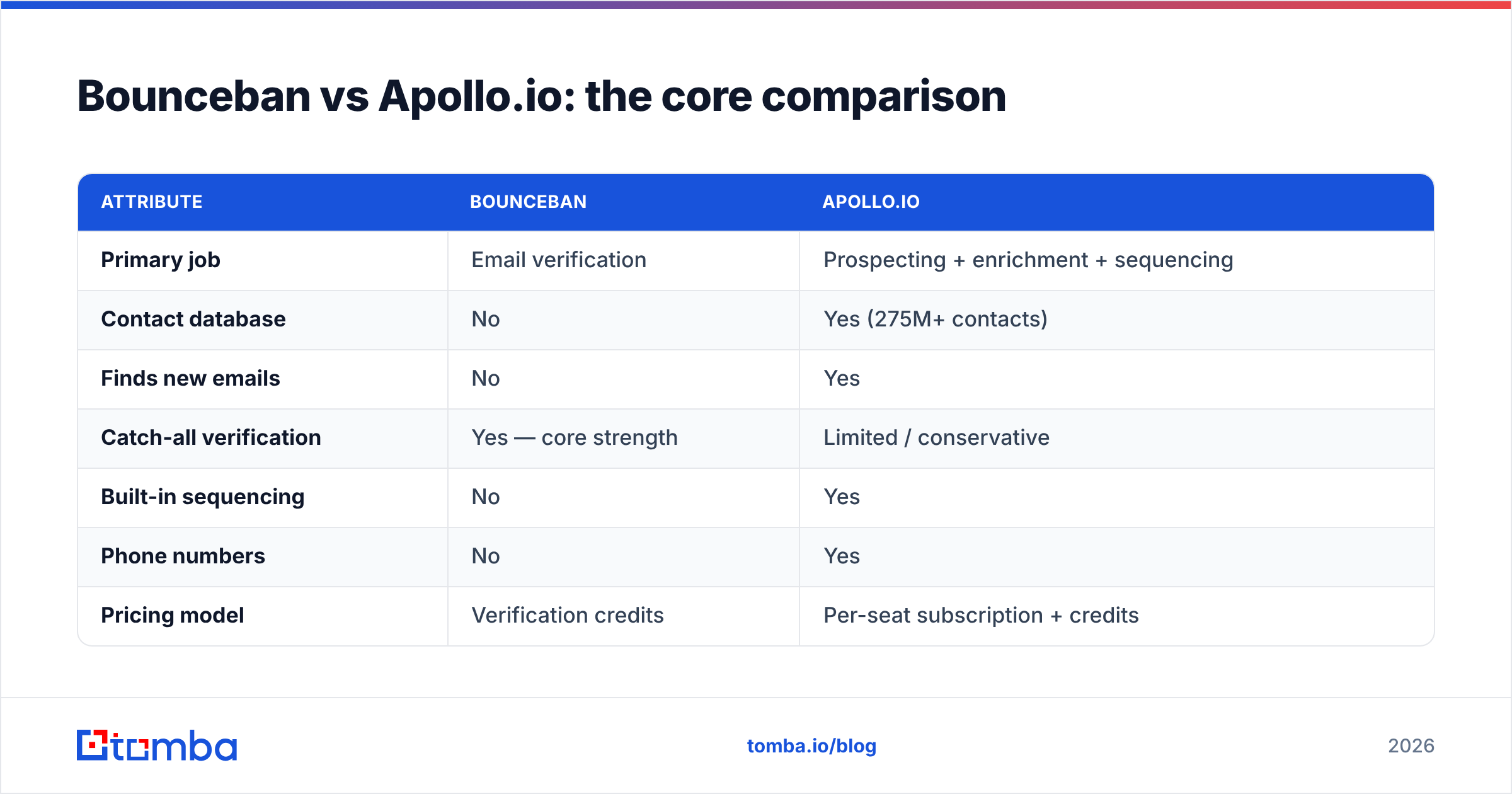
These products sit at different layers of the outbound stack, so the table compares them on the axes that actually matter when you're choosing.
| Attribute | Bounceban | Apollo.io |
|---|---|---|
| Primary job | Email verification | Prospecting + enrichment + sequencing |
| Contact database | No | Yes (275M+ contacts) |
| Finds new emails | No | Yes |
| Catch-all verification | Yes — core strength | Limited / conservative |
| Built-in sequencing | No | Yes |
| Phone numbers | No | Yes |
| Pricing model | Verification credits | Per-seat subscription + credits |
| Free option | Trial credits | Free plan (limited credits) |
| Best for | Cleaning lists you already have | Building lists from scratch |
The takeaway: if you already have a list and just need to know what's safe to send, Bounceban does one thing well. If you have no list at all, Bounceban can't help you and Apollo is the obvious starting point. Most teams eventually need both capabilities — which is exactly why all-in-one tools exist.
Which one is more accurate?#
Accuracy means two different things here, so split it.
Finding accuracy is Apollo's game alone — Bounceban doesn't find emails. The question for Apollo is: when it gives you an email, how often is it correct and deliverable? In practice, Apollo is strong on US-based, mid-to-large companies and weaker on small, international, or recently-changed roles. Its conservative verification means fewer false positives but more "no email found" gaps.
Verification accuracy is where Bounceban shines and where Apollo is merely adequate. On catch-all domains specifically, Bounceban resolves a higher share of addresses to a confident valid/invalid verdict instead of "unknown." If your bounce rate is creeping toward the 3% danger zone that hurts email deliverability, a specialist verifier earns its keep.
A pattern worth knowing: the most accurate workflow isn't one tool, it's a pipeline. Find with one engine, then verify with a second, independent engine — because a finder grading its own homework will always be a little optimistic. That's why teams pair Apollo with a standalone verifier, or use a platform that runs finding and verification as separate, auditable steps.

How much do Bounceban and Apollo.io cost in 2026?#
Pricing is where the "different layers" point gets concrete — you're not paying for the same thing.
- Bounceban charges on a verification-credit model: you buy credits, you spend one per address verified, with trial credits to start. Cost scales with how much list-cleaning you do, not how many seats you have. Catch-all verification is included rather than gated behind a premium tier.
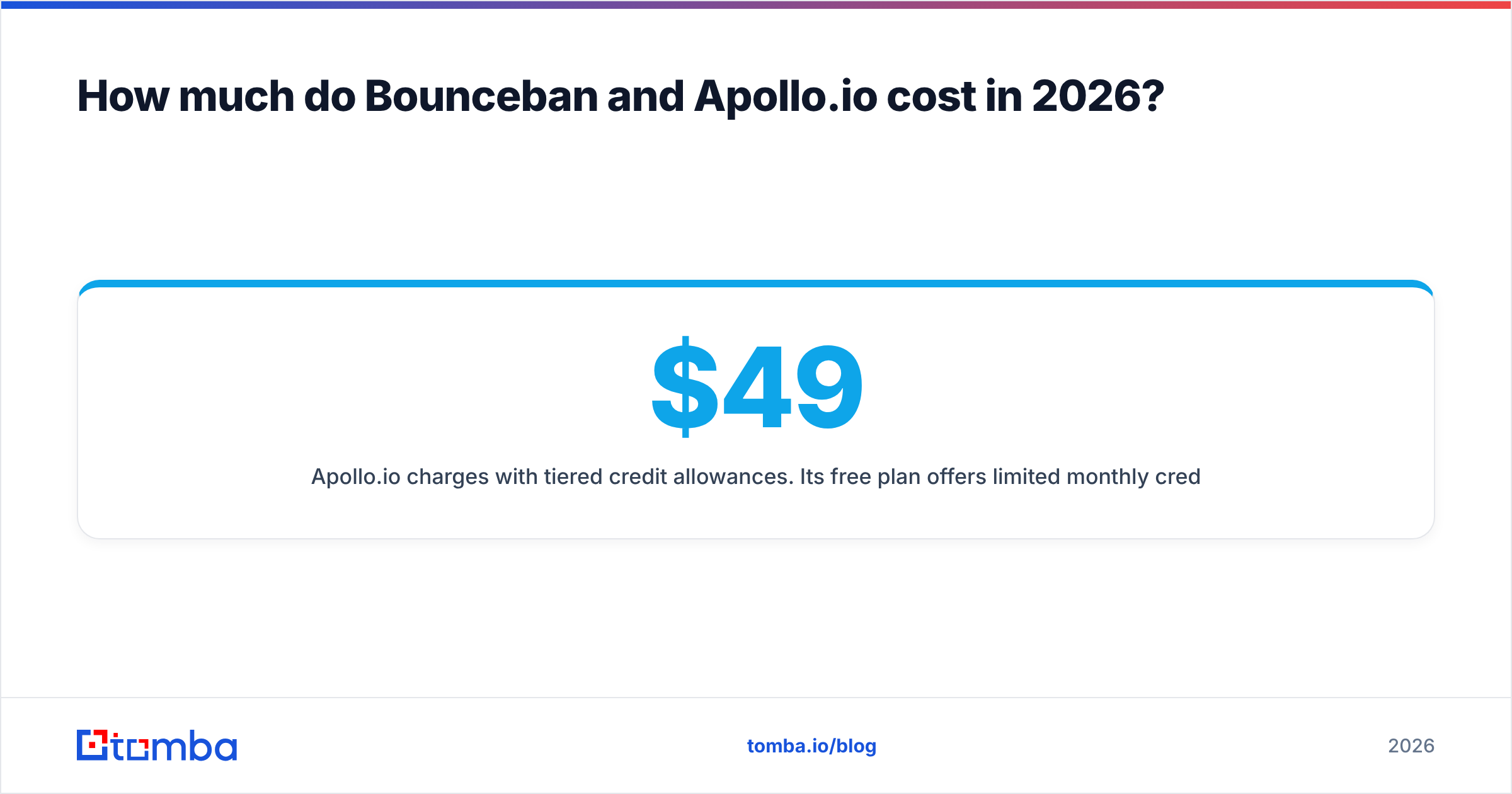
- Apollo.io charges per seat with tiered credit allowances. Its free plan offers limited monthly credits; paid tiers (commonly cited around $49/user/month for the entry paid plan and roughly $79–$119/user/month for higher tiers, billed annually) unlock more credits, sequencing volume, and advanced filters. Add seats, and the bill climbs fast for a team.
Two different meters. Bounceban's bill tracks list volume; Apollo's tracks headcount and usage. A solo founder cleaning a 5,000-row list has a very different math problem than a 12-rep team running sequences daily.
This is also where flat-rate, capability-bundled pricing gets attractive. If you'd rather not run two subscriptions on two billing models, compare both against a single plan that includes finding and verification. See Tomba pricing for the all-in-one math.
When should you choose Bounceban?#
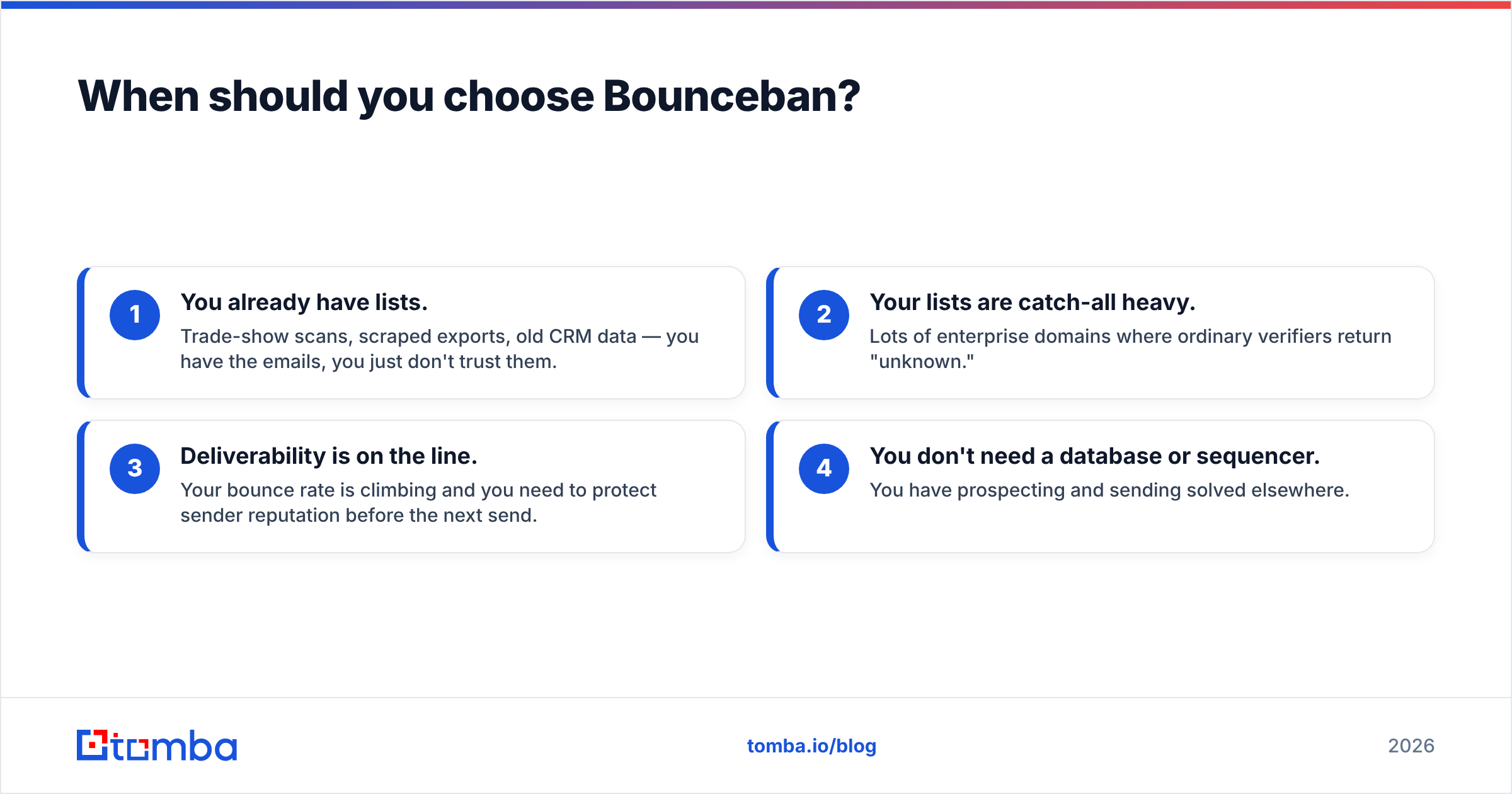
Choose Bounceban when verification is the problem:
- You already have lists. Trade-show scans, scraped exports, old CRM data — you have the emails, you just don't trust them.
- Your lists are catch-all heavy. Lots of enterprise domains where ordinary verifiers return "unknown."
- Deliverability is on the line. Your bounce rate is climbing and you need to protect sender reputation before the next send.
- You don't need a database or sequencer. You have prospecting and sending solved elsewhere.
If that's you, a focused verifier beats a bloated platform you'll use 10% of.
When should you choose Apollo.io?#
Choose Apollo when discovery is the bottleneck:
- You're starting from zero. No list, no contacts — you need to find people matching an ICP.
- You want one tab. Prospect, enrich, and sequence without exporting to four tools.
- You're US-centric and mid-market+. That's where Apollo's data is densest.
- You have budget for seats. The per-user model fits funded teams better than scrappy solo operators.
Apollo's breadth is genuinely useful — just go in knowing the long-tail coverage and catch-all gaps are real, and budget a separate verification pass if your bounce tolerance is tight.
Is there a better all-in-one alternative?#
Yes — if your real goal is "find accurate emails and verify them without juggling two billing models," a combined platform is worth a look. This is where Tomba fits between the two.
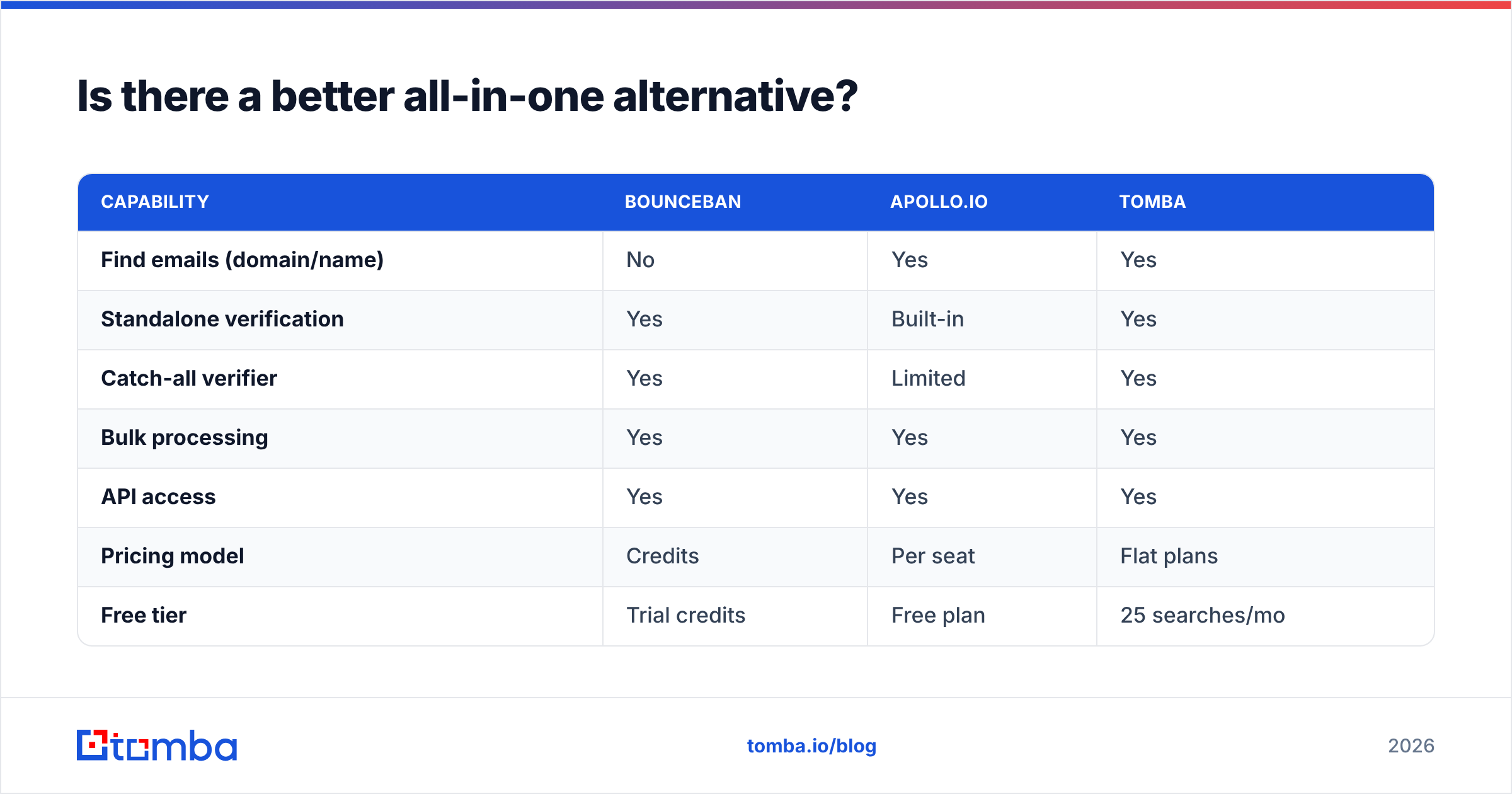
Tomba isn't trying to be a 275-million-row database with intent data and a sequencer. It's a focused finding-and-verification engine: domain search to pull every email pattern at a company, an email finder for individual contacts, a standalone email verifier, and a dedicated catch-all verifier for the exact problem Bounceban specializes in — all under one flat plan instead of per-seat pricing.
| Capability | Bounceban | Apollo.io | Tomba |
|---|---|---|---|
| Find emails (domain/name) | No | Yes | Yes |
| Standalone verification | Yes | Built-in | Yes |
| Catch-all verifier | Yes | Limited | Yes |
| Bulk processing | Yes | Yes | Yes |
| API access | Yes | Yes | Yes |
| Pricing model | Credits | Per seat | Flat plans |
| Free tier | Trial credits | Free plan | 25 searches/mo |
The practical workflow many teams land on: use Tomba's domain search or bulk email finder to build the list, run the catch-all verifier before sending, and skip the second subscription entirely. If you later need a giant database with intent signals and a native sequencer, Apollo still earns a seat — the two aren't mutually exclusive.

How do they handle catch-all domains, specifically?#
Catch-all handling is the single most-searched reason people compare these two, so it deserves its own answer.
- Bounceban treats catch-all resolution as the product. It invests in SMTP-level techniques and pattern intelligence to convert "unknown" into a real verdict, which is why it's popular with agencies sending into enterprise domains.
- Apollo errs conservative. It would rather not surface an email it can't confirm than risk a bounce on your domain. Safer for reputation, worse for coverage — you'll see more blanks.
- Tomba offers a dedicated catch-all verifier as a discrete step, so you can finder-find and catch-all-check inside one workflow and one bill.
If catch-all coverage is the reason you're shopping, that narrows the field fast: you want a specialist verifier, not a database that hedges.
The verdict#
There's no single winner because they're not the same tool.
- Need to clean a list, especially catch-alls? Bounceban is a sharp, focused choice.
- Need to build a list from nothing, with sequencing attached? Apollo.io is the broader platform — budget for seats and a verification pass.
- Want finding and verification in one flat-priced tool without per-seat math? That's where Tomba is the most efficient pick, and it's a credible Apollo alternative for teams that mostly need accurate emails rather than a full sales-engagement suite.
Map the tool to the job, not the hype.
Try it on your own list#
Stop guessing which emails will bounce. The Tomba Email Finder finds professional addresses by name, domain, or company — and runs verification (catch-all included) in the same pass, so the only emails you keep are the ones safe to send. Start free with 25 searches a month, no seat fees, no credit-card maze. Build a clean list, protect your sender reputation, and keep your reply rate where it belongs.
// get started
Find, verify and enrich your first contacts today
Start on the free plan with 25 searches a month, then scale when your team is ready.
Free plan · No credit card required · GDPR & CCPA
// about the author