Bounceban vs Dealsignal: Which B2B Data Tool Wins in 2026?
Bounceban verifies risky emails; Dealsignal sells enriched B2B records. Here's an honest 2026 breakdown of pricing, accuracy, and which one your pipeline actually needs.
Choosing between Bounceban and Dealsignal feels like comparing a smoke detector to a hardware store. One checks whether the emails you already have will bounce. The other sells you fresh records to fill your CRM. They overlap just enough to confuse a buyer, and just little enough that picking the wrong one leaves a hole in your outbound stack.
This guide settles it. You'll get a straight read on what each tool actually does, where the pricing lands, how accurate the data is, and which one belongs in your workflow in 2026.
TL;DR#
- Bounceban is an email verification tool focused on catching catch-all and risky addresses before they hurt your sender reputation. It does not build your list — it cleans it.
- Dealsignal is a B2B data platform that sells on-demand, human-verified contact and company records with intent signals. It builds and enriches lists but is priced for mid-market and enterprise budgets.
- They solve different problems: Bounceban = deliverability hygiene, Dealsignal = sourcing and enrichment. Many teams need both functions, not one tool.
- On cost, Bounceban is cheap and narrow; Dealsignal is expensive and broad. Neither is a full prospecting engine on its own.
- If you want finding, verifying, and enriching in one affordable platform, a combined tool like Tomba covers all three jobs from a single dashboard starting at $49/mo.
What is Bounceban?#
Bounceban is a real-time email verification service. Its main pitch is accuracy on the hardest part of verification: catch-all domains. A catch-all server accepts every address you throw at it, so most verifiers shrug and mark those contacts "unknown." Bounceban tries to resolve them to a real valid/invalid verdict using SMTP probing and reputation heuristics.
What you get with Bounceban:
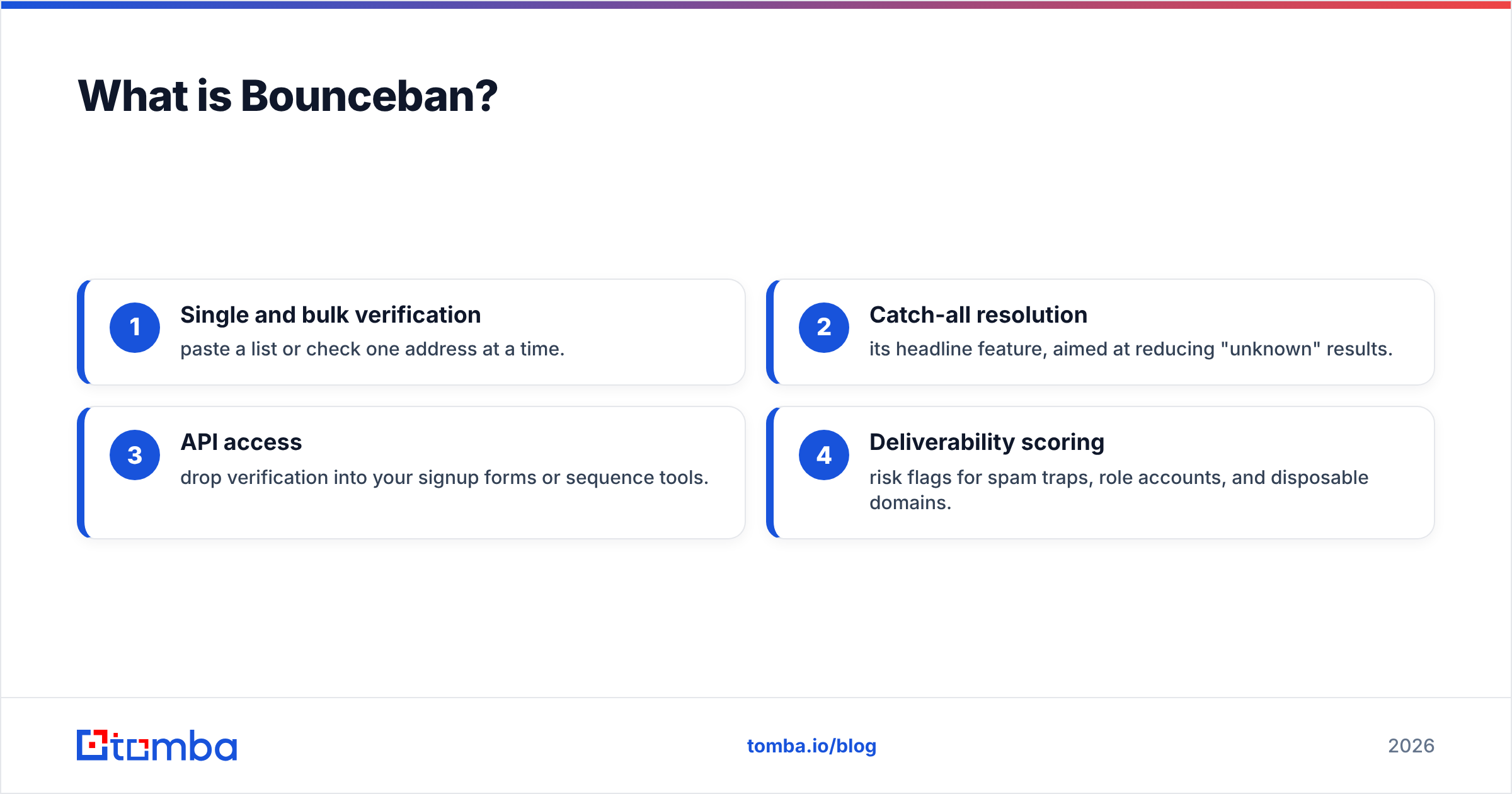
- Single and bulk verification — paste a list or check one address at a time.
- Catch-all resolution — its headline feature, aimed at reducing "unknown" results.
- API access — drop verification into your signup forms or sequence tools.
- Deliverability scoring — risk flags for spam traps, role accounts, and disposable domains.
What Bounceban does not do: it won't find a prospect's email from a name and company, it won't enrich a record with job title or phone, and it won't tell you which accounts are in-market. It's a hygiene layer, not a sourcing layer. If your CRM is already full of addresses and you're worried about email deliverability, it fits. If your CRM is empty, it can't help you yet.
)
What is Dealsignal?#
Dealsignal is a B2B data provider. You don't upload a dirty list to clean — you pull fresh, enriched records out. Its database covers company firmographics, contact details, technographics, and buyer-intent signals, and it markets the data as human-verified rather than purely algorithmic.
Dealsignal's core jobs:
- List building — filter by industry, title, company size, geography, and tech stack to generate a target list.
- Data enrichment — append missing fields (title, phone, company revenue) to records you already own.
- Intent data — surface accounts showing buying signals so you prioritize the warm ones.
- CRM and MAP sync — push records into Salesforce, HubSpot, and marketing automation platforms.
Dealsignal competes with the Clearbit alternative and ZoomInfo alternative crowd — data-first platforms built for revenue and marketing ops teams. The trade-off is price. This is enterprise-leaning software, and the per-record economics reflect that.
Bounceban vs Dealsignal: how do they compare?#
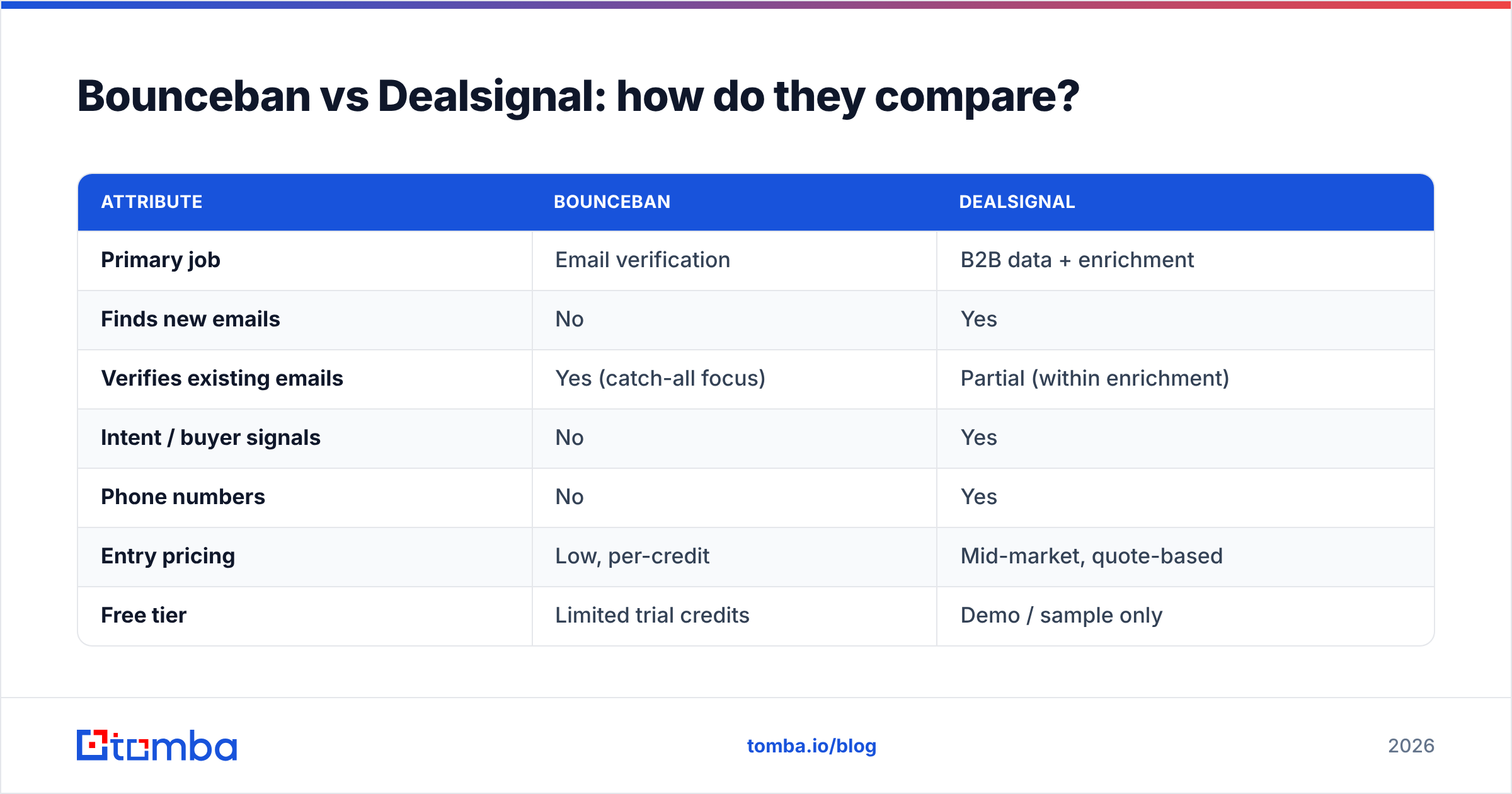
Here's the honest side-by-side. Note that several rows are "N/A" precisely because these tools live in different categories.
| Attribute | Bounceban | Dealsignal |
|---|---|---|
| Primary job | Email verification | B2B data + enrichment |
| Finds new emails | No | Yes |
| Verifies existing emails | Yes (catch-all focus) | Partial (within enrichment) |
| Intent / buyer signals | No | Yes |
| Phone numbers | No | Yes |
| Entry pricing | Low, per-credit | Mid-market, quote-based |
| Free tier | Limited trial credits | Demo / sample only |
| Best for | Deliverability hygiene | Sourcing + enrichment |
| API | Yes | Yes |
| Typical buyer | Cold-email senders, SDRs | RevOps, demand gen |
The pattern is clear. Bounceban is a precision instrument with one job. Dealsignal is a broad data engine with a heavier price tag. Asking "which is better" is like asking whether a scalpel beats a Swiss Army knife — it depends entirely on the cut you're making.
Is Bounceban or Dealsignal more accurate?#
Accuracy means two different things here, so judge each on its own turf.
For verification accuracy — does this address exist and will it bounce — Bounceban is purpose-built and generally strong on catch-all domains, which is exactly where most verifiers fail. If your only worry is bounce rate and sender reputation, a dedicated verifier usually edges out the verification module bundled inside a data platform.
For data accuracy — is this the right person, title, and company — Dealsignal's human-in-the-loop verification is its selling point. Self-reported "95%+ accuracy" claims are common across the data industry, and you should treat any vendor's number as a starting point, not gospel. The real test is a sample run against your own ICP. Most providers, including Dealsignal, will give you a sample list before you commit. Take it, then measure bounce and connect rates yourself.
A practical caution: data decays roughly 25–30% per year as people change jobs. Even a "verified" record from any vendor needs re-verification before a big send. That's why a standalone verifier and a data provider often end up in the same stack — the data tool sources, the verifier keeps it clean over time. You can read independent buyer reviews on G2 to sanity-check accuracy claims for both categories before you buy.
How much do Bounceban and Dealsignal cost?#
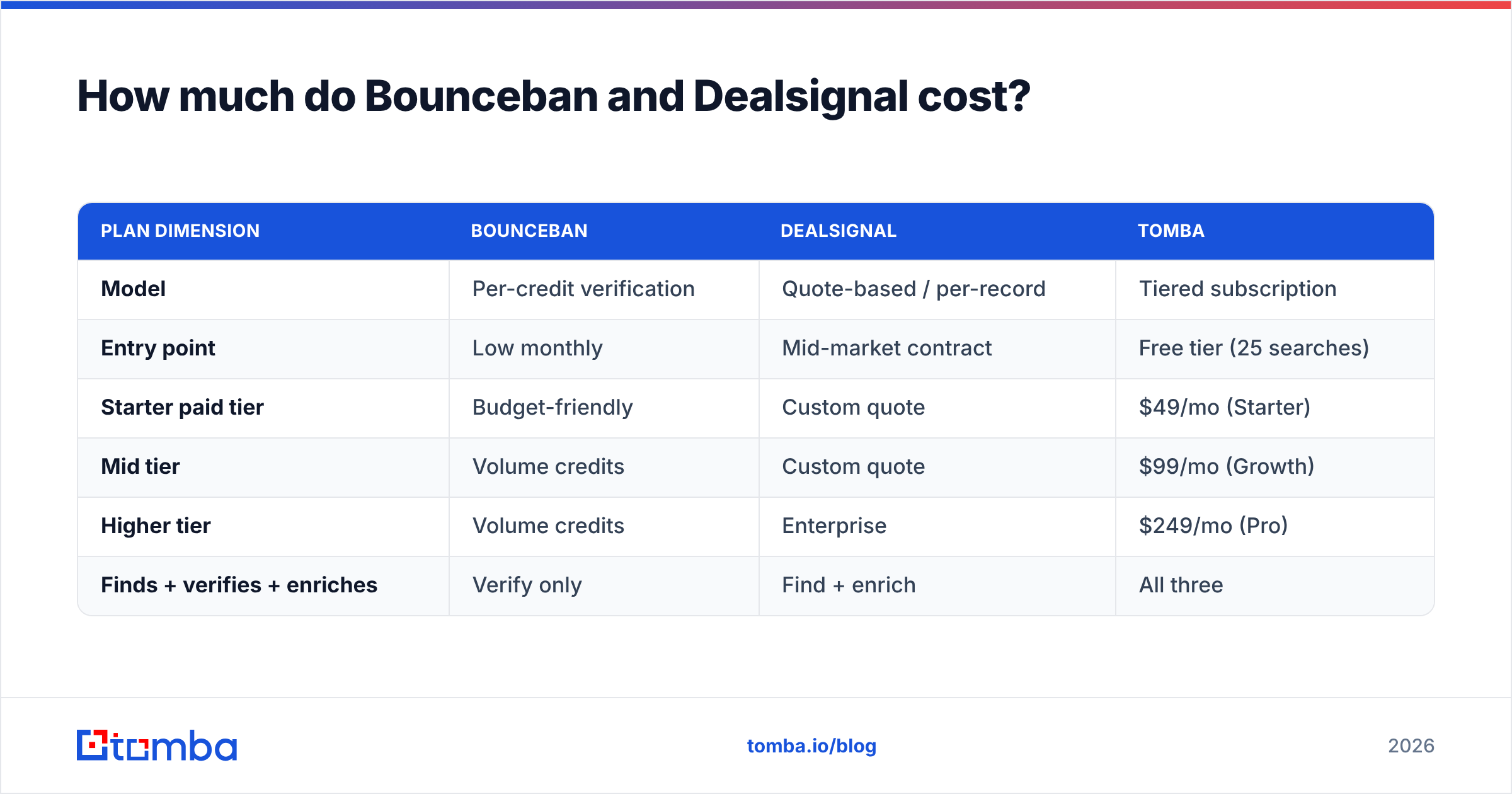
Pricing is where these tools diverge hardest, and where buyers most often overpay.
| Plan dimension | Bounceban | Dealsignal | Tomba |
|---|---|---|---|
| Model | Per-credit verification | Quote-based / per-record | Tiered subscription |
| Entry point | Low monthly | Mid-market contract | Free tier (25 searches) |
| Starter paid tier | Budget-friendly | Custom quote | $49/mo (Starter) |
| Mid tier | Volume credits | Custom quote | $99/mo (Growth) |
| Higher tier | Volume credits | Enterprise | $249/mo (Pro) |
| Finds + verifies + enriches | Verify only | Find + enrich | All three |
Bounceban keeps costs down because it does one thing. Dealsignal's quote-based pricing means you'll talk to sales and your number depends on volume and contract length — fine for funded teams, frustrating for a two-person SDR shop testing a channel.
The hidden cost in both cases is the second tool you'll inevitably buy. Bounceban buyers still need a source of contacts. Dealsignal buyers still want ongoing verification as records age. Two subscriptions, two dashboards, two invoices. That's the gap a combined platform closes — see full Tomba pricing for how find, verify, and enrich roll into one plan.
)
Which tool should you choose?#
Match the tool to the job you actually have right now.
- Choose Bounceban if you already have lists and your problem is bounces, spam traps, and a sinking sender reputation. You want a sharp verifier, especially for catch-all domains, and you don't need it to source anything.
- Choose Dealsignal if you're a RevOps or demand-gen team with budget, you need enriched records and intent data at scale, and you're comfortable with quote-based enterprise pricing.
- Choose a unified tool if you're doing outbound end to end — find the contact, verify it's deliverable, enrich it with title and phone — and you'd rather not stitch two vendors together.
That last case is the most common one for SDR teams, founders, and agencies, and it's where a platform that bundles the jobs wins on both price and workflow.
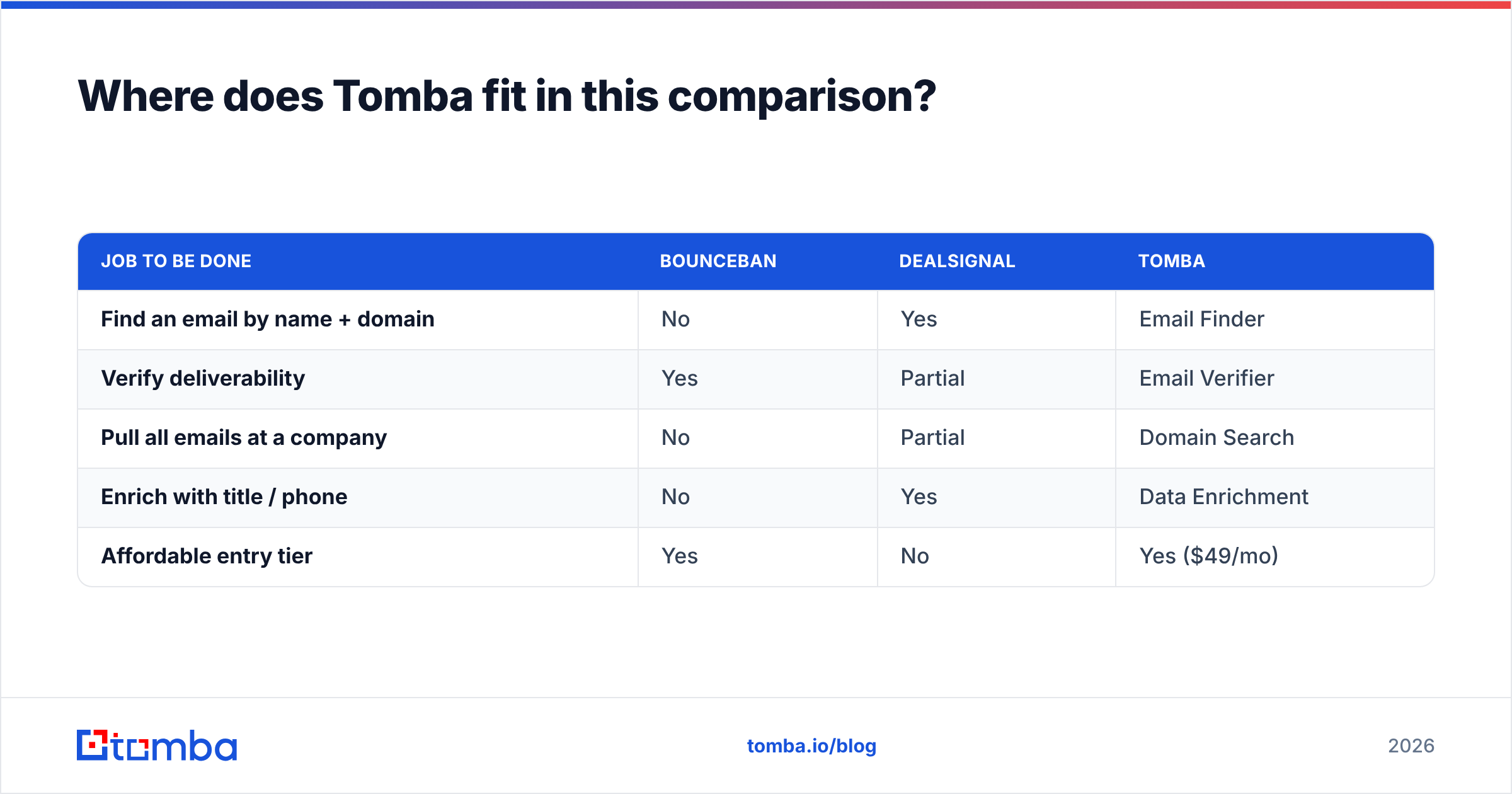
Where does Tomba fit in this comparison?#
Tomba covers the full outbound data loop in one place, which is the part neither Bounceban nor Dealsignal does alone.
| Job to be done | Bounceban | Dealsignal | Tomba |
|---|---|---|---|
| Find an email by name + domain | No | Yes | Email Finder |
| Verify deliverability | Yes | Partial | Email Verifier |
| Pull all emails at a company | No | Partial | Domain Search |
| Enrich with title / phone | No | Yes | Data Enrichment |
| Affordable entry tier | Yes | No | Yes ($49/mo) |
The argument isn't that Tomba beats Bounceban at pure catch-all verification or beats Dealsignal at enterprise intent data — specialists will always go deeper in their lane. The argument is workflow economics. If you'd otherwise buy a verifier and a data provider, one platform that does the email finding, verification, and enrichment from a single dashboard removes a vendor, an invoice, and an integration headache. For most teams sending cold email, that consolidation matters more than the last 1% of catch-all precision.
If you're evaluating Dealsignal specifically for sourcing, it's also worth pricing it against lighter Apollo alternatives and finder-first tools before signing an annual contract — the enterprise tier is overkill for many use cases that a credit-based finder handles for a fraction of the cost.
Frequently asked questions#
Is Bounceban a competitor to Dealsignal? Not really. Bounceban verifies emails you already have; Dealsignal sources and enriches new records. They overlap only in that Dealsignal includes some verification within enrichment. Most teams that need one eventually want the other function too.
Can Bounceban find email addresses? No. Bounceban verifies whether an address is valid and deliverable. To find an address from a name and company, you need an email finder like Tomba's or a data platform like Dealsignal.
Is Dealsignal worth the price? For funded RevOps and demand-gen teams that need intent data and enrichment at scale, the data quality can justify it. For small SDR teams or founders, the quote-based enterprise pricing is often more than the use case requires — a credit-based finder plus a verifier usually costs far less.
Do I need a separate verifier if I use a data provider? Usually yes, over time. B2B data decays 25–30% a year, so records that were accurate at purchase go stale. Ongoing verification keeps bounce rates low regardless of where the data originated.
The bottom line#
Bounceban and Dealsignal aren't rivals so much as two pieces of the same puzzle — one keeps your existing lists clean, the other fills them. Buy Bounceban for deliverability hygiene. Buy Dealsignal for enterprise-grade sourcing and intent. But if your real goal is to run outbound without juggling vendors, start with a platform that finds, verifies, and enriches under one roof.
Ready to consolidate? Try the Tomba Email Finder free — 25 searches a month, no credit card — and see how much of your two-tool stack a single platform can replace before you commit to either specialist.
// get started
Find, verify and enrich your first contacts today
Start on the free plan with 25 searches a month, then scale when your team is ready.
Free plan · No credit card required · GDPR & CCPA
// about the author