Brandnav vs Clodura.ai 2026: Which B2B Data Tool Wins?
Brandnav vs Clodura.ai compared on data accuracy, pricing, email finding, and sales intelligence — plus where a leaner email finder beats both in 2026.
Choosing between Brandnav and Clodura.ai usually means choosing between two different bets: a lean B2B contact-data layer versus a heavier all-in-one sales intelligence suite. This guide compares them on the things that actually move pipeline — data accuracy, email coverage, pricing, and how much platform you're paying for versus how much you'll use.
TL;DR#
- Brandnav is positioned as a focused B2B email and contact-data provider — good when you mainly need verified emails and basic firmographics without a full sales-engagement layer.
- Clodura.ai is a broader sales intelligence platform: contact database, buyer intent signals, sequences, and a built-in dialer — more tool, more cost, more onboarding.
- Accuracy is the deciding factor. Both market large databases, but real-world hit rate and bounce rate on your niche matter more than headline contact counts.
- Price gap is real: focused data tools start cheap; full suites like Clodura push you toward higher annual commitments.
- If your bottleneck is simply finding and verifying emails, a dedicated tool such as the Tomba Email Finder often beats both on cost-per-valid-contact — pair it with whatever sequencer you already own.
)
What is Brandnav?#
Brandnav is a B2B data tool built around contact discovery and email lookup. The core promise is straightforward: give it a company or a person, and get back a business email plus supporting firmographic fields (company, role, location, sometimes phone). It targets founders, agencies, and small sales teams who want list-building without the overhead of a full revenue platform.
Where Brandnav fits well:
- Quick list building for a defined ICP without learning a sprawling platform.
- Lighter budgets — you're buying data, not a 12-module suite.
- Hand-off to existing tools — export to your CRM or sequencer of choice.
The trade-off is scope. Brandnav is not trying to be your dialer, your intent-data vendor, and your sequencing engine. For some teams that focus is the feature; for others it's a gap they'll fill with three more subscriptions.
What is Clodura.ai?#
Clodura.ai is an all-in-one sales prospecting and intelligence platform. Beyond a B2B contact database, it bundles buyer intent signals, org charts, email sequencing, a built-in dialer, and direct-dial discovery. The pitch is "one login for the whole top of funnel" — find accounts, find contacts, see intent, and run outreach without leaving the tool.
Where Clodura.ai fits well:
- Teams that want consolidation — fewer vendors, one contract.
- Intent-led outbound — surfacing accounts showing buying signals.
- Built-in engagement — sequences and dialing without a separate Outreach or Salesloft seat.
The trade-off is the classic suite problem: you pay for breadth you may not use, onboarding is heavier, and any single module (data, intent, sequencing) may be weaker than a best-in-class point solution. If you already run a Salesloft alternative or your own sequencer, much of Clodura's value overlaps with what you own.
Brandnav vs Clodura.ai: core comparison#
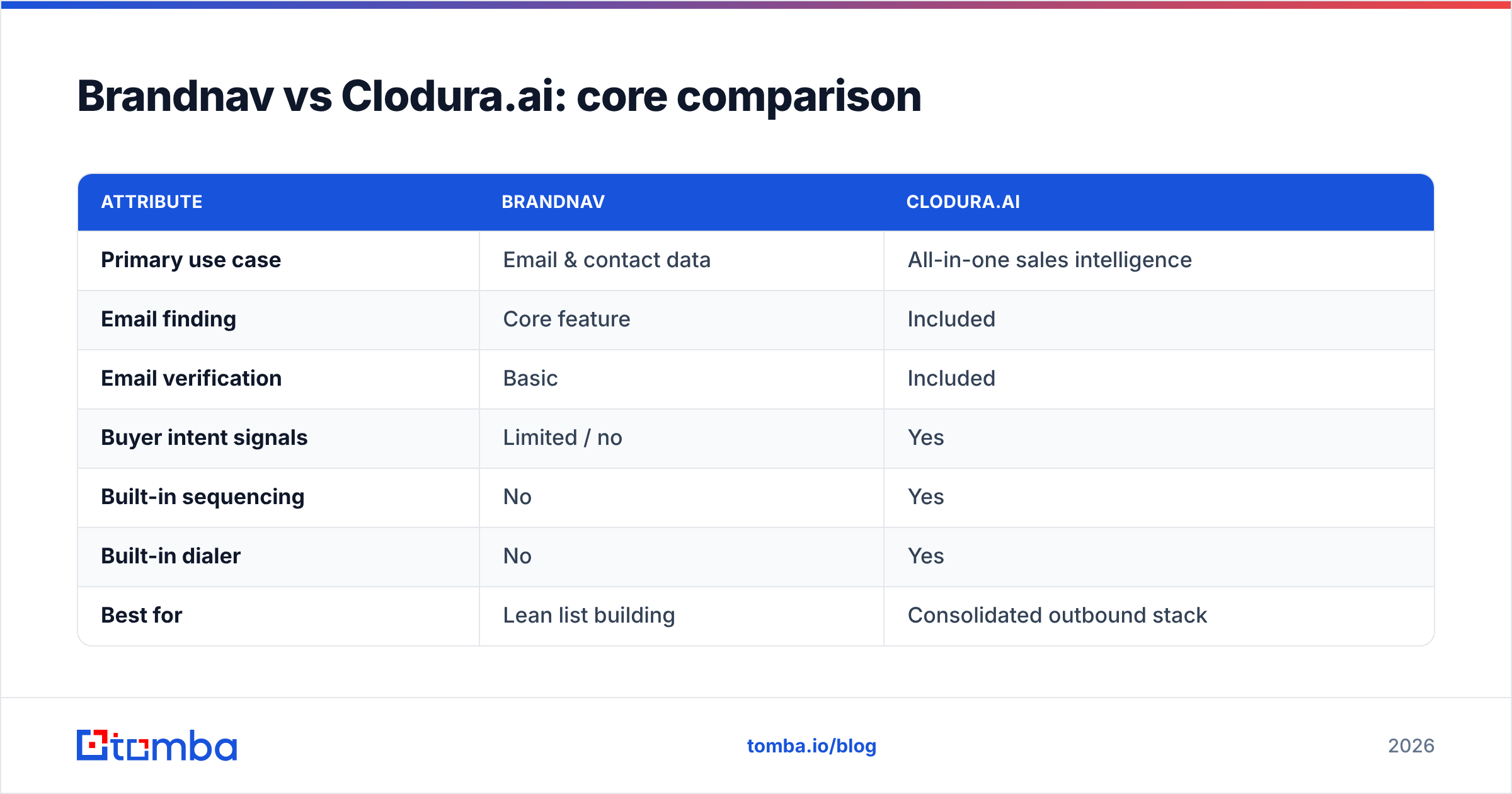
Here's the head-to-head on the attributes that decide most purchases. Treat headline database sizes as marketing, not gospel — what matters is coverage and accuracy for your segment.
| Attribute | Brandnav | Clodura.ai |
|---|---|---|
| Primary use case | Email & contact data | All-in-one sales intelligence |
| Email finding | Core feature | Included |
| Email verification | Basic | Included |
| Buyer intent signals | Limited / no | Yes |
| Built-in sequencing | No | Yes |
| Built-in dialer | No | Yes |
| Best for | Lean list building | Consolidated outbound stack |
| Pricing model | Lower entry, data-focused | Higher, suite/annual-leaning |
| Onboarding effort | Low | Moderate to high |
The pattern is consistent across this category: Brandnav competes on focus and price, Clodura.ai competes on breadth and consolidation. Neither is "better" in the abstract — they answer different questions.
Which has better data accuracy?#
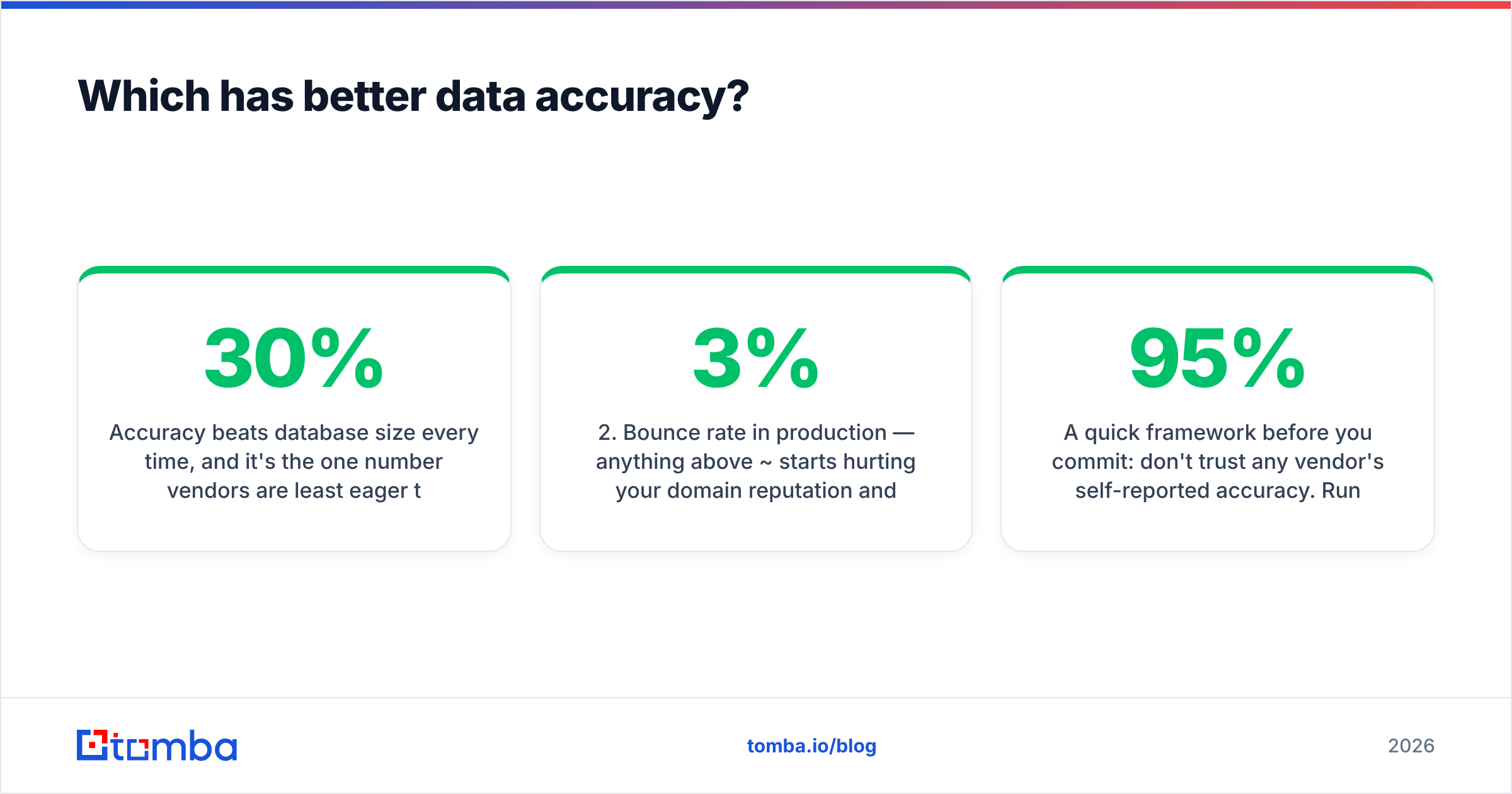
Accuracy beats database size every time, and it's the one number vendors are least eager to publish. A platform advertising 600M contacts is useless if 30% of the emails for your niche bounce. Your sender reputation pays the price, not the vendor's marketing page.
When you evaluate either tool, ignore the totals and test the metrics that protect deliverability:
- Valid-rate on a sample — pull 100 contacts in your exact ICP and verify them independently. This is the only number that matters.
- Bounce rate in production — anything above ~3% starts hurting your domain reputation and inbox placement.
- Catch-all handling — many B2B domains are catch-all, which inflates "deliverable" counts. A tool that can't distinguish a real mailbox from a catch-all is hiding risk.
- Freshness — job changes happen constantly; stale records mean wrong-person emails and wasted sends.
- Phone match rate — if direct dials matter, sample them separately; email accuracy and phone accuracy rarely match.
- Coverage by region — North American coverage is usually strong; EMEA and APAC are where databases thin out.

This is exactly where a dedicated verification layer earns its keep. Even if you buy data from Brandnav or Clodura.ai, running the export through a separate email verifier before you load it into a sequence is cheap insurance. For catch-all domains specifically, a catch-all verifier tells you whether a "valid" address is actually reachable — a distinction both suites tend to blur.
A quick framework before you commit: don't trust any vendor's self-reported accuracy. Run the sample test yourself, measure bounce rate over a real send, and only then decide. Read more on where contact data accuracy actually comes from if you want to understand why two tools quoting "95% accuracy" can perform completely differently on your list.
How do they compare on pricing?#
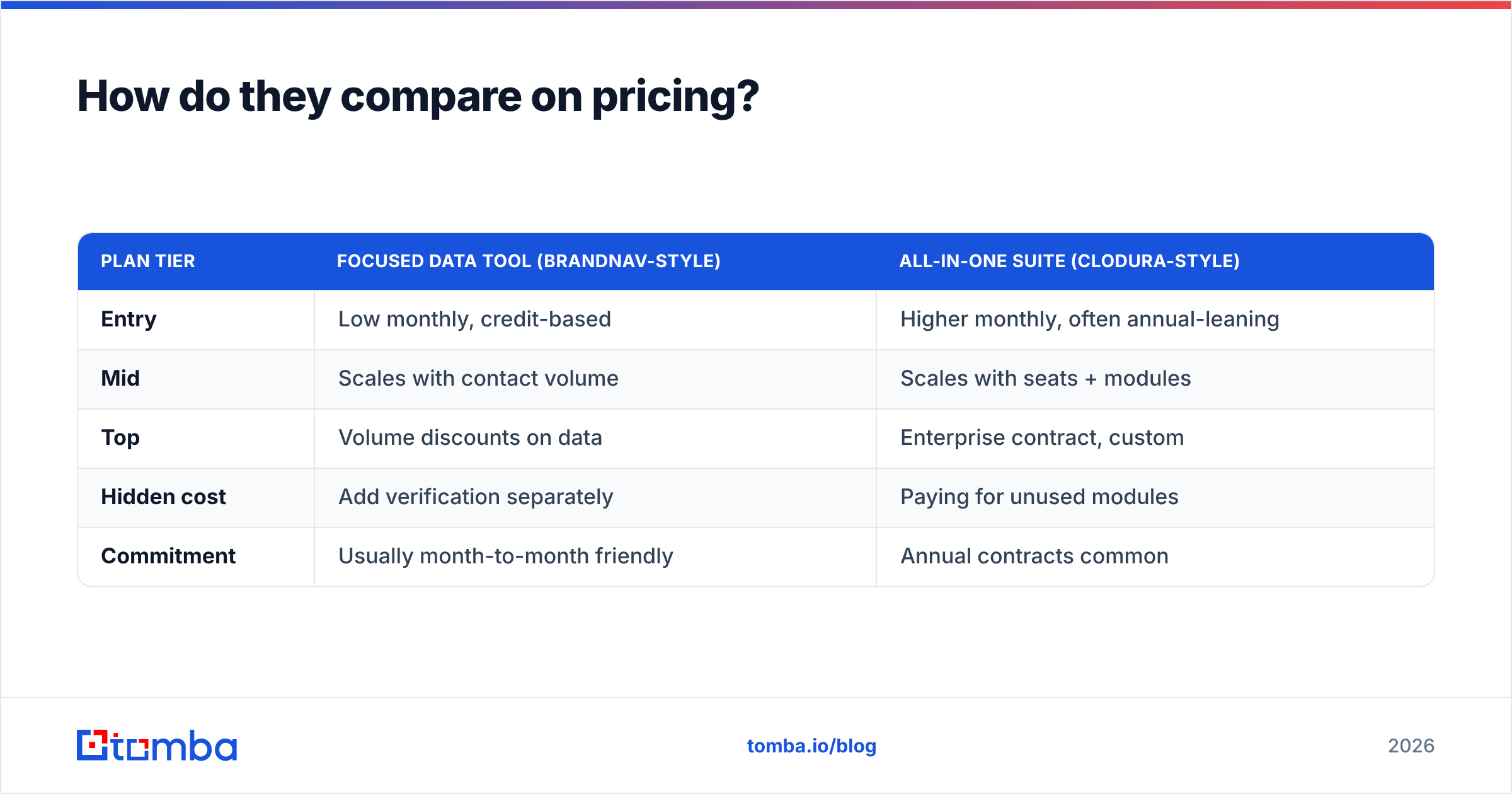
Pricing is where the two tools separate most clearly. Focused data tools price by data volume and stay accessible; full suites push toward higher tiers and annual commitments because you're buying the whole platform.
| Plan tier | Focused data tool (Brandnav-style) | All-in-one suite (Clodura-style) |
|---|---|---|
| Entry | Low monthly, credit-based | Higher monthly, often annual-leaning |
| Mid | Scales with contact volume | Scales with seats + modules |
| Top | Volume discounts on data | Enterprise contract, custom |
| Hidden cost | Add verification separately | Paying for unused modules |
| Commitment | Usually month-to-month friendly | Annual contracts common |
The honest reading: if you only need data, paying suite prices for sequencing and intent you won't use is a leak. If you genuinely use intent + sequencing + dialing every day, the consolidated price can be cheaper than four separate vendors. Map your actual workflow before you compare sticker prices.
For reference on what transparent, volume-based pricing looks like, Tomba pricing runs a free tier (25 searches/mo), Starter at $49/mo, Growth at $99/mo, and Pro at $249/mo — data-focused, month-to-month, no forced suite. You can validate vendor claims further on neutral review sites like G2 and Capterra before signing anything.
)
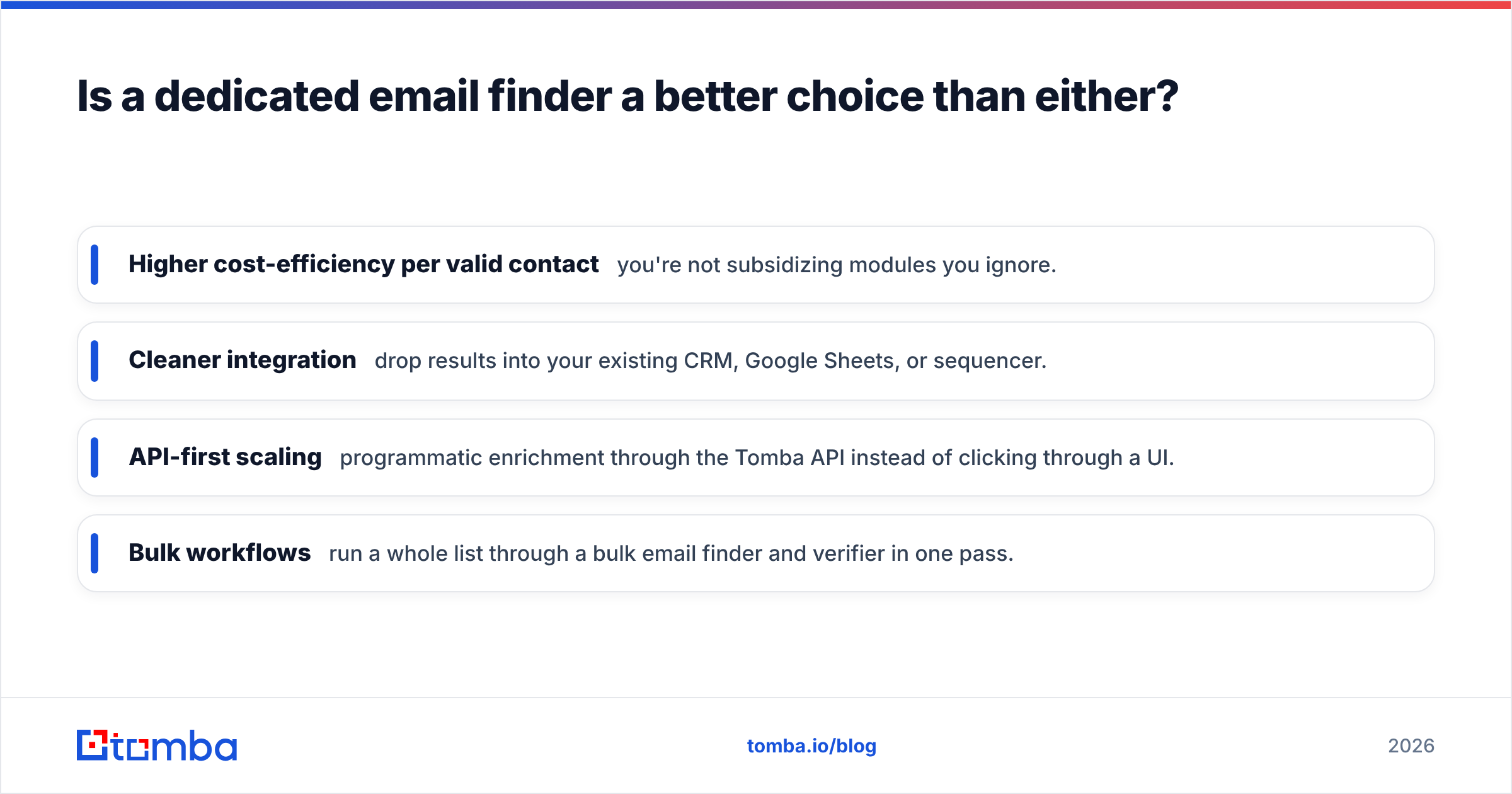
Is a dedicated email finder a better choice than either?#
For many teams, yes — if email is your actual bottleneck. Both Brandnav and Clodura.ai are reasonable, but the most common mistake is buying a platform to solve a data problem. If the thing slowing you down is "I can't reliably find and verify emails for my ICP," you don't need intent dashboards and a dialer; you need a precise finder and verifier you can run at volume and via API.
That's the lane where a specialist tool wins. Compared to a broad suite, a focused finder typically gives you:
- Higher cost-efficiency per valid contact — you're not subsidizing modules you ignore.
- Cleaner integration — drop results into your existing CRM, Google Sheets, or sequencer.
- API-first scaling — programmatic enrichment through the Tomba API instead of clicking through a UI.
- Bulk workflows — run a whole list through a bulk email finder and verifier in one pass.
| Scenario | Best fit |
|---|---|
| "I just need verified emails, cheaply" | Dedicated email finder |
| "I want data + sequencing + intent in one login" | Clodura.ai-style suite |
| "Lean list building, simple firmographics" | Brandnav-style data tool |
| "Enrich at scale via API" | Dedicated finder + API |
| "Catch-all domains are killing my bounce rate" | Finder + catch-all verifier |
None of this means suites are bad — it means you should buy for the job in front of you. If your real constraint is engagement and you want everything consolidated, Clodura.ai is a defensible choice. If it's lightweight data, Brandnav is. If it's accurate email at the lowest cost-per-valid, a specialist finder usually beats both, and you keep the freedom to plug it into whatever stack you already trust — including HubSpot via the HubSpot integration or Pipedrive via the Pipedrive integration.
What about deliverability after you get the data?#
Finding the email is half the job; landing in the inbox is the other half. Even perfect data bounces if your sending setup is weak. Before you scale outbound with contacts from any of these tools:
- Authenticate your domain — SPF, DKIM, and DMARC all aligned. Check your record with an SPF checker.
- Warm gradually — don't blast 2,000 cold emails from a fresh domain on day one.
- Keep bounce rate under ~3% — which loops back to verifying every address first.
- Monitor sender reputation — protect the asset that makes outbound work at all.
This is the part suites and data tools alike tend to under-emphasize, because it's your responsibility, not theirs. Good data into a poorly configured domain still fails. For the fundamentals, vendor docs from established players like HubSpot cover deliverability hygiene well, and you can pressure-test individual messages with a spam checker before launch.
Brandnav vs Clodura.ai: the verdict#
Here's the decision in one paragraph. Pick Clodura.ai if you want a consolidated, intent-aware outbound platform and will actually use the sequencing and dialer. Pick Brandnav if you want lean, affordable B2B contact data and already own your engagement stack. And if the real problem is simply accurate, affordable email at scale, skip the framing entirely and run a dedicated finder alongside your existing tools.
Whatever you choose, run the sample-accuracy test before you pay, verify every address before you send, and don't buy modules you won't open. The most expensive tool is the one whose 80% of features you never touch.
Find and verify emails without the suite tax#
If your goal is more verified contacts per dollar — not another dashboard to log into — start with the Tomba Email Finder. Search by name, company, or domain; verify in the same workflow; export straight to your CRM or run it through the Tomba API for programmatic enrichment. The free tier gives you 25 searches a month to test accuracy on your own ICP before spending a cent, and paid plans start at $49/mo with month-to-month flexibility — no annual suite commitment required. Test it against your Brandnav or Clodura.ai sample list and let the bounce rate decide.
Ready to find emails that actually work?
Join 150,000+ professionals who stopped guessing and started sending. Free credits on signup — no credit card required.
Get the Tomba newsletter
Practical outbound tactics and product updates — once every two weeks.
About the author