Business Acumen in Sales: The 2026 Guide for Sellers
Business acumen in sales is the skill that separates reps who quote features from reps who close on business outcomes. Here is how to build it in 2026.
Business Acumen in Sales: The 2026 Guide for Sellers
TL;DR
- Business acumen in sales is the ability to understand how your buyer makes money, spends money, and measures success — then frame your solution in those terms.
- Reps with strong acumen tie every pitch to a financial outcome (revenue, cost, risk, time), which is why they win larger deals and shorter cycles.
- You build it with three habits: pre-call research, financial fluency, and industry pattern recognition.
- Tools that surface accurate company and contact data — like a reliable email finder and data enrichment — turn research from a chore into a 5-minute routine.
- This guide gives you a maturity model, a comparison of acumen levels, a research checklist, and the metrics that prove it is working.
What is business acumen in sales?#
Business acumen in sales is knowing your customer's business well enough to sell to outcomes instead of features. It is the difference between "our platform has 99.9% uptime" and "every hour of downtime costs your operations team roughly $40,000, and here is how we remove that risk."
Think of it like a doctor versus a vitamin-shop clerk. The clerk lists what is on the shelf. The doctor diagnoses your specific condition, explains the consequences of doing nothing, and prescribes a fix tied to your health goals. Buyers pay a premium for the doctor. Technically, business acumen is the combination of financial literacy, industry knowledge, and commercial judgment that lets you connect your product to the metrics your buyer is graded on.
In practice it shows up in small moments: you know that a CFO cares about cash conversion, not "engagement"; you know a manufacturing buyer measures OEE (overall equipment effectiveness); you know a SaaS VP of Sales lives and dies by net revenue retention. When you speak those languages, you stop being a vendor and start being an advisor.
Why does business acumen matter more in 2026?#
Three shifts made acumen the deciding factor in B2B deals:
- Buying committees got bigger. Gartner has reported that a typical B2B purchase now involves six to ten decision-makers. Each one weighs the deal against a different metric, so a feature pitch that lands with one stakeholder falls flat with the other nine.
- Budgets are scrutinized line by line. After several tight economic cycles, "nice to have" does not survive a procurement review. Deals close when a rep can defend the ROI in the buyer's own spreadsheet.
- Information is commoditized. Buyers can self-educate on features before they ever talk to you. What they cannot easily get is a credible outside view of how a peer company solved the same problem and what it was worth. That is acumen, and it is the value you add.
The cost of low acumen is quiet but brutal: longer cycles, "we'll circle back next quarter," and deals lost to a competitor who simply framed the value better. According to repeated findings summarized by analysts at Gartner, buyers consistently rank "helps me understand my own business problem" above product knowledge when they rate sellers.
What are the levels of business acumen in sales?#
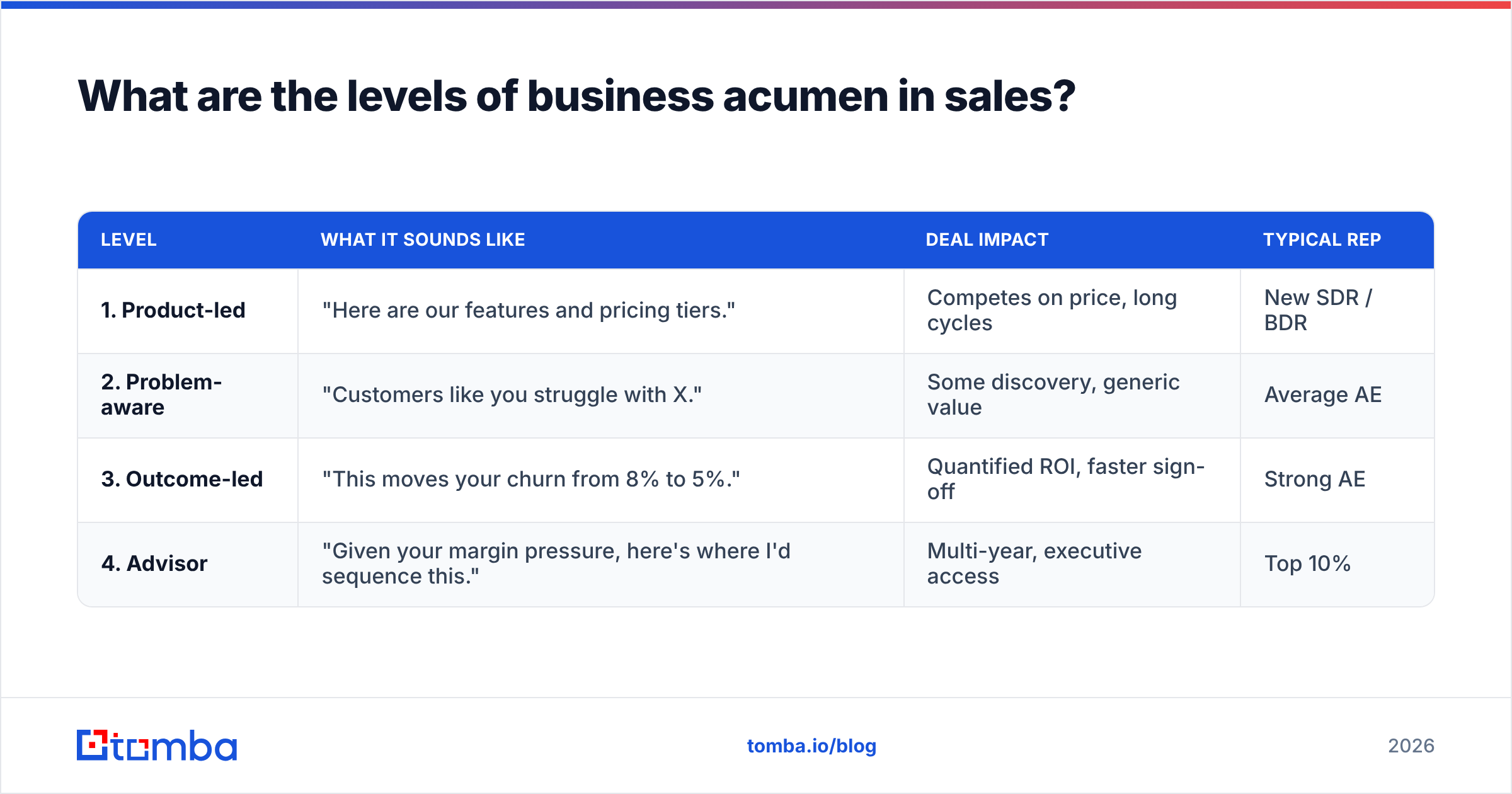
Acumen is not binary — it matures in stages. Use the model below to locate yourself or your team, then target the next rung.
| Level | What it sounds like | Deal impact | Typical rep |
|---|---|---|---|
| 1. Product-led | "Here are our features and pricing tiers." | Competes on price, long cycles | New SDR / BDR |
| 2. Problem-aware | "Customers like you struggle with X." | Some discovery, generic value | Average AE |
| 3. Outcome-led | "This moves your churn from 8% to 5%." | Quantified ROI, faster sign-off | Strong AE |
| 4. Advisor | "Given your margin pressure, here's where I'd sequence this." | Multi-year, executive access | Top 10% |
Most teams cluster at Levels 1 and 2. The revenue lives at Levels 3 and 4, where the conversation moves from "what does it do" to "what is it worth, and why now." Moving up a level is rarely about talent — it is about a repeatable research and framing process, which the rest of this guide lays out.
How do you build business acumen as a sales rep?#
Business acumen is a learnable skill, not an innate gift. Build it across four areas, each with a concrete daily or weekly habit.
- Financial fluency. Learn to read a public company's 10-K and an income statement. Know the difference between revenue, gross margin, and operating income, and which one your buyer's title is accountable for. Spend 30 minutes a week reading one earnings call transcript in your target industry.
- Industry pattern recognition. Pick three to five core verticals and go deep. Track their regulations, their seasonal cycles, their dominant KPIs, and the two or three trends keeping their executives awake. Subscribe to one trade publication per vertical.
- Account research discipline. Before every first call, spend 10–15 minutes building a picture of the company: recent funding, leadership changes, hiring patterns, tech stack, and the named contacts in the buying group. This is where tooling pays off — pulling verified contacts and firmographics with a B2B database and contact enrichment collapses an hour of LinkedIn spelunking into minutes.
- Commercial storytelling. Practice translating a feature into a financial sentence. "Automated routing" becomes "you cut average handle time by 18 seconds across 200 agents, which is roughly $1.2M of recovered capacity a year." Do this for your top five features until it is reflexive.
The compounding effect matters: a rep who runs this loop for two quarters builds a mental library of patterns that makes every future call faster and sharper.
What does business acumen look like on a sales call?#
It shows up as questions, not statements. A low-acumen rep talks. A high-acumen rep diagnoses. Compare the two openings to the same discovery call:
Low acumen: "So, what are you looking for in a solution like ours?"
High acumen: "I saw on your Q3 call that you're pushing into the mid-market segment while protecting gross margin. When sales teams move down-market, the cost-to-serve usually jumps. How are you thinking about keeping acquisition costs in line as you scale that motion?"
The second opener does three things: it proves you did the homework, it anchors on a metric the executive owns (gross margin), and it earns the right to a real conversation. You cannot fake this — it requires that 15 minutes of pre-call research, which is why the best teams systematize the inputs.
A practical pre-call checklist:
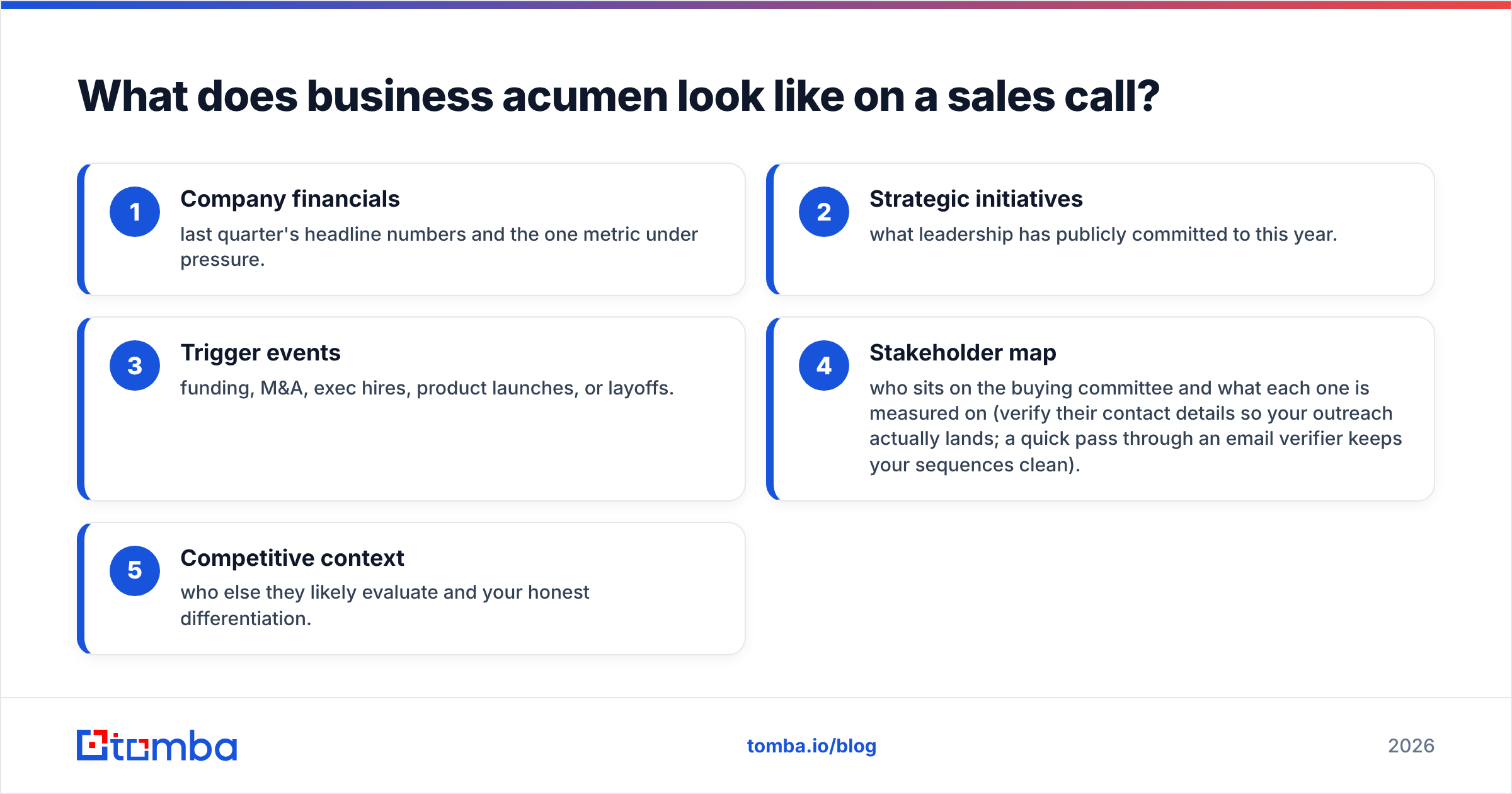
- Company financials — last quarter's headline numbers and the one metric under pressure.
- Strategic initiatives — what leadership has publicly committed to this year.
- Trigger events — funding, M&A, exec hires, product launches, or layoffs.
- Stakeholder map — who sits on the buying committee and what each one is measured on (verify their contact details so your outreach actually lands; a quick pass through an email verifier keeps your sequences clean).
- Competitive context — who else they likely evaluate and your honest differentiation.
How is business acumen different from sales skills?#
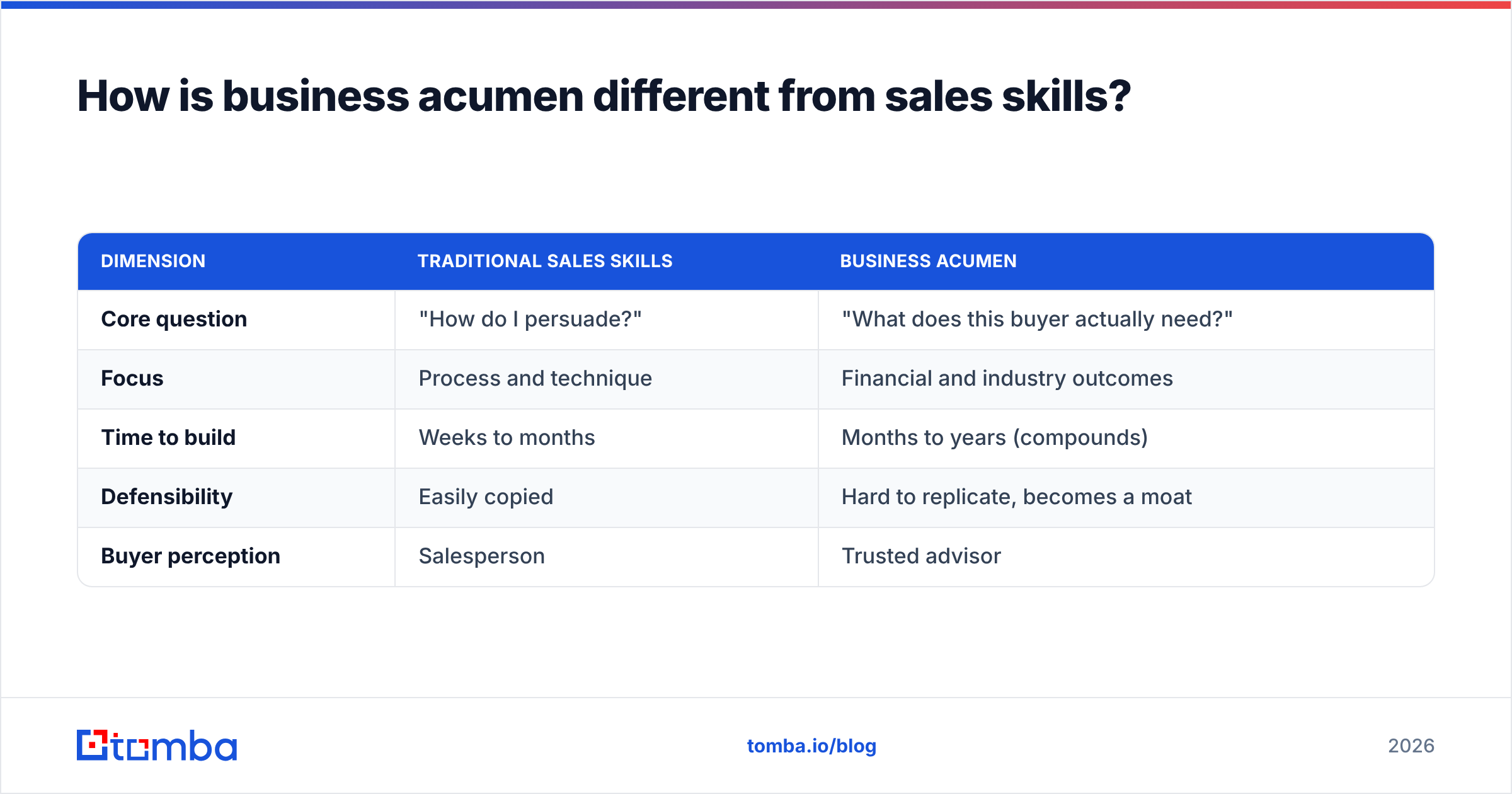
They are cousins, not twins. Traditional sales skills — rapport, objection handling, closing technique — govern how you move a deal forward. Business acumen governs what you say and why it matters to this specific buyer. You need both, but acumen is the scarcer and more defensible asset.
| Dimension | Traditional sales skills | Business acumen |
|---|---|---|
| Core question | "How do I persuade?" | "What does this buyer actually need?" |
| Focus | Process and technique | Financial and industry outcomes |
| Time to build | Weeks to months | Months to years (compounds) |
| Defensibility | Easily copied | Hard to replicate, becomes a moat |
| Buyer perception | Salesperson | Trusted advisor |
Here is the honest trade-off: you can hit quota for a while on technique alone, especially in transactional deals. But the moment you move upmarket — enterprise logos, multi-year contracts, executive sponsors — technique without acumen stalls. The executive sponsor does not want to be "handled." They want a peer who understands their P&L. Pairing acumen with strong outbound mechanics is how modern teams scale; see how a disciplined sales prospecting routine feeds the research engine that acumen depends on.
Which metrics prove your business acumen is working?#
Acumen is intangible, but its effects are not. Track these and you will see whether the investment is landing:
- Average deal size. Outcome-led selling justifies bigger contracts. A rising ACV is the clearest signal.
- Win rate on competitive deals. When you and a competitor are technically close, acumen breaks the tie. Watch your win rate on deals where a named rival was in the room.
- Sales cycle length. Buyers move faster when the business case is built for them, not assembled by them.
- Meeting-to-opportunity conversion. Sharper discovery questions convert more first calls into qualified pipeline.
- Multi-threading rate. High-acumen reps reach more stakeholders because they have a relevant reason to talk to each one.
A simple way to instrument this: tag deals in your CRM by the acumen level of the lead rep at the time, then compare cohorts after two quarters. If the framework is real, the Level 3–4 cohort will out-convert and out-size the Level 1–2 cohort, and the gap will be obvious.
What tools support business acumen without replacing it?#
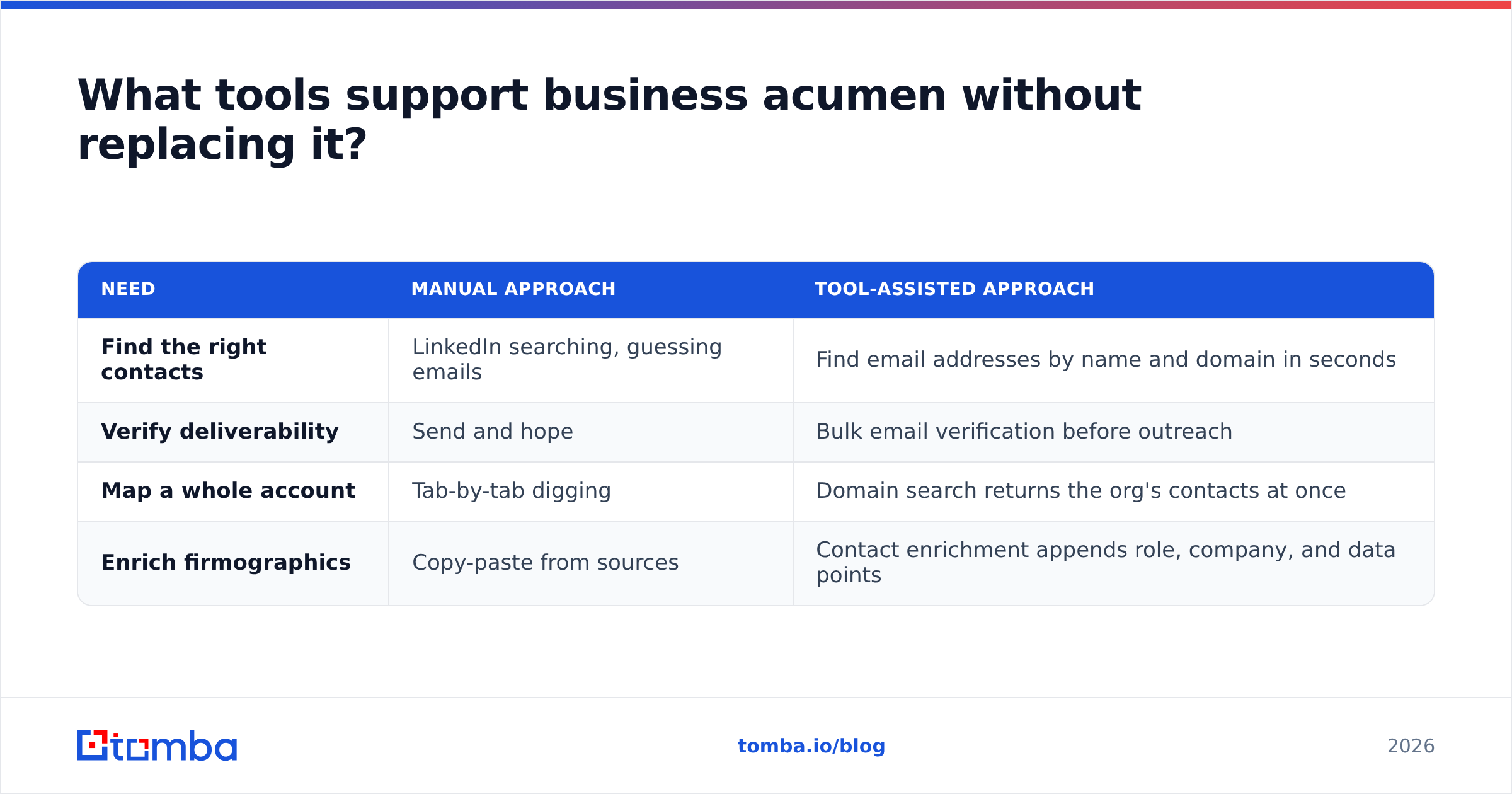
No tool gives you judgment, but the right stack removes the friction that keeps reps from doing the research in the first place. The goal is to spend your scarce time thinking, not gathering. Here is how the categories stack up against the research workflow:
| Need | Manual approach | Tool-assisted approach |
|---|---|---|
| Find the right contacts | LinkedIn searching, guessing emails | Find email addresses by name and domain in seconds |
| Verify deliverability | Send and hope | Bulk email verification before outreach |
| Map a whole account | Tab-by-tab digging | Domain search returns the org's contacts at once |
| Enrich firmographics | Copy-paste from sources | Contact enrichment appends role, company, and data points |
Notice what these tools do and do not do. They get you accurate inputs — names, roles, verified contacts, company context — faster. They do not interpret those inputs for you. The interpretation, the "so what does this mean for the buyer's margin," is the acumen. That is yours. Affordable, accurate data simply means you can run the pre-call research loop on every deal instead of only the biggest ones. You can compare options and pricing on the Tomba pricing page, where the free tier (25 searches a month) is enough to test the workflow before you commit. For broader context on how data quality drives sales productivity, vendor research libraries like HubSpot's sales statistics and peer reviews on G2 are worth a regular skim.
How do you coach business acumen across a team?#
If you manage reps, acumen is your highest-leverage coaching investment because it transfers. One framework, taught well, lifts the whole team. Four moves work:
- Deal reviews focused on the business case, not the forecast. Stop asking "will it close?" and start asking "what is this worth to the buyer, in their numbers?" If the rep cannot answer, that is the coaching gap.
- Build a vertical playbook. For each core industry, document the KPIs, the common pains, the trigger events, and three discovery questions that prove acumen. New reps ramp on patterns instead of reinventing them.
- Role-play the executive conversation. Have reps defend a business case to you playing a skeptical CFO. It is uncomfortable and exactly the rehearsal they need.
- Make research non-negotiable and easy. If you require pre-call research, give the team tooling that makes it 10 minutes, not an hour — otherwise it gets skipped under quota pressure. Standardize on a contact and data enrichment workflow so the inputs are consistent across the team.
The teams that do this well treat acumen like a curriculum, not a personality trait. They onboard it, reinforce it in every deal review, and measure it. Over a year, that compounds into a structural advantage competitors find very hard to copy.
The bottom line#
Business acumen in sales is the skill that turns a vendor into an advisor: understand how your buyer makes money, frame your solution in their financial language, and prove the outcome in their own numbers. It is learnable, coachable, and measurable — and in a 2026 market of bigger buying committees and tighter budgets, it is the difference between deals that stall and deals that close.
Start with the research habit, because everything else builds on it. You cannot diagnose a buyer you have not studied, and you cannot study buyers you cannot reach. Give your team accurate, verified contact data so the pre-call research loop runs on every deal, not just the marquee ones. Try the Tomba Email Finder — find the right people by name, company, or domain, verify they are reachable, and spend your saved time on the work that actually wins: understanding the business across the table.
Ready to find emails that actually work?
Join 150,000+ professionals who stopped guessing and started sending. Free credits on signup — no credit card required.
Get the Tomba newsletter
Practical outbound tactics and product updates — once every two weeks.
About the author