Business Development Coaching: The 2026 Playbook for Reps
Business development coaching turns average reps into pipeline machines. Here's the 2026 framework, a coaching-model comparison, and the metrics that prove it works.
Business development coaching is the difference between a team that hits quota by accident and one that hits it on purpose. Most reps don't fail because they lack effort — they fail because nobody ever taught them a repeatable way to find the right accounts, reach the right people, and move a conversation forward. Coaching fixes that.
This guide breaks down what business development coaching actually is in 2026, the models that work, the metrics that prove it's working, and the tooling that makes coaching stick instead of fading after the offsite.
TL;DR#
- Business development coaching is structured, ongoing skill-building for the people who create pipeline — BDRs, SDRs, and AEs doing their own prospecting.
- The best programs blend call reviews, deal coaching, and prospecting reps on a weekly cadence — not one-off training events.
- Pick a coaching model (manager-led, peer, or hybrid) based on team size and rep tenure. A comparison table is below.
- Coaching only compounds when reps work clean data. Bad contact lists waste every minute you spend on technique.
- Measure leading indicators (activity quality, reply rate, meetings booked) before lagging ones (revenue), or you'll coach blind.
What is business development coaching?#
Business development coaching is the practice of systematically improving how reps generate and advance new business — through repeated observation, feedback, and practice. Think of it like a strength coach for an athlete: the rep already trains hard, but a coach watches the form, spots the one bad habit costing 20% of the output, and drills the correction until it's automatic.
It is different from onboarding (a one-time ramp) and from generic sales training (a workshop everyone forgets in two weeks). Coaching is recurring and individualized. A good coach doesn't lecture the whole team on "objection handling"; they listen to your last five calls, notice you talk past the buyer's pricing concern, and run a role-play until you stop doing it.
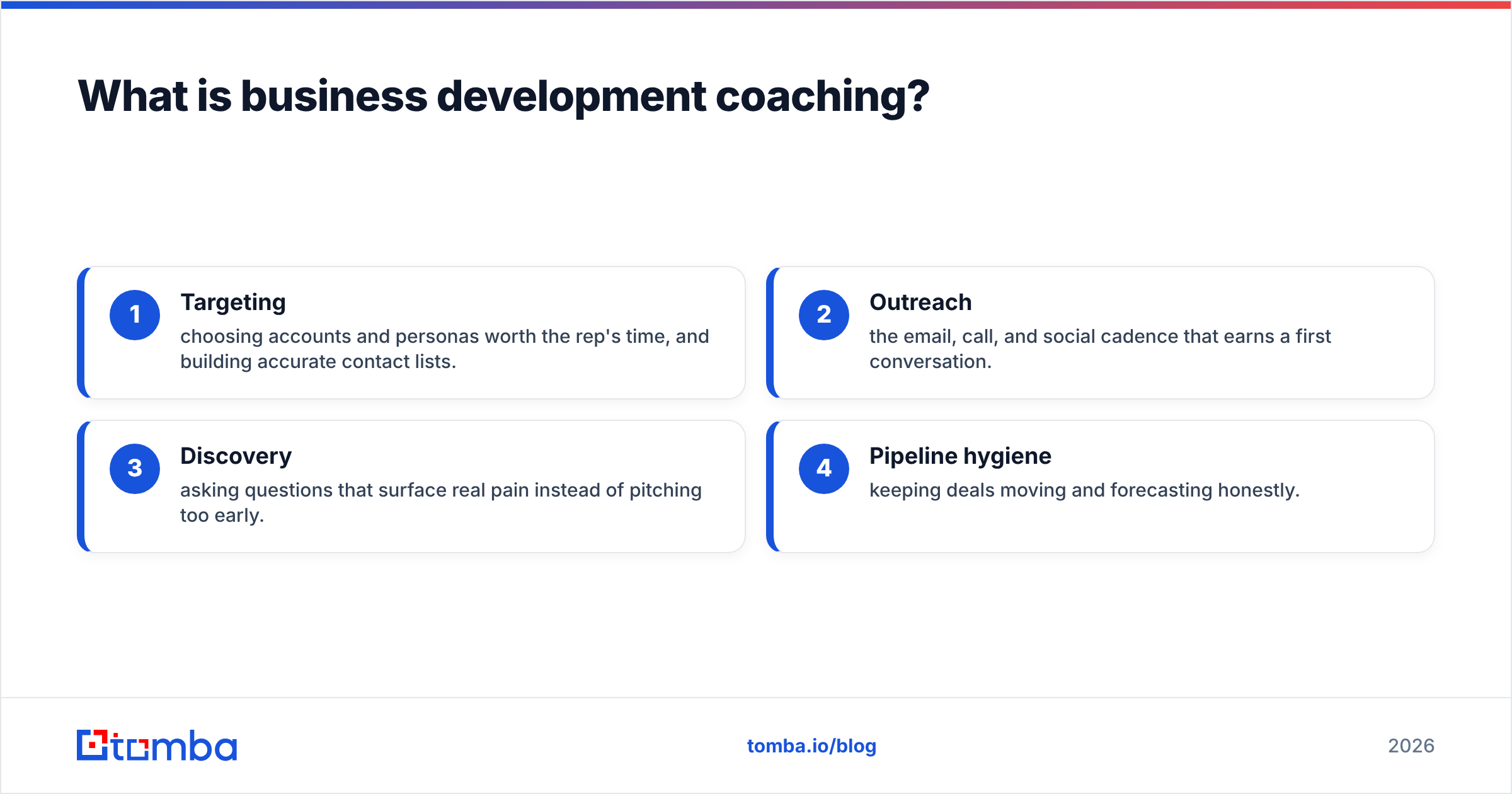
The scope usually covers four areas:
- Targeting — choosing accounts and personas worth the rep's time, and building accurate contact lists.
- Outreach — the email, call, and social cadence that earns a first conversation.
- Discovery — asking questions that surface real pain instead of pitching too early.
- Pipeline hygiene — keeping deals moving and forecasting honestly.
According to HubSpot's sales research, reps who get consistent coaching meaningfully outperform peers who don't — and the gap widens over time because skills compound.
Why does business development coaching matter in 2026?#
Because buying got harder and prospecting got noisier. Buyers ignore generic outreach, inbox providers punish sloppy senders, and a rep working a stale list can burn an entire quarter sending emails that never land. Coaching is how you keep a team sharp against that headwind.
Three forces make it urgent this year:
- Signal over volume. Spraying 1,000 contacts no longer works. Reps need to be coached on who to target and why now — intent, triggers, and fit — not just how many emails they sent.
- Deliverability is a skill, not an afterthought. A rep who blasts a list full of invalid addresses tanks the whole domain's sender reputation. Coaching has to cover list hygiene and warmup, not only copy.
- AI raised the floor and the ceiling. Everyone has AI-written first drafts now, so the differentiator is judgment — research, personalization, and timing. That's coachable; the AI draft isn't.
A team without coaching tends to plateau: the top 20% carry the number, everyone else churns. Coaching lifts the middle, which is where most of your pipeline upside actually lives.
What are the core business development coaching models?#
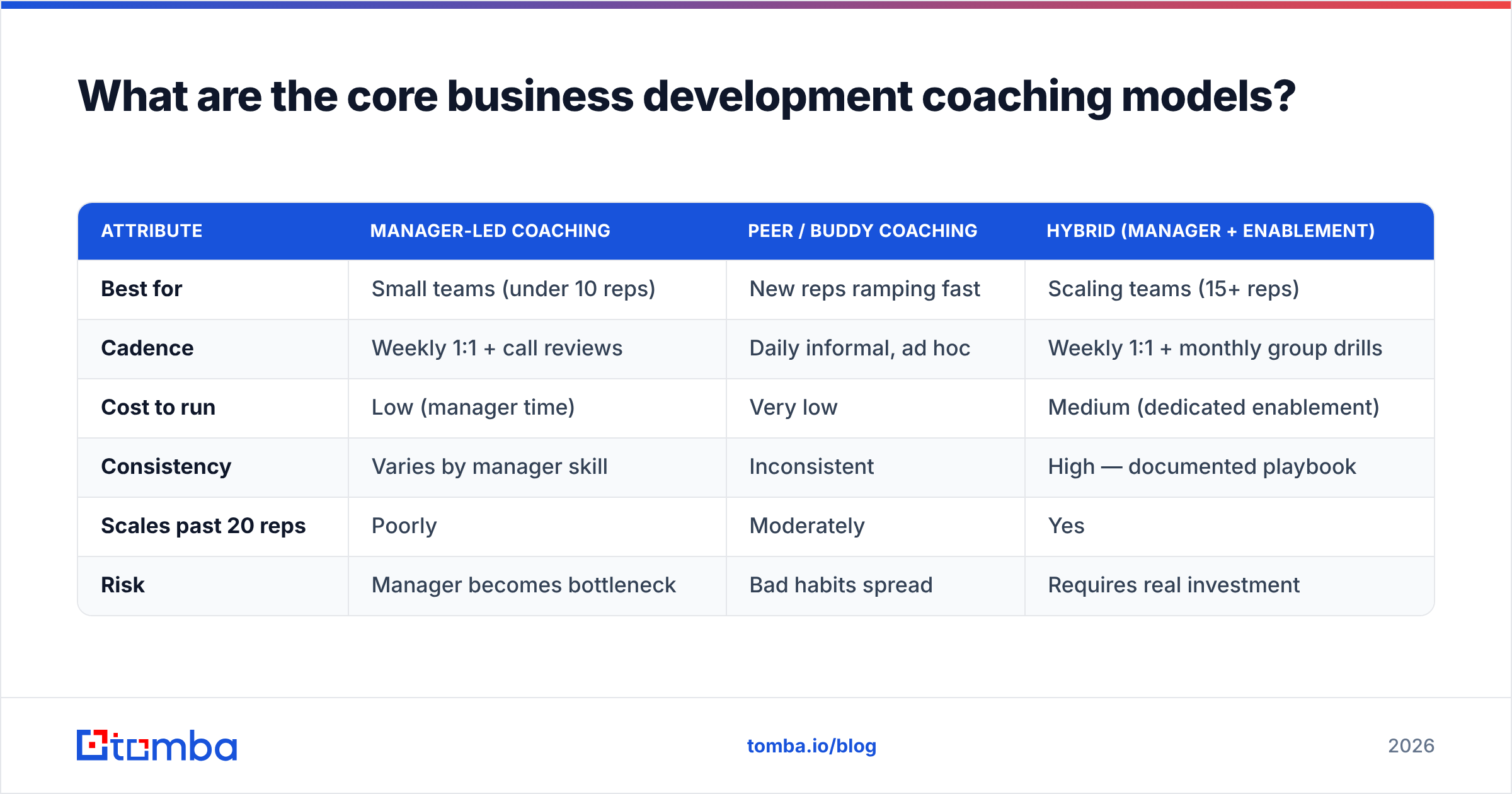
There's no single right model — there's the right model for your team's size and maturity. Below is how the three common approaches compare on the attributes that actually matter when you choose one.
| Attribute | Manager-Led Coaching | Peer / Buddy Coaching | Hybrid (Manager + Enablement) |
|---|---|---|---|
| Best for | Small teams (under 10 reps) | New reps ramping fast | Scaling teams (15+ reps) |
| Cadence | Weekly 1:1 + call reviews | Daily informal, ad hoc | Weekly 1:1 + monthly group drills |
| Cost to run | Low (manager time) | Very low | Medium (dedicated enablement) |
| Consistency | Varies by manager skill | Inconsistent | High — documented playbook |
| Scales past 20 reps | Poorly | Moderately | Yes |
| Risk | Manager becomes bottleneck | Bad habits spread | Requires real investment |
If you're a founder-led team, start manager-led and keep it tight. Once you pass roughly 15 reps, a single manager can't observe enough calls to coach well, and you'll want a hybrid with a documented playbook and someone owning enablement.
A practical starter cadence for any model:
- Monday — review last week's metrics with each rep; pick one skill to focus on.
- Midweek — listen to or shadow two live prospecting sessions; give same-day feedback.
- Friday — 20-minute role-play or call teardown on the focus skill.
- Monthly — group session where reps teach each other what's working.
How do you build accurate prospecting reps into coaching?#
You can't coach outreach technique on a broken list — so the first rep you build is "verify before you send." This is the part most coaching programs skip, and it quietly caps every other improvement. A perfect email to a wrong address still bounces.
Bake data hygiene into the coaching loop directly:
- Coach targeting first. Before a rep writes a single line, review their account list. Are these the right companies? Do they have the trigger that makes now the right time?
- Make verification non-negotiable. Reps should confirm an address is deliverable before it enters a sequence. A quick email verifier pass keeps bounce rates low and protects the domain everyone shares.
- Standardize sourcing. When every rep finds contacts the same clean way — by domain, by name, by role — you can actually compare their results and coach the technique instead of blaming the data.
For example, a coach can have a rep use domain search to pull every relevant contact at a target account, then verify each one, then craft outreach. Now the coaching conversation is about messaging and timing, not "why did half your emails bounce." Tomba's email finder and verifier exist precisely to remove that variable so the human skill is what you're improving.
This is also where leading indicators get clean. If a rep's reply rate is low but their list is verified and well-targeted, you know the problem is the message — and you can coach it. Without clean data, every metric is noise.
What metrics prove business development coaching is working?#
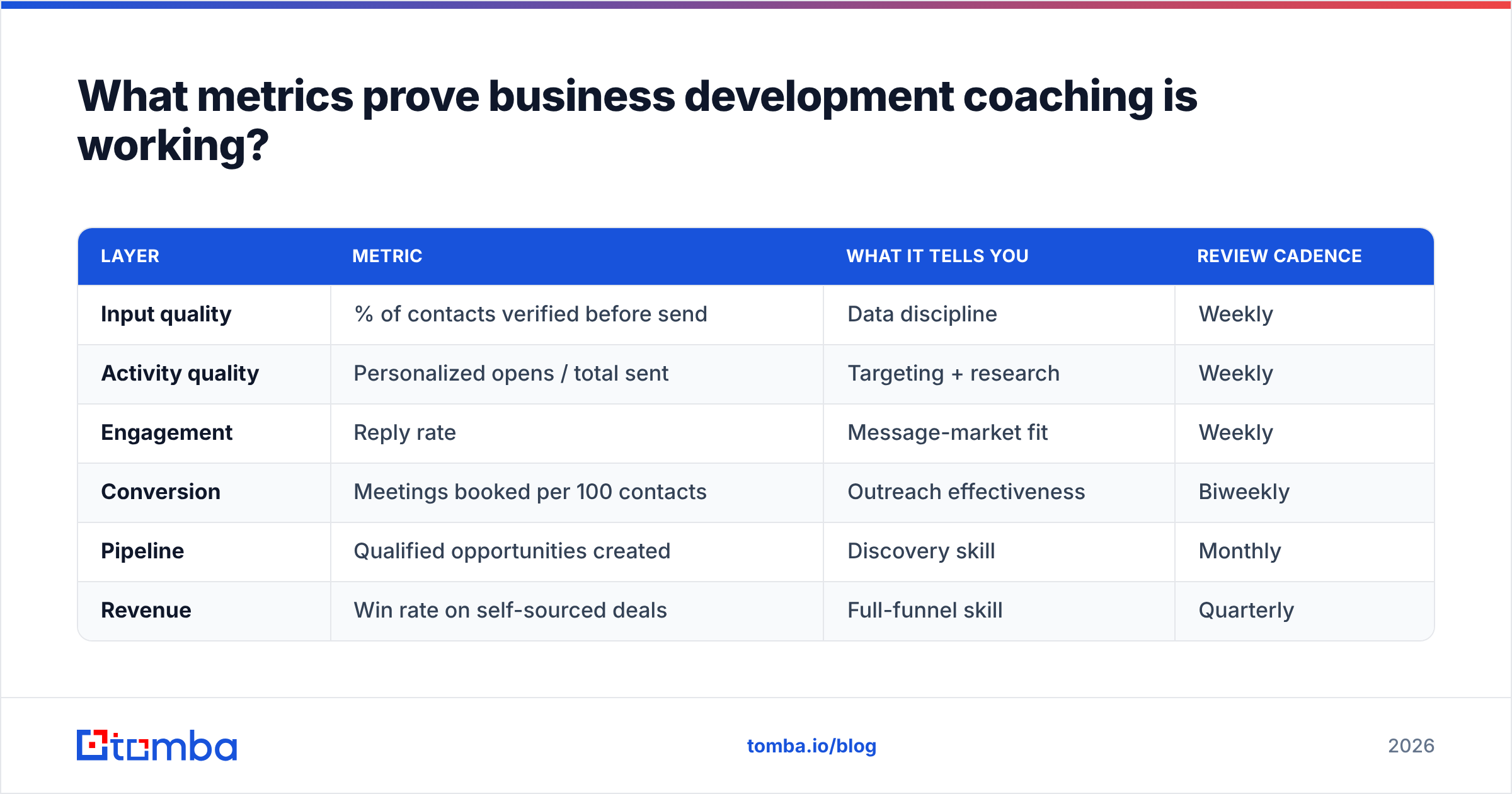
Conclusion first: coach to leading indicators weekly and judge the program on lagging indicators quarterly. If you only watch revenue, you'll find out you have a coaching problem a full quarter too late.
Here's a layered scorecard.
| Layer | Metric | What it tells you | Review cadence |
|---|---|---|---|
| Input quality | % of contacts verified before send | Data discipline | Weekly |
| Activity quality | Personalized opens / total sent | Targeting + research | Weekly |
| Engagement | Reply rate | Message-market fit | Weekly |
| Conversion | Meetings booked per 100 contacts | Outreach effectiveness | Biweekly |
| Pipeline | Qualified opportunities created | Discovery skill | Monthly |
| Revenue | Win rate on self-sourced deals | Full-funnel skill | Quarterly |
The trap is coaching on raw activity — "send more emails." Volume without quality just accelerates burnout and domain damage. Coach the ratios: reply rate, meetings per 100 touches, opportunities per meeting. When those ratios improve, revenue follows on a lag, and you'll have caught the improvement early enough to double down.
Independent review sites like G2 catalog dedicated coaching and conversation-intelligence platforms if you want to automate call scoring — but you don't need software to start. A spreadsheet and a weekly habit beat an expensive tool nobody opens.
How is coaching different from sales training?#
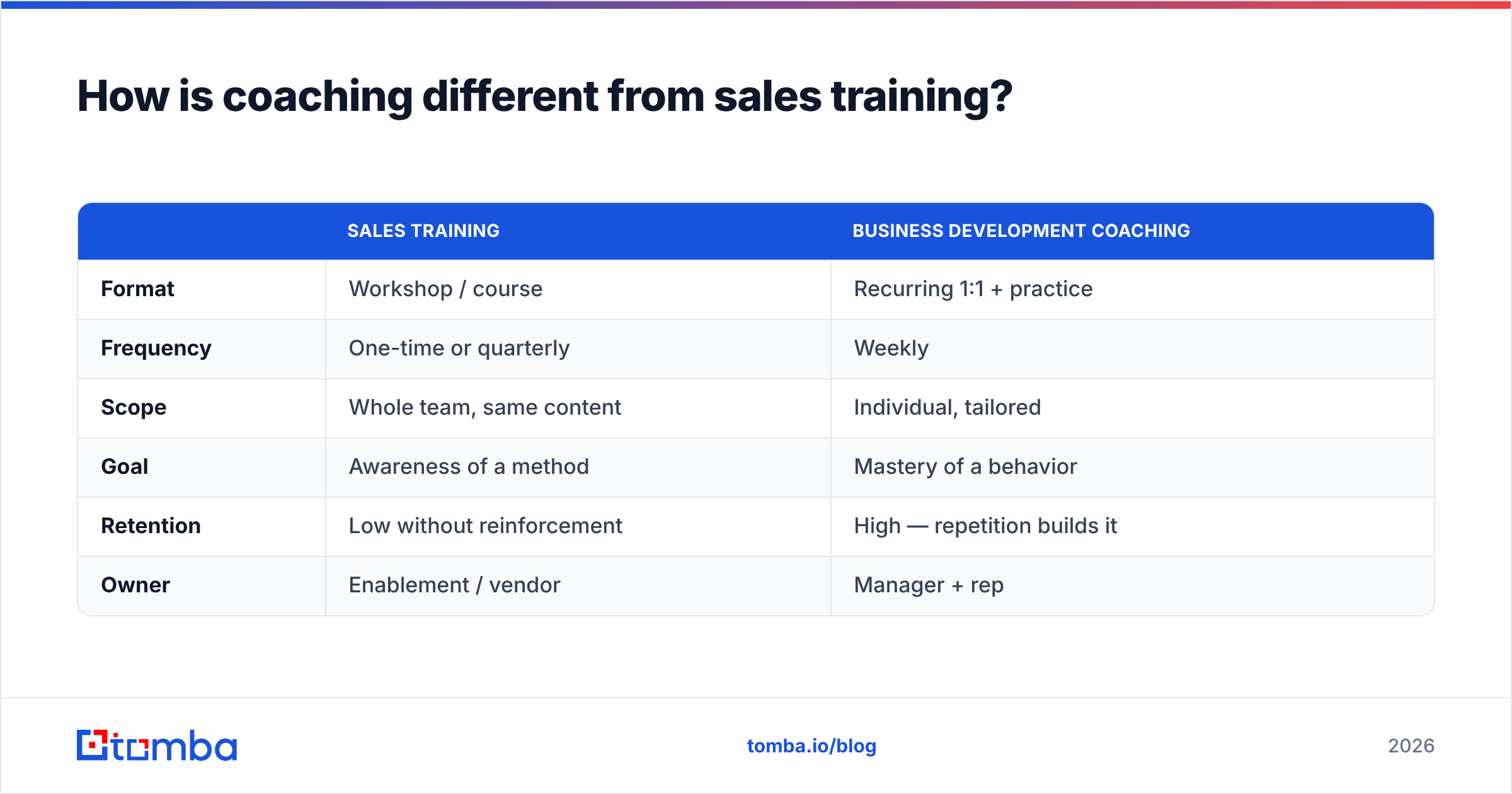
They're complementary, not interchangeable. Training transfers knowledge; coaching builds skill. You can think of training as the classroom and coaching as the practice field — you need both, but reps grow on the field.
| Sales Training | Business Development Coaching | |
|---|---|---|
| Format | Workshop / course | Recurring 1:1 + practice |
| Frequency | One-time or quarterly | Weekly |
| Scope | Whole team, same content | Individual, tailored |
| Goal | Awareness of a method | Mastery of a behavior |
| Retention | Low without reinforcement | High — repetition builds it |
| Owner | Enablement / vendor | Manager + rep |
The biggest mistake teams make is running a training day, feeling productive, and never reinforcing it. Research from analyst firms like Gartner consistently shows that knowledge decays fast without practice. Coaching is the reinforcement. If you only have budget for one, pick the recurring habit over the one-day event.
What does a 90-day coaching rollout look like?#
If you're starting from zero, don't boil the ocean. Run a focused 90-day program and expand what works.
Days 1–30 — Baseline and targeting. Pull each rep's current metrics. Audit their lists for accuracy and fit. Establish the weekly cadence. Focus coaching entirely on who they target and whether their contacts are verified. Quick win: cut every unverified address from active sequences.
Days 31–60 — Message and discovery. Now that lists are clean, coach the outreach. Review real emails and calls. Run weekly role-plays on discovery questions. Track reply rate and meetings booked as the scoreboard. Reps should feel the difference when good targeting meets a sharper message.
Days 61–90 — Pipeline and self-coaching. Shift to deal coaching: are opportunities progressing or stalling? Teach reps to review their own calls so coaching scales beyond you. Lock in the rituals that produced results and document them as a playbook.
Throughout, keep the data layer automated so coaching time goes to skill, not spreadsheet cleanup. Tools like Tomba's bulk email finder and verifier handle list building and hygiene in the background; you can compare plans on the Tomba pricing page to match a tier to team size. The point is to spend your coaching hours on judgment — the part only a human can teach.
Common business development coaching mistakes#
- Coaching everyone the same way. The whole value is individualization. Generic feedback is just training with extra steps.
- Only reviewing deals that closed. You learn more from the deals that stalled. Coach the misses.
- Ignoring data quality. A rep coached to perfection on a list of catch-all and invalid addresses still bounces. Verify first, every time.
- Measuring activity, not ratios. "More emails" is not a strategy. Improve the conversion rates.
- Making it a manager monologue. The rep should talk more than you. Ask, don't tell — they retain what they reason through themselves.
The bottom line#
Business development coaching works when it's recurring, individualized, tied to ratios instead of raw activity, and built on clean data. Pick a model that fits your team size, run a tight weekly cadence, coach targeting before technique, and judge the program on leading indicators long before revenue catches up.
The fastest way to make every coaching hour count is to remove the variables a coach can't fix mid-conversation — starting with whether your reps are even reaching real, deliverable inboxes. Let your reps build accurate, verified contact lists in seconds with the Tomba Email Finder, then spend your coaching time on the judgment that actually moves pipeline. Start on the free tier (25 searches a month), and scale up when your coached reps start needing more.
// get started
Find, verify and enrich your first contacts today
Start on the free plan with 25 searches a month, then scale when your team is ready.
Free plan · No credit card required · GDPR & CCPA
// about the author