Business Development Representative Skills: 2026 Guide
The business development representative skills that actually move pipeline in 2026 — what to learn, how to measure them, and the tools that make each one easier.
TL;DR
- The top business development representative skills in 2026 split into three buckets: research and data hygiene, multichannel communication, and disciplined qualification.
- Hard skills (prospecting, list-building, CRM hygiene, sequence writing) are now table stakes; the differentiator is judgment — knowing who to contact and when to stop.
- BDRs who own their data quality book 2–3x more meetings than those who inherit dirty lists. Accurate contact data is a skill multiplier, not a nice-to-have.
- You can teach most of these skills in 90 days with the right tooling, scorecards, and feedback loop.
- Tools matter: a BDR armed with a reliable email finder and verified phone data spends time selling, not guessing.
What does a business development representative actually do?#
A business development representative (BDR) is the front of the revenue engine. Think of the BDR as the scout who walks the trail before the wagon train rolls through — they find the path, flag the dangers, and clear the way so account executives can close. Technically, the BDR researches target accounts, finds the right contacts, runs outbound across email, phone, and social, qualifies interest, and books meetings.
The role is often confused with an SDR (sales development representative). The practical difference: SDRs typically handle inbound and respond to marketing-qualified leads, while BDRs run outbound and generate net-new pipeline. In many orgs the titles are used interchangeably, so the skill set overlaps heavily. Either way, the job lives or dies on two things — the quality of your list and the quality of your conversations.
The skills below are what separate a BDR who hits 80% of quota from one who hits 140%.
What are the core business development representative skills in 2026?#
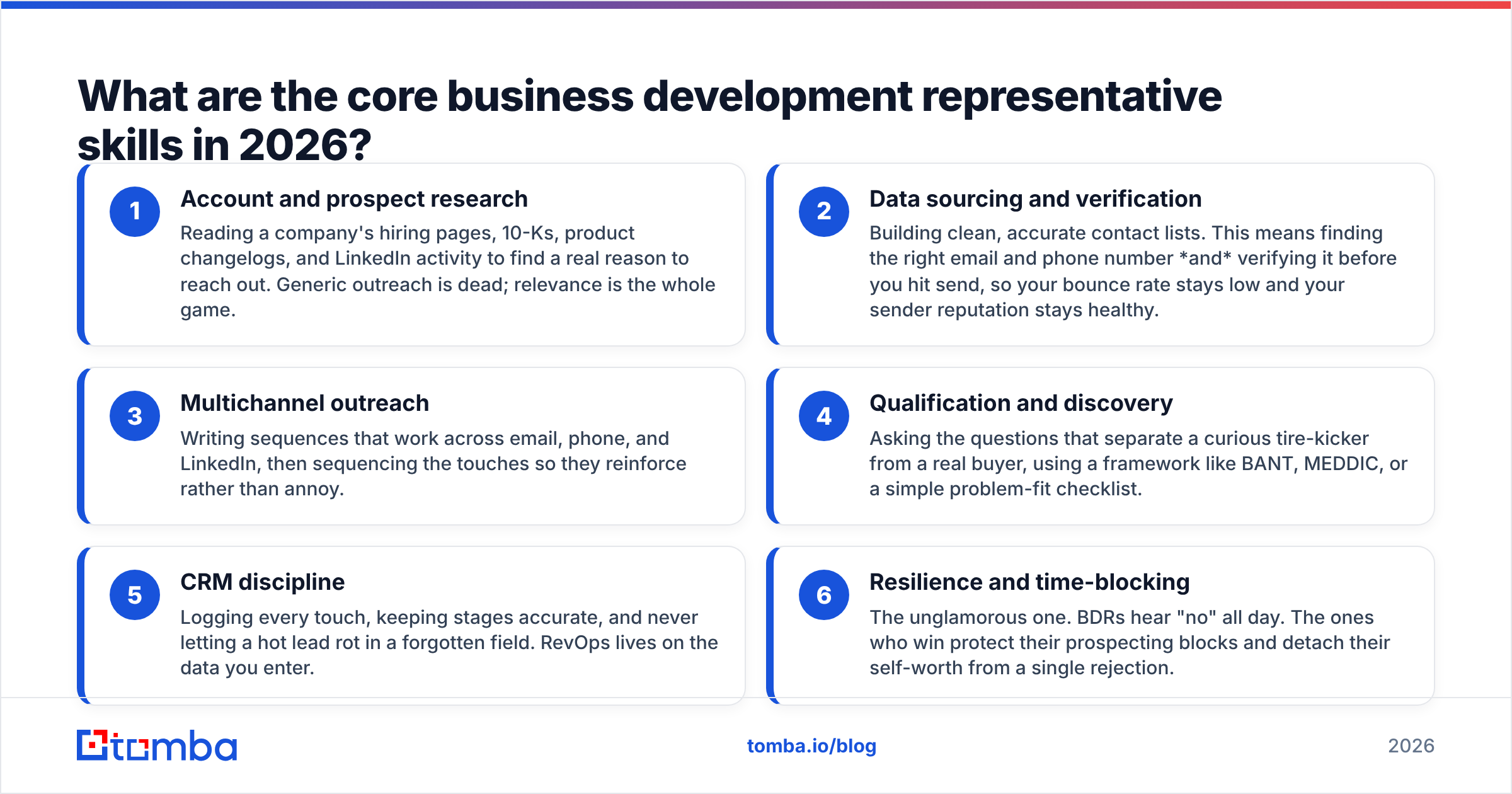
Here are the six foundational competencies, ordered by how much leverage they give you:
- Account and prospect research — Reading a company's hiring pages, 10-Ks, product changelogs, and LinkedIn activity to find a real reason to reach out. Generic outreach is dead; relevance is the whole game.
- Data sourcing and verification — Building clean, accurate contact lists. This means finding the right email and phone number and verifying it before you hit send, so your bounce rate stays low and your sender reputation stays healthy.
- Multichannel outreach — Writing sequences that work across email, phone, and LinkedIn, then sequencing the touches so they reinforce rather than annoy.
- Qualification and discovery — Asking the questions that separate a curious tire-kicker from a real buyer, using a framework like BANT, MEDDIC, or a simple problem-fit checklist.
- CRM discipline — Logging every touch, keeping stages accurate, and never letting a hot lead rot in a forgotten field. RevOps lives on the data you enter.
- Resilience and time-blocking — The unglamorous one. BDRs hear "no" all day. The ones who win protect their prospecting blocks and detach their self-worth from a single rejection.
Notice that two of the top three skills are about data, not talking. That is the shift in 2026: the conversation is only as good as the contact you started with.

Which hard skills should a BDR master first?#
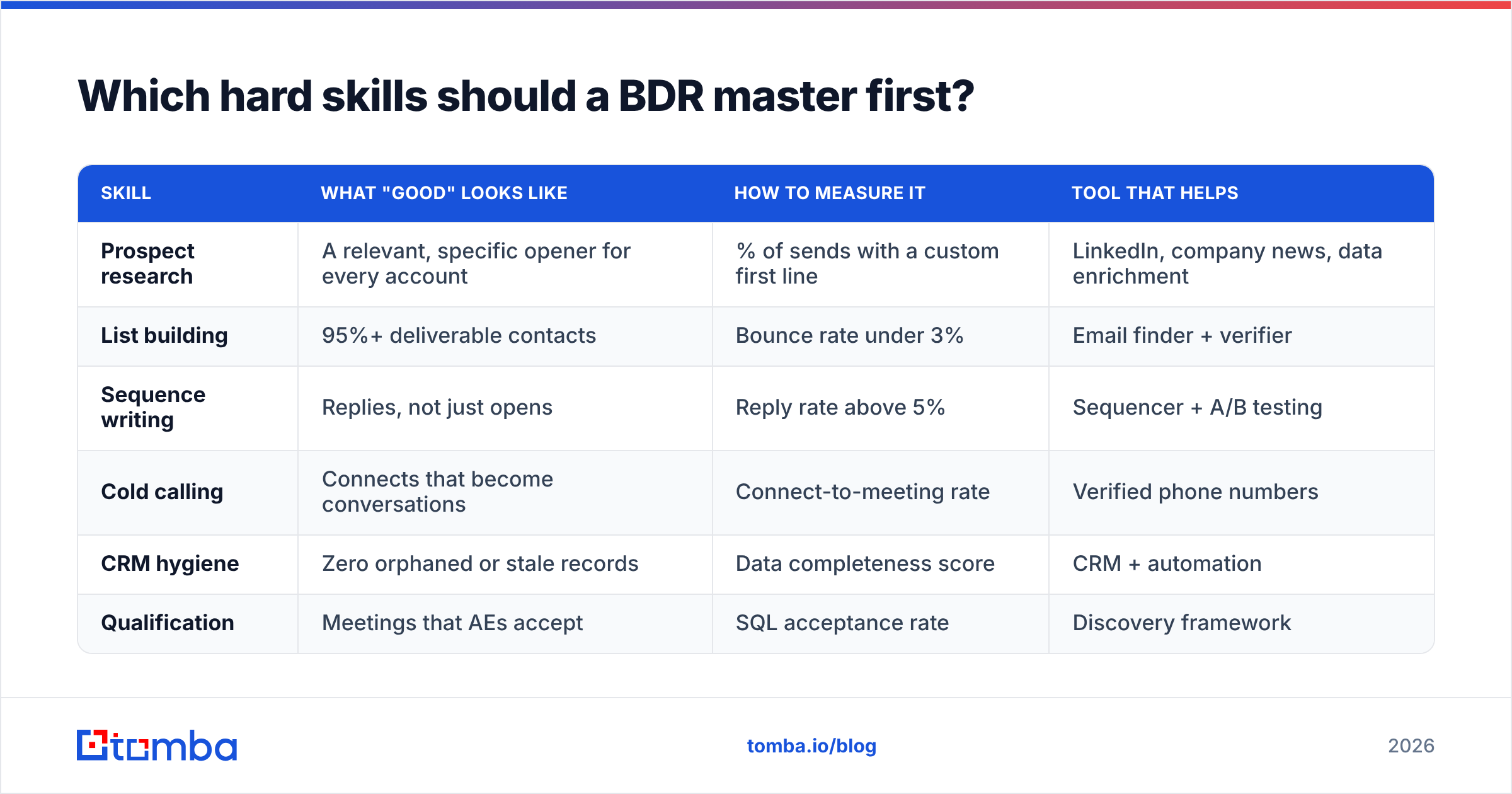
Hard skills are the teachable, measurable ones. If you are ramping a new BDR or auditing your own gaps, start here.
| Skill | What "good" looks like | How to measure it | Tool that helps |
|---|---|---|---|
| Prospect research | A relevant, specific opener for every account | % of sends with a custom first line | LinkedIn, company news, data enrichment |
| List building | 95%+ deliverable contacts | Bounce rate under 3% | Email finder + verifier |
| Sequence writing | Replies, not just opens | Reply rate above 5% | Sequencer + A/B testing |
| Cold calling | Connects that become conversations | Connect-to-meeting rate | Verified phone numbers |
| CRM hygiene | Zero orphaned or stale records | Data completeness score | CRM + automation |
| Qualification | Meetings that AEs accept | SQL acceptance rate | Discovery framework |
The pattern: every hard skill has a number attached. If you can't measure it, you can't coach it. Build a weekly scorecard around these six rows and review it every Friday.
A note on list building, because it is the most under-rated skill on this list. A BDR who sends to a list with a 15% bounce rate isn't just wasting sends — they're poisoning the domain's email deliverability for the entire team. Learning to find and verify contacts before they enter a sequence is a force multiplier. According to HubSpot's sales research, data quality is consistently cited as a top barrier to outbound productivity, and it's the one most BDRs can actually control.
What soft skills separate great BDRs from average ones?#
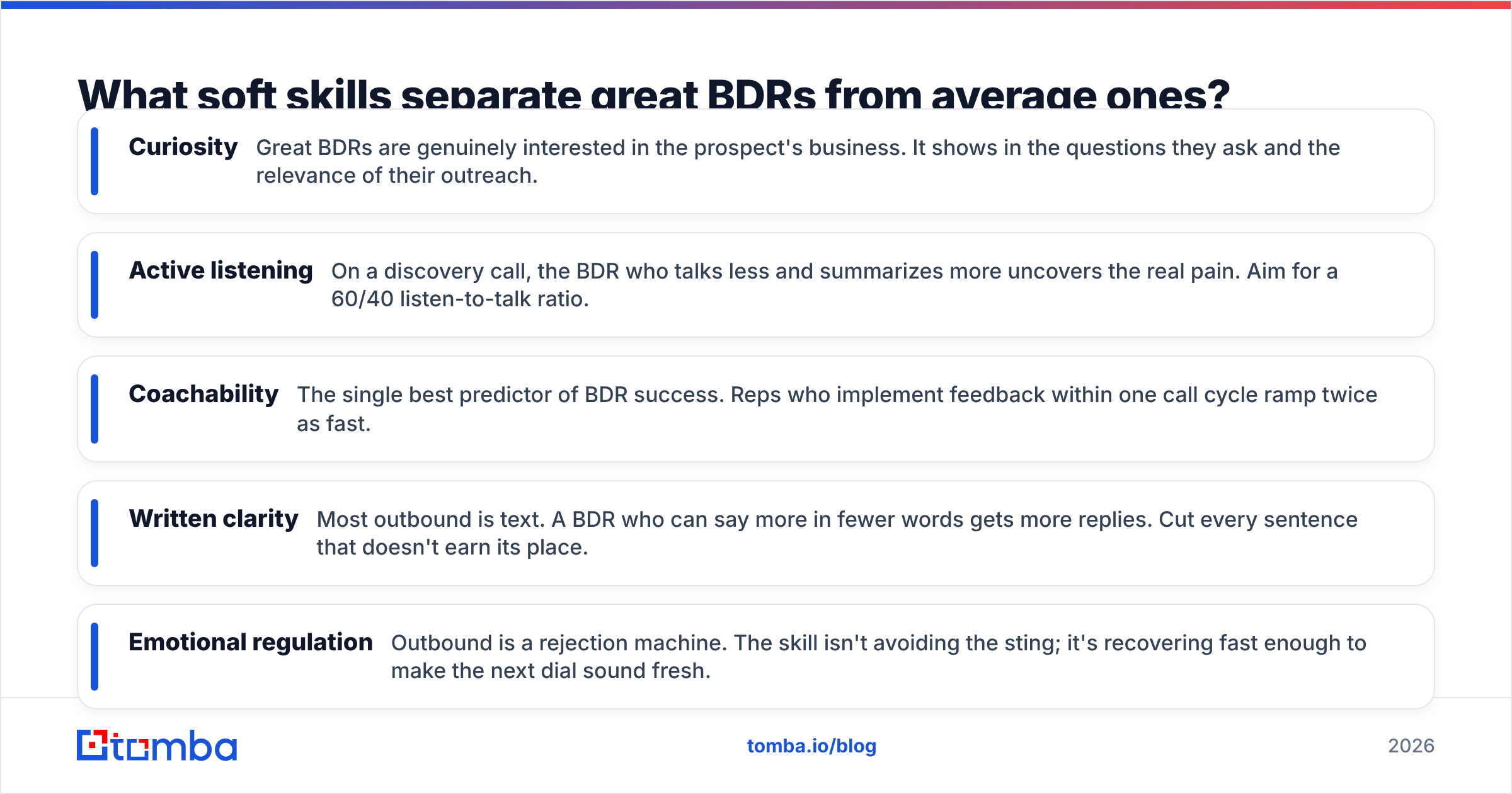
Hard skills get you to quota; soft skills get you promoted. These are harder to teach but worth naming explicitly:
- Curiosity — Great BDRs are genuinely interested in the prospect's business. It shows in the questions they ask and the relevance of their outreach.
- Active listening — On a discovery call, the BDR who talks less and summarizes more uncovers the real pain. Aim for a 60/40 listen-to-talk ratio.
- Coachability — The single best predictor of BDR success. Reps who implement feedback within one call cycle ramp twice as fast.
- Written clarity — Most outbound is text. A BDR who can say more in fewer words gets more replies. Cut every sentence that doesn't earn its place.
- Emotional regulation — Outbound is a rejection machine. The skill isn't avoiding the sting; it's recovering fast enough to make the next dial sound fresh.
Soft skills are why two BDRs working the exact same list get wildly different results. The data sets the ceiling; the human decides how close you get to it.
How do you measure and develop these skills?#
Measurement first, then development. You can't improve what you don't track. Here's a simple framework any sales manager can run.
Leading indicators (activity): dials, emails sent, social touches, accounts researched. These tell you whether the BDR is doing the work.
Conversion indicators (skill): reply rate, connect rate, meeting-booked rate, SQL acceptance rate. These tell you whether the work is good.
Lagging indicators (outcome): pipeline generated, meetings held, opportunities sourced. These are what leadership cares about, but they're too slow to coach on directly.
The trick is to coach the conversion indicators. If activity is high but reply rate is low, the problem is messaging or targeting — not effort. If connect rate is low, the problem is phone data quality or call timing. Diagnosing which lever to pull is itself a management skill.
For development, the fastest loop is: record → review → adjust → repeat. Call recordings, email teardowns, and weekly 1:1s built around one specific skill beat generic "do more activity" pep talks every time. Tools like Gong make call review scalable, and peer review of email sequences surfaces patterns no single rep would catch alone.

What tools should a modern BDR know?#
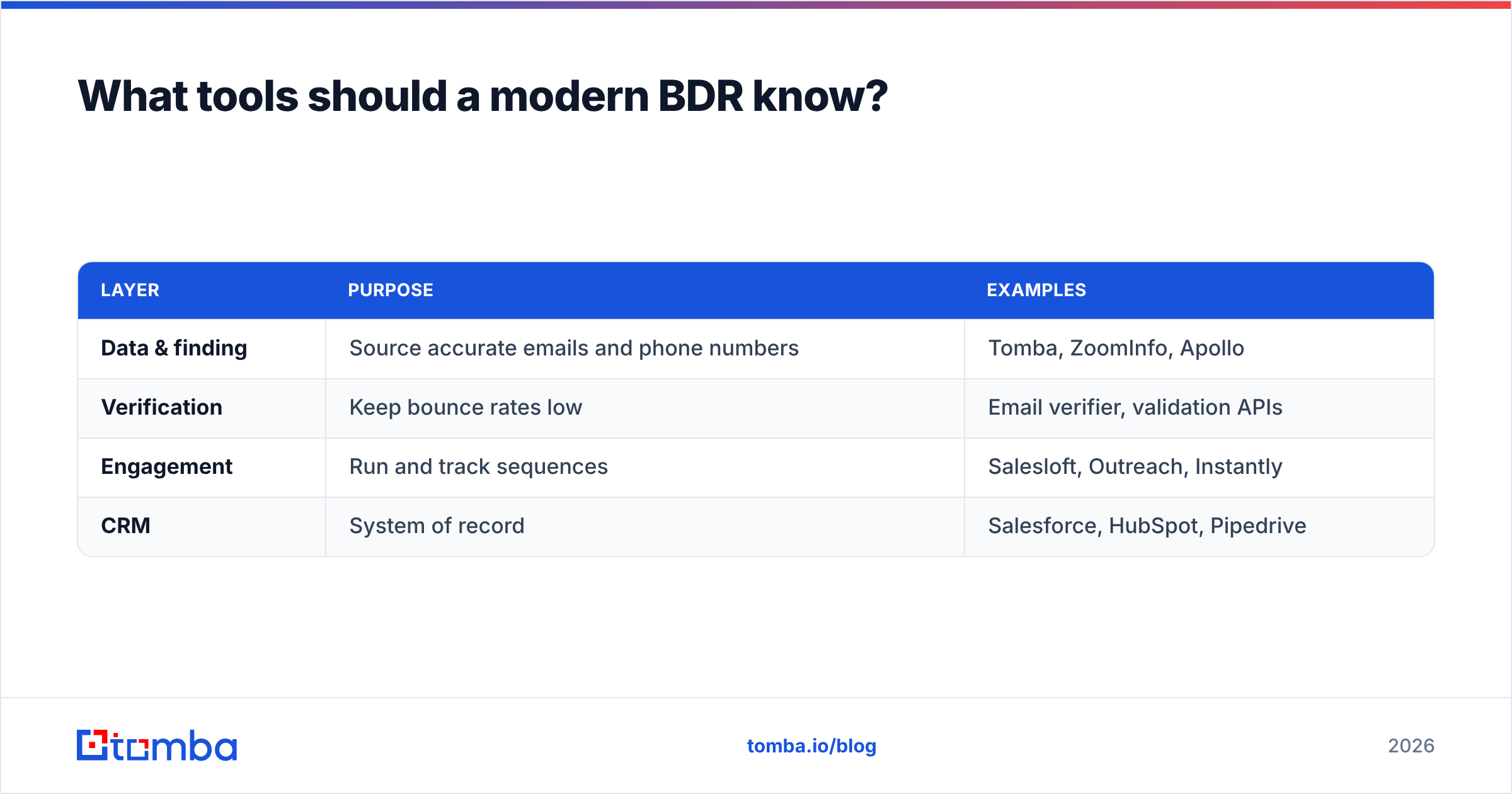
A BDR's tool stack in 2026 has four layers. Knowing how to operate each one is a skill — fluency with the stack is now part of the job description.
| Layer | Purpose | Examples |
|---|---|---|
| Data & finding | Source accurate emails and phone numbers | Tomba, ZoomInfo, Apollo |
| Verification | Keep bounce rates low | Email verifier, validation APIs |
| Engagement | Run and track sequences | Salesloft, Outreach, Instantly |
| CRM | System of record | Salesforce, HubSpot, Pipedrive |
The mistake new BDRs make is over-investing in the engagement layer (fancy sequences) while neglecting the data layer. It's backwards. A perfect sequence sent to a wrong or dead email address produces exactly zero meetings. Get the data layer right first.
When you're evaluating tools, check independent reviews on G2 rather than vendor marketing pages — you want to see accuracy and deliverability complaints before you commit a team to a platform. And whatever you choose, make sure your finding and verification tools connect to your CRM so contact data flows without manual copy-paste. Tomba's CRM integrations and direct connectors keep the data layer and the system of record in sync, which removes a whole category of human error.
How long does it take to become a strong BDR?#
Roughly 90 days to competence, 9–12 months to mastery. Here's a realistic ramp:
- Days 1–30: Learn the product, the ICP, and the tools. Build your first clean lists and send your first sequences under supervision. Goal: activity consistency.
- Days 31–60: Start booking meetings. Focus shifts from "am I doing the work" to "is the work landing." Coach reply rate and connect rate hard here.
- Days 61–90: Hit a repeatable meeting cadence. Begin self-diagnosing which lever to pull when numbers dip. This is the inflection point between order-taker and operator.
The biggest accelerant in that timeline is removing friction from the data layer. A new BDR who spends three hours a day hunting for email addresses ramps slowly because they never get enough reps at the actual skill — the conversation. Hand them a reliable finder and verifier and that same three hours becomes prospecting volume, which is where real skill is built.
How does data quality multiply every other skill?#
This is the throughline of the whole post, so it earns its own section. Every BDR skill compounds off the quality of your contact data:
- Research is wasted if you can't reach the person you researched.
- Sequence writing can't beat a 20% bounce rate dragging down your domain reputation.
- Cold calling dies the moment your phone numbers are stale or wrong.
- CRM hygiene is impossible if half your records are unverified guesses.
- Qualification never happens because the meeting never gets booked.
Treat your data the way a chef treats ingredients: the best technique in the world can't save a dish built on spoiled inputs. Owning your own data sourcing — finding contacts by name or domain, verifying them, enriching them with firmographics — turns a good BDR into a self-sufficient one who never blames "bad leads" for a slow month.
The bottom line#
The best business development representative skills in 2026 are a balance: half human (curiosity, listening, resilience, written clarity) and half operational (research, data verification, multichannel outreach, CRM discipline). The fastest path to all of them is removing the busywork that stops you getting reps at the parts that matter.
That starts with the data layer. If your BDRs are spending their day guessing email addresses and chasing dead phone numbers, no amount of coaching will fix the quota gap. Give them Tomba's Email Finder to source verified, accurate contacts by name or domain — plus phone finding, verification, and enrichment in one stack — and let them spend their hours on the skill that actually closes pipeline: the conversation. Start free with 25 searches a month and see how much faster a clean list lets your team ramp.
Ready to find emails that actually work?
Join 150,000+ professionals who stopped guessing and started sending. Free credits on signup — no credit card required.
Get the Tomba newsletter
Practical outbound tactics and product updates — once every two weeks.
About the author