Buying B2B Data in 2026: Costs, Risks, and Smarter Alternatives
Buying B2B data can fill your pipeline fast or torch your domain reputation. Here's how to vet providers, price plans, and verify lists in 2026.
Buying B2B data sounds like a shortcut: pay a vendor, download a spreadsheet, start emailing. In practice, the wrong purchase decays in weeks, tanks your sender reputation, and burns budget you can't get back. This guide walks through what you're actually buying, how providers price it, and why an on-demand, verify-first model usually beats a bulk list dump in 2026.
TL;DR#
- Buying B2B data is not one product. You're choosing between static list brokers, contact databases, and on-demand finder APIs — and they fail in very different ways.
- Decay is the silent killer. B2B contact data goes stale at roughly 22–30% per year as people switch jobs, so a "fresh" list is often half-rotten by the time you import it.
- Verification is non-negotiable. Sending to unverified bought data is the fastest way to hit spam traps and get your domain blacklisted.
- Pay per accurate record, not per row. On-demand finders with built-in verification (like Tomba) usually beat flat-fee list dumps on real cost-per-usable-contact.
- Compliance is your liability, not the vendor's. GDPR and CAN-SPAM exposure stays with the sender, so provenance and opt-out handling matter more than raw volume.
What does "buying B2B data" actually mean?#
When people say they're buying B2B data, they usually mean one of three different transactions, and conflating them is where budgets die.
- Static list purchase — A broker sells you a one-time CSV of names, emails, titles, and companies. You own the file; the vendor never updates it. Cheapest upfront, fastest to decay.
- Database subscription — You pay monthly for seat-based access to a large contact database and pull records as needed (think Apollo, ZoomInfo, or a B2B database you query on demand). Records refresh, but you pay whether you use 50 contacts or 5,000.
- On-demand finder / enrichment API — You request specific contacts at the moment you need them — by domain, name, or company — and the provider returns a verified result with a confidence score. You pay per lookup, and every record is checked at request time.
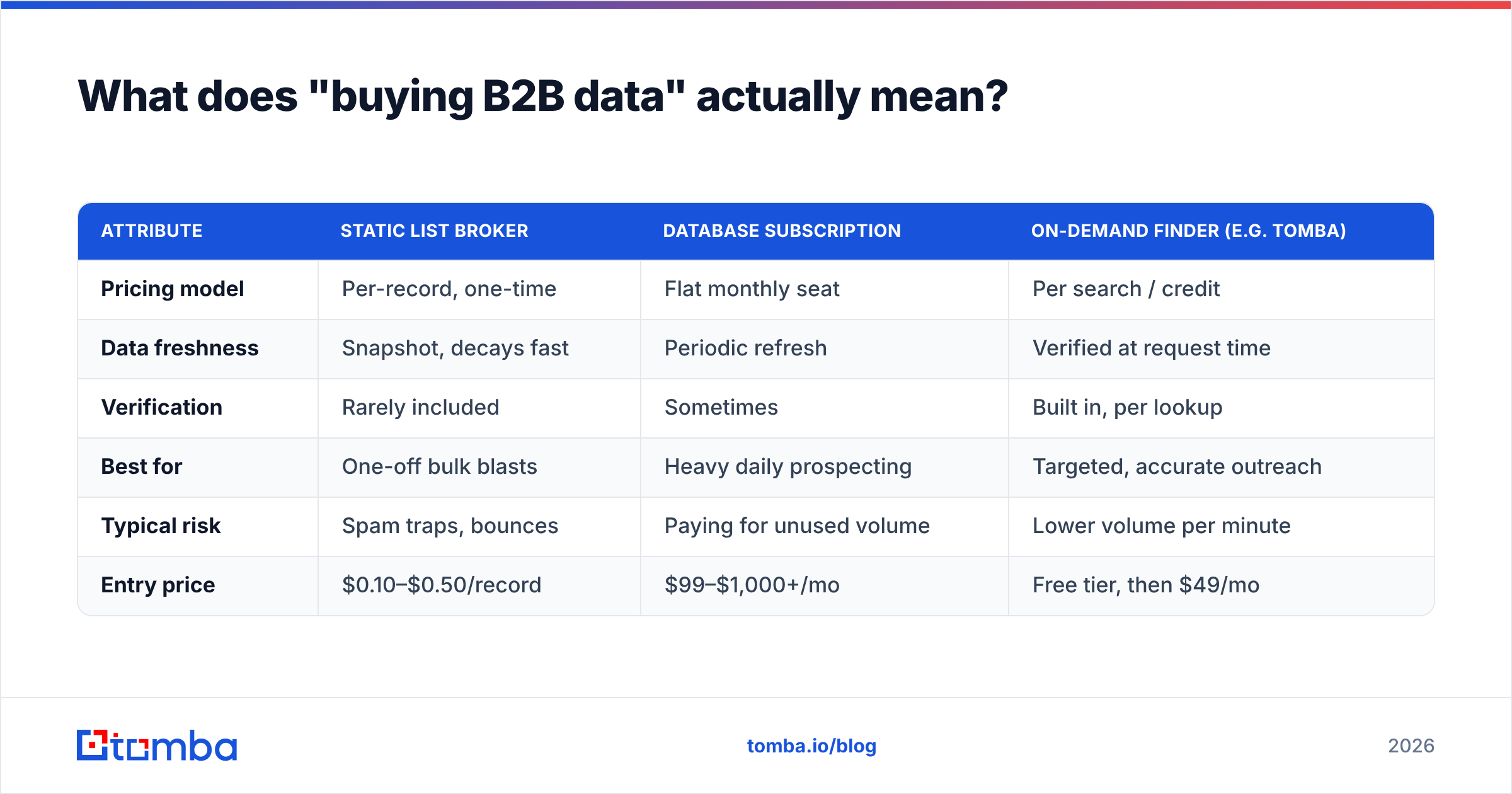
The core trade-off looks like this:
| Attribute | Static list broker | Database subscription | On-demand finder (e.g. Tomba) |
|---|---|---|---|
| Pricing model | Per-record, one-time | Flat monthly seat | Per search / credit |
| Data freshness | Snapshot, decays fast | Periodic refresh | Verified at request time |
| Verification | Rarely included | Sometimes | Built in, per lookup |
| Best for | One-off bulk blasts | Heavy daily prospecting | Targeted, accurate outreach |
| Typical risk | Spam traps, bounces | Paying for unused volume | Lower volume per minute |
| Entry price | $0.10–$0.50/record | $99–$1,000+/mo | Free tier, then $49/mo |
Notice that only the on-demand model verifies at the moment of use. A static list verified six months ago is, statistically, a different list today.
)
Why is bought B2B data so often bad?#
The short answer: B2B data decays faster than almost anyone budgets for. Industry analysts at firms like Gartner have long flagged that contact data degrades meaningfully every year as people change roles, companies rebrand, and domains get retired. When the typical professional changes jobs every couple of years, a contact list loses a meaningful slice of its accuracy each quarter.
Here's what actually goes wrong with a bulk purchase:
- Job changes. The VP you bought left for a competitor. Your email bounces or lands with someone who no longer holds that role.
- Recycled and trap addresses. Brokers padding row counts sometimes include abandoned mailboxes that ISPs have converted into spam traps. Hit one and your sender reputation drops.
- Catch-all noise. Many corporate domains accept every address, so a finder that doesn't run a catch-all verifier reports "valid" for emails that silently vanish.
- No provenance. Cheap lists rarely tell you where the data came from, which makes compliance impossible to defend.
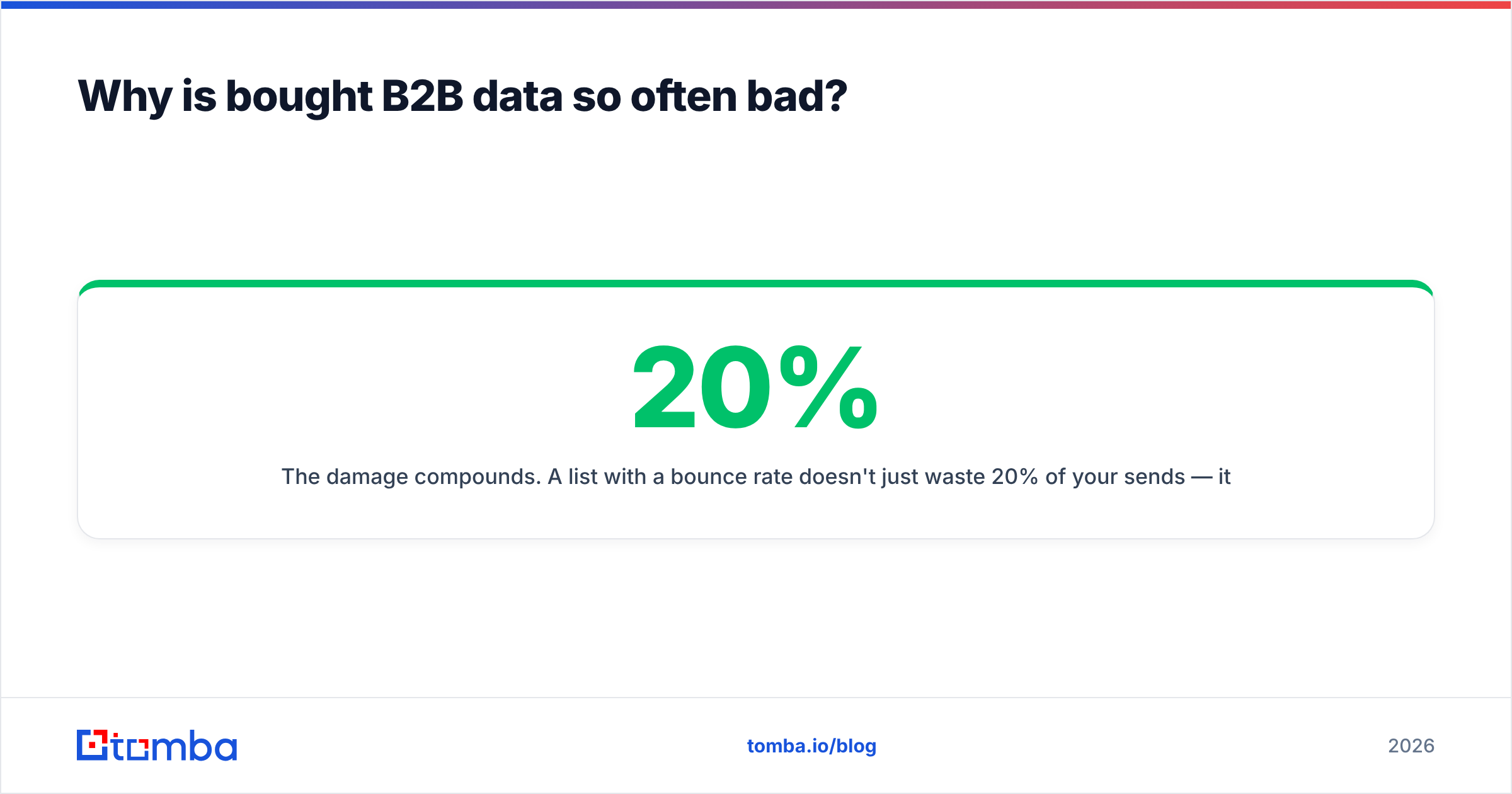
The damage compounds. A list with a 20% bounce rate doesn't just waste 20% of your sends — it signals to inbox providers that you're a careless sender, which suppresses the good 80% too. One bad import can depress deliverability for weeks.
How do you vet a B2B data provider?#
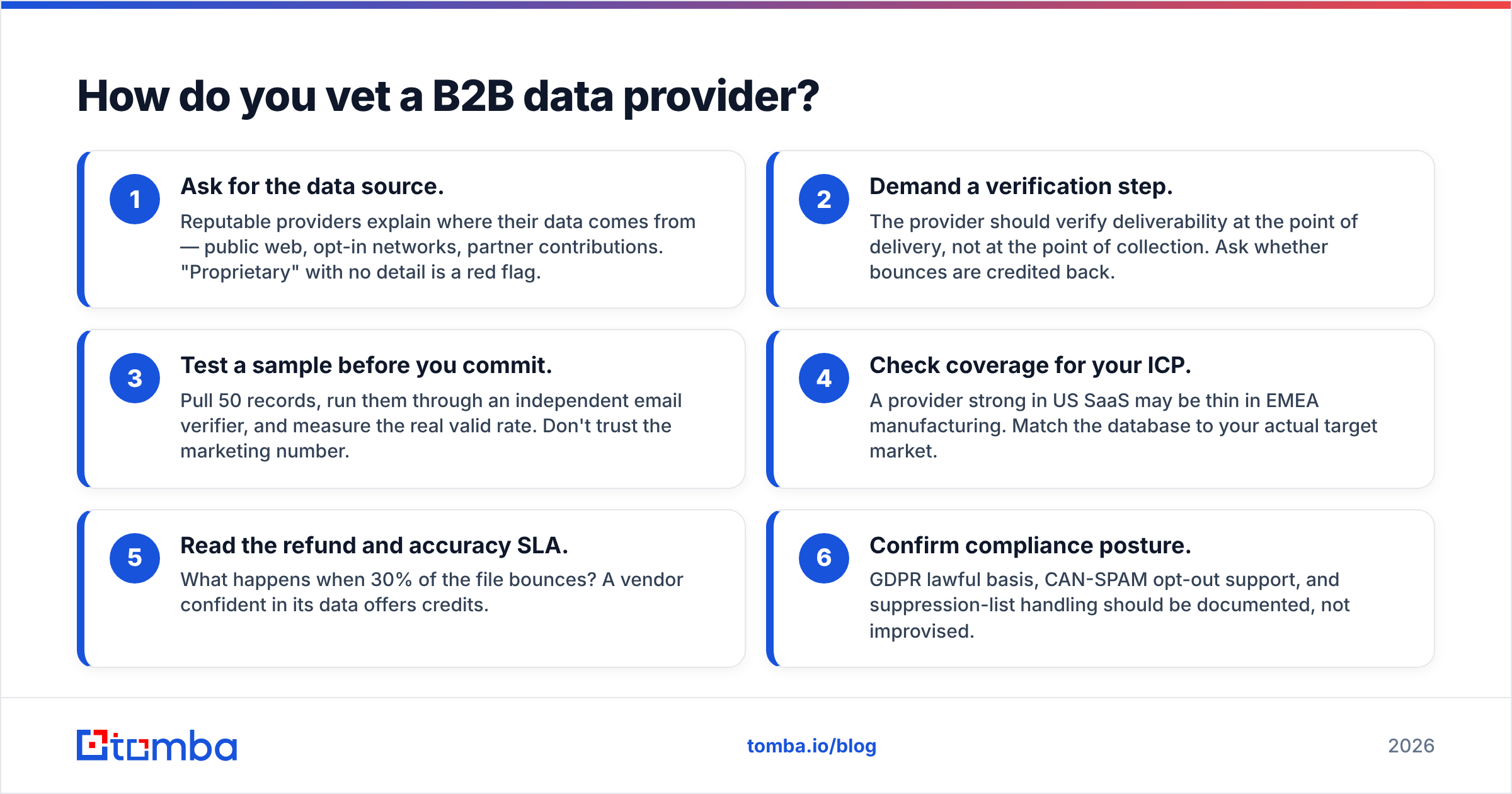
Treat data buying like hiring: check the references before you sign. Run every prospective vendor through this checklist.
- Ask for the data source. Reputable providers explain where their data comes from — public web, opt-in networks, partner contributions. "Proprietary" with no detail is a red flag.
- Demand a verification step. The provider should verify deliverability at the point of delivery, not at the point of collection. Ask whether bounces are credited back.
- Test a sample before you commit. Pull 50 records, run them through an independent email verifier, and measure the real valid rate. Don't trust the marketing number.
- Check coverage for your ICP. A provider strong in US SaaS may be thin in EMEA manufacturing. Match the database to your actual target market.
- Read the refund and accuracy SLA. What happens when 30% of the file bounces? A vendor confident in its data offers credits.
- Confirm compliance posture. GDPR lawful basis, CAN-SPAM opt-out support, and suppression-list handling should be documented, not improvised.
Cross-reference any vendor against third-party review sites like G2 before you trust a sales rep's accuracy claim. Reviews surface the bounce-rate complaints that case studies hide.
Is buying a list cheaper than finding data on demand?#
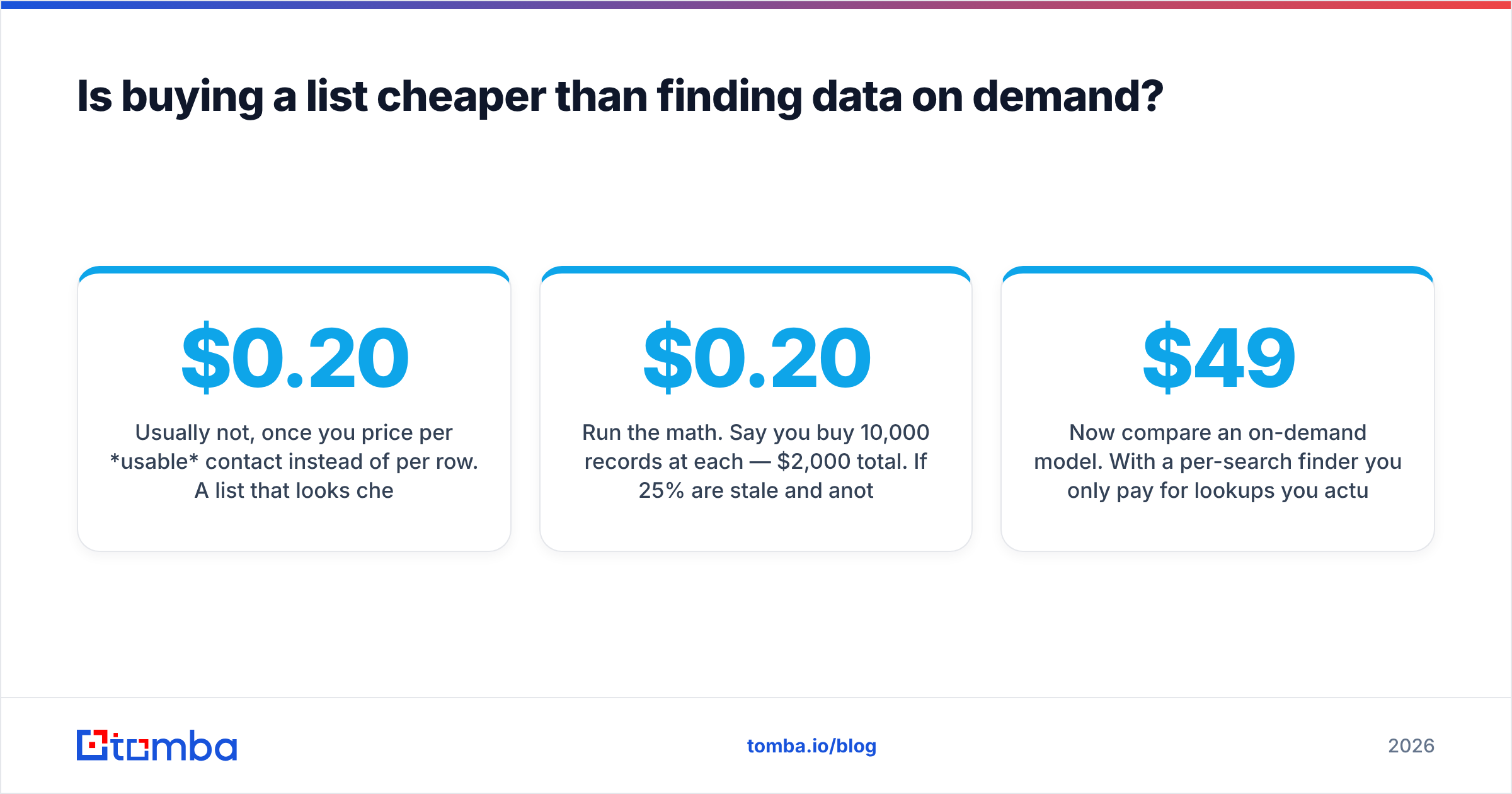
Usually not, once you price per usable contact instead of per row. A list that looks cheap at $0.20 a record stops looking cheap when a third of it bounces.
Run the math. Say you buy 10,000 records at $0.20 each — $2,000 total. If 25% are stale and another 10% are catch-all guesses, you have roughly 6,500 genuinely usable contacts. Your real cost is closer to $0.31 per usable contact, before you've spent a cent verifying or suppressing the dead weight.
Now compare an on-demand model. With a per-search finder you only pay for lookups you actually request, and each one is verified before it counts against your quota. You buy 6,500 good contacts directly instead of 10,000 mixed ones. Tomba's pricing starts with a free tier of 25 searches a month, then $49/mo for the Starter plan, $99/mo for Growth, and $249/mo for Pro — and verification is baked into the finder rather than billed as a separate cleanup step.
The hidden costs that make bulk lists more expensive than they look:
- List cleaning — you'll pay a separate verification vendor to scrub a raw file.
- Deliverability recovery — warmup time and lost sends after a bad batch tank your reputation.
- Sales rep time — reps chasing dead contacts is the most expensive line item of all.
- Suppression management — keeping bounced and opted-out records out of future sends.
)
How do you turn bought data into safe, sendable contacts?#
Assume every record is guilty until verified. The workflow below keeps a purchase from poisoning your domain.
- Verify before the first send. Run the entire file through verification and drop anything that isn't a confirmed deliverable. For ambiguous corporate domains, layer in a catch-all finder so you're not guessing.
- Enrich the gaps. A bought row with a name and company but no verified email is a candidate for re-finding, not a contact. Use a finder or data enrichment to rebuild missing or stale fields from a clean source.
- Segment by confidence. Send to high-confidence verified contacts first. Quarantine catch-all and low-score records into a separate, slower track.
- Warm up gradually. Never blast a fresh list at full volume. Ramp sends so inbox providers see consistent, low-complaint behavior.
- Suppress aggressively. Build a suppression list from every bounce, complaint, and unsubscribe, and apply it to every future campaign.
If you're starting from a clean slate instead of a purchased file, skip the list entirely: a domain search pulls verified contacts for a target company on demand, which sidesteps the decay problem at the source.
What about compliance when you buy B2B data?#
The legal liability for outreach sits with you, the sender — never the data broker. A vendor's terms of service won't protect you from a GDPR complaint or a CAN-SPAM penalty.
Key obligations to keep in mind:
- Lawful basis (GDPR). In the EU, you generally need legitimate interest or consent to email a B2B contact, and you must be able to document it. Buying a list doesn't transfer a lawful basis to you.
- Clear identification and opt-out (CAN-SPAM). US rules require accurate headers, a physical address, and a working unsubscribe in every commercial email. The FTC's CAN-SPAM guidance lays out the specifics.
- Provenance you can show. If a regulator or recipient asks how you got their address, "we bought a list" is not a defense. Providers that document data sources give you something to stand on.
- Honor suppression instantly. Process opt-outs promptly and permanently across every system.
This is another reason on-demand, source-transparent data beats anonymous bulk files: when each record's origin is documented, your compliance story is defensible instead of improvised.
Buying B2B data vs building it: which wins in 2026?#
The honest answer is hybrid. You rarely need to choose one model forever.
- Buy a database subscription when your team prospects heavily every day and needs broad, refreshed coverage.
- Use an on-demand finder when you want targeted, verified contacts for a specific account list and refuse to pay for volume you won't touch.
- Avoid static list brokers unless you've sampled the data, verified the valid rate yourself, and accepted that the file starts decaying the day you receive it.
For most teams in 2026, the winning stack is a precise account list plus an on-demand finder with built-in verification — you get accuracy, provenance, and a cost that scales with actual usage instead of seat count. Compare that against the Apollo alternatives and Clearbit alternatives landscape and the pattern holds: verify-at-request beats buy-in-bulk on the metric that matters, which is cost per contact that actually converts.
Start with accurate data, not a bigger list#
If you take one thing from this guide: stop optimizing for row count and start optimizing for verified, defensible contacts. A 6,000-record list of confirmed-deliverable, source-documented prospects will out-perform a 20,000-record bargain file every quarter — on deliverability, on reply rate, and on the legal exposure you'd rather never think about.
That's exactly what the Tomba Email Finder is built for. Search by domain, name, or company; get a verified email with a confidence score at the moment you need it; and skip the bulk-list decay tax entirely. Start on the free tier with 25 searches a month, and scale to a paid plan only once the accuracy proves itself. Buy data the smart way — one verified contact at a time.
// get started
Find, verify and enrich your first contacts today
Start on the free plan with 25 searches a month, then scale when your team is ready.
Free plan · No credit card required · GDPR & CCPA
// about the author